
Our readers keep the lights on and the weekend projects moving. As an Amazon Associate, I earn from qualifying purchases.
Losing irreplaceable family photos or a week’s worth of work because your laptop crashed is a gut punch you don’t forget. A reliable backup storage device is your digital safety net, but choosing between spinning hard drives and lightning-fast solid-state drives can feel overwhelming when every spec sheet promises different transfer rates and capacities.
I’m Rikta — the co-founder and writer behind FitlyFast. I have spent hundreds of hours analyzing the performance benchmarks, durability ratings, and real-world user feedback on dozens of backup storage devices to separate marketing hype from actual hardware capability.
Whether you need a rugged travel companion for editing 4K video on the go or a massive archive for your entire media library, this guide breaks down the key differences so you can confidently buy the best backup storage device for your exact needs.
How To Choose The Best Backup Storage Device
Selecting the right backup solution means balancing speed, capacity, durability, and your daily workflow. A photographer editing on location needs different specs than someone simply archiving tax documents. Here are the critical factors to weigh.
SSD vs. HDD: Speed Versus Capacity
Solid-state drives (SSDs) like the Samsung T7 deliver read speeds up to 1,050MB/s, making them ideal for active projects, video editing, and gaming. Hard disk drives (HDDs) like the WD 5TB Elements offer far more storage per dollar, but their mechanical read/write heads cap out around 130MB/s. Choose an SSD if you frequently move large files and value speed; choose an HDD if you need maximum capacity for backups you access occasionally.
Data Transfer Interface and Real-World Speeds
USB 3.2 Gen 2 is the current standard for fast external SSDs, delivering up to 10Gbps, while USB 3.0 (5Gbps) is common on budget HDDs. Advertised speeds are theoretical maximums — actual throughput depends on your computer’s port, cable quality, and file size. Large sequential files come closest to peak rates, while random small-file transfers are much slower. Always check customer-verified speeds, not just the label on the box.
Durability and Environmental Protection
If you travel, look for drives with IP65 or IP55 water and dust resistance and drop protection up to 7.5 feet. SSDs have no moving parts, so they inherently survive bumps better than HDDs. The SanDisk Extreme Portable SSD, for example, includes a carabiner loop and rubber bumper, making it purpose-built for outdoor and on-site work. For desktop-only use, a plastic-enclosed HDD like the Toshiba Canvio Basics is perfectly adequate.
Security Features: Encryption and Password Protection
Hardware-based 256-bit AES encryption, found on the Samsung T7 and SanDisk Extreme, protects your data if the drive is lost or stolen without slowing performance. Software-based encryption is less secure and can be cumbersome. If you back up sensitive documents or client work, prioritize a drive with onboard encryption rather than relying on third-party software.
Quick Comparison
On smaller screens, swipe sideways to see the full table.
| Model | Category | Best For | Key Spec | Amazon |
|---|---|---|---|---|
| Samsung T7 Portable SSD | Premium NVMe SSD | Creative Pros & Gamers | 1050 MB/s Read / 1000 MB/s Write | Amazon |
| SanDisk Extreme Portable SSD | Rugged NVMe SSD | Outdoor & Travel Backups | IP65 Dust/Water Resistance | Amazon |
| Crucial X9 Portable SSD | Mid-Range NVMe SSD | Everyday File Transfers | 1050 MB/s Read / IP55 Rated | Amazon |
| Seagate Portable HDD 2TB | Portable HDD | Budget-Conscious Storage | 130 MB/s Transfer Rate | Amazon |
| Toshiba Canvio Basics 2TB | Portable HDD | Large Media Archives | 5 Gbps USB 3.0 Interface | Amazon |
| WD 2TB Elements HDD | Portable HDD | General PC Backups | USB 3.2 Gen 1 (5Gbps) | Amazon |
| WD 5TB Elements HDD | High-Capacity HDD | Massive File Archives | 5 TB Storage / USB 3.0 | Amazon |
In‑Depth Reviews
1. Samsung T7 Portable SSD

The Samsung T7 is the benchmark for portable NVMe backups, delivering sustained read and write speeds of 1,050/1,000 MB/s over USB 3.2 Gen 2. Its aluminum unibody construction dissipates heat efficiently, keeping temperatures around 42°C even during prolonged transfers — well below the 70°C throttle threshold that plagues lesser drives. The drive ships in FAT32/MBR format for legacy compatibility, but real-world performance unlocks fully after reformatting to NTFS/GPT on Windows or APFS on Mac.
Beyond raw speed, the T7 includes 256-bit AES hardware encryption managed through the Samsung Magician software, a feature set often reserved for enterprise-grade drives. The included USB-C cable is functional at roughly 1.5 feet, though many users swap it for a longer Gen2-rated cable for desktop convenience. The drive also supports direct 4K 60fps video recording from compatible cameras and iPhone 15 Pro models, making it a viable field drive for content creators.
User feedback consistently highlights the T7’s reliability after extended use — several reviewers report a year or more of daily laptop and phone backups without any degradation in performance or connection errors. The main caveat is that Samsung Magician’s background processes can interfere with safe ejection, so disabling the auto-start feature is a recommended first step. For the premium price, you get a drive that feels both fast and built to endure years of heavy use.
Why it’s great
- NVMe speeds up to 1,050 MB/s for large file transfers
- Aluminum unibody dissipates heat well above competitor SSDs
- 256-bit AES hardware encryption out of the box
Good to know
- Short USB-C cable; upgrade for desktop setups
- Magician software may prevent safe ejection if not configured
2. SanDisk Extreme Portable SSD

The SanDisk Extreme Portable SSD matches the Samsung T7 on sequential read speeds (up to 1,050 MB/s) but differentiates itself with ruggedized build quality. It carries an IP65 rating for water and dust resistance and survives drops from up to 3 meters, making it the best choice for photographers, videographers, and field technicians who work in unpredictable environments. The integrated carabiner loop lets you clip it to a backpack strap, keeping the drive accessible without needing a separate case.
SanDisk includes both a USB-C cable and a USB-A adapter in the box, simplifying compatibility with older laptops and desktop towers. The drive also supports password protection with 256-bit AES hardware encryption, matching the T7’s security posture. Performance is consistent for large sequential transfers like RAW photo libraries, but users report minor warmth during sustained write operations — a normal behavior for compact NVMe enclosures without active cooling.
After a year of real-world use, reviewers note no slowdowns or failures, even with drives used as primary backup units for Windows laptops. The compact form factor is smaller than expected in person, which is a bonus for storage but also means the drive can be easy to misplace. For anyone who needs a backup device that won’t flinch at a splash or a short drop, the SanDisk Extreme is the clear rugged winner.
Why it’s great
- IP65 water and dust resistance for outdoor use
- Drop survival up to 3 meters with rubber bumper
- Fast 1,050 MB/s reads with NVMe performance
Good to know
- Drive warms under sustained heavy write loads
- Small size makes it easy to misplace without tether
3. Crucial X9 Portable SSD
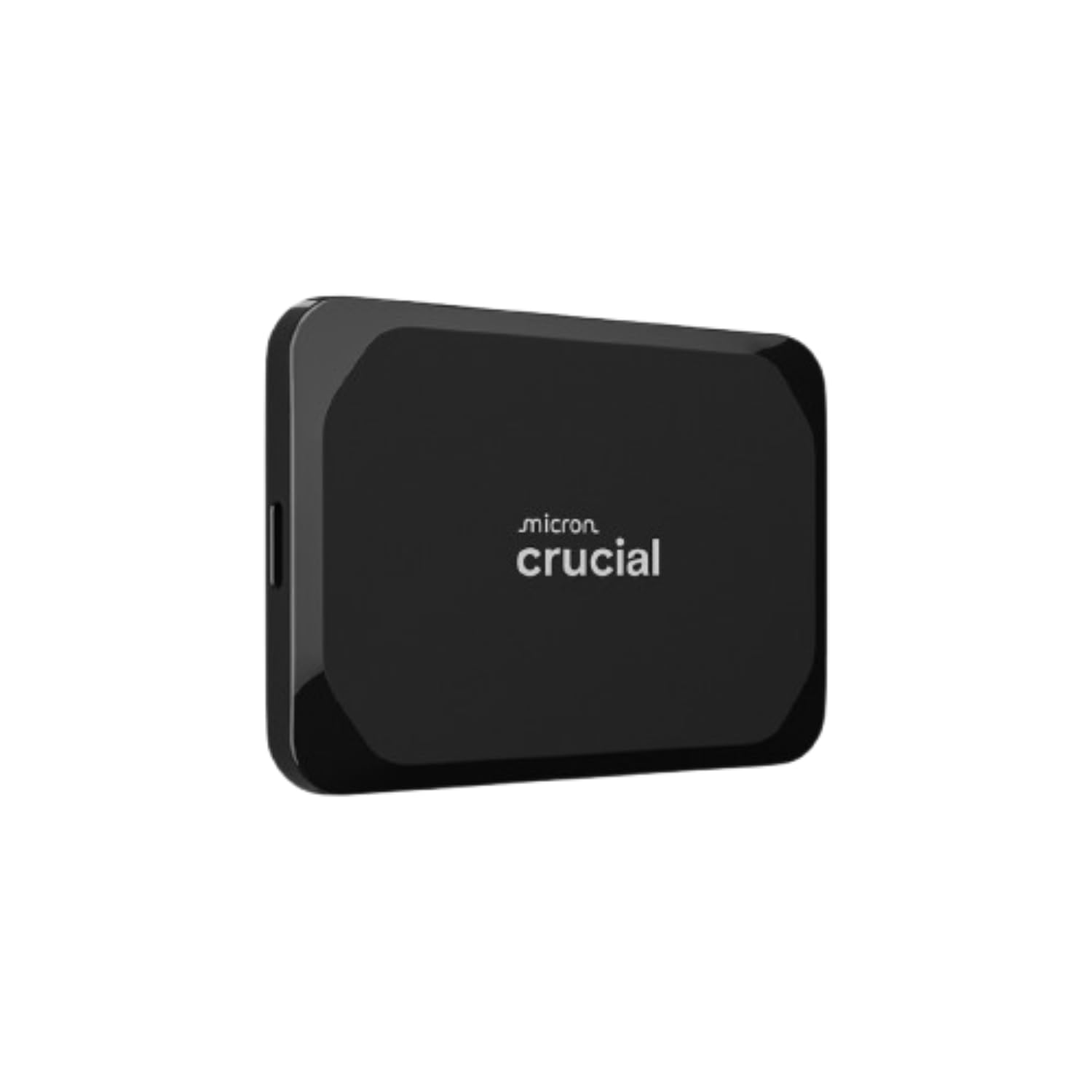
The Crucial X9 bridges the gap between premium NVMe speeds and a mid-range price, offering up to 1,050 MB/s read performance in a compact polycarbonate shell. It carries an IP55 rating for water and dust resistance and can survive drops of up to 7.5 feet, beating even the SanDisk Extreme in drop height. While the enclosure material feels less premium than aluminum, it keeps the drive lightweight and more affordable for everyday users who don’t need enterprise-level build quality.
Compatibility is broad, working out of the box with Windows, Mac, iPad Pro, Chromebooks, Android, Linux, PS4, PS5, and Xbox via the included USB-C cable. Crucial also bundles three-month trials of Mylio Photos+ and Acronis True Image, adding immediate value for photographers and those wanting scheduled backup software without extra cost. The drive is whisper-quiet since there are no moving parts, and users consistently verify it performs at or near its rated speeds with proper USB 3.2 Gen 2 ports.
Customer feedback highlights the drive’s surprising pocketability — several reviewers note it’s smaller than a credit card and thin enough to hang unnoticed from a desktop USB port. The main drawbacks are the short included cable (a common complaint in this category) and the premium price compared to HDDs of the same capacity. For students and professionals who need reliable, fast backups without breaking the bank, the Crucial X9 is a smart middle ground.
Why it’s great
- 1,050 MB/s NVMe speed at a mid-range price
- Drop survival up to 7.5 feet (2 meters)
- Broad platform compatibility with included USB-C cable
Good to know
- Polycarbonate shell feels less durable than aluminum
- Short cable; replace for desktop convenience
4. Seagate Portable HDD 2TB
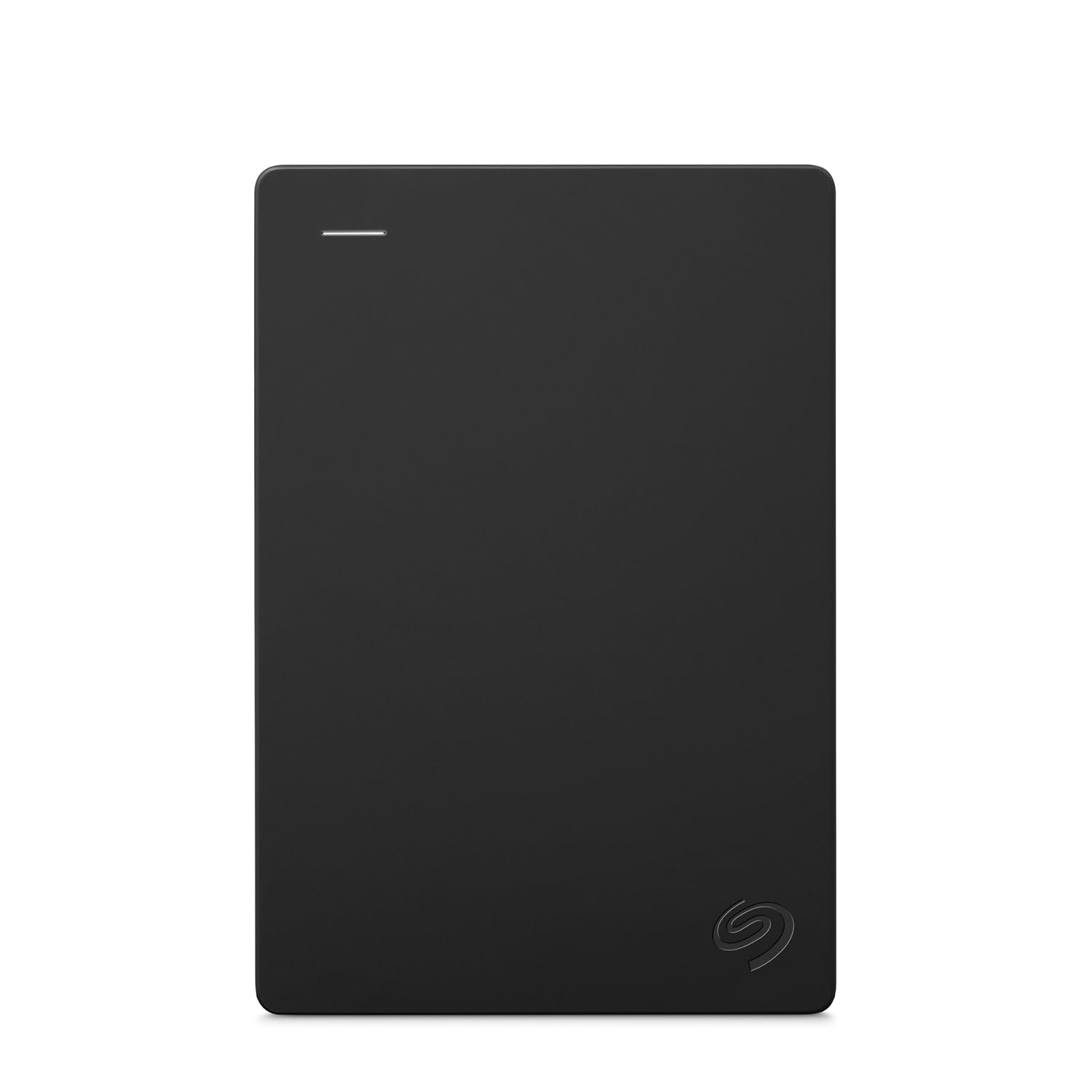
The Seagate Portable 2TB HDD is the standard-bearer for affordable, plug-and-play storage. It uses a mechanical hard disk spinning at roughly 5,400 RPM, delivering real-world sequential transfer speeds around 130 MB/s — about eight times slower than the NVMe SSDs in this guide, but perfectly adequate for backing up documents, music libraries, and less frequently accessed media. The drive requires no software installation on Windows or Mac; you simply plug in the included 18-inch USB 3.0 cable and drag files to the folder.
Its plastic casing is lightweight and portable, but users note the build feels less robust than premium alternatives. The drive is recognized automatically by PlayStation 5 and Xbox consoles for game storage, adding versatility beyond PC backups. Seagate includes a one-year Rescue Service plan, which offers data recovery from a failed drive — a rare peace-of-mind feature in this price tier that can save thousands in professional recovery costs if the drive fails.
Customer reviews consistently praise its reliability for music production workflows, where plugin libraries and sample packs load without noticeable delay. The main drawbacks are the short cable and the lack of hardware encryption. For anyone needing a spacious, no-fuss backup drive for stationary desktop use or occasional travel, the Seagate Portable offers excellent capacity per dollar.
Why it’s great
- 2TB capacity at a budget-friendly price point
- One-year Rescue Service data recovery included
- Plug-and-play with no software installation
Good to know
- Slow sequential speeds (~130 MB/s) vs. SSDs
- Plastic casing is prone to damage if dropped
5. Toshiba Canvio Basics 2TB

The Toshiba Canvio Basics 2TB takes a minimalist approach: a matte black polycarbonate enclosure with a smudge-resistant finish and zero unnecessary software. It ships pre-formatted NTFS for Windows, so it works immediately on any PC — Mac users will need to reformat to ExFAT or APFS using Disk Utility, a quick process explained in several verified reviews. The drive communicates over USB 3.0 (5Gbps), and while advertised speeds hit the interface limit, real-world file transfers for mixed media libraries average between 100-130 MB/s.
At roughly the size of a smartphone, the Canvio Basics is genuinely portable, easily slipping into a laptop bag pocket. It draws power exclusively over the USB bus, so no external AC adapter is needed. Users with years of experience across multiple Toshiba drives note that the brand’s reliability track record is solid, though like all mechanical HDDs, the drive is sensitive to physical shock during operation — it should never be moved while actively reading or writing.
Reviewers report fast backup times for large photo and document collections, with one user completing a full system backup in under an hour. The drive runs cool and quiet even after hours of continuous use. The main limitation is the lack of USB-C natively; you will need an adapter for modern laptops. For a straightforward, reliable HDD with no bloatware, the Toshiba Canvio Basics delivers exactly what it promises.
Why it’s great
- Matte finish resists fingerprints and smudges
- No bloatware or pre-installed software
- Quiet operation with minimal heat buildup
Good to know
- Requires reformatting for Mac out of the box
- No USB-C cable included; adapter needed for modern laptops
6. WD 2TB Elements HDD

Western Digital’s Elements line is one of the most trusted names in external HDDs, and the 2TB model upholds that reputation with consistent USB 3.2 Gen 1 performance. The drive uses a 3.5-inch mechanical hard disk, which means it’s thicker and heavier than 2.5-inch portable drives — this is not a pocket-friendly unit, but a desktop companion best left plugged in on your desk. Data transfer rates hover around the 5Gbps interface limit for large sequential files, translating to roughly 130-150 MB/s in real-world usage.
The plastic enclosure is simple and functional, with a small LED indicator that shows when the drive is active. It’s plug-and-play on Windows, while Mac users must reformat the drive before use with Time Machine or manual backups. A common customer workaround for Apple’s restrictive APFS formatting on Monterey involves creating a new APFS volume to store non-backup files alongside Time Machine backups — a step detailed in several verified reviews. The drive is whisper-quiet and runs only slightly warm to the touch during extended use.
Reviewers with M1 and M2 MacBook Pros confirm the drive works reliably after reformatting, offering massive 2TB storage at roughly half the price of an equivalent SSD. The included USB-A cable is prone to failure according to long-term users, so keeping a spare high-quality cable on hand is wise. For straightforward, affordable capacity without flashy features, the WD Elements 2TB is a dependable choice.
Why it’s great
- Proven WD reliability across millions of drives sold
- 2TB capacity for half the price of an SSD
- Whisper-quiet operation suitable for desktop use
Good to know
- 3.5-inch form factor is not truly portable
- Included USB-A cable may need replacement over time
7. WD 5TB Elements HDD

When capacity is the primary concern, the WD 5TB Elements HDD offers the highest storage ceiling in this lineup at a cost per gigabyte that SSDs cannot touch. It uses a 2.5-inch form factor despite the large capacity, keeping it surprisingly compact for a 5TB drive — it’s roughly the size of a passport, fitting into most laptop bags easily. The drive operates over USB 3.2 Gen 1 (5Gbps), and while real-world transfer speeds top out around 130 MB/s, filling 5TB will take patience no matter the interface.
The drive is pre-formatted NTFS for Windows, and Mac users must reformat it to use it with Time Machine. Several reviewers note that the included SuperSpeed USB-A cable is the weak point — failures are reported, and swapping to a third-party cable often resolves connection issues. The drive itself runs whisper-quiet and stays cool during operation, though it should always remain stationary while spinning to avoid the “click of death” common in mechanical drives.
Customer feedback highlights the 5TB model as the go-to archive for years of family photos, video projects, and document hoarding. It works out of the box with Windows 10 and 11, and several users report using it reliably with PS4 and Xbox consoles for game storage. The trade-off for this massive capacity is the slow per-gigabyte transfer speed compared to SSDs, and the inherent fragility of a mechanical HDD. For a backup that stays on your desk and stores everything, the WD 5TB Elements is unmatched in pure volume.
Why it’s great
- 5TB capacity at the lowest price per gigabyte
- Compact 2.5-inch size for easy bag storage
- Works with PC, Mac, and gaming consoles
Good to know
- Slow HDD speeds (~130 MB/s) for transferring 5TB
- Included cable is prone to early failure
FAQ
Can I use an NVMe SSD for daily backups without wearing it out?
Why does my external HDD show less capacity than advertised?
Should I reformat a new drive before using it for backups?
Is hardware encryption on an SSD really necessary for personal backups?
Final Thoughts: The Verdict
For most users, the best backup storage device winner is the Samsung T7 Portable SSD because it combines NVMe speeds up to 1,050 MB/s, a durable aluminum unibody, and hardware encryption in a truly portable package. If you need rugged protection for outdoor work or travel, grab the SanDisk Extreme Portable SSD for its IP65 water resistance and drop survival to 3 meters. And for massive archives on a budget, nothing beats the sheer capacity of the WD 5TB Elements HDD.