
Our readers keep the lights on and the weekend projects moving. As an Amazon Associate, I earn from qualifying purchases.
That backyard telescope you have your eye on needs to do more than just sit in a corner — it needs to pull in enough light to resolve Saturn’s rings, Jupiter’s cloud bands, and the craters of the Moon from a typical suburban driveway. Too many entry-level scopes promise the cosmos but deliver a blurry dot. The difference between a thrilling first look and a frustrating blur comes down to aperture, mount stability, and optical quality — three specs you must get right from the start.
I’m Rikta — the founder and writer behind FitlyFast. I’ve spent countless hours analyzing telescope optical designs, mount mechanisms, and real-user field reports to separate backyard performers from gimmicky shelf-fillers.
Choosing the right gear for your stargazing setup boils down to matching aperture, mount type, and portability to your specific sky and skill level. This guide covers the best backyard telescope picks across entry-level refractors, app-enabled smart scopes, and large-aperture Dobsonians to help you see real detail on your first night out.
How To Choose The Best Backyard Telescope
The right backyard scope for you hinges on your local light pollution, how much weight you want to haul outside, and whether you prefer visual observing or smartphone astrophotography. Skip the glossy accessories and focus on three core pillars: aperture, mount style, and optical quality. Beginners often over-buy magnification (a high number on the box is a marketing trick) while under-buying the light-gathering power that actually makes dim nebulae visible. A 90mm refractor will show you the Moon and planets clearly; a 150mm reflector or 200mm Dobsonian opens up galaxies and star clusters.
Aperture — The Light Bucket Rule
Aperture (the diameter of the main lens or mirror) is the single most important spec. More aperture means more light captured, which translates to brighter, sharper images of faint deep-sky objects. For backyard use, 80mm to 90mm is a solid entry point for Moon and planets. Jump to 150mm (6 inches) and you resolve globular clusters and the Orion Nebula’s inner detail. At 200mm (8 inches) with a Dobsonian, you see spiral structure in brighter galaxies — all from your yard.
Mount Type — Alt-Az vs Equatorial vs Dobsonian
An Alt-Azimuth mount (pan up-down and left-right) is the most intuitive for beginners and families — just point and look. Manual Alt-Az mounts with slow-motion cables let you track objects smoothly without a learning curve. Equatorial mounts align with Earth’s rotation axis, requiring polar alignment, but they make manual tracking of planets much easier at high magnification. Dobsonian mounts are a specialized Alt-Az design built for large-aperture Newtonian reflectors — they are rock-solid, simple, and deliver the most light per dollar for backyard observing.
Optical Coatings and Glass Quality
Fully-coated optics are the bare minimum for decent backyard views. Fully multi-coated (FMC) lenses transmit more than 95% of light, boosting contrast on lunar craters and planetary bands. Extra-low dispersion (ED) glass further reduces chromatic aberration (that purple fringing around bright objects), a real issue on fast refractors used for high-power planetary work. For backyard telescopes under heavy use, FMC glass in a 90mm refractor gives you vivid, clean images without needing to spend on ED glass unless you shoot astrophotography.
Quick Comparison
On smaller screens, swipe sideways to see the full table.
| Model | Category | Best For | Key Spec | Amazon |
|---|---|---|---|---|
| Sky-Watcher Classic 200 Dobsonian | Dobsonian Reflector | Deep-sky & planetary detail | 203mm aperture, 1200mm FL | Amazon |
| SVBONY SV503 102mm ED | ED Refractor OTA | Astrophotography & planetary | 102mm F7, S-FPL51 ED glass | Amazon |
| MEEZAA 150EQ Reflector | Newtonian Reflector | Deep-sky with guided tracking | 150mm aperture, EQ mount | Amazon |
| DWARFLAB Dwarf 3 Smart | Smart Telescope | Instant astrophotography | 4K auto-tracking, 3lb | Amazon |
| Celestron AstroMaster 102AZ | Short-Tube Refractor | Day & night family use | 102mm, 380mm FL | Amazon |
| Celestron StarSense LT 80AZ | App-Enabled Refractor | No-experience sky tours | 80mm, smartphone navigation | Amazon |
| MEEZAA 90mm 800mm Refractor | Mid-Range Refractor | Budget-friendly family stargazing | 90mm, FMC optics | Amazon |
| Dianfan 90mm 800mm | Entry Refractor | First telescope for kids/teens | 90mm, stainless tripod | Amazon |
| Koolpte 90mm 700mm Vertisteel | Beginner Refractor | Quick-setup backyard viewing | 90mm, slow-motion mount | Amazon |
In‑Depth Reviews
1. Sky-Watcher Classic 200 Dobsonian 8-inch

The Sky-Watcher Classic 200 packs a 203mm parabolic mirror into a simple, rock-solid Dobsonian base that delivers the brightest deep-sky views in this roundup. With 94% reflective multi-coated mirrors and a 1200mm focal length, you resolve Saturn’s Cassini Division, Jupiter’s Great Red Spot, and the spiral arms of brighter galaxies from a dark backyard. The 2-inch Crayford-style focuser accepts wide-field eyepieces for sweeping views of the Milky Way star clouds.
The patented tension control handles let you move the tube smoothly without fighting balance, and the Teflon bearings make azimuth tracking buttery even at high magnification. Owners consistently report seeing the Orion Nebula’s inner trapezium and globular clusters resolved to the core on their first night. The included 25mm and 10mm Super wide-angle eyepieces are usable starters, but the real value is the light-gathering platform itself — you can upgrade eyepieces over years.
At 45 pounds assembled, it is not a grab-and-go scope, but it is easy to wheel out in two pieces and set up in minutes. The 9×50 finderscope works well for locating targets, though a right-angle correct-image finder makes zenith viewing more comfortable. For any backyard astronomer serious about seeing detail, this Dobsonian is the benchmark.
Why it’s great
- Massive 203mm aperture resolves deep-sky detail no 90mm can touch
- Simple Dobsonian base requires no polar alignment — set down and observe
- Parabolic primary mirror with 94% reflectivity delivers bright, contrasty images
- Crayford-style 2-inch focuser is smooth and accepts wide-field upgrades
Good to know
- Weighs 45 lbs assembled — better for semi-permanent backyard setup than frequent car travel
- Stock eyepieces are decent but many owners upgrade soon for sharper edge-to-edge views
- Manual tracking at high power requires practice; no motorized option built in
- Finder scope is straight-through, which can be awkward for objects near zenith
2. SVBONY SV503 102mm F7 ED Refractor OTA

The SVBONY SV503 is an optical tube assembly that targets the observer who wants true apochromatic-level color correction without the + price tag. The 102mm F7 doublet uses an S-FPL51 ED glass element to virtually eliminate chromatic aberration — the purple fringing that ruins planetary and lunar images in cheaper achromats. Paired with the fully multi-coated (FMC) anti-reflection coatings, this scope delivers high-contrast views of Jupiter’s festoons and the delicate structure of the Veil Nebula with a nebula filter.
The dual-speed 1:10 focuser is a joy for fine-tuning focus during astrophotography runs. The 360-degree field rotator lets you square your camera sensor to the horizon without rotating the tube, a huge convenience when shooting mosaic panels. The 133mm retractable lens hood kills stray light from porch lights and helps prevent dew from forming on the objective during humid backyard sessions. At just under 4kg, this OTA rides easily on a mid-range EQ mount like an HEQ5 or a sturdy Alt-Az head.
Note that this is an OTA-only — you need to supply a mount, tripod, diagonal, and eyepieces separately. This makes it a better fit for upgrading astronomers who already have a mount than for absolute beginners. Once set up, the SV503 resolves Encke’s division in Saturn’s rings on steady nights and captures clean RGB data for deep-sky astrophotography at 714mm focal length.
Why it’s great
- S-FPL51 ED glass virtually eliminates chromatic aberration in a fast F7 system
- Dual-speed 1:10 focuser with 90mm travel handles heavy camera rigs
- 360-degree field rotator aligns camera without rotating the entire tube
- Retractable hood blocks stray light and delays dew formation
Good to know
- OTA only — you need a separate mount, tripod, diagonal, and eyepieces
- Not a grab-and-go setup; requires a solid mount (15-20 lb capacity recommended)
- No finderscope or case included — budget for those separately
- Best suited for intermediate to advanced users, not first-time telescope buyers
3. MEEZAA 150EQ Newtonian Reflector
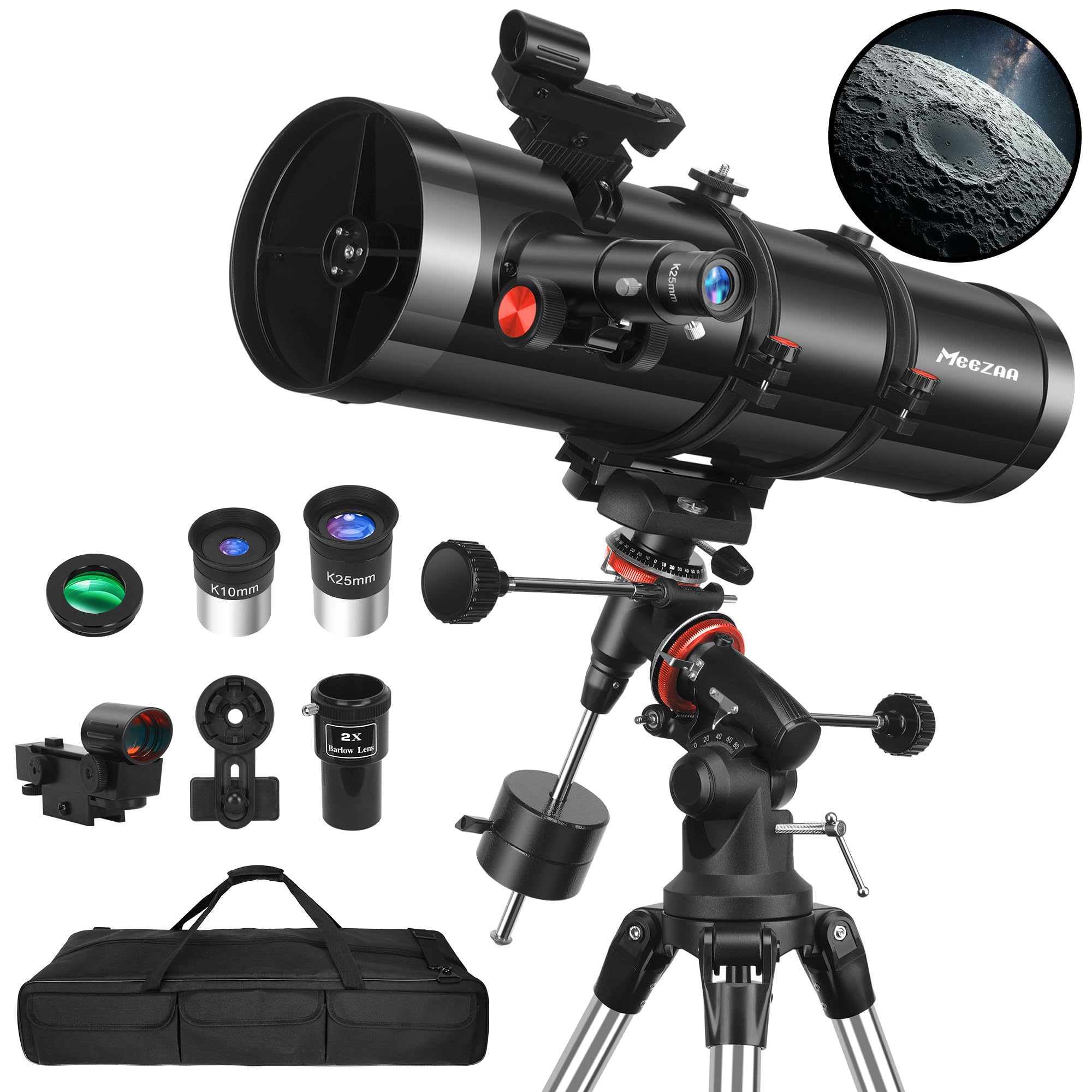
The MEEZAA 150EQ brings a proper 150mm Newtonian reflector paired with a German Equatorial mount — a combination that punches far above its price point for deep-sky hunting. With 650mm focal length at F4.3, this is a fast light bucket: it gathers over three times the light of a 90mm refractor, making the Orion Nebula, Andromeda Galaxy, and globular clusters like M13 appear bright and structured even from moderately light-polluted backyards. The red dot finderscope and included moon filter make targeting and comfortable lunar observation straightforward.
The German Equatorial mount with slow-motion control knobs is a step up from basic Alt-Az mounts because once you polar-align it, you can track objects across the sky by turning a single knob. This matters at high magnification when planets drift through the field in seconds on an Alt-Az. The included 25mm and 10mm Kellner eyepieces plus the 2X Barlow give you a usable range from 26X to 130X. Owners consistently note that the mount is sturdy enough to hold the 150mm tube steady even in light wind.
Assembly takes longer than a simple refractor — the EQ mount requires polar alignment and balancing the tube — but the included illustrated manual helps. The heavy-duty stainless steel tripod with accessory tray keeps everything organized. The carry bag fits all components, making this a realistic option for backyard sessions that you can also take to a darker site on weekends. Budget for a collimation tool, as reflectors need occasional mirror alignment to maintain peak sharpness.
Why it’s great
- 150mm aperture at F4.3 delivers superb light grasp for nebula and galaxies
- EQ mount with slow-motion controls enables smooth manual tracking of planets
- Includes moon filter, phone adapter, and carry bag for complete out-of-box experience
- Sturdy stainless tripod resists vibration during focusing at high magnification
Good to know
- EQ mount has a learning curve for polar alignment that beginners must study
- Reflector requires periodic collimation of the primary mirror to maintain sharp views
- Included Kellner eyepieces are basic; upgrading to Plössl eyepieces improves contrast
- Heavier than a comparable refractor — about 12kg for the full setup
4. DWARFLAB Dwarf 3 Smart Telescope
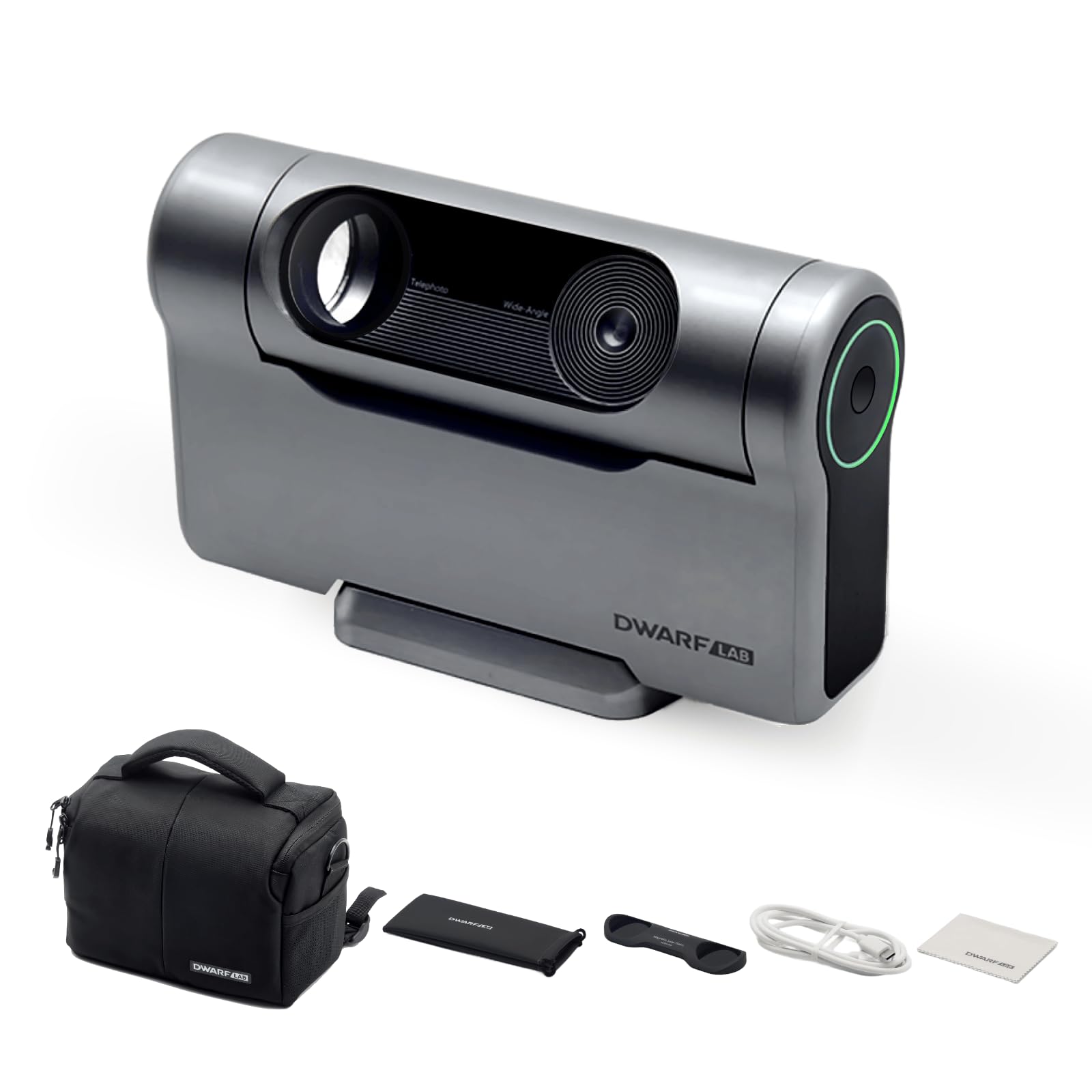
The Dwarf 3 redefines the backyard telescope for the smartphone generation. Weighing just 3 pounds with a dual-lens system (telephoto for deep-space objects and wide-angle for Milky Way panoramas), this smart scope is designed for instant astrophotography rather than visual observation — there is no eyepiece. You control everything through the DWARFLAB app: the telescope auto-tracks celestial objects in 4K resolution, and cloud-based image processing stacks and denoises your captures in minutes with no PC required.
The AZ/EQ dual-mode mount means you can use it in simple Alt-Az mode for quick lunar and planetary shots, or switch to EQ mode with a wedge for long-exposure deep-sky imaging. The 4K auto-tracking holds targets steady for multi-minute exposures, capturing the Orion Nebula’s dust lanes and the Andromeda Galaxy’s core with surprising detail for such a compact unit. Owners report excellent results even under heavy light pollution, thanks to the built-in processing that filters gradients.
Setup is genuinely two minutes from box to first image — the magnetic filters (including a solar filter) snap on, and the USB-C charging is universal. The carrying bag is compact enough for a standard backpack. The trade-off is that you are tied to the app ecosystem and cannot visually observe through an eyepiece. For families or beginners who want shareable astrophotographs immediately without learning mount alignment or image processing, the Dwarf 3 is a game-changer in portability.
Why it’s great
- Ultra-portable 3 lb design fits in a backpack — take it anywhere
- 4K auto-tracking and built-in cloud processing produce shareable images in minutes
- Dual-lens system captures both wide Milky Way shots and close-up deep-sky objects
- EQ mode enables long-exposure astrophotography without a separate mount
Good to know
- No eyepiece — pure camera-based system; no visual observing experience
- App can have occasional connectivity glitches, especially during image transfer
- Battery lasts a full night with an external power bank, but internal battery is limited
- Best for astrophotography enthusiasts who prioritize ease over visual detail
5. Celestron AstroMaster 102AZ

The AstroMaster 102AZ is a short-tube refractor that balances daytime terrestrial use with nighttime astronomy — a rare dual-purpose capability that families appreciate. Its 102mm fully-coated optics with a 380mm focal length (F3.7) produce a wide 8.1-degree field of view, making it excellent for scanning star fields, bright open clusters like the Pleiades, and the Andromeda Galaxy’s core. During the day, the erect image diagonal renders landscapes correctly oriented, so it doubles as a spotting scope for wildlife or distant landmarks.
The manual Alt-Azimuth mount with panhandle control is intuitive: just push to point, and the smooth bearings hold position without slipping. The adjustable-height tripod with 1.25-inch steel legs provides a stable platform for the lightweight 102mm tube. Users consistently report seeing Saturn’s rings clearly with the included 20mm eyepiece and Jupiter’s bands with the 10mm. The included StarPointer red dot finder simplifies aiming, though some owners replace it with a better unit for easier daytime alignment.
The free astronomy software download adds educational value for families with kids. The main limitation is the short focal length — high-power views above 100X get soft due to chromatic aberration common in fast achromats. A 2X Barlow helps push magnification, but the scope shines brightest at low-to-mid power sweeping views. For a household that wants one instrument for backyard planets, Moon, and afternoon birdwatching, this Celestron is the most versatile pick.
Why it’s great
- Wide 8.1-degree field is perfect for scanning star fields and large nebula
- Erect image diagonal enables daytime terrestrial use as a spotting scope
- Intuitive Alt-Az panhandle mount requires zero setup knowledge
- 102mm aperture gathers enough light for bright planets and Moon detail
Good to know
- Short 380mm focal length limits high-power magnification — chromatic aberration appears above 100X
- Red dot finder is basic and may need replacement for easier alignment
- Not ideal for faint deep-sky objects like galaxies due to fast F ratio
- No smartphone adapter included — budget separately for astrophotography
6. Celestron StarSense Explorer LT 80AZ

The StarSense Explorer LT 80AZ removes the biggest hurdle for beginners: knowing where to point. Instead of using star charts or guesswork, you dock your phone into the included holder, launch the StarSense app, and follow on-screen arrows that overlay your camera feed. The patented sky recognition technology analyzes star patterns overhead to calculate exactly where the telescope is aimed, then guides you to any target with a green bullseye confirmation.
The 80mm fully-coated refractor with 400mm focal length delivers crisp lunar and planetary views — craters, Jupiter’s four Galilean moons, and Saturn’s rings are readily visible with the included 25mm and 10mm eyepieces. The 2X Barlow pushes magnification to 80X for closer looks. The manual Alt-Azimuth mount has a slow-motion altitude rod that lets you nudge the tube precisely once you arrive at your target. The StarPointer red dot finderscope provides a backup manual aiming option when you want to skip the phone.
Setup is quick — the pre-assembled mount and tripod mean you are observing within 15 minutes of opening the box. The app’s curated “Tonight’s Best” list adapts to your time and location, making it easy to find seasonally visible planets and bright nebulae. The trade-off is the 80mm aperture; it shows you what is there but does not render the detail a 102mm or 150mm would on faint galaxies. For a beginner family who wants to find things immediately without frustration, this system is unmatched in user-friendliness.
Why it’s great
- Patented StarSense app guides you to targets with zero astronomy knowledge
- Phone dock and included app make finding objects as easy as following arrows
- Pre-assembled mount and tripod enable fast box-to-backyard setup
- 2-Year US warranty from Celestron with solid customer support
Good to know
- 80mm aperture limits light grasp for deep-sky objects — best for Moon and planets
- Phone dependency means battery life and screen glare can affect sessions
- Alt-Az mount lacks fine slow-motion control on azimuth axis
- Some units ship with non-functional finderscope; Celestron support handles replacements
7. MEEZAA 90mm 800mm Refractor

The MEEZAA 90mm refractor hits a sweet spot for backyard observers who want a large aperture without the price jump to premium glass. The 90mm fully multi-coated objective with 800mm focal length (F8.88) provides bright, contrasty views of the Moon’s Tycho crater system, Jupiter’s equatorial bands, and Saturn’s rings at 64X with the 25mm eyepiece. The slower F ratio means chromatic aberration is well-controlled — purple fringing is minimal compared to fast short-tube refractors.
The manual Alt-Azimuth mount with stainless steel tripod adjusts from 28 to 46 inches, accommodating both seated and standing viewing. The included 10mm and 25mm Kellner eyepieces plus 3X Barlow give a magnification range from 32X to 240X. The smartphone adapter is easy to align and works for casual Moon shots and planetary imaging. Owners consistently report assembling the scope in under 10 minutes per the paper manual, and the carry bag keeps everything organized for trips to darker sites.
The main limitation is the straight-through finderscope, which can be awkward for tall users when the tube points near zenith. A right-angle correct-image finder is a worthwhile upgrade. The focuser is a basic rack-and-pinion that works smoothly but lacks a fine-focus knob for high-power tweaks. For a family or beginner who wants reliable views of the Moon and bright planets with room to grow into deep-sky observing, this MEEZAA offers the best value-to-aperture ratio in the entry-tier range.
Why it’s great
- 90mm FMC aperture delivers bright lunar and planetary views at a friendly price
- 800mm focal length at F8.88 keeps chromatic aberration low in an achromat
- 10-minute tool-free assembly with clear paper manual and carry bag included
- Phone adapter and 3X Barlow enable entry-level astrophotography immediately
Good to know
- Straight-through finder requires contorting body position for overhead targets
- Basic rack-and-pinion focuser lacks fine-fine control for critical focus at high power
- Included Kellner eyepieces are functional but benefit from upgrade to Plössl types
- Tripod may need periodic tightening of leg locks for stable viewing
8. Dianfan 90mm 800mm Refractor

The Dianfan 90mm telescope offers an 800mm focal length and fully coated optics at an entry-level price that undercuts most of the competition. The 90mm objective gathers enough light to make the Moon’s craters pop and reveal Jupiter’s moons as distinct disks. The 45-degree erect image diagonal keeps terrestrial views correctly oriented, making this a solid choice for backyard birdwatching or landscape scanning during the day before switching to the night sky.
The stainless steel tripod is a step above the aluminum legs found on many budget scopes — it resists vibration better when focusing at 80X or higher. The included 10mm and 25mm Kellner eyepieces plus the 3X Barlow lens provide a magnification range of 32X to 240X. The smartphone adapter clamps securely onto the eyepiece for capturing Moon shots and sharing them with family. Assembly takes about 15 minutes, and the included carry bag keeps the tube and tripod protected during transport.
The Alt-Azimuth mount is basic — it lacks slow-motion cables, so fine tracking at high power requires gentle tapping. The finderscope is a straight-through type that needs alignment with the main tube during setup; some users report it arrives slightly out of collimation and requires a simple screw adjustment. For a first telescope for a child or teen where budget is the primary constraint, the Dianfan delivers functional optics and a sturdy tripod at a price that leaves room for an upgraded eyepiece soon after purchase.
Why it’s great
- 90mm fully coated optics provide clear Moon and planet views at a low entry cost
- Stainless steel tripod offers better vibration damping than aluminum alternatives
- 45-degree erect diagonal enables daytime terrestrial use without image flip
- Full accessory bundle includes phone adapter, Barlow, and carry bag
Good to know
- Basic mount lacks fine slow-motion controls — high-power tracking is tricky
- Finderscope may arrive slightly misaligned and needs simple manual adjustment
- Kellner eyepieces have modest eye relief; glasses wearers may prefer upgraded models
- Plastic components on the focuser feel less durable than all-metal alternatives
9. Koolpte 90mm 700mm Vertisteel AZ Telescope
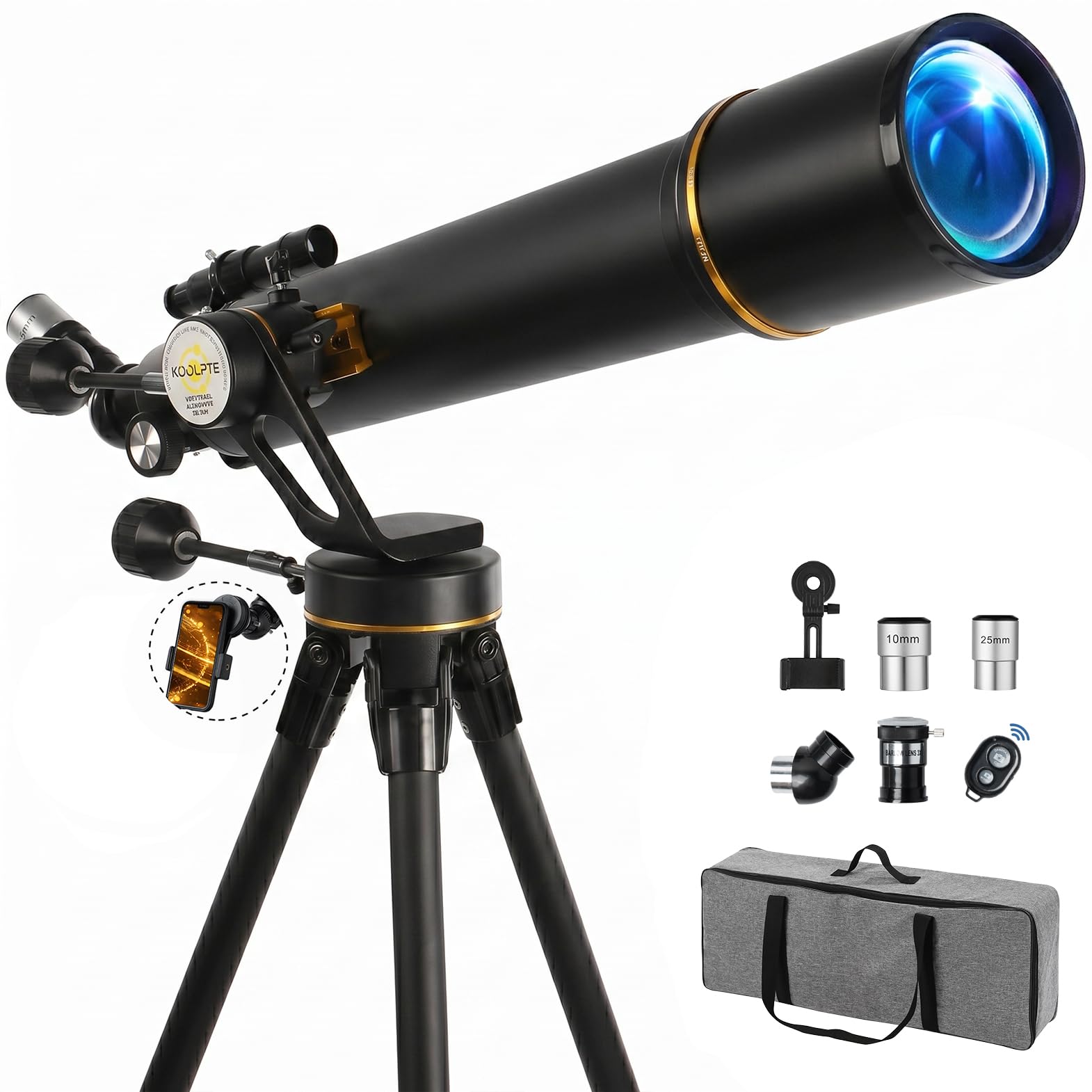
The Koolpte 90mm telescope distinguishes itself from other entry-level refractors with its exclusive Vertisteel AZ Slow-Motion Mount, which provides ultra-smooth altitude and azimuth tracking — a feature normally reserved for more expensive scopes. The 90mm fully multi-coated objective with 700mm focal length (F7.78) produces bright, contrasty images of the Moon’s Alpine Valley, Jupiter’s bands, and Saturn’s rings at 70X with the included 10mm eyepiece. The slow-motion cables let you follow the target without bumping the tripod, a massive advantage at high power.
The tool-free assembly is genuinely fast — most first-time users are observing within 10 minutes. The included wireless remote and phone adapter make it easy to capture and share lunar photos immediately. The “Follow and Stop” design of the mount prevents overshooting when tracking a planet across the sky, a common frustration with basic friction mounts. The stainless steel tripod with accessory tray stays stable even with the phone adapter attached.
The K25mm and K10mm Kellner eyepieces plus 3X Barlow cover 28X to 210X magnification. The reflex finderscope is a red-dot style that works well for quick target acquisition. The carrying bag is large enough to hold the assembled tripod and tube, making this a true grab-and-go option for backyard sessions. The main area for improvement is the focuser — it works smoothly but would benefit from a dual-speed upgrade for critical planetary focusing. For a beginner who wants stable tracking and minimal setup friction, this is the most refined entry-level package tested.
Why it’s great
- Vertisteel AZ mount with slow-motion cables enables smooth, drift-free tracking at high power
- Tool-free assembly in under 10 minutes — fastest setup in this category
- Wireless remote and phone adapter make astrophotography effortless for beginners
- 90mm FMC optics at F7.78 strike a solid balance between light grasp and CA control
Good to know
- 6-foot users may find the tripod slightly short for comfortable overhead viewing
- Basic rack-and-pinion focuser lacks micro-fine adjustment for planetary detail
- Kellner eyepieces are usable but upgrading to Plössl or wide-angle improves eye relief
- Plastic components on the accessory tray feel less robust than the steel tripod
FAQ
What size backyard telescope do I need to see Saturn’s rings clearly?
Can I use a backyard telescope from a city with street lights?
What does the magnification number on the box really mean?
Should I choose a refractor or a reflector for my first backyard telescope?
Final Thoughts: The Verdict
For most users, the best backyard telescope winner is the Sky-Watcher Classic 200 Dobsonian because its 203mm aperture delivers breathtaking deep-sky detail on a simple, stable mount that requires no setup knowledge. If you want a portable astrophotography rig that fits in a backpack, grab the DWARFLAB Dwarf 3 Smart Telescope. And for a beginner family that wants reliable views of the Moon and planets with tool-free assembly and smooth tracking, nothing beats the Koolpte 90mm Vertisteel for its refined mount and quick-start experience.