
Our readers keep the lights on and the weekend projects moving. As an Amazon Associate, I earn from qualifying purchases.
Selecting a balance bike for a barely-walking toddler presents a unique challenge: the machine must be light enough to not intimidate, low enough for both feet to rest flat, and stable enough to handle the wobbles of a new walker without tipping. Most adult-sized logic about geometry and speed does not apply here—this category is about controlled falling and learning weight shift, not propulsion.
I’m Rikta — the co-founder and writer behind FitlyFast. I’ve spent years analyzing early-mobility gear and tracking how frame angles, tire compliance, and weight distribution affect a toddler’s confidence during those first independent glides.
After filtering through build quality, safety certifications, and real-world reports from parents, the most reliable options for a balance bike for 1 year old prioritize a low stand-over height, adjustable seat range starting at 10 inches or less, and a weight under 7 pounds so tiny legs can lift and steer without strain.
How To Choose The Best Balance Bike For 1 Year Old
The market is flooded with miniaturized bikes that look like scaled-down versions of full-size balances, but a one-year-old’s biomechanics are dramatically different from a three-year-old’s. The priorities shift entirely toward the weight of the frame, the lowest seat position, and the stability system (four wheels versus two).
Weight Is The Primary Spec
A 10-pound bike might seem light to an adult, but for a toddler who weighs 22 pounds, that bike represents nearly half their body weight. Liftability matters—if your child cannot stand the bike upright or pick it up after a fall, they will lose interest quickly. Look for a bike under 7 pounds if possible; the lightest options in this list hover around 4.6 pounds.
Seat Height Range Versus Inseam
Your child’s inseam (floor to crotch) must be greater than the minimum seat height for them to stand flat-footed. For a typical 12-month-old, the inseam is around 9 to 10 inches. The bike’s seat must adjust down to at least that number. Mid-range bikes with adjustable seats that start at 9.7 inches accommodate most one-year-olds without being too tall.
Wheel Configuration: Four or Two?
Two-wheel balance bikes require the child to counterbalance instantly, which is cognitively demanding for a twelve-month-old. Four-wheel designs or dual-rear-wheel configurations offer lateral stability, meaning the bike will not tip sideways even when stationary. This reduces fear and allows the child to focus on the forward-gliding motion rather than panic about falling.
Quick Comparison
On smaller screens, swipe sideways to see the full table.
| Model | Category | Best For | Key Spec | Amazon |
|---|---|---|---|---|
| Liberry Baby Balance Bike | Four-Wheel | Stability for new walkers | Seat 9.7–11 inches | Amazon |
| Yvolution Y Velo Junior | Dual-Rear | Growing with skill level | Dual/single wheel mode | Amazon |
| Retrospec Cub | Two-Wheel | Outdoor durability | Puncture-proof tires | Amazon |
| Bobike Toddler Balance Bike | Two-Wheel | Classic steel frame feel | 135° steering limit | Amazon |
| PerKidern Baby Balance Bike | Four-Wheel | Lightest option | 4.6 pounds total weight | Amazon |
| Doselie Light & Music Bike | Four-Wheel | Engagement through lights | 5 songs + animal sounds | Amazon |
| kidpop PULA Push Walker | Push Wagon | Pre-balance walking aid | 7-month minimum age | Amazon |
In‑Depth Reviews
1. Liberry Baby Balance Bike

The Liberry stands out because its adjustable seat drops to 9.7 inches, which is the lowest in this comparison and directly matches the inseam of a typical 12-month-old. The four-wheel layout provides a stable platform that resists tipping, letting the child focus on the sensation of gliding rather than panic-balancing. The rubber handlebars are a meaningful upgrade over foam, as they resist tearing when chewed or dropped.
At 6.4 pounds, it is not the lightest bike here, but the weight is distributed low thanks to the steel frame, which makes it feel planted. Smooth EVA tires roll quietly on hardwood and tile without leaving marks, a detail multiple reviewers noted. The included letter stickers for customizing the bike with the child’s name add a personal touch that makes the bike feel like “theirs” from day one.
The 55-pound weight limit means this bike will comfortably serve until age 3 or 4, long after the first-glide phase. The bottom bracket clearance is adequate for indoor use and pavement, though parents should avoid gravel or very uneven surfaces due to the small wheel diameter. Assembly takes roughly ten minutes with the included manual.
Why it’s great
- Lowest seat height at 9.7 inches fits small toddlers
- Rubber handlebars resist chewing and tearing
- 55-pound weight limit extends usable life
Good to know
- 6.4 pounds is heavier than some alternatives
- Not recommended for gravel or bumpy terrain
2. Yvolution Y Velo Junior 9″ Balance Bike

The Y Velo Junior introduces a clever transitional system: the dual rear wheel configuration (essentially two wheels flanking a central point) provides lateral stability for beginners, and once the child gains confidence, a parent can switch to a single-wheel setup without buying a new bike. The larger 9-inch wheels give better rollover clearance than the tiny 4-inch wheels found on some alternatives, making it more capable on grass or packed dirt.
The seat adjusts from 11 to 14.2 inches, so it works best for toddlers who have already reached the 11-inch inseam threshold—typically around 18 months rather than 12 months. That said, the wider wheelbase makes accidental tipping nearly impossible, which reviewers consistently praised for building confidence without tears. The 7.7-pound frame is heavier, but the stability payoff is substantial for a cautious toddler.
One notable safety detail: there is no brake, which is appropriate because at this stage the child stops by planting their feet. The absence of a braking mechanism removes a potential pinch hazard. Assembly involves attaching the handlebars and rear wheel carriage, and reviewers reported it being straightforward with clear pictorial instructions.
Why it’s great
- Dual-to-single wheel conversion extends skill progression
- Larger wheels handle uneven terrain better
- Near-impossible to tip sideways
Good to know
- Seat minimum 11 inches may not fit very short 12-month-olds
- 7.7 pounds is the heaviest bike in this group
3. Retrospec Cub Toddler Balance Bike
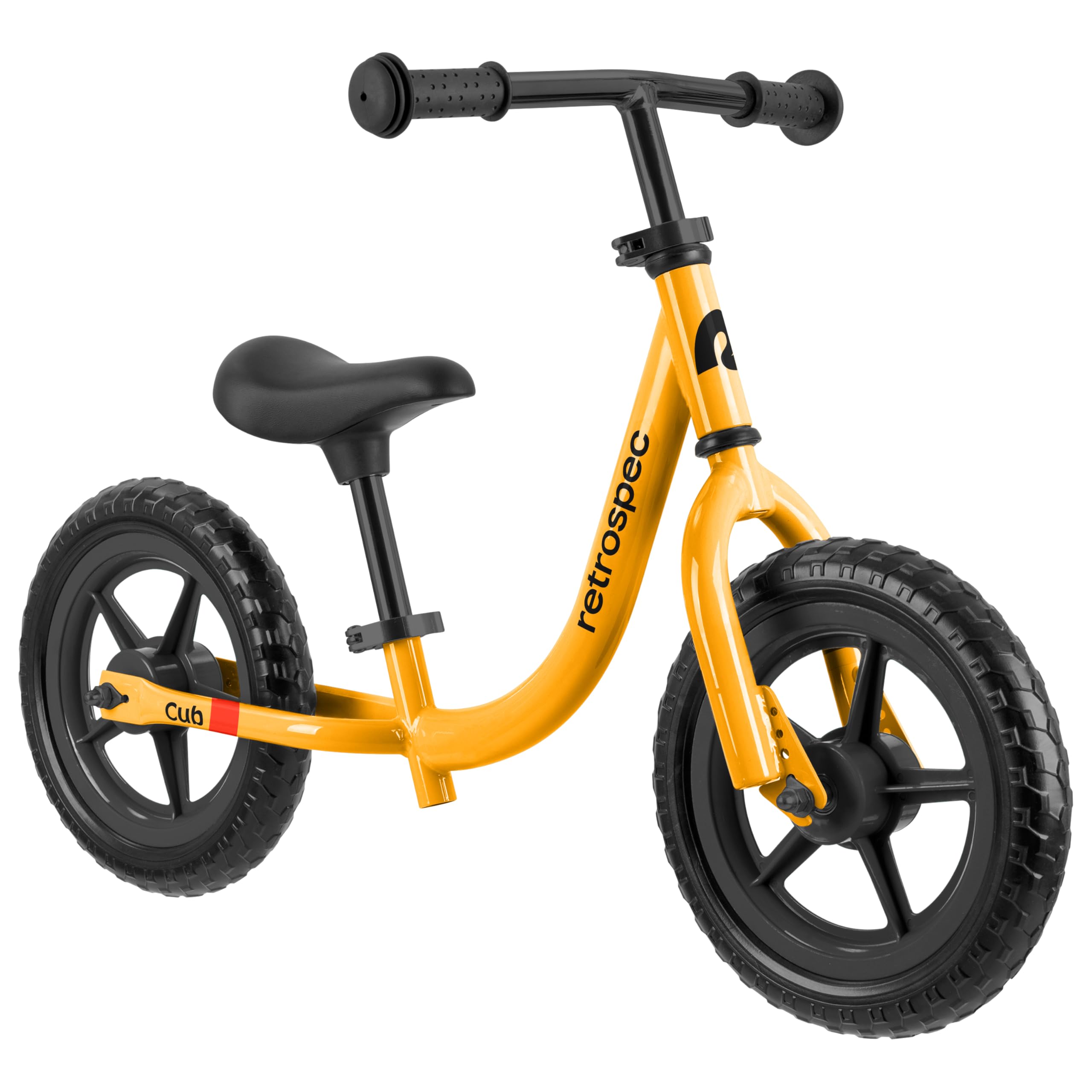
Retrospec’s Cub is built around the concept of maintenance-free outdoor use. The airless, puncture-proof tires are the key differentiator—they never go flat, which matters when the bike is stored in a hot garage or dragged through wet grass. The low frame design means the top tube drops significantly, giving the child a clear step-through path and lowering the center of gravity for stability on uneven ground.
The seat adjusts from 11 to 14.5 inches, and while that minimum is on par with the Y Velo, the Cub uses a traditional two-wheel balance layout rather than a dual-rear system. That means it demands a slightly higher level of balance readiness, making it better suited for the 18-to-24-month range rather than a brand-new walker. The quick-release handlebars are a welcome feature for parents who need to adjust the riding position frequently as the child grows.
At 10 pounds, this is the heaviest bike reviewed here, and that weight is noticeable during lifting and carrying. The rounded edges and non-slip grips are standard but well-executed.
Why it’s great
- Puncture-proof tires eliminate flat-tire maintenance
- Low step-through frame is easy for toddlers to mount
- Quick-release handlebar adjustment
Good to know
- 10-pound frame is heavy for a 1-year-old to lift
- Two-wheel design requires better balance readiness
4. Bobike Toddler Balance Bike

The Bobike is the most traditional-looking bike in the lineup—carbon steel frame, enclosed non-slip wheels, and a vintage aesthetic that parents often appreciate. The 135° steering limit prevents the handlebars from turning 90 degrees and jackknifing, which is a common cause of face-first falls in traditional two-wheelers. The adjustable seat is basic but functional, accommodating growth from roughly 12 months to 4 years.
At a moderate weight, the steel frame provides a solid feel without the exaggerated heft of the Retrospec. The enclosed wheels are a strong safety feature: they prevent the child’s foot from slipping through the spokes and also stop the bike from catching on carpet edges or rug corners. Multiple reviewers noted that the bike survived heavy daily use indoors without squeaking or wobbling.
A few reviewers flagged that the brand labeling on Amazon can be misleading—some units ship with different branding than the Bobike name. If you specifically want Bobike support, confirm the seller before checkout. The assembly is straightforward, requiring only a few bolts, and the included manual is clearly illustrated.
Why it’s great
- 135° steering limit prevents sharp jackknife turns
- Enclosed wheels eliminate foot-slip hazards
- Durable steel frame feels solid and rides smoothly
Good to know
- Brand labeling can be inconsistent across sellers
- No shock absorption for rough outdoor surfaces
5. PerKidern Baby Balance Bike

The PerKidern weighs only 4.6 pounds, making it the lightest option in this list and the easiest for a one-year-old to lift independently. The four-wheel configuration provides the same lateral stability as the Liberry, but the frame has been lengthened by 2 inches and raised by 3 inches compared to typical 12–24 month bikes, creating a more comfortable posture for taller toddlers within the age range. The saddle has a slight rear scoop to prevent the child from sliding backward during forward gliding.
The EVA foam tires are silent on indoor floors, which is a meaningful advantage for parents who work from home or have light sleepers. The PU padded seat is more comfortable than a hard plastic saddle, though the material can be warm in hot climates. Assembly is tool-free and takes under five minutes—the included instructions are hand-drawn but clear.
One limitation: the carbon steel frame, while light, is not as impact-resistant as a higher-gauge steel or aluminum frame. Parents should avoid dropping the bike off curbs or stairs repeatedly. The 44-pound weight limit is lower than the Liberry’s 55 pounds, but still covers the typical range up to age 3.
Why it’s great
- Ultra-light 4.6-pound frame is easy for toddlers to manage
- Silent EVA wheels do not disturb indoor quiet
- Tool-free assembly in under five minutes
Good to know
- Lower impact resistance than heavier steel frames
- 44-pound weight limit means shorter usable life
6. Doselie Light & Music Balance Bike

The Doselie bike brings a sensory dimension that the other bikes lack: LED wheels that light up when rolling (no batteries required for the wheel lights) and a tail button that triggers five songs and five animal sounds. This auditory-visual feedback is powerful for a one-year-old, who associates the lights with movement and becomes motivated to push forward. The headlight requires 3 AAA batteries and adds visibility for evening play.
The bike is a four-wheel design with a low center of gravity, and the 135° steering limit mirrors the Bobike’s safety logic. The frame is plastic rather than steel, which makes it very lightweight, but also means it flexes more under load. The music cannot be turned off or adjusted for volume, which several reviewers mentioned as a potential annoyance for parents. The animal sounds include a lion roar that may startle sensitive children.
For a 12–24 month child who is motivated by lights and sound, this bike can accelerate the learning curve because the child actively wants to ride it. The trade-off is durability: plastic frames do not hold up to rough outdoor use as well as steel. If you plan to use the bike primarily indoors on smooth floors, this is a reasonable choice.
Why it’s great
- Light-up wheels motivate toddlers to push forward
- 5 songs and animal sounds add play value
- Lightweight and low to the ground
Good to know
- No volume control on music; lion sound may startle
- Plastic frame is less durable than steel alternatives
7. kidpop PULA Push Walker
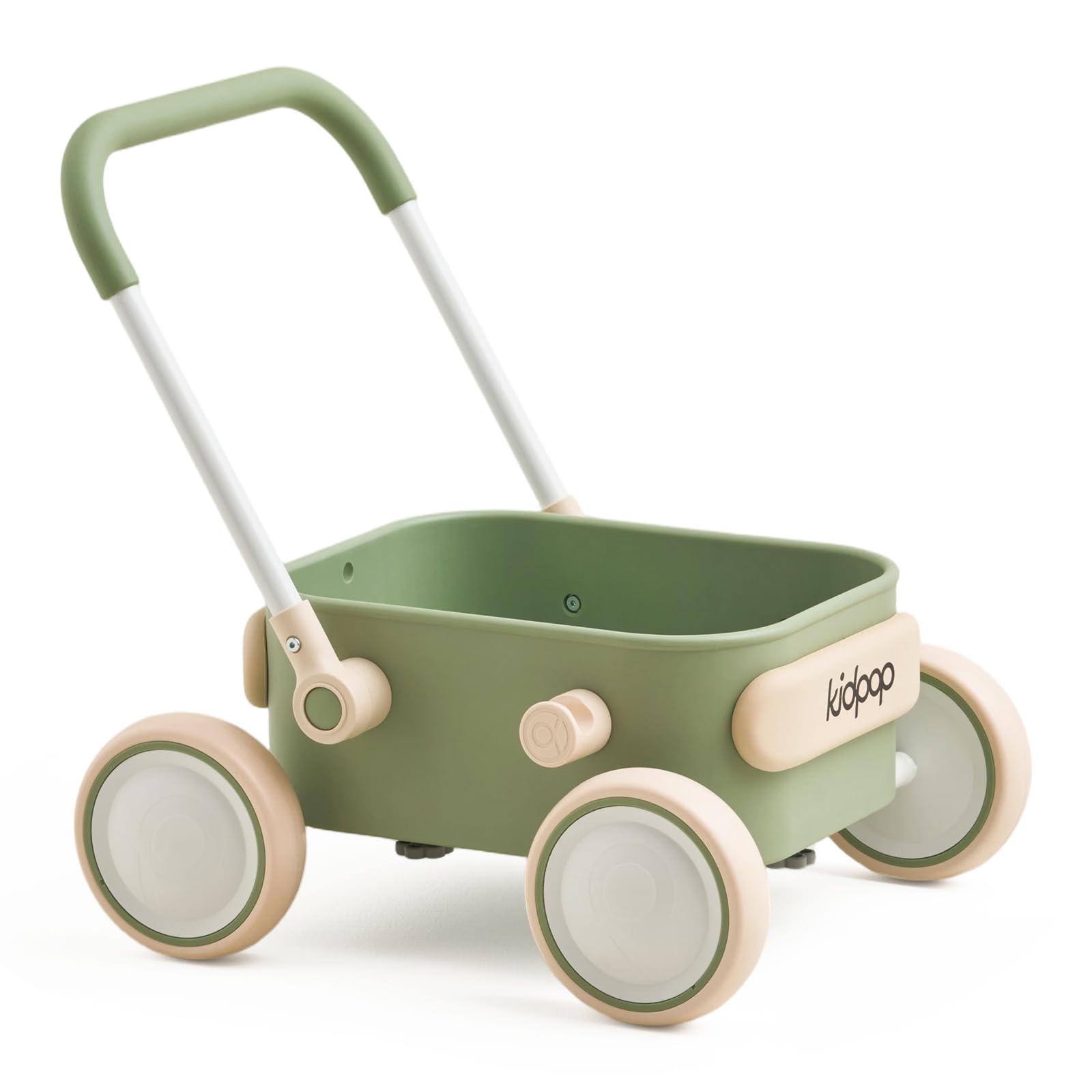
The PULA is not a balance bike in the traditional sense—it is a push wagon that functions as a 2-in-1 walker and ride-on. For a one-year-old who has not yet begun to walk independently, this is a safer entry point than a balance bike, because the child can use it as a support while taking steps, then later transition to sitting in the wagon and being pushed. The fully enclosed EVA wheels and low-gravity design make tipping virtually impossible.
The hopper is made from food-grade PP material, meaning the child can safely sit inside it and be pulled around. The handlebar is non-slip and the overall height is designed for toddlers aged 7 to 48 months, so it accommodates a much younger starting age than any balance bike in this list. The one-click folding mechanism makes it easy to transport or store.
The main drawback is that the PULA does not teach gliding balance—it supports upright walking. If your goal is specifically a balance bike for gliding practice, this is not the tool. However, for a 1-year-old at the earliest stages of walking, the PULA provides a stable, confidence-building experience that bridges the gap between crawling and biking.
Why it’s great
- Supports pre-walkers with stable push-wagon design
- Food-grade PP hopper is safe for sitting and carrying
- One-click folding for easy storage
Good to know
- Does not teach gliding balance like a bike
- Heavier at 9.9 pounds
FAQ
At what age can a child start using a balance bike?
Should I buy a two-wheel or four-wheel balance bike for a 1-year-old?
How do I know if the balance bike is the right height for my child?
Final Thoughts: The Verdict
For most users, the balance bike for 1 year old winner is the Liberry Baby Balance Bike because its 9.7-inch minimum seat height, four-wheel stability, and rubber handlebars hit every priority for a brand-new walker. If you want a transitional system that grows from stable dual-rear to single-wheel riding, grab the Yvolution Y Velo Junior. And for outdoor durability with zero maintenance, nothing beats the Retrospec Cub.