
Our readers keep the lights on and the weekend projects moving. As an Amazon Associate, I earn from qualifying purchases.
A wobble board isn’t a gimmick—it’s a direct tool for retraining your ankle stabilizers, waking up dormant deep-core fibers, and fixing the proprioceptive blind spots that decades of flat-shoe living create. For a beginner, the challenge is finding a board that offers enough resistance without demanding circus-level coordination on day one.
I’m Rikta — the founder and writer behind FitlyFast. I’ve spent years analyzing the structural integrity, material density, and motion arcs of balance equipment to separate durable training tools from flimsy plastic toys that waste your money and frustrate your progress.
Whether you’re recovering from an ankle sprain, trying to stand longer at your desk without back pain, or simply want better coordination for everyday movement, finding the best balance board for beginners requires understanding three factors: base movement type, surface grip, and weight capacity relative to your body.
How To Choose The Best Balance Board For Beginners
A beginner board must forgive small mistakes while still challenging your stabilizing muscles. The wrong board either wobbles too freely (dangerous for a novice) or locks into a single rocker plane that doesn’t train multi-directional control. Here are the specific specs that separate a smart first purchase from a regretful one.
Movement Type: Rocker vs. Wobble vs. 360-Degree
Rocker boards tilt along a single axis (front-to-back or side-to-side). They are the safest starting point because you can predict the motion plane. Wobble boards use a hemispherical base that tilts in all directions—this demands more active ankle correction. True 360-degree rotation boards allow the top plate to spin while tilting, which is best left for intermediate users. For absolute beginners, a board with a defined rocker pattern or a wobble base with a low maximum tilt angle (around 15-22 degrees) prevents overcorrection falls.
Surface Grip and Footprint Size
A non-slip textured surface isn’t optional. Smooth wood boards become dangerously slick when you sweat or wear low-grip socks. Look for a board that measures at least 15 inches in diameter or 13 x 17 inches if rectangular—this gives you room to adjust your stance without your foot hanging off the edge. Boards with rubberized or TPE bases also protect your flooring and absorb some vibration, making the learning curve less jarring on your joints.
Weight Capacity and Material Durability
Every board has a maximum weight recommendation, and beginners should aim for a board rated at least 50 pounds above their body weight. This buffer prevents the board from “bottoming out” under load and ensures the foam or wood core remains responsive. Solid wood boards (lauan, birch, or high-density plywood) outlast plastic composites by years and resist warping from humidity. Avoid boards with thin particle board construction—they delaminate after a few months of daily use.
Quick Comparison
On smaller screens, swipe sideways to see the full table.
| Model | Category | Best For | Key Spec | Amazon |
|---|---|---|---|---|
| StrongTek Professional | 360-Degree | Core training & rehab | Wood construction, 350 lbs | Amazon |
| Gaiam Evolve Rocker | Rocker Board | Standing desk use | PU/PVC build, 250 lbs | Amazon |
| PROIRON Wobble Board | Wobble Base | All-age beginners | TPE base, 330 lbs | Amazon |
| ProsourceFit Wobble | Wobble Base | Lightweight portability | Wood with plastic tilt ring, 300 lbs | Amazon |
| Yes4All Incline Board | Incline Wedge | Calf stretching & squat | Solid wood, 400 lbs | Amazon |
| Woodure Wobble Board | Wobble Base | Light home therapy | Wood construction, 350 lbs | Amazon |
| WOOD CITY Rocker Board | Curved Rocker | Family & toddler play | Natural wood, 480 lbs | Amazon |
In‑Depth Reviews
1. StrongTek Professional Wooden Balance Board

The StrongTek board uses a cross-shaped base that allows 360-degree rotation and tilting in every direction, making it the most versatile option for a beginner who intends to progress beyond basic rocking. The 17.5-by-13.5-inch surface accommodates a natural shoulder-width stance, and the Lauan hardwood plywood resists warping far better than the fiberboard used in cheaper models. Multiple users in their 60s and 70s reported noticeable balance improvements within weeks of daily use, which confirms the board’s stability doesn’t punish older joints.
The non-slip top surface provides reliable grip whether you train barefoot, in socks, or with sneakers. The board includes four corner edge protectors that prevent floor scuffing, though a few units arrived with poorly adhered protectors that require a dab of super glue to secure permanently. The 3-inch height adds enough clearance for comfortable standing desk use without feeling like a step-up platform.
Physical therapy reviews consistently praise its effectiveness for post-knee-surgery rehab and ankle strain recovery. The 350-pound weight capacity gives a generous safety buffer for most body types, and the design folds into a slim profile that stores upright next to a desk. It is a mid-range investment that delivers premium-grade material quality and will likely outlast cheaper plastic alternatives by several years.
Why it’s great
- Lauan hardwood holds up to daily use without creaking or warping.
- 360-degree rotation challenges every ankle angle for full proprioception training.
- Wide platform feels secure for feet up to size 12.
Good to know
- Corner protector adhesive fails on some units—easy fix with glue.
- Requires a few sessions to master full-axis motion if you’re new to balance training.
2. Gaiam Evolve Balance Board
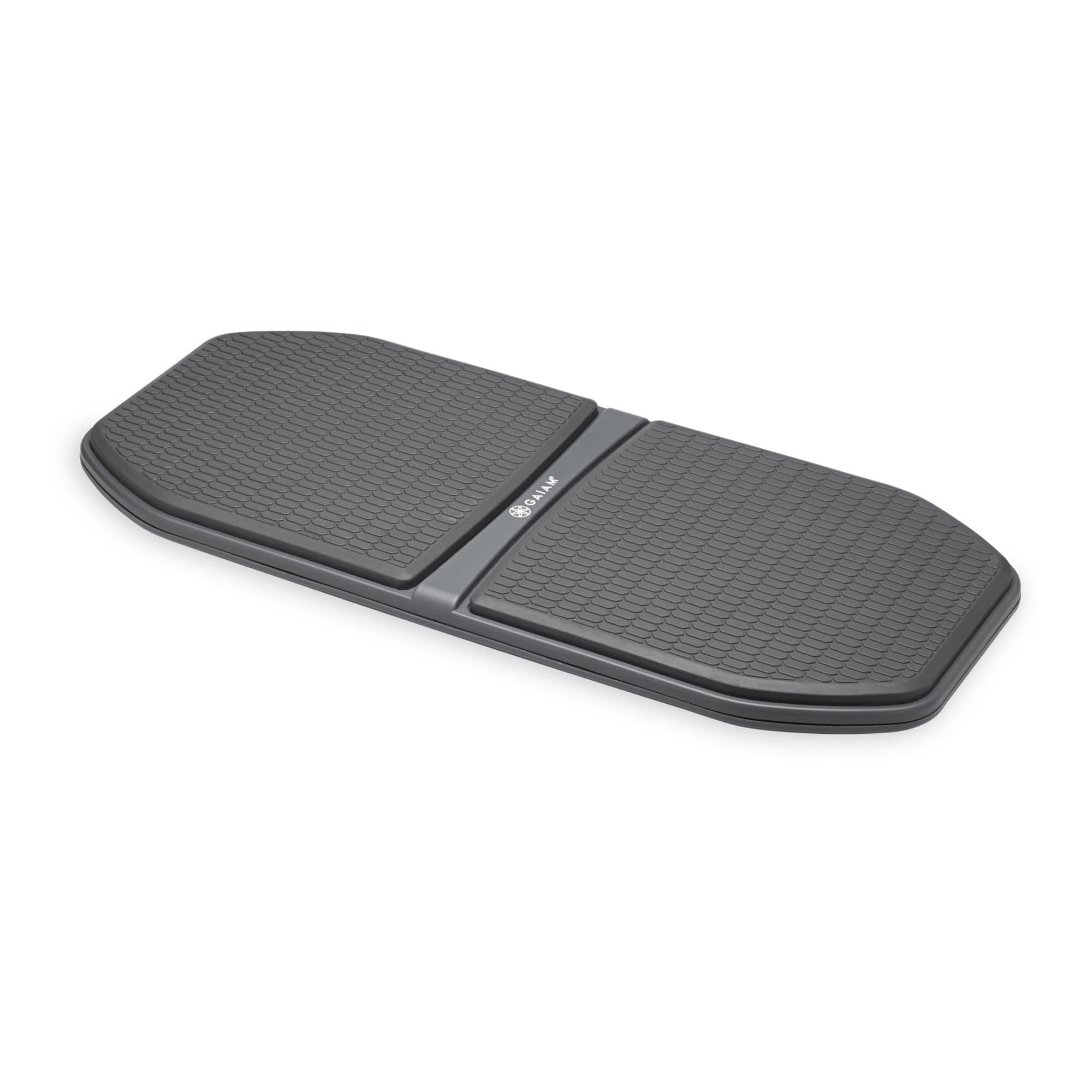
The Gaiam Evolve is purpose-built for standing desk users who want micro-movements without the instability of a full wobble platform. Its curved base creates a predictable front-to-back and side-to-side rocker motion that keeps you engaged without demanding constant ankle correction. Weighing only 6.5 pounds, it shifts easily between home office and corporate workspace, and the 27-inch length provides a generous stance area for natural weight shifting over an eight-hour shift.
The honeycomb non-slip texture grips both carpet and hard floor firmly, and the PU/PVC/TPR material combo dampens vibration that would otherwise travel into your knees. Several long-term users report standing four to five hours daily without the lower-back stiffness that occurs on a static mat. The low 250-pound weight capacity is the main trade-off—it suits average-sized beginners but excludes heavier users.
A handful of owners noted a creaking sound developing after two months of heavy use, which may indicate the internal foam core settling. The board also adds about 3.6 inches of height, so ensure your standing desk can accommodate the extra lift. For pure desk ergonomics with a manageable learning curve, this remains a top contender in the rocker category.
Why it’s great
- Subtle rocker motion prevents leg fatigue during prolonged standing.
- Light enough to carry between rooms or to a co-working space.
- Non-slip surface works reliably on carpet without sliding.
Good to know
- Weight limit of 250 pounds restricts larger beginners.
- Some units develop mechanical creak after extended use.
3. PROIRON Upgraded Wobble Balance Board

PROIRON differentiates its board with a textured PP top that doubles as a foot-massage surface and a TPE bottom that grips the floor without slipping. The spherical base allows a 0-to-22-degree tilt arc, which is forgiving enough for a beginner while still offering progressive resistance as your balance improves. Twelve screws secure the top to the base—a redundant fastening system that prevents the wobble mechanism from separating under load, a failure mode seen in cheaper clip-on designs.
Integrated dual handles serve a dual purpose: they make the board easy to carry, and they enable upper-body exercises like push-ups and Russian twists while balancing. Owners aged 65 and older report using it daily for ankle strengthening without falling, which speaks to the 22-degree max tilt being accessible rather than intimidating. The 330.7-pound capacity is near the top of the mid-range tier, making it suitable for a wide range of body types.
The bump surface texture can feel slightly abrasive against bare feet, and some users find the board slick when used in socks alone. Beginners should wear grippy shoes or use bare feet with caution until they adapt. For a novice who wants to eventually use the board for multi-plane training and strength combos, this is a smart transitional tool.
Why it’s great
- 12-screw construction prevents base separation during intense wobbling.
- 22-degree tilt angle is steep enough for challenge but safe for new users.
- Dual handles enable integrated balance-and-strength exercises.
Good to know
- Bumpy top surface may be uncomfortable for long barefoot sessions.
- Handles reduce usable surface area for foot placement.
4. ProsourceFit Wooden Balance Board

The ProsourceFit board is the lightest entry on this list at roughly three pounds, making it the obvious choice for those who need to pack a board into a gym bag or slide it under a couch between sessions. The 15.75-inch circular platform provides a compact but usable stance area, and the textured top surface prevents foot slippage during dynamic exercises like bodyweight squats or push-ups with hands on the board.
The wobble base uses a plastic ring atop a solid wood disc, creating a 360-degree tilt that moves freely in any direction. Experienced users with a background in skateboarding or skiing found the board intuitive, but absolute beginners noted a steep initial learning curve because the tilt sensitivity is high. The company explicitly advises against using this board for rehabilitation or fall-risk training—this is a core-conditioning tool, not a clinical rehab aid.
After one year of daily use, the board shows minimal wear thanks to the solid wood core. The plastic ring does scuff on very rough concrete, but on hardwood, tile, or gym matting it glides smoothly. The 300-pound capacity is adequate for most beginners, though heavier users may find the board less stable because the smaller diameter concentrates weight in a tighter footprint.
Why it’s great
- Ultra-light build makes it truly portable for travel or office storage.
- Solid wood core holds up well under daily use without splintering.
- 360-degree tilt trains multi-directional stability.
Good to know
- Not recommended for rehab or fall-prone beginners due to sensitive tilt.
- Plastic base ring can be slippery on polished hardwood floors.
5. Yes4All Professional Incline Board
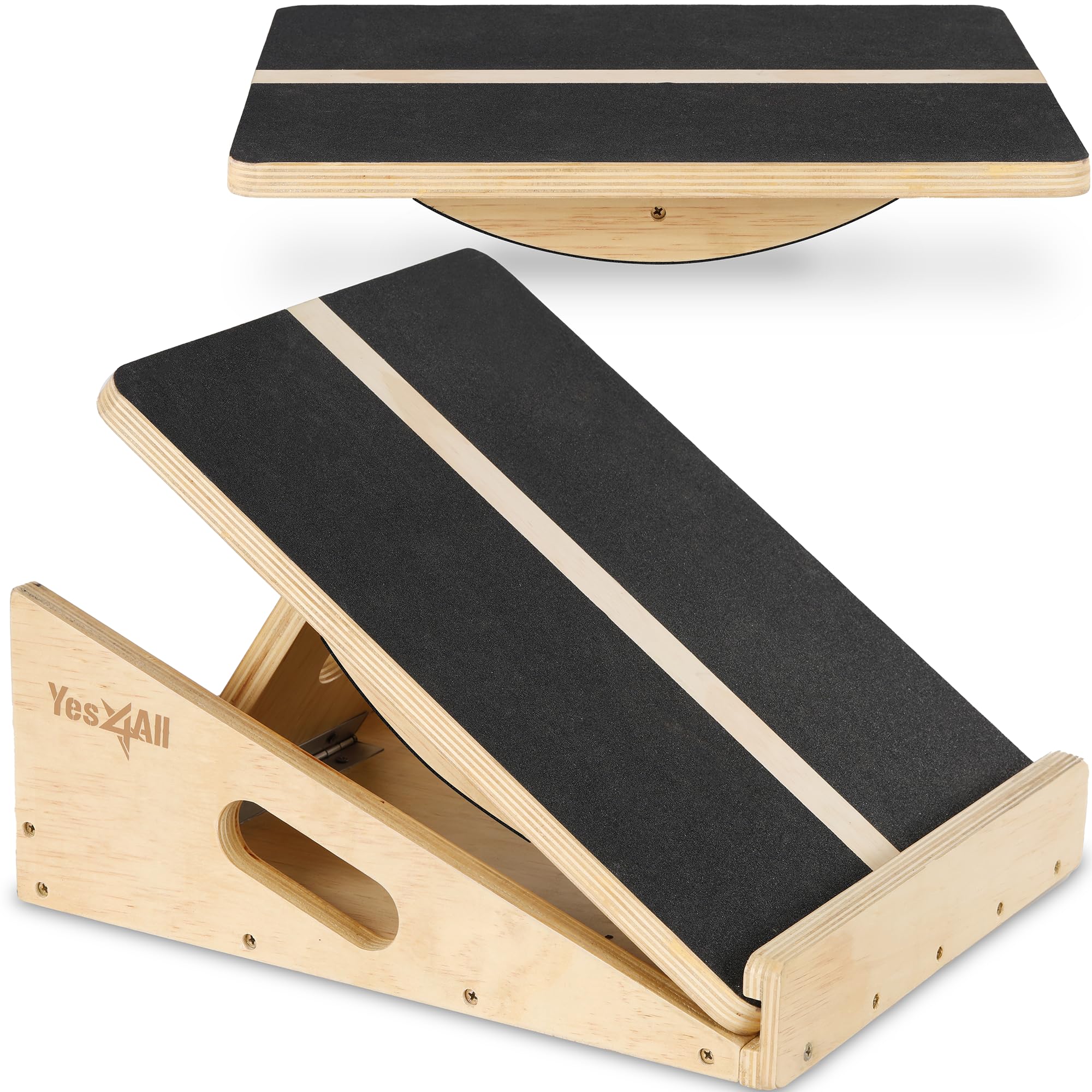
The Yes4All board blurs the line between a balance trainer and a calf-stretching wedge, offering four adjustable incline levels (20, 25, 30, and 35 degrees). Beginners recovering from Achilles issues or knee stiffness will appreciate the ability to start at the lowest incline and gradually increase the squat or stretch angle without buying separate equipment. The wooden construction feels substantial at nearly nine pounds, and the anti-slip surface keeps your feet planted during dynamic movement.
The 400-pound weight capacity is the highest in this comparison, making it the safest choice for larger-framed beginners or anyone who wants an absolute durability margin. The large side handle simplifies transport despite the board’s weight, and the noise-reducing base pads protect hardwood floors from scuffs during use. Assembly is not required—the board arrives ready to use out of the box.
This board functions primarily as a rocker (front-to-back motion) rather than a 360-degree wobble platform, which reduces the fall risk for a novice. The trade-off is that it doesn’t train lateral ankle stability in the same way as a spherical-base board. For targeted lower-leg rehab or squat-depth progression, it’s an exceptional entry-level tool that doubles as a stretching aid.
Why it’s great
- Adjustable incline levels let you progress the stretch angle over weeks.
- 400-pound capacity accommodates nearly any beginner body type.
- Solid wood build with noise-reducing base pads protects floors.
Good to know
- Only rocks front-to-back—does not train lateral balance.
- Heavier than most boards, less portable for travel.
6. Woodure Wobble Board

Woodure’s budget-friendly wobble board offers a straightforward no-frills design that prioritizes safety over flashy features. The wooden platform has pre-drilled holes for simple assembly, though you’ll need your own screwdriver, and the included non-slip top sheet requires careful placement to avoid air bubbles. Once assembled, the board provides a stable wobble platform that multiple buyers described as “good enough” for home vestibular therapy.
The 13.5 x 17-inch surface is slightly narrower than the StrongTek or ProsourceFit boards, so users with size 12 feet or larger may find their toes hanging off the front edge. The 350-pound weight capacity is generous for the price tier, and the sticky non-slip material keeps your feet planted during wobbling. Customer reviews consistently note that it works well on both carpet and hard floors without leaving marks.
The main limitation is the thin non-slip sheet—several buyers reported it lifting at the corners after a few weeks and having to re-secure it with adhesive. This is a minor inconvenience for the cost, but it means the board requires a bit of maintenance over time. For a casual user who wants a low-commitment entry into balance training without spending extra, this board delivers acceptable performance.
Why it’s great
- Very low entry cost makes it accessible for casual experimentation.
- Sturdy wood base with 350-pound capacity offers a generous safety margin.
- Works well on both carpet and hard floors.
Good to know
- Non-slip surface may peel at edges after repeated use; requires adhesive touch-up.
- Surface area is narrow—large feet may overhang the platform.
7. WOOD CITY Curved Rocker Board

The WOOD CITY rocker board breaks from the small circular or rectangular wobble designs by offering a 35-inch-long curved plank that functions as both a balance tool and an open-ended play toy for children. The 480-pound capacity is the highest in this entire comparison, and the 0.66-inch-thick natural wood construction provides a solid flex-free platform that won’t crack under adult weight. It is technically a rocker board—it tilts along one axis—which makes it inherently safer for toddlers learning to stand and shifting their weight.
Parents report that kids aged 18 months to six years use the board as a bridge, tunnel, lounge chair, or stepping stone, making it a Montessori-aligned toy that develops vestibular sense without instruction. Adults in the same household use it for yoga, back stretching, seated hamstring work, and balance training. The eco-friendly lacquer is smooth to the touch and free of splinters, and the wood grain pattern varies per board.
The rocker motion is simple and predictable, which limits its utility for advanced multi-directional training. If your goal is solely lateral ankle rehabilitation or standing wobble work, a traditional circular board is more effective. For a family that wants one durable piece of equipment that serves both a child’s development and an adult’s fitness, the WOOD CITY board is the most versatile option available.
Why it’s great
- 480-pound capacity handles two kids or a large adult without flexing.
- Natural wood construction with child-safe finish is splinter-free.
- Serves as both balance trainer and open-ended play toy for toddlers.
Good to know
- Rocker-only motion cannot replicate the 360-degree wobble needed for advanced rehab.
- Length makes it less portable than circular boards; storage requires floor space.
FAQ
How long should a beginner use a balance board each day?
Can a balance board help with flat feet or fallen arches?
What is the difference between a wobble board and a rocker board for beginners?
Final Thoughts: The Verdict
For most users, the best balance board for beginners winner is the StrongTek Professional Wooden Balance Board because its hardwood construction, 360-degree rotation capability, and wide platform provide the most forgiving yet progressive learning curve in this comparison. If you want a board dedicated specifically to standing desk micro-movements, grab the Gaiam Evolve. And for a family-friendly option that trains balance for both toddlers and adults, nothing beats the WOOD CITY Curved Rocker Board.