
Our readers keep the lights on and the weekend projects moving. As an Amazon Associate, I earn from qualifying purchases.
Whether it’s metatarsalgia, Morton’s neuroma, or sesamoiditis, the right pad can mean the difference between wincing through the day and walking without a second thought. The challenge is choosing between a thin adhesive felt insert, a bulky gel sleeve, or a full-length insole with a built-in metatarsal rise.
I’m Rikta — the co-founder and writer behind FitlyFast. I’ve spent countless hours analyzing foot pad materials, adhesive durability, thickness tolerances, and real-user wear patterns to separate the few products that actually redistribute forefoot pressure from the many that just add bulk.
What follows is a structured breakdown of the seven best options available, designed to match your specific foot shape, activity level, and pain pattern. Whether you need a budget-friendly disposable felt pad for high heels or a premium full-length insole for daily running, this guide to the best ball of foot pads will help you choose with confidence.
How To Choose The Best Ball Of Foot Pads
Selecting the wrong pad is a common mistake—it either slides around inside your shoe, adds too much volume, or fails to place pressure relief exactly where the metatarsal heads meet the ground. The goal is to offload the forefoot without altering your natural stride or compressing the toes.
Material: Felt, Gel, or Foam
Adhesive felt pads (typically 1/8″ to 1/4″ wool felt) are excellent for targeted pressure redistribution under the metatarsal heads, but they are semi-disposable and lose stickiness after a few days. Gel sleeves wrap around the forefoot and provide continuous shock absorption without adhesive, but they add noticeable volume and may require sizing up in shoes. Full-length foam insoles with a built-in metatarsal dome offer the most comprehensive support by addressing arch collapse simultaneously, though they are the most expensive and least discreet option.
Thickness and Shoe Compatibility
A 1/4″ felt pad fits easily in most sneakers and casual shoes, but can feel obstructive in tight dress shoes or ballet flats. Gel sleeves thicken the forefoot by roughly 3-5mm, which can cause a snug toe box to become painful over time. If you wear high heels or narrow footwear, a thin, low-profile adhesive pad is your only viable choice. For running shoes or work boots, the extra volume of a gel sleeve or full-length insole is rarely a problem.
Adhesive Durability vs. Reusability
Stick-on pads rely on medical-grade acrylic adhesive, but foot sweat, friction, and daily removal degrade the bond within a few days to a week. Some washable gel sleeves can last months if cleaned regularly. Full-length insoles typically last 3-6 months before the foam compresses. Evaluate how often you’re willing to replace the product against the severity of your daily foot pain.
Quick Comparison
On smaller screens, swipe sideways to see the full table.
| Model | Category | Best For | Key Spec | Amazon |
|---|---|---|---|---|
| PowerStep Pulse Plus Met | Full Insole | Running & Morton’s Neuroma | Metatarsal dome + arch support | Amazon |
| 10 Seconds Pressure Relief 3030 | Full Insole | All-day cushioned comfort | Plastazote memory foam topper | Amazon |
| Pedag Drop Metatarsal Pad | Leather Pad | Splayfoot & leather shoe use | Vegetable-tanned leather, 3 pairs | Amazon |
| Brison Metatarsal Cushion | Gel Sleeve | Barefoot & workout use | SEBS gel, extended toe sleeve | Amazon |
| PediFix Pedi-gel Ball-of-foot Pad | Gel Pad | Dancers & sesamoiditis relief | Self-adhesive, reusable gel | Amazon |
| Wellsfoot Metatarsal Felt Pads | Felt Pad | Pinched nerve & high heels | 1/4″ wool felt, 18-pack | Amazon |
| Temiart 18-Pack Felt Cushions | Felt Pad | Bulk value for Morton’s neuroma | 1/4″ wool felt, 18-pack | Amazon |
In‑Depth Reviews
1. PowerStep Pulse Plus Met Ball of Foot Pain Relief Shoe Insoles
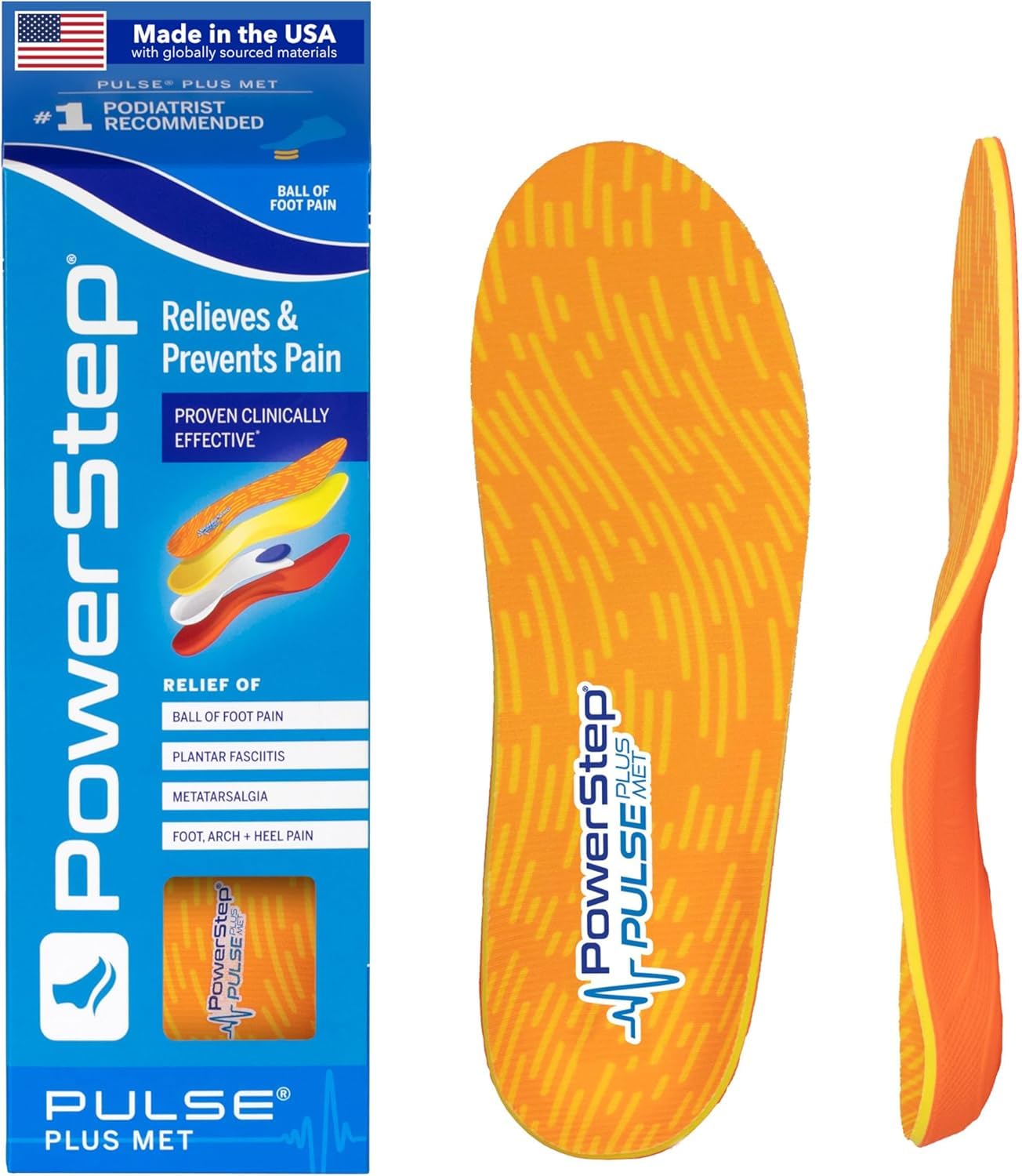
The PowerStep Pulse Plus Met is the most complete solution for persistent ball-of-foot pain because it doesn’t just add a pad—it rebuilds the foot’s entire support structure. The full-length design includes a pronounced metatarsal dome that lifts the transverse arch slightly, offloading the metatarsal heads while the deep heel cradle controls pronation. Multiple podiatrist recommendations and verified reviews confirm it eliminated burning neuroma pain during runs where other insoles failed entirely.
The built-in pad is subtle enough that most users don’t feel a discrete lump underfoot, yet effective enough to redistribute pressure away from the forefoot. The odor-control top fabric reduces friction and wicks moisture during sweaty miles, and the polyester construction holds its shape for roughly six months of daily use before the dome begins to compress. This is not a discreet stick-on pad—it replaces your existing insole—so it requires shoes with removable insoles and adequate volume.
Users logging 50-60 miles across multiple shoe types report complete pain elimination, and those with Morton’s neuroma find the lift relieves the “pebble in the shoe” sensation without digging into the foot. The price point is premium, but the durability and structural support make it more cost-effective over six months than repeatedly buying disposable felt pads.
Why it’s great
- Podiatrist-recommended design with proven neuroma relief
- Durable construction lasts 6 months before compression
- Full arch support and heel cup correct gait issues
Good to know
- Requires shoes with removable insoles; not a stick-on pad
- Premium cost may be excessive for mild or occasional pain
2. 10 Seconds Pressure Relief 3030 with Metatarsal Pad

The 10 Seconds Pressure Relief 3030 combines a cushioned Plastazote memory foam topper with a molded metatarsal pad, creating an insole that feels plush underfoot while still providing targeted forefoot lifting. Unlike hard plastic or rigid orthotic domes, the foam metatarsal rise compresses slightly with each step, making it comfortable for users who find traditional metatarsal pads too aggressive. The medium arch support is geared toward everyday walking and light running rather than high-impact sports.
The Poron strike pads in the heel and forefoot absorb shock effectively, and the “trim to fit” sizing accommodates a wide range of shoe widths. Users in Skechers slip-ons reported excellent comfort, while those in cowboy boots found the heel elevation slightly too high. The foam does compress faster than the PowerStep—some users noted reduced effectiveness after several weeks of daily walking, with pain returning around the 3-mile mark.
For users who want an immediate improvement in forefoot comfort without the sticker shock of premium orthotics, this insole offers a strong mid-range value. The metatarsal pad is soft but supportive, making it a safe choice for those with sensitive feet who cannot tolerate a hard leather or rigid plastic dome.
Why it’s great
- Plush Plastazote foam molds to foot shape for custom comfort
- Poron strike pads provide excellent shock absorption
- Trim-to-fit design works with most casual and walking shoes
Good to know
- Foam compression reduces effectiveness after several weeks
- Heel elevation may be too high for some boot styles
3. Pedag Drop Metatarsal Pads (German Made)

The Pedag Drop represents the opposite philosophy from full-length foam insoles: a minimalist, handcrafted leather pad that sits directly under the metatarsal heads without adding bulk anywhere else. Made in Germany from vegetable-tanned leather, these teardrop-shaped pads provide a firm, non-compressible lift that effectively reshapes the splayfoot and relieves burning metatarsal pain. The self-adhesive backing sticks securely to any insole without shifting, and the low profile means they don’t thicken the shoe—a critical advantage for dress shoes and loafers.
Users with splayfoot or collapsed transverse arches report immediate relief during hiking and long walks, though a small number of reviewers found the leather too hard for their sensitivity. The adhesive holds well even under hours of pressure, and the three-pair pack provides a full set for both shoes with a spare. These pads are not washable or reusable after removal; once stuck, they are intended to stay in place for the life of the insole.
For the discerning buyer who values precision, longevity, and material quality over cheap disposability, the Pedag Drop is an outstanding choice. The price reflects German craftsmanship, and the design has remained essentially unchanged since its introduction—a sign that the engineering is right.
Why it’s great
- Firm leather provides consistent, non-compressible metatarsal lift
- Ultra-low profile fits tight dress shoes and loafers
- Handmade in Germany with premium vegetable-tanned leather
Good to know
- Leather may feel too hard for users with very sensitive feet
- Not reusable after removal; adhesive is one-time application
4. Brison Metatarsal Pads Ball of Foot Cushion

The Brison pad takes a completely different approach: a gel sleeve that wraps around the entire forefoot and extends slightly over the toes, holding the cushion in place without any adhesive. This makes it ideal for barefoot walking, yoga, or gym workouts where a stick-on pad would slide off or a full insole wouldn’t fit. The patented design uses a thick SEBS gel cushion that absorbs impact effectively, and the breathable fabric sleeve prevents the pad from migrating during dynamic movement.
The biggest trade-off is volume. Brison explicitly states the pads are thick and recommends sizing up one full shoe size. Users with thin or narrow feet found the XS size too loose, while larger sizes provided a snug, comfortable fit. The reversible fabric sleeve means you can wear two on the same foot for extra cushioning, which is a unique flexibility. The gel material is washable and durable, offering months of reuse compared to disposable felt pads.
For active individuals who need forefoot cushioning during barefoot-style training, or for those who dislike adhesive residue on their feet, the Brison sleeve is a smart alternative. It won’t fit well in tight shoes, but for roomy sneakers or home use, it delivers reliable, repositionable relief.
Why it’s great
- No adhesive; stays in place with extended toe sleeve design
- Washable SEBS gel offers long reuse life
- Thick cushion ideal for barefoot walking and workouts
Good to know
- Adds significant volume; may require sizing up in shoes
- Not suitable for tight dress shoes or narrow toe boxes
5. PediFix Pedi-gel Ball-of-foot Pad

The PediFix Pedi-gel is a straightforward, time-tested product that has been relieving ball-of-foot pain since 2010. The translucent gel pad adheres directly to the skin and provides a soft, continuous cushion that redistributes pressure away from the metatarsal heads. Users with sesamoiditis—a notoriously stubborn condition—report complete pain resolution after three months of consistent use, including those who stand on concrete all day or dance in ballet flats.
The self-adhesive gel is reusable for roughly a week if washed nightly with warm water, and the stickiness decreases gradually with each use. The pad is thin enough to fit in most closed-toe and open-toe shoes without crowding the toe box, and multiple dancers confirm it stays on sweaty feet during two-hour practices. The main limitation is that the adhesive can pick up lint over time, and the gel can become ruined if the pads stick together in a purse or bag.
For a simple, reliable solution that podiatrists and dancers alike have trusted for years, the PediFix remains a benchmark. It won’t fix structural foot issues, but for immediate symptom relief with minimal footprint, it’s hard to beat.
Why it’s great
- Proven long-term relief for sesamoiditis and HIIT foot pain
- Thin profile fits nearly all shoe types, including ballet flats
- Reusable with nightly warm water rinse
Good to know
- Adhesive weakens after multiple reuses; not indefinitely reusable
- Gel can be damaged if pads stick together during storage
6. Wellsfoot Metatarsal Felt Foot Pads

The Wellsfoot felt pads deliver the highest value per pad of any product in this guide. With 18 pads per pack at a mid-range price, the per-use cost is minimal—especially since each pad can last up to five days with nightly removal. The 1/4″ wool felt is soft enough to be comfortable on hard surfaces, yet dense enough to provide genuine pressure redistribution under the metatarsal heads. Podiatrists often recommend these for pinched nerves and metatarsalgia, and users with pinched nerve pain report that the pads allowed their feet to heal by reducing pressure during walking.
The strong acrylic adhesive sticks well to skin under socks or directly to shoe insoles. However, repositioning is nearly impossible—once the pad touches a surface, it bonds aggressively, and removal can leave sticky residue on skin or delicate insole materials. Users who stick them to their feet and wear them overnight report that moisture from sweating detaches the pad, making insole application more reliable for all-day wear. The felt also compresses over time, so heavy walkers may need to replace pads every 3-4 days rather than five.
For users who want an inexpensive trial before committing to a more expensive insole or leather pad, the Wellsfoot 18-pack is an ideal starting point. The bulk quantity also makes it practical for rotating through multiple pairs of shoes.
Why it’s great
- 18 pads per pack offers the lowest per-use cost
- Prescribed by podiatrists for pinched nerve pain
- Soft wool felt is comfortable on hard walking surfaces
Good to know
- Adhesive is permanent; repositioning is not possible
- Felt compresses faster than gel or leather options
7. Temiart 18-Pack Ball of Foot Cushions
The Temiart 18-pack is a near-identical alternative to the Wellsfoot felt pads, offering the same 1/4″ wool felt construction and bulk count at a comparable price point. Users with Morton’s neuroma report that the pads provide effective relief in work boots and slippers, and the right thickness helps offload pressure without altering shoe fit. The adhesive is strong enough to hold on smooth insole surfaces but struggles with foot moisture—several users noted the pads shifted during sweaty workdays when applied directly to skin.
The felt compresses faster than premium gel or leather options, and the pads cannot be removed and reused once applied. Some users found creative workarounds, such as cutting the pads in half to prevent sandal rubbing on little toes, suggesting the material itself is comfortable but the stickiness and placement precision are variable. The manufacturer recommends sticking the pads to the shoe insole rather than the foot for better durability.
For the budget-conscious buyer who needs a large supply of disposable pads for multiple shoes, the Temiart pack delivers on quantity. However, if you need a pad that stays put through a full day of walking without shifting, the adhesion may not be reliable enough without supplemental tape or powder.
Why it’s great
- Bulk 18-pack provides generous supply for multiple shoes
- Soft felt offers comfortable pressure redistribution for neuroma
- Right thickness for work boots and slippers
Good to know
- Adhesion on skin weakens with sweat; better on insole
- Felt compresses quickly; not a long-term solution
FAQ
How do I know if I need a metatarsal pad or a full insole?
Can I wear ball of foot pads with high heels?
How often should I replace a ball of foot pad?
Will a ball of foot pad help Morton’s neuroma?
Final Thoughts: The Verdict
For most users, the best ball of foot pads winner is the PowerStep Pulse Plus Met because it provides comprehensive structural support that corrects the underlying arch collapse while delivering targeted metatarsal relief. If you need something discreet for dress shoes or want European craftsmanship, grab the Pedag Drop leather pads. And for active, barefoot-style training or workout use, nothing beats the Brison gel sleeve for continuous cushion without adhesive fuss.