
Our readers keep the lights on and the weekend projects moving. As an Amazon Associate, I earn from qualifying purchases.
Road rash turns a simple fall into a raw, weeping wound where every bandage change tears off the fragile new skin you are trying to grow. The wrong dressing—something that dries onto the wound bed—means pulling off healing tissue and restarting the clock each time you swap it. That is the specific pain this guide exists to solve.
I’m Rikta — the co-founder and writer behind FitlyFast. I have spent many hours combing through wound care material science and dressing absorption rates to identify which products actually keep a traumatic abrasion clean without destroying the healing surface underneath.
The skin lost to a slide across asphalt needs a dressing that manages heavy exudate, stays in place across moving joints, and lifts away without pulling. This guide breaks down the best bandage for road rash using real absorption data, border adhesion designs, and non-stick contact layers.
How To Choose The Best Bandage For Road Rash
Gravel abrasions are not like paper cuts. They involve a large surface area, uneven wound depth, and a heavy fluid exudate that can saturate a basic adhesive bandage within minutes. The wrong dressing sticks to the wound bed, traps bacteria, or fails to stay anchored over a bent knee or elbow. Focus on three specific criteria when selecting a dressing for road rash.
Non-Stick Contact Layer
This is the single most important feature for road rash. A dressing that adheres to the wound will tear away epithelial cells every time you change it. Silicone contact layers (like Dimora) and petrolatum-impregnated gauze (like Carbou Xeroform) are designed to sit against raw tissue without bonding. The material must be atraumatic—it lifts off cleanly with zero pulling on the healing bed.
Absorption Capacity and Strike-Through Prevention
Road rash weeps plasma and serous fluid for the first 24 to 72 hours. A dressing with low absorption will leak fluid to the exterior, creating a pathway for bacteria and ruining the seal around the wound. Look for dressings that specify “highly absorbent” or “super absorbent” with a fluid-repellent backing layer. The EVERLIT pad, for example, uses a medical-grade SAP polymer that holds up to 22 times its weight, which prevents maceration of the surrounding healthy skin.
Adhesive Border and Conformability
Road rash often spans joints—knees, elbows, shoulders—where skin stretches and folds. A dressing without a secure adhesive border will roll off within minutes of movement. Bordered island dressings (such as Ceeport) feature a hypoallergenic adhesive frame that holds the pad in place while the center remains non-stick. The dressing must also conform to body contours; stiff gauze pads will gap and let debris enter the wound.
Quick Comparison
On smaller screens, swipe sideways to see the full table.
| Model | Category | Best For | Key Spec | Amazon |
|---|---|---|---|---|
| Carbou Xeroform Petrolatum Dressing | Petrolatum Gauze | Large raw surfaces needing a moist healing barrier | 25 pads, 4×4, petrolatum + bismuth tribromophenate | Amazon |
| ZMZPA Silicone Foam Dressing | Silicone Foam | Heavy drainage on joint areas with sensitive skin | 20 pads, 4×4, silicone border, 2.4×2.4 pad | Amazon |
| EVERLIT Super Absorbent Dressing | Super Absorbent Pad | Heavily weeping wounds needing 5-layer fluid lock | 10 pads, 4×4, holds 22x weight in fluid | Amazon |
| Ceeport Island Dressing Bordered Gauze | Bordered Island Dressing | Securing large pads over moving limbs and joints | 25 dressings, 4×10, adhesive border, 2×8 pad | Amazon |
| Dimora Silicone Wound Contact Layer | Silicone Contact Layer | Primary layer under secondary absorbent dressing | 10 pads, 3×4, perforated silicone, transparent | Amazon |
| Nexcare Advanced Healing Hydrocolloid | Hydrocolloid Gel Pad | Shallow abrasions with minimal drainage | 6 pads, hydrocolloid gel, water-resistant | Amazon |
| Medtecs Hydrocolloid Gel Bandage | Hydrocolloid Gel | Small blister-like patches and minor scrapes | 30 pieces (20 ellipse + 10 strip), waterproof | Amazon |
In‑Depth Reviews
1. Carbou Xeroform Petrolatum Dressing
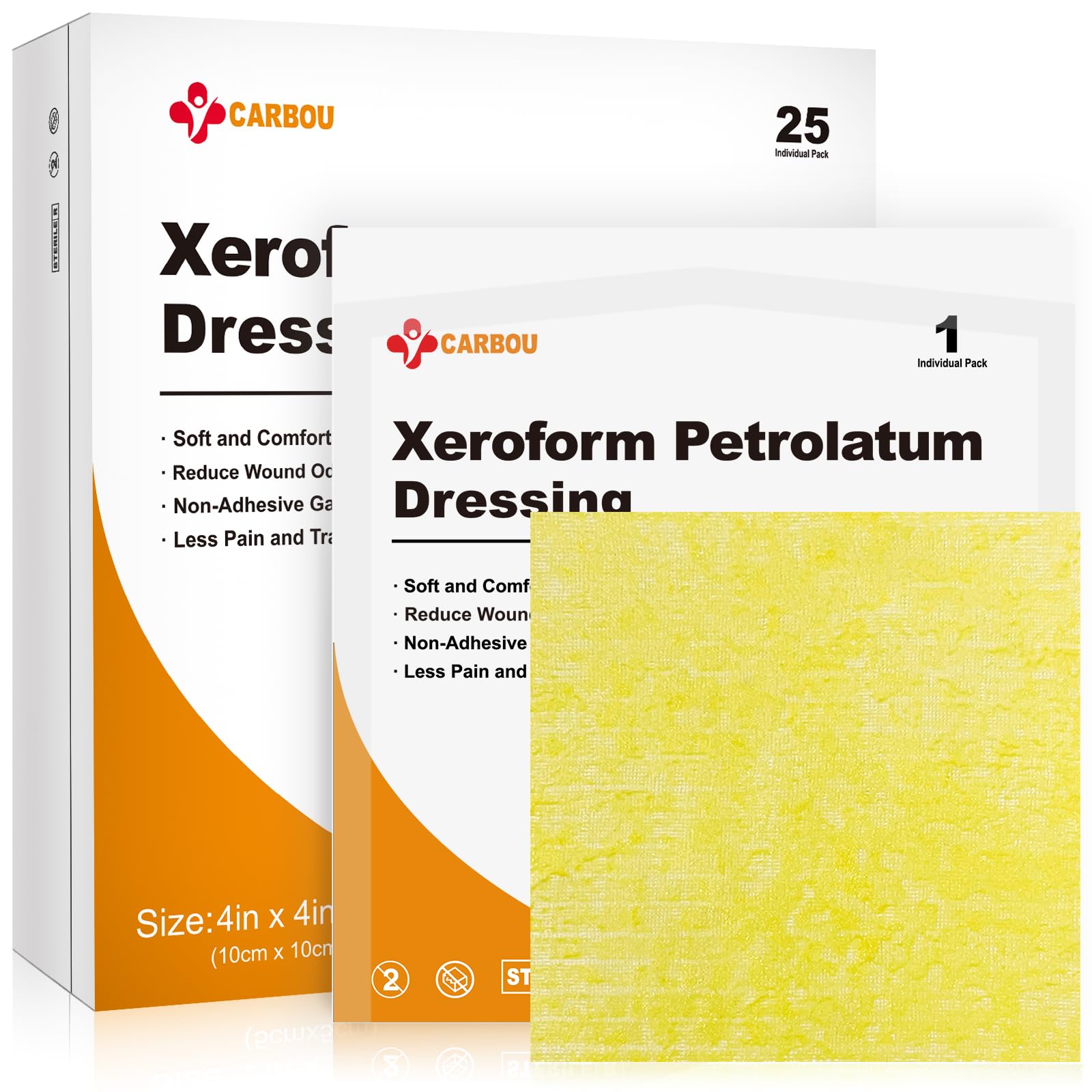
The Carbou Xeroform dressing is the closest home-care equivalent to the petrolatum gauze used in emergency rooms for large abrasions and burn debridement. Each 4×4 pad is impregnated with a petrolatum and bismuth tribromophenate blend that creates a non-adherent barrier against the raw wound surface. The fine mesh nylon weave allows exudate to pass through into an outer absorbent layer while maintaining a moist healing environment that prevents scab desiccation.
Road rash covering the forearm, thigh, or flank benefits from the generous 25-count supply—you can change the dressing twice daily without rationing pads. Users treating third-degree burns and post-surgical incisions report that the dressing lifts cleanly without sticking to granulation tissue, which is exactly the behavior needed for the weeping first 72 hours of a gravel abrasion. The petrolatum base also helps mask wound odor, a practical advantage when a large rash is covered for multiple days.
The pads do dry out faster than hospital-grade equivalents, requiring more frequent changes if exudate is heavy. Some users supplement with a secondary absorbent pad on top to extend wear time. For the priority of zero wound-bed adhesion at a reasonable per-pad cost, this is the strongest choice in the lineup.
Why it’s great
- Zero sticking to raw granulation tissue
- Petrolatum maintains ideal moist wound environment
- High quantity (25 pads) supports frequent changes
Good to know
- Dries out quicker than full-occlusive foam dressings
- Requires secondary absorbent pad on top for heavy drainage
2. ZMZPA Silicone Foam Dressing 4×4

Silicone foam dressings represent the gold standard in modern wound care for their combination of atraumatic adhesion and high absorbency. The ZMZPA variant delivers a 4×4 bordered pad with a 2.4 x 2.4 inch absorbent foam center—an ideal footprint for medium-sized road rash patches on the hip, shoulder, or lower leg. The silicone border grips intact skin without tearing delicate periwound tissue, while the foam core wicks fluid vertically and locks it away from the wound bed.
Wound care nurses have specifically approved these dressings for diabetic heel wounds, which speaks to their ability to manage exudate without macerating fragile skin. Users report that the seal holds through full shower exposure, a critical feature when road rash needs to stay covered for multiple days without reapplication. The foam cushioning also adds a layer of padding that reduces pressure pain when the injured area rests against a mattress or car seat.
Some feedback indicates batch inconsistency in adhesion strength—the first order held firmly while a subsequent box had slightly weaker border grip. The silicone surface is fully tacky (not just border adhesive), which makes repositioning difficult if the pad is placed slightly off-center. For a premium foam that minimizes trauma on removal, this is a top-tier pick.
Why it’s great
- Silicone adhesive border won’t strip healthy skin
- Foam core absorbs heavy drainage without leaking
- Waterproof seal stays intact through showers
Good to know
- Adhesion strength can vary between production batches
- Full-surface tack makes repositioning tricky
3. EVERLIT Super Absorbent Dressing

When road rash produces the kind of heavy serous weeping that soaks through standard gauze within an hour, the EVERLIT Super Absorbent Dressing becomes necessary. Its five-layer construction—two more than typical medical pads—includes a SAP polymer core that absorbs up to 22 times its own weight in fluid and dries the wound contact layer in seconds. The non-adhesive, silk-like contact layer prevents adherence to the wound bed, making it suitable for direct application over raw dermis.
The 4×4 size works well for contained road rash patches, but the dressing has no adhesive border, which means it must be secured with medical tape, rolled gauze, or compression sleeves. Users treating G-tube drainage and post-surgical wounds confirm that the pad puffs up as it absorbs, keeping fluid away from the wound while maintaining a dry environment. The fluid-repellent backing layer prevents strike-through—fluid will not leak onto clothing or bedding.
The stiffness of the SAP core when dry reduces conformability around curved body surfaces like the elbow or kneecap. Some users report that the pad feels rigid against the skin before absorption softens it. For stationary road rash on the thigh, back, or forearm, the absorption performance is unmatched in this price tier.
Why it’s great
- Holds 22x its weight in fluid; prevents maceration
- Non-adherent silk-like layer won’t stick to wound
- Fluid-repellent backing stops strike-through leaks
Good to know
- No adhesive border; needs tape or wrap to secure
- Stiff feel before absorption reduces joint conformability
4. Ceeport Island Dressing Bordered Gauze 4×10

Road rash frequently follows the long axis of an arm or leg where the body scraped against pavement. The Ceeport Island Dressing in 4×10 inches is sized specifically for these linear abrasions, with a 2×8 inch non-stick pad surrounded by a hypoallergenic acrylic adhesive border. This island dressing design eliminates the need for separate tape or wrap—the border holds the pad in place while the center remains completely free of adhesive contact with the wound.
Users recovering from third-degree burns and knee replacement incisions report that this dressing stays anchored through repeated bending and movement. The non-woven fabric backing is breathable yet holds the pad securely against skin that stretches. For road rash on the outer forearm, shin, or bicep, the long rectangular shape provides coverage that square pads cannot match without overlapping.
The adhesive border is strong enough to stay put during summer heat and sweaty activity, but users with significant body hair report that removal can tug at hairs. The center pad is moderately absorbent—adequate for light to moderate exudate but not designed for the heavy fluid output of a fresh deep abrasion. Pairing it with a secondary absorbent layer underneath extends its utility for wetter wounds.
Why it’s great
- Long 10-inch footprint matches linear road rash shapes
- Adhesive border stays secure through joint movement
- Non-stick center pad prevents wound bed trauma
Good to know
- Border adhesive can pull arm hair during removal
- Center pad absorption best for light-to-moderate exudate
5. Dimora Silicone Wound Contact Layer

This product functions as a protective interface between the wound and whatever absorbent pad you place on top. The Dimora Silicone Contact Layer is a thin, transparent, perforated sheet made from medical-grade silicone with light adhesive on one side. When laid directly over road rash, its perforations allow exudate to pass upward into a secondary dressing while the silicone sheet prevents that secondary dressing from bonding to the wound surface.
Type 1 diabetic patients and wound care professionals use this layer to protect foot and leg wounds that require frequent dressing changes. The silicone tack is gentle enough to avoid tearing newly formed epithelium but sufficient to stay in place for five to seven days. The transparency allows visual inspection of the wound without removing the layer—a practical advantage when monitoring for infection during road rash recovery.
The 3×4 inch size covers moderate patches but requires cutting for larger abrasions. The silicone sheet has no absorbent capacity itself, so it must always be paired with a secondary pad. Users with highly sensitive skin report mild irritation from the one-sided adhesive, though reactions are far less common than with acrylic-based contact layers.
Why it’s great
- Creates a reliable non-stick barrier for any secondary dressing
- Transparent material enables wound inspection without removal
- Light silicone tack stays for 5-7 days without slipping
Good to know
- Requires a secondary absorbent dressing on top
- Small size may need cutting for larger road rash areas
6. Nexcare Advanced Healing Hydrocolloid Pads

Hydrocolloid technology works by absorbing wound fluid into a gel-forming matrix that creates a moist, protective blister over the injury. The Nexcare Advanced Healing Pads use a stretchy, water-resistant adhesive that sticks to damp skin and seals out dirt, making them useful for shallow abrasions that have stopped heavy drainage. Users with thin skin from thyroid conditions or aging report that these pads stay on for multiple days and provide cushioning against external bumps.
The gel pad actively reduces pain by covering exposed nerve endings with a cushioning layer, and the water-resistant seal allows showering without dislodging the dressing. For road rash that has progressed past the initial wet phase and entered the epithelialization stage (days 3-7), the hydrocolloid maintains a protected environment where new skin can form without scabbing over.
Hydrocolloid pads are not suitable for the heavy exudate phase of fresh road rash—the gel cannot absorb large fluid volumes, and the dressing will leak or fall off prematurely. The pack contains only six pads, making it cost-inefficient for large surface areas that require full coverage. These work best as a secondary stage dressing once the wound has dried significantly.
Why it’s great
- Gel pad cushions and reduces pain over healing skin
- Water-resistant adhesive holds through showers
- Stretchy material conforms to body curves
Good to know
- Not designed for heavy exudate; leaks on wet wounds
- Only 6 pads per pack limits coverage for large rashes
7. Medtecs Hydrocolloid Gel Bandage
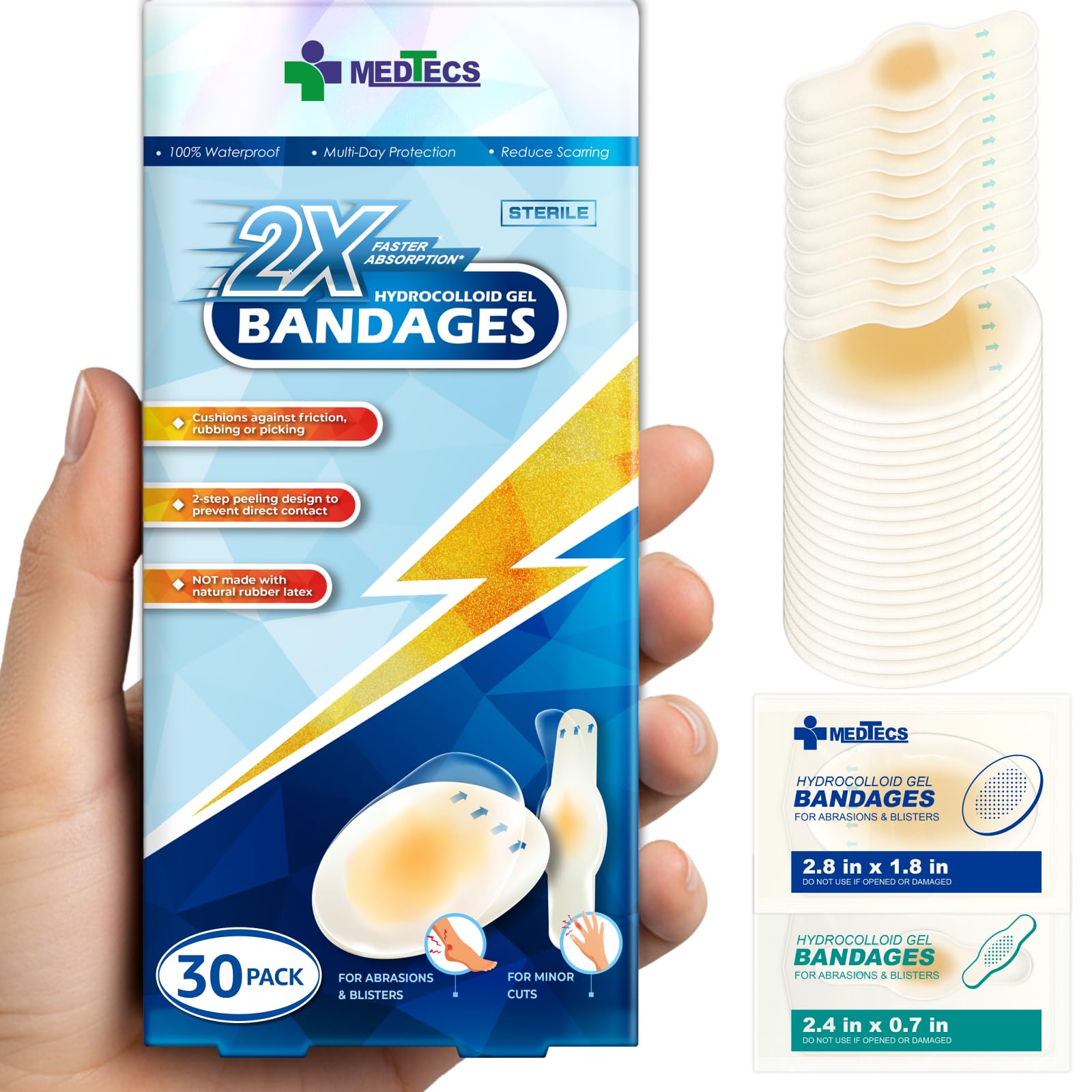
Medtecs brings a next-generation hydrocolloid formulation that claims twice the absorption power of standard gel bandages, which matters for small road rash patches that continue to weep. The bandage forms a tight waterproof seal that users confirm holds up through full shower exposure and days of continuous wear. The gel turns white with bubbles as it absorbs fluid, providing a visual cue that the dressing is actively managing the wound environment.
The pack includes 20 ellipse-shaped pads and 10 strip pads, giving you variety for different abrasion shapes and sizes. Users recovering from blisters and minor wounds report that the adhesive strength exceeds typical bandages—the dressing stays where you place it and does not peel at the edges. For small contact points of road rash on the heel, fingers, or palm, this product delivers reliable multi-day protection.
Some users note that the edges of the ellipse pads curl and peel off before the center gel is fully saturated, requiring a piece of medical tape to secure the perimeter. Absorption is rated for minor cuts and blisters, not for the high-volume fluid output of a large deep abrasion. This product is best reserved for shallow, contained road rash spots rather than broad surface areas.
Why it’s great
- Waterproof seal survives full shower exposure
- Two size options for different wound dimensions
- Twice the absorption of standard hydrocolloid formulas
Good to know
- Ellipse edges can curl before gel is saturated
- Absorption not sufficient for large or deep wounds
FAQ
Can I use a standard adhesive bandage on fresh road rash?
How often should I change a road rash dressing during the first 48 hours?
What is the difference between a hydrocolloid bandage and a silicone foam dressing for road rash?
Final Thoughts: The Verdict
For most users, the best bandage for road rash winner is the Carbou Xeroform Petrolatum Dressing because it provides the gold-standard non-stick interface used in hospitals for large surface abrasions at a quantity and price that supports frequent changes. If you want a waterproof seal that handles heavy drainage on a joint area, grab the ZMZPA Silicone Foam Dressing. And for a linear abrasion that requires a long adhesive-bordered pad that moves with your body, nothing beats the Ceeport Island Dressing 4×10.