
Our readers keep the lights on and the weekend projects moving. As an Amazon Associate, I earn from qualifying purchases.
Managing a wound after stitches or a deep laceration demands a bandage that stays put, doesn’t stick to the healing tissue, and provides a sterile barrier against infection. The wrong choice can mean reopening the wound, painful removal, or a trip back to the doctor.
I’m Rikta — the founder and writer behind FitlyFast. I’ve spent years analyzing medical-grade wound care supplies, comparing adhesive technologies, absorbency rates, and closure mechanisms to help you find the right product for your specific injury.
Whether you need wound closure strips to avoid the ER or a non-stick dressing to protect a surgical incision, this guide breaks down the best bandage for stitches based on real-world performance, adhesive strength, and healing support.
How To Choose The Best Bandage For Stitches
Choosing the wrong bandage for a fresh stitch line or deep laceration can lead to infection, scarring, or delayed healing. The two main categories you’ll encounter are wound closure strips (designed to pull wound edges together) and island dressings/covered gauze (designed to protect and absorb). Understanding your specific needs — wound type, location, moisture level, and activity — narrows the field quickly.
Closure Strength vs. Absorbent Protection
If your wound is still open or the stitches are supporting a gap, you need a closure device like zip-stitch strips or butterfly bandages that apply tension across the wound. For post-suture coverage where the wound is already closed but needs protection from moisture and friction, a bordered island dressing with a non-stick pad is the better call. The wrong category can either fail to close the wound or stick to it.
Adhesive Quality and Skin Safety
The adhesive on a stitch bandage must be strong enough to stay put for 24–72 hours but gentle enough to remove without tearing delicate healing skin. Look for hypoallergenic acrylic adhesives on the border (not the pad) and water-resistant backing. Premium options use medical-grade adhesives that maintain grip even on joints like knees and elbows, while budget options may peel prematurely or cause irritation.
Sterility and Packaging
Every product reviewed here is sterile and individually wrapped, which is non-negotiable for wound care. The packaging quality matters — easy-peel pouches let you apply the bandage without touching the sterile pad. Bulk packs (25–30 dressings) offer cost efficiency for daily changes, while smaller kits are better for emergency kits or travel.
Quick Comparison
On smaller screens, swipe sideways to see the full table.
| Model | Category | Best For | Key Spec | Amazon |
|---|---|---|---|---|
| Carbou Island Dressing 4″x10″ | Island Dressing | Post-suture coverage & incisions | 2″x8″ non-stick pad | Amazon |
| EVERLIT Wound Closure Kit | Closure Kit | Emergency wound closure | 6 zip-stitch devices | Amazon |
| AZEN 28 Pack Wound Closure Strips | Closure Strips | Small cuts & laceration closure | 20 butterfly + 8 zip closures | Amazon |
| Ceeport Island Dressing 4″x10″ | Island Dressing | Sensitive skin & burns | 2″x8″ non-stick absorbent pad | Amazon |
| Carbou Xeroform Petrolatum Dressing | Non-Adherent Gauze | Burns & open wounds | 3% Bismuth Tribromophenate | Amazon |
| HEALQU Bordered Gauze Island Dressing | Island Dressing | Large incisions & daily changes | 2″x7.5″ non-stick pad | Amazon |
| Dotodo Wound Closure Strips | Closure Strips | Wilderness & emergency kits | 4 stretchable closure devices | Amazon |
In‑Depth Reviews
1. Carbou Island Dressing Bordered Gauze 4″x10″
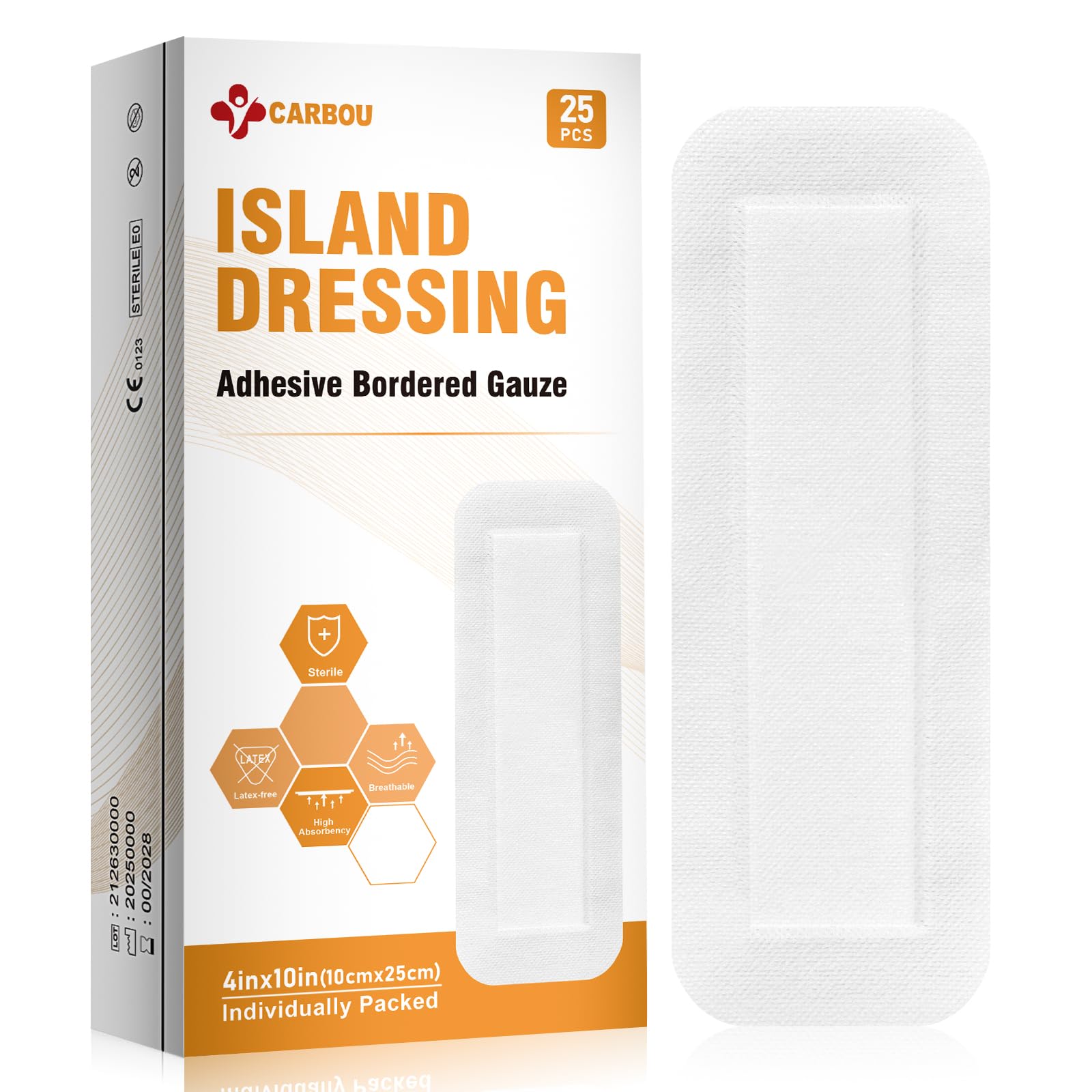
The Carbou Island Dressing strikes the ideal balance between absorbent protection and painless removal for post-stitch care. Its 2″x8″ non-stick absorbent pad sits inside a breathable non-woven border coated with a medical-grade acrylic adhesive, meaning the pad never touches the wound while the border stays put for days. The 4″x10″ size covers most surgical incisions and deeper lacerations without overlap gaps.
According to the listed product details, the adhesive is designed to conform to body contours, and the border is described as water-resistant, which can help during light splashes in the shower. The 25-count individually wrapped sterile pack is cost-effective for daily dressing changes during the first week of healing, and the peel-open pouches help avoid touching the sterile pad.
The listing describes the adhesive border as designed to stay in place on curved areas of the body. The manufacturer describes the fabric as breathable, which may help reduce moisture buildup around the stitch line, and the product is described as latex-free. As with any adhesive dressing, if removal is uncomfortable, ask a pharmacist or your care provider about a safe adhesive-remover wipe rather than using household products. For covering sutures that are already closed, this is a solid all-around bandage based on its listed specs.
Why it’s great
- True non-stick pad prevents wound reopening
- Strong water-resistant border holds on joints
- Breathable backing reduces moisture buildup
Good to know
- Adhesive is very strong — removal may need oil
- Peeling can start on day two if applied on oily skin
2. EVERLIT Wound Closure Kit

The EVERLIT Wound Closure Kit is built for the worst-case scenario: a deep laceration with no hospital in sight. At its core are 6 zip-stitch closure devices that let you pull wound edges together with adjustable tension — you tighten the hasp to match the wound’s specific width, then lock it in place. This is far more versatile than standard butterfly bandages for irregular or longer cuts.
The kit goes beyond closure strips by including sterile wound dressings, large adhesive bandages, an elastic wrap, and medical shears, all packed in a compact pouch. The waterproof transparent dressings are a standout — they let you monitor the wound without removing the protective layer, which can be useful in the first 48 hours when disturbing the closure risks reopening it. This kit is intended to buy time in remote settings; it is not a substitute for medical evaluation, and any deep, gaping, or heavily bleeding wound still needs to be seen by a professional as soon as possible.
One limitation is the absence of wound flush in the kit, so you’ll need saline or clean water on hand for irrigation before applying the closure. The zip-stitch devices are sterile and designed to be straightforward to apply, but they work best on clean, dry wound edges. For anyone building a survival or first-responder bag, this is a comprehensive closure-focused kit based on its listed contents.
Why it’s great
- Adjustable tension controls wound closure
- Includes sterile dressings, shears, and bandages
- Waterproof transparent dressing for wound monitoring
Good to know
- No wound flush or antiseptic included
- Requires clean, dry wound edges for best adhesion
3. AZEN 28 Pack Wound Closure Strips
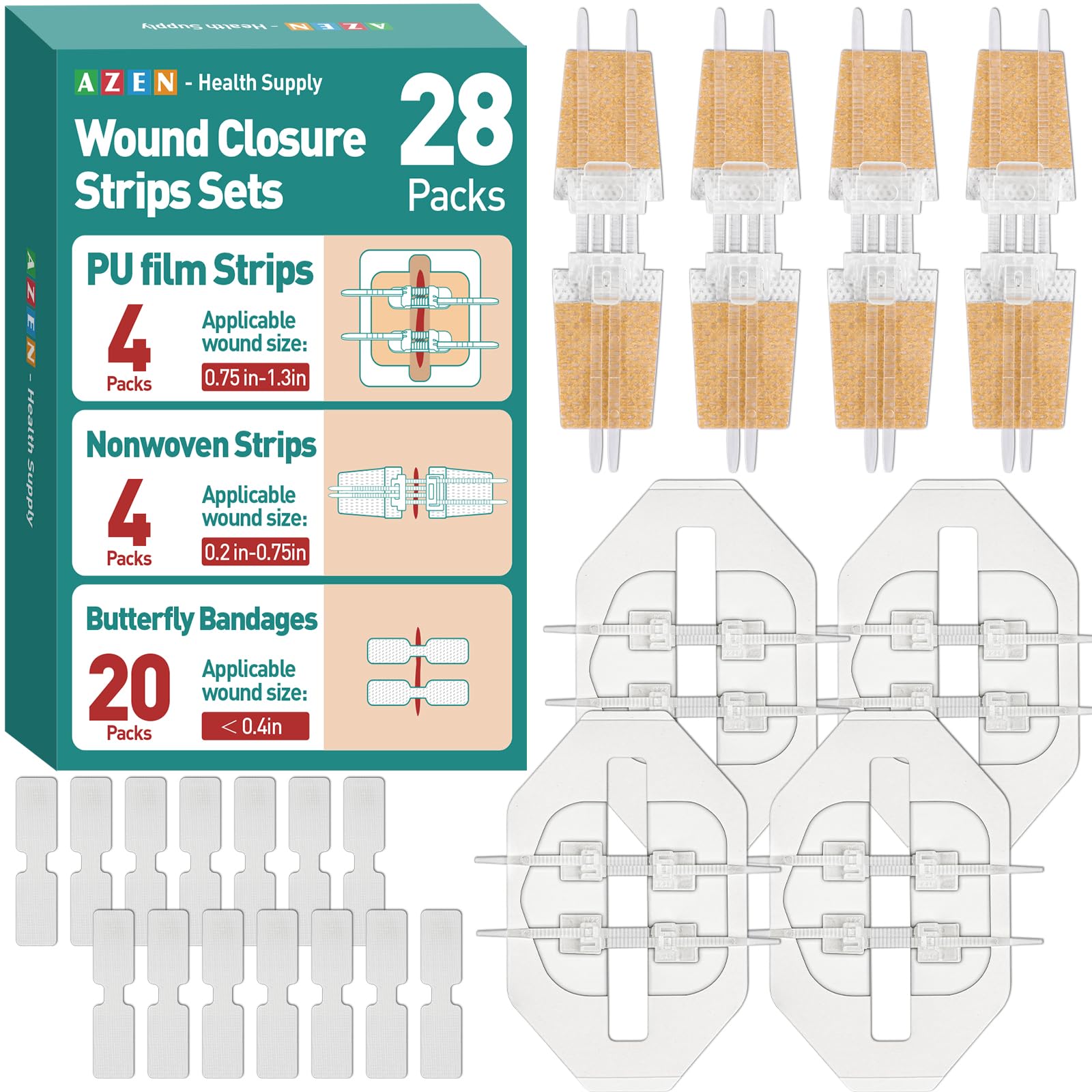
The AZEN 28 Pack delivers serious versatility with 20 traditional butterfly closure strips and 8 zip-style wound closure devices in one sterile kit. The butterfly strips use a barbell-style adhesive shape for strong tensile hold across the wound, while the zip closures allow cinching tension — similar to the premium kits but at a lower per-unit cost. This makes it ideal for households with active kids or outdoor enthusiasts who need multiple closure options on hand.
The listing describes the adhesive as professional-grade and designed for high tensile hold. The zip closures are meant to work by sticking each side to the wound edge, then pulling the buckles to tighten. The butterfly strips are individually packed to maintain sterility, and the entire kit fits into a standard first aid pouch. As with any closure strip, these are meant for superficial cuts with edges that meet easily — a deep, gaping, or heavily bleeding wound still needs medical evaluation rather than a DIY closure.
What holds this back from the top spot is the lack of secondary dressings — you’ll need separate gauze pads and tape to cover the closure. The zip devices also lack the adjustable hasp of the EVERLIT kit, so tension is set once and locked. But for the price and sheer quantity, the AZEN pack is an economical way to stock a family first aid kit for minor, stitch-strip-appropriate cuts.
Why it’s great
- Two closure types in one kit for flexibility
- Strong adhesive — surgeon-recommended
- Low per-unit cost for bulk stocking
Good to know
- No dressing or gauze included for coverage
- Zip closures have fixed tension, not adjustable
4. Ceeport Island Dressing Bordered Gauze 4″x10″

The Ceeport Island Dressing is nearly identical to the Carbou option but with a softer, more flexible non-woven border that conforms to body contours with less edge-lifting. The center 2″x8″ pad is non-stick and highly absorbent, designed for mild to moderate exudate — perfect for post-surgical incisions that are oozing slightly. The hypoallergenic acrylic adhesive is gentle enough for daily changes on sensitive skin yet holds for 24+ hours on active areas.
What distinguishes Ceeport from other island dressings is that the manufacturer markets it specifically toward sensitive skin, describing the adhesive as hypoallergenic and the center pad as non-stick so it should not adhere to the wound surface. Note that this is a first-aid dressing for minor to moderate wound drainage — a third-degree burn is a medical emergency and needs professional treatment, not a home dressing. The 25-count sterile box provides a full week’s supply for typical post-op care.
The main downside is the adhesive’s gentleness — on very active individuals, it may start lifting at the edges by day two compared to the stronger Carbou option. It also lacks a dedicated removal tab, requiring careful peeling from one corner. For anyone with eczema, fragile aging skin, or a history of adhesive reactions, this is the safest island dressing for maintaining a sterile stitch environment.
Why it’s great
- Hypoallergenic adhesive safe for sensitive skin
- Non-stick pad prevents wound disruption
- Flexible border reduces lifting on joints
Good to know
- Adhesive is gentler — may lift on day two
- No removal tab; peel carefully from corner
5. Carbou Xeroform Petrolatum Dressing 4″x4″
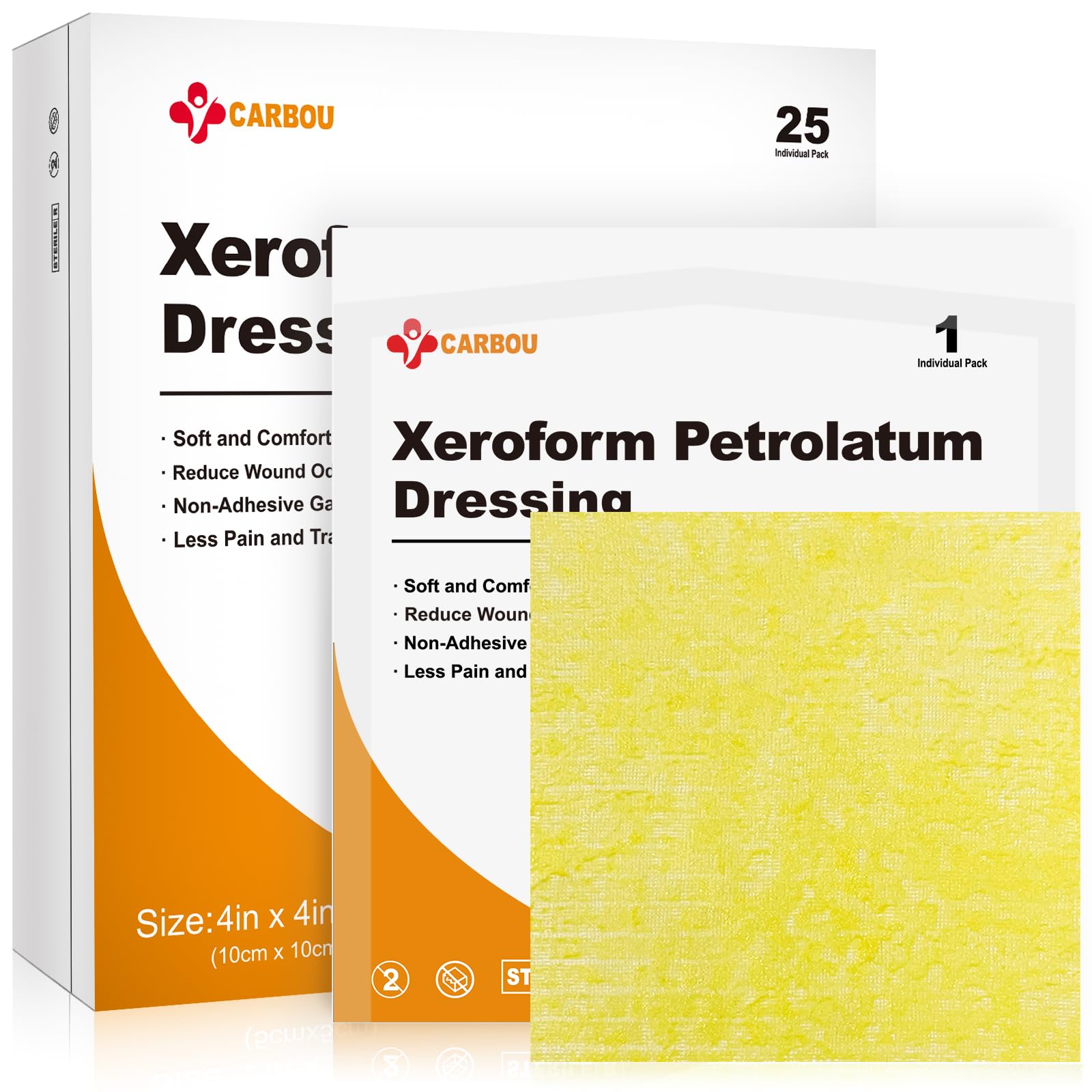
Xeroform petrolatum dressings have been a hospital staple for decades, and the Carbou version brings that standard to home care. The 4″x4″ fine mesh gauze is impregnated with petrolatum and 3% Bismuth Tribromophenate, a mild antiseptic that reduces wound odor and maintains a moist healing environment. This is not an island dressing — it’s a non-adherent wound contact layer meant to be covered with secondary gauze or a wrap.
For stitch sites with surrounding abrasions or minor burns, Xeroform’s petrolatum barrier is designed to keep the dressing from adhering to the wound bed, which should make changes less painful than with plain gauze — this can matter for anyone with thin or fragile skin, such as some elderly patients. It can be cut to size, so one pad can cover multiple smaller wounds or be shaped around a drain site. Deeper burns or wounds should still be evaluated by a healthcare provider.
The trade-off is that, like most petrolatum gauze, it can dry out with extended wear and may need more frequent changing than some clinical-grade versions. It also requires a secondary dressing, adding complexity and cost. For deep, weeping wounds or skin grafts, this is the best non-stick contact layer, but for simple closed incisions, a bordered island dressing is more convenient.
Why it’s great
- Petrolatum barrier prevents sticking to wound
- Cut-to-size flexibility for irregular wounds
- Reduces odor in infected or weeping wounds
Good to know
- Requires secondary gauze or wrap over it
- Dries out faster than clinical-grade Xeroform
6. HEALQU Bordered Gauze Island Dressing 4″x10″
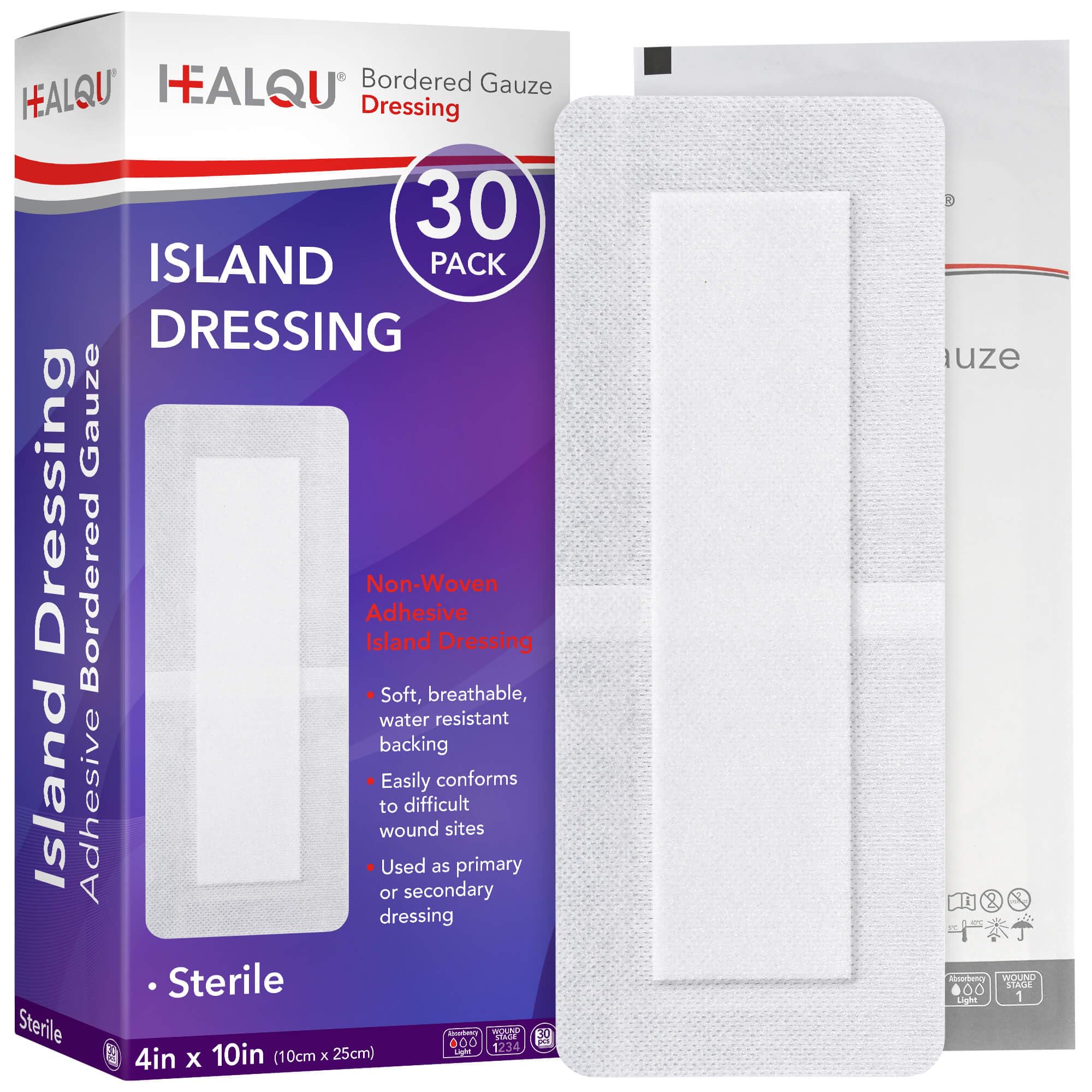
The HEALQU Bordered Gauze Island Dressing offers a slightly smaller non-stick pad (2″x7.5″ instead of the standard 2″x8″) within a larger adhesive border, making it ideal for covering large surgical incisions where the wound itself is narrow but the surrounding skin needs protection. The water-resistant non-woven backing resists moisture penetration during showers, and the border adhesive sticks well on clean, dry skin without tugging during removal.
The all-in-one bordered design is meant to be easier to apply than separate gauze and tape combinations, which can help after major surgeries such as knee replacements or abdominal incisions. The peel-open sterile packaging is straightforward, and the pad’s absorbency is intended for light to moderate drainage without saturating through. The 30-count box provides more dressings than most competitors at a comparable unit cost, making it practical for twice-daily changes during the first week.
The most common complaint is that the border can begin peeling by day two on oily or moist skin, especially in high-friction areas like the lower back or under clothing. It also lacks the ultra-strong adhesive needed for active individuals. For short-term coverage on clean, stationary incisions with minimal exudate, HEALQU offers solid value and convenience in a generous pack size.
Why it’s great
- Large 30-count box for frequent changes
- Water-resistant backing for shower protection
- Easy peel-and-stick application
Good to know
- Adhesive may peel on day two on oily skin
- Smaller pad size than other 4″x10″ options
7. Dotodo Emergency Wound Closure Strips
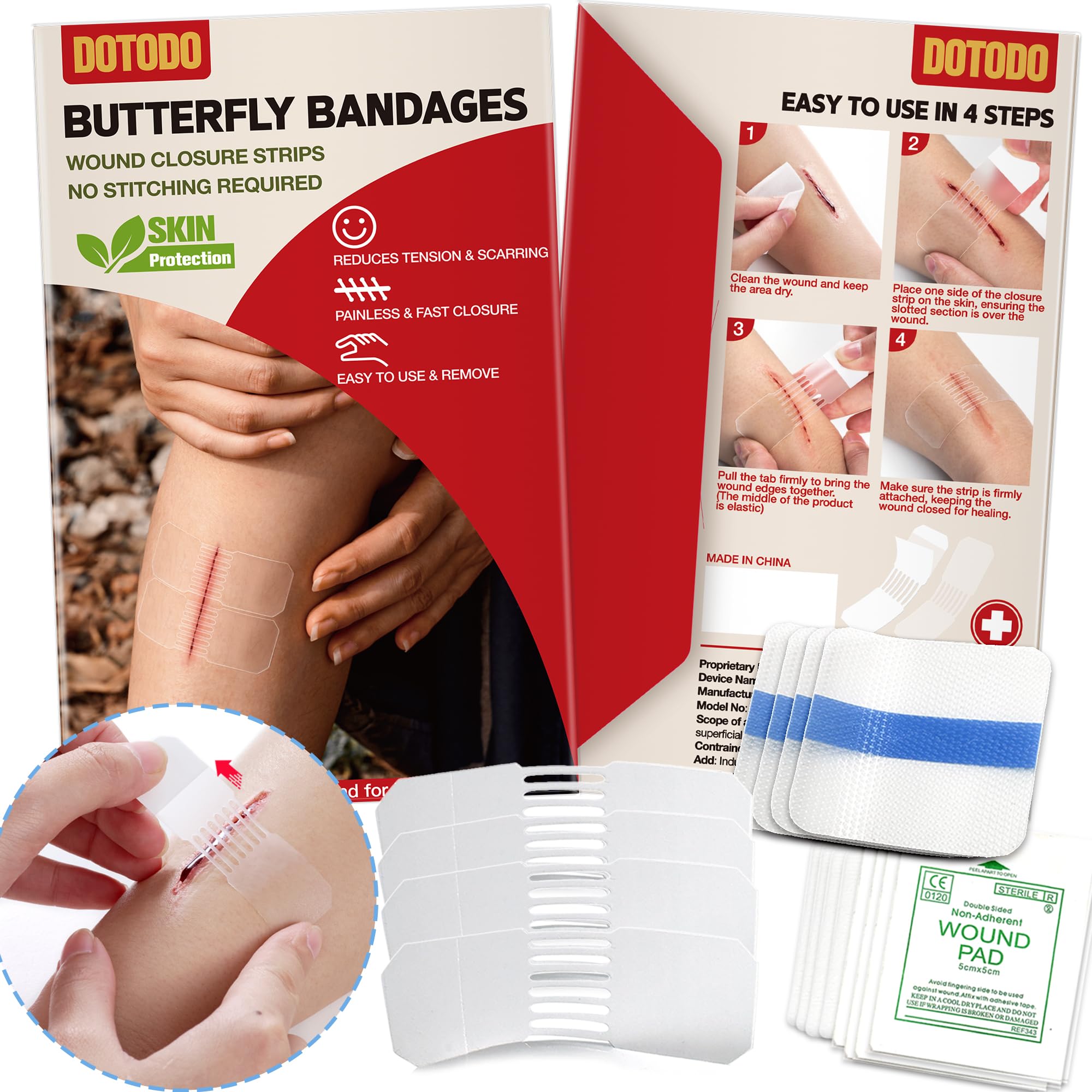
The Dotodo Wound Closure Strips are the most compact and affordable entry into stitch-free wound closure. The kit includes 4 stretchable closure devices, 4 waterproof dressings, and 4 gauze pads — everything needed for a single laceration closure in one small package. The closure strips use a stretch-and-shrink mechanism: you stretch the strip across the wound, and it gently contracts to pull the edges together without zip-stitch hardware.
This simplicity is both the strength and limitation. The design aims for one-handed application and easier removal, which can help with children and in outdoor scenarios where medical help is hours away — though any wound serious enough to need multiple closures should still be seen by a professional when possible. The waterproof dressing adds an extra layer for keeping the wound dry. The manufacturer describes the adhesive as hypoallergenic; as with any adhesive product, check with a doctor first if it will be used on young children or during nursing.
The limitation is that the stretch mechanism provides less closing force than zip-stitch devices, so it works best on straight, clean cuts under 2 inches long. The kit also contains only 4 closures, which may not suffice for longer wounds or multiple injuries. For hikers, campers, and parents wanting a minimal emergency closure option, the Dotodo kit fits in a pocket and delivers immediate wound edge approximation.
Why it’s great
- Ultra-portable pocket-sized kit
- Stretchable material adapts to wound shape
- Safe for children and sensitive skin
Good to know
- Lower closing force than zip-stitch devices
- Only 4 closures — limited for multiple wounds
FAQ
Can I use a regular adhesive bandage on stitches?
How often should I change a stitch bandage?
Are wound closure strips as effective as stitches?
Final Thoughts: The Verdict
For most users, the best bandage for stitches winner is the Carbou Island Dressing 4″x10″ because it combines a true non-stick absorbent pad with a water-resistant, strong adhesive border that stays put on joints and contours. If you need emergency wound closure for a deep laceration, grab the EVERLIT Wound Closure Kit for its adjustable zip-stitch devices and comprehensive dressing set. And for sensitive skin or burn injuries, nothing beats the Carbou Xeroform Petrolatum Dressing for painless, non-stick wound coverage.