
Our readers keep the lights on and the weekend projects moving. As an Amazon Associate, I earn from qualifying purchases.
Specs are compiled from manufacturer listings and verified buyer reviews and can change over time — please confirm the key details on the product page before buying.
You can tear up your hands, hit a grip limit before your target muscle does, and waste sets readjusting a slipping pad. The fix is simpler than you think: a pair of barbell grips that wraps your bar to a thicker diameter. That extra circumference forces your forearm and hand muscles to work harder with every rep, turning your regular dumbbells or barbell into a dedicated grip-strength and arm-building tool. This guide breaks down the four best options by how they actually behave in a workout — not how the packaging sells them.
I’m Rikta — the founder and writer behind FitlyFast. This guide is built by comparing the manufacturers’ published specifications and the patterns across verified customer reviews, so you get each pick’s real strengths and trade-offs instead of marketing spin.
By the end of this guide, you will know exactly which barbell grips will fit your gear, your grip strength level, and the exercises you actually do every week.
Quick Picks
- Tribus Thick Grips for Dumbbells & Barbells (2.05″ & 2.44″) — 3-in-1 — Progressive System
- Thick Grips for Dumbbells & Barbells (2.0” diameter) – Tribus Grips — Stackable Design
- Hikeen Thick Bar Dumbbell Grips, 1.77″ Outer Diameter — Best Value
- qibylift Thick Grips Dumbbell Barbell Handles, 2.2″ Diameter — Budget Padding
How To Choose The Best Barbell Grips
Picking the right set is not a one-size-fits-all decision. Your bar diameter at home, the exercises you prioritize, and your current grip strength all determine which of these four will actually stay put and push your forearms. Here is what to check first.
Material: Hard Rubber vs. Silicone vs. Soft Rubber
Hard rubber holds its shape under heavy weight and does not roll or compress. It is the best choice for pulling movements (rows, pull-ups, deadlifts) because it resists slipping sideways on the bar. Softer silicone or rubber, on the other hand, is easier to squeeze and swap between dumbbells during a circuit, but buyers report it can rotate out of place during heavy pulls. Match the material to your main exercises: hard rubber for pulling, softer material for curling and pressing.
Thickness Options: Fixed vs. Stackable vs. Multi-Size Sets
A single fixed thickness (usually around 2 inches) works if you only want one challenge level. Stackable grips, where you add layers one at a time, let you progress from a smaller diameter to a much larger one as your strength grows — without buying three separate products. A 3-in-1 set that ships with different sized rings gives you the same progressive overload in a single purchase. If you intend to build grip strength over months, choose a system that lets you increase the diameter.
Compatibility with Your Gear
Most grips fit standard barbells and dumbbells, but you need to check the inner diameter — almost all listed here have a 1-inch inner hole, which matches the standard 1-inch handle of most home gym bars. If your dumbbells have oversized handles, like some adjustable models, measure the handle diameter first. A few buyers mention that thicker grips can make holding a kettlebell overhead awkward because the added thickness requires a wider palm span.
Durability and Maintenance
Rubber and silicone grips are low maintenance: wipe them down with a damp cloth and let them air dry. Hard rubber is more resistant to compression and cracking over years of use. Softer silicone grips can deform or soften over time under heavy loads, especially if left in a hot car. A solid rubber or dense silicone construction will outlast the cheaper, spongier alternatives.
Quick Comparison
| Model | Best For | Overall Length | Outer Diameter | Material | Amazon |
|---|---|---|---|---|---|
| Tribus 3-in-1 | Progressive grip strength training | 2.87″ | 2.05″ / 2.44″ / 2.87″ | Heavy-duty rubber | Amazon |
| Tribus 2.0″ | Heavy pressing and pulling | 4.9″ | 2.0″ | Rubber | Amazon |
| Hikeen 1.77″ | Quick swaps between dumbbells | 4.6″ | 1.77″ | Silicone | Amazon |
| qibylift 2.2″ | Adding padding to thin bars | 5″ | 2.2″ | Silicone rubber | Amazon |
In‑Depth Reviews
1. Tribus Thick Grips for Dumbbells & Barbells (2.05″ & 2.44″) — 3-in-1
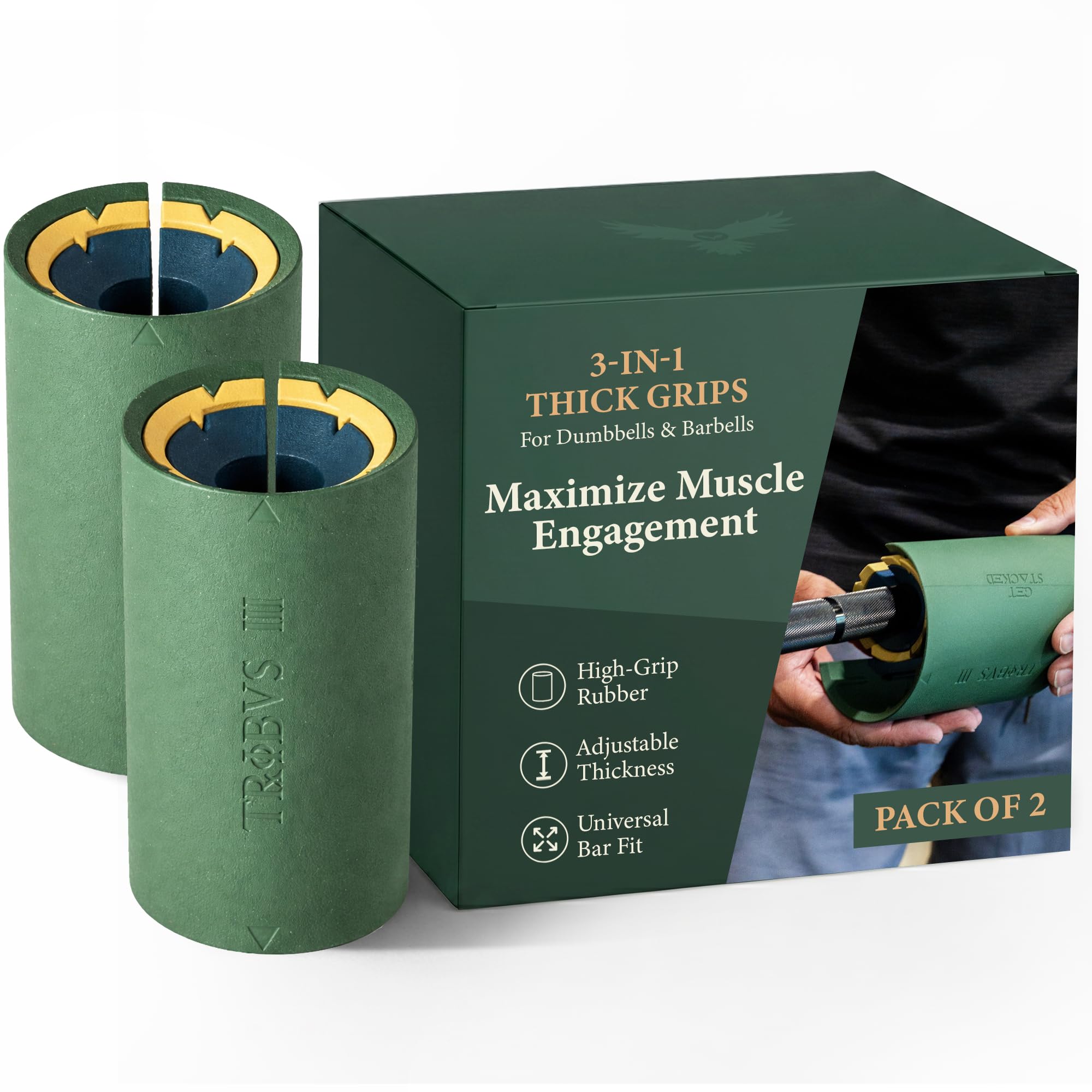
Three thickness levels in one set, so your grip never stalls.
This is the only set in this roundup that lets you climb through three outer diameters — 2.05 inches, 2.44 inches, and 2.87 inches — using a stackable design. That means you start with the thinnest layer for familiar exercises and add the next ring only when your forearm endurance catches up. Owners mention that once you add the grippers, your grip strength becomes the limiting factor, noting that 40-pound curls dropped to 30 pounds. It is a clear sign of how much harder your hands and forearms have to work with each added millimeter.
The heavy-duty rubber does not compress or roll during use, which makes these stable for pulling movements like rows and deadlifts. At 1.22 kilograms, they are heavier than the qibylift pair at 0.7 pounds, but that weight reflects the denser material and the multi-layer system. They also fit most gym equipment — barbells, dumbbells, kettlebells, cable handles, pull-up bars — so you can take one set through an entire circuit. The only assembly friction buyers mention is lining up the layers takes a bit of patience, but the result is a solid, non-slip platform that outperforms buying three separate pairs of Fat Gripz clones.
What pulls ahead
- Three progressive diameters (2.05″ → 2.44″ → 2.87″) in one product
- Heavy-duty rubber resists rolling and slipping during pulls
- Buyers confirm no rotation on dumbbells during use
What holds it back
- Lining up the layers takes time during setup
- One reviewer noted less grippy feel than expected
Your grip-growth companion: Ideal if you want to systematically increase your grip challenge without buying three separate pairs. Best for anyone committed to progressive overload on forearms.
Who should pass: If you just want a single fixed thickness for quick workouts and do not care about progression, the 2.0″ Tribus pair below is simpler and cheaper.
2. Thick Grips for Dumbbells & Barbells (2.0” diameter) – Tribus Grips
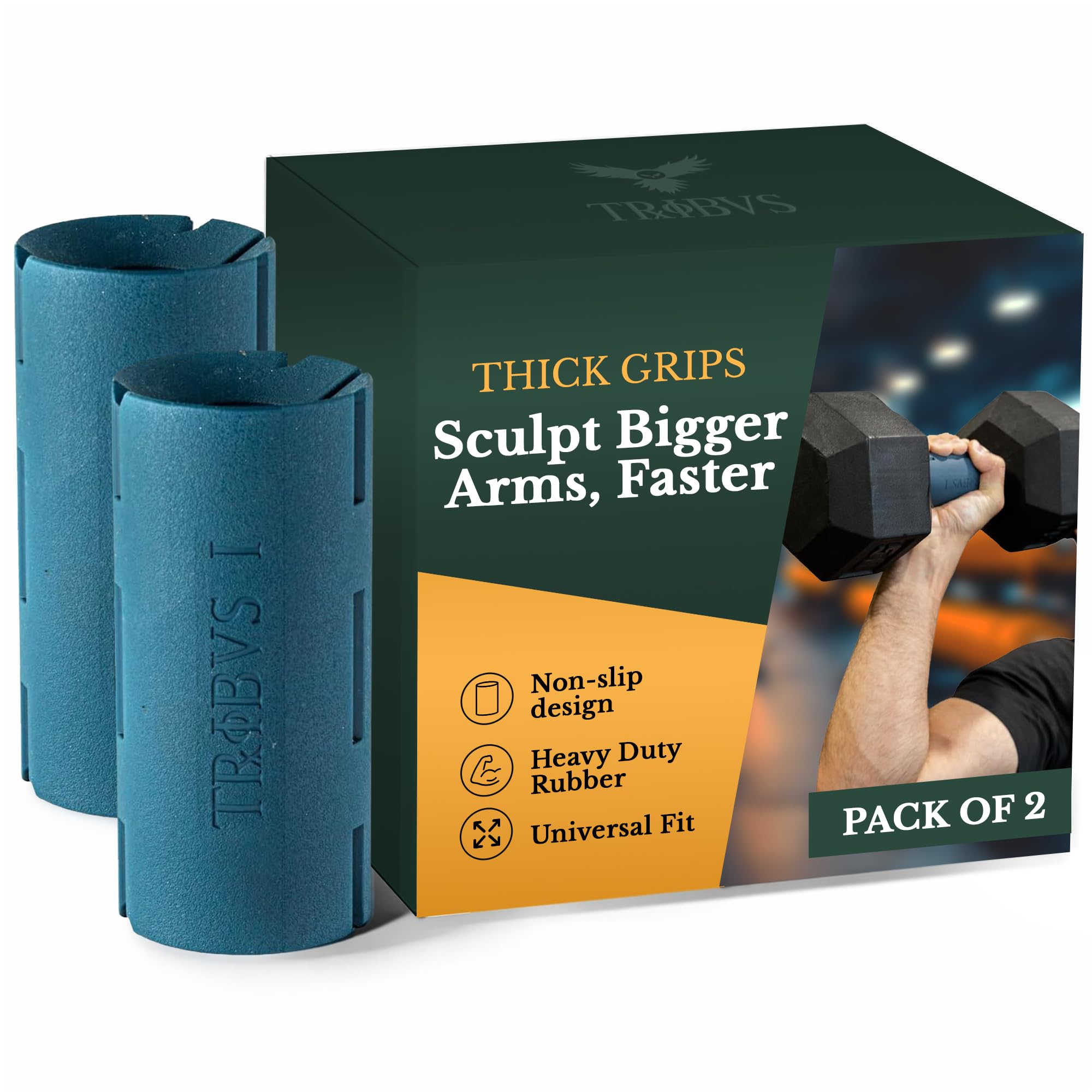
A straightforward 2-inch rubber block that stops hand pain cold.
If your main reason for barbell grips is the one buyers cite — a heavy dumbbell with a thin handle digging into your palm — this pair solves it. The 2-inch outer diameter spreads your hand’s load across a wider surface, which relieves the focused pressure point that causes bone pain. One buyer wrote that this product “prevented my hand bones from hurting” when using a heavier dumbbell with a smaller handle diameter. It is a simple fix for a common problem.
At 0.42 kilograms versus 1.22 kilograms for the 3-in-1 Tribus set above, it is easier to toss in a gym bag. The rubber surface is smooth and inflexible, which buyers describe as “thick, durable” but note it can make holding the bar challenging if your grip strength is still building. Unlike the 3-in-1 that ships with three layers, this is a single fixed thickness — you get the 2-inch diameter and that is it. Still, for the price and the lifetime warranty, it is a solid choice if all you need is one reliable thickness.
Why it stands out
- Dense rubber construction feels sturdy and durable
- Lifetime replacement warranty attached to the brand
- Light enough (0.42 kg) to carry between home and gym
Where it struggles
- Smooth, inflexible surface requires a decent grip to start
- One buyer mentioned the “very large size makes holding bars challenging”
Best for steady-state grip training: Get this if you have a specific bar or dumbbell that hurts your hands and you want a single, solid thickness to fix it. The lifetime warranty removes the durability worry.
Skip if you need progression: If you plan to push your grip strength upward over several months, you will outgrow this single size and want the 3-in-1 system from the first pick.
3. Hikeen Thick Bar Dumbbell Grips, 1.77″ Outer Diameter

A softer, more forgiving option that switches between weights fast.
The Hikeen pair uses a silicone construction that customers note is “softer than Fat Grips Pro 2.25″, which makes it easier to slide onto a dumbbell and pull off again mid-circuit. If your workout involves swapping between 30 and 40-pound dumbbells quickly, that pliability saves time. It hits a 1.77-inch outer diameter — noticeably smaller than the 2.0-inch Tribus and the 2.2-inch qibylift, so it is less of a jump from a standard bar. For a 5’10”, 157-pound buyer using 30-40 pound dumbbells and a pull-up bar, it fit the bill for grip strength and rep intensity.
However, that softness comes with a trade-off that shows up in pulling movements. Reviewers point out that during rows and pull-ups the grip slips and rotates, requiring you to stop and reset your hold. The name brand Fat Gripz, they note, do not roll. If your routine is mostly curls, presses, and isolation work, the softer silicone works fine. If you rely on heavy pulling exercises, the less pliable hard rubber of the Tribus picks above is a safer bet. At 1.77 inches, it is also a gentler entry point for anyone new to thick-bar training.
Its strengths
- Softer than premium alternatives, so it slides on and off easily
- Affordable entry-level price for testing thick-bar training
- Buyers confirm good durability even after over a year of use
Its limits
- Rotates and slips during pulling exercises like rows and pull-ups
- 1.77″ outer diameter is thinner than many competitors
For the budget-curious lifter: A low-risk way to see if thicker grips improve your arm and forearm engagement — as long as your main lifts are presses and curls, not heavy pulls.
Not for deadlifts and rows: If your program leans heavily on pulling movements, the rolling issue will frustrate you. Spend a little more on the Tribus 2.0″ and get a non-slip rubber build.
4. qibylift Thick Grips Dumbbell Barbell Handles, 2.2″ Diameter
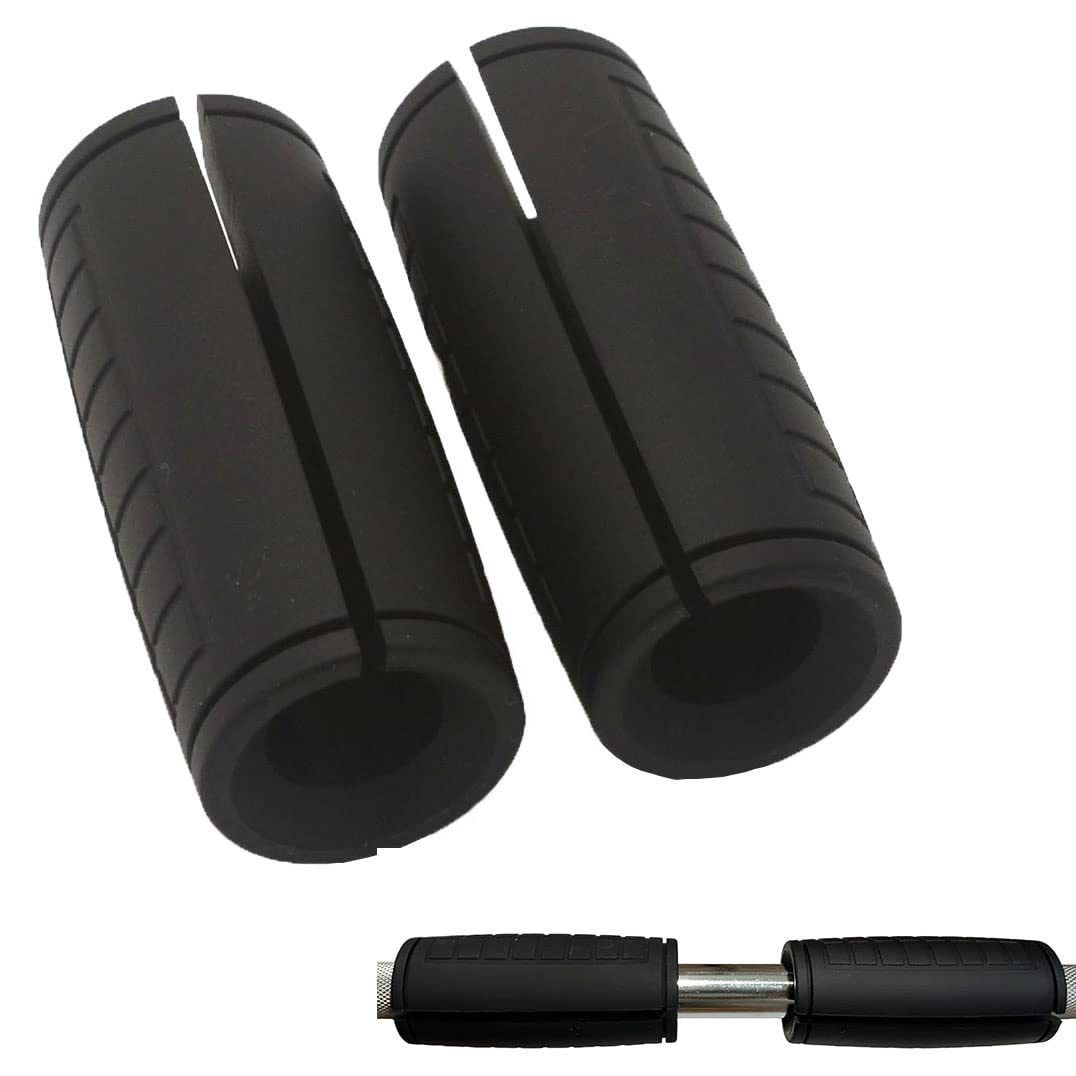
A big, soft wrap that kills hand pain on thin bars.
If you have a skinny pull-up bar that digs into your palms, the qibylift is your cheapest fix. At 5 inches long and 2.2 inches wide, it is the largest single-piece grip in this comparison, versus the Tribus 3-in-1’s 2.87-inch length, so it covers more of the bar and distributes pressure over a bigger surface area. Shoppers say it “thickens a small pull-up bar grip, eliminating hand pain from thin metal” and allows more reps because of the added padding.
The high-density silicone rubber construction is softer than the hard rubber Tribus pairs. Buyers describe it as “slightly soft; less support than desired,” which makes it better suited for lighter training or for protecting hands on a cable attachment or a thin pull-up bar. Unlike the Hikeen pair that rotates during pulls, buyers report only “slight sliding” that they did not find bothersome. It is also a simple two-step install — spread it open and slip it on — so you can move it between your barbell, kettlebell handle, or lat pulldown bar in seconds. It is the lightest option here at 0.7 pounds, but the softer material means it compresses more under heavy loads than a hard rubber grip would.
What you get
- Longest single-piece grip (5 inches) for full bar coverage
- Easy to move between different gym equipment in seconds
- Several buyers bought a second pair immediately
What you trade
- Softer than the Tribus hard rubber, so less firm support for heavy lifts
- Added thickness can make overhead kettlebell holds awkward
Great for protecting your hands on thin bars: If your main pain point is a thin metal pull-up bar or cable attachment digging into your palms, this is a cheap and effective cushion that covers a big surface area.
Skip for serious grip strength work: The softness will compress under heavy weight, reducing the grip challenge. Choose the Tribus 2.0″ or the 3-in-1 if you want to actually build forearm strength rather than just pad your hands.
Understanding the Specs
Outer Diameter: The Real Grip Challenge
The outer diameter is the thickness of the grip once it is on the bar. A standard barbell handle is about 1 inch thick. Adding a 2-inch grip nearly doubles that, forcing your fingers to squeeze harder with every rep. Smaller diameters like 1.77 inches are a gentler introduction; larger ones like 2.44 or 2.87 inches drastically increase forearm activation. If you switch to a 2.44-inch grip from a standard bar, you will feel it in your forearms within a few reps — that is the purpose.
Material Firmness: Stability vs. Comfort
Hard rubber (like the Tribus pair) keeps its shape under heavy weight and resists rolling or compressing. Softer silicone (like the Hikeen or qibylift) is easier to squeeze and move between equipment, but it can compress under high loads and slip or rotate during pulling exercises. If your workout involves deadlifts, rows, or pull-ups, a firm material that will not deform matters more than comfort. If you are doing curls and presses, soft material is less of a problem.
Stackable vs. Fixed Design: Progressive Overload
A fixed-thickness grip gives you one challenge level. A stackable system (like the 3-in-1 Tribus) lets you add layers over weeks or months. This mirrors how you would increase weight on a barbell — your grip strength improves, you add another layer, and your muscles adapt again. Fixed grips are simpler if you only need to address hand pain or try thick-bar training once. Stackable systems are better if you plan to chase continuous forearm and grip gains.
Weight of the Grip: What It Signals
The listed weight of a grip (0.42 kg vs. 1.22 kg, for example) tells you about the density of the material. Heavier grips usually mean denser, harder rubber that will not compress over time. Lighter grips may use softer or less dense silicone. Do not confuse grip weight with the amount of weight you will lift; it is a clue about durability and firmness, not performance.
FAQ
Will barbell grips fit my dumbbells or barbell at home?
Do thicker grips actually build forearm muscle?
Will soft silicone grips slip during pull-ups or rows?
Can I use these on a kettlebell handle?
How do I clean barbell grips?
Are stackable grips better than a single fixed thickness?
Will these grips make standard barbell exercises harder?
How long do rubber barbell grips last with regular use?
Is there a downside to using thick grips on every exercise?
Do I need two pairs for both dumbbells at once?
Final Thoughts: The Verdict
For the majority of shoppers, the barbell grips winner is the Tribus 3-in-1 Thick Grips because it gives you three progressive diameters (2.05″, 2.44″, and 2.87″) in one purchase, powered by a heavy-duty rubber build that does not roll or slip on pulling movements. If you want a lighter, single-thickness option for hand pain relief and stable pressing, grab the Tribus 2.0″ fixed pair. And for a budget-friendly entry point that cushions thin bars and switches between equipment quickly, the qibylift 2.2″ silicone grips get the job done without the investment.
How We Picked
We do not accept paid placement. Every pick is matched to a real buyer and a real use-case; we do not hands-on test units.
Sources & Methodology
Specifications: manufacturer listings and product documentation. Review insights: verified customer reviews, as of July 2026. Pricing: not shown on this page (it changes often); check the current price via the retailer link.
As an Amazon Associate, FitlyFast earns from qualifying purchases. This does not affect which products we feature.