
Our readers keep the lights on and the weekend projects moving. As an Amazon Associate, I earn from qualifying purchases.
A budget AV receiver is the heart of any home theater, but the wrong choice can leave you with anemic sound, limited connectivity, and annoying firmware bugs. The market is flooded with options, and many low-cost units sacrifice critical features like HDMI 2.1 support, proper room calibration, and multi-channel audio decoding to hit a price point. Knowing which corners are cut and which are worth your attention is the difference between a system that thrills and one that frustrates.
I’m Rikta — the co-founder and writer behind FitlyFast. I’ve analyzed hundreds of hours of customer feedback and technical specifications across the mid-range and premium AV receiver landscape to find the true bargains that don’t compromise on the features that actually matter.
Whether you’re building your first 5.1 setup, upgrading to 8K gaming, or seeking a reliable stereo receiver for a dedicated music room, this guide ranks the top units that deliver real performance without the inflated price tag. After thorough analysis, these are the best picks for a truly bargain av receiver that balances cost, build quality, and essential home theater specs.
How To Choose The Best Bargain AV Receiver
Selecting a budget AV receiver requires a clear understanding of what features are non-negotiable for your use case and which ones you can safely skip. The key is to match the receiver’s capabilities to your specific speakers, TV, and listening habits without paying for power or channels you will never use.
Channel Count: 5.1 vs 7.1 vs 5.1.2
The number of channels determines your surround sound layout. A 5.1 receiver powers five main speakers and one subwoofer — perfect for a traditional setup. A 7.1 receiver adds two rear speakers for more enveloping sound, while a 5.1.2 system includes two height channels for Dolby Atmos. For most living rooms and budget builds, 5.1 is adequate. If you intend to build an Atmos setup with ceiling or up-firing speakers, look for a 7.1 or 5.1.2 unit that supports object-based audio.
HDMI Specifications and Video Pass-Through
HDMI version is the single most important spec for video quality. HDMI 2.0 supports 4K at 60Hz, HDR10, and Dolby Vision, which is sufficient for movies and streaming. HDMI 2.1 enables 4K at 120Hz and 8K pass-through, along with VRR and ALLM for gaming. If you own a PS5 or Xbox Series X, HDMI 2.1 is essential. eARC (enhanced Audio Return Channel) is also critical for sending lossless audio from your TV back to the receiver.
Amplifier Power and Speaker Matching
Wattage ratings are often misleading. Look for power measured with all channels driven and at a low distortion level (THD). A receiver delivering 70-80 watts per channel is sufficient for most bookshelf and tower speakers with average sensitivity. Pay attention to impedance rating (usually 6 or 8 ohms) and ensure your speakers are compatible. Underpowering a receiver can cause clipping and damage your speakers over time.
Room Calibration and Sound Optimization
Room calibration systems like Audyssey MultEQ, YPAO, and MCACC measure your speaker distances, levels, and frequencies to correct for room acoustics. This feature transforms the listening experience, especially in irregularly shaped rooms. A budget receiver with good calibration software can sound dramatically better than a more expensive unit without it. Check if the calibration microphone is included and whether the system auto-adjusts for subwoofer integration.
Quick Comparison
On smaller screens, swipe sideways to see the full table.
| Model | Category | Best For | Key Spec | Amazon |
|---|---|---|---|---|
| Denon AVR-X1700H | Renewed Premium | Atmos & 8K Gaming | 7.2ch, 8K/60Hz, Audyssey MultEQ | Amazon |
| Onkyo TX-NR6100 | THX Certified | High-Power Home Theater | 7.2ch, THX Select, 210W/ch | Amazon |
| Denon AVR-S670H | Entry-Level 8K | First-Time 8K Setup | 5.2ch, 8K/60Hz, HEOS Built-in | Amazon |
| Yamaha RX-V4A | MusicCast | Music Streaming & Multi-Room | 5.2ch, 8K60, YPAO, Wi-Fi | Amazon |
| Onkyo TX-NR5100 | Gaming Ready | VRR & 4K/120Hz Gaming | 7.2ch, 8K, 4K/120Hz, eARC | Amazon |
| Pioneer VSX-935 | Network Receiver | Streaming & 8K Readiness | 7.2ch, 8K, Dolby Atmos, Wi-Fi | Amazon |
| Sony STRDH590 | Slim 5.2 | Compact 4K Theater | 5.2ch, 4K HDR, Bluetooth | Amazon |
| JBL MA310 | White Design | Visually Clean Setup | 5.2ch, 4K, ARC, Bluetooth | Amazon |
| Sony STRDH190 | 2-Ch Stereo | Vinyl & Music Listening | 2ch, 100W, Phono Input, BT | Amazon |
In‑Depth Reviews
1. Denon AVR-X1700H (Renewed)

The Denon AVR-X1700H is the benchmark for a bargain AV receiver that doesn’t skip the essentials. It offers 7 channels of amplification with full Dolby Atmos and DTS:X support, plus Dolby Atmos Height Virtualization for a convincing 3D soundstage without ceiling speakers. Its 8K HDMI 2.1 inputs (3 dedicated) and 4K/120Hz pass-through make it fully compatible with next-gen consoles and the latest TVs.
Audyssey MultEQ room calibration is a standout feature at this price tier. The included microphone walks you through setup and corrects for room reflections and standing waves, resulting in a balanced, immersive sound. The AVR-X1700H also features HEOS built-in for multi-room audio, AirPlay 2, and a phono input for turntable users.
Some users on the renewed market have reported needing certified 48Gbps HDMI cables to prevent intermittent picture dropouts, and the HEOS wireless streaming can occasionally suffer from lag. However, for a 7.2 channel receiver with this level of calibration and HDMI 2.1 support, the value is unmatched. It powers KEF Q150s with clarity and authority.
Why it’s great
- Full Dolby Atmos and DTS:X with height virtualization.
- Audyssey MultEQ room correction transforms sound in challenging rooms.
- Three 8K HDMI inputs ready for PS5 and Xbox Series X.
Good to know
- Renewed units may require high-speed HDMI cables for stable 8K/4K120 signals.
- HEOS streaming can have occasional buffering issues.
2. Onkyo TX-NR6100
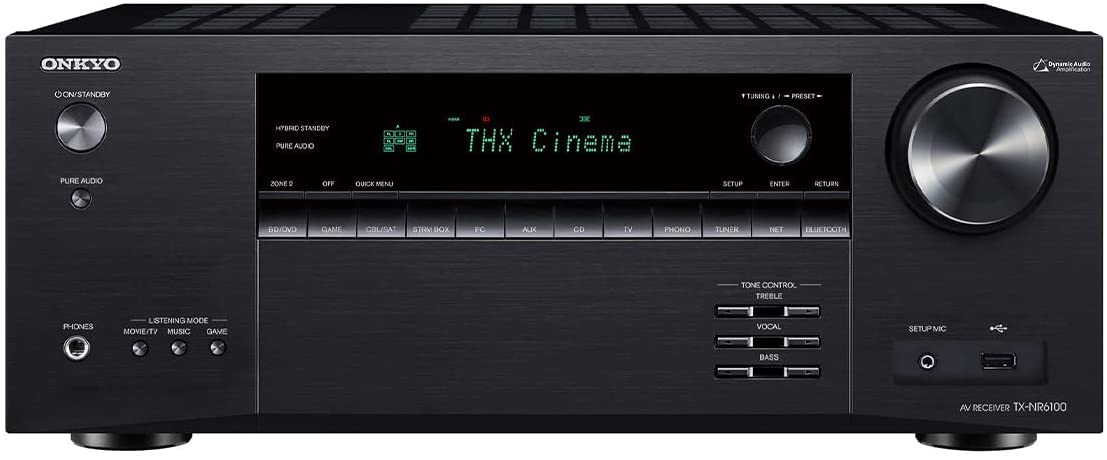
The Onkyo TX-NR6100 is a THX Select certified receiver, meaning it has been tested to deliver reference-level sound in rooms where the screen is roughly 10-12 feet away. With a claimed 210W per channel, it has serious headroom for driving demanding speakers like Klipsch towers, delivering clean, distortion-free sound even at high volumes.
This receiver supports Dolby Atmos and DTS:X with a 5.2.2 layout, and it passes through 8K video at 40Gbps via its HDMI 2.1 inputs. It has 8 HDMI ports in total, which is generous for a mid-range unit. The built-in calibration system automatically tunes the sound to your specific speaker model, which users have found to produce excellent channel separation and crisp high frequencies.
The main downsides are the flimsy, non-backlit remote and the fact that inputs 4-6 are limited to 4K, not 8K. Also, some users have reported defective units out of the box, a potential concern with pandemic-era production. However, when working properly, the TX-NR6100 is one of the most powerful and feature-rich bargains available for a dedicated home theater.
Why it’s great
- THX Select certification guarantees high-performance standards.
- 210W per channel provides massive headroom for power-hungry speakers.
- 8 HDMI inputs and full HDMI 2.1 40Gbps support.
Good to know
- Remote is cheap-feeling and not backlit.
- Some units arrive with defects or HDMI issues.
3. Denon AVR-S670H

The Denon AVR-S670H brings 8K/60Hz and 4K/120Hz pass-through to a 5.2 channel package, making it one of the most affordable ways to future-proof your home theater for the latest gaming consoles. It supports Dolby TrueHD, DTS HD Master Audio, and Dolby Pro Logic II, ensuring you get detailed, room-filling sound from your favorite content.
Setup is remarkably simple, with a guided on-screen menu that walks you through speaker connections and a basic auto-calibration. The HEOS platform allows for multi-room audio streaming via Wi-Fi or Bluetooth, and it works with Apple AirPlay 2. Users have praised its seamless integration with their TV via HDMI ARC/eARC, with the remote able to control both devices.
One limitation is the 5.2 channel count, which means you cannot run a full 7-speaker Atmos setup. The HEOS app, while functional, can sometimes have connectivity hiccups with Spotify and TIDAL. However, for a user wanting 8K compatibility and a reliable, straightforward surround sound upgrade, the S670H delivers exceptional value.
Why it’s great
- Supports 8K/60Hz and 4K/120Hz for next-gen gaming.
- Simple setup with guided menu and auto-calibration.
- HEOS multi-room streaming works with popular services.
Good to know
- Limited to 5.2 channels; no full Atmos support without external amplification.
- HEOS wireless streaming can be occasionally unreliable.
4. Yamaha RX-V4A

The Yamaha RX-V4A is a 5.2 channel receiver that excels in streaming and multi-room audio thanks to its MusicCast platform. It features Wi-Fi, AirPlay 2, and Spotify Connect, allowing you to stream high-res audio from services like Qobuz, TIDAL, and Amazon Music HD. The YPAO room calibration is effective at optimizing speaker performance for your specific room layout.
This receiver offers HDMI 2.1 with 8K/60Hz and 4K/120Hz pass-through, as well as eARC for lossless audio from your TV. It supports Dolby Vision, HDR10+, and HLG. Users have described the sound as clean, detailed, and precise, with excellent stereo separation that rivals dedicated stereo amplifiers.
The setup process, however, can be confusing. The on-screen menu is somewhat clunky and the remote has small, difficult-to-press buttons. Some users have experienced HDMI switching issues or defective units. The MusicCast app is superior to the hardware interface and is essential for managing settings. For streaming-centric listeners, this is a strong contender.
Why it’s great
- Robust streaming support via MusicCast, AirPlay 2, and Spotify Connect.
- YPAO room calibration provides effective sound optimization.
- HDMI 2.1 with 8K pass-through and eARC.
Good to know
- Setup and on-screen menus can be confusing.
- Remote has small, tactilely poor buttons.
5. Onkyo TX-NR5100

The Onkyo TX-NR5100 is purpose-built for gamers, featuring HDMI 2.1 enhancements including VRR, ALLM, and QFT for fluid, tear-free gameplay at 4K/120Hz. It supports eARC to pass through high-bitrate audio from your TV apps, including Dolby Atmos and DTS:X, creating an immersive gaming environment without complex cabling.
The receiver offers 7.2 channels of amplification, giving you the flexibility to set up a 5.2.2 Atmos system. The on-screen menu is easy to navigate, and the remote is simpler than some competitors. Users have reported it works flawlessly with PlayStation 5 and Xbox Series X, providing a lag-free experience with excellent sound quality.
Bluetooth implementation is a consistent weak point. Users report sync issues with headphones and unreliable connections with Mac computers. Some have also noted that the unit is actually a 7.1 receiver, not a true 7.2, despite the “7.2” labeling. If wired gaming performance is your priority and Bluetooth is secondary, this is a solid choice.
Why it’s great
- Full HDMI 2.1 gaming features: VRR, ALLM, QFT.
- eARC support for lossless audio from TV apps.
- 7.2 channel capability for 5.2.2 Atmos.
Good to know
- Bluetooth performance is unreliable with sync and connectivity issues.
- Technically a 7.1 receiver, not a true 7.2.
6. Pioneer VSX-935
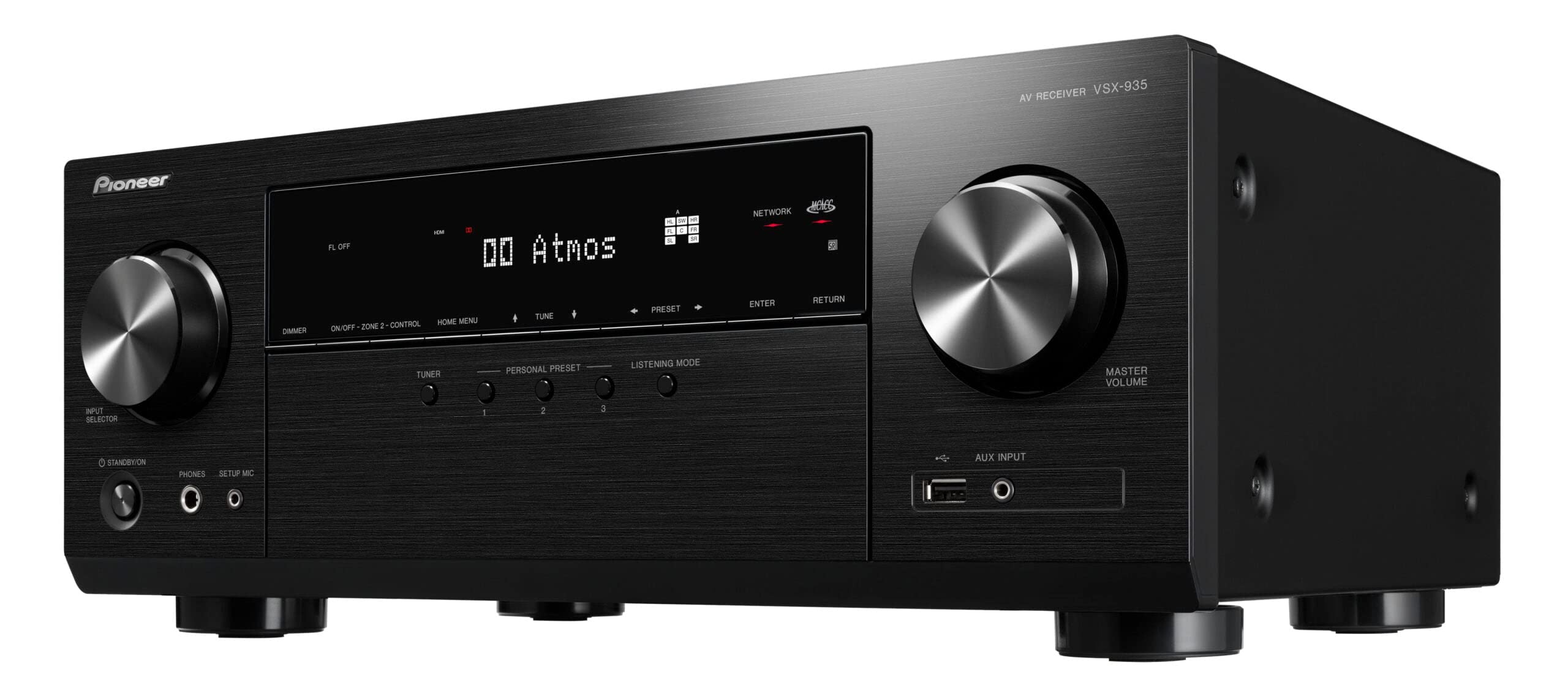
The Pioneer VSX-935 is a 7.2 channel network receiver that offers Dolby Atmos Height Virtualization, creating a convincing overhead effect without needing physical height speakers. It features 8K pass-through and enhanced gaming support, making it suitable for both movie enthusiasts and gamers.
Streaming is a strong point, with built-in Wi-Fi for services like Spotify, TIDAL, and Amazon Music. The dual-zone output lets you play different audio in another room. Users have praised its crisp, clear, and loud audio output, noting a noticeable improvement over older receivers. The large, clear display and RF remote are appreciated features.
Firmware can be buggy and the Bluetooth implementation is often described as “useless” due to its unreliability. The unit lacks sophisticated EQ controls, offering only simple bass/treble adjustments. Some units have arrived DOA. For those who prioritize wired home theater performance and streaming, the VSX-935 delivers, but wireless functionality is a trade-off.
Why it’s great
- Dolby Atmos Height Virtualization for 3D sound without ceiling speakers.
- 8K pass-through and enhanced gaming features.
- Dual-zone audio output for multi-room use.
Good to know
- Bluetooth functionality is poorly implemented and unreliable.
- Firmware can be buggy and some units arrive defective.
7. Sony STRDH590
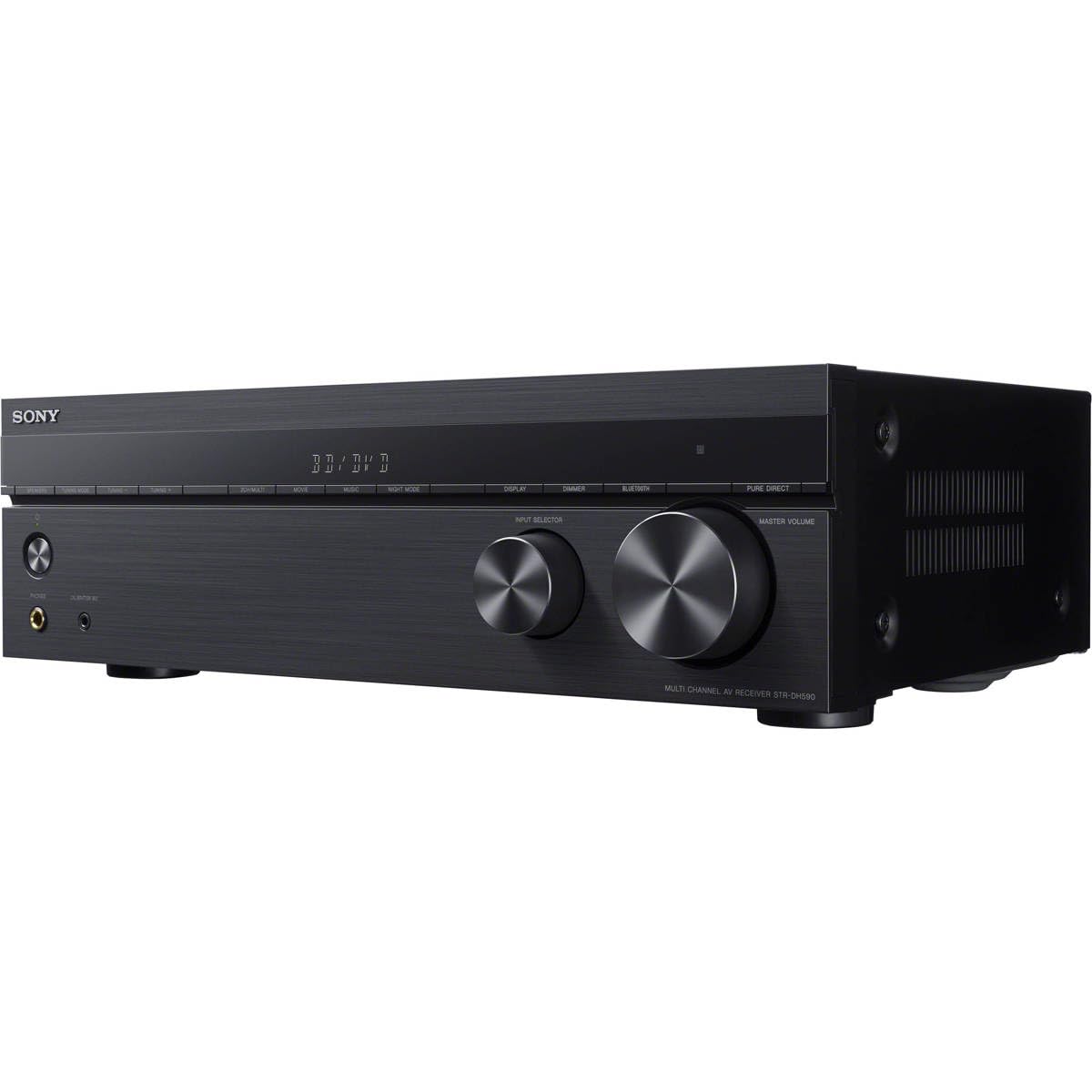
The Sony STRDH590 is a 5.2 channel 4K receiver built for simplicity and space-saving. Its slim chassis fits easily in media consoles that cannot accommodate full-sized units. It includes S Force PRO virtual surround sound, creating a wide soundstage from just two speakers, and handles 4K HDR pass-through with HDCP 2.2 support.
Connectivity is straightforward: 4 HDMI inputs, 1 output with ARC, and Bluetooth for streaming from your phone. Users like the simple remote with dedicated buttons for FM, TV, and Bluetooth. The auto speaker setup with the included microphone adjusts levels for your seating position, making installation quick.
The STRDH590 lacks HDMI 2.1, 8K support, and advanced room calibration. It does not have a phono input for turntables. Some users note that the input jacks are closely spaced, making it tricky to connect thick cables. For a basic, compact 4K theater setup, it is a reliable workhorse, but it is not a feature-rich bargain.
Why it’s great
- Slim chassis saves space in tight media consoles.
- Simple, intuitive remote and straightforward setup.
- S Force PRO provides decent virtual surround from 2 speakers.
Good to know
- No HDMI 2.1, 8K support, or advanced room calibration.
- Input jacks are closely spaced, complicating thick cable management.
8. JBL MA310

The JBL MA310 is a rare find in the budget AV receiver market: a 5.2 channel unit available in a crisp white finish that blends seamlessly with modern decor. It delivers 60 watts per channel across five channels, with native Dolby and DTS decoding, providing a true high-fidelity home cinema experience.
It features 4 HDMI inputs with ARC support for easy connection to your TV and gaming consoles. Bluetooth v5.1 with Low Energy allows for stable wireless streaming from any device. Its shallow depth is a major advantage for fitting into smaller entertainment centers where a standard receiver would protrude.
The setup can be initially confusing, often requiring a firmware update that may not work smoothly out of the box. The remote lacks a backlight, making it difficult to use in a dark room. Some users have reported that it does not properly mix down DTS-HD Master Audio to 2.1 channels. It is a great style-focused choice, but performance bugs are a concern.
Why it’s great
- Unique white finish for modern home decor.
- Shallow depth fits in tight media consoles.
- Bluetooth v5.1 with Low Energy for stable streaming.
Good to know
- Setup process can be buggy with required firmware updates.
- Remote is not backlit and audio downmixing is limited.
9. Sony STRDH190

The Sony STRDH190 is a pure 2-channel stereo receiver, ideal for vinyl enthusiasts and music lovers who prioritize sound quality over surround sound. It features a dedicated phono input for turntables, a large-capacity power transformer, and High-Resolution Audio support for playback of lossless formats at higher than CD quality.
Bluetooth connectivity with Bluetooth Standby allows you to turn the receiver on directly from your smartphone. The bundle includes 14AWG speaker wire and gold-plated banana plugs, saving you the hassle of buying accessories separately. Users consistently praise its excellent sound quality, especially when paired with quality bookshelf speakers like Klipsch RP-600M.
This is not a surround sound receiver. It is limited to two channels, with no HDMI inputs or video processing. The FM tuner uses a proprietary antenna connector that is incompatible with standard coaxial roof antennas. For a dedicated stereo system or a simple powered setup, this is unbeatable value.
Why it’s great
- Dedicated phono input for vinyl playback.
- Bundle includes quality speaker wire and banana plugs.
- High-Resolution Audio support for pristine sound quality.
Good to know
- No surround sound, HDMI, or video processing capabilities.
- FM antenna connector is proprietary and limits external antenna use.
FAQ
Can I use a 5.1 receiver for a 7.1 speaker setup?
What is the advantage of eARC over regular ARC?
Final Thoughts: The Verdict
For most users, the bargain av receiver winner is the Denon AVR-X1700H because it delivers essential features like 8K HDMI 2.1, Dolby Atmos Height Virtualization, and Audyssey MultEQ room calibration at a price that feels like a steal. If you want THX-certified power for a dedicated theater, grab the Onkyo TX-NR6100. And for the simplest path to a pure stereo music system with a phono input, nothing beats the Sony STRDH190.