
Our readers keep the lights on and the weekend projects moving. As an Amazon Associate, I earn from qualifying purchases.
Knowing when a front is moving in without staring at your phone is the quiet superpower of a reliable home barometer. Whether you’re tracking pressure trends for gardening, managing a greenhouse, or just want to understand your local microclimate, the right barometer delivers real-time atmospheric data without the noise of a full smartphone app.
I’m Rikta — the co-founder and writer behind FitlyFast. I’ve spent hundreds of hours cross-referencing user reports, sensor accuracy specs, and build quality across the most talked-about home barometers on the market right now.
After comparing analog precision, digital refresh rates, wireless range, and data logging capabilities, this guide cuts through the noise to present the best barometer for home use that actually fits your room, wall, or desk setup.
How To Choose The Best Barometer For Home Use
Not all barometers are created equal. A decorative storm glass looks beautiful but won’t give you the tenth-of-a-millibar precision a digital sensor provides. Conversely, a digital weather station with atomic time sync may be overkill if you only want a visual indicator of pressure change. Narrow your decision by focusing on three core considerations.
Analog vs. Digital — The Accuracy Trade-Off
Analog barometers, like storm glasses or aneroid dials, rely on mechanical movement of liquid or metal. They offer a tangible, low-maintenance way to see rising or falling pressure, but lack the precision to display exact numeric values. Digital barometers use MEMS sensors that report pressure in hPa or inHg with decimal-level accuracy, and many update readings every 10 to 30 seconds. If you need specific numbers for logging or comparison, go digital. If you want a conversation piece that shows trends at a glance, analog works beautifully.
Sensor Placement and Wireless Range
For accurate outdoor pressure readings, the sensor must be shielded from direct sun, wind, and rain. Wireless barometers with separate remote sensors give you the flexibility to place the sensor in the shade on the north side of your house while keeping the display inside. Check the wireless range — some units handle 200 feet line-of-sight but drop signal at 50 feet through brick walls. For home use, a range of 80 to 100 feet through typical wood-frame construction is a safe baseline.
Extra Features That Actually Matter
Beyond pressure, many home barometers also track temperature, humidity, dew point, and heat index. A pressure graph showing the last 12 to 24 hours helps you spot trends faster than a single number. Atomic clocks that self-set from WWVB signals ensure your time stamps are accurate. App-connected Bluetooth barometers, like the SensorPush, let you log data for weeks and export it for analysis — useful for wine cellars, greenhouses, or reptile enclosures where long-term trend tracking matters more than a glance at the wall.
Quick Comparison
On smaller screens, swipe sideways to see the full table.
| Model | Category | Best For | Key Spec | Amazon |
|---|---|---|---|---|
| TempPro TP50 | Digital Hygrometer | Quick humidity & temp check | ±1°F accuracy, 10-sec refresh | Amazon |
| U UNNI Weather Station | Digital Weather Station | All-in-one home forecasting | 330ft wireless range, atomic clock | Amazon |
| BALDR Weather Station | Digital Weather Station | 12‑hr forecast & vertical display | 3 brightness levels, AC powered | Amazon |
| Ambient Weather BA212 | Analog Storm Glass | Decorative pressure trend indicator | 18″ cherry wood frame | Amazon |
| La Crosse 308-1451 | Digital Forecast Station | Fisherman-friendly pressure graph | 12‑hr barometric pressure graph | Amazon |
| Lily’s Home Analog Station | Analog Combo Station | Elegant living-room decor | Galileo thermometer + barometer | Amazon |
| SensorPush HTP.xw | Smart Bluetooth Sensor | Pro-level data logging & alerts | Barometric pressure ±0.1 hPa | Amazon |
In‑Depth Reviews
1. SensorPush HTP.xw Smart Sensor

The SensorPush HTP.xw is a compact Bluetooth sensor that measures temperature, humidity, heat index, dew point, VPD, and barometric pressure with laboratory-grade accuracy. The tiny blue puck houses a MEMS barometer that reports pressure in hPa or inHg with a resolution of 0.1 hPa — precise enough to correlate with local airport calibration. Setup takes seconds: install the included CR2477 battery, pair with the app, and readings stream every few minutes with a battery lifespan of one to two years in typical conditions.
What separates the HTP.xw from typical weather stations is the depth of its data logging. The sensor stores 30 days of onboard readings, and the app provides unlimited cloud storage with intuitive day, week, and month graphs. You can export raw .csv data for custom analysis, set alerts for pressure thresholds, and integrate the SensorPush G1 WiFi Gateway (sold separately) for remote monitoring anywhere. Users have confirmed the barometer matches airport calibration readings within a fraction of a millibar, and four units deployed across a property showed readings differing by less than 0.02 percent.
The trade-off is that the SensorPush is not a wall-mounted display — it’s a data platform. You interact through a phone or tablet, not a glanceable screen. The Bluetooth range reaches roughly 100 meters line-of-sight, but drops to 30 feet through brick walls. For those who want trend tracking, freezer failure alerts, or greenhouse climate logging with professional-grade pressure data, this is the most capable barometer in the roundup. It’s also splash-resistant, making it viable for refrigerators, reptile enclosures, and outdoor shelters.
Why it’s great
- Barometric pressure accuracy matches airport calibration within ±0.1 hPa
- 30-day onboard storage plus unlimited cloud logging with exportable .csv graphs
- 1–2 year battery life and splash-resistant build for versatile placement
Good to know
- No built-in display — requires phone or tablet for all readings and graphs
- WiFi gateway sold separately for remote access beyond Bluetooth range
2. La Crosse Technology 308-1451 Forecast Station

The La Crosse 308-1451 combines a 12-hour barometric pressure graph with atomic timekeeping, indoor and outdoor temperature and humidity, plus sunrise and sunset times. The pressure graph shows rising, steady, or falling trends using a series of bars — a far better tool for spotting approaching weather changes than a single number. The station uses absolute pressure internally but displays relative pressure after calibration, an essential distinction for accurate home forecasting that many digital units leave to the user to figure out.
The remote sensor transmits data over radio frequency with a claimed 200-foot open-air range. Users report reliable syncing at 50 to 70 feet through standard residential construction. The atomic clock receives the WWVB signal nightly for automatic DST switching, so the time stamps on your pressure graph remain accurate without manual adjustment. The LED backlight activates on demand, preserving battery life when the station runs on five AA cells. The fisherman icon with tendency arrows reacts to temperature and pressure shifts, adding a playful but genuinely useful visual cue for quick trend assessment.
One area to be aware of is the display’s viewing angle: straight-on is crisp, but the LCD panel becomes harder to read from off-center positions. There’s no wall-mounting bracket included, so it sits on a counter or shelf. The humidity sensor is more monitor-grade than weather-station-grade, meaning it tracks relative changes well but shouldn’t be mistaken for a certified hygrometer. For a mid-range station that delivers a solid barometric trend history, atomic sync, and dual-zone temperature tracking, this La Crosse model holds up well against pricier competitors.
Why it’s great
- 12-hour barometric pressure graph reveals rising and falling trends at a glance
- Atomic clock syncs automatically and adjusts for daylight saving time
- Remote sensor provides indoor/outdoor temperature and humidity comparison
Good to know
- Display readability drops significantly when viewed from an off-center angle
- No wall-mount included; sits on a flat surface only
3. BALDR Weather Station
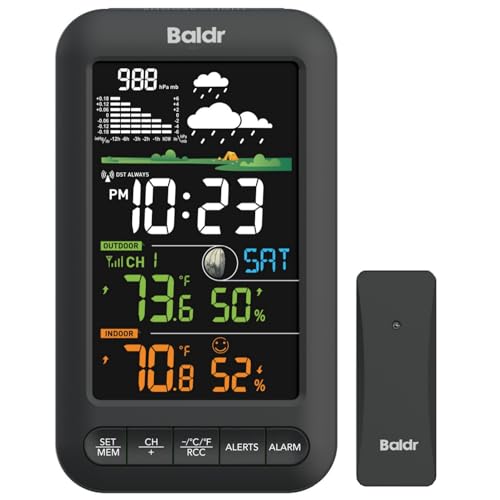
The BALDR Weather Station takes a hyper-local approach to forecasting by generating a 12-hour outlook based entirely on your local pressure trends — no app, no internet, no external data feed required. The vertical LCD display organizes indoor and outdoor temperature, humidity, pressure, and forecast icons in a stacked format that reads naturally from top to bottom. With a 7.1-inch width and 4.1-inch height, it fits neatly on a kitchen counter or nightstand without dominating the surface.
Setup is plug-and-play: the included AC adapter powers the always-on backlight with three adjustable brightness levels, and a battery backup preserves settings during power outages. The optional atomic clock auto-syncs from the WWVB signal for accurate time and date, with a built-in 5-minute snooze alarm. The remote sensor transmits temperature and humidity data over radio frequency, and the display cycles through up to three sensor channels automatically so you can monitor different rooms or outdoor spots without manual switching.
Where the BALDR falls short is in outdoor sensor weatherproofing. The sensor is not fully sealed against moisture; users report water ingress around the sensor port after prolonged exposure to rain, which causes humidity readings to spike to 99 percent until dried. Mounting it under an eave or in a dedicated radiation shield solves this. The vertical display with large digits is genuinely easy to read from across the room, and the forecast accuracy improves after the first few days as the unit calibrates to your local pressure patterns.
Why it’s great
- 12-hour local forecast generated from your own pressure trends without internet
- Vertical display with large digits and adjustable brightness for daytime and night
- Auto-cycling through 3 sensor channels lets you monitor multiple zones effortlessly
Good to know
- Outdoor sensor is not waterproof — needs sheltered mounting to avoid moisture ingress
- Backlight only stays on continuously when plugged into AC power
4. U UNNI Weather Station
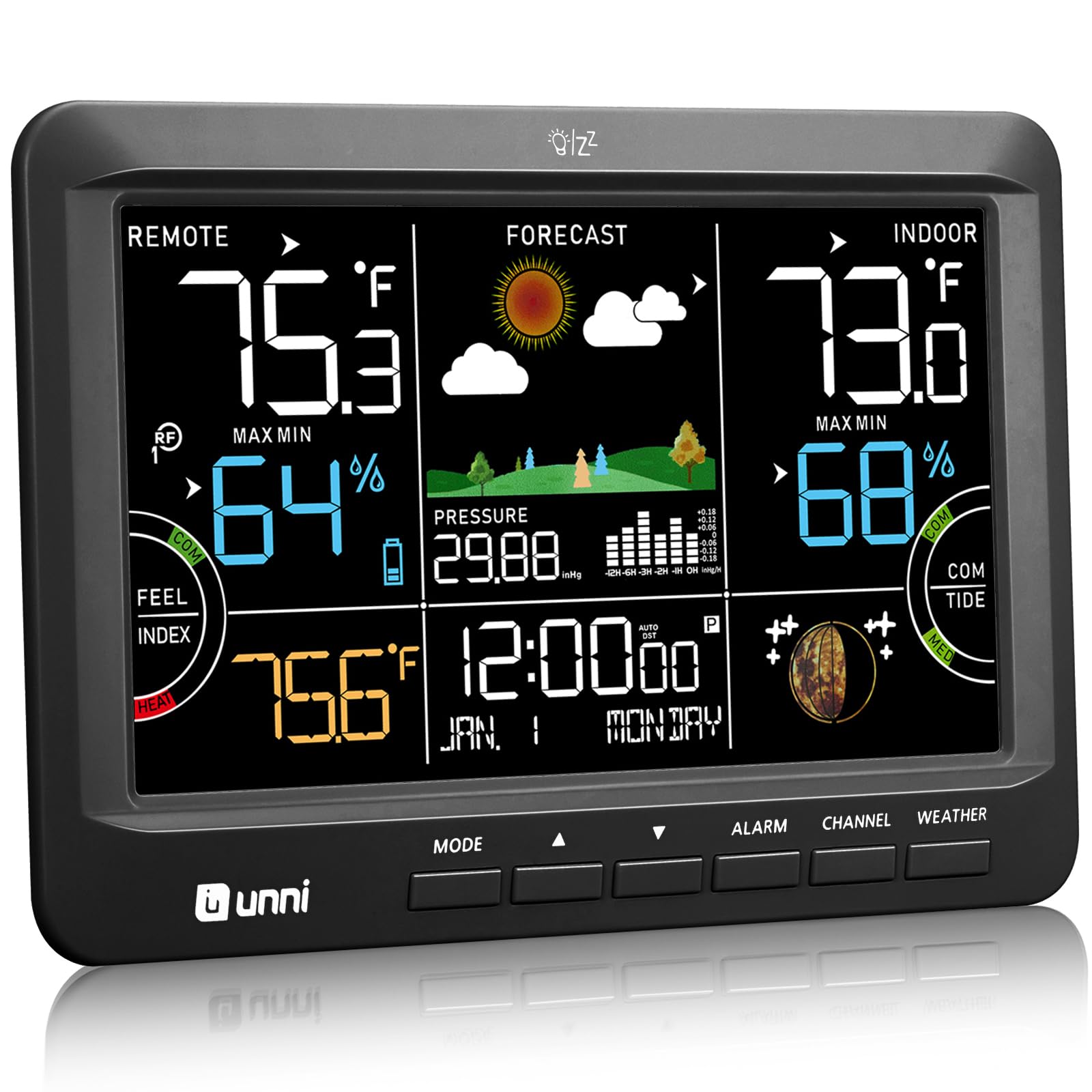
The U UNNI Weather Station bundles barometric pressure, indoor/outdoor temperature and humidity, dew point, heat index, moon phase, tide data, and an atomic clock into one sharp black display. The 7.5-inch screen shows all this information at once with a large central temperature readout that’s legible from across a living room. The barometric pressure data appears alongside a weather forecast icon, giving you both the raw number and an instantly interpretable symbol — sunny, partly cloudy, rainy, or stormy.
Wireless performance stands out: U UNNI claims a 330-foot open-air radius, and users confirm reliable transmission at 80 to 100 feet through typical interior walls and floor assemblies. The station runs on AC power (adapter included) for a continuous backlight, with battery backup for settings only — meaning the display goes dark without the cord. The atomic clock receives the WWVB signal daily, adjusting for DST automatically. The setup menu is guided, making initial configuration straightforward even for users who don’t typically enjoy programming electronics.
The only real criticism centers on the tide data, which is calculated rather than site-specific, making it a rough guide rather than a precise nautical tool. The display also lacks the 12-hour pressure graph that the La Crosse 308-1451 offers, so you get a current pressure reading and a forecast icon but not a visual trend line. For someone who wants a complete home weather dashboard — barometer, temperature, humidity, moon phase, tide, comfort index, and mold risk indicator — all displayed in an easy-to-read black panel, this station delivers exceptional breadth for the price.
Why it’s great
- 330-foot wireless range provides reliable sensor communication through most homes
- Includes barometer, heat index, dew point, moon phase, and tide data on one screen
- Atomic clock with automatic DST adjustment eliminates manual time setting
Good to know
- Backlight only functions when plugged into AC; no continuous illumination on batteries
- Tide data is a calculated estimate, not site-specific, so accuracy varies by location
5. TempPro TP50 3-Pack Hygrometer
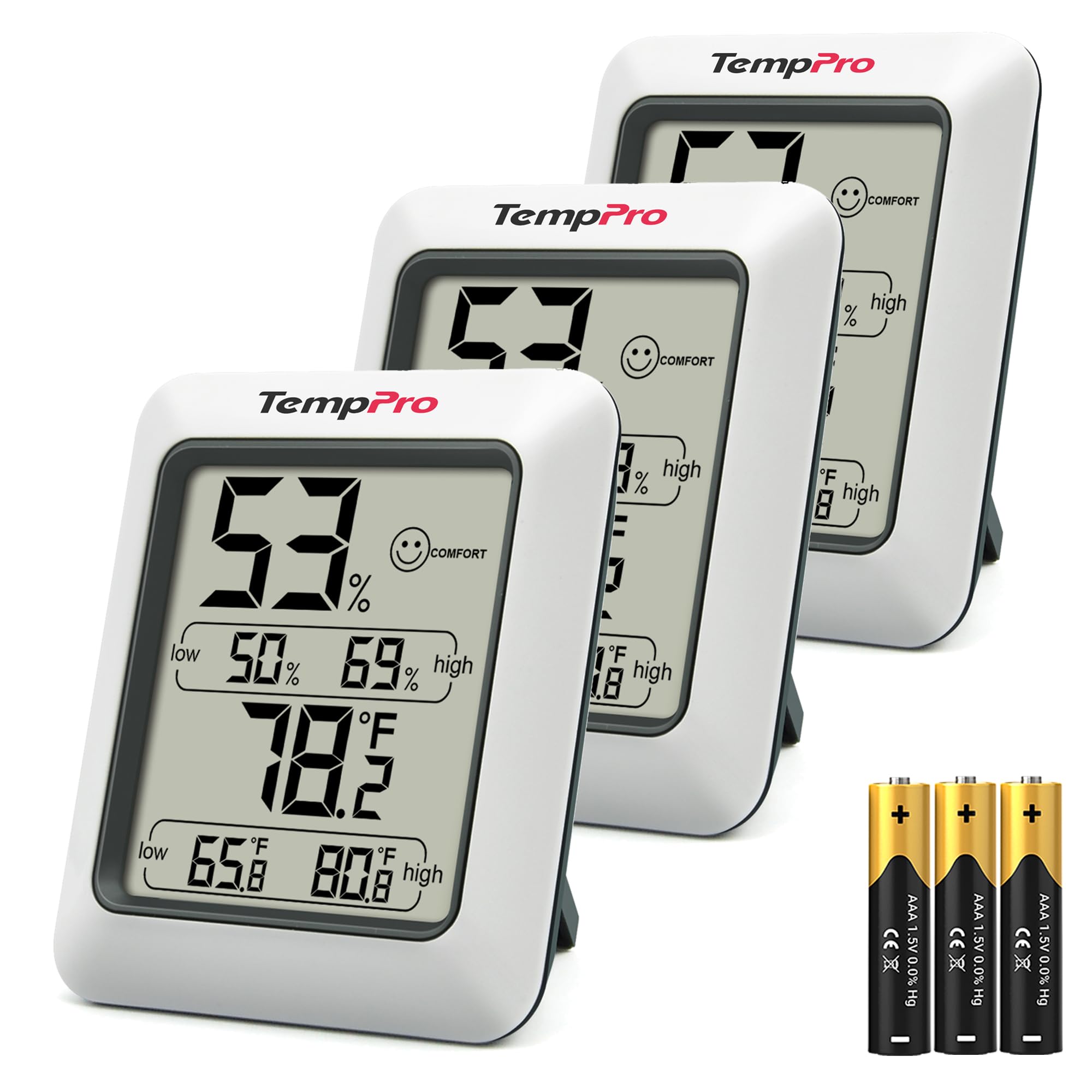
The TempPro TP50 is a no-frills digital thermometer and hygrometer that also displays a humidity comfort icon — DRY, COMFORT, or WET — giving you a quick visual check of whether your indoor air is in the healthy range. While it doesn’t measure barometric pressure directly, it is often paired with a barometer by home users who want an at-a-glance humidity reference alongside their pressure reading. The 10-second refresh rate is fast enough to track rapid changes when a door or window opens, and the high/low recording feature saves the day’s extremes for comparison.
The three-pack format makes this a practical choice for monitoring multiple rooms. Each unit includes a magnetic back and a tabletop stand, along with a °F/°C selector and a set of three AAA batteries in the box. Accuracy is rated at ±2 to 3 percent relative humidity and ±1°F, which is solid for a sensor at this tier. Users consistently report that the temperature readings match calibrated references within a degree, though the humidity sensor can drift if exposed to direct condensation from misting or spray.
What the TP50 lacks is any connectivity, logging, or barometric sensing. It’s a standalone display, not a data platform. The lack of a backlight means you’ll need ambient light to read it at night. For someone on a tight budget who wants to pair a simple hygrometer with a separate barometer, or who just needs to keep an eye on comfort levels in a reptile enclosure, nursery, or basement, the TP50 delivers reliable basic data without complexity. The three-pack sweetens the deal for whole-home coverage.
Why it’s great
- Three units in one pack for multi-room humidity and temperature monitoring
- Fast 10-second refresh rate catches rapid changes from doors or HVAC cycles
- High/low recording tracks daily temperature and humidity extremes automatically
Good to know
- No backlight — difficult to read in a dark room without external lighting
- Humidity sensor can fail if exposed to direct misting or water spray
6. Lily’s Home Analog Weather Station
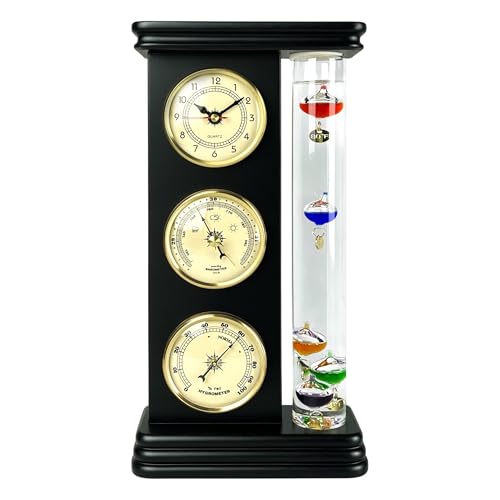
The Lily’s Home Analog Weather Station combines a Galileo thermometer, an aneroid barometer, a hygrometer, and a precision quartz clock into a single freestanding wooden frame. The barometer uses a sealed metal cell that expands and contracts with atmospheric pressure, moving a needle across an analog dial marked with weather descriptors like STORM, RAIN, CHANGE, FAIR, and VERY DRY. It requires a light tap before reading to overcome the built-in friction that prevents the needle from jittering — a normal characteristic of aneroid barometers designed for home use.
The Galileo thermometer is the visual centerpiece: five multi-colored glass spheres float in a liquid-filled tube, with the lowest floating sphere indicating the current temperature in 4°F increments from 64°F to 80°F. The hygrometer uses a mechanical coil that expands with humidity, moving a needle across a dial. The overall assembly stands 12 inches tall and 6 inches wide, making it a substantial decorative object that fits on a bookshelf, mantel, or desk. Users consistently describe it as a conversation piece that draws attention and sparks curiosity.
The accuracy limitations of analog instruments are real. The barometer shows pressure trends but not specific numeric values, and the Galileo thermometer only covers a limited temperature range (64–80°F). The hygrometer provides relative humidity direction rather than exact percentage. The build quality is mixed: the wood frame looks elegant, but some users report stripped battery door screws and imprecise calibration instructions. For someone who values aesthetic harmony and tactile instrument reading over decimal-point data, this piece adds warmth and character to a room while giving a useful general sense of weather trends.
Why it’s great
- Combines barometer, hygrometer, Galileo thermometer, and clock in one decorative unit
- Aneroid barometer provides visual pressure trend indication without batteries or power
- Galileo thermometer is a functional art piece that draws attention and starts conversations
Good to know
- Barometer shows trends but does not display numeric pressure values in inHg or hPa
- Galileo thermometer only covers 64–80°F; useless for temperature readings outside that range
7. Ambient Weather BA212 Wall Mounted Weather Station

The Ambient Weather BA212 is a traditional liquid barometer — often called a storm glass — encased in a rich cherry wood frame with a glass front. It operates on the principle first described by Lucien Vidie: a sealed glass body half-filled with water connects to a narrow spout open to the atmosphere. When air pressure drops, the water level rises in the spout; when pressure rises, the water level falls. It is entirely passive, requiring no batteries, wiring, or calibration beyond an initial filling with distilled water and adjustment to your local barometric reading.
In addition to the liquid barometer, the BA212 includes a comfortmeter that displays temperature and humidity with a color-coded comfort zone indicator. The unit measures 18 inches tall and 6 inches wide, designed to hang on a wall like a piece of fine art. Users report that the barometer’s water level responds visibly before weather changes — the liquid rises in the spout ahead of falling pressure preceding a storm. The cherry wood finish and traditional styling make it a natural fit for a study, library, or dining room where decor matters as much as function.
The limitations are significant for anyone expecting scientific precision. The liquid barometer has no printed pressure scale — you calibrate it by marking the initial water level against your local weather report. It’s a trend indicator, not a measurement instrument. The assembly requires careful filling and sealing; if the glass leaks or the water evaporates over months, the reading drifts. The comfortmeter uses a simple bimetallic strip and hair hygrometer, accurate to within a few degrees but not a lab tool. If your goal is aesthetic charm and a tangible connection to changing weather patterns, the BA212 delivers exactly that. If you need exact kPa readings for logging, choose a digital unit.
Why it’s great
- Cherry wood frame and storm glass design function as both a weather instrument and wall art
- Passive liquid barometer requires no batteries or power to show pressure trends
- Water level rises visibly in the spout ahead of falling pressure, providing early storm cues
Good to know
- No numeric pressure scale; calibration requires matching the water level to local weather data
- Liquid level can drift if the glass leaks or water evaporates, needing periodic refilling
FAQ
How do I calibrate a home barometer for accurate readings?
Can a barometer actually predict rain or storms?
Should I get an analog or digital barometer for home use?
Why does my barometer reading not match the official weather report?
Final Thoughts: The Verdict
For most users, the best barometer for home use winner is the BALDR Weather Station because it combines a 12-hour locally-calibrated forecast, a vertical display with adjustable backlight, and multi-sensor support in a very easy-to-read format. If you want the deepest data logging and app-based trend analysis, grab the SensorPush HTP.xw. And for traditional decor with a tangible storm glass and cherry wood artistry, nothing beats the Ambient Weather BA212.