
Our readers keep the lights on and the weekend projects moving. As an Amazon Associate, I earn from qualifying purchases.
A garden shed is an investment, but it’s only as good as the ground it sits on. A poorly prepared base leads to warped doors, damp floors, and a structure that shifts with every freeze-thaw cycle — turning a weekend project into a repair headache.
I’m Rikta — the co-founder and writer behind FitlyFast. I’ve spent countless hours analyzing load ratings, material durability, and real-world installation feedback to separate the bases that truly stabilize a shed from those that just look the part.
This guide covers the most durable ground grids, deck blocks, and permeable pavers available today, giving you the confidence to pick the right base for garden shed that matches your soil type, shed weight, and DIY skill level.
How To Choose The Best Base For Garden Shed
Selecting the right foundation isn’t about buying the biggest option — it’s about matching the base type to your shed’s weight, your soil’s drainage, and how much work you’re willing to do on installation day. Three main categories dominate this space: ground grids (geocells), deck blocks, and permeable pavers. Each serves a different threshold of load and permanence.
Load Capacity and Shed Weight
Every shed exerts downward force on its base. Lightweight metal or plastic sheds may only need a level gravel base held in place by a shallow ground grid. Heavy wooden sheds or those storing equipment — think riding mowers or full tool benches — demand a base rated well over 1,000 lbs per square foot to prevent sinking or shifting during wet seasons.
Drainage and Permeability
A solid base that traps water underneath is worse than no base at all — it accelerates rot and attracts pests. Permeable options like ground grids with open-cell structures allow rainwater to drain directly into the soil below, while impermeable surfaces like solid concrete slabs need careful grading. If your shed sits in a low-lying area, prioritize a base with active water flow through its structure.
Installation Effort and Site Prep
Ground grids and permeable pavers demand a day of prep: excavating a few inches, leveling a bed of sand or crushed stone, and anchoring the perimeter. Deck blocks are far simpler — place them on a leveled spot, drop your skids on top, and build. Evaluate your tolerance for labor. A more complex install usually delivers a more permanent result.
Quick Comparison
On smaller screens, swipe sideways to see the full table.
| Model | Category | Best For | Key Spec | Amazon |
|---|---|---|---|---|
| TRUEGRID PRO LITE | Permeable Paver | Heavy sheds & vehicle loads | 120,000 lb load class | Amazon |
| Standartpark EasyPave | Permeable Paver | Premium gravel stability | 80,000 lb load class @ 2″ depth | Amazon |
| Vodaland HexPave | Permeable Paver | Quick-install grass/gravel base | 27,000 lbs capacity | Amazon |
| VEVOR Ground Grid 3″ | Ground Grid | Large-area erosion & load | 1,885 lbs/sq ft @ 3″ depth | Amazon |
| VIVOSUN 4″ Ground Grid | Ground Grid | Deeper fill for heavy use | 1,885 lbs/sq ft @ 4″ depth | Amazon |
| CAMO Block Heavy Duty | Deck Block | Post & skid foundations | 1,800 lbs per block | Amazon |
| USA Made Round Foundation Block | Deck Block | Floating shed platforms | 1,250 lbs per block, 10-pack | Amazon |
In‑Depth Reviews
1. TRUEGRID PRO LITE Permeable Paver
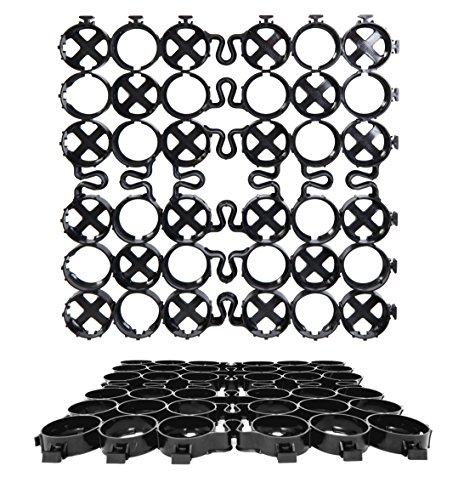
TRUEGRID PRO LITE sets the standard for shed bases that also handle vehicle traffic. This pack of 18 covers 72 square feet with a 1-inch-thick grid made from 100% post-consumer recycled HDPE, solid enough to earn a 120,000 lb load class. That rating means you could park a fully loaded dump truck on your shed base without the grid deforming — a massive safety margin for any residential storage structure.
The square 24 x 24 inch tiles lock together on all sides, creating a continuous surface that prevents gravel migration and rutting. Customers consistently report that the grid eliminates mud, puddles, and ruts even under daily van parking in wet Pacific Northwest winters. The open-cell design drains instantly, so water never pools against your shed’s floor frame — a key detail for preventing rot in wooden sheds.
Installation requires only a 1-inch excavation, making it one of the least disruptive heavy-duty options available. The pavers can be cut with a standard sawzall or garden shears for tight fits around trees or existing structures. The only trade-off is that once gravel is compacted into the cells, repositioning the grid is extremely difficult — plan your layout carefully before filling.
Why it’s great
- Extreme 120,000 lb load class provides unmatched durability
- Made from 100% recycled HDPE in the USA
- Instant water drainage prevents shed floor rot
- Easy to cut and install with minimal excavation
Good to know
- Repairing damaged edge sections can take time
- Gravel fill makes the grid effectively permanent after installation
2. Standartpark EasyPave Permeable Paver

The Standartpark EasyPave takes the permeable paver concept deeper — literally. At 2 inches of depth, each of the 14 units (covering 35 square feet) uses a wave-type design that tapers at the edges for added structural rigidity. The True Lock system on all four sides creates a secure connection that doesn’t come apart during installation or under lateral load, a common failure point in cheaper grids.
With an 80,000 lb load class, this system is engineered for driveways, RV pads, and shed bases where heavy equipment will roll over the surface. Customers have used it to park a 22-foot Dodge Promaster van on grass without sinking — the grid distributes the weight so effectively that grass continues to grow through the cells. The 2-inch depth accommodates a thicker gravel or crushed stone fill, providing a deeper, more stable base than 1-inch systems.
The anchors, however, are sold separately — budget for them before starting your project. Some users found that driving the anchors too aggressively can crack the bottom flanges, so a careful hand or a rubber mallet is required. Despite this, the system’s ability to turn a muddy incline into a stable, walkable surface makes it a top contender for sloped shed sites.
Why it’s great
- Deep 2-inch cells provide superior gravel retention
- True Lock system prevents grid separation under load
- Handles heavy vehicle parking without sinking
- 100% recycled PPE plastic construction
Good to know
- Anchors must be purchased separately
- Driving anchors too deep can damage bottom flanges
3. Vodaland HexPave Permeable Paver

The Vodaland HexPave system offers the same recycled plastic pedigree as premium options but at a lower coverage cost. With 22 units covering 65 square feet at a 1-inch depth, this is the most area-efficient paver in this roundup. Each unit measures nearly 23 by 20 inches, so you place fewer individual pieces to cover your shed footprint — a real time-saver on installation day.
Its 27,000 lb capacity is more than adequate for any residential shed, including those filled with heavy tools or small tractors. Customers praise the no-tool assembly; the hexagonal pieces snap together by hand without any connectors. One reviewer used ten boxes to create a stable, erosion-proof parking area, noting that the grid retained soil and prevented washouts even during heavy rain. The system is also shallow enough that grass can be grown through it, creating a green shed base that blends into the lawn.
The 1-inch depth means a thinner gravel layer, which may not be ideal for areas with very soft or organic topsoil. Some users recommended adding a vapor barrier and sand base underneath for a more rigid shed foundation. The package also comes with fewer anchors than ideal — plan to order extra if your grid covers a large area or sits on a slope.
Why it’s great
- Best area coverage per pack: 65 sq ft
- Tool-free snap assembly saves installation time
- Allows grass growth for a natural look
- High load capacity for its depth and price
Good to know
- 1-inch depth not ideal for very soft soil
- Pack includes fewer anchors than recommended for full stability
4. VEVOR Ground Grid 25 ft x 9.5 ft

VEVOR’s ground grid brings industrial-grade geocell technology to the DIY shed market. At 25 feet by 9.5 feet, this single unit covers 237.5 square feet — enough for a large shed and surrounding walkway in one piece. The 3-inch deep HDPE cells create a honeycomb structure that locks gravel or soil in place, distributing load at an impressive 1,885 lbs per square foot when each cell is fully filled.
The supersonic weld technology gives each cell node consistent strength, preventing the grid from tearing apart under heavy loads. Customer reviews highlight its performance under vehicles — gravel fill locks together so tightly that the surface feels like concrete. The permeable design allows water to flow through horizontally and vertically, eliminating the pooling issues common with solid slabs.
The included plastic clips and stakes are a weak point — many reviewers replaced them with galvanized bolts and rebar J-hooks for a more secure installation. The grid also lacks printed instructions, so you’ll need to watch online tutorials before starting. For large shed bases and heavy-duty use, this is a budget-friendly workhorse, but plan on upgrading the anchoring hardware.
Why it’s great
- Massive 237.5 sq ft coverage in a single piece
- 1,885 lbs/sq ft load capacity when cells are filled
- Permeable honeycomb structure prevents water pooling
- Excellent slope stabilization and erosion control
Good to know
- Plastic clips and stakes are ineffective – use metal hardware
- No installation instructions included in the box
5. VIVOSUN 4” Depth Ground Grid

VIVOSUN adds an extra inch of cell depth compared to the VEVOR grid, pushing its capacity to hold a 4-inch layer of gravel or crushed stone. This deeper fill is a meaningful advantage for shed bases on soft, loamy soil where a shallower grid might eventually sink. The HDPE construction offers the same photooxidation and corrosion resistance as the VEVOR, ensuring a long outdoor lifespan in any climate.
The 9×17 foot coverage (153 sq ft) is smaller than the VEVOR sheet, but the 4-inch depth provides a more substantial anchor for heavier sheds. Customers report using it to create solid pads for motorcycle garages, horse areas, and greenhouse floors. One reviewer filled the cells with 1A crushed rock and found that the grid prevented ruts from forming under repeated vehicle traffic. The three-step installation — spread, anchor, fill — is straightforward, though the grid initially comes folded tightly and needs time to relax open.
The biggest complaint is that some cells arrive misshapen from packing and shipping, which can make the grid look uneven when unfolded. This doesn’t affect structural performance once filled, but if a clean decorative appearance matters for your shed base, you may need to spend extra time adjusting the cells. No stakes are included, so budget for ground staples or rebar hooks.
Why it’s great
- 4-inch cell depth for superior stability on soft soil
- Holds heavy vehicle loads without rutting
- Easy DIY installation with basic tools
- Wear-resistant and weather-proof HDPE material
Good to know
- Some cells arrive misshapen from shipping compression
- No stakes included – need to purchase separately
6. CAMO Block Heavy Duty Deck Block
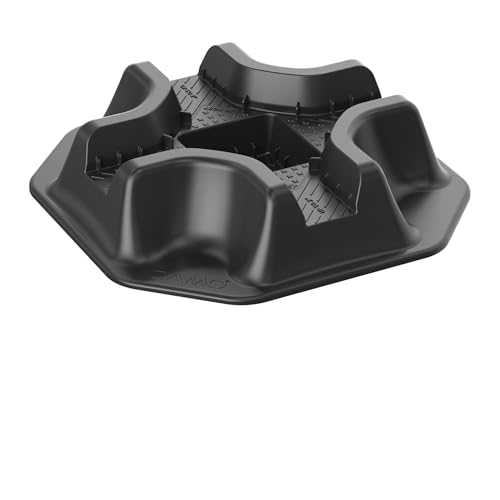
CAMO Block takes an entirely different approach to shed foundations — instead of a continuous grid, these individual blocks create discrete support points for posts or skids. Each block weighs just over 2 lbs but supports up to 1,800 lbs, thanks to its injection-molded polyolefin construction. The UV-protected material won’t crack or fade in direct sunlight, and the vented design prevents water from pooling inside the block during wet weather.
The versatility here is exceptional: these blocks accept 4×4 and 6×6 posts, plus 2×4, 2×6, and 2×8 wood joists, as well as 2-inch metal joists. This makes them suitable for floating shed platforms, decks, chicken coops, and any structure where you want to keep wood off the ground without pouring concrete. Customers consistently note that installation is faster than concrete — level a spot on the ground, set the block, and build. No mixing, no curing, no waiting.
The blocks are designed to be repositionable after installation, a major advantage if you later decide to adjust your shed’s layout. The rectangular foot print (15.75 x 15.75 inches) provides a wide enough base to resist tipping on most soils. The trade-off is that individual blocks work best on well-compacted or slightly uneven ground; for very soft or loose soil, you’ll want to dig out a shallow pad and infill with crushed stone before setting each block.
Why it’s great
- Supports 1,800 lbs while weighing just over 2 lbs per block
- Accepts multiple post and joist sizes for flexible design
- UV-protected polyolefin resists weathering
- Fully repositionable — adjust layout after initial installation
Good to know
- Best for well-compacted ground; may need gravel pad on soft soil
- Designed for 2x corners and posts, not full-surface coverage
7. USA Made Round Foundation Block (10-Pack)
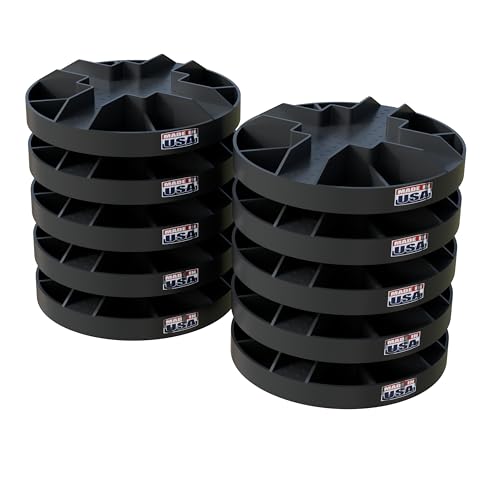
This 10-pack of round foundation blocks from BULLKE offers the simplest path to a shed base for small-to-medium structures. Each disc measures 10 inches in diameter and 1.75 inches tall, elevating your shed frame just over an inch above the ground — enough to keep wood dry and promote airflow underneath. Made from 100% recycled HDPE in the USA, these blocks support up to 1,250 lbs each on solid, level ground.
The circular design improves stability by distributing load evenly across the full diameter, and the low profile means your shed stays close to the ground without looking like it’s floating. Customers have used them successfully for 16×16 foot floating decks, noting that installation is as simple as leveling the ground, placing the block, and setting treated 2x4s into the grooves. The blocks work well with construction sand for fine leveling adjustments, making them forgiving for DIY builders who aren’t perfect graders.
The main drawback is the lack of drain holes in the design — some users have drilled their own to prevent water from sitting inside the block after rain. Additionally, the round shape offers less lateral resistance than square or rectangular blocks, so these are best for sheds on stable, non-sloping ground. For lightweight to medium sheds on flat terrain, this is an affordable, no-concrete solution.
Why it’s great
- 10-pack covers multiple support points for a complete shed base
- Made from 100% recycled HDPE in the USA
- Simple installation — level ground, place block, build
- Circular design provides even load distribution
Good to know
- No pre-drilled drain holes — may need to drill your own
- Round shape offers less lateral stability on slopes
FAQ
Can I install a ground grid directly on grass for a shed base?
How many deck blocks do I need for a standard 8×10 shed?
Will a permeable paver base stop my shed floor from getting damp?
What is the difference between HDPE and polypropylene ground grids?
Final Thoughts: The Verdict
For most users, the base for garden shed winner is the TRUEGRID PRO LITE because it combines an extreme 120,000 lb load class with easy DIY installation and instant drainage — covering the widest range of shed sizes and soil conditions. If you want deep fill for soft ground, grab the VIVOSUN 4″ Ground Grid for its 4-inch cells and high lateral stability. And for a quick, no-concrete shed base on flat, stable ground, nothing beats the simplicity of the CAMO Block Heavy Duty Deck Block.