
Our readers keep the lights on and the weekend projects moving. As an Amazon Associate, I earn from qualifying purchases.
A targeted odor eliminator doesn’t just mask that musty funk; it chemically neutralizes or physically adsorbs the sulfur, ammonia, and microbial VOCs causing it. The right choice depends entirely on whether your problem is chronic humidity, a one-time dead animal event, or constant pet odors seeping through the foundation.
I’m Rikta — the co-founder and writer behind FitlyFast. After analyzing thousands of real user reports and cross-referencing technical specs like ozone output in mg/h, moisture adsorption rates, and filter CADR ratings, I’ve pinpointed exactly which units actually deliver measurable relief for below-ground spaces.
Whether you need an aggressive ozone machine to nuke a skunk-in-the-crawlspace disaster or a passive charcoal bucket for steady maintenance, this guide to the best basement odor eliminator breaks down the concrete specs that separate effective tools from glorified air fresheners.
How To Choose The Best Basement Odor Eliminator
Basement odors fall into two camps: moisture-driven mustiness (mildew, mold, and damp concrete gases) and point-source biological decay (dead rodents, pet accidents, smoke residue). The eliminator technology must match the scent chemistry. Ozone oxidizes VOCs at the molecular level but requires unoccupied space. Charcoal adsorbs passively and continuously. Dehumidifiers solve the root cause of dampness but don’t actively scrub existing airborne smells. Know your enemy before you buy.
Ozone Output vs. Square Footage
Ozone machines are rated by milligram per hour output. A 70,000 mg/h unit can handle basements up to 6,000 sq. ft., while a 198,000 mg/h machine pushes that zone further. The trade-off: higher ozone concentrations require longer ventilation periods after treatment and can degrade rubber, electronics, and plants if not fully cleared. For a standard 500–1,500 sq. ft. finished basement, a mid-range ozone unit with adjustable timer is the practical sweet spot.
Passive Adsorption vs. Active Filtration
Activated charcoal and moisture-absorbing crystals work without electricity — you place them and forget them for weeks. These are ideal for crawlspaces, storage rooms, or seasonal vacation homes where plugging in a device is inconvenient. The downside: they saturate over time and stop working silently. HEPA-based purifiers with dedicated carbon pre-filters, like the LEVOIT Core300-P, actively pull air through the media, increasing contact rate and removing fine particulate (dust, dander, mold spores) that passive buckets miss.
Humidity Control as Odor Prevention
A dehumidifier doesn’t eliminate existing odors, but it prevents the moisture that causes them to regenerate. If your basement consistently reads above 60% relative humidity, every odor eliminator you use will be fighting a losing battle — new musty VOCs will form as condensation feeds mold colonies. A compressor dehumidifier rated for 74 pints/day, like the AEOCKY LEO-Lite, can drop a damp basement from 70% to 50% RH, starving the microbial source of the odor entirely.
Quick Comparison
On smaller screens, swipe sideways to see the full table.
| Model | Category | Best For | Key Spec | Amazon |
|---|---|---|---|---|
| AEOCKY 74 Pint LEO-Lite | Compressor Dehumidifier | Chronic basement damp & must | 74 pints/day @ 95°F/95% RH | Amazon |
| ONAMOR 70,000mg Ozone | Ozone Generator | Dead animal & smoke shock treatment | 70,000 mg/h output | Amazon |
| HHGM 198,000mg/h Dual-Fan | Ozone Generator | Large, stubborn industrial-grade odors | 198,000 mg/h output | Amazon |
| LEVOIT Core300-P | HEPA Air Purifier | Finished basement air with pets/allergies | 143 CFM CADR (smoke) | Amazon |
| Delta Nature’s Air Sponge | Charcoal Bucket | Small crawlspace / seasonal odor maintenance | 300 sq. ft. coverage | Amazon |
| DampRid Hi-Capacity Bucket | Moisture Absorber | Humidity + odor combo in large spaces | 2 x 2lb 15.5oz buckets | Amazon |
| OWAAE 95oz Dehumidifier | Compact Dehumidifier | Small basement rooms / bathrooms | 95 oz reservoir / 30 dB sleep mode | Amazon |
In‑Depth Reviews
1. AEOCKY 74 Pint/Day LEO-Lite Dehumidifier
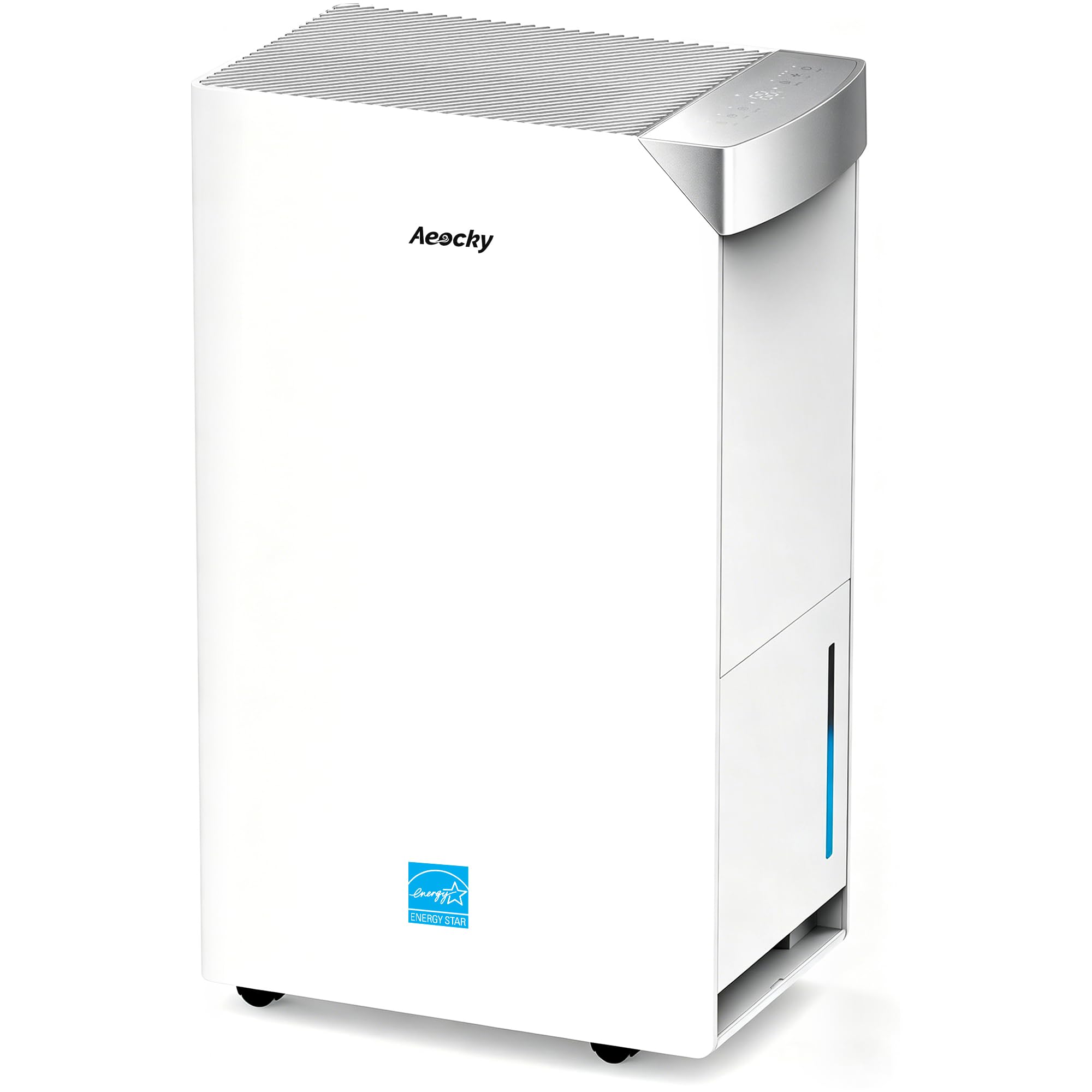
The AEOCKY LEO-Lite is a compressor dehumidifier built on a flagship platform, specifically engineered for large, chronically damp basements up to 4,500 sq. ft. It pulls 74 pints per day at 95°F/95% RH and 52 pints at 86°F/80% RH, using a high-efficiency Rotor Compressor Pro+ with 7 mm pure copper coils and blue hydrophilic aluminum fins. The proprietary humidity compensation algorithm provides millisecond-level dynamic detection, maintaining a stable setpoint without the wide swings typical of budget dehumidifiers.
Customer reports confirm it removes 5–6 quarts of water every 12–13 hours in a furnished basement, and multiple verified reviews note that within two days the persistent musty basement odor completely disappeared — not masked, but eliminated because the moisture source was starved. The unit operates down to 42°F with an auto-defrost system that prevents frost shutdown in cooler below-grade spaces, a critical weakness of many lower-tier dehumidifiers.
The downsides are real but manageable: the water bucket is small relative to its removal capacity, meaning daily emptying is necessary unless you attach the included drain hose. Some users reported compressor failure after roughly a year, but AEOCKY’s customer service replaced the unit promptly and extended the warranty — a strong indicator that the company stands behind its hardware. At 44 dB on low fan speed, it’s quieter than most competing units of this capacity.
Why it’s great
- Energy Star Version 6.0 certified, up to 50% more efficient than pre-2023 standards
- Continuous drainage via hose eliminates bucket emptying for permanent installs
- Runs down to 42°F with intelligent defrost — works in unheated basements year-round
Good to know
- Bucket only holds about 1.5 gallons — expect to empty daily at high humidity
- Rated 74 pints at extreme 95°F/95% test conditions; actual output in a cool basement is lower
- Weighs 34 lbs and measures 23 inches tall — not a portable room-to-room unit
2. ONAMOR 70,000mg Ozone Generator

The ONAMOR ozone generator uses a double-layer honeycomb ceramic plate to produce 70,000 mg/h of ozone — enough to oxidize even the most stubborn organic VOCs, including skunk spray, cigarette smoke residue, and decomposition gases from dead animals trapped in walls. The mechanical timer runs from 10 to 180 minutes plus a “HOLD” setting for continuous operation, giving you precise control over treatment duration based on room size and odor severity.
Real-world customer data supports extreme efficacy: one user eliminated a skunk-in-car odor with a single 10-minute cycle, while another eliminated an unlocatable decay smell in a bathroom after seven 1-hour sessions over a week. The aluminum shell and foldable handle make it compact and portable — you can move it from basement to car to storage unit in seconds. At 3.5 lbs, it’s the most portable heavy-duty option in this lineup.
The critical limitation is safety: ozone is a lung irritant. The unit has no occupancy sensor, no auto-shutoff based on air quality, and users report the included warning signage is too small. You must seal the room, remove all people, pets, and plants, and ventilate thoroughly — typically 30–60 minutes — before re-entering. Ozone also accelerates degradation of rubber gaskets, electronics, and certain plastics, so sensitive items should be removed or covered.
Why it’s great
- Palm-sized and extremely portable — 3.5 lbs with carry handle
- Proven to eliminate skunk, smoke, and dead animal VOCs at the molecular level
- Simple mechanical timer with hold option for continuous treatment
Good to know
- Not safe for occupied spaces — requires evac of all living things during use
- Ozone can rust metal and damage electronics if not ventilated before re-entry
- Not certified for sale in California due to CARB regulations
3. HHGM 198,000mg/h Dual-Fan Ozone Machine
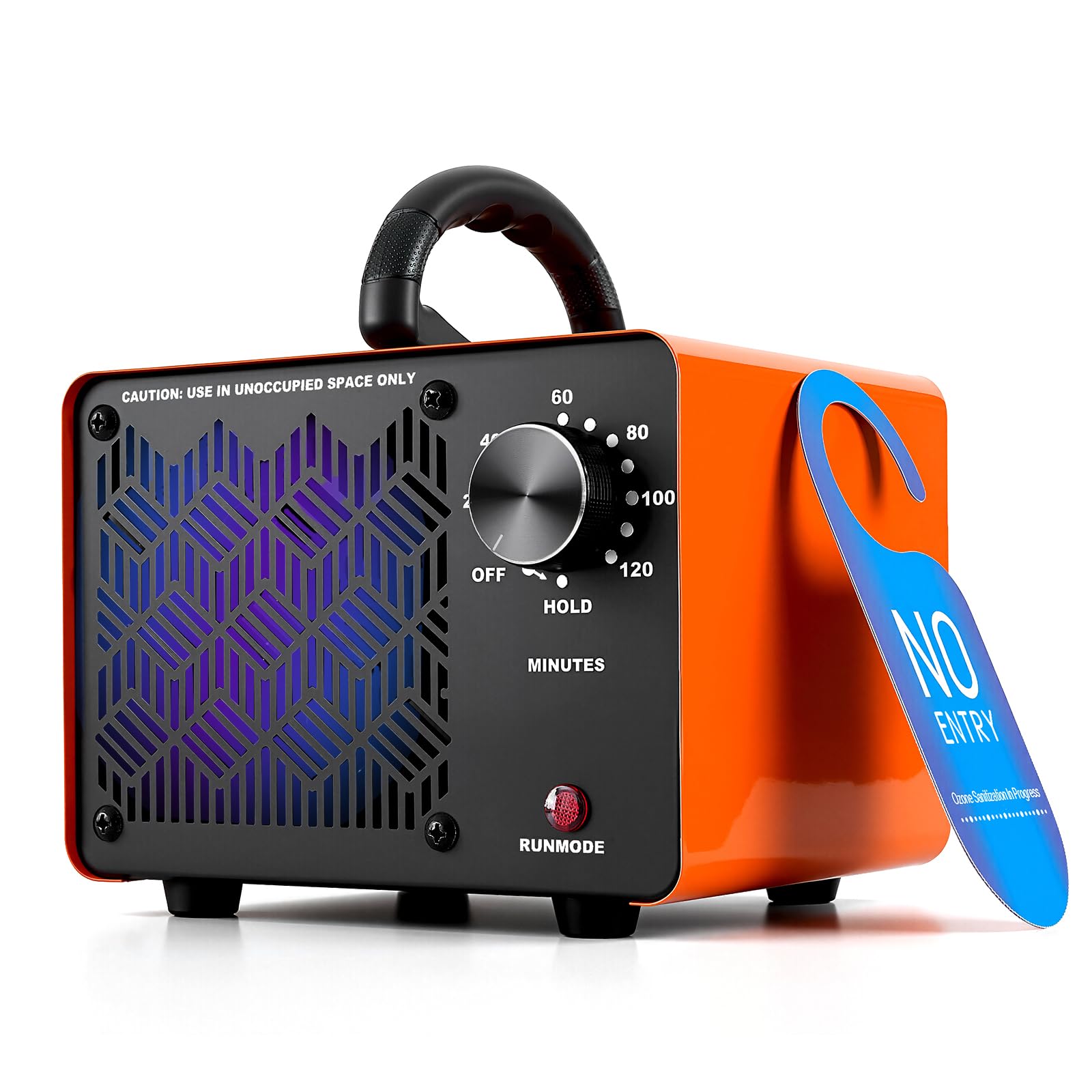
The HHGM dual-fan ozone machine delivers 198,000 mg/h — nearly three times the raw output of the ONAMOR — through a front-and-rear turbo fan system that circulates ozone 60% faster and extends coverage by 50% over single-fan units. The dual fans create 360-degree ozone distribution, reaching corners and irregular basement layouts that single-output generators might miss. The unit also has an estimated 40,000-hour lifespan thanks to improved heat dissipation in the fan system.
Reports from owners are graphic: one user ran the unit for a full day in a mold-infested house and reported that every spider in the basement died and the musty smell was gone — without any chemical cleaners. A car owner with wet-carpet mildew eliminated the odor after two 4-hour cycles, and the smell had not returned after three weeks. The 120-minute timer with auto shut-off provides a safety buffer, but the machine lacks adjustable output — it runs at full strength only.
The biggest practical trade-off: the HHGM runs at maximum output every time, which means a 10-minute treatment might be overkill for a small basement but insufficient for a truly large commercial space. Because it has no output dial, you must control exposure solely by timer duration and room sealing. Post-treatment ventilation of at least 40 minutes is mandatory, and users report a residual “bleach-like” smell that dissipates within a day. This is a tool for serious odor events, not daily maintenance.
Why it’s great
- 198,000 mg/h output is the highest in this class — nukes mold, smoke, dead animal smells fast
- Dual turbo fans provide 360-degree coverage for irregular basement layouts
- 40,000-hour motor life; optimized heat dissipation for continuous runs in hot basements
Good to know
- No adjustable output — runs at full power; time is your only control variable
- Post-treatment ventilation of 40+ minutes needed; residual ozone smell lingers 1-2 days
- Not CARB compliant — cannot be shipped to California addresses
4. LEVOIT Core300-P Air Purifier

The LEVOIT Core300-P is an AHAM Verifide air purifier with a 56W high-torque motor delivering 143 CFM CADR for smoke — meaning it can cycle a 222 sq. ft. room 4.8 times per hour or a 1,073 sq. ft. room once per hour. The 3-in-1 filter combines a pre-filter, HEPA-grade media (99.97% capture of 0.3-micron particles), and an activated carbon layer that adsorbs VOCs like cooking smoke, pet dander, and basement mustiness. Sleep mode reduces noise to a near-silent 24 dB, and the display lights fully disable to avoid light pollution.
Verified customers consistently note immediate improvement in air quality — one owner placed it near a bedroom window facing a busy road and reported fumes and smoke smells vanished within hours. For a finished basement used as a living space, this unit runs 24/7 safely, unlike ozone generators that require evacuation. The Toxic Absorber replacement filter option specifically targets VOCs and formaldehyde, making it a strong choice if the basement smell is from off-gassing furniture or cleaning products rather than biological decay.
The Core300-P is not designed for raw moisture removal or ozone-level shock treatment. If the basement smell is from active mold or standing water, this purifier will help with airborne spores but won’t address the source. Replacement filters are proprietary and cost roughly a quarter of the unit price per change, and some users report that third-party filters damage the motor — best to stick with official Levoit filters. There is no remote control or auto mode; fan speed must be adjusted manually.
Why it’s great
- AHAM Verifide with verified CADR of 143 CFM smoke — independently tested performance
- Sleep mode at 24 dB is genuinely silent; ideal for bedroom or finished basement living space
- Multiple filter options including Toxin Absorber for VOCs and Smoke Remover for wildfire odors
Good to know
- Does not remove moisture — only filters airborne particulates and odors
- Proprietary filters are expensive; off-brand alternatives risk motor damage
- No remote, no auto mode, no air quality sensor — manual fan control only
5. OWAAE 95oz Dehumidifier
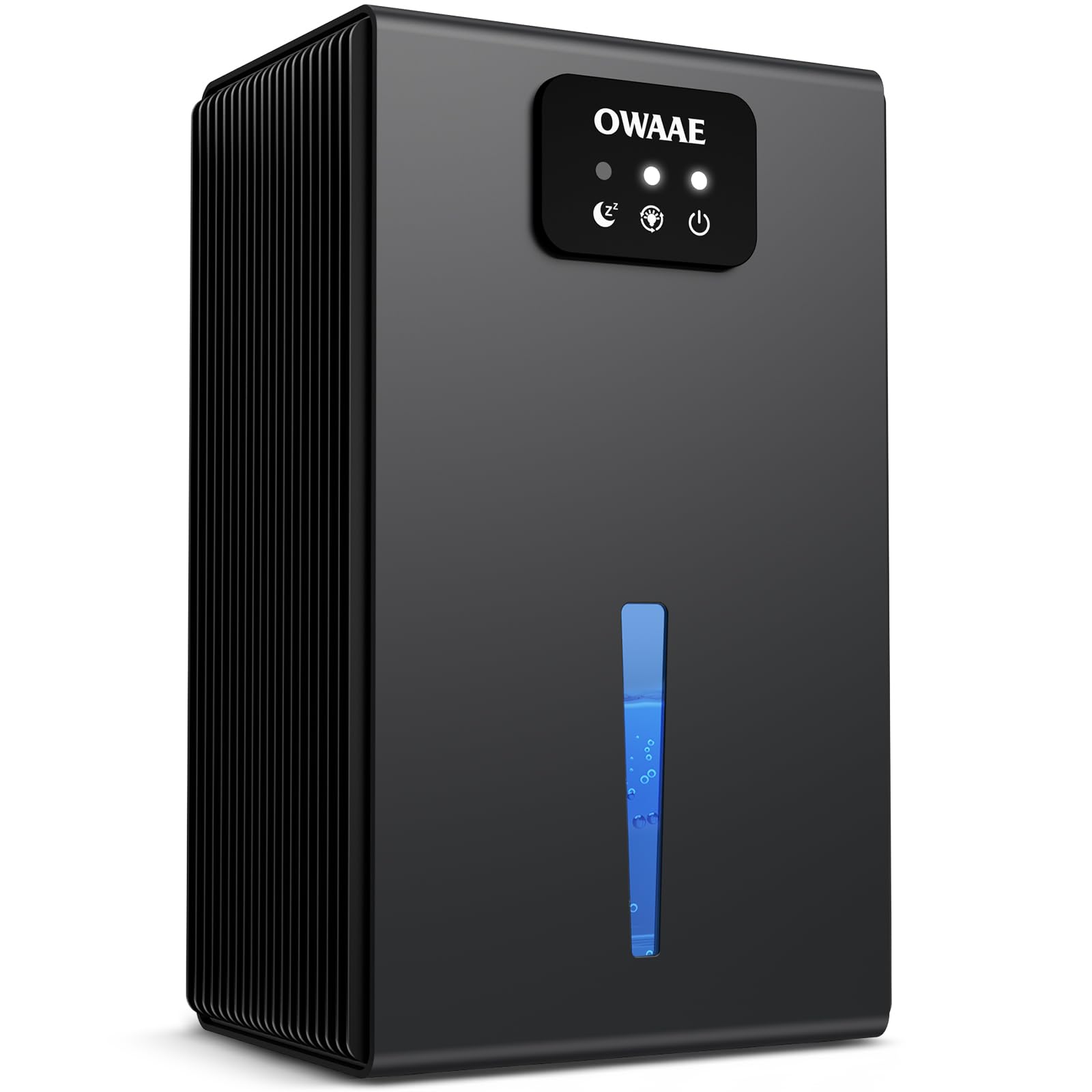
The OWAAE TZ-C4S is a compact Peltier-style dehumidifier rated for spaces up to 1,000 sq. ft., with a 95-fluid-ounce (about 0.74 gallon) water tank and a sleep mode that operates below 30 dB. It’s designed for moderate-to-high humidity environments — think a finished basement room, a bathroom with a shower, or a small workshop — where the issue is occasional condensation rather than a flooded slab. The auto shut-off feature stops operation when the tank is full or misaligned, preventing water spills on finished floors.
Customer reviews consistently praise its quiet operation: multiple owners call it “perfect for the bedroom” and note that the 7-color LED light adds a nightlight function without being disruptive. For a small basement that feels damp but doesn’t pool water, this unit can drop humidity noticeably within 24 hours, which in turn reduces the musty baseline smell. The compact footprint — 7.8 x 4.9 x 13.3 inches — means it tucks onto a shelf or counter without dominating the space.
The limitations are tied to its size: this is not a high-capacity compressor dehumidifier. In truly wet basements (RH above 80%), the Peltier mechanism will struggle to keep up, and the small tank may fill several times per day. It has no continuous drain option, so you must manually empty the bucket. Users also note that the commercial-grade claims are overstated; it’s best viewed as a residential room dehumidifier for light moisture management.
Why it’s great
- Ultra-quiet sleep mode under 30 dB — won’t disturb TV or sleep in a finished basement
- Compact size fits on shelves, counters, or even in closets of small basement rooms
- Auto shut-off prevents overflow; 7-color LED doubles as ambient night light
Good to know
- Peltier design is less effective than compressor units in high-humidity basements
- Small tank needs frequent emptying — no continuous drain hose option
- Best for rooms under 500 sq. ft.; 1,000 sq. ft. rating is generous in real-world conditions
6. DampRid Hi-Capacity Moisture Absorber Bucket (2-Pack)

DampRid’s Hi-Capacity buckets use a calcium chloride crystal formula that passively attracts and traps excess moisture from the air, along with the musty odors that moisture creates. Each 2-pound 15.5-ounce bucket lasts up to 6 months depending on ambient humidity, making this a true set-and-forget solution for garages, crawlspaces, and stored RVs. The included moisture detection strips help you identify problem rooms before committing to a powered dehumidifier.
Verified customers confirm the odor reduction is real: one reviewer’s parent had a tenant with dead mice in the wall, and a single DampRid bucket in the bathroom “really helped out a lot.” Others note the fresh scent is a pleasant upgrade from the “damp rusty smell” of storm cellars and workshops. Because there’s no electricity, vibration, or noise, you can place these in sealed storage areas where cords are impractical — even inside a boat or camper during winter storage.
The caveat: passive absorption is slower than active dehumidification. If the basement is actively moldy or has standing water, these buckets will fill quickly and may not keep up. The “fresh scent” is a fragrance additive, not odor neutralization — it masks rather than eliminates. Some users report the scent is mild and pleasant, but those with extreme chemical sensitivities may prefer the unscented version. Also, the buckets must be thrown out once the liquid reaches the fill line; there’s no recycling or refilling option.
Why it’s great
- No electricity, no moving parts — works in unpowered basements, sheds, and crawlspaces
- Each bucket lasts up to 6 months; 2-pack covers large areas like garages
- Includes moisture detection strips to measure humidity levels before purchase
Good to know
- Fragrance masks odors rather than chemically neutralizing them
- Slower than active dehumidifiers; struggles in high-moisture emergencies
- Single-use disposable buckets — no refill option; creates plastic waste
7. Delta Nature’s Air Sponge Odor Absorber
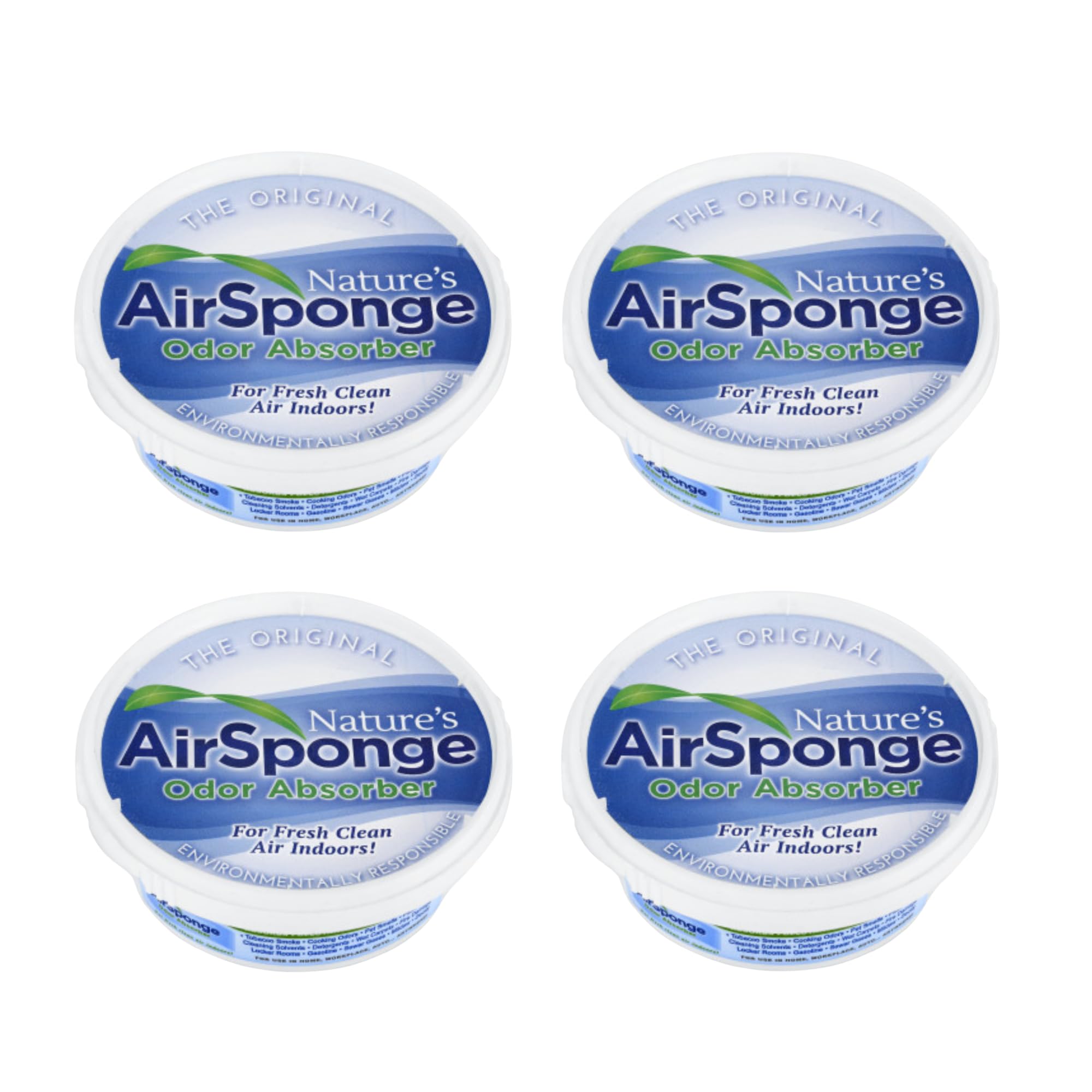
The Delta Nature’s Air Sponge is a half-pound solid block of activated charcoal in a ventilated plastic tub, rated to cover 300 square feet. Unlike fragrance-based products, activated charcoal physically adsorbs VOCs through a process called adsorption — odor molecules bond to the porous surface of the carbon rather than being masked by perfume oils. This makes it uniquely effective for organic decay smells like dead rodents, cat urine, and pet scents that sprays only cover temporarily.
Customer reviews are emphatic: one user reported a mouse died inside a wall and the Air Sponge “took the smell away in about two days completely.” Another with cats bringing home “trophies” in hot, humid weather noted the sponge made the air “smelling and feeling so much cleaner.” Multiple reviewers praise that it’s a safer alternative to sprays and air purifiers for pet owners, and a faint “peanut scent” is mentioned but is clearly from the charcoal itself, not added fragrance.
The trade-offs are about scale and speed. A single tub covers only 300 sq. ft. — a typical 1,000 sq. ft. basement needs at least three units placed strategically near odor sources. The charcoal saturates over time; once full, it stops working with no visual indicator, so you must replace it proactively every 2-3 months or when the smell returns. The plastic tub is also small enough that curious pets may try to chew it, as one reviewer warns to “keep away from your pets.” Best for spot treatment, not whole-basement remediation.
Why it’s great
- Activated charcoal adsorbs VOCs chemically — doesn’t just mask with fragrance
- Proven effective against dead animal decay and strong pet urine in under 48 hours
- No electricity, no noise, no batteries — place and forget in small spaces
Good to know
- Only covers 300 sq. ft. per tub — large basements need multiple units
- Saturates silently; there’s no indicator when the charcoal is full
- Small plastic tub can be a chewing hazard for dogs and cats
FAQ
Will an ozone generator damage electronics in my basement?
How often should I replace a passive charcoal odor absorber?
Can I run a dehumidifier and ozone generator in the same basement?
Final Thoughts: The Verdict
For most users, the best basement odor eliminator winner is the AEOCKY 74 Pint LEO-Lite Dehumidifier because it attacks the root cause of chronic mustiness — excess humidity — with verified Energy Star 6.0 efficiency, continuous drain capability, and quiet operation in basements as cool as 42°F. If you need a one-time shock treatment for a dead animal or heavy smoke, grab the ONAMOR 70,000mg Ozone Generator for its compact, palm-sized portability. And for long-term, no-power odor maintenance in a crawlspace or seasonal storage area, nothing beats the passive simplicity of the Delta Nature’s Air Sponge — just place it near the source and let activated charcoal silently adsorb the smell.