
Our readers keep the lights on and the weekend projects moving. As an Amazon Associate, I earn from qualifying purchases.
Slapping any old interior latex on cinder block or poured concrete guarantees peeling, bubbling, and mold growth within months — a costly mistake that forces total stripping and re-coating.
I’m Rikta — the co-founder and writer behind FitlyFast. I’ve spent hundreds of hours analyzing pH resistance ratings, elongation percentages, waterproofing certification claims, and real customer failure reports across dozens of masonry paint formulas to separate the few products that genuinely bond to basement walls from the many that fail.
This guide cuts through the marketing noise to help you choose the right basement wall paint for your specific substrate, moisture level, and finish preference — without wasting money on paint that won’t stick or seal.
How To Choose The Best Basement Wall Paint
Basement wall paint is not regular wall paint. The concrete, cinder block, or stone surfaces in a basement are alkaline, porous, and often subject to dampness or liquid water intrusion. Choosing the wrong coating leads to adhesion failure within a season. Here are the key factors to evaluate before buying.
Waterproofing versus Decorative Paint
This is the single most important distinction. Waterproofing paints like liquid rubber formulations or elastomeric coatings are engineered to block liquid water under hydrostatic pressure — measured in psi. Decorative acrylic paints provide color and some moisture resistance but will not stop active water seepage. If your basement has ever shown damp spots, efflorescence (white salty deposits), or visible water, you need a waterproofing product, not a standard wall paint.
Substrate Chemistry: Acrylic vs. Elastomeric vs. Liquid Rubber
Standard acrylic latex paint bonds best to drywall and previously painted surfaces. It fails on raw concrete because the alkaline chemistry of cement (up to pH-13) breaks down the acrylic binders over time. Elastomeric paints contain flexible polymers that bridge small cracks and resist alkali attack. Liquid rubber coatings offer the highest elongation (up to 900% for some AMES products) and form a continuous waterproof membrane — ideal for below-grade foundations where concrete movement is expected.
Sheen Selection for Basement Conditions
Flat and matte finishes absorb moisture and are difficult to clean — the worst choice for basement walls. Semi-gloss and satin sheens offer better moisture resistance, easier wipe-down capability, and slower dirt accumulation. Eggshell is a reasonable compromise for wall surfaces that are already sealed. For waterproofing paints, the sheen is typically flat or semi-gloss by design because the film thickness matters more than light reflection.
VOC Levels and Indoor Air Quality
Basements are often poorly ventilated, making low-VOC and zero-VOC paints non-negotiable. But there is a catch: the colorants added to tint a base paint can increase VOC levels significantly. If you are sensitive to chemical fumes or plan to use the basement as living space, choose a paint that specifies zero-VOC at the tinted state, not just the base. For waterproofing paints, check that the formula is compliant in all 50 states (some rubberized coatings have regional restrictions).
Quick Comparison
On smaller screens, swipe sideways to see the full table.
| Model | Category | Best For | Key Spec | Amazon |
|---|---|---|---|---|
| INSL-X WaterBlock | Waterproofing | Active leak prevention | Withstands 12 psi pressure | Amazon |
| AMES Blue Max | Liquid Rubber | Below-grade waterproofing | 900% elongation | Amazon |
| AMES Block & Wall | Liquid Rubber | Thick crack-filling seal | 9.3 lb weight per gallon | Amazon |
| Glidden Total All-in-One | Paint+Primer | One-coat coverage | Up to 400 sq. ft./gal. | Amazon |
| PRESTIGE Elements | Satin Finish | Fade-resistant topcoat | UV fade resistance | Amazon |
| RECOLOR Eco-Friendly | Recycled Latex | Eco-conscious projects | 450 sq. ft./gal. coverage | Amazon |
| EVOLVE Porch & Floor | Floor Coating | Basement floor painting | Scratch-resistant finish | Amazon |
In‑Depth Reviews
1. INSL-X WaterBlock Acrylic Masonry Waterproofer

The INSL-X WaterBlock is the most targeted product in this lineup for basement wall waterproofing. It is explicitly formulated for vertical interior and exterior concrete walls, cinder blocks, stucco, and brick. Its standout spec is a 12 psi hydrostatic pressure rating — meaning it can hold back a column of water over 27 feet high without leaking. That is genuine waterproofing performance, not just moisture resistance.
The paint is water-based with a semi-gloss finish that cleans up with soap and water. Coverage is modest at 75 to 125 square feet per gallon because the film thickness required for waterproofing is higher than standard paint. The included can opener and stir stick are thoughtful touches for a product that comes in a heavy-duty container. Its high alkali resistance (up to pH-13) ensures the concrete chemistry won’t break down the binder over time.
Real-world reviews consistently report that two coats stop basement water intrusion that has persisted for years. The fast-drying formula allows recoating within a single day. For anyone dealing with active wall dampness or occasional seepage, this is the paint-engineered for that exact job — not a compromised multi-surface product.
Why it’s great
- Rated to withstand 12 psi hydrostatic pressure
- High alkali resistance up to pH-13
- Semi-gloss sheen resists moisture damage
Good to know
- Low coverage per gallon due to thick application
- Requires clean dry surface and 50–90°F temperature
2. AMES Blue Max Liquid Rubber Waterproofer

AMES Blue Max represents a different category from standard paint: it is a liquid rubber that dries into an elastomeric membrane capable of stretching 900% without cracking. This extreme flexibility is critical for below-grade concrete foundations that experience thermal expansion, settlement, or minor shifting. The white liquid rubber applies via brush, roller, or spray and bonds to concrete, wood, metal, and even existing coatings.
As a waterproofing product rather than a decorative paint, Blue Max is designed for function first. It is non-toxic and VOC compliant in all 50 states, which matters for basement applications where ventilation is limited. The manufacturer recommends allowing 24 hours between coats to achieve maximum film integrity. The 1-gallon pail covers a smaller area than standard paint because the applied thickness is intended to be substantial.
Customers consistently highlight its durability on cement board, shower window sills, and pet-stained subfloors — all demanding waterproofing scenarios. One reviewer described it as needing a top coat if exposed to direct sunlight outdoors, but for interior basement use, the UV concern does not apply. For raw concrete or cinder block walls that need a true moisture barrier, this is the most effective option in the mid-range tier.
Why it’s great
- 900% elongation resists cracking as foundations shift
- Non-toxic and compliant in all 50 states
- Bonds to concrete, metal, wood, and masonry
Good to know
- Requires overnight cure between coats
- Thick consistency needs thorough mixing
3. AMES Block & Wall Liquid Rubber Waterproofer

The AMES Block & Wall formulation is noticeably thicker than the Blue Max — so thick that experienced users describe applying it like cake frosting. At 9.3 pounds per gallon, this is a high-solids liquid rubber designed to fill cracks and voids in cinder block and poured concrete walls rather than simply coating the surface. It is ideal for walls with hairline fractures or rough-textured block that needs leveling.
This product is built for heavy-duty below-grade use. The white liquid rubber applies with a brush for edges and a roller for broad surfaces, but its thick consistency means it does not run or drip excessively on vertical walls — a major advantage for basement application. The manufacturer recommends two coats for basic waterproofing, and the dried film forms a smooth, slightly shiny finish that can be top-coated if desired.
Long-term users report applying this sealer to tornado shelters, foundation walls, and planter beds against cinderblock with excellent results stretching over a decade. Some reviewers note that the thickness can cause drying issues if applied too heavy in a single pass, so working in thin, even layers is recommended. For sealing rough, cracked, or uneven masonry, this is the superior choice over thinner waterproofers.
Why it’s great
- Extremely thick consistency fills cracks effectively
- Does not run or drip on vertical walls
- Proven 10+ year performance in real basements
Good to know
- Must be applied in thin layers to dry properly
- Heavier than most paints at 9.3 lb per gallon
4. Glidden Total Interior Wall Paint & Primer All-in-One

The Glidden Total All-in-One is an interior wall paint, not a waterproofing sealer, but it earns its place in this guide for finished basement walls that are already dry. Its paint-and-primer-in-one formulation provides excellent hide — verified by customer reports of one-coat coverage over dark walls — and its semi-gloss sheen offers the best moisture resistance among decorative finishes. For basement walls that have been sealed or are above-grade, this is a strong finish coat option.
The zero-VOC base low in volatile organic compounds, though the colorants added during tinting may increase VOC levels depending on the shade selected. The Blue Oasis color reviewed here shows true-to-sample with a green undertone that brightens dim basement spaces. Coverage is advertised at up to 400 square feet per gallon, which is typical for a premium interior paint. Drying time is quick, with full cure in four hours.
Outstanding scrubbability and washability are key for basement environments where dust, dirt, and occasional moisture contact are inevitable. Former professional painters in the reviews confirm that this Glidden formula covers better than Bear brand and requires no separate primer. This is the best choice for homeowners who want a clean, bright, durable finish on basement walls that have already been waterproofed.
Why it’s great
- One-coat coverage over many existing colors
- Zero-VOC base suitable for enclosed spaces
- Outstanding scrub resistance for basement use
Good to know
- Not a waterproofing paint — requires dry substrate
- Colorants may raise VOC levels
5. PRESTIGE Paints Elements Interior Paint and Primer in One
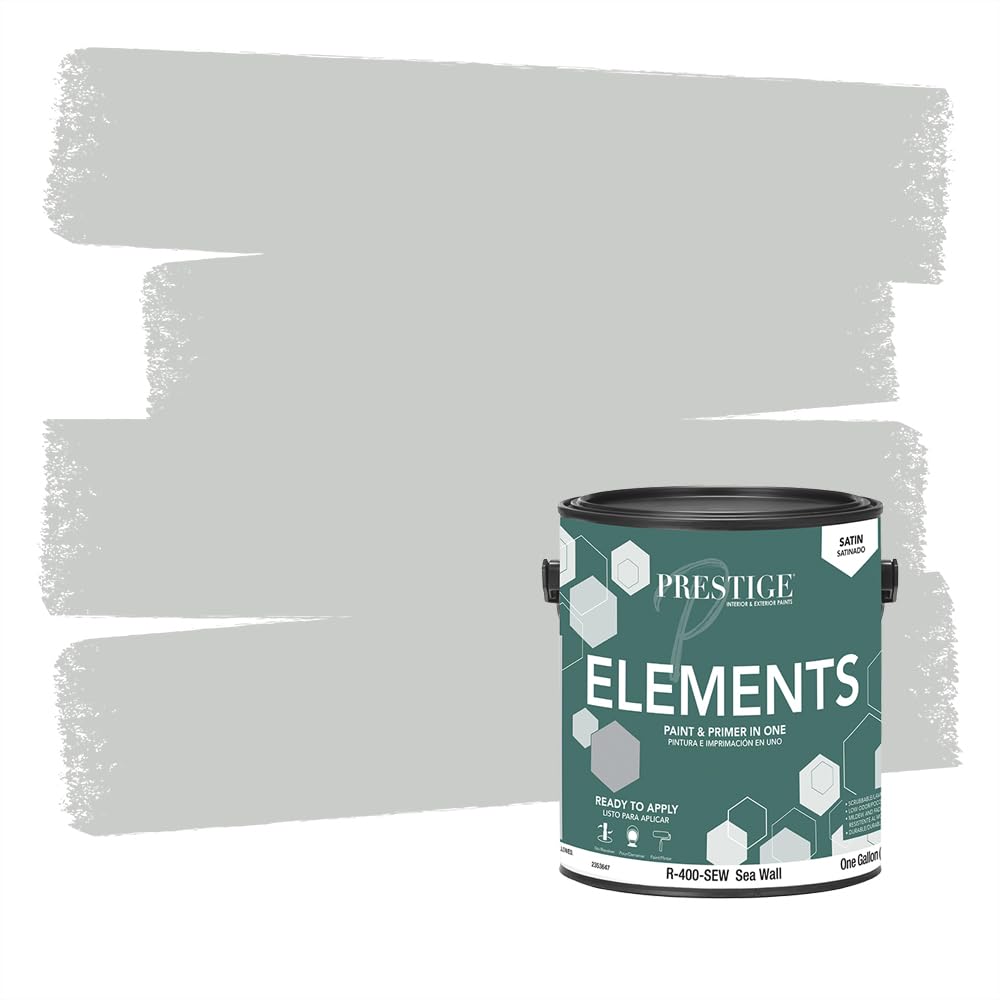
PRESTIGE Elements offers a satin sheen that sits perfectly between eggshell and semi-gloss — reflective enough for easy cleaning but not so shiny that it highlights every imperfection in basement walls. This paint includes primer built in, saving a step for walls that are already sealed or previously painted. Its fade resistance is listed as a feature, which matters for basement walls with egress windows that get direct sunlight exposure through the day.
The Sea Wall color is a light warm gray with a slightly green undertone that works well in low-light basement conditions, making the space feel larger and brighter. Coverage is rated at 250–400 square feet per gallon, putting it in the mid-range for interior paints. The acrylic latex formula cleans up easily with soap and water, and the paint is labeled as waterproof, though this refers to washability rather than hydrostatic pressure resistance.
Customer reviews emphasize the smooth, even finish and the fact that the paint spreads without clumping — important when working on textured concrete surfaces. Several repeat buyers note that PRESTIGE has become their new preferred brand over major competitors. The included can opener and stir stick add convenience. This paint works best as a final topcoat over properly sealed basement walls where a satin aesthetic is desired.
Why it’s great
- Satin sheen balances cleanability and hide
- Fade-resistant formulation for window-lit areas
- Primer included for fewer coats
Good to know
- Not a waterproofing paint
- Color may vary slightly between batches
6. RECOLOR Eco-Friendly Interior Latex Paint

RECOLOR takes a fundamentally different approach: it is professionally recycled paint processed from carefully screened leftover feedstock, meaning each batch reduces waste while delivering performance comparable to virgin paint. The Storm color is a deep blue-gray that adds character to finished basement spaces. The finish is described as between flat and eggshell, providing a subtle luster without excessive shine.
Coverage is an impressive 450 square feet per gallon — slightly better than many virgin paints. The recycled content naturally lowers VOCs because the paint has already off-gassed during its first life cycle. However, batch-to-batch color variation is a real possibility, and the manufacturer explicitly recommends bulking paint from different batches together to ensure uniformity. For a single-wall project this is less of a concern; for whole basements, order enough at once.
Women-owned and processed in the USA, RECOLOR appeals to buyers who prioritize environmental impact without wanting to sacrifice application quality. Reviews from DIY beginners and professional painters alike highlight the minimal odor, low splatter, and good coverage. Some quality-control complaints exist — one reviewer received a can of watery, clumped paint — but the overwhelming majority report a product that performs on par with premium virgin latex paints.
Why it’s great
- Environmentally responsible recycled formulation
- Generous 450 sq. ft. coverage per gallon
- Minimal odor and low splatter application
Good to know
- Some batch-to-batch color variation possible
- Not a waterproofing paint
7. EVOLVE Porch & Floor Paint
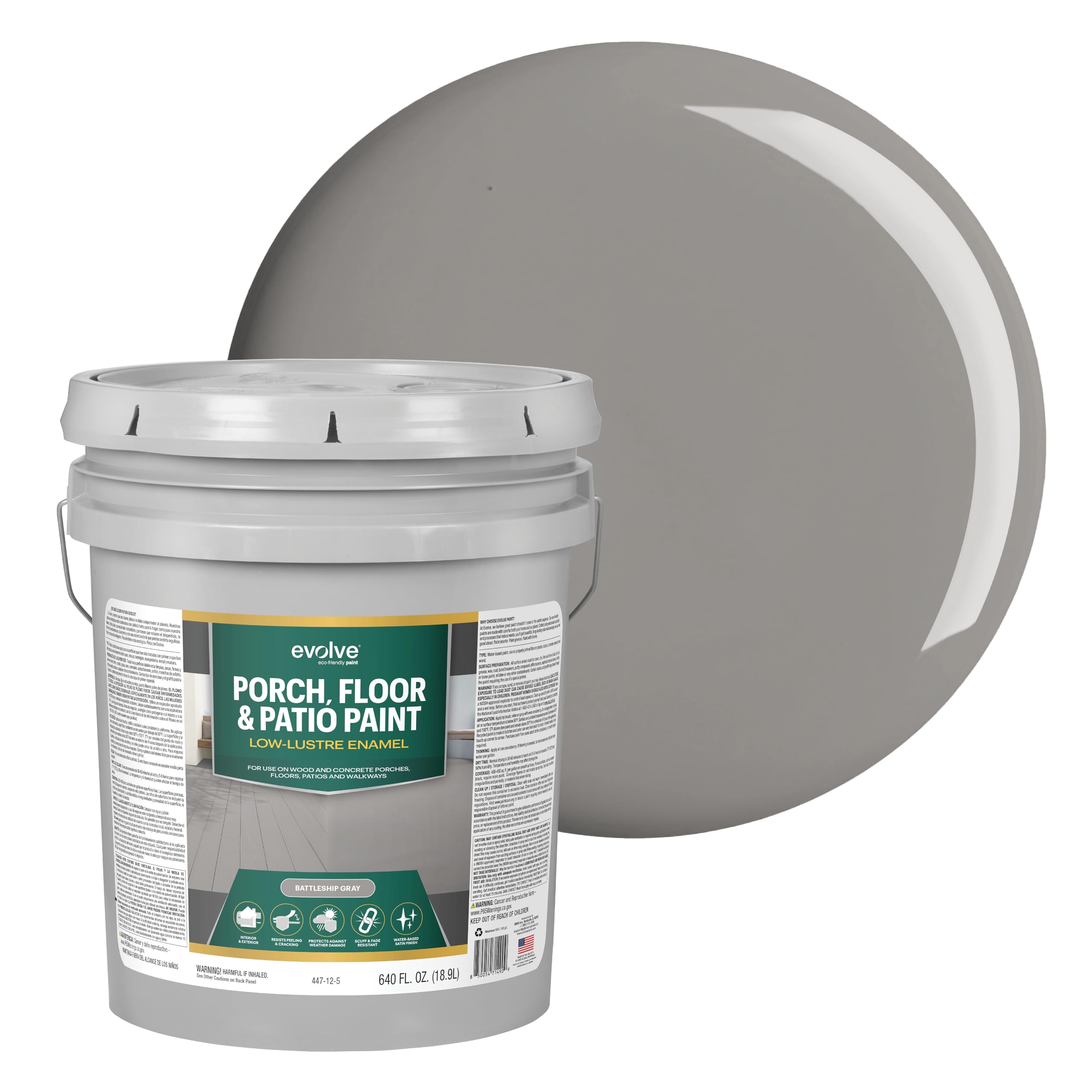
The EVOLVE Porch & Floor Paint is designed for horizontal basement surfaces — floors — not walls. Its high-traffic durability and scratch-resistant finish make it the correct choice for basement floors that experience foot traffic, storage movement, or occasional moisture. The Battleship Gray color is a versatile mid-tone gray that hides dirt better than white or light colors.
This is a water-based acrylic latex with a semi-gloss finish that dries to the touch in about one hour, minimizing downtime in finished basements. The formulation resists scuffing from shoes and furniture, and its moisture barrier properties protect the concrete substrate from spills and humidity. Coverage information is not precisely listed, but a 5-gallon bucket is the standard volume for floor projects — one coat covers roughly 400–500 square feet depending on surface texture.
Customer reviews are mixed in a way that reflects the difficulty of floor painting. Some experienced painters praise the smooth application and durable finish, while one reported catastrophic failure where rain dissolved the paint. For interior basement floors protected from rain, this risk is eliminated. Several users note that the paint adds traction to aged decks, which translates well to basement steps. Proper surface prep — sweeping, mopping, and drying — is emphasized by successful reviewers.
Why it’s great
- Engineered for high-traffic horizontal surfaces
- Fast drying in about 1 hour
- Scratch and scuff resistant
Good to know
- Some reports of failure with rain exposure
- Battleship Gray may appear darker than expected
FAQ
Can I use regular interior paint on basement walls?
What is the difference between Drylok and liquid rubber waterproofers?
How long does basement wall paint last before needing repainting?
Should I prime basement walls before painting?
Final Thoughts: The Verdict
For most users, the basement wall paint winner is the INSL-X WaterBlock because it offers genuine 12 psi hydrostatic pressure resistance in a semi-gloss acrylic formula that cleans up easily and is explicitly designed for basement masonry. If you need thick crack-filling waterproofing on rough cinderblock, grab the AMES Block & Wall. And for a decorative finish coat on already-sealed basement walls, the Glidden Total All-in-One delivers one-coat coverage and zero-VOC safety in the poorly ventilated environment.