
Our readers keep the lights on and the weekend projects moving. As an Amazon Associate, I earn from qualifying purchases.
Tinny desktop speakers ruin immersion whether you are tracking footsteps in a competitive shooter or feeling the low-end thump of a bassline during a late-night session. A dedicated subwoofer and properly tuned satellite drivers separate muddy noise from controlled, punchy low-frequency response — and that distinction defines a serious listening setup.
I’m Rikta — the founder and writer behind FitlyFast. I spend hours analyzing frequency response curves, driver materials, and amplifier ratings to find the desktop audio configurations that deliver real sub-bass extension without distorting the upper register.
After dissecting the specs and real-user feedback on seven configurations, one speaker system consistently outperforms its peers for deep, clean low-end output. This guide breaks down the top contenders to help you find bass pc speakers that genuinely move air on your desk.
How To Choose The Best Bass PC Speakers
Selecting desktop speakers that deliver satisfying low-end requires understanding the physical components and specifications that actually produce deep frequencies. Generic “peak power” claims often mislead — you need to look at driver size, amplifier architecture, and enclosure design to predict real-world bass performance.
Subwoofer Driver Size and Enclosure Type
The diameter of the subwoofer driver directly determines how much air it can displace. A 5.25-inch driver can produce tight, musical bass down to around 50Hz, while a 6.5-inch driver extends deeper into the 35-40Hz range. Ported enclosures (with a tuned vent) boost low-end output but can sound boomy if not well-engineered; sealed enclosures trade raw extension for tighter, more controlled response.
Amplifier Power: RMS vs Peak
RMS (continuous) power tells you how much clean wattage the amplifier can sustain. A 200-watt peak rating often translates to only 50-100 watts RMS. For clean bass at moderate listening levels, look for at least 30-50 watts RMS dedicated to the subwoofer channel. Systems that list a combined RMS figure for all channels give a more honest picture of sustained performance.
DSP Tuning and Crossover Management
Digital signal processing fine-tunes the frequency split between satellites and subwoofer. A well-implemented crossover (typically 80-120Hz) ensures the sub handles only low frequencies while the satellites stay clean in the midrange. Systems with adjustable crossover or subwoofer gain let you dial in the bass to match your room acoustics and personal taste.
Quick Comparison
On smaller screens, swipe sideways to see the full table.
| Model | Category | Best For | Key Spec | Amazon |
|---|---|---|---|---|
| Klipsch ProMedia 2.1 | Premium | THX-certified clarity & deep sub-bass | 6.5” ported sub / 200W peak | Amazon |
| Logitech Z623 | Premium | High-power room-filling bass | 7” driver sub / 400W peak | Amazon |
| Bluedee 2.1 (80W) | Mid-Range | Deep bass & RGB in compact 2.1 | Dedicated sub / 80W peak | Amazon |
| Nylavee 2.1 | Mid-Range | Soundbar + sub for desk setups | 5.25” sub driver / 60W peak | Amazon |
| OHAYO 60W 2.0 | Value | Near-field clarity with MDF build | 3” carbon fiber driver / 60W | Amazon |
| Bluedee 20W 2.0 | Budget | Compact 2.0 with passive radiators | Passive radiator / 20W peak | Amazon |
| Creative Pebble Plus 2.1 | Budget | USB-powered 2.1 with subwoofer | 4” down-firing sub / 8W RMS | Amazon |
In‑Depth Reviews
1. Klipsch ProMedia 2.1 THX Certified

The Klipsch ProMedia 2.1 pairs a 6.5-inch side-firing ported subwoofer with MicroTractrix horn-loaded satellite speakers, delivering clean, articulate bass down to the low 30Hz range. The THX certification confirms the system meets rigorous standards for output and clarity — real-world users consistently praise its ability to reproduce deep kick drums and cinematic rumbles without muddying the midrange or tweeter.
Satellite speakers use a 3-inch midrange driver combined with the proprietary horn tweeter, creating a wide soundstage with precise instrument placement. The wired control pod provides independent volume and subwoofer gain, letting you tune the low-end balance to your room. Build quality is robust, with multiple users reporting reliable performance spanning over a decade.
A minor caveat: the connection plugs for the satellite cables use plastic tabs that can break if handled roughly, and there is no physical on/off switch. The horn-loaded tweeter can sound slightly forward with poorly recorded material until about 50 hours of break-in. For pure, reference-level bass from a compact 2.1 system, this remains the benchmark.
Why it’s great
- 6.5” ported subwoofer delivers deep, controlled sub-bass
- THX certification ensures high output with low distortion
- Separate subwoofer gain control for room-specific tuning
Good to know
- No physical power switch; always in standby
- Speaker wire clips use fragile plastic tabs
- Tweeter can sound bright before burn-in
2. Logitech Z623 THX 2.1

The Logitech Z623 uses a 7-inch subwoofer driver inside a ported cabinet, producing substantial low-frequency output that can fill a large room. With 400 watts peak (200 watts RMS), this system delivers authority in the lower registers — users report clean, tight bass at moderate volumes and window-rattling extension when pushed. The satellites contain 2.5-inch full-range drivers that handle mids and highs without a dedicated tweeter, which gives the system a warmer, bass-forward character.
Input flexibility stands out: dual RCA and a 3.5mm auxiliary input allow three simultaneous source connections, ideal for desktop setups with a PC, gaming console, and phone. The right satellite houses the volume knob, power button, and headphone jack. Some users note the mids and treble sound slightly recessed compared to systems with separate tweeters, but parametric EQ calibration can resolve this.
Long-term reliability is strong, though the power button can develop static noise after extended use — a quick treatment with contact cleaner fixes it. The satellite speaker connector uses a proprietary VGA-style pin arrangement that makes replacement cables difficult to source. For those who prioritize raw bass power over audiophile flatness, the Z623 delivers visceral low-end impact.
Why it’s great
- 7” subwoofer driver provides exceptional bass extension and volume
- Dual RCA + 3.5mm inputs for three simultaneous sources
- Impressive 200W RMS power for large room coverage
Good to know
- Mids and highs can sound recessed without EQ adjustment
- Proprietary satellite connector limits cable replacement options
- Power button may develop static over time
3. Bluedee 2.1 (80W Peak)
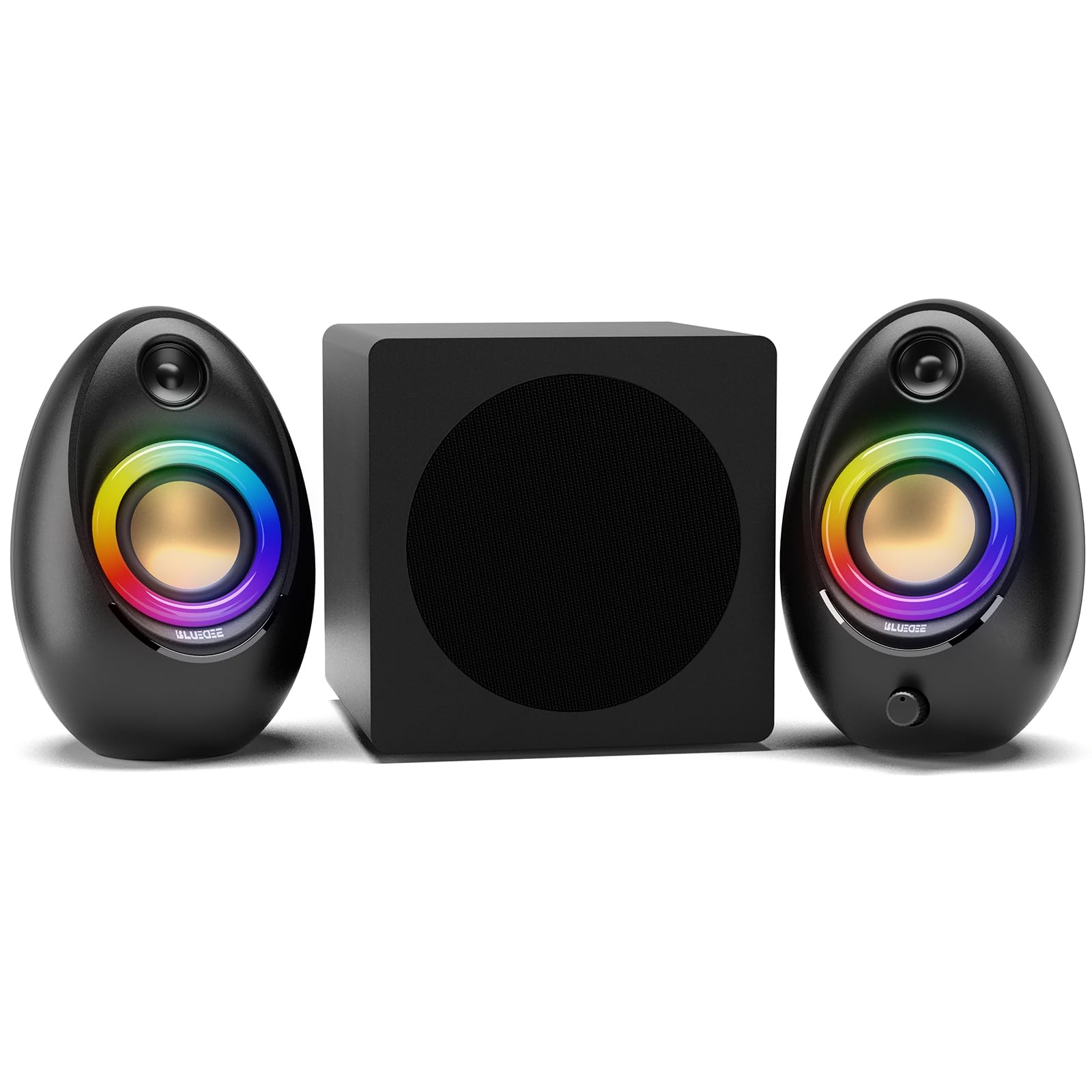
The Bluedee 2.1 system integrates a dedicated subwoofer with satellite speakers that include USB, USB-C, and 3.5mm AUX inputs plus Bluetooth 5.4, giving you flexible connectivity in a compact 2.1 package. DSP tuning manages the crossover between the sub and satellites, keeping vocals clear while the independent bass unit handles low frequencies. Users consistently note the subwoofer produces deep, punchy bass that enhances movies and gaming without overwhelming the midrange.
An all-in-one control knob on the right satellite manages volume, playback, lighting effects, and input mode. The RGB lighting offers several dynamic and static color patterns that can be switched off entirely. Build quality uses plastic enclosures, but the system feels sturdy and the compact footprint fits neatly under monitors or beside a laptop.
At 80W peak power, this system provides ample volume for a medium-sized room or home office setup. Some users note the RGB lights do not sync with music — they cycle through preset color patterns independently. For a mid-range 2.1 with wireless convenience, clean DSP crossover, and aesthetic desk appeal, the Bluedee 80W is a strong contender.
Why it’s great
- Dedicated subwoofer delivers deep bass without satellite muddiness
- Bluetooth 5.4 plus USB/USB-C/AUX for flexible connectivity
- Adjustable RGB lighting enhances desk aesthetics
Good to know
- RGB lights do not sync to music rhythm
- Plastic enclosure lacks the resonance damping of MDF
- Peak power rating is modest; not for large rooms
4. Nylavee 2.1 Soundbar with Subwoofer
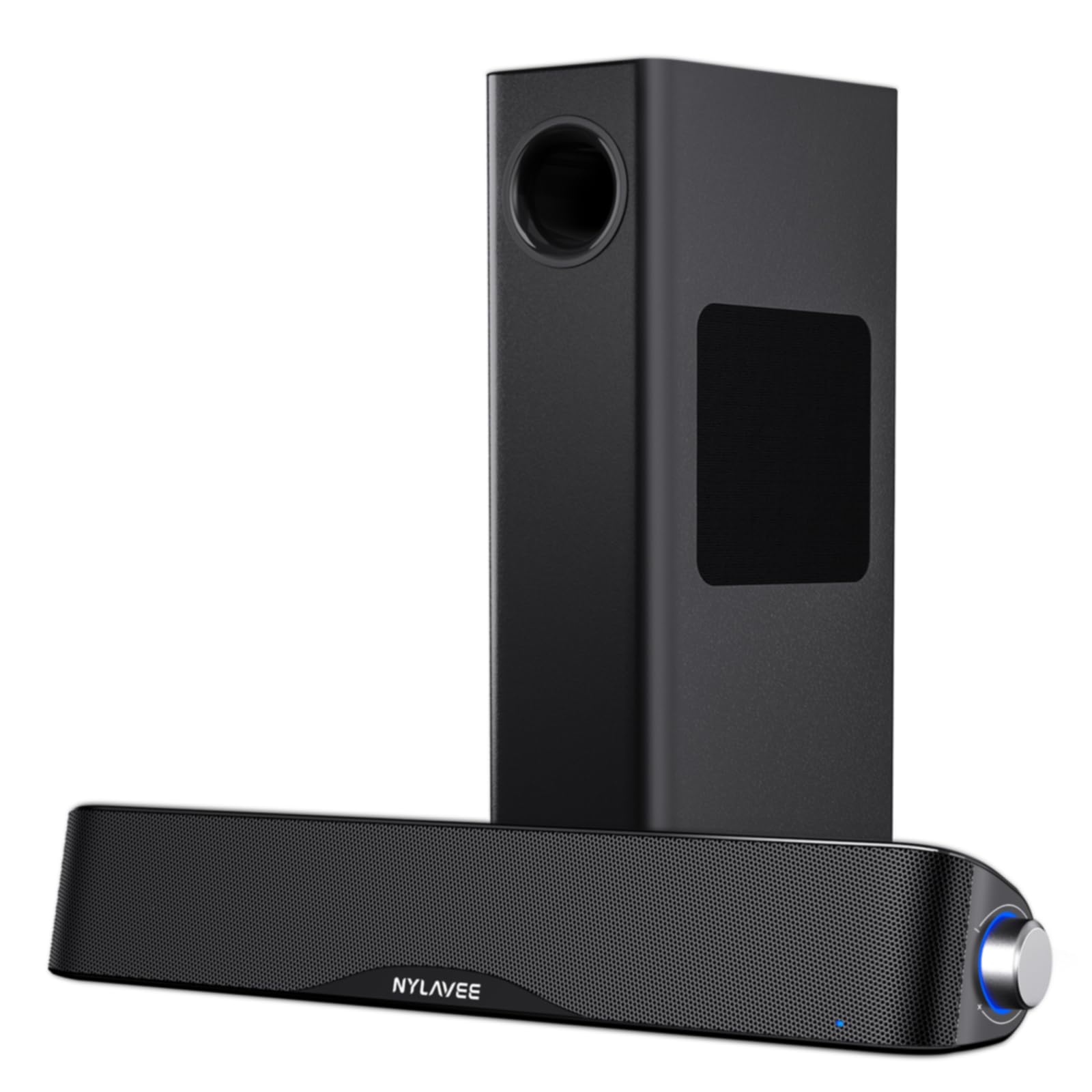
The Nylavee 2.1 system takes a different approach by using a compact soundbar as the satellite unit instead of traditional separated speakers. This soundbar houses dual soft-dome silk tweeters and full-range drivers, while a standalone 5.25-inch subwoofer handles the low frequencies with 60W peak power. The design saves significant desk space while still producing defined bass that can be felt during gaming and action scenes.
Connectivity covers Bluetooth 5.4 for wireless streaming and 3.5mm AUX input for wired connection to PCs, consoles, or monitors. The side-mounted control knob handles power, volume, input switching, and mode selection. Users report the subwoofer delivers punchy, impactful bass that stays tight and does not distort at moderate volumes, making it effective for both music and cinematic content.
The ABS plastic enclosure of the subwoofer does not match the acoustic properties of MDF, but the cavity design helps maintain consistent performance. Some users wish for a separate subwoofer gain control for finer tuning, but the default crossover point works well for near-field desktop listening. For a space-efficient 2.1 with a soundbar silhouette, the Nylavee offers respectable low-end presence without dominating your desk.
Why it’s great
- Soundbar design saves desk space while providing stereo imaging
- 5.25” subwoofer delivers punchy, defined low-end
- Bluetooth 5.4 supports wireless streaming from any device
Good to know
- ABS plastic sub enclosure less acoustically inert than wood
- No separate subwoofer gain control for fine-tuning
- Soundbar lacks left/right separation compared to true stereo satellites
5. OHAYO 60W 2.0 Bookshelf Speakers

The OHAYO 60W system forgoes a separate subwoofer, instead using a 0.75-inch carbon fiber silk dome tweeter and a 3-inch carbon fiber full-range driver in each MDF wooden enclosure to produce clean, extended low-end. The 3-inch drivers handle mid-bass with surprising authority thanks to the rear bass port, which tunes the cabinet to amplify lower frequencies. Users report these speakers produce audible extension down to 20Hz in-room, with tight, controlled bass that does not overwhelm vocals.
Connectivity includes Bluetooth 5.3, RCA, AUX, and USB inputs, accommodating turntables, PCs, gaming consoles, and phones. The front-panel volume knob also controls power, and the included cables cover 3.5mm and USB-C connections. The MDF cabinet effectively dampens box resonance, resulting in a cleaner midrange and more defined stereo imaging than plastic equivalents.
Without a dedicated subwoofer, the OHAYO cannot match the visceral deep-bass impact of a full 2.1 system for electronic music or heavy cinematic use. Some users note rap and pop tracks lack the low-end weight that a separate subwoofer provides. For near-field desktop listening with excellent clarity, soundstage, and respectable bass from a compact 2.0 setup, the OHAYO punches above its price point.
Why it’s great
- MDF enclosure minimizes resonance for cleaner mids and bass
- Carbon fiber drivers provide detailed highs and controlled mid-bass
- Multiple inputs including Bluetooth 5.3, RCA, and USB
Good to know
- No subwoofer limits deep low-end extension for bass-heavy genres
- 3” drivers cannot match the output of dedicated subwoofer systems
- Rear bass port requires a few inches of clearance from walls
6. Bluedee 20W 2.0 with Passive Radiators
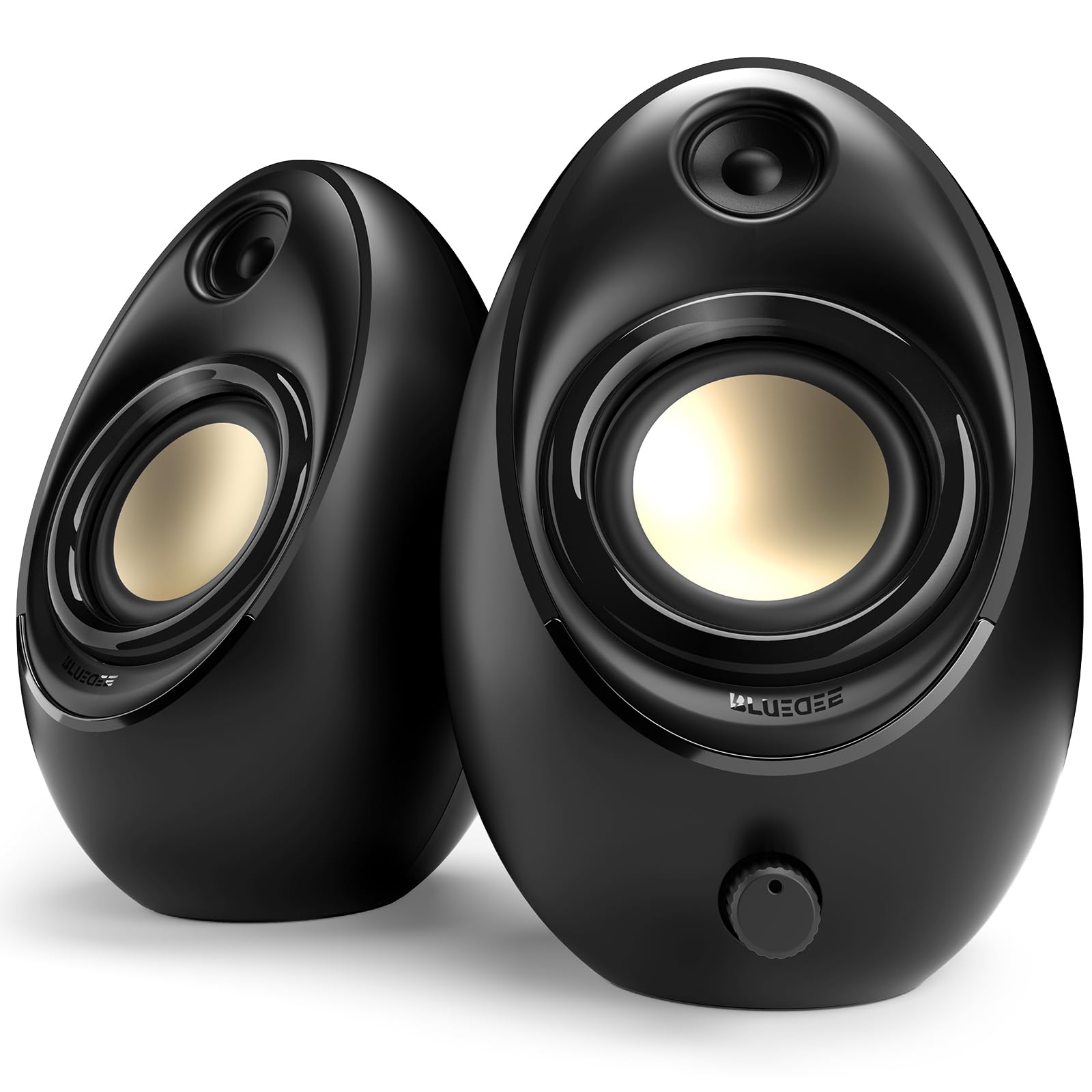
The Bluedee 20W 2.0 system uses two tweeters, two full-range drivers, and two passive radiators to produce enhanced bass from a compact, subwoofer-free design. The passive radiators move in sympathy with the main drivers, effectively extending low-frequency output without needing a separate amplifier channel. DSP tuning smooths the frequency response, minimizing distortion at higher volumes. Users consistently report better bass than expected from such small speakers, with clear sound suitable for music, videos, and daily desktop use.
An all-in-one control knob on the front of the right speaker manages volume, playback, RGB lighting effects (8 options), and connection mode switching. Connectivity covers Bluetooth 5.4 plus USB/USB-C plug-and-play, making it simple to switch between wired and wireless sources. The compact footprint fits easily under a monitor riser or beside a laptop stand.
The physical limitations of passive radiators mean the low-end punch cannot match a dedicated subwoofer. The inter-speaker cable at 50 inches is too short for setups with dual 24-inch monitors, requiring an extension in wider arrangements. For buyers who prioritize desk space, aesthetics, and surprisingly good bass from a 2.0 system, the Bluedee 20W delivers a well-balanced package.
Why it’s great
- Passive radiators produce impressive bass for the size
- DSP tuning maintains clarity at higher volumes
- Compact design with 8 RGB lighting modes
Good to know
- Inter-speaker cable is only 50 inches — short for wide desk setups
- Cannot match the sub-bass extension of a 2.1 system
- Peak 20W power limits maximum volume in larger rooms
7. Creative Pebble Plus 2.1

The Creative Pebble Plus brings a 4-inch down-firing ported subwoofer into a USB-powered 2.1 configuration, making it the most accessible entry point for desktop bass. The sub connects via a 3.5mm audio cable to the satellite speakers, which feature 2-inch mid-range drivers angled at 45 degrees for improved stereo imaging. At 8W RMS total (with a 2A USB adapter for high gain mode), the system delivers surprising volume and bass depth for a compact, low-power setup.
Users note that the subwoofer fills out the low end effectively for movies and gaming, but deeper bass notes in music with extended sub-bass can be lost. The controls are front-mounted for easy access, and the entire system draws power through a single USB connection, eliminating the need for a wall outlet for the satellites (the sub does connect to power). Several reviewers mention the subwoofer can sound boomy around 130Hz without EQ tuning, while the treble rolls off after 16kHz.
The passive subwoofer design uses the amplifier inside the right satellite, limiting total output compared to active subwoofer systems. The 4-second power-on delay can be slightly inconvenient. For a low-power consumption, affordable 2.1 that adds noticeable bass to a desktop setup without cluttering your space, the Creative Pebble Plus is a solid budget-friendly option.
Why it’s great
- 4” down-firing subwoofer adds real bass to a desktop
- USB-powered satellites for simple, clean cable management
- 45-degree angled drivers improve soundstage at desk level
Good to know
- Subwoofer can sound boomy around 130Hz without EQ
- Limited deep sub-bass extension for bass-heavy music
- 4-second power-on delay when starting audio
FAQ
How much subwoofer size do I need for desktop bass?
Can I get good bass from a 2.0 speaker system without a subwoofer?
Why does my subwoofer sound boomy or muddy?
Final Thoughts: The Verdict
For most users, the bass pc speakers winner is the Klipsch ProMedia 2.1 because it combines a 6.5-inch ported subwoofer with THX-certified clarity and independent subwoofer gain control, delivering deep, clean bass that works for music, movies, and gaming. If you want maximum raw power and room-filling low-end, grab the Logitech Z623. And for a space-conscious desk setup with wireless Bluetooth and RGB aesthetics, the Bluedee 2.1 (80W) offers excellent value and adaptable connectivity.