
Our readers keep the lights on and the weekend projects moving. As an Amazon Associate, I earn from qualifying purchases.
A bathroom scale that delivers the same weight twice in a row feels like a minor miracle. The reality is that many scales drift, wobble, or peg a number that looks fine but changes moments later. For anyone tracking progress—whether losing fat, gaining muscle, or managing a health condition—that inconsistency erodes trust and makes every morning weigh-in a small exercise in frustration.
I’m Rikta — the co-founder and writer behind FitlyFast. My research for this guide involved cross-referencing hundreds of customer reports against manufacturer specs, analyzing sensor configurations, and digging into what actually separates a scale that lies from one that can be trusted day after day.
After weeks of analysis, I’ve compiled the definitive list of best bathroom scale for accuracy options, focused on the models that prove their precision through consistent readings, robust hardware, and sensible design.
How To Choose The Best Bathroom Scale For Accuracy
Picking a scale based on a low price tag usually ends with a drawer full of frustration. Real accuracy comes from three specific design choices: the number and quality of load cells, the algorithm that processes the raw signal, and the consistency of the platform itself. Here is what matters most.
Sensor Count and Strain Gauge Quality
Four-sensor systems distribute pressure evenly across the platform and reduce the error introduced by shifting your stance. Scales with a single central sensor tend to produce different readings when you lean forward versus backward. The best units use four bonded strain gauges that measure micro-deformations in the metal with high linearity.
Incremental Resolution vs. Repeatability
A scale that displays 0.1 lb increments may still be erratic—the display resolution is not the same as measurement repeatability. The key spec is whether the scale returns the same number when you step on and off three times in a row. That repeatability is governed by the analog-to-digital converter and the firmware filtering noise.
Platform Stability and Surface Compatibility
Scales built on thin tempered glass or with small foot pads wobble on tile or hardwood. An accurate scale needs a rigid base and rubberized feet that grip the floor. Soft surfaces like carpet or vinyl matting will absorb weight and shift the reading regardless of the sensor quality inside the unit.
Quick Comparison
On smaller screens, swipe sideways to see the full table.
| Model | Category | Best For | Key Spec | Amazon |
|---|---|---|---|---|
| Withings Body Smart | Smart / Premium | Clinical consistency & heart rate | 0.1 lb / 50 g resolution | Amazon |
| Tanita HD-351 | Mechanical / Premium | Zero-gimmick daily tracking | 0.2 lb increments | Amazon |
| RunStar Precision | Smart / Mid-Range | TFT display & 22 metrics | 0.1 lb increments | Amazon |
| GE Smart Scale | Smart / Mid-Range | App sync & body composition | 0.1 lb increments | Amazon |
| Vitafit 550lb Smart Scale | Smart / Mid-Range | High capacity & 13 metrics | 0.1 lb increments | Amazon |
| RENPHO Core 1L | Basic / Value | Wide platform & high capacity | 0.05 lb increments | Amazon |
| Taylor Digital Scale | Basic / Entry | Simple step-on durability | 0.2 lb increments | Amazon |
In‑Depth Reviews
1. Withings Body Smart

The Withings Body Smart sits at the top of the accuracy tier because it was developed in collaboration with clinical institutions and validated against medical reference scales. Its weight resolution of 50 g (about 0.1 lb) is only part of the story—what matters is that the reading holds within that margin on repeated steps, which is rare among consumer scales.
The high-resolution color display shows weight and body fat trends directly on the scale, and the built-in Wi-Fi syncs data to the app without needing your phone nearby. Heart rate measurement at weigh-in is a bonus for cardiovascular context, and the baby weigh mode (weigh yourself holding the baby, then subtract) works smoothly for parents tracking infant growth.
Some users note the platform can rock slightly on uneven tile, and the reflective glass surface shows dust quickly. The initial setup process is slightly involved compared to simpler Bluetooth-only models, but the long-term consistency rewards the effort.
Why it’s great
- Clinically validated accuracy within 50 g
- Wi-Fi and Bluetooth dual connectivity
- Heart rate measurement built in
Good to know
- Reflective surface shows smudges and dust
- Setup is more involved than basic models
2. Tanita HD-351

The Tanita HD-351 is the analog digital scale that accuracy enthusiasts trust because it does not try to be a smartphone accessory. It uses a heavy-gauge steel frame and precision load cells that have been tested against known reference weights—customers report that a 20 lb dumbbell reads exactly 20.0, and stacking two reads exactly 40.0. That level of linearity is unusual.
The two-inch LCD display shows your current weight on one line and your previous weight on the second, so you see the delta instantly without digging through an app. Up to five users can store their own history by tapping one of the numbered buttons. It is a design as old-school as it is effective.
The trade-off is that there is no Bluetooth, no body composition analysis, and no fancy screen animations. The display is a standard non-backlit LCD, and the unit itself weighs over 6 pounds, so it is not meant for travel.
Why it’s great
- Validated against known reference weights
- Shows current vs. previous weight simultaneously
- Durable steel construction
Good to know
- No Bluetooth or app integration
- Heavy and not portable
3. RunStar Precision Smart Scale
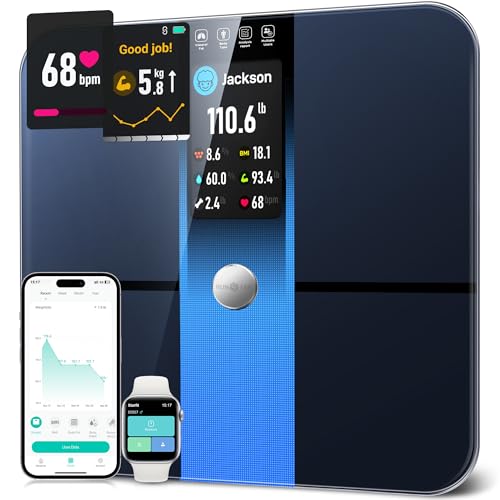
The RunStar Precision scale stands out for its vibrant 3.5-inch TFT color display, which shows dynamic trend curves and animations directly on the scale. It uses advanced BIA (bio-impedance) technology to measure 22 body composition metrics, including weight, BMI, muscle mass, visceral fat, protein, and even heart rate.
Accuracy is supported by a full-ITO coated weighing platform, which reduces the effect of foot placement on readings. The scale supports up to 24 user profiles, making it ideal for families. It also offers offline measurement that syncs to the Starfit app when your phone is nearby, and the data integrates with Apple Health and Fitbit.
A few customers reported app security quirks (the app changing stored passwords), and the platform feels slightly less stable than heavier competitors. But for the depth of data and the quality of the display at this tier, it delivers strong value.
Why it’s great
- Large TFT screen with trend animations
- ITO-coated platform reduces foot placement error
- Measures 22 body composition metrics
Good to know
- App password security issue reported
- Platform feels less robust than premium models
4. GE Smart Scale
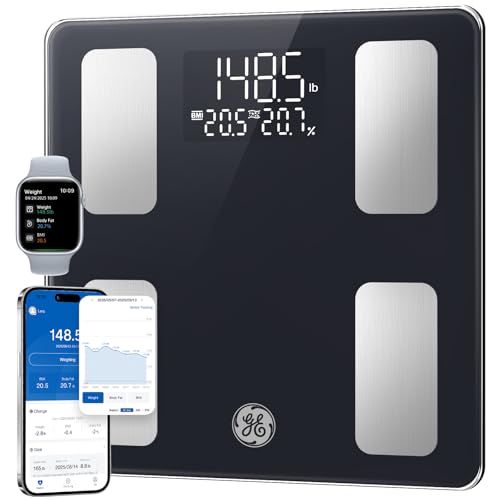
The GE Smart Scale uses four high-precision sensors and auto-calibration to deliver consistent weight readings at 0.1 lb increments. Its primary strength is the seamless app experience: after initial Bluetooth setup, you can step on and see weight, BMI, and body fat percentage instantly on the large LED display without touching your phone.
The scale measures 13 body composition metrics using BIA, and it automatically recognizes multiple user profiles so that each family member’s data is tracked separately. It syncs with Apple Health, Google Fit, and Health Connect, making it a strong hub for anyone already using those platforms.
Some users report intermittent Bluetooth connectivity issues, though the scale stores readings and syncs later. The tempered glass surface is attractive but requires a hard, flat floor for accurate results. Avoid use if you have a pacemaker or are pregnant.
Why it’s great
- Auto-calibrating four-sensor system
- Offline storage and later sync
- Automatic user recognition
Good to know
- Bluetooth connection can be intermittent
- Not recommended for pacemaker users
5. Vitafit 550lb Smart Scale
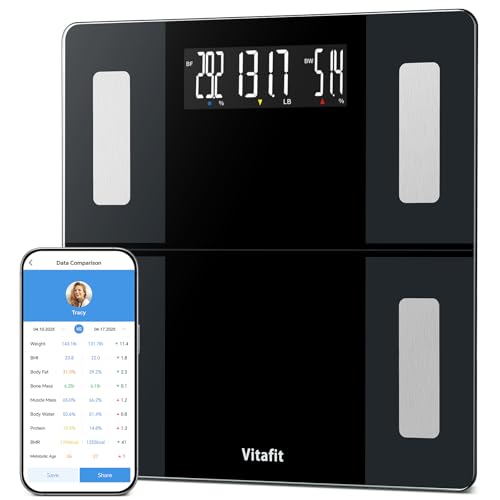
The Vitafit 550lb Smart Scale is built by a dedicated scale factory that has been manufacturing since 2001, which gives confidence in the sensor hardware. It measures to 0.1 lb accuracy across a 550 lb / 250 kg capacity—rare at this tier—making it one of the few high-capacity options that also tracks 13 body composition metrics.
The Vitafit app stores data on US and EU cloud servers via AWS, and it supports unlimited users with a special Zero-Current mode that measures only weight and BMI for children or pregnant individuals. The app syncs with Apple Health, Google Fit, Samsung Health, and Fitbit, closing the integration gap neatly.
Some users note occasional Bluetooth glitches that are resolved by restarting the app, and the LCD display is standard rather than high-contrast. The tempered glass platform is large enough for most foot sizes, though the overall build feels lighter than the premium steel competitors.
Why it’s great
- 0.1 lb accuracy up to 550 lb
- 13 body composition metrics
- Zero-Current mode for safe child use
Good to know
- Bluetooth connection sometimes glitchy
- Build feels lighter than steel models
6. RENPHO Core 1L Scale

The RENPHO Core 1L offers the finest increment resolution in this roundup—0.05 lb—though it is important to note that fine increments do not guarantee repeatability. Where this scale wins is platform size: the 13 x 11.8 inch surface accommodates larger feet comfortably, and the extra-high 550 lb capacity covers a wide range of users.
The backlit LCD screen is large at 3.2 x 1.7 inches and produces clear readings even in dim bathrooms. The audio notification (two beeps when measurement is complete) is a thoughtful touch for visually impaired users or anyone who does not want to bend down immediately. The silicone foot pads provide solid slip resistance on tile.
Some units shipped without batteries, and users report that moving the scale between rooms can shift the reading by a pound or two. Like most glass-platform scales, it requires a perfectly hard, flat floor for consistent results.
Why it’s great
- Extra-wide platform for large feet
- 0.05 lb increment display
- Audio notification at measurement
Good to know
- Batteries not always included
- Readings shift when scale is moved
7. Taylor Digital Bathroom Scale
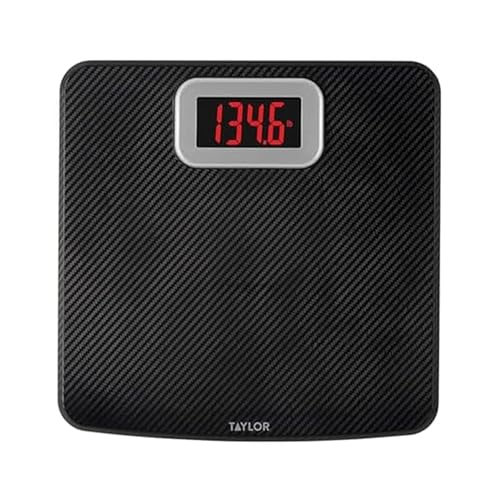
The Taylor Digital Scale uses four precision sensors and an anti-slip carbon fiber mat instead of bare glass, which reduces the chance of the scale sliding on a wet floor. The 440 lb capacity is adequate for most users, and the bright red LED display is readable from a standing height without bending.
The step-on activation works reliably—stand on it to turn it on, step off, then step back on to get your reading. This two-step process is intentional: it forces the scale to tare to zero before measuring. The build is lighter than the Tanita, but the carbon fiber surface feels more durable than typical tempered glass.
Accuracy reviews are mixed: most call it consistent, but a notable minority report that moving the scale changes the reading by 1–2 pounds. The 0.2 lb increments are standard for this price point but less granular than the 0.1 lb competitors. It is a solid entry-level choice for someone who just wants a straightforward weight.
Why it’s great
- Anti-slip carbon fiber surface
- Bright red LED display
- Auto tares before each measurement
Good to know
- 0.2 lb increments, not 0.1
- Readings shift if the scale is moved
FAQ
How do I test if my bathroom scale is actually accurate?
Why does my scale give different readings when I move it between rooms?
Final Thoughts: The Verdict
For most users, the bathroom scale for accuracy winner is the Withings Body Smart because it delivers clinically validated 50 g repeatability and integrates seamlessly into a broader health tracking ecosystem. If you want a no-app, heavy-duty workhorse that has been verified against known weights for years, grab the Tanita HD-351. And for a budget-friendly entry point that still uses four sensors and avoids glass fragility, nothing beats the Taylor Digital Scale.