
Our readers keep the lights on and the weekend projects moving. As an Amazon Associate, I earn from qualifying purchases.
A power outage during a critical save, a brownout that corrupts your OS, or a surge that fries your motherboard — these aren’t rare inconveniences; they’re the everyday gamble of running a desktop computer without a proper uninterruptible power supply between it and the wall. A battery backup is the only hardware that buys you the time to save, shut down, and walk away with your data and components intact.
I’m Rikta — the co-founder and writer behind FitlyFast. My focus here is on matching UPS topologies, sine wave types, and VA ratings to the real power draw of modern PCs, monitors, and networking gear so you don’t overpay for capacity you can’t use or under-spec a unit that drops your machine mid-save.
After sorting through runtime claims, battery chemistries, and customer stress tests across seven distinct models, this guide to the best battery backup for computer explains exactly which unit fits your desk size, component wattage, and outage frequency.
How To Choose The Best Battery Backup For Computer
Most buyers start by looking at the VA number, assuming bigger always means better. In reality, the wattage rating is what determines whether a UPS can actually power your PC, and the sine wave type determines whether your power supply will cooperate. Matching these two specs to your specific hardware is the core decision.
Wattage vs. VA — Read the Fine Print
A 1500VA unit might only deliver 900W of real output. Your computer’s power supply rating (say, 750W) is the maximum it can draw, not what it typically uses. Measure your actual load with a kill-a-watt meter or add up component TDPs before picking a unit. For a mid-range gaming rig, a 600W to 900W UPS is usually the sweet spot that provides runtime without being oversized and heavy.
Simulated Sine Wave vs. Pure Sine Wave
If your computer uses an Active Power Factor Correction (PFC) power supply — common in mid-to-high-end desktop PSUs — a simulated sine wave UPS can cause the PSU to drop into protection mode during battery operation, effectively shutting down your PC before the battery is even depleted. Pure sine wave output mimics utility power and prevents that conflict. For standard office PCs without PFC, simulated sine wave works reliably and costs less.
Battery Chemistry and Lifecycle Costs
Sealed Lead Acid (SLA) batteries dominate the budget-to-mid-range market. They’re cheap upfront but typically need replacement every three to five years, adding to over the unit’s life. Lithium Iron Phosphate (LiFePO4) batteries, found in premium units, boast ten-year lifespans and thousands of charge cycles. The higher initial cost often pays off if you plan to keep the same UPS for years rather than replacing the whole unit when the SLA battery dies.
Quick Comparison
On smaller screens, swipe sideways to see the full table.
| Model | Category | Best For | Key Spec | Amazon |
|---|---|---|---|---|
| CyberPower CP1500PFCLCD | Pure Sine Wave | Active PFC PCs | 1500VA / 1000W | Amazon |
| APC Back-UPS Pro Gaming | Pure Sine Wave | High-end gaming rigs | 1500VA / 900W | Amazon |
| Eaton Tripp Lite OMNI1500LCDT | Simulated Sine Wave | Office/workstation setups | 1500VA / 810W | Amazon |
| CyberPower AVRG900LCD | Simulated Sine Wave | Budget-conscious desktop builds | 900VA / 480W | Amazon |
| GOLDENMATE 1000VA | Pure Sine Wave | Long lifespan & compact footprint | 1000VA / 600W | Amazon |
| APC BE600M1 | Simulated Sine Wave | Entry-level PC & network gear | 600VA / 330W | Amazon |
| TalentCell Mini UPS | DC-Only Lithium | Low-power gear (router/modem) | 98Wh / 27000mAh | Amazon |
In‑Depth Reviews
1. CyberPower CP1500PFCLCD

This is the most frequently recommended pure sine wave UPS in the mid-premium tier for a clear reason: 1500VA and 1000W of clean output that matches the real-world draw of a high-end desktop with a PFC power supply. The line-interactive topology with Automatic Voltage Regulation smooths out brownouts without tapping the battery, preserving cycle life for when you actually need it. The color LCD tilts up to 22 degrees and reports input/output voltage, load in watts and VA, battery percentage, and remaining runtime — a level of transparency that makes capacity planning trivial.
Customer data shows this unit handling idle loads around 260W and gaming loads up to 870W on systems with RTX 5090-class GPUs without triggering overload warnings. At a typical 40% load on a network setup — router, NAS, PoE switch — reviewers report over 60 minutes of runtime. The unit includes 12 outlets, six battery-backed and six surge-only, plus a Type-A and Type-C USB charging port. The two internal 12V batteries are user-replaceable, and the bundled PowerPanel software enables automatic shutdown scheduling and sensitivity adjustment.
The initial electrical smell reported by some buyers dissipates within a day of use. The simulated sine wave of cheaper units causes random shutdowns on PFC-equipped Mac Pros and gaming desktops; the CP1500PFCLCD’s pure sine wave eliminates that failure mode entirely, making it the safest choice for modern hardware without moving to the gaming-aesthetic price tier.
Why it’s great
- Pure sine wave output compatible with Active PFC power supplies
- Informative tilting color LCD with real-time wattage and runtime data
- 12 outlets with AVR preserve battery during voltage fluctuations
- User-replaceable batteries and free PowerPanel management software
Good to know
- Strong initial plastic/electronics smell reported by several buyers
- Heavy at nearly 25 pounds for its footprint
- Outlets are spaced closely, which may block adjacent ports with bulky AC adapters
2. APC Back-UPS Pro Gaming BGM1500B-US

APC targeted this UPS directly at the gaming segment, and the design decisions reflect that focus. The 1500VA / 900W pure sine wave output handles high-wattage components — verified by a customer running an RX 7900 XTX on a 1200W PSU — without the false overload trips that occur on less tolerant units. The Reactor Circle LCD screen is tilted at 160 degrees for readability from a seated position, showing runtime, load, and power health at a glance. The customizable RGB LED ring with 12 colors lets you match the unit to your case lighting without third-party software.
Six battery-backed outlets cover the PC, monitor, and console, while four surge-only outlets handle peripherals. Auto Voltage Regulation boosts low voltage and trims high voltage without switching to battery, which extends runtime when you do hit a full outage. The unit passed self-tests and survived multiple short-duration outages with less than 20% battery drain on high-end gaming loads. The built-in Type-C charger adds convenience for modern peripherals and phones during a blackout.
The main trade-offs are weight — 30.8 pounds, making relocation a two-hand job — and a faint high-frequency whine that buyers with sensitive hearing reported as distracting in a quiet room. The RG B accent light on the rear is always on when the unit is powered, with no software toggle to disable it, which may annoy some users who prefer a completely dark entertainment center or office corner.
Why it’s great
- Pure sine wave output for gaming PCs with Active PFC power supplies
- Customizable RGB LED ring integrates with gaming setup aesthetics
- Reactor Circle LCD is easy to read from a seated position
- AVR extends battery life by correcting voltage fluctuations without switching to battery
Good to know
- Very heavy at over 30 pounds
- Faint high-frequency whine audible to some users
- Rear accent light cannot be turned off without physically covering it
3. Eaton Tripp Lite OMNI1500LCDT

The OMNI1500LCDT delivers 1500VA and 810W in a tower form factor that includes AVR, a detailed LCD screen, and 10 outlets — six battery-backed and four surge-only. The simulated sine wave output is sufficient for standard desktop computers and peripherals that don’t use Active PFC power supplies. The Automatic Voltage Regulation corrects brownouts from 92V up to 120V and trims over-voltage down to 120V without draining the battery, which makes this unit particularly effective in areas with frequent grid fluctuations rather than total blackouts.
Customer testing shows this unit running a desktop tower, monitor, modem, and router at about 16% load, delivering approximately 50 minutes of backup runtime. On a security camera setup, it ran for over three hours before depleting. The internal battery is user-replaceable with the RBC51 cartridge, and the three-year warranty covers the battery as well. Tripp Lite’s reputation for longevity is backed by a reviewer who reported a five-year-old unit still performing well during an outage, running network gear for several hours on the original battery.
The bundled PowerAlert software has been widely criticized as buggy — multiple users reported it failing to discover the device on the network and causing registry errors during uninstallation. If remote management isn’t a requirement, this is a non-issue; the unit works perfectly in standalone mode. A strong electronics smell during the first few days of operation is common, but it fades with normal use.
Why it’s great
- Durable build with reported 5+ year battery service life
- AVR corrects voltage fluctuations without using battery
- LCD display provides clear runtime, load, and status information
- connected equipment insurance included
Good to know
- PowerAlert software is poorly rated — skip it and use standalone mode
- Initial strong electronics smell reported by many buyers
- Simulated sine wave may cause issues with Active PFC power supplies
4. CyberPower AVRG900LCD
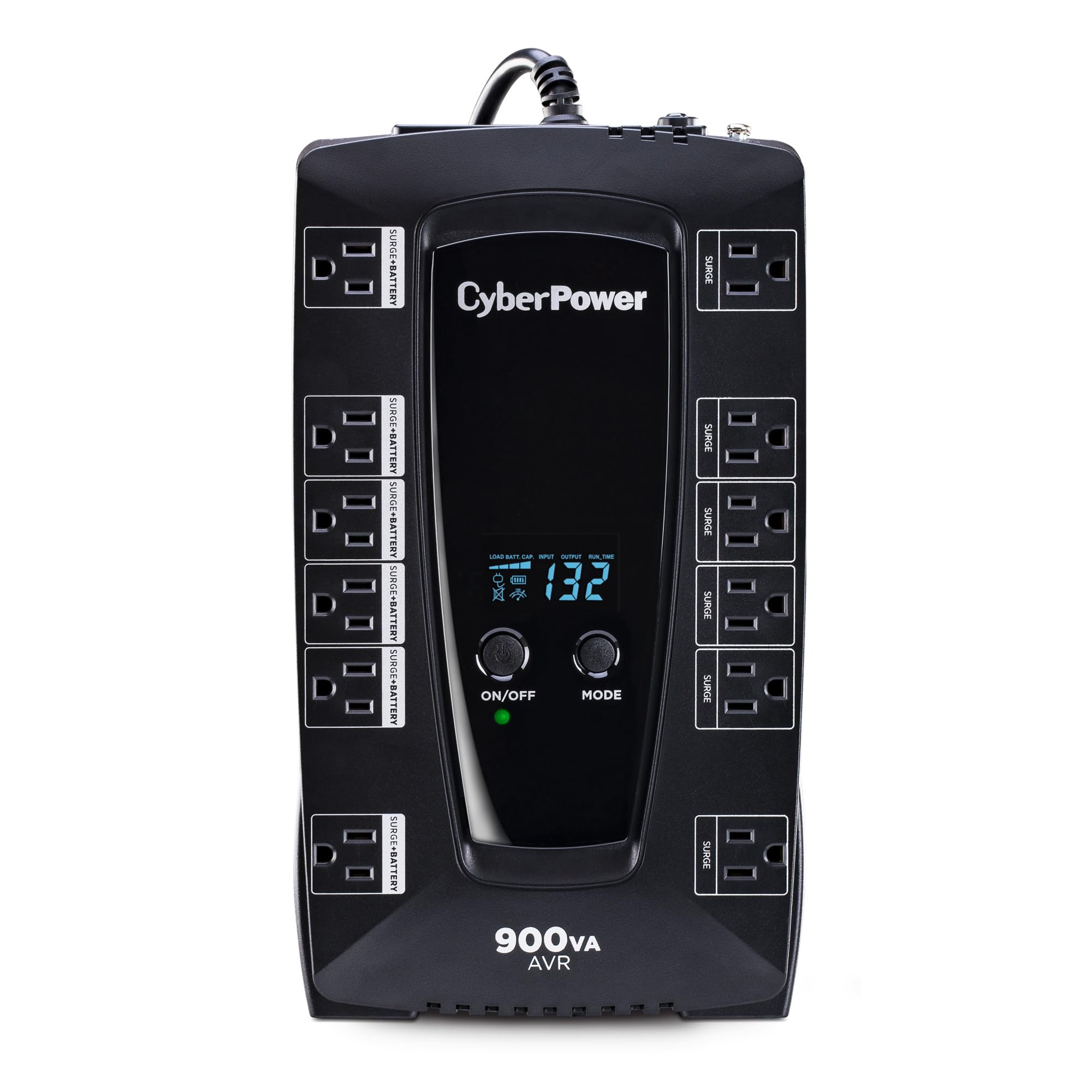
The AVRG900LCD sits at a capacity that matches the real power draw of a standard desktop PC plus monitor — 480W of battery output is enough for most office builds, light gaming rigs, and home theater PCs. The AVR feature corrects voltages between 90V and 140V back to a safe 120V without engaging the battery, which means this unit spends less time in battery mode during minor fluctuations, preserving its three-year battery life for actual outages. The LCD panel shows input voltage, output wattage, battery capacity, and estimated runtime.
Real-world customer data shows a 72W load — a modest desktop, router, and modem — delivering approximately 62 minutes of backup time. A heavier 175W to 200W load with two machines and monitors provided 18 to 20 minutes, which is sufficient for saving work and initiating a graceful shutdown. The 12 outlets split evenly between battery-backed and surge-only, giving you room for a PC, two monitors, a printer, and a couple of phone chargers behind surge protection only.
The setup process involves pressing the mode button to calibrate the unit, which some users found unintuitive initially. The free PowerPanel software is well-regarded for automatic shutdown scheduling. A small percentage of units arrived with display or battery faults, but CyberPower’s support team handled replacements responsively with prepaid return labels. The simulated sine wave output is not suitable for Active PFC power supplies — if your PC has one, skip this model and go up to the pure sine wave tier.
Why it’s great
- AVR preserves battery life during brownouts and voltage spikes
- LCD display shows real-time wattage, voltage, and runtime data
- 12 outlets provide ample room for a full desktop setup
- Free PowerPanel management software for automated shutdown
Good to know
- Simulated sine wave incompatible with Active PFC power supplies
- Mode button setup can be confusing for first-time users
- Some units arrive with display or battery faults, though support is responsive
5. GOLDENMATE 1000VA Lithium UPS

This unit distinguishes itself from every other UPS on this list through its LiFePO4 battery chemistry, which claims over 5000 charge cycles and a decade of service life compared to the three-to-five-year lifespan of the sealed lead acid batteries in the APC, CyberPower, and Tripp Lite units. The pure sine wave output at 1000VA / 600W makes it suitable for a mid-range desktop with an Active PFC power supply, a gaming console, or a home office setup. The white enclosure and compact footprint — roughly 13 inches deep and 10 inches tall — fit neatly on a desk corner or under a monitor stand without dominating the space.
Customer testing shows a 22W load running for over 40 minutes while maintaining above 90% capacity, indicating the BMS (Battery Management System) efficiently manages discharge. The intelligent LCD panel provides real-time data on battery voltage, load wattage, and fault alerts, and the built-in buzzer mute function lets you silence the alarm with a single button press during an outage. Eight NEMA 5-15P outlets offer plenty of connection points, and the low-noise cooling fan stays under 50 dB during heavy battery operation.
The main drawbacks are the lack of a USB data port or network card for automated shutdown — this unit operates purely as a standalone power source without software integration. A mild plastic smell during the burn-in period is common, and the outlets are spaced closely enough that chunky AC adapters may block adjacent ports. The transfer time is rated at around 20ms, which is standard for a line-interactive UPS but could be too slow for some ultra-sensitive telecom equipment.
Why it’s great
- LiFePO4 battery with 5000+ charge cycles and 10-year lifespan
- Pure sine wave output compatible with Active PFC power supplies
- Compact white design fits discreetly into home office setups
- Buzzer mute function silences alarm with a single press
Good to know
- No USB or network data port for automated shutdown software
- Outlets are close together — bulky adapters may need a short extension cord
- Mild plastic smell reported during initial days of use
6. APC BE600M1

The BE600M1 is the most popular entry-level UPS on the market for a simple reason: it provides the essential safety functions — surge protection, battery backup for a graceful shutdown, and a USB charging port — at a price point that makes it an easy addition to any desktop setup. With 600VA / 330W of battery output, this unit is designed for a single computer plus a modem and router, not for multi-monitor gaming rigs or server stacks. The simulated sine wave output works reliably with standard office PC power supplies that don’t use Active PFC.
Customer reports consistently show 10 to 15 minutes of runtime at the 100W load of a typical desktop and monitor, which is exactly the window needed to save open files and initiate a safe shutdown. The 23-minute runtime claim at a 100W load is achievable with the modem and router alone. The five battery-backed outlets and two surge-only outlets provide enough ports for a basic setup, and the built-in 1.5A USB port keeps your phone charged during an outage. The recessed on/off button is a small but appreciated detail — it prevents pets and accidental bumps from powering down your protection.
The battery is user-replaceable using APC’s RBC154 cartridge, extending the unit’s life beyond the initial battery cycle. The 10-hour recharge time is standard for this class. The main limitation is capacity: if you add a second monitor, a high-end GPU, or plan to keep working through an extended outage, you’ll outgrow this unit quickly. It is a safety net for data integrity, not a run-through-the-night power source.
Why it’s great
- Reliable simulated sine wave performance for standard desktop PCs
- Recessed power button prevents accidental shutdown by pets or bumping
- Built-in USB port charges devices during power outages
- User-replaceable battery extends the unit’s service life
Good to know
- 330W capacity limits use to basic desktop and network gear only
- 10-hour recharge time may be slow for back-to-back outages
- Simulated sine wave unsuitable for Active PFC power supplies
7. TalentCell Mini UPS 27000mAh

This is not a conventional UPS — it’s a DC-only lithium battery pack designed for low-power 12V, 9V, and 5V equipment. It won’t power a desktop computer’s AC power supply, but it excels at keeping your modem, router, ONT, and security cameras online for extended periods during a blackout. The 98Wh capacity, delivered via four DC 12V ports, one DC 9V port, and two USB ports (one with 18W USB-C PD), can run a typical networking stack for 8 to 24 hours depending on the load. One customer recorded 24 hours and 18 minutes of uptime on a modem and VoIP phone setup.
The compact form factor — 6.3 x 5.5 x 1.3 inches — and 700-gram weight make it easy to tuck behind a desk or mount on a wall near your router. The internal BMS provides short-circuit, over-current, and over-charge/discharge protection. The unit consolidates up to five wall adapters into a single power source, reducing cord clutter and parasitic draw from multiple power bricks. The lithium battery chemistry means no memory effect and a flat discharge curve through most of its capacity.
The main limitation is the 98-watt maximum output — anything that draws more than 37W continuously will deplete the battery quickly. The LED battery indicator is imprecise, with the 75% light remaining illuminated from about 85% capacity down to 40% charge, making it hard to gauge actual remaining runtime. The DC barrel connectors are 5.5mm x 2.1mm, which means you may need separate adapter cables if your device uses a different jack size. This unit is a supplement to a standard AC UPS, not a replacement for one.
Why it’s great
- Extremely long runtime for network gear — 8 to 24 hours on a single charge
- Compact and light enough to mount near a router without floor space
- Multiple voltage outputs (12V, 9V, 5V) eliminate separate wall adapters
- Lithium battery with no memory effect and long cycle life
Good to know
- Cannot power standard desktop computers — DC-only output
- LED battery indicator is imprecise between 85% and 40% charge
- DC barrel connectors require adapter cables for non-standard jack sizes
FAQ
Can a UPS with simulated sine wave damage my computer’s power supply?
How do I calculate the right VA rating for my desktop computer?
Should I replace the battery in my existing UPS or buy a new unit?
Why does my UPS beep constantly during an outage?
Can I plug a power strip or surge protector into my UPS?
Final Thoughts: The Verdict
For most users, the best battery backup for computer winner is the CyberPower CP1500PFCLCD because its pure sine wave output, informative LCD, and user-replaceable battery deliver the right balance of compatibility and transparency for modern desktop hardware at a justifiable price. If you want a dedicated gaming aesthetic and RGB customization, grab the APC Back-UPS Pro Gaming BGM1500B-US. And for a compact workstation or home office where longevity matters more than peak wattage, nothing beats the decade-plus lifespan of the GOLDENMATE 1000VA Lithium UPS.