
Our readers keep the lights on and the weekend projects moving. As an Amazon Associate, I earn from qualifying purchases.
A power outage isn’t just an inconvenience when you rely on an oxygen concentrator—it’s a direct threat to your respiratory health. You need a battery backup that delivers clean, stable power to your medical-grade compressor the moment the grid goes dark, without causing alarm cycling or equipment damage.
I’m Rikta — the founder and writer behind FitlyFast. I’ve spent years analyzing backup power solutions for medical devices, comparing sine-wave purity, battery chemistry, and runtime performance to separate the options that genuinely protect patient safety from those that simply check a box.
This guide focuses on the specs that matter most when finding the right battery backup for oxygen concentrator, from pure sine wave output and battery capacity to automatic voltage regulation and safe pass-through charging.
How To Choose The Best Battery Backup For Oxygen Concentrator
Selecting a battery backup for an oxygen concentrator isn’t like picking one for a home office. The compressor motor inside a concentrator is sensitive to electrical noise and voltage dips. The wrong backup can cause the unit to alarm, cycle on and off, or even fail to start. You need to evaluate four specific factors before making a choice.
Output Waveform: Pure Sine Wave Is Non-Negotiable
Oxygen concentrators use precision compressor motors that expect a clean, smooth AC sine wave. A simulated or modified sine wave inverter can introduce harmonic distortion that makes the motor run hot, vibrate erratically, or refuse to start altogether. Pure sine wave UPS units—like the CyberPower CP1500PFCLCD—deliver power indistinguishable from grid electricity, keeping the concentrator running exactly as designed.
Battery Chemistry: Lead-Acid vs. LiFePO4
Traditional lead-acid UPS batteries are affordable upfront, but they degrade faster under deep discharge cycles. For a medical device that needs reliable runtime during multi-hour outages, LiFePO4 chemistry offers ten times the cycle life and stable voltage output until the battery is nearly empty. A unit like the GOLDENMATE 1000VA uses LiFePO4 cells rated for over 5000 cycles, reducing long-term replacement costs and ensuring consistent performance for years.
Runtime Under Load: Matching Capacity to Your Device
Check your concentrator’s label for its power draw in watts—most home units consume between 120 and 350 watts during normal operation. A backup with higher VA rating doesn’t always mean longer runtime; watt-hour (Wh) capacity is the real metric. For a 200W concentrator, a 300Wh LiFePO4 battery provides roughly 1.5 hours of continuous operation, while a 600Wh unit extends that to three hours. Always overestimate your needs by 20 to 30 percent to account for startup surges.
Automatic Voltage Regulation and Transfer Time
AVR corrects sags and surges without switching to battery, preserving the battery’s charge for when you truly need it. Equally important is transfer time—how quickly the UPS switches to battery when grid power fails. For a concentrator motor, a transfer time under 10 milliseconds is ideal to prevent the compressor from stalling. Sine-wave UPS units with line-interactive topology typically achieve the fastest switching.
Pass-Through Charging and Continuous Use
If you plan to leave the backup permanently connected, it must support pass-through charging—delivering clean AC power to the concentrator while simultaneously keeping its internal battery topped up. Many CPAP-focused battery packs like the BLUETTI X30 and EASYLONGER ES960 PRO are designed for always-on inline operation, making them practical for daily use rather than just emergency deployment.
Quick Comparison
On smaller screens, swipe sideways to see the full table.
| Model | Category | Best For | Key Spec | Amazon |
|---|---|---|---|---|
| APC BE600M1 | UPS | Short-duration desktop protection | 330W / 600VA, lead-acid | Amazon |
| SKE SK625 | UPS | Compact backup with AVR | 360W / 625VA, lead-acid | Amazon |
| SKE SK1500 | UPS | Extended runtime for higher power | 900W / 1500VA, lead-acid | Amazon |
| GOLDENMATE 1000VA | UPS | Long-life LiFePO4 backup | 600W / 1000VA, LiFePO4 | Amazon |
| CyberPower OR500LCDRM1U | Rack UPS | Rack-mount deployment | 300W / 500VA, simulated sine | Amazon |
| EASYLONGER ES720 PRO | Portable Battery | Multi-night CPAC/concentrator use | 276.48Wh, Li-ion | Amazon |
| CyberPower CP1500PFCLCD | UPS | Pure sine wave, high-watt concentrators | 1000W / 1500VA, pure sine | Amazon |
| BLUETTI X30 | Portable Battery | Ultra-light CPAP/concentrator travel | 297Wh, Li-ion | Amazon |
| EASYLONGER ES960 PRO | Portable Battery | Multi-night with pass-through | 297.6Wh, LiFePO4 | Amazon |
In‑Depth Reviews
1. EASYLONGER ES960 PRO
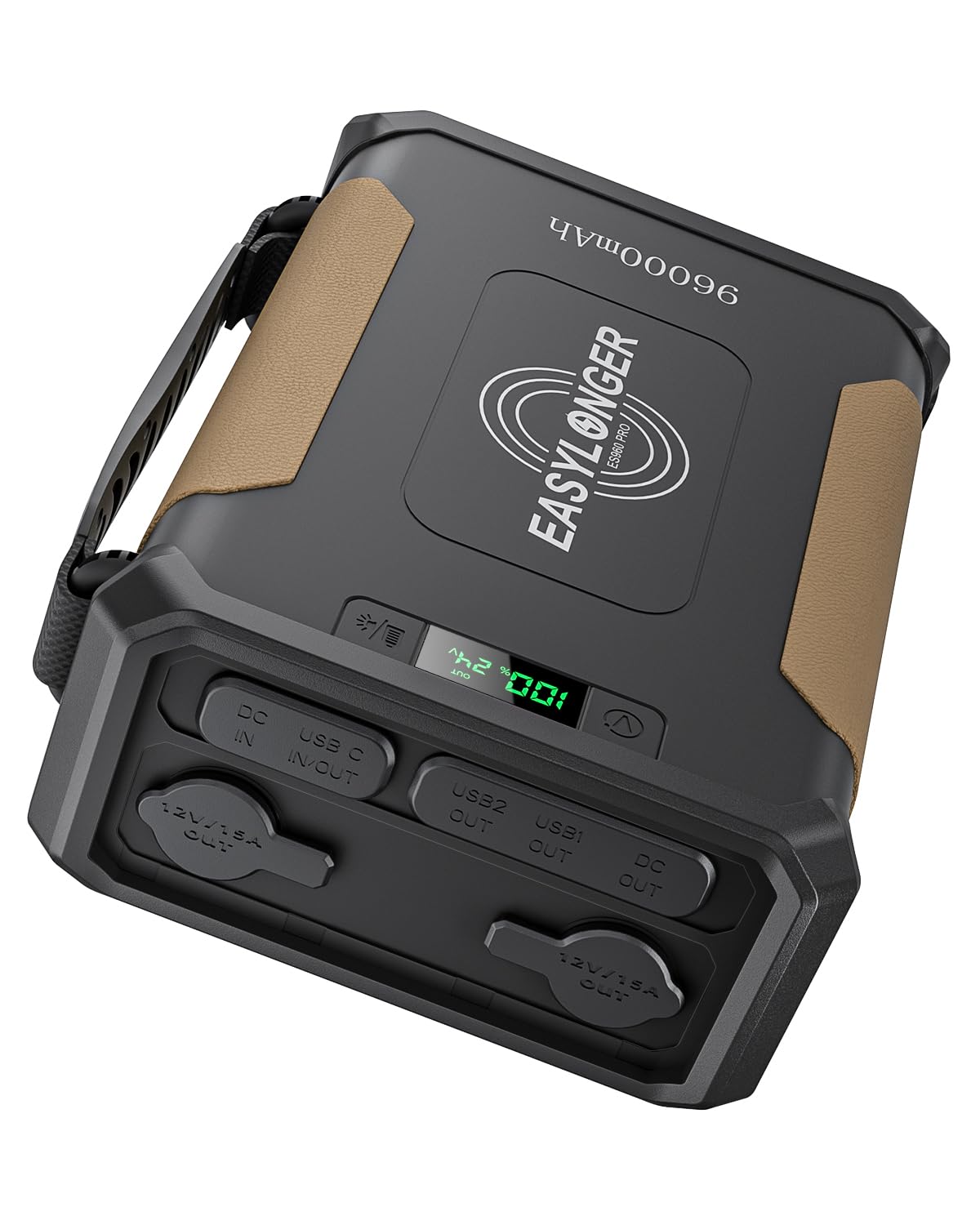
The EASYLONGER ES960 PRO packs 297.6Wh of LiFePO4 chemistry into a body that supports continuous pass-through operation, meaning it stays plugged inline between the wall and your concentrator, always charged and ready. Its memory function remembers the last DC output voltage setting—a small convenience that matters when you’re setting it up bedside and don’t want to reconfigure at every power interruption.
Real-world runtime tests with an AirSense 10 at moderate pressure (humidifier and heated tube off) showed approximately 14 hours of use before hitting 50 percent capacity. The unit also charges fully from the included wall adapter in about five hours, which aligns well with an overnight recharge window. Six output ports—including a 100W USB-C—mean you can keep a phone or tablet alive during the same outage.
At 6.6 pounds, it is not a featherweight, but the rugged build and five-hour recharge time make it a viable daily companion for anyone who needs guaranteed backup. One caveat: the flashlight on the unit can activate accidentally if jostled in a bag, so store it with the interface side protected.
Why it’s great
- LiFePO4 delivers over 3000 charge cycles for long-term reliability
- Always-on pass-through charging keeps it topped up without manual intervention
- Fast 5-hour recharge prepares it for the next night
Good to know
- Heavier than Li-ion alternatives at 6.6 pounds
- Flashlight can activate accidentally during transport
2. CyberPower CP1500PFCLCD

When an oxygen concentrator demands clean power, pure sine wave is the only safe route. The CyberPower CP1500PFCLCD delivers 1000 watts of true sine wave AC output, matching the waveform your concentrator expects from the wall. This prevents the compressor from overheating, developing erratic vibration patterns, or triggering false alarms during an outage.
Its line-interactive topology and Automatic Voltage Regulation keep the load stable without draining the battery during brownouts—a significant advantage if you experience frequent voltage dips rather than full blackouts. The color LCD panel displays real-time wattage consumption, which helps you confirm your concentrator’s actual draw and estimate remaining runtime accurately.
Twelve outlets (six backed up by battery) give you the flexibility to also power a home Wi-Fi router or a phone charger during the same outage. The connected equipment guarantee reflects confidence in its surge protection. At 24.9 pounds, it’s a stationary unit best placed near the concentrator, not carried between rooms.
Why it’s great
- True pure sine wave output protects sensitive compressor motors
- AVR extends battery life by correcting fluctuations without switching to battery
- Real-time wattage display helps you plan runtime
Good to know
- Heavy tower design unsuitable for portable use
- Initial burn-off smell from electronics may occur on first use
3. BLUETTI X30

At just 4.1 pounds with a built-in handle, the BLUETTI X30 is the lightest dedicated backup in this lineup. Its 297Wh capacity delivered 5 to 7 nights of use in independent tests when paired with a ResMed AirSense 10 running at a therapeutic pressure without humidification—an impressive range for such a compact frame.
The X30 includes three DC output ports covering 12V, 15V, and 24V, along with a full set of color-coded cables that map clearly to specific machine models. The LCD screen shows remaining capacity in clear percentages, and the unit supports simultaneous pass-through operation, so you can keep it plugged in between the wall and your concentrator without worrying about battery drain.
Recharging takes around 4 hours from a standard wall outlet. One limitation: only one device can be powered at a time through the DC ports, which is fine for a single concentrator but means you cannot charge a separate device simultaneously through the DC pathways. The USB-A port does provide 5V/2.5A for phone charging on the side.
Why it’s great
- Extremely lightweight for travel to appointments or alternate sleeping locations
- Multiple nights of runtime on a single charge at moderate settings
- Clear LCD battery percentage eliminates runtime guesswork
Good to know
- Only one device can draw from the DC outputs at a time
- Not compatible with all Philips DreamStation models—verify before buying
4. EASYLONGER ES720 PRO
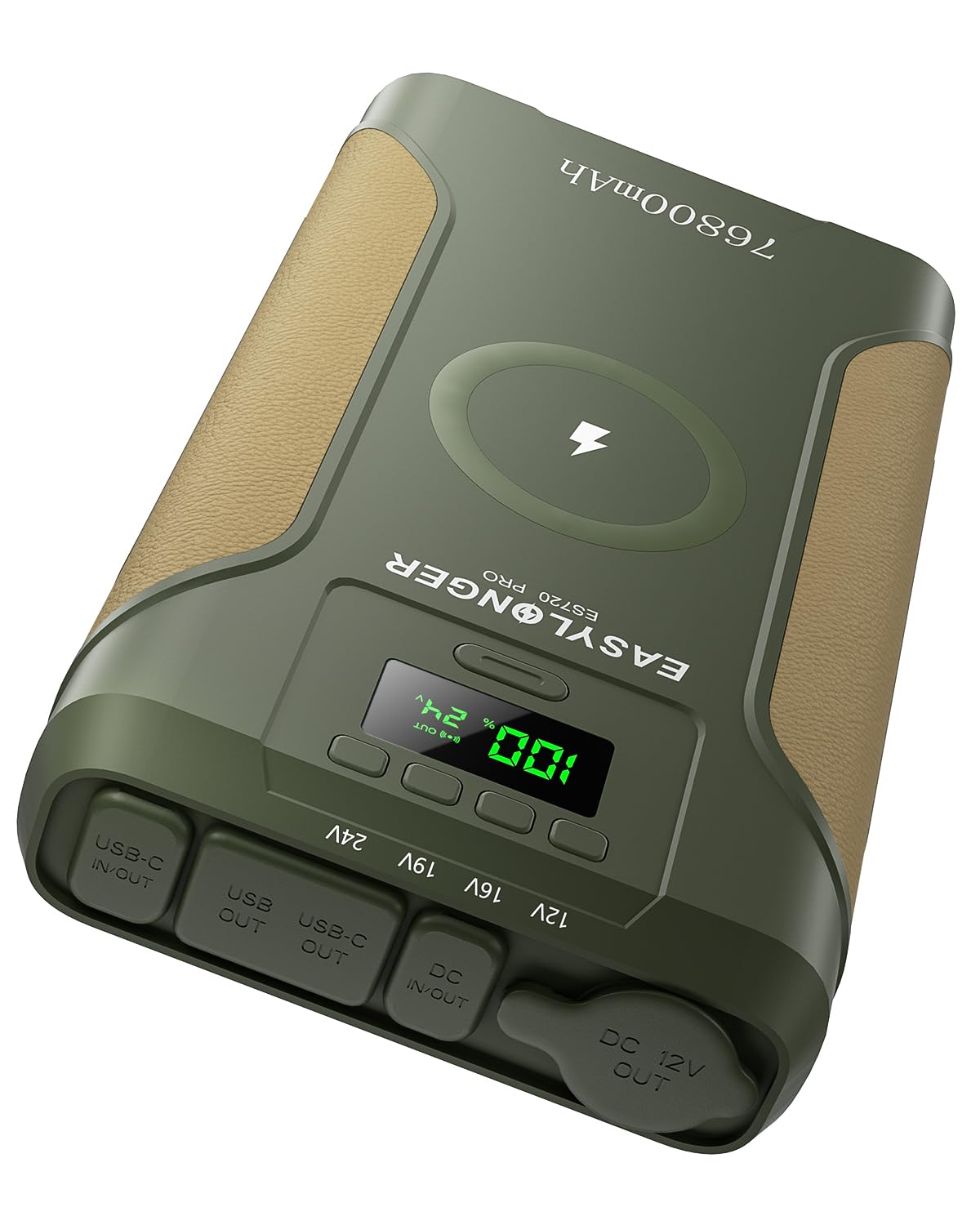
The EASYLONGER ES720 PRO bridges the gap between a compact travel battery and a multi-night power solution. Its 276.48Wh capacity is enough for 2 to 3 nights of CPAP or concentrator use with the humidifier off, and the included set of four dedicated DC cables covers the most common ResMed and Philips connections right out of the box.
A smart digital display shows real-time battery level, voltage, and charging status, with dedicated buttons to switch between 12V, 16V, 19V, and 24V DC outputs. The unit also supports wireless phone charging on its top surface and includes a 60W USB-C PD input that can recharge the battery from a laptop charger or car adapter in about 4 hours.
Weighing just 3.3 pounds, it is among the lightest options for its capacity class. The integrated BMS handles overcharge, over-discharge, and short-circuit protection. A white LED with steady and SOS modes adds emergency utility. The main trade-off is the Li-ion chemistry, which offers fewer total charge cycles compared to LiFePO4 alternatives like the ES960 PRO.
Why it’s great
- Very lightweight at 3.3 pounds for easy transport
- Four included DC cables cover the major CPAP/concentrator brands
- Wireless charging pad and 60W USB-C add everyday value
Good to know
- Li-ion chemistry has a shorter cycle life than LiFePO4
- Voltage setting must be reset after each power cycle
5. GOLDENMATE 1000VA

The GOLDENMATE 1000VA is one of the few UPS units in its class to leverage LiFePO4 battery chemistry rather than sealed lead-acid. That choice translates into an expected service life exceeding 10 years with over 5000 charge cycles, versus the typical 3-year lead-acid lifespan. For a medical device that cannot afford unexpected battery failure, this longevity is a practical safety feature, not just a spec sheet boast.
Its pure sine wave output delivers 600 watts continuously, which comfortably covers most home oxygen concentrators. The eight NEMA 5-15R outlets (all backed by battery) provide plenty of capacity for additional monitoring equipment. The intelligent LCD panel displays input/output voltage, load level, and battery capacity, and the built-in BMS actively manages charging to prevent over-temperature and over-voltage conditions.
At 10.6 pounds, it is significantly lighter than equivalently rated lead-acid UPS units thanks to the lithium chemistry. The cooling fan operates below 50 dB and only activates under heavy load, so it stays quiet during normal pass-through operation. Be aware: the outlets are spaced relatively close together, so bulky transformer-based plugs may block adjacent sockets.
Why it’s great
- LiFePO4 battery lasts over 10 years with thousands of cycles
- Pure sine wave output ensures clean power for the compressor motor
- Significantly lighter than lead-acid UPS units with the same capacity
Good to know
- Outlet spacing is tight for bulky AC adapters
- No USB data or network connection for automated shutdown
6. SKE SK1500

The SKE SK1500 provides 900 watts of backup power through 8 outlets (6 battery-backed), making it one of the highest-capacity UPS units in the mid-range segment. That wattage headroom is important if you have a high-flow concentrator pulling 300 to 400 watts, or if you want to share the backup with a secondary medical device during the same outage.
Its LCD display gives you real-time visibility into input voltage, output voltage, battery capacity, and load level, all at a glance. The AVR function corrects minor voltage fluctuations without draining the battery, preserving runtime for when the power actually cuts. The front-panel button can disable the audible alarm during battery mode, which is a welcome feature if the backup is stationed in a bedroom.
Multiple users have reported one hour of runtime under a moderate load, and some have achieved over two hours when running networking equipment alone. The 22-pound weight and tower form factor mean it is a fixed installation—place it beside the concentrator and leave it. Battery replacement is straightforward with the user-accessible compartment, and the lead-acid cells are inexpensive to swap when they eventually age out after 2 to 3 years.
Why it’s great
- 900W capacity covers high-wattage concentrators comfortably
- User-replaceable lead-acid batteries keep long-term costs low
- AVR extends usable battery life during brownout conditions
Good to know
- Heavy 22-pound tower is not portable
- Some units have experienced premature battery failure after 18 months
7. CyberPower OR500LCDRM1U

The CyberPower OR500LCDRM1U is a specialized unit for users who need to rack-mount their backup alongside other equipment. Its 1U height saves valuable floor space, but the 300-watt capacity means it is only appropriate for low-power concentrators—those drawing under 250 watts continuous. The simulated sine wave output is a limitation for sensitive medical compressors; verify your specific concentrator’s compatibility before relying on this waveform.
It includes six NEMA 5-15R outlets (four backed by battery, two surge-only), and the multifunction LCD panel displays runtime in minutes and battery status. An optional RMCARD205 management card adds remote power monitoring via HTTP/SNMP, which is useful in a clinical or multi-device setting where network-based alerts are beneficial.
The 3-year warranty covering the battery is better than many competitors, and the connected equipment guarantee adds recovery protection. At 1.75 inches tall, it fits neatly into a standard 19-inch rack. If you need rack-mount form factor and can operate within the power envelope, this is a clean installation solution. Otherwise, the simulated sine wave and modest wattage limit its utility for concentrator duty.
Why it’s great
- 1U rackmount design saves floor space in clinical or home-lab settings
- Optional network management card enables remote monitoring alerts
- 3-year warranty including battery is longer than typical
Good to know
- Simulated sine wave may not be suitable for all concentrator motors
- 300W limit only works with low-power concentrator models
8. SKE SK625
The SKE SK625 offers a rare combination: budget-friendly price, Automatic Voltage Regulation, and an intelligent LCD display in one compact 9.26-pound package. Its 360-watt capacity is tight but workable for a low-power oxygen concentrator in the 150 to 250 watt range, and the AVR helps it handle voltage sags without draining the battery prematurely.
User reviews specifically mention using this unit with an oxygen concentrator during brief power outages, with the LCD providing clear feedback on load level and battery status. The 6 outlets include 4 battery-backed positions and 2 surge-only, giving you one spare outlet for a router or phone charger. The audible beep during battery operation can be silenced by pressing the on key—a feature designed for bedroom environments where alarm noise would be disruptive.
The lead-acid battery takes about 10 hours to fully charge and provides roughly 23 minutes of runtime at a 100W load; expect proportionally less at the higher draw of a concentrator. It is a solid entry-level option for someone who wants basic protection with the reassurance of AVR, but the runtime limitation means it works best for short-duration or transitional outages rather than multi-hour events.
Why it’s great
- AVR corrects voltage fluctuations without draining the battery
- LCD display shows load, battery, and voltage at a glance
- Audible alarm mute prevents bedroom disturbance
Good to know
- 360W capacity limits it to low-power concentrator models
- Lead-acid battery has limited runtime at full concentrator draw
9. APC BE600M1

The APC BE600M1 is the most recognizable UPS on this list, and for good reason: its 330-watt capacity and 600VA rating provide basic backup for a low-power concentrator, while the familiar APC brand offers a sense of reliability the generic options lack. It includes 7 outlets (5 battery-backed plus 2 surge-only) and a 1.5A USB port for phone charging during the outage.
The standout feature for concentrator users is the user-replaceable battery design. When the internal lead-acid cell inevitably degrades after 2 to 3 years, you can swap in APC replacement battery RBC154 without replacing the entire unit—a cost-saving benefit that medical device owners often appreciate. The compact form factor (10.8 x 4.1 x 5.5 inches) slides easily onto a side table or shelf beside the concentrator.
Runtime at a 100W load is rated at 23 minutes, so if your concentrator draws 200W, you can expect roughly 11 to 12 minutes of backup—enough for a short blip or a graceful shutdown. The deep-socket power cord plug is recessed, adding a small layer of protection against accidental unplugging. This is a solid starting point for those on a restricted budget, but the modest runtime and lead-acid aging curve make it a short-term solution for concentrator backup.
Why it’s great
- User-replaceable battery avoids total unit replacement after 2-3 years
- Compact footprint fits easily beside a concentrator
- Built-in USB port charges a phone during the outage
Good to know
- Roughly 11-12 minutes of runtime at a typical 200W concentrator draw
- Lead-acid chemistry degrades faster with deep discharge cycles
FAQ
Can I use a regular computer UPS for my oxygen concentrator?
How many hours of backup runtime do I need for an oxygen concentrator?
What is the difference between Li-ion and LiFePO4 for concentrator backup?
Does automatic voltage regulation matter for an oxygen concentrator?
Final Thoughts: The Verdict
For most users, the battery backup for oxygen concentrator winner is the CyberPower CP1500PFCLCD because its pure sine wave output and 1000-watt capacity protect sensitive compressor motors while providing enough runtime for short to medium power interruptions. If you want multi-night autonomy with LiFePO4 safety, grab the EASYLONGER ES960 PRO. And for lightweight portability when traveling between rooms or to appointments, nothing beats the BLUETTI X30.