
Our readers keep the lights on and the weekend projects moving. As an Amazon Associate, I earn from qualifying purchases.
Portable power stations have quietly killed the gas generator’s monopoly on home backup. No more fumes, no more fuel runs, no more waking the neighborhood at 2 AM when the grid drops. The challenge now is sifting through the spec sheets — watt-hours, surge ratings, inverter types, and charge times — to find a unit that actually handles your fridge, sump pump, or CPAP without breaking your back or your budget.
I’m Rikta — the co-founder and writer behind FitlyFast. Over the years, I have spent hundreds of hours analyzing battery chemistries, inverter topologies, and charge controller specs to separate the genuinely useful portable power stations from the marketing fluff.
This article walks through the capacity, output, and expandability metrics that matter most, so you can confidently pick the right battery backup generator for your home, RV, or adventure rig.
How To Choose The Best Battery Backup Generator
Buying a battery backup generator requires you to think beyond the total watt-hours. You need to evaluate inverter type, battery chemistry, recharge speed, and whether the system can grow with your needs. A unit that perfectly powers a weekend campsite might fail when a hurricane knocks out power for three days.
Battery Chemistry: LiFePO4 vs. NMC
Lithium Iron Phosphate (LiFePO4) cells dominate the current market. They handle over 3,500 charge cycles before dropping to 80% capacity, while older NMC (Nickel Manganese Cobalt) cells typically fade after 500-800 cycles. LiFePO4 also resists thermal runaway better, making it safer for indoor use. Every unit in this guide uses LiFePO4 chemistry.
Inverter Type and Surge Capacity
A pure sine wave inverter is non-negotiable for sensitive electronics like laptops, CPAP machines, and modern refrigerator control boards. Look at both the continuous wattage (what the unit can sustain) and the peak surge (the burst needed to start a motor, compressor, or pump). Some appliances draw three times their running wattage on startup.
Expansion and Recharge Flexibility
Consider whether the station accepts external battery packs to double or triple its capacity down the road. Equally important is how fast it recharges from a wall outlet and whether it can accept high-wattage solar input. A unit that refills in two hours is vastly more practical than one that takes ten when the grid is unreliable.
Quick Comparison
On smaller screens, swipe sideways to see the full table.
| Model | Category | Best For | Key Spec | Amazon |
|---|---|---|---|---|
| EF ECOFLOW Delta 3 Classic | Mid-Range | Compact all-around home backup | 1024Wh, 1800W | Amazon |
| Anker SOLIX C2000 Gen 2 | Mid-Range | Ultra-low standby for long fridge run | 2048Wh, 2400W | Amazon |
| Jackery Explorer 2000 v2 | Mid-Range | Lightest 2kWh unit for portability | 2042Wh, 2200W | Amazon |
| AFERIY P210 | Mid-Range | Long warranty near-silent operation | 2048Wh, 2400W | Amazon |
| BLUETTI AC200L | Premium | Massive expansion via B300 packs | 2048Wh, 2400W | Amazon |
| PECRON F3000LFP | Premium | High capacity direct solar acceptance | 3072Wh, 3600W | Amazon |
| Jackery HomePower 3600 Plus | Premium | Wheeled whole-home 240V backup | 3584Wh, 3600W | Amazon |
| Westinghouse iGen12000DFc | Premium | High-wattage fuel-flexible inverter | 12000W peak, 9000W run | Amazon |
| GROWATT HELIOS 3600 | Premium | Dual-unit 7200W whole-house parallel | 7200W, 7200Wh total | Amazon |
In‑Depth Reviews
1. EF ECOFLOW Delta 3 Classic
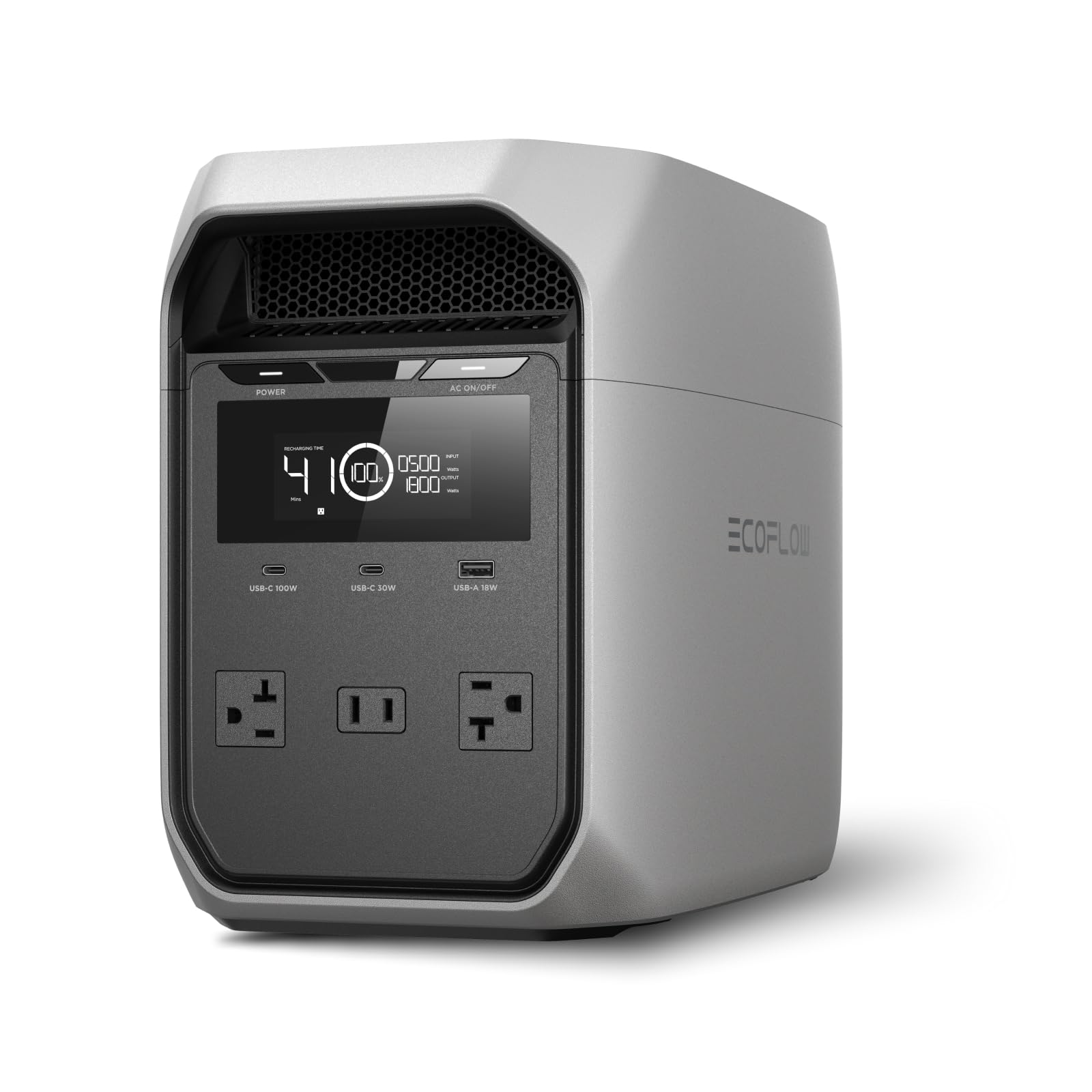
The Delta 3 Classic packs 1024Wh of LiFePO4 storage and a 1800W pure sine wave inverter into a 15-pound frame — an unusually high power-to-weight ratio for this capacity class. Its X-Boost technology handles loads up to 2600W, so you can start a refrigerator compressor or a 1500W space heater without tripping the inverter.
AC recharging is genuinely fast. The X-Stream mode pushes 0–80% in about 45 minutes, which makes the unit practical for quick top-offs between outages. The built-in UPS switches in under 10ms, fast enough to keep a desktop PC from blinking during a brownout.
The app lets you schedule on/off times and monitor load in real time. Real-world users report running a 65-inch TV for over four hours, two CPAP machines for two nights, and even a tankless water heater. The unit lacks expandable battery support, so its 1024Wh is fixed — fine for short outages and camping, but not for multi-day whole-home backup.
Why it’s great
- Extremely fast AC recharge (45 min to 80%)
- Excellent UPS with under-10ms switchover
- Compact and light at 15 pounds
Good to know
- Battery capacity is not expandable
- Fan runs audibly during heavy loads
2. Anker SOLIX C2000 Gen 2
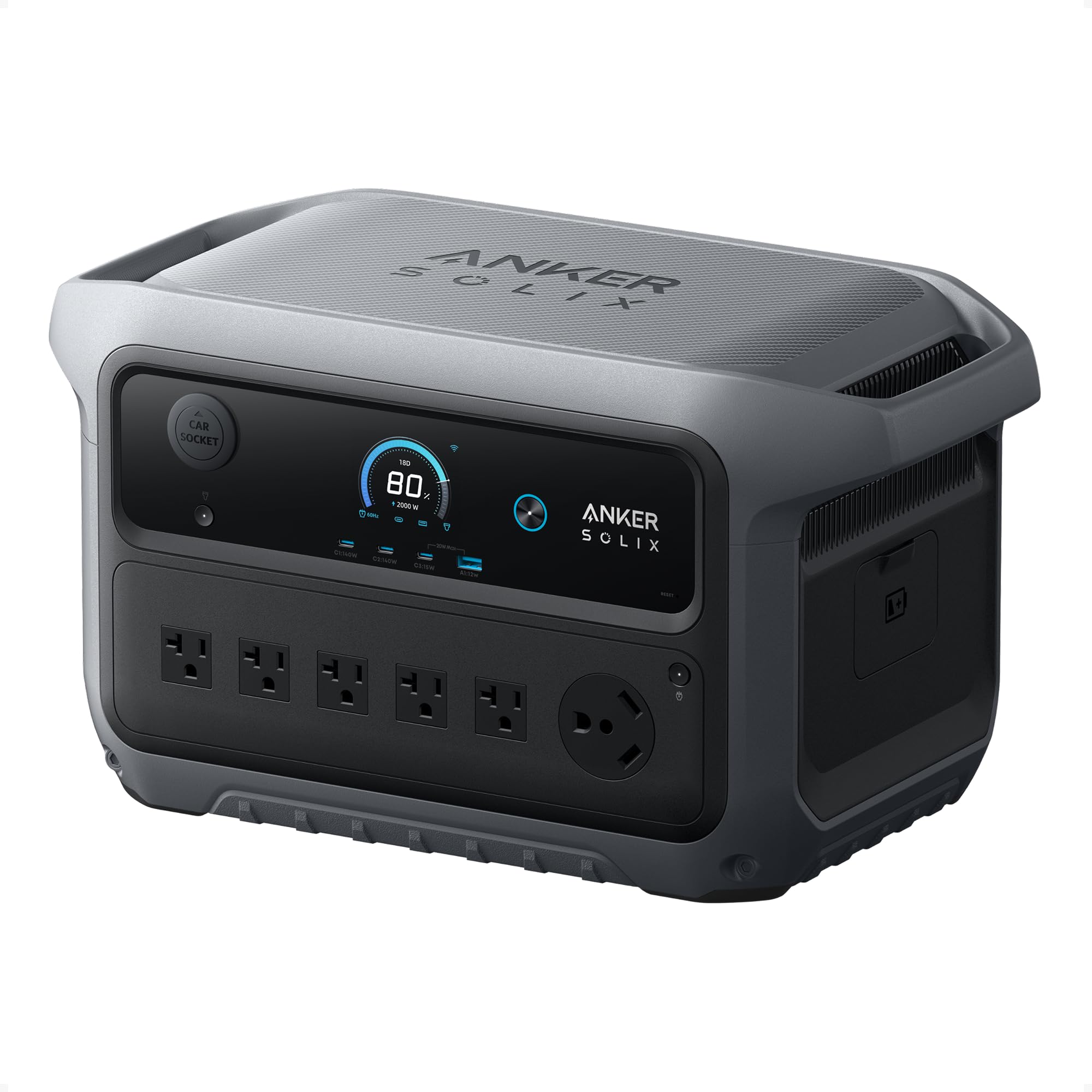
The C2000 Gen 2 distinguishes itself with an absurdly low 9W standby draw. That matters because most power stations burn 30-50W just sitting on the shelf, draining their own battery. With a standby rate this low, a connected fridge can run up to 32 hours before the station itself needs a recharge.
Output hits 2400W continuous with a 4000W peak, enough to kick-start most window or RV air conditioners. Full recharge takes just 58 minutes via AC, and the unit supports 800W alternator charging — roughly eight times faster than a standard 12V car socket. You can also add an expansion battery to push total capacity to 4kWh.
Owners report running a 30-quart car fridge for five to seven days on a single charge. The Bluetooth app tracks real-time consumption and usage predictions. The unit weighs 41.7 pounds and measures 18.1 x 9.8 x 10.1 inches, making it one of the most space-efficient 2kWh stations available.
Why it’s great
- Ultra-low 9W standby extends fridge runtime dramatically
- Full 2400W recharge in under 1 hour
- 800W alternator charging for vehicle top-ups
Good to know
- No hard copy manual included in box
- App requires initial setup for full features
3. Jackery Explorer 2000 v2

Jackery’s Explorer 2000 v2 uses automotive-grade CTB (Cell-to-Body) technology to shave weight. At 39.5 pounds, it is 41% lighter than many rival 2kWh stations. The trade-off is a slightly lower 2200W continuous output, though the unit still surges high enough to start most residential appliances.
AC fast charging hits 0–80% in 66 minutes, with an Emergency Super Charging mode — accessible via the app — that fully charges in 102 minutes. Solar input maxes at 400W, making a full sun-based recharge feasible in about six hours with the right panels. The 20ms UPS switch is UL1778 certified, meaning it passes official uninterruptible power supply testing.
User reports from off-grid living situations — one in Belize — show the unit powering Wi-Fi, lights, and electronics for days. The flashlight with SOS mode is a small but appreciated touch. Some owners note that the solar barrel ports feel slightly flexible when cables are inserted, which is the main physical weak point.
Why it’s great
- Lightest 2kWh station at 39.5 pounds
- UL1778 certified UPS for sensitive electronics
- Fast AC charge to 80% in 66 minutes
Good to know
- Solar barrel ports flex slightly under cable pressure
- Bluetooth connection can be inconsistent
4. AFERIY P210

The AFERIY P210 operates at a claimed 16 dB under normal load and under 30 dB at full draw — genuinely quiet enough to set up in a bedroom or van without disturbing sleep. That silence, combined with a 2048Wh LiFePO4 bank and a 2400W pure sine wave inverter, makes it a strong choice for overnight CPAP use and off-grid mobile living.
It is heavier than the Jackery at 54 pounds, but the 16-port panel — six AC outlets, two USB-C (one 100W), two USB-A, a car outlet, DC ports, and an XT60 — is unusually generous. The server-class UPS switches in under 10ms. A 7-year extended warranty backs the unit, which is two years longer than the industry standard.
Real-world feedback from food truck operators confirms the unit can handle commercial equipment all day. A few users report occasional display screen glitches after solar charging, and the app lacks schedule-based charging. Solar panel owners praise the customer support responsiveness.
Why it’s great
- Near-silent operation at 16-30 dB
- 16 ports including 2 USB-C and 6 AC outlets
- Extended 7-year warranty
Good to know
- Heavier than comparable 2kWh units at 54 lbs
- App lacks schedule-based charging
5. BLUETTI AC200L

The AC200L is a true modular power station. Its base 2048Wh pack expands via multiple B-series batteries up to 8192Wh, and you can mix B230, B300, and B300K packs to reach that ceiling. The 2400W inverter feature a 3600W Power Lifting mode for startup surges on air conditioners and well pumps.
AC charging input reaches 2400W, pushing a 0-80% top-up in 45 minutes. Solar input is rated at 1200W, so a full solar recharge takes roughly two hours with the right array. The unit includes a 30A RV outlet and a 48V/8A DC port, making it directly compatible with many trailer electrical systems.
Owners report running a 12,000 BTU window air conditioner for about four hours on solar alone. The app monitors usage over Wi-Fi and Bluetooth and supports grid passthrough to preserve battery during normal operation. At 61.4 pounds, it is heavy, but the expansion potential is unmatched at this price band.
Why it’s great
- Expandable to 8192Wh with B-series battery packs
- 1200W solar input for fast off-grid recharge
- 30A RV outlet and 48V DC port built in
Good to know
- Heavy base unit at 61.4 pounds
- Proprietary power cord requires ordering a spare
6. PECRON F3000LFP
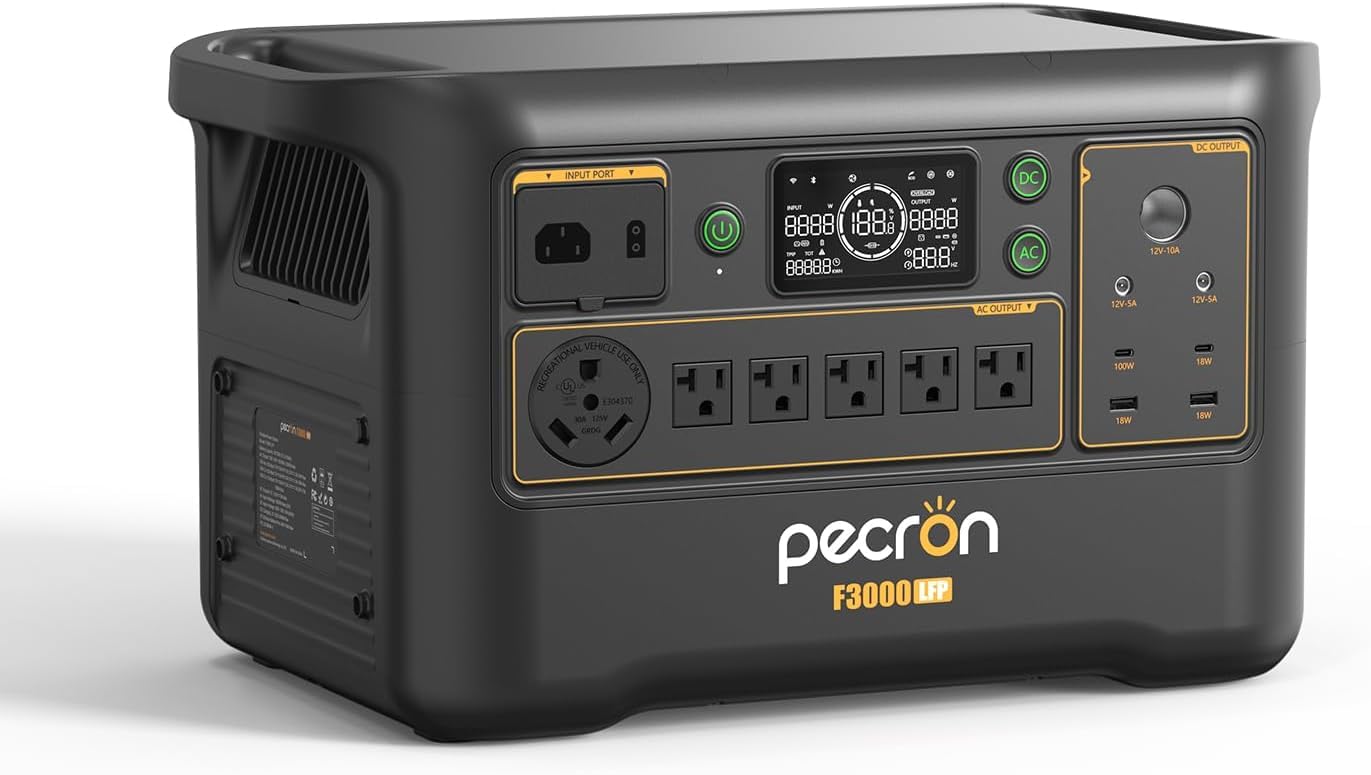
The F3000LFP delivers 3072Wh and a 3600W pure sine wave inverter in a package that weighs 63.3 pounds — relatively light for a 3kWh unit. AC input hits 1800W, allowing a full recharge in two hours. The solar controller accepts up to 1600W over a 25-120V input range, so it plays well with standard residential solar panels without a separate MPPT controller.
The 13-port panel includes six AC outlets, two USB-C ports with 100W PD, and a carport. Expansion using the optional EP3800-48V battery pushes total capacity to 10,752Wh. The app connects via Bluetooth and provides real-time load monitoring, though it lacks Wi-Fi remote access.
Users report a steady idle draw of around 30W/hr when the inverter is on — higher than some comparables. The fan runs audibly during heavy loads. On the positive side, one owner measured over 420W of solar input from a single 400W panel, suggesting generous MPPT headroom. The unit’s 8-20ms UPS switch keeps computers and medical gear safe.
Why it’s great
- Large 3072Wh capacity at a competitive weight
- Accepts 1600W solar input for fast off-grid refills
- Expandable beyond 10kWh with add-on battery
Good to know
- Inverter draws ~30W idle
- Fan is audible when charging or under load
7. Jackery HomePower 3600 Plus

The HomePower 3600 Plus is Jackery’s most ambitious station. It holds 3584Wh and outputs 3600W on a single unit, with the ability to parallel two units for 7200W at 120/240V. Expandable to 21kWh per unit, this system can power a three-person household for over two weeks according to Jackery’s internal testing.
It uses ceramic membrane battery cells that resist thermal runaway even at 302°F, and operates down to -4°F — critical for blizzard-prone regions. The built-in hand truck with telescoping handle makes the 77-pound unit relatively easy to move around the garage. Full recharge takes about two hours via hybrid AC+DC input.
User reviews consistently highlight the built-in hand truck as a game-changer for this weight class. One owner ran a fridge, TV, CPAP, and coffee maker for 26 hours and still had 89% charge remaining. The dual-voltage parallel capability lets it replace a traditional gas generator for whole-home transfer switch connections.
Why it’s great
- Massive 3584Wh base capacity expands to 21kWh
- Parallel support for 240V whole-home output
- Integrated hand truck and telescopic handle
Good to know
- Heavy at 77 pounds without expansion batteries
- Premium investment for whole-home setup
8. Westinghouse iGen12000DFc
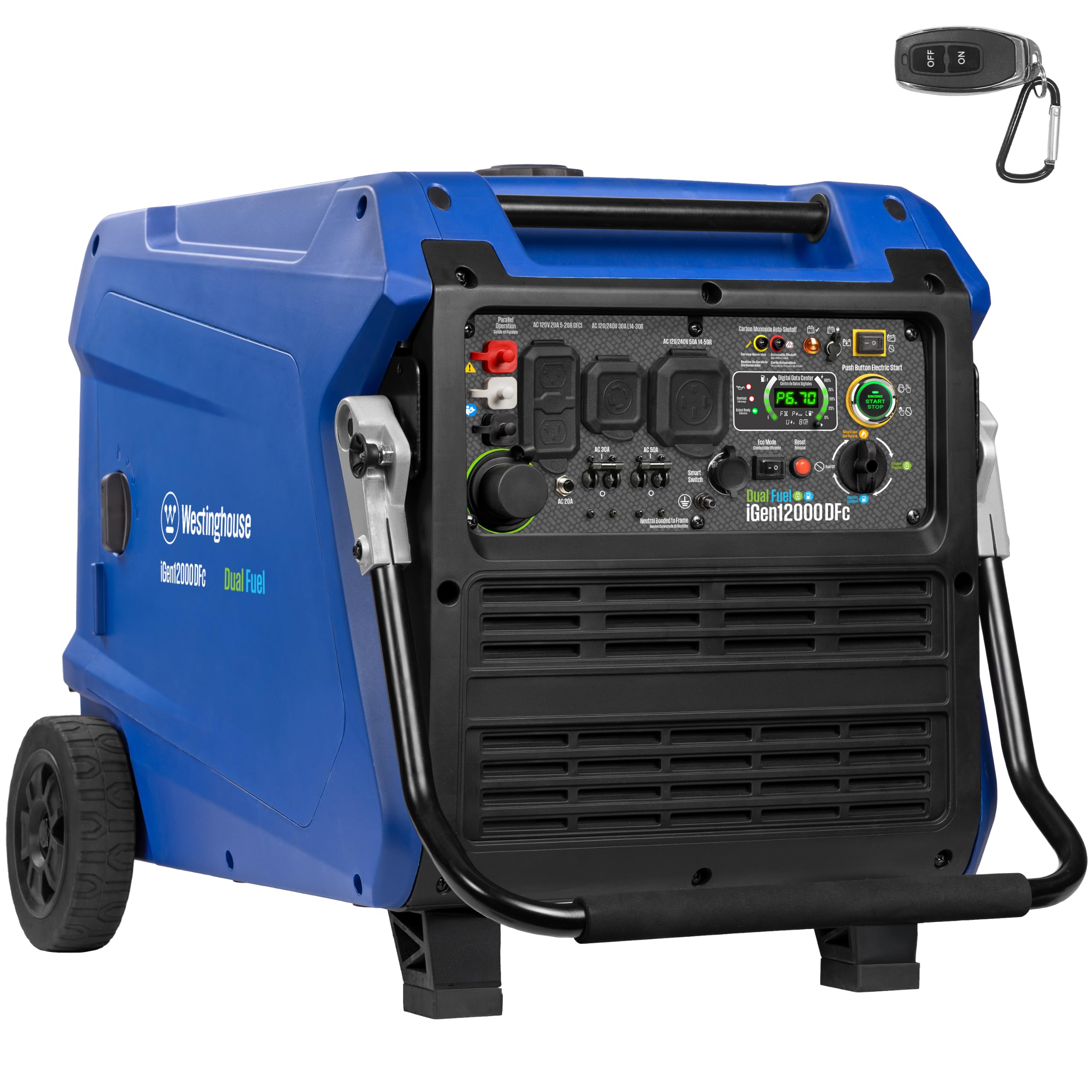
The iGen12000DFc is a dual-fuel inverter generator, meaning it uses gasoline or propane and produces inverter-grade power (less than 3% THD) that is safe for sensitive electronics. It peaks at 12,000W on gasoline (9,000W running) and 11,000W on propane (8,100W running). That is enough to run a whole-home transfer switch including a heat pump and electric dryer.
Eco Mode matches the engine speed to the load, cutting fuel consumption up to 50%. The 7.9-gallon tank delivers up to 19 hours of runtime at 25% load. The remote start key fob works from about 50 feet. A 50A 14-50R outlet is included for direct RV or transfer switch connection, plus a 30A twist-lock and a 20A duplex GFCI.
Owners confirm the unit runs a Tesla at 20-25 miles of range per hour via the 50A outlet — a unique use case for battery generators. The CO sensor and low-oil shutdown add safety layers. At 187 pounds, it is not portable in the same sense as a power station, but the foldable handle and flat-free tires make it manageable to position.
Why it’s great
- 12,000W peak power for whole-home backup
- Inverter tech with under 3% THD for electronics
- Remote start and dual fuel flexibility
Good to know
- Heavy at 187 pounds
- Requires routine fuel and oil maintenance
9. GROWATT HELIOS 3600
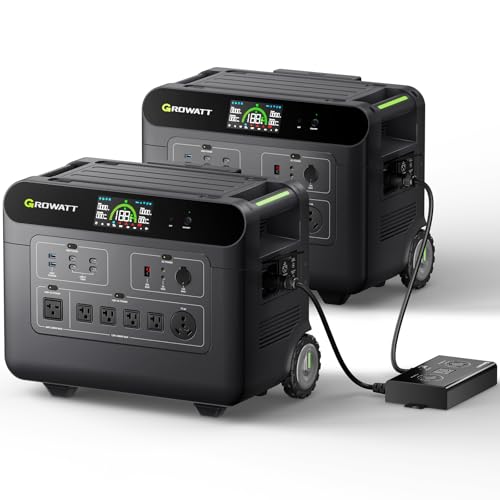
The HELIOS 3600 package ships with two 3600W / 3600Wh power stations and a split-phase connector that links them for 7200W at 120/240V. Each unit can expand to 36kWh total, providing up to a week of whole-home backup. The setup is truly plug-and-play — no electrician needed to achieve 240V output.
Each individual station charges via AC or up to 2000W of solar input. With both units charging simultaneously, the system can refill in about 1.5 hours in hybrid AC+DC mode. The EPS switch is rated under 15ms, keeping critical loads online during grid flickers. Growatt’s app enables load scheduling and real-time monitoring.
Real-world tests show a single HELIOS 3600 running an 8,000 BTU air conditioner for roughly five hours. With both units paralleled, owners can run well pumps, electric water heaters, and dryers. The EV-grade LFP cells retain 80% capacity after 4,000 cycles. Some users reported Bluetooth connectivity issues with the app, but the basic EPS function works without app connectivity.
Why it’s great
- 7200W / 7200Wh out of the box for whole-home power
- Plug-and-play 240V setup without an electrician
- Expandable to 36kWh for extended outages
Good to know
- 250-pound total system weight
- Bluetooth app connectivity can be inconsistent
FAQ
Can a battery backup generator power a house during an extended outage?
How long does a LiFePO4 battery in a power station actually last?
Can I recharge a battery generator with solar panels, and how many watts do I need?
What is the difference between a pure sine wave inverter and a modified sine wave inverter?
Final Thoughts: The Verdict
For most users, the battery backup generator winner is the EF ECOFLOW Delta 3 Classic because it packs an excellent balance of portability, fast charging, and UPS functionality into a 15-pound package that works for both home backup and camping. If you want maximum expandability and whole-home potential, grab the BLUETTI AC200L and scale it up with B-series batteries. And for off-grid scenarios where silence and a generous port selection matter, nothing beats the AFERIY P210 with its near-silent operation and 7-year warranty.