
Few household frustrations match the moment your TV remote, wireless mouse, or mechanical toy grinds to a halt because the batteries inside have given up. Disposables drain wallets and fill landfills, yet many rechargeable chargers are slow, unsafe, or incompatible with the cells you already own. A well-chosen charger pays for itself in months and keeps your devices running on demand — but only if it delivers the right current, independent bay control, and broad battery-type support.
I’m Rikta — the co-founder and writer behind FitlyFast. For this guide I’ve spent dozens of hours combing through real user feedback and cross-referencing charging curves, safety certifications, and bay configurations to separate the workhorses from the duds.
Whether you need to revive a dead car battery, top off 8 AA cells for a gaming marathon, or condition lithium-ion packs for pro gear, the right battery charger can mean the difference between a quick top-up and a frustrating afternoon of waiting.
How To Choose The Best Battery Charger
A charger’s job seems simple — push electricity into cells until they’re full. But cheap units cook batteries, misread chemistries, or quit after a few months. Focus on four factors that separate a smart investment from a fire hazard.
Independent Bays vs. Series Charging
Chargers that treat all slots as one group stop only when the weakest cell is full, overcharging healthier ones. Independent bays monitor each cell individually and cut power at peak voltage. This is essential for preserving NiMH cells that don’t tolerate trickle charging.
Chemistry Compatibility
Some chargers handle only NiMH. Others work with Li-ion, LiFePO4, and lead-acid. If you own 18650 vape cells, eneloop AA packs, or a car battery, pick a model with auto-detection or manual chemistry selection. Forcing the wrong charge curve damages the cell or triggers a safety shutdown.
Charge Current and Speed
Higher amperage means faster charging, but also more heat. A 1-amp charger fills a dead car battery in 24–48 hours (safe for maintenance). A 4-amp unit charges 8 AA cells in a few hours. For NiMH, stay under 0.5C (half the battery’s mAh rating) to avoid overheating. For lithium, the charger must limit current to the cell’s spec.
Safety Protections and Certifications
Look for overcharge protection, reverse polarity detection, short-circuit cutoff, and temperature compensation. UL, CE, and FCC marks indicate the unit passed independent testing. Chargers with thermal sensors adjust voltage in hot or cold garages, preventing boiling or undercharging. A smart maintainer can stay connected indefinitely without risk.
Quick Comparison
On smaller screens, swipe sideways to see the full table.
| Model | Category | Best For | Key Spec | Amazon |
|---|---|---|---|---|
| ANSMANN 8‑Bay | Household | High-volume family use | 8 independent bays | Amazon |
| NOCO GENIUS1 | Automotive | Vehicle maintenance | 1A, desulfation | Amazon |
| Tenergy TN486U | Universal | Mixed-size NiMH | 5 bays, LCD | Amazon |
| Panasonic eneloop CC63 | Premium Household | eneloop AA/AAA | 8 bays, 5‑hour charge | Amazon |
| MIEKLALE 8+2 Bay | Lithium Specialist | 18650 / LiFePO4 | 10 slots, LCD | Amazon |
| Panasonic eneloop CC65 | Pro Household | eneloop Pro / data nerds | 4 bays, LCD + USB | Amazon |
| Spektrum S2100 G2 | RC Pro | RC LiPo / Smart packs | 2x100W, AC smart | Amazon |
In‑Depth Reviews
1. Amazon Basics 8‑Bay NiMH Charger + 16 Cells
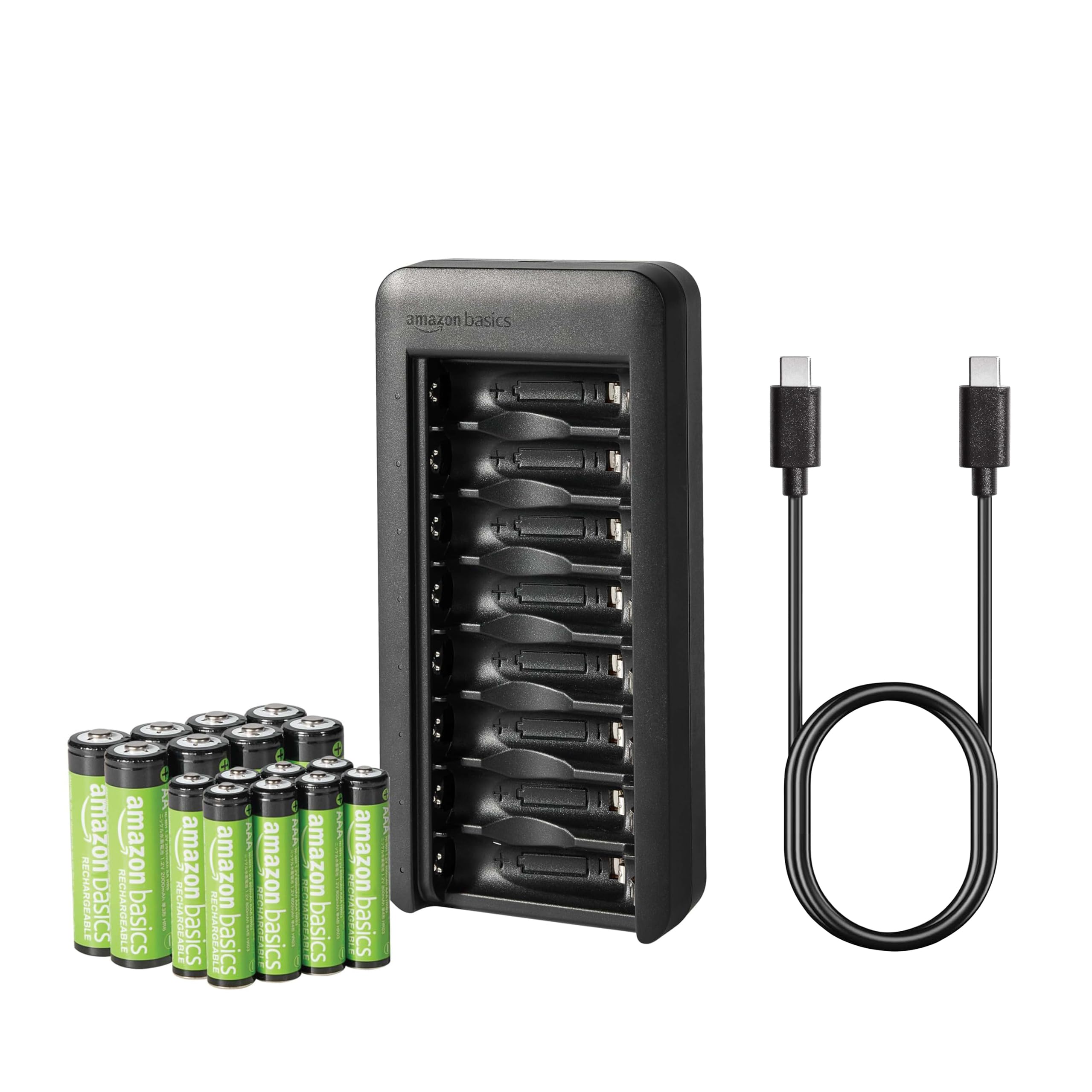
This bundle is the easiest path to ditching disposables entirely. The 8‑bay charger uses independent slots with smart LED patterns — slow blink for charging, solid white for full, fast blink for a bad cell. It shipped with eight AA 2000mAh and eight AAA 800mAh NiMH cells that carry 80% capacity after 12 months of shelf storage.
Users praised the cool operation and reliable charge termination, though a few noted that loading more than two AA batteries sometimes triggered the error LED. The USB-C input is a smart modern touch, but the missing AC adapter means you’ll need a 5V USB-C phone brick to get started. Full charge for all eight AA cells takes about 10 hours, which is reasonable for an overnight cycle.
If you routinely burn through batteries in remotes, toys, and kitchen scales, this is the most cost-effective solution on the market. The charger handles only NiMH chemistry — do not insert alkaline or lithium primary cells. For pure household duty, this bundle is unbeatable.
Why it’s great
- Includes 16 quality NiMH cells (AA + AAA) with long shelf life
- Independent bays prevent overcharging and extend cell lifespan
- USB-C input matches modern charging habits
Good to know
- No AC adapter included — must supply own USB-C power brick
- Charger is NiMH-only; not compatible with lithium chemistries
- Some users report error flashing when charging more than 2 AA
2. Panasonic eneloop BQ-CC63SBA 8‑Position Charger
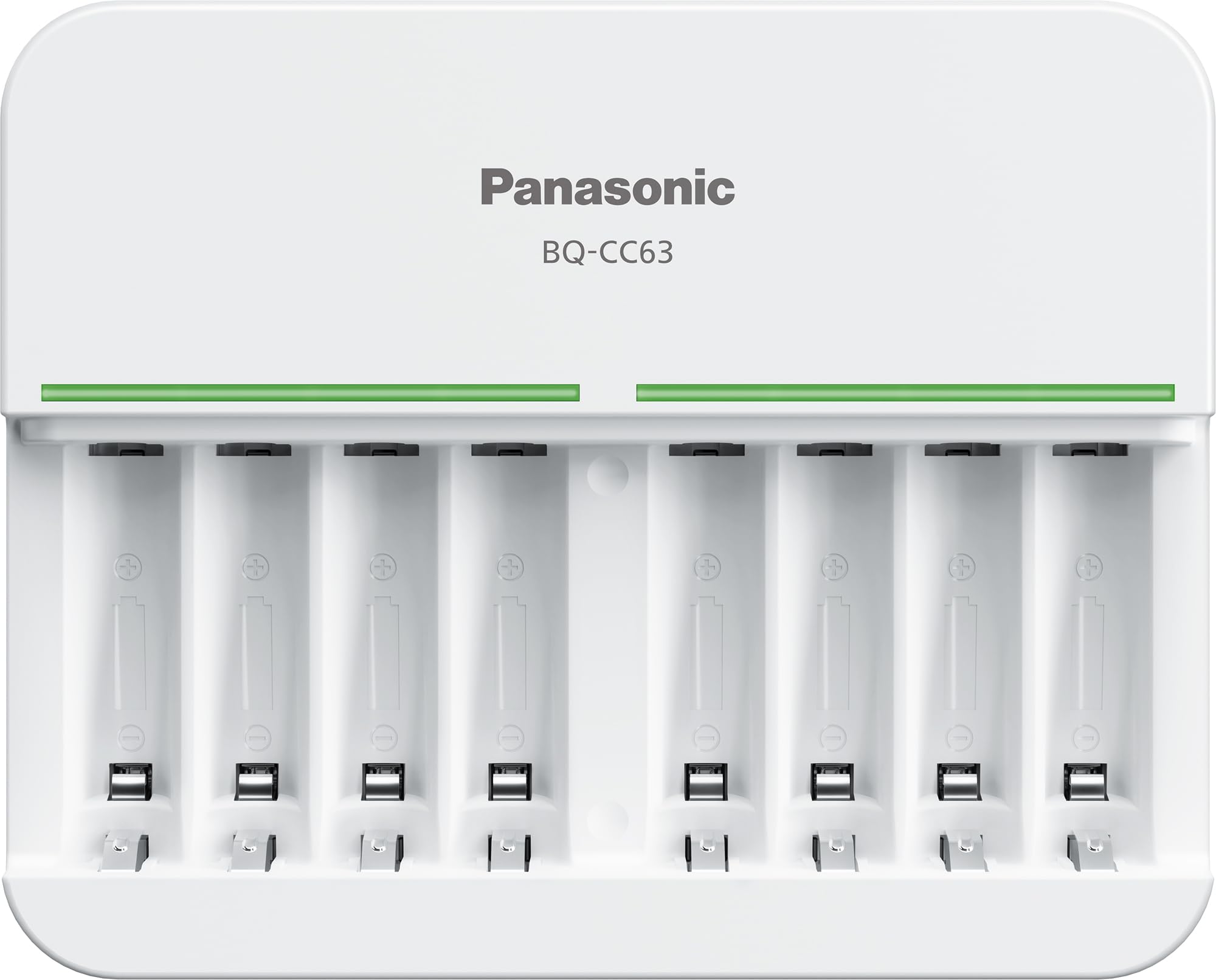
For eneloop devotees who want maximum throughput in a compact package, the CC63 delivers. Eight independent bays charge any mix of AA and AAA eneloop cells, finishing a full set of AA in 5 hours and AAA in 3 hours. The smart termination uses -ΔV detection — it cuts power the moment each cell peaks, preventing the heat buildup that shortens NiMH lifespan. Eight green LEDs give clear at-a-glance status without guesswork.
Reviewers consistently note the gentle, cool charging that leaves batteries at room temperature even after a full cycle. The 6‑foot AC cord offers flexibility for garage or desk placement. The build quality feels dense and well-damped, with snug spring contacts that handle frequent insertions without loosening. This is not a universal charger — it works exclusively with NiMH AA and AAA eneloop/eneloop Pro cells.
If your household runs on eneloop batteries and you need to charge 8 cells at once without fiddling with menus or settings, this is the most trustworthy option. The only notable omission is any charge-level readout beyond on/off — you won’t see voltage or capacity. For pure ease-of-use, that’s a trade worth making.
Why it’s great
- Eight truly independent bays treat each cell individually
- Fast 5‑hour AA charge without overheating
- Includes 6‑foot AC power cord for flexible placement
Good to know
- eneloop/eneloop Pro AA/AAA only — no lithium or C/D support
- LED only shows charging (green) or done (off); no voltage readout
- Premium price versus generic 8‑bay alternatives
3. Tenergy TN486U 5‑Bay Universal Charger

The Tenergy TN486U solves a specific problem: charging multiple battery sizes — AA, AAA, C, D, and 9V NiMH/NiCd — in one compact unit. Five independent bays accept any mix, and the LCD screen shows charging status per slot. The unit runs on USB power (micro USB or USB-C), making it easy to use with a laptop, power bank, or car adapter. Maximum charge current is 600mA per bay, which is moderate but safe for prolonged battery life.
Real-world users report excellent results charging large D cells that other chargers failed to fill. One reviewer noted the Tenergy fully charged four D batteries in under 20 hours, while a competing brand took over 30. The LCD readout is clear but basic — it shows charging status without voltage or capacity numbers. A minor complaint is the lack of an included USB power supply; you provide your own wall brick.
This is the pick for households that still use C, D, or 9V batteries regularly. The slim profile and dual-input USB options make it travel-friendly. It won’t match the speed of a dedicated 8‑bay AA/AAA charger, but for mixed-size convenience at an accessible price, the Tenergy is hard to beat.
Why it’s great
- Charges AA, AAA, C, D, and 9V NiMH/NiCd in one unit
- USB-C and micro USB input for versatile power sourcing
- LCD screen provides per-slot charge status clarity
Good to know
- No AC power supply included in box
- 600mA max per bay is slower than premium competitors
- No discharge or refresh function for battery conditioning
4. Panasonic eneloop BQ-CC65AKBBA 4‑Position LCD Charger

The CC65 is the analytical sibling of the CC63. Four independent LCD panels display real-time voltage, charge/discharge time, and mAh capacity for each of the four slots. That data lets you track battery health and spot weak cells before they fail in a device. The charger also includes a USB-A output port (5V, 1A) that doubles as a slow phone charger — useful for topping up a phone while conditioning eneloop Pro batteries.
Charge times are faster than the 8‑bay CC63: 4 AA eneloop Pro cells in up to 4 hours, or 2 cells in 2 hours. The refresh mode runs a discharge-recharge cycle that can resurrect old NiMH cells that have developed memory. Users with high-drain devices like Xbox controllers swear by this charger for the consistency it brings to battery performance. It works with NiMH AA/AAA only — do not insert lithium or other chemistries.
If you want to know exactly how much charge each battery received and maintain a log of cell capacity over time, the CC65 is the tool. The premium price reflects the LCD data and USB port. For casual users who just want charged batteries, the simpler CC63 or the Amazon Basics bundle offers better value.
Why it’s great
- Per-slot LCD shows voltage, mAh, and charge time
- Refresh mode restores older NiMH cells
- Built-in USB port charges phones or other devices
Good to know
- 4 bays only — fewer slots than the 8‑bay Amazon Basics or CC63
- NiMH AA/AAA only; no support for C/D/9V or lithium
- Premium cost reflects LCD and feature set
5. MIEKLALE 8+2 Bay Smart Li‑ion / NiMH Charger
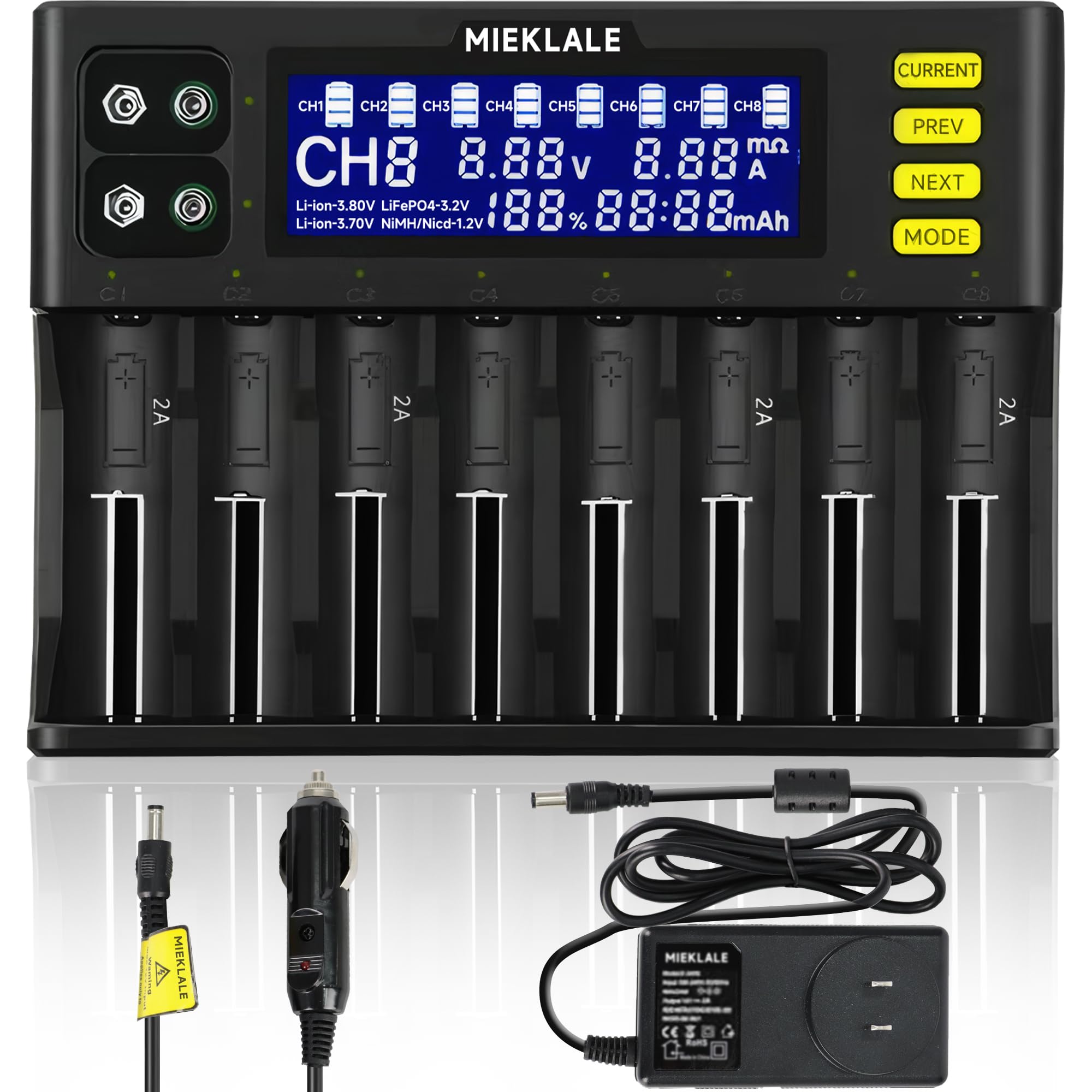
This charger is built for the enthusiast who juggles multiple chemistries. It handles Li-ion, LiFePO4, NiMH, and NiCd cells across 10 slots (8 adjustable channels plus 2 fixed). The LCD display cycles through voltage, current, charging time, capacity in mAh, energy percentage, and internal resistance in milliohms. The included 12V/4A power adapter delivers up to 2A per channel for fast charging of 18650, 26650, 16340, 14500, and 10440 cells.
Users appreciate the auto-detection feature that identifies battery chemistry and voltage without manual configuration, though the interface has a learning curve. Independent slot control means you can charge a LiFePO4 26650 next to a NiMH AA without conflict. The charger also includes a 12V car power cord for on-the-road use. A few reviewers noted that the charger does not always flag a dead or damaged LiPo cell accurately — it may show 100% on a bad cell, so keep an eye on voltage readings.
If your drawer contains a mix of vape 18650s, flashlights running 26650s, and AA NiMH for kitchen gadgets, this one device replaces three separate chargers. It is not needed for households that only use AA/AAA. The build feels slightly lightweight for a bay charger at this price, but the feature density is unmatched.
Why it’s great
- Charges Li-ion, LiFePO4, NiMH, and NiCd in 10 independent slots
- Detailed LCD shows voltage, mAh, internal resistance, and charge time
- Includes 12V/4A AC adapter and car power cord
Good to know
- Interface takes time to learn — not plug-and-play for everyone
- Build plastic feels lightweight compared to Panasonic options
- Does not discharge or condition batteries
6. NOCO GENIUS1 1A 6V/12V Smart Charger

The NOCO GENIUS1 is the go-to for maintaining lead-acid and lithium starter batteries. It delivers 1 amp to 6V or 12V batteries, including AGM, Gel, SLA, and LiFePO4. The unit continuously monitors ambient temperature and adjusts charge voltage to prevent overcharging in hot weather and undercharging in cold conditions. A desulfation mode sends precision pulses that can dissolve sulfate crystals and extend battery life for deeply discharged cells.
Users report the charger can revive batteries that sat dead for months, though the process is slow — expect 24–48 hours for a fully discharged car battery. Force Mode allows manual charging of batteries down to zero volts, which is a lifesaver for neglected garage finds. The unit is compact enough to leave permanently connected in a motorcycle or boat during storage. The single-button interface and LED color codes take some getting used to; read the manual carefully.
If you need a smarter way to keep vehicle batteries topped off during long storage periods, this is the most affordable quality option. It is not for fast charging a dead battery to get back on the road quickly — that requires a higher-amp unit. For three-season maintenance, the GENIUS1 is a proven performer.
Why it’s great
- Desulfation pulses restore sulfated lead-acid batteries
- Automatic temperature compensation adjusts charge curve
- Compact size allows permanent mounting in engine bays
Good to know
- 1 ampere output is very slow for deeply discharged batteries
- Interface is cryptic without the manual in hand
- Not for jump-starting or rapid recovery
7. Spektrum S2100 G2 2x100W AC Smart Charger

The S2100 G2 is a dual-channel AC charger built for RC hobbyists. Each channel delivers up to 100 watts (200W total on a single channel), charging and balancing Spektrum Smart G2 batteries through a single IC3 or IC5 connection — no separate balance lead is needed. The charger automatically recognizes Smart battery parameters and begins charging at the correct rate. It also handles conventional LiPo, LiFe, NiMH, NiCd, and lead‑acid packs.
Users highlight the bright display, dedicated hardware power switch, and customizable charge/discharge/storage profiles. The two channels operate independently, so you can charge a 4S LiPo for a drone and a 6S LiPo for a car simultaneously. The built-in balance function for non-G2 packs requires a separate balance board. The charger runs cool during normal operation, but the discharge fan is loud when set to high rate.
If you fly drones, race RC cars, or maintain a fleet of hobby-grade LiPo packs, this is the gold standard for convenience and power. General households with AA/AAA needs should stick with the eneloop or Tenergy chargers. The Spektrum is purpose-built for serious RC work and priced accordingly.
Why it’s great
- 200W total power for fast charging of large RC packs
- Smart G2 batteries charge with one connection, no balance lead
- Independent dual channels for simultaneous different batteries
Good to know
- High price is overkill for household AA/AAA charging
- Discharge fan is loud when running at full speed
- XT60 adapters needed for non-Spektrum packs
FAQ
Can I charge lithium (Li‑ion) batteries in a NiMH‑only charger?
How long does it take to fully charge eight AA NiMH batteries?
What does the “Force Mode” on the NOCO GENIUS1 do?
Is it safe to leave a battery charger connected indefinitely?
Why does my charger show “null” or “error” for a battery?
Final Thoughts: The Verdict
For most users, the battery charger winner is the Amazon Basics 8‑Bay Charger + 16 Cells because it delivers the best cost‑per‑charge ratio with independent bays, USB‑C input, and enough cells to retire disposable batteries for months. If you run eneloop Pro batteries in high‑drain gadgets and want real charging data, grab the Panasonic eneloop BQ‑CC65. And for keeping vehicle batteries healthy during storage, nothing beats the NOCO GENIUS1 for its desulfation mode and temperature compensation at an entry‑level price.