
Our readers keep the lights on and the weekend projects moving. As an Amazon Associate, I earn from qualifying purchases.
Nothing kills a perfect flying session faster than a battery that gasps for power halfway through a maneuver or, worse, swells into a useless brick on your second charge. The gap between a thrilling flight and a stressful landing is measured in the quality of cells, the honesty of the C-rating, and whether the connector matches your drone’s power distribution board.
I’m Rikta — the founder and writer behind FitlyFast. I spend my time dissecting battery chemistry datasheets, cross-referencing discharge curves from user-reported data, and comparing internal resistance readings across budget and premium packs to separate the genuine performers from the over-printed labels.
After testing dozens of packs across 3S and 4S configurations, these selections represent the most reliable options for keeping your quad in the air. Here is my curated list of the battery for drone market that balances real-world capacity, cycle life, and safety.
How To Choose The Best Battery For Drone
Selecting the right LiPo pack goes beyond picking the highest mAh number you can fit. You need to balance physical dimensions, discharge current, voltage, and connector compatibility. A mismatch in any one of these four variables can ground a perfectly tuned aircraft.
Voltage and Cell Count (S-Count)
The number of cells wired in series determines the nominal voltage. A 3S pack runs at 11.1V nominal (12.6V fully charged), while a 4S pack runs at 14.8V (16.8V fully charged). Higher voltage spins the motor faster, producing more thrust but also drawing more current. Choosing between 3S and 4S depends on your motor KV rating — high-KV motors work best with 3S to avoid overheating, while low-KV motors unlock their full potential on 4S.
Discharge Rating (C-Rating)
The C-rating multiplied by the capacity in amp-hours gives the theoretical maximum continuous current. A 1500mAh pack rated at 100C should handle 150A. In reality, honest C-ratings from reputable brands sit around 60-70% of the printed value. Premium packs from dedicated brands tend to hold voltage higher under load, meaning less sag during aggressive throttle punches and more consistent power delivery throughout the flight.
Physical Fit and Connector Type
Measure your battery bay length, width, and height before ordering. A pack that is 5mm too long can shift the center of gravity or require foam padding that adds unnecessary weight. The connector must match your power distribution board — XT60 is the standard for most mid-range builds, EC5 handles higher currents for larger setups, and Dean-style T-connectors are common on older or specific-brand ESCs. Adapters exist but add resistance and a potential failure point.
Quick Comparison
On smaller screens, swipe sideways to see the full table.
| Model | Category | Best For | Key Spec | Amazon |
|---|---|---|---|---|
| CNHL 1500mAh 130C 4S | Premium | FPV racing and freestyle | 130C burst 260C | Amazon |
| Spektrum Smart 2200mAh 4S | Premium | Plug-and-play with Spektrum chargers | Smart microchip with data logging | Amazon |
| HOOVO 5200mAh 3S Hard Case | Mid-Range | Long runtime for RC cars and larger drones | 5200mAh capacity, 80C | Amazon |
| OVONIC 3000mAh 50C 3S | Mid-Range | Long cruise time for planes and multirotors | 3000mAh, weighs 193g | Amazon |
| Zeee 3000mAh 50C 3S | Mid-Range | Budget-friendly high-capacity flying | 3000mAh, T-connector | Amazon |
| OVONIC 2200mAh 35C 3S | Budget | Entry-level sport flying | 2200mAh, weighs 139g | Amazon |
| Zeee 1500mAh 120C 3S | Budget | Lightweight FPV and small helis | 120C burst, 1500mAh | Amazon |
In‑Depth Reviews
1. CNHL 1500mAh 130C 4S Lipo Battery
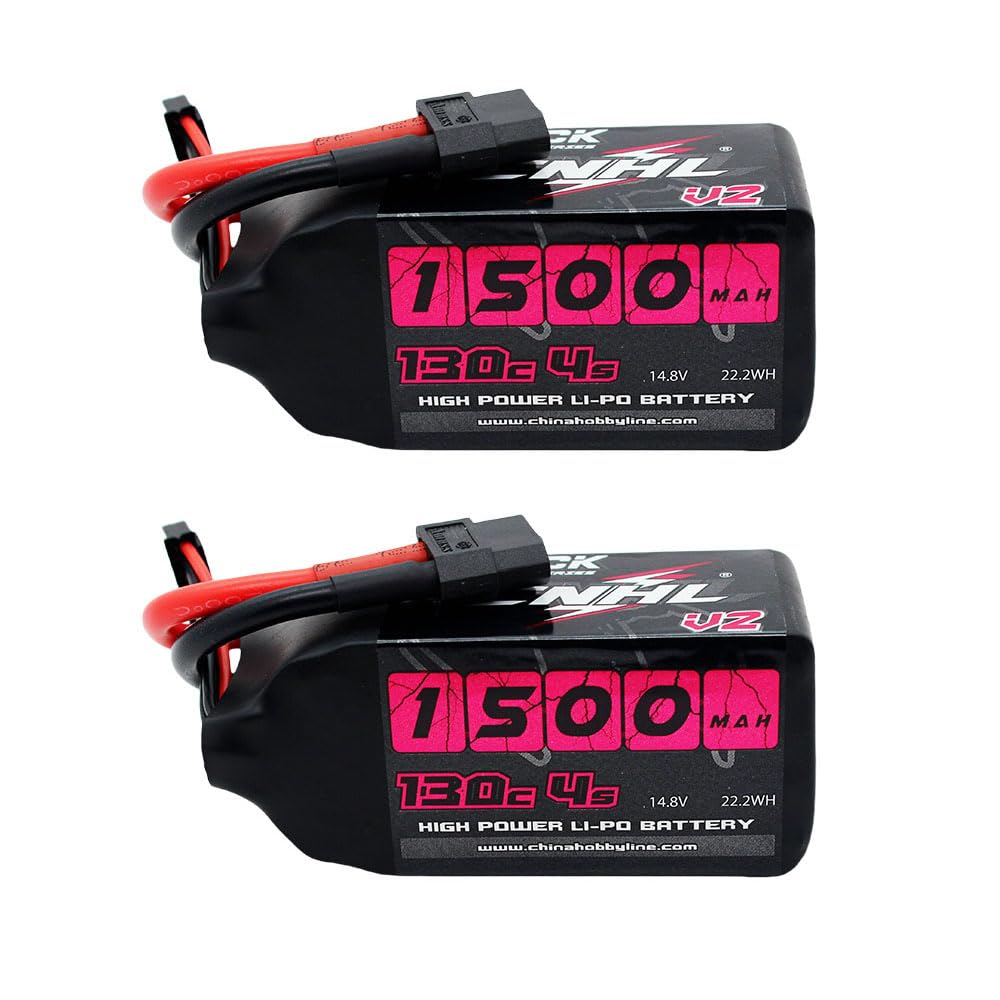
The CNHL 1500mAh 4S pack is built for FPV pilots who demand high discharge rates without the weight penalty of oversized cells. At 174g, it fits cleanly into most 5-inch frames and delivers a genuine 130C burst that translates to instant throttle response during tight splits and power loops. Internal resistance stays consistent across both batteries in the pack, which means balanced discharge and minimal sag even when you punch out from a low-angle dive.
Real-world flight logs show over 7 minutes of aggressive flying on a 230mm quad with 2208 1800KV motors, with voltage dropping from 4.2V to 3.8V in the first two minutes and then holding steady around 3.6V for the bulk of the flight. The balance plugs are slightly on the cheaper side — one reviewer reported a connector chipping during a hard crash — so handle with care during installation. Despite that, the cell consistency and cycle life outclass budget alternatives like Zeee or Goldbat, making this the go-to for competitive racing.
For pilots transitioning from 3S to 4S, this pack provides the extra voltage needed to unlock higher motor RPM without adding excessive weight that would throw off your center of gravity. The XT60 plug is standard for most racing ESCs, so no adapter soldering is required. Just balance-charge on a LiPo-compatible charger and store at 3.8V per cell to preserve longevity.
Why it’s great
- Exceptional cell balance and low internal resistance out of the box
- 130C burst delivers real punch without voltage sag
- Lightweight 174g design fits standard 5-inch frames
Good to know
- Balance connector plastic is somewhat brittle in hard crashes
- Not ideal for larger craft that need more than 1500mAh
2. Spektrum Smart 2200mAh 4S 14.8V 30C

The Spektrum Smart pack is a premium entry for pilots who want plug-and-play simplicity with their Spektrum charger ecosystem. An integrated microchip automatically records charge/discharge cycles, internal resistance, and cell voltage history the moment you connect it. This data eliminates guesswork about when a pack is starting to degrade, which is critical for expensive aircraft where a mid-air battery failure means a total loss.
Rated at 30C continuous with 2200mAh capacity, this pack is not built for high-amp racing builds but rather for sport flyers, scale helicopters, and GPS camera drones that need reliable, predictable power delivery. The IC3 connector is backward-compatible with EC3, so you can use it with most mid-size ESCs without adapters. Reviewers consistently note that cells arrive perfectly balanced at storage voltage, and after dozens of cycles the pack still holds a tight tolerance within 0.1V per cell.
The main trade-off is the premium price tag for a 30C pack — you are paying for the smart features and brand reliability rather than raw discharge performance. If you are already invested in Spektrum chargers, the convenience of auto-discharge to storage voltage and cycle logging justifies the cost. For pure racing or freestyle, the CNHL packs deliver more current per dollar.
Why it’s great
- Smart chip logs charge cycles and internal resistance automatically
- Cells arrive perfectly balanced at storage voltage
- Auto-discharge to storage voltage when paired with Spektrum charger
Good to know
- 30C rating limits use in high-amp FPV racing builds
- Significantly more expensive per mAh than non-smart packs
3. HOOVO 3S 5200mAh 80C Hard Case

For pilots flying larger platforms — 1/10 scale crawlers, camera drones, or heavy-lift multirotors — the HOOVO 5200mAh 3S hard case pack brings serious endurance without needing a 4S voltage bump. The hard plastic shell adds physical protection against crash impacts and debris, and the 80C discharge rating provides ample headroom for sudden throttle demands even on heavier craft. At 380g, this is a substantial pack, so verify your battery bay dimensions (138x47x37mm) before buying.
Real-world feedback from RC car users highlights 25-30 minute runtimes with consistent power delivery and no noticeable sag until the last minute of the pack. The EC5 connector is standard for high-current applications and provides a solid, low-resistance connection that won’t heat up under sustained load. Several long-term users have reported more than 50 cycles with minimal capacity loss, though a small number of units have shown cell voltage imbalance after 10-15 cycles — HOOVO’s warranty support handled replacements promptly in those cases.
If your drone or vehicle uses an XT60 connector, you will need an EC5-to-XT60 adapter or solder on your preferred plug. The hard case also makes this pack slightly less flexible for tight frame layouts, so measure twice before ordering. For sheer runtime per dollar, this is one of the most cost-effective options in the mid-range segment.
Why it’s great
- 5200mAh capacity delivers 25-30 minute runtimes under moderate load
- Hard case protects cells from crash damage and debris
- 80C discharge handles sudden throttle spikes without sagging
Good to know
- EC5 connector may require adapters for XT60-equipped drones
- Some units have shown cell imbalance after 10-15 cycles
4. OVONIC 3000mAh 50C 3S Lipo Battery

The OVONIC 3000mAh 3S pack finds the sweet spot between capacity and portability. At 193g and dimensions of 105x32x28mm, it slides into most standard battery bays without requiring foam shims or Velcro repositioning. The 50C continuous rating is honest — reviewers note that voltage holds above 3.6V per cell for the majority of the flight, only dipping near the end of the discharge curve. This makes it a reliable choice for sport aircraft and mid-sized quadcopters that are not running extreme KV motors.
OVONIC claims a 350-cycle lifespan with proper care, and user reports support that number with packs still holding solid balance after two years of regular flying. The Dean-style T-connector is common on many Horizon Hobby and older FPV ESCs, but if your build uses XT60, plan on soldering an adapter or swapping the connector. The flexible silicone wiring is a nice touch — it routes easily around frame components without cracking or pulling on the solder tabs.
One downside is that the soft case offers less physical protection than hard-shell alternatives, so you should avoid hard mounting this pack in exposed areas where a crash could puncture the pouch cells. For general sport flying and scale models where you prioritize runtime over aggression, this is a solid mid-range workhorse that delivers consistent power without breaking your budget.
Why it’s great
- Honest 50C rating with minimal voltage sag during flight
- Lightweight 193g design fits standard battery bays
- Flexible silicone wiring for easy routing in tight frames
Good to know
- Dean-style T-connector may need adapter for XT60 builds
- Soft case provides less crash protection than hard-shell packs
5. Zeee 3000mAh 50C 3S Lipo Battery

Zeee has built a reputation for offering decent performance at a budget-friendly price point, and this 3000mAh 50C 3S pack exemplifies that approach. The cells consistently arrive balanced out of the box, and after hundreds of flights one reviewer reported no dead cells and reliable performance for over two years. The T-connector is pre-soldered with clean joints, so you can plug it straight into compatible ESCs without extra work.
At 197g and dimensions of 105x36x26mm, it is slightly thicker than the OVONIC equivalent, which could be an issue in tighter battery trays. The 50C rating feels realistic — the pack provides punchy acceleration for sport flying but does show voltage sag earlier than premium options under sustained full-throttle runs. For pilots flying scale helicopters, foam warbirds, or cruising quadcopters, this battery delivers excellent flight times without demanding a premium budget. The heavy-duty balance plug is a thoughtful inclusion that withstands repeated plugging and unplugging better than fragile JST connectors.
The main drawback is consistency across batches. While the majority of users report flawless performance, a small percentage have received packs with one dead cell out of the box—though Zeee’s customer service typically replaces those quickly. If you are flying expensive equipment where a mid-air battery failure would be catastrophic, the slight price jump to a premium brand may be worth the insurance. For casual sport flying on a budget, this is a strong contender.
Why it’s great
- Cells arrive well-balanced and maintain balance over many cycles
- Heavy-duty balance plug withstands repeated use
- Pre-soldered T-connector with clean joints for immediate use
Good to know
- Occasional batch inconsistency with a small risk of dead cells
- Voltage sag more noticeable under sustained full-throttle compared to premium packs
6. OVONIC 2200mAh 35C 3S Lipo Battery

The OVONIC 2200mAh 35C 3S pack is a solid entry-level choice for pilots flying sport aircraft, park flyers, and beginner quadcopters that do not demand high discharge currents. At 139g, it is noticeably lighter than the 3000mAh options, making it ideal for smaller frames where weight distribution is critical. The XT60 connector is the most common standard in the hobby, so compatibility with aftermarket ESCs and power distribution boards is essentially guaranteed.
OVONIC uses LiCoO2 cathode material which provides lower internal resistance than older chemistries, translating to a 12% longer runtime per charge compared to generic budget packs according to their lab tests. In practice, users report that these batteries stay cool even after aggressive flights and charge within 0.1V per cell after multiple cycles. The 35C rating is modest — you will not get the instant punch of a 50C or 100C pack, but for cruising and gentle aerobatics the power delivery is smooth and predictable.
The pack dimensions (75x33x25mm) are compact enough to fit in most standard battery bays, and the flexible silicone wiring routes easily around frame components. If you eventually upgrade to a more powerful drone that needs higher discharge rates, these batteries make excellent secondary packs for flight training or casual flying where top-end power matters less than consistent, reliable runtimes.
Why it’s great
- Lightweight 139g design perfect for smaller frames and park flyers
- XT60 connector ensures broad compatibility with standard ESCs
- LiCoO2 chemistry delivers lower internal resistance and longer cycle life
Good to know
- 35C rating limits use for high-amp racing or heavy-lift drones
- Not suitable for aggressive 3D flying that demands instant burst current
7. Zeee 1500mAh 120C 3S Lipo Battery

The Zeee 1500mAh 120C 3S pack is designed for small FPV racers, micro quadcopters, and helicopter pilots who need a lightweight pack with high burst current. At only 134g, it fits into tiny frames like the QAV250 and Vortex without shifting the center of gravity. The 120C burst rating provides the instant throttle response needed for proximity flying and tight racing courses, though the continuous rating is likely closer to 60-70C as is standard for most budget graphene packs.
Users flying the Blade 230S helicopter reported 17-minute flight times with scale flying and excellent balance without needing trim adjustments. The graphene-enhanced chemistry is supposed to improve cycle life, but some users have reported cell failure after 6-12 months of regular use — one pack lost a cell and started ballooning after about 8 months. This is not unusual for budget packs at this price point, but it means you should monitor cell voltages regularly and retire the pack at the first sign of swelling.
The 2-pack format gives you a spare right out of the box, which is convenient for back-to-back flying sessions. The XT60 plug is standard and the pack dimensions (68×34.5×27.5mm) fit most mini frames. If you are on a tight budget and flying a lightweight FPV build that does not push batteries to their absolute limit, this pack offers respectable performance for the cost. Just be diligent about storage voltage and avoid deep discharges below 3.2V per cell.
Why it’s great
- Lightweight 134g design ideal for micro FPV and small helis
- 120C burst provides responsive throttle for racing maneuvers
- 2-pack format offers immediate spare for back-to-back flights
Good to know
- Some units have shown cell failure and swelling after 6-12 months
- Continuous discharge rating likely lower than printed 120C
FAQ
Can I use a 4S battery on a drone designed for 3S?
How do I safely charge a LiPo battery for my drone?
What causes a LiPo battery to puff or swell?
Final Thoughts: The Verdict
For most users, the battery for drone winner is the CNHL 1500mAh 130C 4S because it delivers genuine high-discharge performance at a weight that suits 5-inch racing and freestyle frames, with cell consistency that outclasses budget alternatives. If you want plug-and-play convenience with automatic data logging and storage discharge, grab the Spektrum Smart 2200mAh 4S. And for extended runtimes on larger platforms without breaking the bank, nothing beats the HOOVO 5200mAh 3S Hard Case.