
Our readers keep the lights on and the weekend projects moving. As an Amazon Associate, I earn from qualifying purchases.
Specs are compiled from manufacturer listings and verified buyer reviews and can change over time — please confirm the key details on the product page before buying.
The single biggest mistake people make when building a small solar system is getting a battery that can’t handle the daily drain. You buy a panel, wire it up, and then the power dies two hours after sunset. A deep-cycle battery (designed to be discharged and recharged many times without damage) fixes that — it lets you actually use the solar power you collect.
I’m Rikta — the founder and writer behind FitlyFast. This guide is built by comparing the manufacturers’ published specifications and the patterns across verified customer reviews, so you get each pick’s real strengths and trade-offs instead of marketing spin.
Choosing the right battery for small solar system depends on matching capacity, chemistry, and physical size to your actual energy load and budget.
Quick Picks
- HRBEENERGY 12.8V 100Ah LiFePO4 Deep Cycle Battery — Best Overall
- WEIZE 12V 100Ah Deep Cycle AGM Battery — Off-Grid Workhorse
- SUPER EMPOWER 12V 100Ah LiFePO4 Battery — High-Cycle Champion
- Power Queen 12V 100Ah LiFePO4 Battery — Premium Build
- GRNOE 2-Pack 12V 100Ah LiFePO4 Battery — Two-Pack Value
- ECO-WORTHY 12V 280Ah LiFePO4 Battery — Massive Capacity
How To Choose The Best Battery For Small Solar System
Picking the wrong battery chemistry or capacity is the fastest way to waste your solar budget. Here are the three specs that matter most for a small setup.
Chemistry: LiFePO4 vs. Lead-Acid
LiFePO4 lithium batteries cost more upfront but give you 80 to 100 percent usable capacity — you can drain them nearly empty. Lead-acid batteries only let you safely use about 50 percent of their rated capacity before they take damage. For a small solar system, LiFePO4 means you need roughly half the physical battery to get the same usable runtime.
Capacity: Amp-Hours
Amp-hour (Ah) tells you how much energy the battery stores. A 100Ah battery running at 12 volts holds 1,280 watt-hours. That is enough to run a 50-watt LED light for about 25 hours or a small 12-volt refrigerator for roughly a day. Count up the wattage of everything you plan to power, multiply by hours of use, and pick a capacity that covers your overnight load with a buffer.
Built-in BMS (Battery Management System)
Every lithium battery in this list includes a BMS circuit board that automatically cuts charging when the battery is full, stops discharging when it is empty, and shuts down operation if the temperature gets too hot or too cold. For a solar system that charges and discharges daily, a BMS is the difference between a battery lasting years and one failing in months.
Quick Comparison
| Model | Best For | Capacity & Chemistry | Cycle Life | Weight | Amazon |
|---|---|---|---|---|---|
| HRBEENERGY 100Ah LiFePO4 | Compact drop-in replacement | 100Ah / LiFePO4 | 8000+ cycles | 20.9 lbs | Amazon |
| WEIZE 100Ah AGM | Budget-friendly lead-acid | 100Ah / AGM Lead-Acid | 300-500 cycles | 59.98 lbs | Amazon |
| SUPER EMPOWER 100Ah LiFePO4 | High cycle life & warranty | 100Ah / LiFePO4 | 15000 cycles | 21.58 lbs | Amazon |
| Power Queen 100Ah LiFePO4 | Premium brand reliability | 100Ah / LiFePO4 | 4000 cycles | 21 lbs | Amazon |
| GRNOE 2-Pack 100Ah LiFePO4 | Two-battery value bundle | 100Ah each / LiFePO4 | 15000 cycles | 22.4 lbs each | Amazon |
| ECO-WORTHY 280Ah LiFePO4 | High-capacity single battery | 280Ah / LiFePO4 | 4000+ cycles | 68.5 lbs | Amazon |
In‑Depth Reviews
1. HRBEENERGY 12.8V 100Ah LiFePO4 Deep Cycle Battery

A lightweight lithium battery with IP67 waterproofing for wet solar installations.
This battery gives you 1,280 watt-hours of usable energy — that is enough to run a 50W LED light for 25 hours — in a compact Group 24 size that weighs 20.9 pounds. It is about a third the weight of a lead-acid battery with the same rated capacity. The built-in 100-amp BMS (Battery Management System) protects against overcharge, over-discharge, and short circuits, critical for a solar system that cycles daily. Buyers report a “long haul on the minn kota 30lbs thrust trolling motor,” noting it barely drained after three hours and recharged in an hour.
Unlike the WEIZE AGM battery below, which weighs 59.98 pounds, this HRBEENERGY unit is nearly 40 pounds lighter, making it far easier to carry into a cabin or mount in a tight compartment. The IP67-rated case (fully dust-tight and protected against temporary water immersion) means you can install it in a marine or outdoor battery box without worrying about rain or splashes. At 6.6 inches deep, 10.23 inches wide, and 8.5 inches tall, it slides into place as a direct replacement for an old lead-acid or AGM battery.
The rated 8,000-plus deep cycles at 100% depth of discharge (DoD — the amount of capacity you use before recharging) translates to roughly three times the lifespan of a standard AGM battery, which typically lasts 300 to 1,500 cycles. For a small solar system that charges and discharges every day, that means years of reliable service before replacement.
What Stands Out
- IP67 waterproof case protects against rain and splashes in outdoor solar setups
- Weighs only 20.9 pounds — easy to carry and install compared to lead-acid alternatives
- 8,000+ deep cycles at 100% depth of discharge (DoD) for long-term off-grid use
What to Watch For
- One reviewer noted the low-voltage cutoff kicks in around 9.5V — slightly lower than the ideal 10V for some sensitive electronics
- Not designed for engine starting or high-cranking applications; strictly an energy storage battery
Reach for this if: you need a lightweight, waterproof drop-in lithium battery for a small solar system that cycles daily and sits in a damp or outdoor space.
Look elsewhere if: you need the absolute highest capacity in a single unit — the ECO-WORTHY 280Ah below offers nearly three times the stored energy.
2. WEIZE 12V 100Ah Deep Cycle AGM Battery

A sealed lead-acid battery that nails the basics when you are not ready for lithium pricing.
If your budget does not stretch to lithium and your solar system is modest, this WEIZE AGM battery delivers solid 100Ah capacity at a significantly lower entry cost. One buyer who runs a boondocked RV in the mountains shared: “I bought two of the 100 amp hour, 12v, agm batteries about 2 years ago for an off grid (boondocked) rv on our property in the mountains and have them connected to two 150 watt solar panels.” After two years of regular use, they reported zero issues and just bought two more.
The catch is weight and usable capacity. At 59.98 pounds, this battery is nearly three times heavier than any 100Ah lithium battery in this list — the HRBEENERGY above weighs just 20.9 pounds. And because lead-acid chemistry only lets you safely use about 50% of the rated capacity, your real usable energy is roughly 50Ah (600 watt-hours) before the battery takes damage. Compare that to the 100Ah (1,280 watt-hours) you get from a lithium battery of the same size rating.
On the plus side, the maintenance-free and spill-proof design means you never need to check fluid levels. The dimensions are 12.99 inches long by 6.73 inches wide by 8.34 inches tall, making it a Group 31 size that fits standard battery trays found in RVs, campers, and solar setups.
Budget Pick Strengths
- Sealed, maintenance-free design — no water checks or terminal cleaning required
- Proven reliability over two years of daily solar charging, per buyer reports
- 305 amp-hours at 20-hour rate and 1,150A max discharge current for high-draw inverter loads
The Trade-Offs
- At 59.98 pounds, it is roughly 2.8 times heavier than a comparable 100Ah lithium battery
- Only 300-500 cycle life at 50% depth of discharge versus thousands of cycles for LiFePO4
Go with this if: your solar system is small, your budget is tight, and you are comfortable with a heavier battery that needs replacement after a few years of daily cycling.
skip it if: you want lightweight portability or the ability to drain the battery below 50% without damaging its lifespan — lithium is the better choice there.
3. SUPER EMPOWER 12V 100Ah LiFePO4 Battery
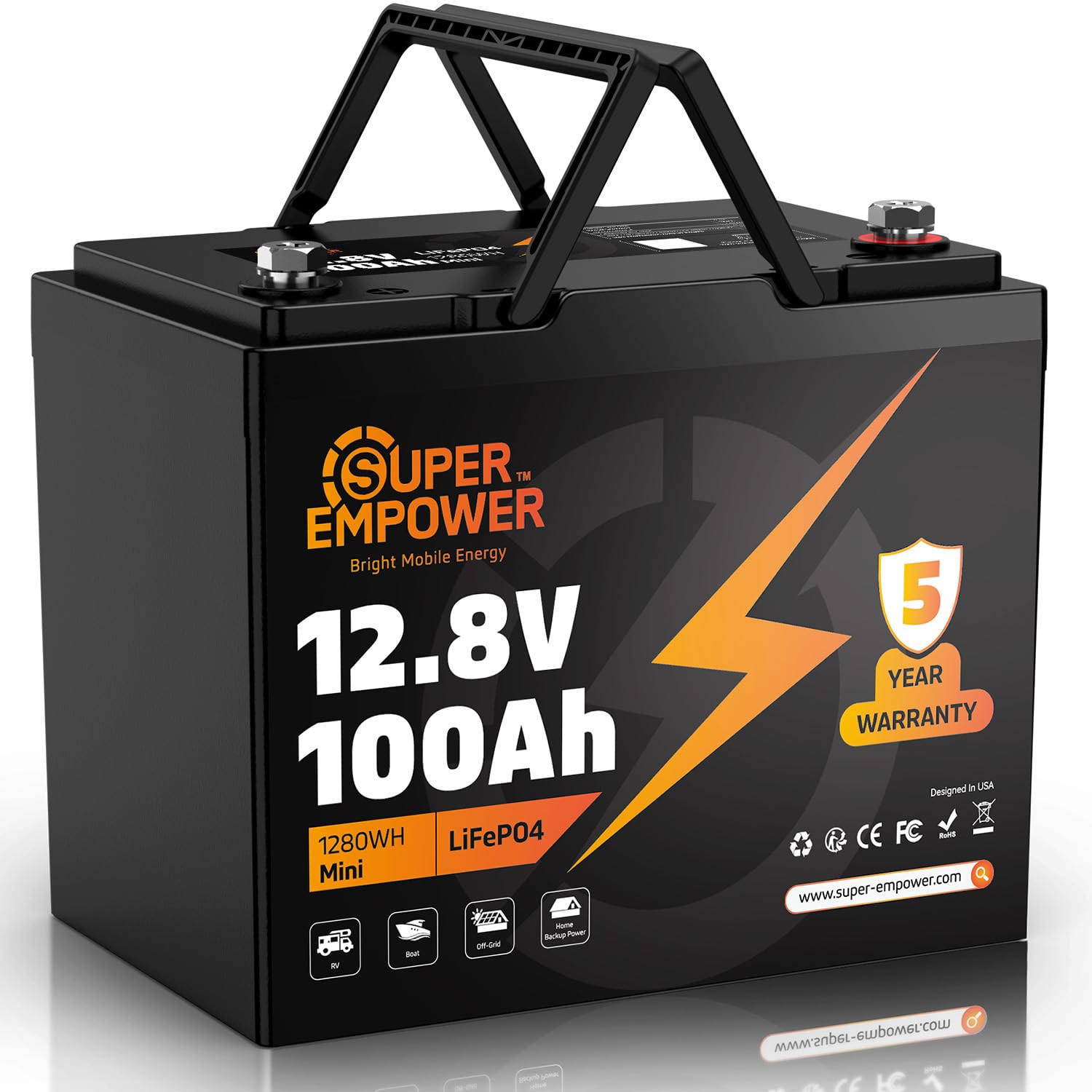
Rated for 15,000 cycles at shallow discharge — built to outlast your solar panels.
This SUPER EMPOWER lithium battery uses Grade A+ cells and the manufacturer claims up to 15,000 cycles at 60% depth of discharge (DoD), which is roughly the daily drain pattern of a well-sized solar system. At 100% DoD, it is rated for about 5,000 cycles. That kind of lifespan means this battery could run for a decade or more in a cabin or RV that cycles daily, compared to the 300 to 500 cycles of a typical AGM lead-acid battery.
The battery sits at 21.58 pounds, making it about 38 pounds lighter than the WEIZE AGM battery above. Dimensions are 6.49 inches deep by 10.24 inches wide by 8.98 inches tall — a BCI Group 24 size that fits standard battery boxes without modifications. The integrated BMS includes low-temperature charging protection that automatically shuts off charging below 32°F (0°C) and stops discharging at -4°F (-20°C), resuming above 41°F (5°C). This prevents permanent cell damage that cold weather can cause to lithium batteries.
Owners mention it works well for kayak motors and RV boondocking. One buyer mentioned that with a 20-amp charger, the battery went from about 50% charge to full in six to seven hours. The 5-year manufacturer warranty provides extra confidence for a purchase intended to last through many solar seasons.
Long-Life Highlights
- Up to 15,000 cycles at 60% depth of discharge — far exceeds typical lead-acid lifespan
- Low-temperature charging protection prevents cell damage in freezing conditions
- Includes 5-year manufacturer warranty for long-term ownership confidence
Worth Noting
- No built-in battery percentage display — you need an external battery monitor to check state of charge
- Charging pauses automatically below 32°F; requires a lithium-compatible charger for best results
Best for: a solar system in a cold-climate cabin or RV where the battery will cycle daily and you want the longest possible lifespan.
Consider another option if: you need to monitor battery percentage at a glance without an external monitor — the ECO-WORTHY 280Ah below includes Bluetooth app monitoring.
4. Power Queen 12V 100Ah LiFePO4 Battery
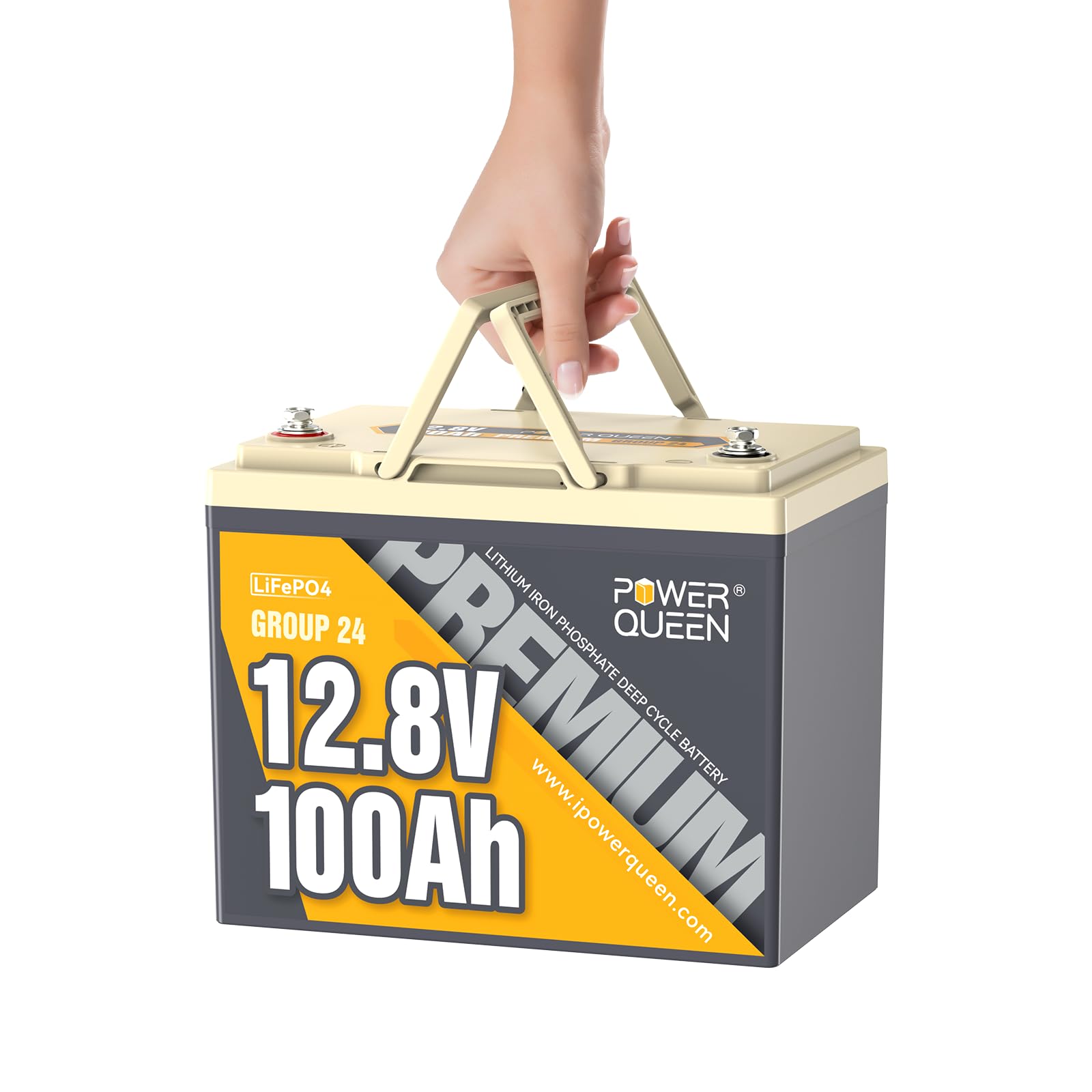
A proven brand with an excellent warranty track record that buyers trust for long-term use.
Power Queen has built a reputation in the solar and RV space for reliable LiFePO4 batteries backed by responsive customer service. One owner shared that their first Power Queen battery lasted over three years of trolling motor use, and when a BMS issue came up, the company shipped a replacement within days without hassle. That kind of support matters when your off-grid system depends on a single battery.
This Group 24 battery packs 1,280 watt-hours of usable energy (100% depth of discharge) at just 21 pounds — roughly one-third the weight of a Group 24 AGM battery. The company rates it for 4,000 cycles at 100% DoD, backed by a 5-year warranty and a claimed 10-year lifespan. It fits standard Group 24 battery boxes with dimensions of 6.61 inches deep, 10.24 inches wide, and 8.27 inches tall.
Buyers specifically praise the built-in carry handles, making it easy to move around a campsite or RV compartment. One reviewer who dropped it into a 2004 Roadtrek C190 RV reported that the battery lasted all night (eight hours) with the fan running and was still at 80% charge in the morning. The 20+ BMS protections cover overcharge, over-discharge, overheat, and short circuits — everything a solar daily-cycle battery needs.
Quality Signals
- Proven 3+ year track record in real-world use with documented warranty replacement support
- Battery lasted 8 hours with fan on and still showed 80% charge, per buyer report
- Carry handles make installation and repositioning genuinely easier than lithium batteries without them
Know Before You Buy
- Slightly higher cost per amp-hour than some newer competitors with similar specs
- Not rated for engine starting or golf cart applications — strictly an energy storage battery
Choose this if: you want a brand with a proven warranty history and a 5-year manufacturer guarantee for your small solar system.
Pass if: you are strictly looking for the lowest price per Ah and are willing to try a newer brand without an established reputation.
5. GRNOE 2-Pack 12V 100Ah LiFePO4 Battery
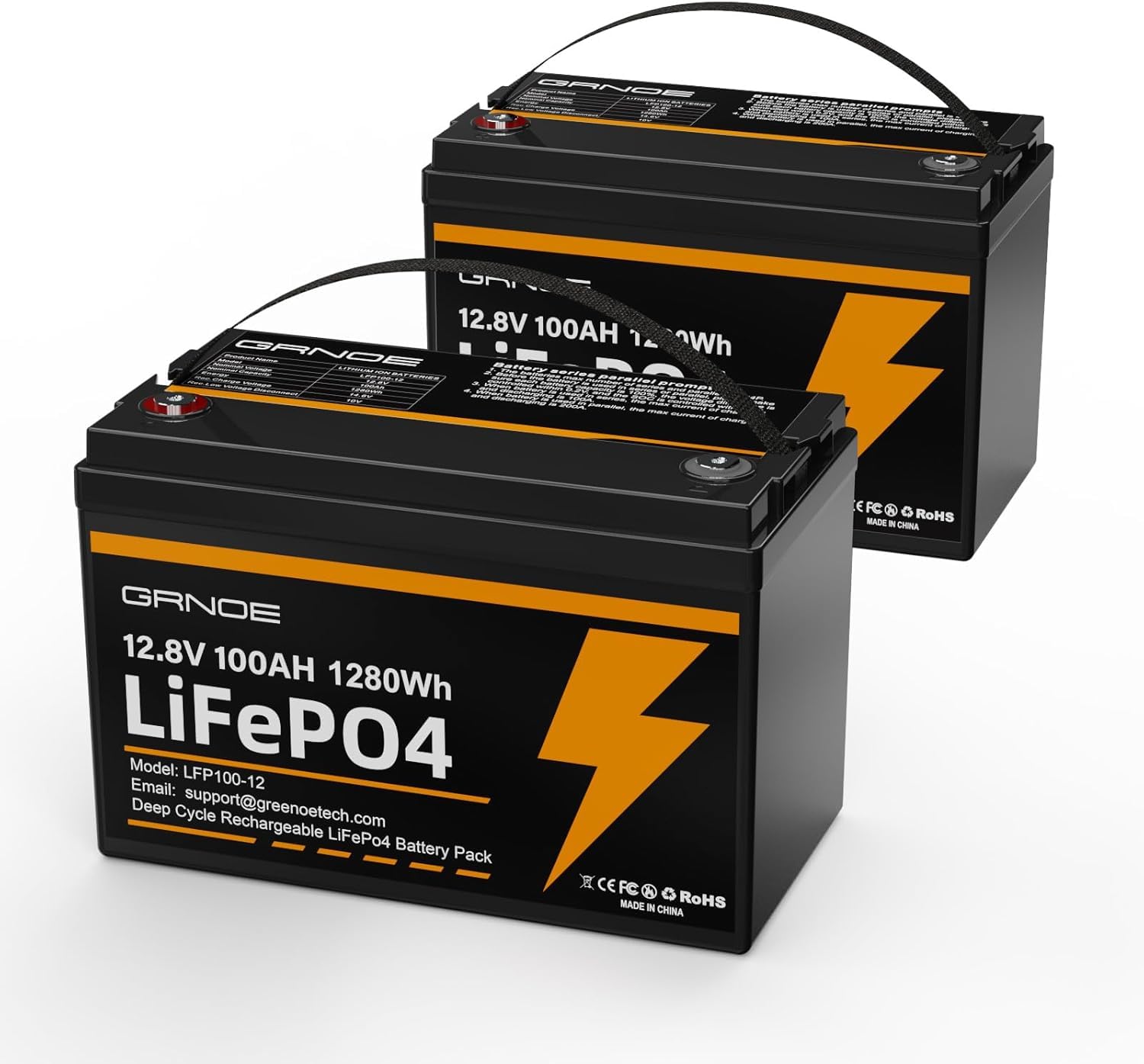
A two-pack bundle for building a larger 200Ah bank at a lower per-unit price.
If your small solar system needs 200 amp-hours of storage — enough to power a small refrigerator, lights, and phone charging overnight — this GRNOE two-pack gives you two matched 100Ah batteries for wiring in parallel. Each battery measures 12.9 inches by 6.7 inches by 8.6 inches and weighs 22.4 pounds, which works out to about 33% of the weight of equivalent lead-acid batteries.
The integrated BMS includes low-temperature charging cut-off that stops charging below 32°F to protect the cells. Discharge continues down to -4°F, so you can still draw power in freezing conditions. Each battery supports a max discharge current of 300 amps for three seconds, which is enough to start an inverter for a microwave or power tool. The IP65 waterproof rating (protected against water jets, not immersion) means the battery resists splashes but is not fully submersible like the IP67-rated HRBEENERGY above.
Customers note excellent performance in marine and solar PV setups, noting that the batteries hold charge well and the low-temperature protection works smoothly. One caveat: some users experienced a warranty response delay, with one buyer reporting a failure after a few uses and no response from customer support. The 3-year manufacturer warranty covers defects, but the support experience appears inconsistent.
Bundle Benefits
- Two batteries provide 200Ah total capacity at a lower per-unit cost than buying singles
- Low-temperature charging cutoff protects cells during cold-weather solar charging
- Each battery weighs 22.4 pounds — light enough for one person to carry and install
Possible Drawbacks
- Customer support response times vary, with at least one review reporting unresolved battery failure
- Requires a dedicated 14.6V lithium charger — standard 12V lead-acid chargers will not fully charge it
Pick this set if: you need 200Ah for a moderate solar load and want the convenience of matched batteries shipped together.
Think twice if: consistent customer support response is a high priority — the mixed support reviews suggest some risk.
6. ECO-WORTHY 12V 280Ah LiFePO4 Battery
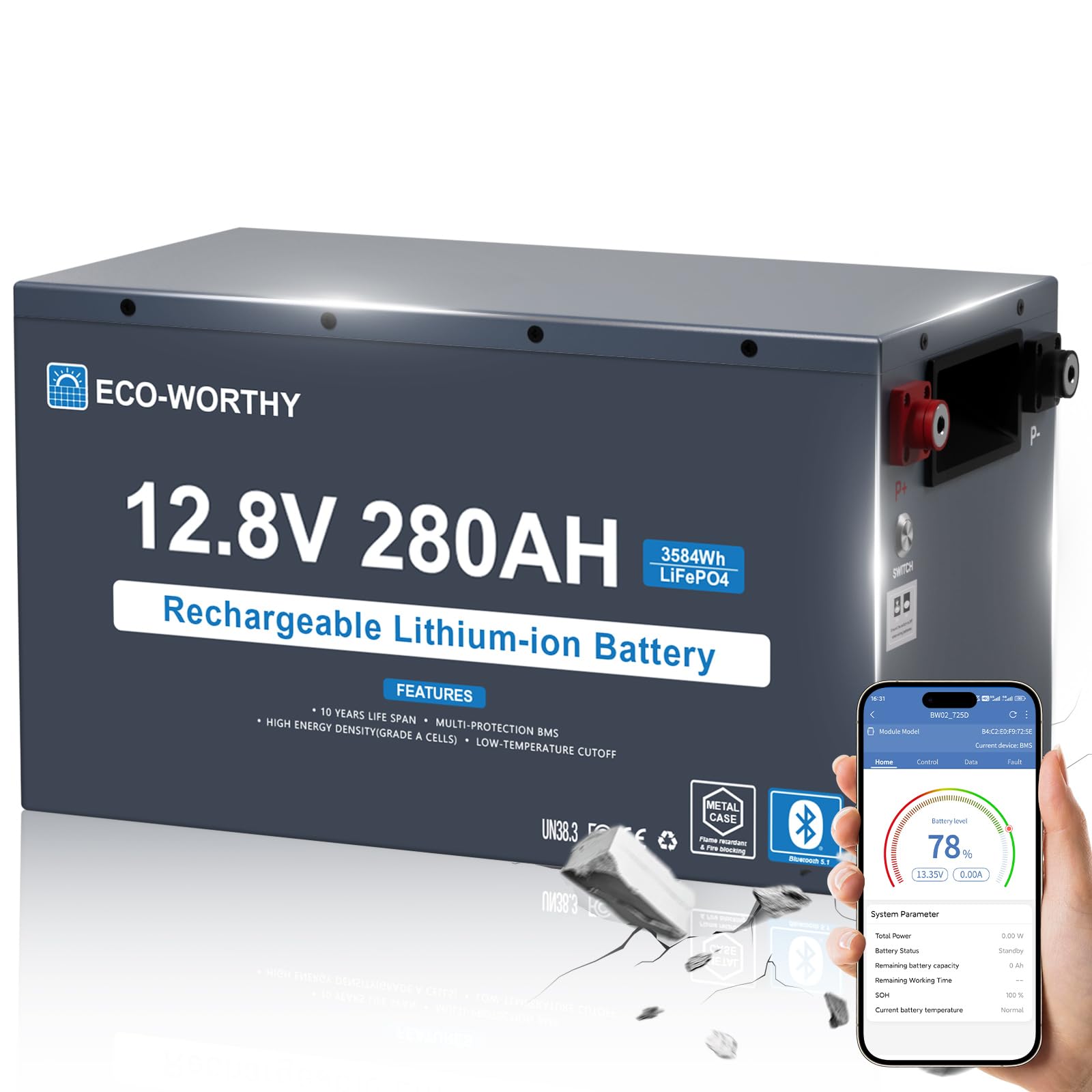
A 280Ah single battery with Bluetooth monitoring — enough capacity to replace four standard 100Ah units.
This ECO-WORTHY is the heavy hitter of the list, offering 3,584 watt-hours of usable energy in a single 68.5-pound package. That is nearly three times the capacity of the 100Ah lithium batteries above, making it a strong choice for a cabin or RV that runs a full-size refrigerator, lights, a water pump, and device charging without needing multiple parallel batteries. The rated capacity is 280Ah at 12.8 volts, which means roughly 3.5 kWh of daily usable energy — enough for most small off-grid homes to run overnight and recharge the next day.
The metal case is a meaningful safety upgrade over plastic-shelled lithium batteries. It provides heat resistance and acts as a fire barrier, and it comes with four mounting feet so you can bolt the battery directly to the floor of your RV or camper without needing a separate battery box. The built-in 200-amp BMS handles overcharge, over-discharge, over-current, short circuit, and temperature protection, with a separate low-voltage power switch for one-touch shutdown during maintenance.
Bluetooth monitoring via an app shows real-time voltage, capacity, and charge/discharge status right on your phone — a feature none of the other batteries in this list offer. Reviewers point out it “exceeds rated capacity” and powers a microwave, instant pot, and induction stove through a 2,000-watt inverter without issue. The low-temperature charging cutoff kicks in around 20°F, which matches well for winter camping.
Big Battery Advantages
- 3,584 watt-hours in a single unit — simplifies wiring compared to multiple parallel batteries
- Bluetooth app provides real-time voltage, capacity, and charge status monitoring
- Metal case with mounting feet for direct floor installation without an external battery box
Size Trade-Offs
- At 68.5 pounds, it is the heaviest battery in this list — requires two people for safe installation
- Physical dimensions of 16.54 x 9.65 x 8.64 inches need a larger battery compartment than standard Group 24 or 31 boxes
Ideal for: a larger small solar system where you want a single high-capacity battery with Bluetooth monitoring and a fire-safe metal enclosure.
Not for you if: your battery space is limited to a standard Group 24 or 31 tray — the 16.5-inch length requires a larger compartment.
Understanding the Specs
Amp-Hours (Ah) and Watt-Hours (Wh)
Amp-hours tell you how much current the battery can supply for one hour. For a 12V system, multiply Ah by 12 to get watt-hours — the total energy stored. A 100Ah battery gives you 1,280 watt-hours. That means you could run a 50W LED light for about 25 hours or a 500W heater for roughly 2.5 hours before the battery is empty. Always match your total daily watt-hour load to at least 1.5 times the battery’s usable capacity to avoid deep discharging every cycle.
Depth of Discharge (DoD) and Cycle Life
Depth of discharge is how much of the battery’s capacity you use before recharging. LiFePO4 batteries handle 100% DoD — you can drain them fully without damage. Lead-acid batteries should only be drained to 50% to avoid permanent capacity loss. Cycle life is how many charge-discharge cycles a battery can handle before its capacity drops. A LiFePO4 battery rated for 4,000 cycles at 100% DoD will last over 10 years if cycled daily, while a lead-acid battery at 50% DoD might last 3 to 5 years.
FAQ
How many amp-hours do I need for a small solar system?
Can I use a car battery for a small solar system?
What is the difference between AGM and LiFePO4 for solar?
How do I connect two solar batteries in parallel?
Can I charge a LiFePO4 battery with a regular solar charge controller?
Will a 100W solar panel charge a 100Ah battery?
How long will a 100Ah battery run a 12V refrigerator?
What does the BMS in a solar battery do?
Is it OK to leave a solar battery fully discharged for a long time?
How do I know if my solar battery is fully charged?
Final Thoughts: The Verdict
For most users building a battery for small solar system, the winner is the HRBEENERGY 100Ah LiFePO4 because it combines a waterproof IP67 case, 8,000-plus cycle life, and lightweight portability at a mid-range price that still leaves room in your budget for solar panels. If you need the absolute most capacity in a single unit, grab the ECO-WORTHY 280Ah LiFePO4 for its 3,584 watt-hours and Bluetooth monitoring. And for a tight budget where lead-acid is the only option, the WEIZE 100Ah AGM delivers reliable off-grid power with a proven track record from real owners who have run it for years on solar.
How We Picked
We do not accept paid placement. Every pick is matched to a real buyer and a real use-case; we do not hands-on test units.
Sources & Methodology
Specifications: manufacturer listings and product documentation. Review insights: verified customer reviews, as of July 2026. Pricing: not shown on this page (it changes often); check the current price via the retailer link.
As an Amazon Associate, FitlyFast earns from qualifying purchases. This does not affect which products we feature.