
Our readers keep the lights on and the weekend projects moving. As an Amazon Associate, I earn from qualifying purchases.
The moment your engine cranks slow on a cold morning, you start gambling — is it the battery fading, the alternator struggling, or just a loose connection? A proper load tester settles that bet instantly by applying a measured electrical load and reading real voltage sag, cold cranking amps (CCA), and internal resistance. Without it, you are swapping parts based on hope, not data.
I’m Rikta — the co-founder and writer behind FitlyFast. Over the past four years I have cross-analyzed dozens of battery diagnostic tools across price bands, focusing on conductance testers and carbon-pile load testers to isolate the metrics that actually predict battery failure before it leaves you stranded.
Whether you maintain a single daily driver or manage a fleet of vehicles, the right battery load tester saves time, money, and the frustration of replacing a good battery too early or trusting a bad one too long.
How To Choose The Best Battery Load Tester
Not all load testers work the same way. A digital conductance unit calculates internal resistance from a low-current pulse, while a carbon-pile tester physically draws up to 130 amps of load. Your choice depends on the battery types you test and whether you need a pass/fail verdict or granular diagnosis. Below are the three factors that separate a useful tool from a frustrating one.
CCA Range and Battery Chemistry Compatibility
Every tester lists a CCA range — typically 100–2000 CCA for modern units. If you work with small motorcycle batteries or massive diesel truck batteries, verify that the lower and upper limits match your fleet. Beyond CCA, check whether the tester supports AGM, EFB, GEL, flooded lead-acid, and lithium chemistries. Some budget models skip lithium entirely, which matters if you own a modern motorcycle or RV with a LiFePO4 bank.
Cable Length and Display Readability
Short cables force you to perch the tester directly above the battery terminals, which is awkward when the battery is tucked into a wheel well or under a plastic cowl. A 6-foot cable lets you sit the unit on the fender or ground and still reach both posts. The display quality matters equally — a bright color screen makes results legible in direct sunlight, while a monochrome LCD can wash out in bright daylight and become hard to read in a dark garage corner.
Safety Protections and Build Durability
Reverse polarity protection is the single non-negotiable safety feature. Connect the clamps backward and the tool should refuse to test or shut down, not spark or blow a fuse. Overheating safeguards matter especially for carbon-pile units that generate heat during a 10-second load. For home mechanics, a robust ABS shell and insulated clamps with strong springs provide the daily durability that keeps a tester alive for years.
Quick Comparison
On smaller screens, swipe sideways to see the full table.
| Model | Category | Best For | Key Spec | Amazon |
|---|---|---|---|---|
| ANCEL BT410 | Digital | Lithium & lead-acid versatility | 2.4-inch color TFT display | Amazon |
| FOXWELL BT301 | Digital | Long-reach testing from the seat | 6.5-foot cable | Amazon |
| AUTOPHIX BAS100 | Digital | High-accuracy & OBD feature | 99.98% accuracy rate | Amazon |
| Clore SOLAR BA9 | Digital | Reliable brand for routine checks | 40–1200 CCA range | Amazon |
| OTC 3181 | Carbon-Pile | True 130A heavy load testing | 130 amp load capacity | Amazon |
| Veepeak | Digital | Budget-friendly 12V/24V testing | 24V max operating voltage | Amazon |
| TOPDON BT50 | Digital | Entry-level spark-free safety | IP67 rating / spark-free | Amazon |
In‑Depth Reviews
1. ANCEL BT410
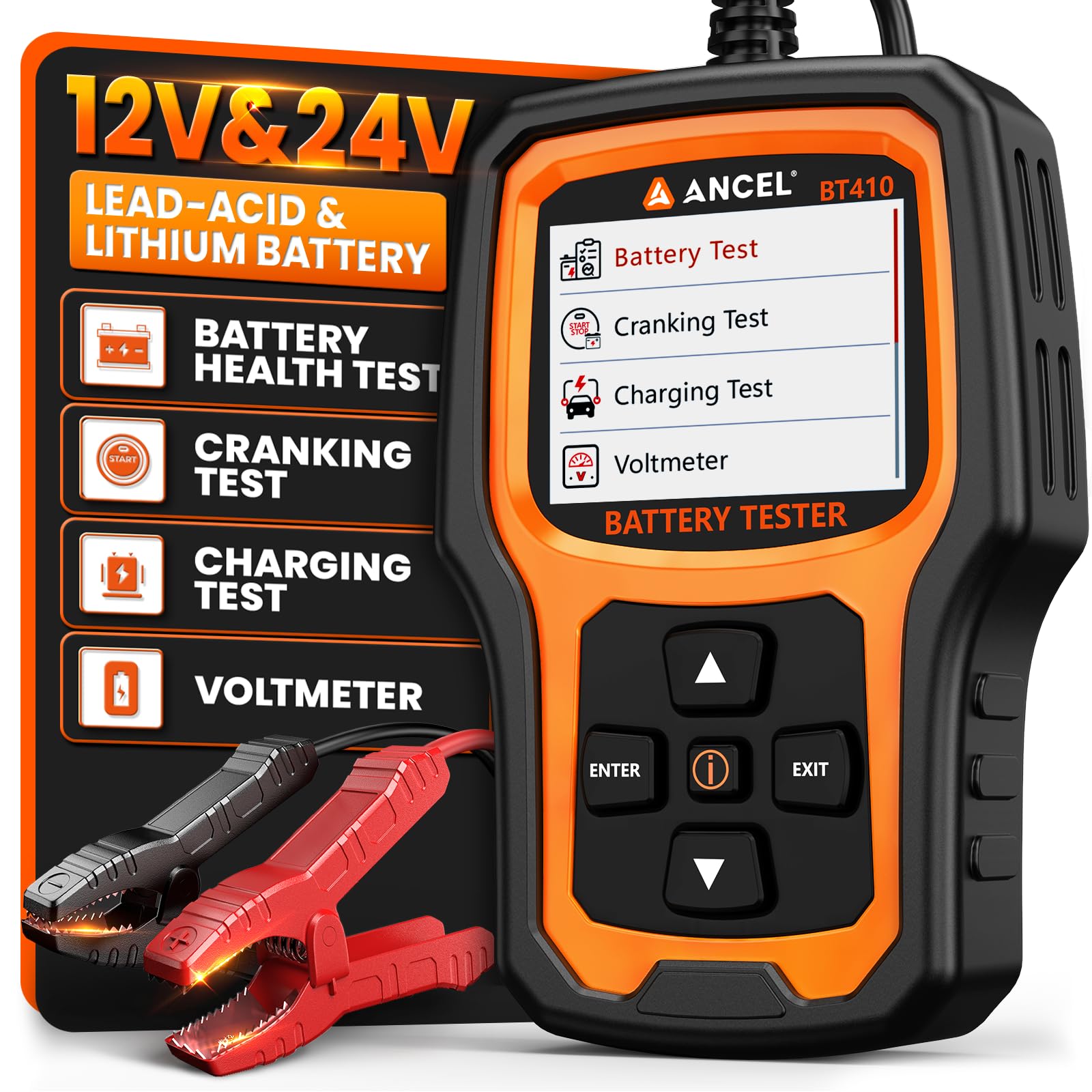
This tester stands apart because it handles both 12V and 24V systems while supporting lead-acid and lithium batteries — a rare combination at this level. The 2.4-inch color TFT screen with adjustable contrast and day/night mode makes the SOC, SOH, and internal resistance graphs readable whether you are squinting into engine-bay shadows or working under a bright shop light. The smart chip delivers over 99.9% testing accuracy, and after each test it generates a QR-coded report that you can share with a mechanic or save for your own records.
The cranking and charging diagnostics go beyond a simple pass-fail verdict. The BT410 analyzes voltage drop during engine start to isolate a weak starter from a dying battery, and it checks ripple voltage from the alternator so you can catch a failing diode before it drains a fresh battery. The 31.5-inch cable is adequate for most top-post batteries in cars and SUVs, though you may need to position the unit close to the battery in trucks with recessed trays. It operates from -4°F to 158°F, so cold-weather starting tests remain reliable.
Short-circuit and reverse-polarity protection give you confidence when connecting to unfamiliar batteries. The reinforced ABS clamps feel sturdy in the hand, and the overall weight of 0.4 kg makes it easy to toss into a glove box or tool bag. The only real absence is a carrying case — the bare unit is fine for stationary use, but a protective sleeve would be welcome for mobile mechanics who toss it in a service van.
Why it’s great
- Works with lead-acid and lithium chemistries in 12V and 24V systems
- Color TFT display with day/night mode is readable in all lighting
- QR-code report sharing makes tracking battery health over time simple
Good to know
- No carrying case included for portable storage
- 31.5-inch cable fine for cars, borderline for deep-set truck batteries
2. FOXWELL BT301
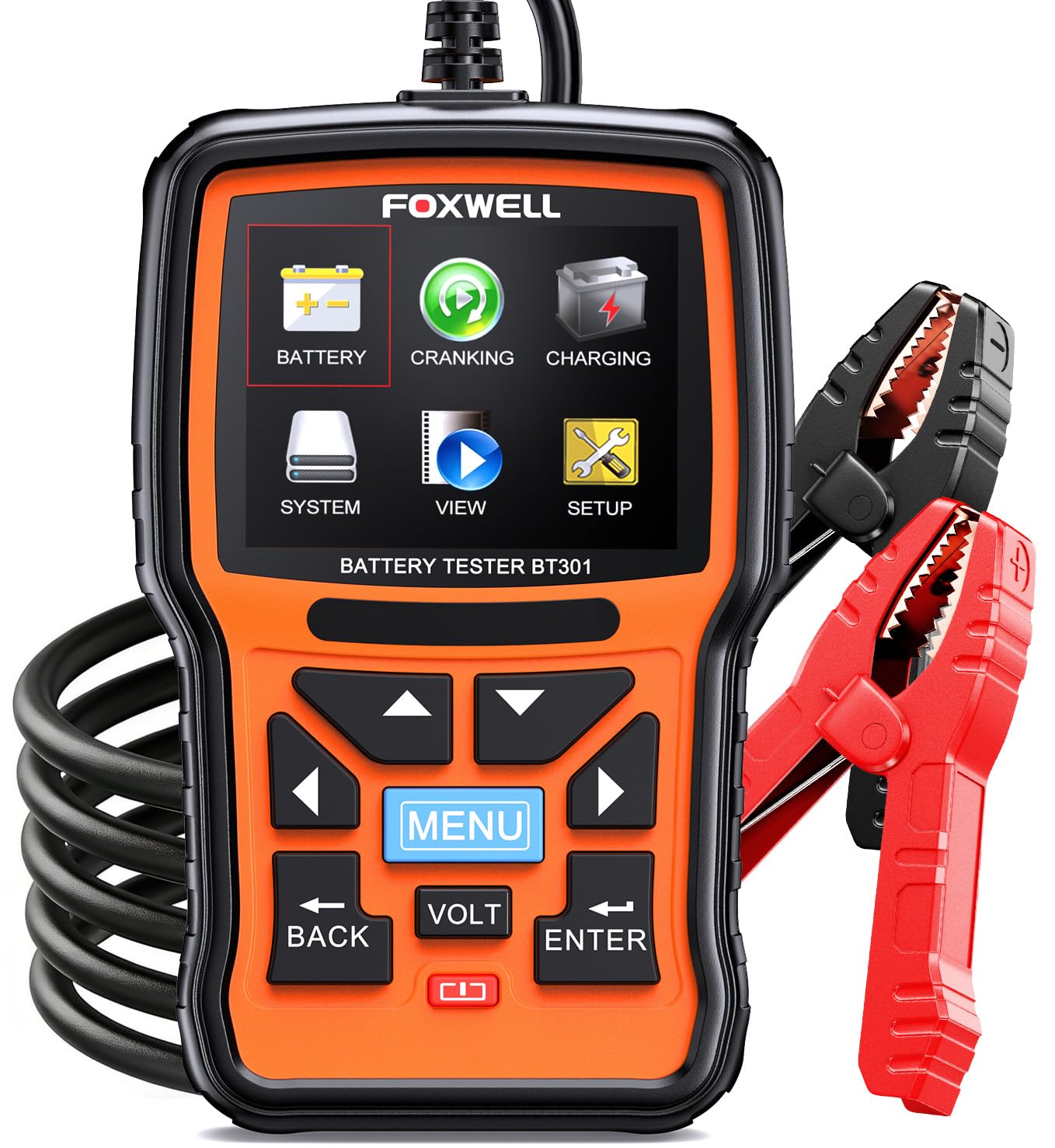
The BT301 is the upgraded successor to the popular BT100, and the headline improvement is the 6.5-foot cable. That extra length lets you sit in the driver’s seat with the tester on your lap while someone else cranks the engine, or clip it to a battery buried under a plastic shroud and still have the display at eye level. The 2.8-inch color display is noticeably larger than most competitors at this price point, and the high-contrast screen stays legible even with sunlight washing over it.
FOXWELL claims 99.9% accuracy, and user reviews consistently show its CCA and voltage readings matching calibrated Fluke DVM results within a single digit. It tests SOH, SOC, cranking voltage, and alternator output across flooded, AGM (flat and spiral), EFB, and GEL batteries — though it does not support lithium chemistries, which matters if you own modern power-sports equipment. The phantom power design draws energy from the battery under test, so you never need separate batteries, and the minimum operating voltage of 6 volts means it can still test a deeply discharged battery that reads only 6V.
The heavy-duty clips with reverse polarity protection feel industrial-grade, and the included zippered carrying case protects the unit during storage. One oddity: a red button on the touchpad whose function is not documented in the manual — it appears to serve no active role in testing, which can confuse first-time users. The instructions also emphasize connecting directly to battery posts rather than ground points to avoid false readings.
Why it’s great
- 6.5-foot cable enables flexible positioning far from the battery
- Large 2.8-inch color screen remains viewable in sunlight
- Accuracy matches professional shop tools per user comparisons
Good to know
- Does not test lithium batteries — only lead-acid types
- Undocumented red button on the interface may cause confusion
3. AUTOPHIX BAS100

Project Farm recommended this unit, and the reason is clear: the BAS100 uses high-conductivity copper alligator clips with strong springs and an anti-slip coating that delivers a rock-solid connection every time, eliminating the voltage fluctuation that plagues testers with cheap clip assemblies. The built-in AI smart chip processes results at 99.98% accuracy, and in side-by-side comparisons with professional diagnostic tools, the SOH and CCA numbers align within a margin that most home mechanics will never notice.
Beyond standard battery, cranking, and charging tests, the BAS100 includes an OBD-II code reader function that can clear check-engine lights. That dual-purpose capability adds real value if you already carry a scan tool — the BAS100 can eliminate one device from your toolbox. It supports 12V and 24V systems with 100–2000 CCA range and handles flooded, AGM flat plate, AGM spiral, GEL, and EFB batteries. It does not work with lithium batteries or 6V/8V systems, so confirm your battery chemistry before buying.
The industrial-grade ABS shell is impact-resistant, and the 4-in-1 smart protection system covers reverse connections, short circuits, over-voltage, and over-current. The only limitation users report is that the USB-C port on the unit is for factory programming only — not for data export or charging. The tester is powered exclusively by the battery under test, which is standard for this category, but the lack of a CSV or PDF export means you record results manually.
Why it’s great
- High-conductivity clamps provide stable, accurate connections
- OBD-II code reader saves carrying a separate diagnostic tool
- 4-in-1 smart protection prevents damage from common connection errors
Good to know
- USB-C port not functional for data export — factory-only use
- Does not support lithium batteries or 6V/8V systems
4. Clore Automotive SOLAR BA9

Clore Automotive has built a reputation for no-nonsense battery service tools, and the BA9 is their entry-level conductance tester aimed at the home mechanic who wants reliable results without a steep learning curve. The four-line LCD display shows resting voltage, measured CCA, SOH, and SOC in a single glance, and the conductance method applies no heavy load — it simply measures how well the battery accepts a test current, then calculates condition. This makes it non-destructive and safe to use repeatedly without waiting for a carbon pile to cool.
The CCA range of 40–1200 covers passenger cars, light trucks, most marine batteries, and ATVs — but it will not reach the top end of a dual-battery diesel truck setup. It supports flooded, AGM, spiral-wound, and gel-cell batteries, which covers the vast majority of consumer vehicles. The BA9 can test in-vehicle without disconnecting the battery, and it runs the cranking and charging system tests that tell you whether the starter or alternator is the real problem. In hot climates like Phoenix where battery failure is predictable, users report using it at every oil change to spot degradation early.
At 9.6 ounces, the BA9 is one of the lightest testers on this list, and the simple button interface requires no menu scrolling. The manual is small and the text is tiny, so keep a printed cheat sheet in the tool box if you test infrequently. The unit is powered by the battery under test and has no internal rechargeable battery, which is standard, but the lack of a backlit display in older revisions makes night-time testing slightly more difficult than the TFT-equipped models in this guide.
Why it’s great
- Trusted Clore/SOLAR brand with years of battery-industry history
- Lightweight and simple — connect, input CCA, read result
- Non-destructive conductance testing safe for repeated use
Good to know
- 40–1200 CCA range does not cover large diesel truck batteries
- Small manual with tiny text; no backlight on standard LCD
5. OTC 3181

This is not a conductance tester — the OTC 3181 is a true carbon-pile load tester that draws 130 amps of current and holds it for 10 seconds while you watch the analog voltmeter. If the voltage drops below 9.6 volts on a 12V battery during the load, the battery is weak or bad, regardless of what the resting voltage says. That direct physical test is the gold standard for professional shops and fleet maintenance, and it catches batteries that a conductance tester might flag as borderline but not conclusively failing.
The heavy-duty clamps are some of the best in this category — they grip top-post and side-post batteries with equal authority, and the ergonomic handle makes the 1.38-pound unit easy to carry even though it feels dense in the hand. The 0–16 volt range on the large dial is easy to read from a standing position, and the zero-adjust screw lets you calibrate the meter before each test. The side tabs store the clamps on the tool body when not in use, and the back brackets let you hang the tester on a wall or tool cart.
The main tradeoff is duty cycle. After a 10-second load test, the carbon pile gets hot and you must wait before running another test — trying to sequence multiple batteries in quick succession will produce inaccurate results and risks overheating. The short cables also limit reach; you need to place the tester close to the battery, which is fine on an open bench but tight in a cramped engine bay. This is a purpose-built tool for the mechanic who wants a definitive load-test result and accepts the slower workflow.
Why it’s great
- 130-amp carbon-pile test provides a definitive pass/fail under real load
- Heavy-duty clamps grip top and side posts securely
- Analog dial with zero adjust is simple, durable, and requires no batteries
Good to know
- Short cooling period required between load tests — slow for multi-battery work
- Cables are short, limiting placement flexibility in tight engine bays
6. Veepeak Car Battery Tester
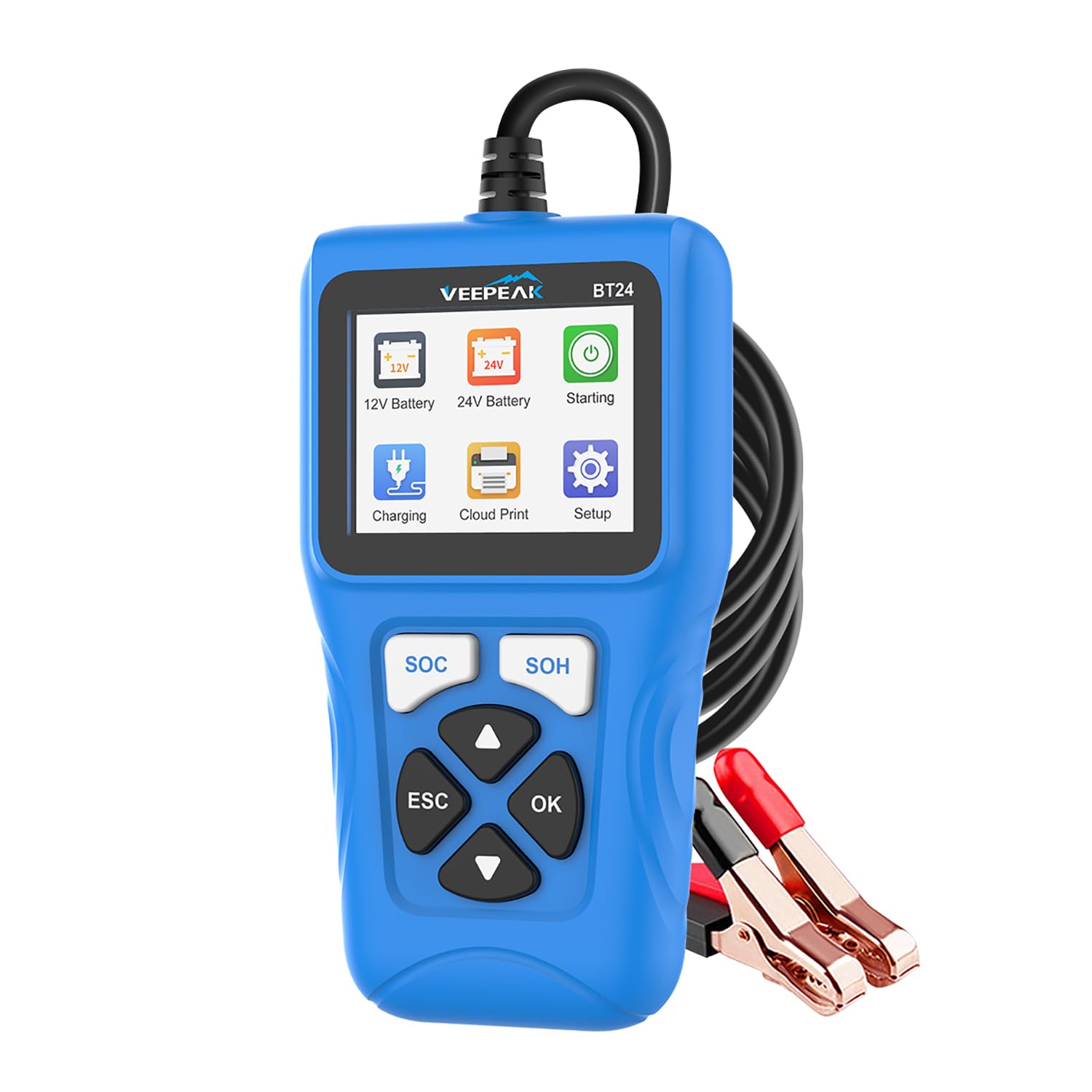
The Veepeak gives you the full suite of battery diagnostics — voltage, CCA, internal resistance, SOH, and SOC — plus cranking and charging system analysis, all in a lightweight 0.65-pound package. It supports 12V and 24V systems with a CCA range of 100–2000, covering everything from a motorcycle battery to a heavy-duty truck battery, and it works with AGM, EFB, GEL, and flooded lead-acid chemistries. The self-powered design means you just connect and go, with no external power source needed.
The multilingual interface includes several European languages, which is convenient if you work on imported vehicles or share the tool with a multilingual crew. The screen is a standard monochrome LCD — not as vibrant as the ANCEL or FOXWELL color screens, but still readable in most conditions. The instructions have a noted translation error in the charging-test sequence, telling users to “turn off engine then turn back on” instead of the correct “start then turn off.” If you are new to battery testing, that confusion can cost you a few minutes of head-scratching.
The clamps include reverse-polarity protection, and the circuitry is stable enough that users report readings matching their ohmmeter nearly dead-on. The cable is about one meter long, which is average for this price tier — adequate for most installs but not generous enough to route the tester into the cabin easily. For the price, it delivers professional-grade battery diagnostics with the minor caveat that prior experience with a load tester helps you navigate the slightly garbled instructions.
Why it’s great
- Covers 12V and 24V systems with 100–2000 CCA range
- Multilingual interface useful for multicultural workshops
- Self-powered — no external batteries or adapters needed
Good to know
- Instruction manual has a translation error in the charging test sequence
- Monochrome LCD lacks the contrast of color TFT screens
7. TOPDON BT50

The TOPDON BT50 is the most budget-friendly unit in this roundup, but it does not cut corners on the safety features that matter most for a first-time tester buyer. The spark-free design eliminates the small arc that occurs when you make final contact with the battery terminal — a minor but real concern in tight engine bays with fuel vapors nearby. The IP67 rating means it is dust-tight and can survive immersion in one meter of water, which is overkill for home-garage use but indicates serious build quality for the price.
The CCA range of 100–2000 matches the broader market, and it supports 12V lead-acid batteries in flooded, AGM, and GEL chemistries. It does not support lithium or 24V systems, so it is best suited for the typical passenger car, SUV, or light truck. The one-button operation is extremely simple — select the battery type, enter the CCA rating, and the bright LCD gives you a clear health verdict. A lube tech in a real-world review reported accurate readings in under ten seconds per test, making it fast enough for quick pre-road-trip checks.
The included 12-month warranty and lifetime technical support add peace of mind. Two consistent criticisms: the clamp grips are not as robust as higher-priced competitors, and the cables are short — you will need to hold the tester close to the battery terminals. The internal load resistor is also small (20–22 AWG), which limits the test duration to milliseconds, so it relies entirely on conductance rather than applying a sustained load. For a home mechanic checking one or two vehicles, that limitation is irrelevant; for a full-time shop tech, the clamp quality becomes a daily frustration.
Why it’s great
- Spark-free and reverse-polarity protection for safe first-time use
- IP67 dust and water resistance rating for durability
- One-button operation with bright LCD — quick and intuitive
Good to know
- Short cables and average clamp grip; not ideal for daily pro use
- Conductance-only testing with small load resistor — no sustained load test
FAQ
Can a battery load tester damage my vehicle electronics?
What is the difference between conductance testing and carbon-pile load testing?
Why does my load tester show a different CCA reading than the auto parts store?
Can I test a lithium battery with a standard lead-acid load tester?
How often should I load-test my car battery?
Final Thoughts: The Verdict
For most users, the battery load tester winner is the ANCEL BT410 because it covers both lead-acid and lithium chemistries in 12V and 24V systems, adds a color TFT display and QR reporting, and delivers professional-grade accuracy without breaking your budget. If you need the longest cable for hard-to-reach batteries, grab the FOXWELL BT301 with its 6.5-foot lead and large color screen. And for the definitive 130-amp carbon-pile test that leaves no doubt about battery condition, nothing beats the OTC 3181.