
Our readers keep the lights on and the weekend projects moving. As an Amazon Associate, I earn from qualifying purchases.
The ache in your forearm after ten minutes of demolition, the constant retreat to swap a dull blade, the dead battery right when you hit the knot in the lumber — a cordless reciprocating saw is either a liberation or a liability. This guide is the cure for that gamble.
I’m Rikta — the co-founder and writer behind FitlyFast. I’ve spent years dissecting brushless motor technology, stroke-length geometry, and tool-platform ecosystems so you don’t have to guess which bare tool or kit belongs in your rig.
Whether you are pruning overgrown limbs, gutting a bathroom, or cutting galvanized pipe, the right battery powered reciprocating saw saves time and saves your hands from unnecessary fatigue.
How To Choose The Best Battery Powered Reciprocating Saw
A cordless reciprocating saw is defined by the interplay of three elements: the motor’s electrical architecture, the physical stroke length, and the battery ecosystem you already own. Getting the combination wrong means buying a tool that either stalls under load or leaves your arm vibrating for hours.
Brushless vs. Brushed Motor
Brushless motors are the standard for any serious cordless recip saw. They generate more torque per watt, run cooler during extended cuts, and deliver up to fifty percent more runtime from the same battery. A brushed motor is acceptable only for the lightest occasional homeowner use — avoid it if you expect to cut wet wood, thick plastic pipe, or metal studs regularly.
Stroke Length and Speed
Stroke length — the distance the blade travels with each cycle — directly determines how aggressively the saw removes material. A 1-1/8-inch stroke clears chips faster and cuts thicker stock than a 7/8-inch stroke at the same strokes-per-minute (SPM). Look for at least 1-inch stroke for demolition work; compact one-handed saws often compromise here for weight savings. Max SPM in the 2,800 to 3,100 range is adequate for most users.
Battery Platform and Voltage
If you already own tools from a specific manufacturer, staying within that battery ecosystem is the most economical move. The voltage choice — 18V/20V MAX versus 60V FLEXVOLT — affects raw power. Higher voltage platforms deliver sustained torque under load, but the saw itself is heavier. For pruning and DIY tasks, 18V/20V MAX is sufficient. For frequent metal cutting or thick lumber, a 60V platform provides noticeably more grunt.
Quick Comparison
On smaller screens, swipe sideways to see the full table.
| Model | Category | Best For | Key Spec | Amazon |
|---|---|---|---|---|
| Makita XRJ08Z | Compact One-Handed | One-handed pruning and tight spaces | 7/8″ stroke; 3,100 SPM | Amazon |
| DEWALT DCS389B FLEXVOLT | Full-Size High Torque | Demolition and thick lumber | 1-1/8″ stroke; 3,000 SPM | Amazon |
| Milwaukee 2625-21 Hackzall | Compact One-Handed | Overhead cutting and root removal | 1″ stroke; one-handed grip | Amazon |
| DEWALT DCS387P1 20V MAX | Compact 20V Kit | Flush cutting in confined spaces | 1-1/8″ stroke; 2,900 SPM | Amazon |
| CRAFTSMAN V20 CMCS300M1 | Mid-Size Kit | Homeowner general use with battery | 1″ stroke; 3,000 SPM | Amazon |
| RYOBI PSBRS01B | Compact One-Handed | Light DIY and brush clearing | One-handed design; 3.6 lbs | Amazon |
| Worx WX500L.9 | Entry-Level | Budget pruning and occasional cutting | Pendulum cutting; 3,000 SPM | Amazon |
In‑Depth Reviews
1. Makita XRJ08Z 18V LXT Brushless Compact One-Handed Recipro Saw

Makita’s compact one-handed recip saw delivers a brushless motor that pushes 3,100 SPM with a 7/8-inch stroke — a combination that cuts through softwood branches and soaked lumber with surprising aggression for its size. The loop-shaped handle guard adds rigidity under load, and the low-vibration design reduces fatigue noticeably during repetitive cuts above shoulder height.
At just over 4 pounds, this is the lightest premium option in the lineup. It ships as a bare tool, so you need an existing 18V LXT battery to power it, but the three included blades (wood, all-purpose, and metal) let you begin cutting immediately. The one-handed grip keeps the tool stable when you are reaching into tight shrubbery or awkward attic corners.
Users consistently report that it slices through small trees and thick limbs with the same authority as larger saws, and the blade release mechanism is smoother than competing compact models. The only real trade-off is the shorter stroke length — you lose some chip-clearing speed on very thick stock compared to full-size saws.
Why it’s great
- Brilliant low-vibration one-handed form factor
- 3,100 SPM brushless motor cuts fast and clean
- Includes three different blades for varied tasks
Good to know
- Battery and charger not included
- 7/8-inch stroke less aggressive than 1-1/8-inch alternatives for heavy demolition
2. DEWALT FLEXVOLT 60V MAX DCS389B Reciprocating Saw
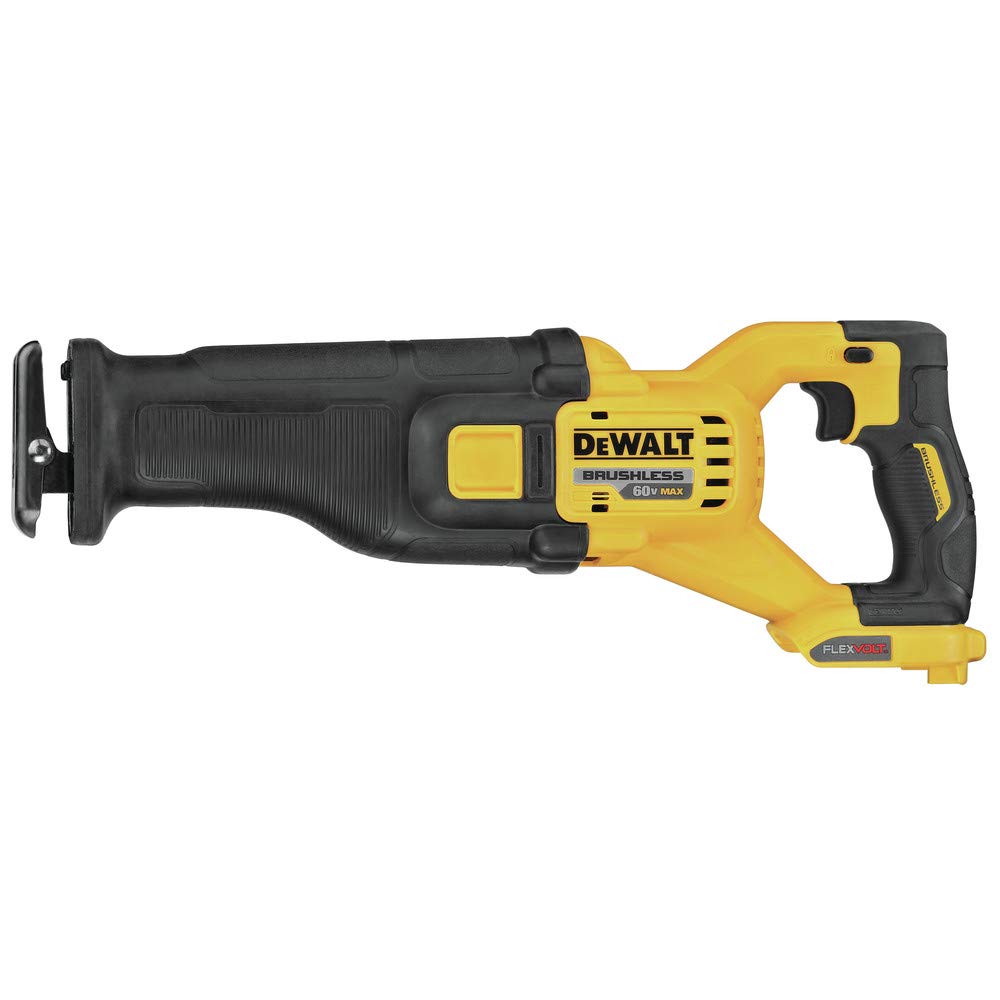
The DEWALT DCS389B is a full-size reciprocating saw that uses the FLEXVOLT 60V battery platform to deliver corded-level power without a wall outlet. The 1-1/8-inch stroke length and 3,000 SPM motor produce rapid chip evacuation, making it the strongest choice for cutting through laminated beams, schedule-40 PVC, and thick metal conduit.
At 7.4 pounds, this is a two-handed tool — you accept the weight in exchange for brute force. The keyless lever-action blade clamp allows blade swaps in seconds, and the pivoting shoe provides stable contact on uneven surfaces. The variable-speed trigger is responsive, and the integrated LED illuminates dim crawlspaces well.
Owners emphasize that the 60V battery provides a noticeable torque advantage over 20V MAX saws during sustained heavy cuts, though runtime depends heavily on the load. It is overkill for occasional pruning but essential if you are demolishing framing or cutting thick metal on a regular basis.
Why it’s great
- 1-1/8-inch stroke and 60V motor deliver demolition-grade torque
- Keyless lever-action blade clamp for fast changes
- Pivoting shoe adapts to angled cuts
Good to know
- Heavy at 7.4 pounds, not suited for one-handed use
- Battery and charger sold separately
3. Milwaukee 2625-21 M18 Hackzall Cordless One-Handed Reciprocating Saw Kit
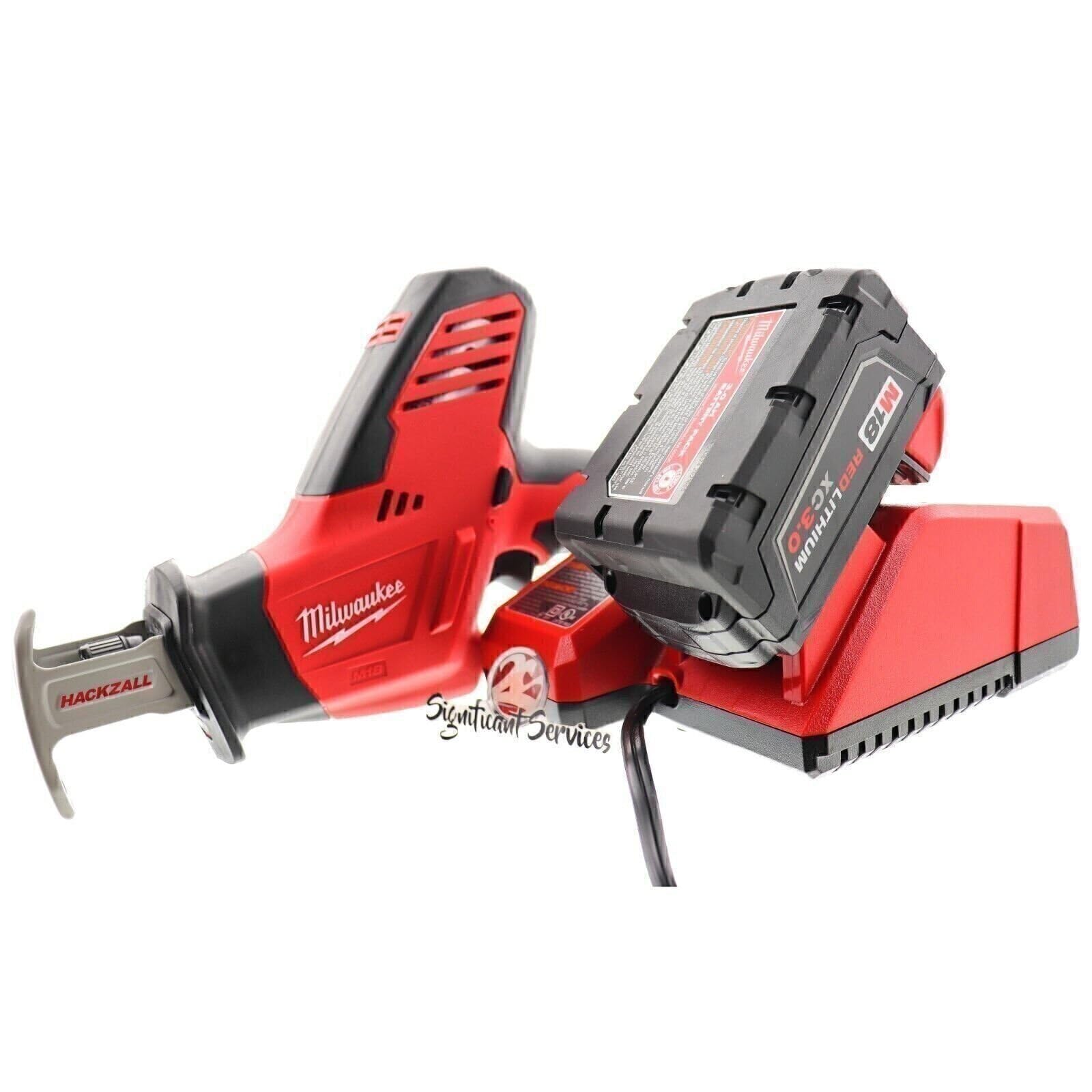
Milwaukee’s Hackzall is the original one-handed compact recip saw, and the 2625-21 kit remains a benchmark for tight-space cutting. Its M18 motor delivers a 1-inch stroke with variable speed, and the QUIK-LOK blade clamp accepts both SAWZALL and HACKZALL blades without tools. The compact body weighs just over 4 pounds, making overhead cutting on roots or drywall significantly less fatiguing than with a full-size saw.
The built-in LED light is a genuine help in dark basements and under-sink cabinets. This kit includes a battery and charger, which is a major advantage over bare-tool options if you are new to the M18 platform. The one-handed design sacrifices some mechanical leverage, so it is not the ideal tool for long straight cuts in lumber, but it excels at plunge cuts and trimming flush surfaces.
User reviews highlight the smooth low-vibration operation and the excellent battery life from the included XC high-capacity pack. The only common criticism is that the saw lacks an orbital action setting, which could improve cutting speed in softer materials.
Why it’s great
- Lightweight one-handed design with low vibration
- Comes with battery and charger for immediate use
- QUIK-LOK clamp works with standard and Hackzall blades
Good to know
- No orbital action for faster cuts in wood
- Not ideal for long rip cuts or heavy demolition
4. DEWALT 20V MAX DCS387P1 Compact Reciprocating Saw Kit
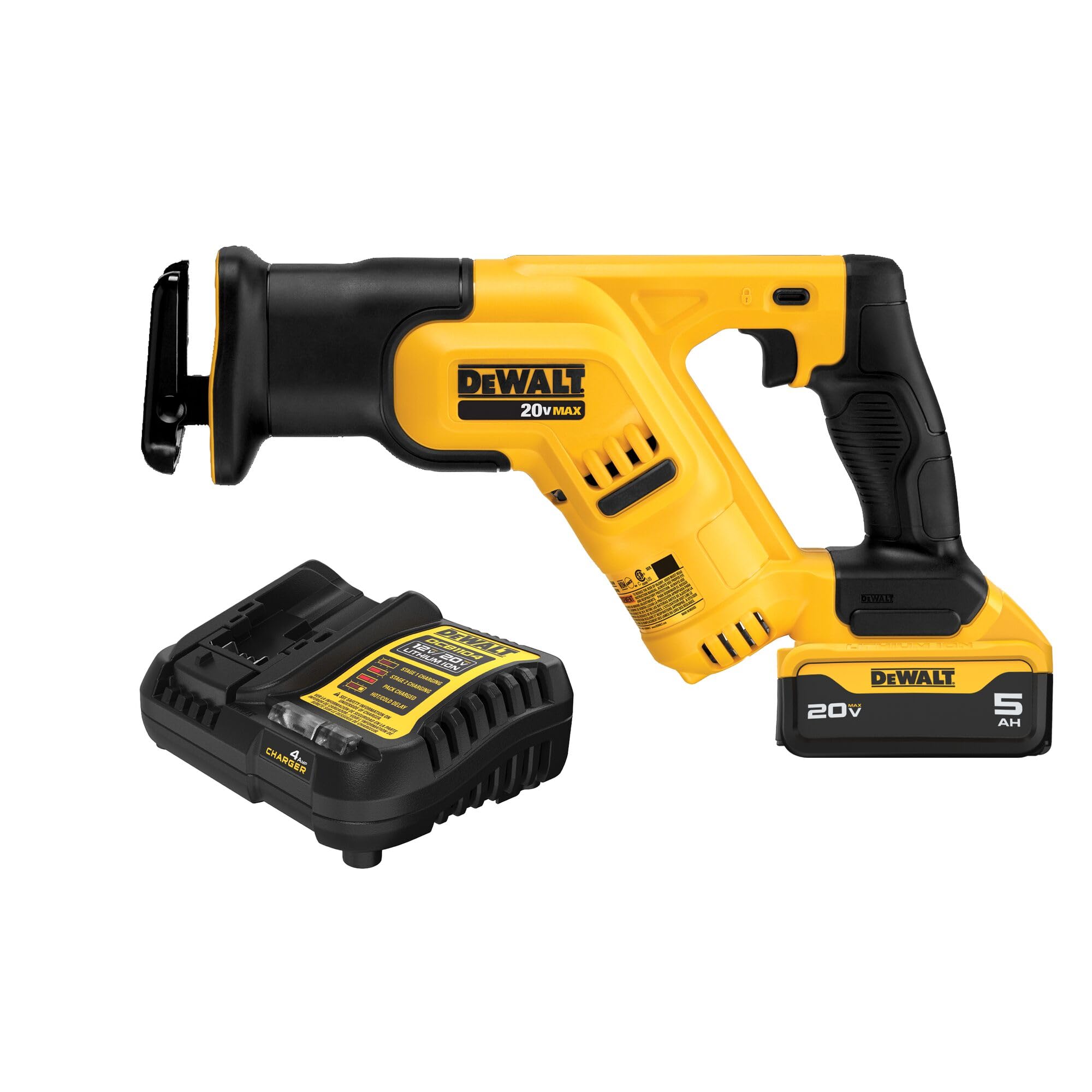
The DEWALT DCS387P1 is a compact 20V MAX recip saw that prioritizes maneuverability over raw muscle. Its 14.5-inch overall length fits easily between wall studs, and the 4-position blade clamp allows flush cutting against surfaces — a critical feature when you need to cut a pipe or nail flush with a joist without leaving a stub.
The 1-1/8-inch stroke length is generous for a compact saw, delivering 2,900 SPM with adequate aggression for most homeowner and light contractor tasks. The kit includes a 5.0Ah battery and charger, making it a complete ready-to-work package. The variable-speed trigger and pivoting shoe offer good control for precise cuts in wood, PVC, and drywall.
Users appreciate the battery efficiency: the 5.0Ah pack often lasts a full day of mixed cutting on a single charge. The saw is not as powerful as the FLEXVOLT model, but for pruning branches up to 4-5 inches, cutting fence pickets, and remodeling tasks, it hits a strong balance of size, power, and value.
Why it’s great
- Short length fits between studs and in tight cavities
- 4-position blade clamp for flush cutting against surfaces
- Kit includes 5.0Ah battery and charger
Good to know
- Not as powerful as FLEXVOLT or full-size 60V models
- Heavier than pure one-handed compact designs
5. CRAFTSMAN V20 Cordless Reciprocating Saw Kit CMCS300M1

The CRAFTSMAN V20 CMCS300M1 is a full-size reciprocating saw that brings a 1-inch stroke and 3,000 SPM to the table at a mid-range price point. The kit includes a battery and charger, which makes it a convenient entry point for users who are starting their V20 tool collection. The contoured over-molded handle provides a secure grip even with gloves.
The 14.5-inch overall length is compact enough for most tight spaces, though the tool-free blade release and variable-speed trigger feel comparable to saws at a higher price tier. It is capable of cutting through tree trunks up to 10 inches in diameter, though users recommend quality blades for optimal performance on thick stock.
Owners note that the battery charges quickly and provides adequate runtime for typical homeowner projects. The saw is heavier than compact one-handed models but comfortable for two-handed use. Some users mention that the fixed shoe limits cutting angle versatility compared to pivoting-shoe alternatives.
Why it’s great
- Good power-to-price ratio with included battery and charger
- Contoured rubber overmold handle for comfort
- Capable of cutting 10-inch tree trunks
Good to know
- Fixed shoe lacks pivoting adjustment
- Heavier bulk can limit use in very tight spots
6. RYOBI 18V ONE+ One-Handed Reciprocating Saw PSBRS01B

Ryobi’s PSBRS01B is a compact one-handed recip saw designed for users who want maneuverability over maximum cutting force. At 3.6 pounds, it is the lightest saw in this lineup, making it ideal for one-handed branch trimming, cutting drywall, and slicing through plastic plumbing pipes. The brushless motor is not specified, but the 18V ONE+ platform provides adequate torque for light-duty tasks.
The tool-free blade clamp allows quick swaps, and the variable-speed trigger gives reasonable control for precision cuts. It is a natural fit for anyone already invested in the Ryobi 18V ecosystem, as it uses the same batteries as drills, circular saws, and blowers. The single-handed grip and balance make it easy to hold in awkward positions.
Customer reviews consistently describe it as much easier to use than a full-size reciprocating saw for pruning and fence repairs. The primary limitation is power: it struggles with thick hardwood or metal beyond thin gauge. It is best treated as a specialist tool for fast, light work rather than a demolition saw.
Why it’s great
- Extremely lightweight at 3.6 pounds for one-handed use
- Shares batteries with the entire Ryobi ONE+ system
- Tool-free blade clamp for quick changes
Good to know
- Limited power for thick hardwood or heavy metal
- Only one blade included in the box
7. Worx 20V Power Share Reciprocating Saw WX500L.9

The Worx WX500L.9 is a budget-friendly option that includes pendulum (orbital) cutting action — a rare feature at this price point. The pendulum function increases cutting speed by rocking the blade forward on each stroke, which is beneficial for sawing through softer materials like wood and drywall. The 3,000 SPM no-load speed is competitive with saws costing significantly more.
The adjustable pivot foot plate provides a larger contact surface for stability, and the tool-less blade change system works smoothly. It is compatible with the full Worx Power Share ecosystem, so it can share batteries with Worx 20V, 40V, and 80V tools. The saw also includes an LED light for dim work areas and variable speed control.
User reports confirm that it handles vinyl siding, bushes, and small branches well, but it burns through batteries quickly under heavy load — expect to use multiple battery packs for extended projects. It is best suited for occasional homeowner use where budget is the primary concern and you already own Worx batteries.
Why it’s great
- Pendulum cutting mode improves speed in wood and drywall
- Tool-free blade change and adjustable pivot foot plate
- Shares batteries across the Worx Power Share platform
Good to know
- Battery not included, and performance is battery-intensive
- Best for light to medium homeowner tasks only
FAQ
Can a battery powered reciprocating saw replace a corded sawzall for demolition?
What is the difference between a one-handed and a full-size reciprocating saw?
Do I need a brushless motor for occasional home use?
What size battery works best with a cordless reciprocating saw?
Final Thoughts: The Verdict
For most users, the battery powered reciprocating saw winner is the Makita XRJ08Z because its brushless motor, low-vibration one-handed design, and reliable 18V LXT platform handle both pruning and light demolition with exceptional balance. If you want raw demolition torque for thick lumber and metal, grab the DEWALT DCS389B FLEXVOLT. And for a compact kit that is ready out of the box, nothing beats the Milwaukee 2625-21 Hackzall.