
Our readers keep the lights on and the weekend projects moving. As an Amazon Associate, I earn from qualifying purchases.
A power outage during a heavy storm is the moment your sump pump earns its keep—or your basement floods. Cordless battery-powered models eliminate the extension-cord scramble and the generator hum, but choosing the wrong one means trusting a plastic float switch with thousands of gallons of water. The real split in this category isn’t price; it’s between systems built for emergency-only use and those rugged enough for daily dewatering.
I’m Rikta — the co-founder and writer behind FitlyFast. I’ve spent years cross-referencing battery chemistries, GPM curves under lift, and control-panel logic to separate true home-protection systems from glorified transfer pumps.
After analyzing pump curves, battery compatibility, and real-world runtime reports, the quiet truth is that the most critical spec often gets overlooked: how many vertical feet the pump can lift against gravity. This guide cuts through the float-switch noise to find the genuine best battery powered sump pump for your home.
How To Choose The Best Battery Powered Sump Pump
A battery powered sump pump isn’t a single product type—it’s either a 12V DC backup pump that requires a separate deep-cycle battery and charger, or a cordless portable pump with an integrated lithium-ion pack. The choice comes down to whether you want home-wide emergency protection or a grab-and-go unit for spot-flooding. Each configuration has a distinct set of trade-offs.
Pump Motor Construction and Materials
The motor housing determines longevity in a damp pit. Stainless steel and cast-iron housings resist corrosion and dissipate heat better than thermoplastic shells. Look for copper-wound motors rather than aluminum—copper handles repeated start-up torque without overheating, which matters when the pump cycles dozens of times during a single storm. Dielectric oil-filled chambers further protect windings from moisture ingress.
Float Switch Reliability and Redundancy
A single mechanical float switch can jam if debris accumulates in the pit. Dual-float systems—where two switches must agree to turn on the pump—reduce false starts and missed activations. Electronic pressure-sensor switches are rarer at this price tier but eliminate moving parts entirely. For backup systems, the float switch on the DC pump should be set slightly higher than the primary AC pump’s switch so the backup only activates when genuinely needed, preserving battery charge.
Battery Capacity, Chemistry, and Charger Quality
Most DC backup sump pumps don’t include a battery, so you’re buying into a specific charging ecosystem. AGM (Absorbent Glass Mat) batteries are the standard choice—they’re sealed, spill-proof, and tolerate deep discharges better than traditional wet-cell marine batteries. The charger matters more than most buyers realize: a multi-stage smart charger that switches to trickle mode after full charge prevents sulfation. A 0.4-amp trickle charger is adequate for maintaining a battery; a 20-amp charger can refill a 100Ah battery in roughly five hours after a storm event, which is critical if multiple outages occur in quick succession.
Vertical Lift and Flow Rate at Working Head
Every pump lists a maximum flow rate, but that number is measured at zero vertical lift—meaning the pump is sitting next to the water source. Real-world performance drops sharply with every foot of rise. A pump rated for 2,500 GPH at zero lift might deliver only 1,500 GPH at a 10-foot lift. For basements with deeper pits or long horizontal runs before the discharge exits the house, you need a model with strong performance at 10 to 15 feet of head. The 1/2 horsepower pumps generally outperform 1/3 HP units at higher lifts, but they also draw more current, which drains the battery faster.
Quick Comparison
On smaller screens, swipe sideways to see the full table.
| Model | Category | Best For | Key Spec | Amazon |
|---|---|---|---|---|
| Wayne WSS30VN | Primary + Backup | Whole-home flood protection | 5,100 GPH / 1/2 HP | Amazon |
| Westinghouse WH50BBU | Primary + Backup | Dual stainless steel durability | 5,220 GPH / 1/2 HP | Amazon |
| Zoeller 508-0005 | DC Backup Only | Premium backup pump | 2,400 GPH / 12V DC | Amazon |
| PumpSpy 2000W | Inverter Backup | Powering two pumps during outage | 2,000W pure sine wave | Amazon |
| VEVOR 2000W | Inverter Backup | Budget inverter with LCD display | 2,000W / 20A charger | Amazon |
| Basement Watchdog BWE | DC Backup System | Entry-level backup with dual floats | 2,500 GPH / copper-wound | Amazon |
| Superior Pump 92941 | Pre-Assembled Kit | All-in-one primary + backup kit | 2,760 GPH / dual pump | Amazon |
| Superior Pump 91012 | 12V Portable | Vehicle-mounted flood pumping | 1,380 GPH / alligator clips | Amazon |
| AMPFORCE 20V | Cordless Portable | Spot flooding and rain barrels | 1,003 GPH / 4.0Ah battery | Amazon |
In‑Depth Reviews
1. Wayne WSS30VN 1/2 HP Primary & Backup System

The Wayne WSS30VN is a pre-assembled dual-pump system that marries a 1/2 HP AC primary pump with a 12V DC backup pump inside a single compact frame. The primary pump moves up to 5,100 GPH, and the DC pump can evacuate roughly 10,000 gallons on a single 75 Ah battery charge—enough to handle an overnight storm. Users consistently report whisper-quiet operation from the primary motor and reliable automatic switchover to the backup when the power cuts. The included controller monitors battery condition and pump status through an LED interface.
Installation is straightforward for a DIY homeowner: the unit drops into pits 16 inches or larger in diameter, and the dual-float switches are factory-set at different heights to prevent short-cycling. The backup pump activates for a 20-second run cycle to avoid air intake, then waits for the water to rise again. One caveat: the base is wide, so it may not fit tight 14-inch round pits. Users also recommend pairing the system with a separate dedicated battery charger rather than relying solely on the built-in smart charger for long battery life.
Build quality is solid—the polypropylene housing resists corrosion, and the DC motor is designed for intermittent emergency use. The backup pump’s float switch has been tested to over a million cycles, which gives confidence during multi-day power outages. The primary drawback is that the battery is sold separately, and the included documentation could be clearer about optimal battery sizing for extended runtime. For homeowners who want a single-drop solution that covers both normal and emergency pumping, this is the most complete package at a mid-premium price point.
Why it’s great
- Integrated AC and DC pumps in one unit
- 5,100 GPH primary flow rate handles heavy inflow
- Quiet enough for finished basements
Good to know
- Requires a separate deep-cycle battery
- Wide base may not fit narrow sump pits
2. Westinghouse WH50BBU 1/2 HP Dual Pump System
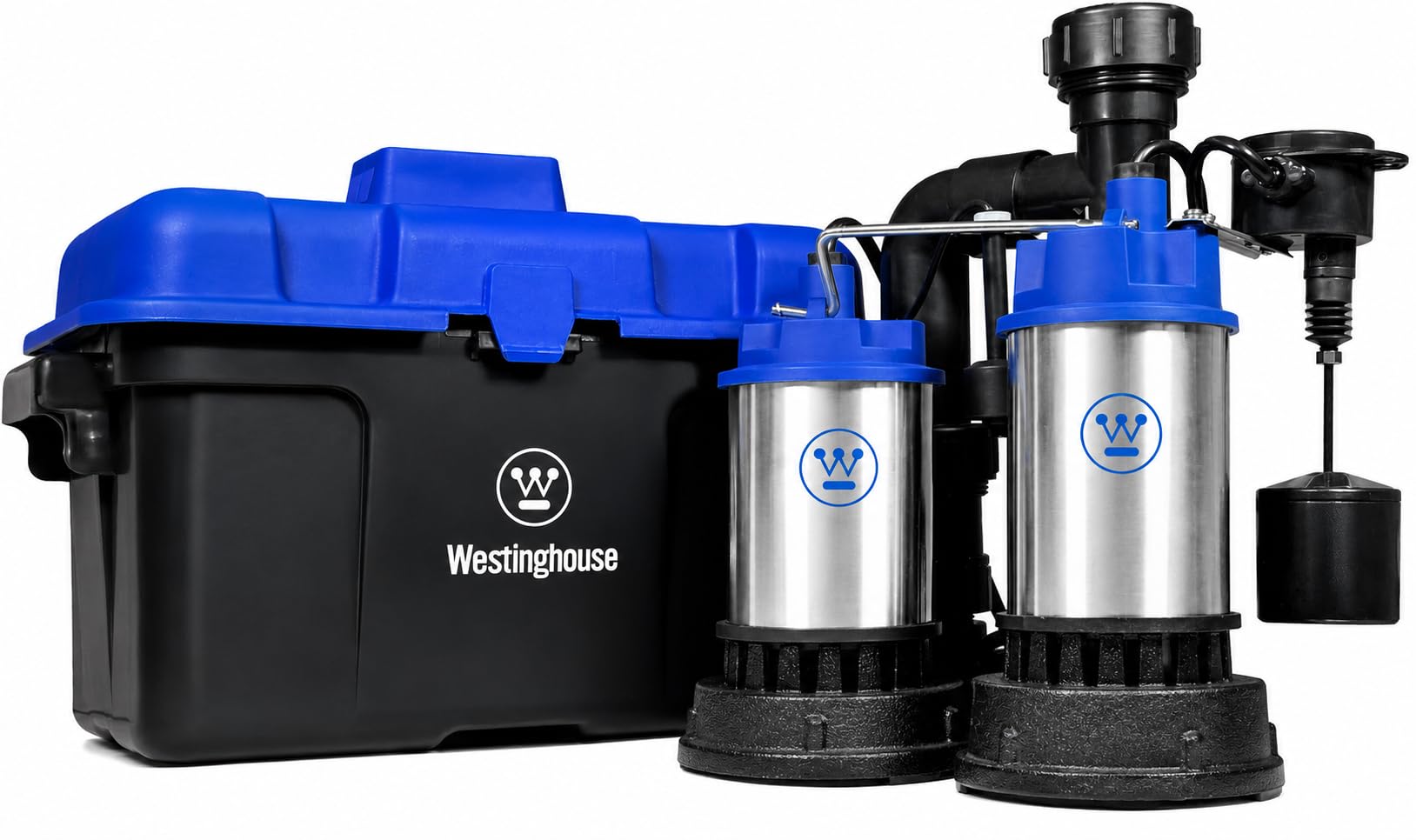
The Westinghouse WH50BBU stands out for its corrosion-resistant construction: both the primary and backup pumps feature stainless steel housings and cast-iron components, which dramatically outlast thermoplastic shells in acidic groundwater. The 1/2 HP AC pump delivers up to 5,220 GPH, and the DC backup pump automatically engages during a power failure via a dedicated control panel. Users frequently note that the cast-iron build gives the pump a reassuring heft compared to plastic competitors, and the top-suction intake minimizes airlock issues during rapid water drawdown.
Installation is simplified by the pre-assembled bracket—the entire system sits in a 16-inch or larger pit without requiring separate piping for each pump. The dual independently mounted float switches provide redundancy; if one switch sticks, the other still activates the pump. The controller includes an audible alarm that sounds when the backup kicks in, plus a visual battery-level indicator. The energy-efficient PSC motor runs cooler than standard induction motors, which extends duty cycles during heavy rain. The main reported issue is the charger’s AC adapter cable, which some users found too short for convenient wall-plug placement, requiring an extension cord.
At this premium tier, the Westinghouse system competes directly with Wayne’s offering but edges ahead for buyers who prioritize metal construction over plastic. The top-suction design also allows the pump to sit closer to the pit bottom without sucking debris, reducing maintenance frequency. The system’s main trade-off is weight—50 pounds—which makes it less portable but more durable once installed. For a full-featured primary-plus-backup solution built to last decades, this is the strongest contender.
Why it’s great
- Stainless steel and cast-iron housings
- Top-suction prevents airlock and debris clogs
- Two independent float switches for redundancy
Good to know
- Heavy unit at 50 pounds
- Charger cable is notably short
3. Zoeller 508-0005 Aquanot 508 DC Backup
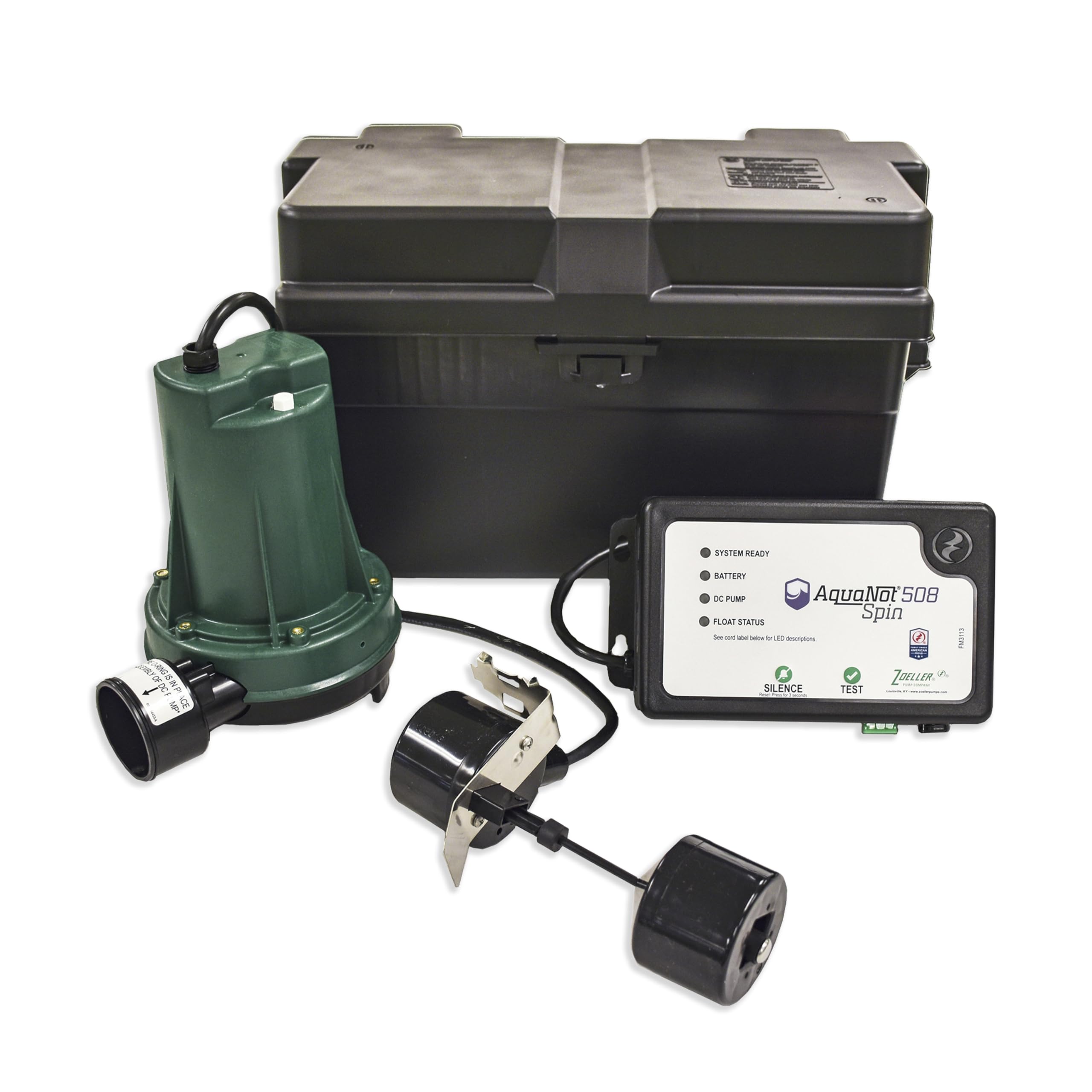
The Zoeller Aquanot 508 is the gold standard for dedicated DC backup sump pumps—it does nothing else, and it does that one thing exceptionally well. The pump is 12V-only, rated at 40 GPM (2,400 GPH), and features a noncorrosive plastic body with an aluminum seal pocket and cooling plate. The control unit mounts to the wall and includes an LCD screen that displays battery voltage, pump running time, and alarm history. Zoeller hand-builds and 100-percent tests each unit in the USA, a rarity in this category. Users moving from cheaper backup systems consistently report that the Zoeller’s build quality eliminates the ghost errors and false alarms common with budget alternatives.
Installation requires connecting the battery (a deep-cycle AGM battery is strongly recommended, sold separately) and routing the discharge line through the integrated check valve—no external check valve needed. The pump includes a quick-disconnect discharge fitting for simple removal during maintenance. The controller’s piercing audible alarm is loud enough to be heard upstairs, even in a finished basement, which is critical if the backup kicks on while the occupants are asleep. One design nuance: the built-in flapper valve eliminates the weep-hole drilling required on many other pumps, reducing installation steps. Users note that the warranty extends to 36 months when paired with an official Zoeller Aquanot battery, a strong incentive to stay within the brand ecosystem.
On the downside, the 508 is purely a backup solution—it cannot serve as a primary pump, so it must be installed alongside an existing AC pump. The control box uses a resin-filled transformer that runs warm; some users add a small USB fan nearby for extended reliability. The total cost, when accounting for a quality AGM battery, lands firmly in the premium tier. For homeowners who already have a reliable primary pump and want a backup with industrial-grade components and US-based support, the Zoeller Aquanot 508 is the definitive choice.
Why it’s great
- American-made with 100% factory testing
- Integrated check valve simplifies installation
- Loud alarm alerts you to backup activation
Good to know
- Backup-only; requires an existing AC pump
- Requires Zoeller battery for full warranty
4. PumpSpy 2000W Inverter Backup System

The PumpSpy 2000W represents a different philosophy for battery backup: instead of a dedicated DC pump, it’s a pure sine wave inverter that powers your existing AC sump pump from a 12V battery during outages. This approach has two advantages: you keep your current primary pump’s flow characteristics, and the unit can power other devices (lights, phones, a small fridge) during a blackout. The inverter delivers 2,000 watts continuously (16.6 amps), enough to run most 1/3 HP to 1/2 HP pumps simultaneously if you have two pits. The aluminum enclosure and smart cooling fan keep the unit from overheating during extended operation.
Installation is straightforward: connect the inverter to a 12V deep-cycle battery, plug your sump pump into one of the two grounded outlets, and let the built-in smart charger maintain the battery. When AC power fails, the inverter automatically switches to battery mode with no manual intervention; when power returns, it recharges the battery and resumes trickle-charge maintenance. Users have tested it with 1/3 HP pumps running continuously for over 15 hours on a single Group 27 battery, and with a second battery, runtime extends past 48 hours. The digital display shows voltage, power draw, and charge status, giving you real-time situational awareness during a storm. The unit is assembled and tested in Kalamazoo, Michigan, and CE-certified.
The main trade-off versus a dedicated DC pump: efficiency. Running a pump through an inverter incurs conversion losses (roughly 10–15 percent more battery drain than a native DC pump). The battery cables included are on the short side, which may require repositioning the battery closer to the inverter. And because the system relies on your existing AC pump’s performance, a weak or failing primary pump will still perform poorly during emergency backup. For customers who want versatile emergency power beyond just sump pumping, this inverter system offers flexibility that a dedicated backup pump cannot match.
Why it’s great
- Powers any standard AC pump and other devices
- Pure sine wave output protects pump motors
- Smart charger maintains battery indefinitely
Good to know
- Inverter conversion reduces battery runtime
- Battery cables are shorter than ideal
5. VEVOR 2000W LCD Inverter Backup

The VEVOR 2000W inverter backup system competes directly with the PumpSpy at a lower price point while adding a high-definition LCD screen that shows voltage, power consumption, and battery level in real time. It delivers 2,000 watts of pure sine wave power across two outlets, and its 20-amp charging current refills a 100Ah battery in roughly five hours—four times faster than a standard 5-amp charger. This rapid recharge is critical if multiple power outages occur in the same storm event. The unit automatically switches to battery power when AC input drops, and the three-pin plug design eliminates hardwiring, reducing installation mistakes.
User reports highlight the LCD as genuinely useful—the battery bar graph and voltage readout let you estimate remaining runtime at a glance, which is a rare feature at this price tier. The multi-layer protection scheme includes overload, short-circuit, overcharge, overvoltage, and overheat protection, plus a physical circuit breaker. During extended use, the fan spins up audibly but is acceptable in a basement environment. The unit is slightly larger than the PumpSpy, measuring 17.3 inches long, so plan your mounting location accordingly. One recurring critical note: the internal fuse requires partial disassembly to replace, though the external 120V input fuse and a spare are easily accessible.
Quality control has been a minor concern—a handful of units arrived dead on arrival, likely due to shipping damage or manufacturing variance, though VEVOR’s customer support generally resolves these quickly. For budget-conscious homeowners who want an inverter-based backup with fast charging and real-time monitoring, the VEVOR offers compelling value. However, the build precision doesn’t match the PumpSpy’s domestic assembly standards. If you’re handy and willing to tolerate occasional component variance, this system delivers core functionality at a mid-range price.
Why it’s great
- 20A charger refills battery in ~5 hours
- Informative LCD with battery level display
- Pure sine wave output protects sensitive pumps
Good to know
- Internal fuse requires disassembly to replace
- Occasional QA issues on arrival
6. Basement Watchdog BWE Emergency Backup System

The Basement Watchdog BWE is the entry-level standard for DC backup sump pumps—it’s compact, priced accessibly, and includes the essential components: pump, dual float switch, control panel, battery box, and 0.4-amp charger. The pump (battery not included) delivers 2,500 GPH at zero lift and an effective 1,500 GPH at 10 vertical feet, which covers most residential basement depths. The copper-wound motor is a welcome spec at this tier, as budget pumps often use aluminum windings that degrade faster under repeated thermal stress. Users report that the BWE is quiet during operation and that the control panel’s visual and audible alerts clearly describe the issue, reducing guesswork during a crisis.
Installation is straightforward for a DIYer with basic plumbing skills—the pump sits in the pit alongside your existing primary AC pump, and the dual float switches provide double protection against a single stuck switch. The 0.4-amp smart charger is automatic switch trickle maintenance once the battery is full, preventing overcharge damage. Several users moved to the BWE from no-name backup pumps and noted immediate reliability improvements: fewer false alarms and more consistent activation during testing. The compact pump body fits in narrow pits, which is a practical advantage if your sump basket is crowded with the primary pump and discharge pipes.
The main limitation is battery compatibility: the BWE works with both AGM and wet-cell batteries, but the included charger is low-amperage, so recharging a depleted 100Ah battery takes 20+ hours. If you experience multiple back-to-back outages, the pump may not have enough recovery time between cycles. The warranty is two years, which is adequate but shorter than premium competitors. For homeowners on a tighter budget who need a reliable secondary pump without paying for inverter flexibility or stainless steel enclosures, the Basement Watchdog BWE is a proven, no-nonsense choice.
Why it’s great
- Copper-wound motor for thermal durability
- Dual float switches reduce failure risk
- Compact frame fits tight sump pits
Good to know
- 0.4A charger is slow for large batteries
- No inverter—pump only works with included DC motor
7. Superior Pump 92941 Pre-Assembled Backup Kit
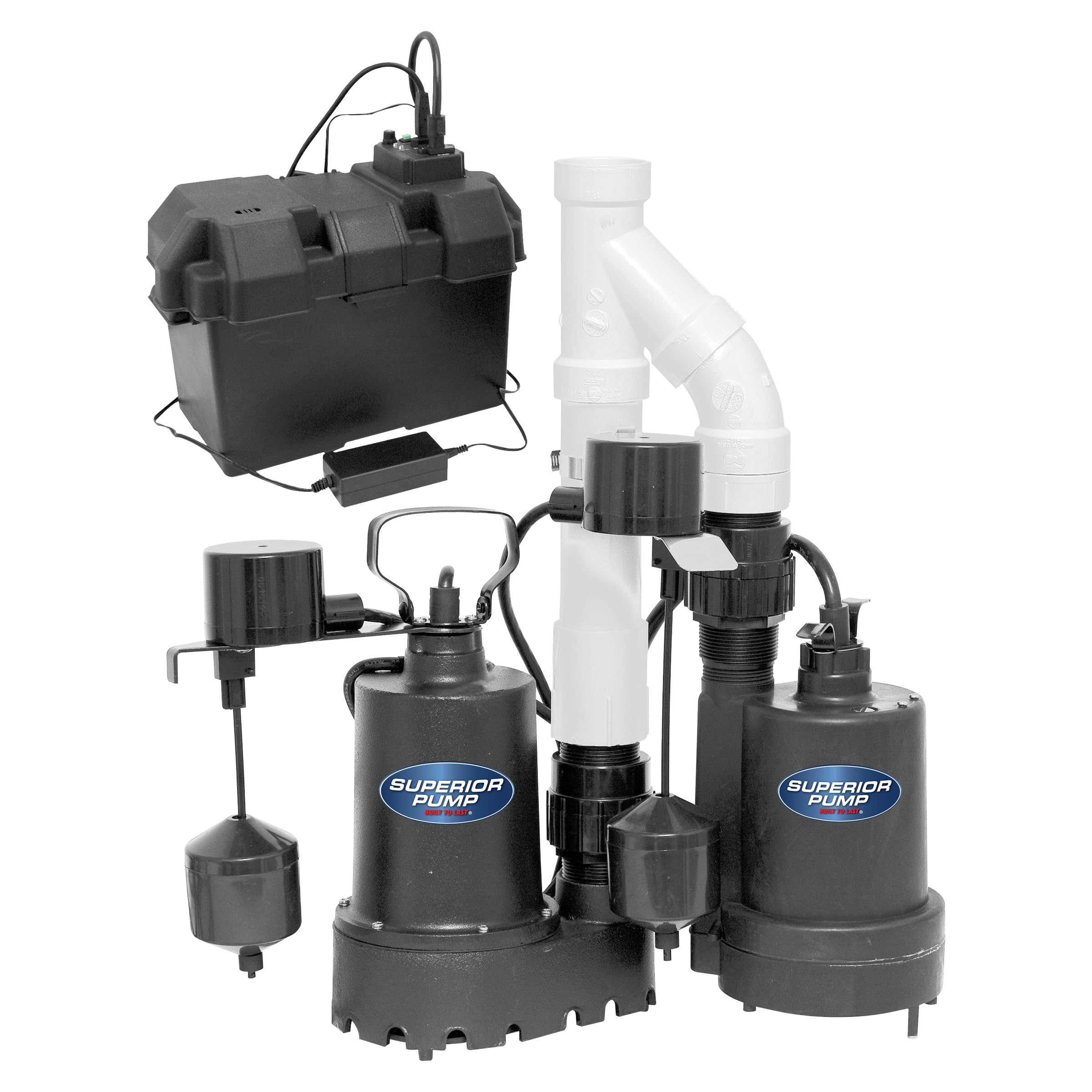
The Superior Pump 92941 is a pre-assembled dual-pump kit that includes a primary AC pump, a DC backup pump, a control box, and a battery case—everything except the 12V deep-cycle battery. The primary pump uses a 1/3 HP motor with a cast-iron housing (rated for 2,760 GPH), and the DC backup is made from durable thermoplastic. The kit is designed for homeowners who want a turnkey solution without sourcing individual components. Users appreciate the tethered float switch that saves vertical space in the pit and the inclusion of a battery box with standoffs to keep the battery elevated above potential moisture.
Performance is solid for mid-range water intrusion: the primary pump handles normal groundwater seepage, and the backup automatically engages during power loss. The control panel includes a battery charger and status monitoring, though the user interface is simpler than the LCD screens found on premium inverters. Installation is simplified because the bracket holds both pumps at the correct depth, and the included check valve prevents backflow. One recurring user note: the plastic check valve included in the kit can crack during tightening, so many owners swap it for a rubber or brass check valve during installation. The pump also requires a weep hole drilled into the discharge pipe (unless you add an above-check valve relief hole) to prevent air lock.
The primary advantage of this kit is value: at a mid-range price, you get a nearly complete system with iron construction on the primary pump and a 3-year warranty. The trade-offs are that the backup pump is plastic-bodied and the charger connection plug fits loosely in some units, potentially dislodging during maintenance. Also, because both pumps share the same 1.5-inch discharge line, you must carefully install the backup pump’s check valve to prevent the primary pump from pushing water through the backup. For DIYers who want a single-box solution and don’t mind swapping a check valve, the Superior Pump 92941 is a competent mid-range pick.
Why it’s great
- Pre-assembled kit includes primary and backup pumps
- Cast-iron primary motor is more durable than plastic
- 3-year warranty covers both pumps
Good to know
- Plastic check valve may crack during installation
- Backup pump housing is thermoplastic
8. Superior Pump 91012 12V Utility Pump
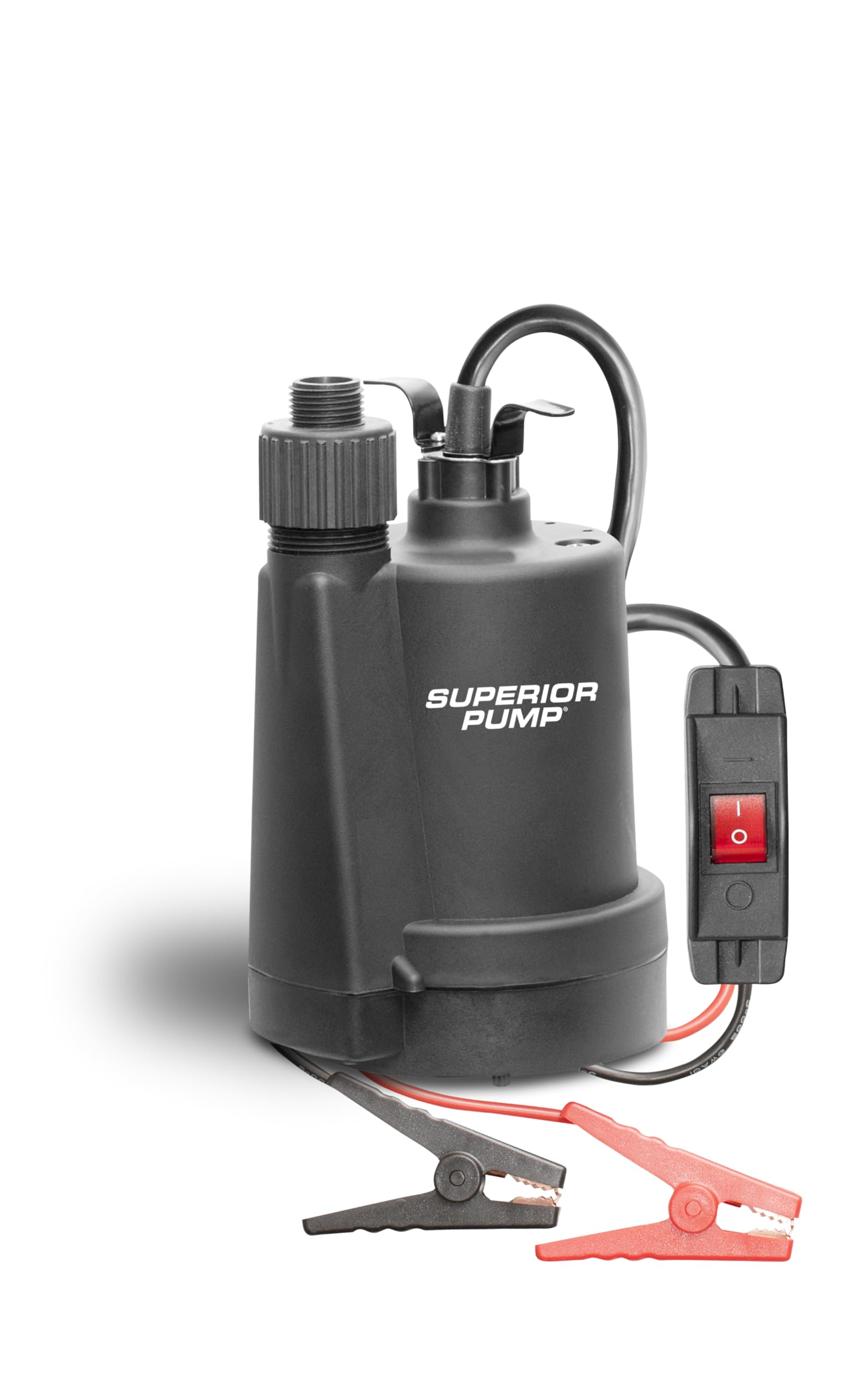
The Superior Pump 91012 is a straightforward 12-volt utility pump designed to connect directly to a car or marine battery via alligator clips. With a flow rate of 1,380 GPH and a maximum lift of 20 vertical feet, it’s less powerful than dedicated sump systems but highly portable. The 20-foot power cord gives you flexibility to position the battery away from standing water, and the included garden hose adapter connects to standard 3/4-inch hoses. Users commonly employ this pump for emptying water from pressure-washing jobs, draining pool covers, or as a vehicle-mounted emergency pump for roadside flooding.
The pump body is made from thermoplastic with an oil-free motor design that won’t contaminate aquatic environments—a consideration for pond or rainwater-harvesting applications. The on/off switch is integrated into the cord, so you can control the pump from the battery location rather than reaching into the water. Users report that the pump self-primes quickly and moves water effectively up to a 6-foot lift through a 20-foot hose. The base has small feet with intake holes that are only about half an inch tall, which means the pump sits close to the surface and can struggle if debris is present—clearing the intake grate becomes a regular maintenance task in murky water.
This pump is not designed for automatic sump pit operation; it lacks a float switch, so you must manually turn it on and off. If used as a basement backup, you would need to add an external float switch and an inline fuse (the unit ships without one). The 12V motor draws enough current that users recommend a 100Ah battery for reasonable runtime. For homeowners who want a second line of defense during an outage and already own a deep-cycle battery for other purposes, the Superior Pump 91012 offers a budget-friendly, manual backup option. For automated protection, however, the dedicated sump systems above are a better fit.
Why it’s great
- Connects directly to any 12V battery with clips
- 20-foot cord for flexible battery placement
- Oil-free motor safe for aquatic use
Good to know
- No float switch—manual operation only
- Intake holes clog easily with debris
9. AMPFORCE 20V Cordless Submersible Pump
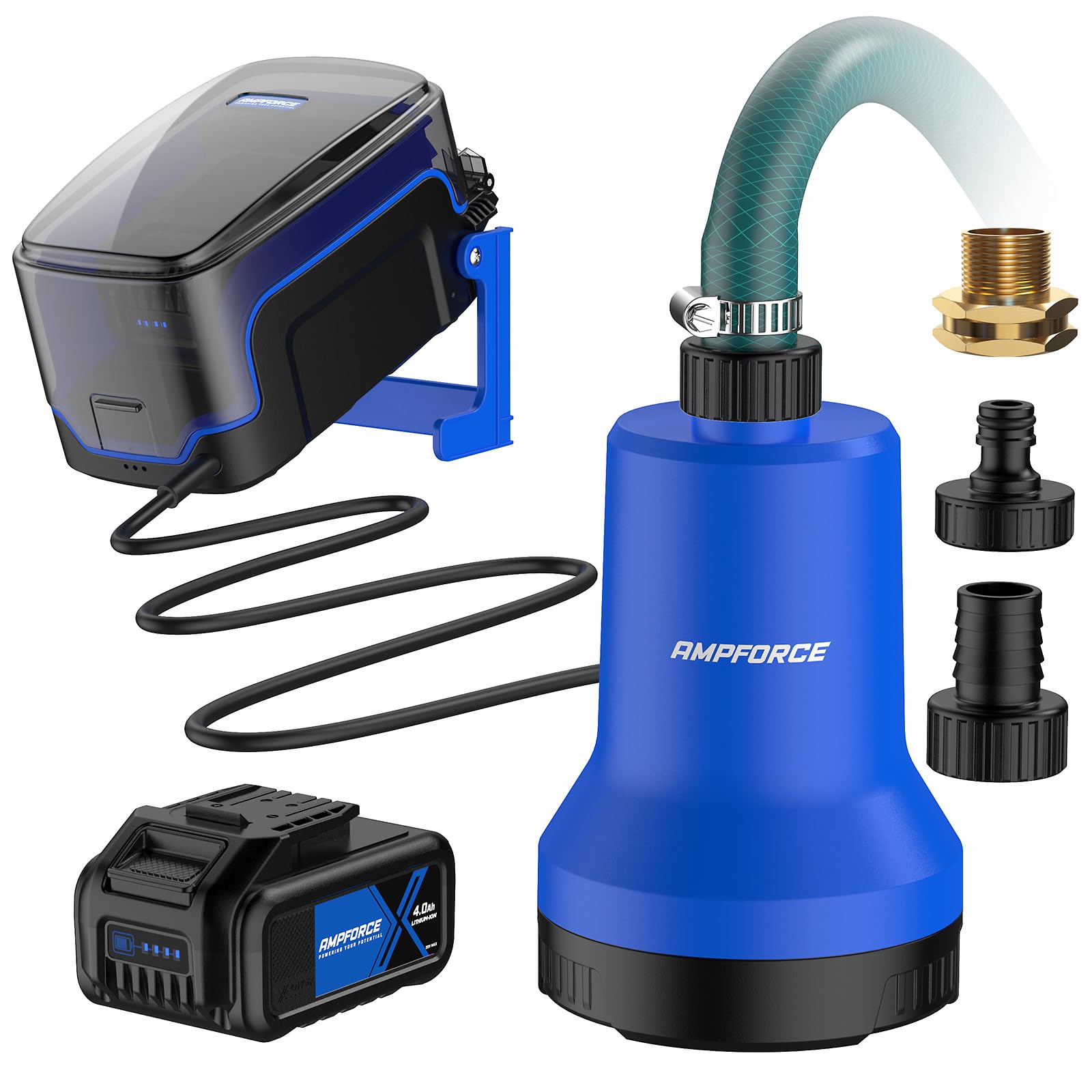
The AMPFORCE 20V cordless pump is the budget-friendly, grab-and-go option in this lineup—a fully submersible unit powered by a 20V 4.0Ah lithium-ion battery that delivers about an hour of runtime at full flow. It pumps 1,003 GPH through a standard garden hose, making it ideal for draining inflatable pools, emptying a flooded basement corner, or moving water from a rain barrel for garden irrigation. The separate battery housing is designed to stay above water, protecting the battery while the pump sits submerged. Users consistently praise the surprising water output for such a compact, lightweight tool.
The automatic shutdown timer offers three presets (5, 10, and 15 minutes), letting the pump run unattended without draining the battery completely. This feature is useful for draining a known volume of water—set it and walk away. The pump handles clean water best but can manage light sewage in a pinch, according to user reports. One customer used it for months to water trees from a creek 100 feet away, reporting a full hose stream and adequate pressure. The battery is a standard 20V power tool battery, so replacements and extra batteries are widely available on Amazon if you need extended runtime for larger jobs.
This is not a permanent sump pump installation—it lacks a float switch for automatic cycling, and the battery runtime (roughly 60-90 minutes per charge) limits its use to specific, short-duration tasks. The plastic housing is adequate for occasional use but won’t survive years of continuous submersion like a cast-iron pump. The auto-shutdown timer is a useful power-conservation tool, but you must manually restart the pump for each cycle. For homeowners who want an affordable, portable solution for spot flooding and outdoor water transfer, the AMPFORCE 20V is a solid entry-level companion—just don’t expect it to replace a hardwired system.
Why it’s great
- Fully cordless and submersible for instant use
- Auto-shutdown timer conserves battery charge
- Compact enough for car trunk storage
Good to know
- ~1 hour runtime limits use to short jobs
- No float switch for automatic operation
FAQ
Can I use a regular car battery for a battery backup sump pump?
How do I know how much runtime I’ll get from a backup sump pump?
Should I buy a dedicated DC backup pump or an inverter system?
Final Thoughts: The Verdict
For most users, the best battery powered sump pump winner is the Wayne WSS30VN because it integrates a powerful 1/2 HP primary AC pump with a reliable DC backup in a single drop-in assembly, offering true whole-home protection without cobbling together separate components. If you want the raw durability of stainless steel and cast-iron construction, grab the Westinghouse WH50BBU. And for a premium, American-made DC backup pump that pairs seamlessly with an existing primary system, nothing beats the Zoeller Aquanot 508.