
Our readers keep the lights on and the weekend projects moving. As an Amazon Associate, I earn from qualifying purchases.
Wondering if that orphaned AA from the junk drawer will power your remote for another month, or if that AAA is truly dead? A dedicated tester removes the guesswork, checking both voltage and load to separate usable cells from landfill-bound ones.
I’m Rikta — the founder and writer behind FitlyFast. I’ve spent years analyzing household tool categories, comparing load-testing circuits, build quality, and compatibility claims to find the testers that actually save you money.
These seven picks cover simple analog gauges, affordable digital readers, and premium organizers. Here is my research-backed guide to the battery tester for aa and aaa batteries.
How To Choose The Best Battery Tester For AA And AAA Batteries
The right tester for your household comes down to three things: how it applies a load to the cell, what battery chemistries it supports, and how easy it is to read the result. Skip any of these and you risk tossing good batteries or keeping dead ones.
Load Testing vs. Open-Circuit Voltage
A battery with a resting voltage of 1.3V might seem fine, but under load it can drop to 0.9V — too weak for a motorized toy or a high-drain flashlight. Good testers place a resistor (typically 4 to 5.5 ohms for AA/AAA) across the cell during the measurement. This load test reveals the true working capacity. Simple voltmeter-only testers miss this entirely, so look for one that explicitly applies a load.
Compatibility and Chemistry Support
Not all testers handle rechargeable Ni-MH cells. Some models are designed only for alkaline chemistries and may give false readings or even refuse to power on when testing a 1.2V rechargeable. If you use both disposable and rechargeable AA/AAA batteries, confirm the tester specifies support for Ni-MH or Ni-CD cells. The same goes for lithium button cells at 3V versus standard 1.5V cells — a voltage selector switch avoids frustration.
Readability and Build Quality
Analog needle gauges are durable but require interpreting a scale, while digital LCD displays offer clear numeric readouts with “Good/Weak/Poor” labels. Check whether the display is backlit — dim lighting in a drawer or basement makes unbacklit screens hard to read. Magnetic contact arms or sliding trays keep cylindrical AA and AAA batteries aligned without jiggling, which improves consistency test after test.
Quick Comparison
On smaller screens, swipe sideways to see the full table.
| Model | Category | Best For | Key Spec | Amazon |
|---|---|---|---|---|
| Dlypow DB1 | Premium Digital | Rechargeable + backlit precision | USB-C rechargeable, 1.2V–9V | Amazon |
| Dlypow DB2 | Compact Digital | Magnetic hold, portable use | Magnetic ends, 3-step voltage select | Amazon |
| Dlyfull (Black) | Universal LCD | Wide cylinder + coin cell support | Runs on included AAA, anti-slip grip | Amazon |
| Dlyfull (Blue) | Universal LCD | Extra button cell + 9V coverage | Runs on included AAA, compact chassis | Amazon |
| Tenergy T-333 | Analog LCD | Durable, no-nonsense longevity | Battery-powered, 5 years+ life | Amazon |
| Amprobe BAT-250 | Analog Gauge | No batteries needed, load test | Color-coded dial, 4–215 ohm load | Amazon |
| Ontel Battery Daddy | Organizer + Tester | Storage for 180 batteries + tester | Double-sided case, built-in tester | Amazon |
In‑Depth Reviews
1. Dlypow DB1 Universal Digital Battery Tester
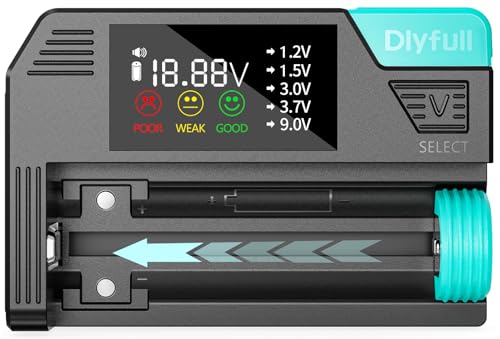
The DB1 stands apart with a built-in rechargeable battery charged via USB-C, lasting two to three months per full charge. That means no hunting for a spare AAA to power the tester itself. It uses a voltage selector button covering 1.2V Ni-MH, 1.5V alkaline, 3V lithium, and 9V, making it the most chemistry-flexible option on this list. A magnetic buckle holds AA and AAA cells steady during the test, and the backlit LCD shows both voltage and a color-coded status label (green for Good, yellow for Weak, red for Replace).
Open-circuit testing draws zero power from the battery under test, so even a nearly dead 0.6V cell won’t falsify a reading by draining further. The compact body (3.8 x 2.5 x 1.2 inches) fits in a pants pocket, though it is slightly larger than a basic analog gauge. One reviewer noted it is excellent for home use but not the most travel-friendly option. Overall, the DB1 eliminates the need for disposable batteries and provides clear, backlit feedback even in dim drawers.
It also handles 18650 and other lithium-ion cells, expanding its usefulness beyond household alkaline. If you manage a mix of rechargeable and single-use batteries, the DB1 is the most future-proof tester here.
Why it’s great
- USB-C rechargeable — no disposable battery needed for the tester
- Backlit LCD readable in low light with color status icons
- Supports 1.2V, 1.5V, 3V, and 9V chemistries including Ni-MH and Li-ion
Good to know
- Slightly larger than basic analog testers; not ultra-compact for travel
- Voltage selection requires pressing a button before each test
2. Dlypow Digital Battery Tester with Magnetic End
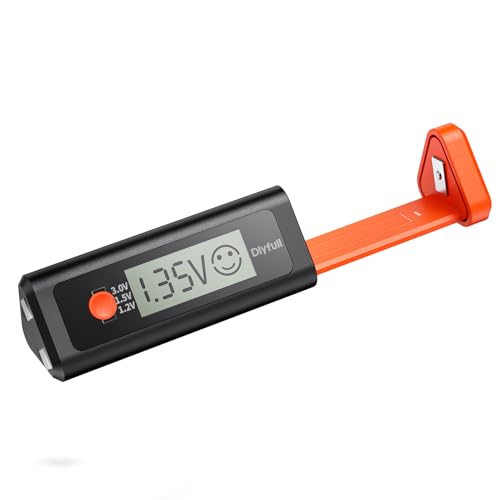
The Dlypow DB2 uses a clever sliding magnetic tray that holds cylindrical AA and AAA batteries firmly in place — no fumbling or rocking contacts. A voltage selector switch lets you toggle between 1.2V, 1.5V, and 3V ranges before inserting the cell. Within three seconds, the LCD shows voltage and a smiley-face emoji icon indicating Good, Weak, or Poor health. The magnetic fixation does double duty: it stabilizes the connection for more repeatable readings and makes one-handed operation possible.
It weighs only 1.4 ounces and measures 3.77 x 1.29 x 1.18 inches, making it the most pocketable digital option. It runs entirely on the battery under test, so no extra batteries or charging are needed — though very dead cells below roughly 0.6V won’t power the display. Build quality feels solid, with a triangular slot that prevents shifting. One user noted the LCD viewing angle is narrow; you need to look straight at the screen for the best contrast.
Compatibility covers AA, AAA, C, D, 9V, CR123A, and button cells like CR2032 and LR44. The magnetic tray is a genuine design improvement over spring-loaded slots found on cheaper testers.
Why it’s great
- Magnetic sliding tray holds batteries steady for accurate contact
- Runs on the tested battery — no separate power source needed
- Ultra-light at 1.4 oz, easy to store or carry
Good to know
- LCD has a narrow viewing angle; best read head-on
- Does not work on cells below about 0.6V as tester lacks its own power
3. Dlyfull Battery Tester LCD Display (Black)
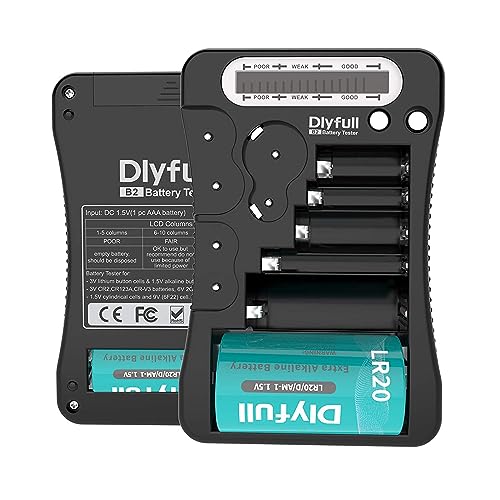
The Dlyfull black tester delivers universal compatibility at a mid-range price point. It accepts AA, AAA, C, D, 9V, CR123A, CR2, and a long list of button cells, plus CRV3 and 2CR5 photo batteries. A single included AAA battery powers the LCD display, which shows Good, Weak, or Poor status bars along with voltage. The chassis has an anti-slip finish that helps maintain grip during testing, and the unit is one of the smaller universal models at 5.2 x 3.46 x 0.94 inches.
It is important to note that the manufacturer warns against testing rechargeable batteries with this model. The instruction explicitly states not to power the tester with a rechargeable cell and not to test Ni-MH batteries. If your household runs primarily on rechargeable AA and AAA cells, skip this one. For alkaline-only users, however, it is fast, intuitive, and covers nearly every consumer battery shape.
While the tester is battery-powered, the internal AAA cell lasts a long time thanks to low-drain LCD operation. The fit is snug enough that some users found removing AA batteries requires a little wiggling, but the trade-off is reliable contact every time.
Why it’s great
- Tests a huge range of cylindrical and button cell sizes
- Anti-slip finish provides a secure hold during testing
- Includes the AAA battery needed to power the tester
Good to know
- Do NOT use with rechargeable Ni-MH batteries
- AA batteries can be slightly tight to remove from the slot
4. Dlyfull Universal Battery Checker (Blue)

The blue Dlyfull model shares the same core design as the black version: a compact, battery-powered LCD tester that works on AA, AAA, C, D, 9V, N, CR123A, CR2, CRV3, 2CR5, CR-P2, and a broad range of button cells. It ships with a welcome guide and an 18-month warranty, which is longer than most competitors offer at this tier. The LCD uses bar-graph icons to show poor, weak, or good condition, making interpretation instant even without reading the voltage number.
Like the black variant, this tester is explicitly not designed for rechargeable batteries. It requires an AAA battery (included) to operate. One user pointed out that it does not perform a load test — it measures open-circuit voltage only. For low-drain devices like TV remotes, clocks, or wall thermostats, that is usually sufficient. For high-drain gadgets like digital cameras or motorized toys, the voltage reading alone may overestimate the usable life of a weak cell.
The plastic build is lightweight at just 0.02 pounds, and the blue color scheme makes it easy to spot in a crowded drawer. Some users noted that AA batteries feel snug when inserting or removing, but this ensures solid contact for accurate readings.
Why it’s great
- Backed by an 18-month warranty — better than average
- Extremely lightweight and pocket-friendly
- Tests an unusually wide variety of battery sizes
Good to know
- No load test — open-circuit voltage may overestimate weak cells
- Not compatible with rechargeable Ni-MH batteries
5. Tenergy T-333 Universal Battery Tester

The Tenergy T-333 has been a staple in households for years, with multiple reviewers reporting five or more years of reliable service. It uses a simple LCD bar display (not a digital numeric readout) that shows Poor, Weak, or Good condition. Powered by its own AAA battery, the T-333 tests the battery under a load, not just open-circuit voltage, so you get a more realistic picture of a cell’s usable capacity. It supports AA, AAA, C, D, 9V, CR123A, CR2, CRV3, 2CR5, CR-P2, and a variety of button cells.
The build is all plastic but feels sturdy. There are no test leads or switches — you simply snap the battery into the appropriate slot and read the bar. The included AAA battery lasts for years with light household use. The T-333 does not have a backlight, so reading the LCD bars in dim conditions requires a nearby light source.
It is a purely analog interpretation of battery health — no numeric voltage is displayed. For users who just want a pass/fail verdict without squinting at numbers, this is a plus. The lack of complex electronics also contributes to its legendary longevity.
Why it’s great
- Proven track record of 5+ years of reliable use
- Applies a load to the battery for realistic health assessment
- No switches or menus — just insert and read
Good to know
- Non-backlit LCD screen hard to read in dim light
- Shows only bar status, not exact voltage number
6. Amprobe BAT-250 Battery Tester

The Amprobe BAT-250 is the only tester on this list that requires zero internal batteries — its needle gauge is powered entirely by the cell being tested. This is a true load tester: it places a 4-ohm resistor across 1.5V batteries (AA, AAA, C, D, button cells) and a higher 215-ohm load for 9V batteries. The color-coded display shows green for Good, yellow for Low, and red for Replace/Recharge, making it instantly readable for any user. Reviewers consistently praise its accuracy under load compared to cheap open-circuit testers.
The build is lightweight and feels slightly inexpensive, but the internal mechanism is robust. The V-shaped contact holder keeps AA and AAA cells aligned. Reverse-polarity insertion does not damage the unit. One ergonomic note: right-handed users may find the grip slightly awkward because the gauge face is oriented for a left-hand hold, but this is a minor quibble for most occasional use.
It supports standard and rechargeable batteries, including Ni-MH cells. The Good/Low thresholds are set at 1.0V/0.9V for 1.5V batteries and 6.5V/5.3V for 9V batteries, which aligns well with the actual cutoff points for low-drain devices.
Why it’s great
- Applies a proper load resistor (4 ohms) for accurate testing
- No internal batteries needed — works on the test cell’s power
- Color-coded dial is instantly understandable
Good to know
- Plastic body feels light and slightly cheap
- Grip angle is mildly awkward for right-handed users
7. Ontel Battery Daddy Storage & Organizer Case w/ Tester

The double-sided case holds up to 180 cells: 78 AA, 64 AAA, 8 9-volt, 10 C, 12 coin cell, and 8 D batteries. A clear locking lid lets you see inventory at a glance, and heavy-duty latches plus a carry handle make it easy to transport. An included battery tester clips onto the case and reads the charge status of inserted cells using simple indicator LEDs.
The tester itself is basic — it applies a minimal load and shows a pass/fail result — but for sorting a mixed pile of loose batteries, it is perfectly adequate. The case comes empty (batteries not included). When fully loaded, the 2.2-pound unit is fairly heavy, but the handle makes carrying manageable. One user noted they wish there were more AA and AAA slots, as those are the most common sizes, but the existing allocation covers the majority of household needs.
If your main problem is battery chaos rather than testing precision, the Battery Daddy solves both in one purchase. Just be aware the tester is a convenience add-on, not a clinical instrument.
Why it’s great
- Massive storage capacity for up to 180 batteries
- Clear lid allows quick visual inventory checks
- Includes a battery tester for sorting dead from good cells
Good to know
- Tester is basic — suitable for sorting, not detailed diagnostics
- Case is heavy (2.2 lbs) when fully loaded
FAQ
Can I test rechargeable Ni-MH batteries with any battery tester?
Why does a battery show good voltage but still not power my device?
How do I know if a battery tester is applying a proper load to AA and AAA cells?
Final Thoughts: The Verdict
For most users, the battery tester for aa and aaa batteries winner is the Dlypow DB1 because it combines a rechargeable power source, backlit display, and broad chemistry support including Ni-MH and 18650 cells. If you want an ultra-portable tester with a magnetic hold, grab the Dlypow DB2. And for bulk battery storage with a simple sorting tester, nothing beats the Ontel Battery Daddy.