
Our readers keep the lights on and the weekend projects moving. As an Amazon Associate, I earn from qualifying purchases.
That drawer full of loose batteries is a landfill of guesswork. You toss them in a device, it sputters, and you assume the battery is dead—when it might have plenty of life left for a lower-draw gadget. A proper battery tester removes that gamble, giving you a clear voltage reading and a reliable status indication so every cell works its full useful life before recycling.
I’m Rikta — the co-founder and writer behind FitlyFast. I researched battery tester specs, customer feedback, and load-testing performance across dozens of household units to separate the meters that merely display voltage from the ones that reveal true battery health under actual load.
Whether you need to test a 9V smoke detector battery, a handful of AA cells for your kids’ toys, or a lithium coin cell for a key fob, finding the right tool comes down to slot compatibility, measurement accuracy, and real-load testing capability. After analyzing the market, I recommend the battery tester for household batteries that balances broad coverage with dependable readouts for everyday home use.
How To Choose The Best Battery Tester For Household Batteries
A household battery tester isn’t a complex tool, but a few design choices separate the units that give you fast, trustworthy results from those that just light up a bar graph. Pay attention to three things: how the tester applies a load, which battery types it physically accepts, and whether it can handle rechargeable chemistries without misreading them.
Real Load Testing vs. Open-Circuit Voltage
A cheap tester only measures voltage with no load on the battery. That reading can look healthy even when the cell is nearly empty because a dying alkaline battery can still show 1.3V with zero current draw. A real-load tester applies a resistor (typically 20Ω to 30Ω for AA/AAA cells) and reads voltage under that drain. That number tells you whether the battery can actually power a toy, a flashlight, or a remote. Look for testers that specify the discharge resistor value in the specs — it’s the single best indicator of a useful reading.
Slot Coverage and Contact Quality
Not every tester accepts every battery shape. Some use spring-loaded sliding contacts to fit AA, AAA, C, and D cells, while others have fixed slots that can be too short for longer cells like a C or D battery. Button cell support varies widely — a good household tester includes a dedicated tray or contact strips for CR2032, LR44, and similar coin cells. 9V batteries need their own snap connector. Check the product’s listed battery compatibility list against what you actually keep in your home, and note whether the contacts feel robust when you insert and remove cells.
Rechargeable Battery Support
Ni-MH and Ni-CD rechargeables operate at a lower nominal voltage (1.2V) than alkaline cells (1.5V). Many basic testers either refuse to read them or mark them as “weak” even when they’re fully charged. A tester designed for rechargeable support will either have a dedicated 1.2V setting or a multi-range selector that lets you pick the correct voltage band. If you use rechargeable AA/AAA cells regularly, this feature is essential.
Quick Comparison
On smaller screens, swipe sideways to see the full table.
| Model | Category | Best For | Key Spec | Amazon |
|---|---|---|---|---|
| KKEANIC SL-049 | Household All-Rounder | Real-load testing for alkaline & rechargeable AA/AAA/C/D/9V | 20Ω load resistor for AA/AAA | Amazon |
| Dlypow DB1 | USB-C Rechargeable | Quick health checks with magnetic terminals & color display | USB-C rechargeable internal battery | Amazon |
| FNIRSI HRM-10 | Advanced Analyzer | Internal resistance & voltage measurement via Kelvin 4-wire | 4-wire Kelvin probes, 100V/200Ω range | Amazon |
| Dlyfull Lead-Style | Flexible Probe | Versatile contact with loose leads for awkward battery sizes | Measures IR, voltage, capacity % | Amazon |
| Dlyfull Compact | Pocket Tester | Quick pass/fail for common household cylindrical cells | Weighs 9g, fits in a pocket | Amazon |
| Yaegoo Load Tester | Auto Battery | 6V/12V automotive battery load testing up to 100A | 100A load test for 12V | Amazon |
| Ansbell Power Probe | Automotive Circuit | Automotive circuit troubleshooting with power/ground injection | 14.7ft cable, 8A current limit | Amazon |
In‑Depth Reviews
1. KKEANIC SL-049 Universal Battery Tester

This is the household tester that actually applies a real load — a 20Ω resistor for AA/AAA/AAAA/C/D cells and a 30Ω resistor for 1.2V rechargeables — so you get a voltage reading that reflects how the battery behaves under drain, not just its resting surface charge. It handles alkaline and rechargeable AA, AAA, C, D, 9V, CR2032, CR123A, LR44, and most common button cells with dedicated slots that prevent polarity mistakes.
The LCD displays both the exact voltage and a color-coded power bar (Good/Weak/Poor) that updates in about 0.1 seconds. Accuracy is rated at ±1% of reading plus 0.02V, which is tight enough to catch a failing cell before it lets you down. The unit auto-powers on when a battery exceeds 0.7V and auto-shuts off after three seconds of non-use, preserving the internal AAA battery for roughly a year of standby.
One minor caveat: the screen lacks a backlight, and the tester does not come with a storage case. But for the price, the build quality and the inclusion of true load resistors make this the most practical pick for households that use a mix of alkaline and rechargeable cells across multiple devices.
Why it’s great
- Real load resistors (20Ω/30Ω) give accurate discharge readings
- Wide compatibility includes 1.2V rechargeables and coin cells
- Ultra-fast response time with color-coded health bars
Good to know
- No backlight on the LCD screen
- No on/off switch — must remove internal battery for long storage
2. Dlypow DB1 Universal Digital Battery Tester
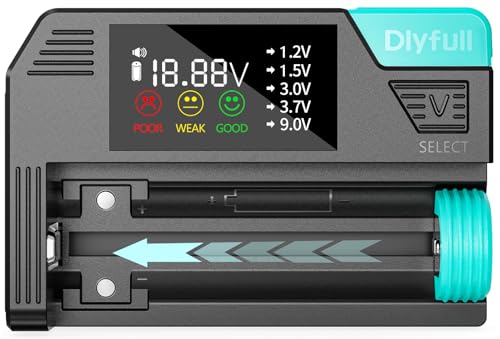
The Dlypow DB1 stands out because it powers itself via a built-in rechargeable battery charged over USB-C, so you never need to hunt down a spare AAA to operate the tester. It works with 1.2V Ni-MH/CD, 1.5V alkaline, 3.0V lithium, 3.7V Li-ion, and 9V cells — covering AA, AAA, C, D, 18650, CR123A, CR2032, and more through a sliding slot that adjusts to different cylindrical lengths.
Operation is straightforward: press the SELECT button to choose the voltage range, insert the battery with correct polarity, and the backlit LCD shows voltage alongside a smiley-face status display (green Good, yellow Weak, red Replace). The magnetic buckle on the back holds the battery securely against the contacts, which helps when testing smaller coin cells that can be fiddly to align manually.
Standby time is rated at two to three months per full charge, and the open-circuit test design means it draws no current from the battery under test, preserving your cells. The main trade-off is size — at 3.8 x 2.5 x 1.2 inches, it’s bulkier than a pocket tester, and the maximum cylindrical battery length it accepts is about 76.8mm, which should fit most standard cells but not extra-long D-size variants.
Why it’s great
- Internal rechargeable battery with USB-C eliminates disposable cells
- Backlit LCD with clear color-coded status icons
- Magnetic terminal holds batteries steady during testing
Good to know
- Larger footprint than basic testers
- Limited to cylindrical cells up to ~77mm length
3. FNIRSI HRM-10 Voltage & Internal Resistance Tester

The FNIRSI HRM-10 is an advanced analyzer that simultaneously measures voltage and internal resistance using a Kelvin four-wire connection. This method eliminates the resistance of the test leads and contacts, giving you a true reading of the battery’s internal health — something a standard voltmeter can’t do. For households that maintain a stockpile of rechargeable 18650s, Ni-MH packs, or automotive batteries, internal resistance is the metric that reveals whether a cell can still deliver high current or is ready for recycling.
The TFT color display presents voltage and resistance values clearly, and you can manually adjust the measurement range (up to 100V and 200Ω). The unit stores up to eight sets of historical readings and can export data via the included cable. This feature is useful if you track battery degradation over time or need to match cells for multi-battery devices like power tool packs.
A few users report inconsistent internal resistance readings on the same battery when the Kelvin clips aren’t making perfect contact, and the product typically ships with Kelvin clips rather than a dedicated cylindrical battery holder. If you primarily test loose cylindrical cells, consider buying the variant that includes the battery cradle. This isn’t a casual household pick — it’s for the user who treats battery health as a measurable, trackable variable.
Why it’s great
- Kelvin 4-wire measurement eliminates lead resistance error
- TFT color display with voltage and resistance simultaneously
- Data logging and export for trend analysis
Good to know
- Kelvin clips alone are not ideal for cylindrical cells
- Higher price point suited to enthusiasts and pros
4. Dlyfull Universal Battery Tester with Test Leads
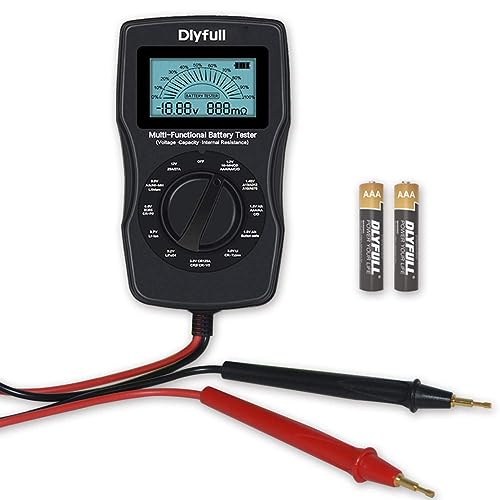
This Dlyfull tester uses a pair of probe leads instead of fixed slots, which makes it uniquely flexible for odd-shaped batteries and cells that don’t fit standard bays. It supports A, AA, AAA, AAAA, C, D, SC, 9V, plus lithium-ion sizes like 26650, 21700, 18650, and a wide range of button cells — you simply select the corresponding voltage on the rotary dial and touch the probes to the battery terminals.
Beyond voltage, the tester displays battery capacity percentage and internal resistance, giving you a more complete picture of battery health than a basic pass/fail bar. Users consistently report repeatable internal resistance values that match analog reference meters, which is impressive at this price tier. The large LCD screen is easy to read, though it lacks a backlight, and the unit is extremely lightweight at under one gram.
The biggest usability complaint is that the stiff probe wires tend to drag the lightweight tester across the table while you position the contacts. Some users add adhesive feet or a small phone stand to hold it steady. Also, the text labels next to the rotary dial are quite small. If you need a tester that can handle unusual battery sizes or you want internal resistance data without paying for a Kelvin pro-grade unit, this is the best mid-range option.
Why it’s great
- Flexible probe leads fit non-standard battery shapes
- Measures voltage, capacity %, and internal resistance
- Good IR repeatability for the price
Good to know
- Stiff wires make the lightweight unit slide around
- No backlight and tiny dial labels
5. Dlyfull LCD Universal Battery Checker

At just 9 grams, this is the smallest and lightest tester in the lineup — genuinely pocket-friendly for quick checks on AA, AAA, C, D, 9V, CR123A, CR2, CRV3, and button cells. You insert the battery into one of the built-in slots, and the LCD shows a bar graph indicating poor, weak, or good condition. It requires a single AAA battery (included) for power and has an anti-slip finish that helps with grip.
The compatibility list is solid for a device this small: it handles cylindrical batteries up to D size plus the common coin cells. The tester is not powered by rechargeable batteries, and the manufacturer explicitly advises against testing rechargeable cells, so this is strictly an alkaline and primary lithium checker. For users who only need a quick pass/fail check on disposables, the size and simplicity are a huge advantage.
Reviewers note that AA batteries can be a bit tight to remove from the slot, and the unit performs no-load testing only — it measures voltage without applying a discharge resistor. That means a dying alkaline can still show “good” on the bar graph. It’s a fine quick-check tool, but not one you should rely on for critical equipment or for making recycle-or-keep decisions on marginal cells.
Why it’s great
- Extremely compact and lightweight for carrying in a drawer or bag
- Broad slot support for AA, AAA, C, D, 9V, and coin cells
- Includes a AAA battery for immediate use
Good to know
- No load testing — only measures open-circuit voltage
- Does not support rechargeable batteries
6. Yaegoo Car Battery Tester and Load Checker

If your testing needs extend beyond household cells to automotive batteries, the Yaegoo load tester applies a 50A load on 6V batteries and a 100A load on 12V batteries up to 1000 CCA. That’s enough to stress-test a car, truck, RV, or marine starting battery and determine if it can actually crank an engine. The built-in handle and copper clips with red/black grips make connecting to battery posts safe and quick.
The tester goes beyond simple load testing: it can diagnose battery condition, starter motor draw, and charging system output. Experienced users report that it matches the accuracy of much more expensive units they used as auto techs. The perforated metal case provides ventilation during heavy-duty use, preventing overheating during repeated load cycles.
This is a specialized tool, not a universal household tester. It doesn’t work with AA, AAA, 9V, or coin cells — only automotive lead-acid or AGM batteries with exposed terminals. If you already own a good household tester and need a dedicated load tester for your vehicle, this is a cost-effective alternative to shop-grade diagnostic tools. The voltage accuracy is rated at ±0.2V, which is adequate for automotive work.
Why it’s great
- True load testing at 50A/100A for automotive batteries
- Includes starter and charging system diagnosis
- Ventilated case prevents overheating during repeated use
Good to know
- Not suitable for household AA/AAA/9V cells
- Heavier and bulkier than standard household testers
7. Ansbell Power Circuit Probe Tester
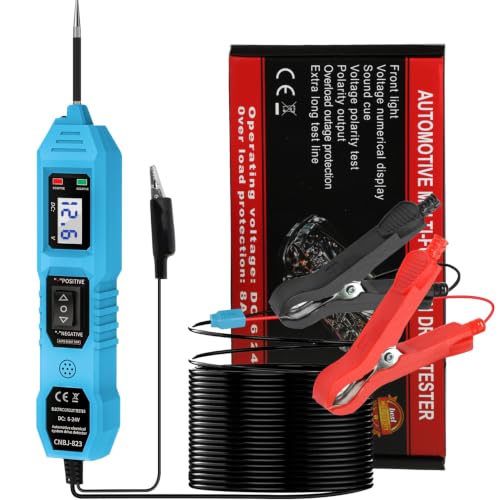
Designed primarily for automotive electrical diagnostics, the Ansbell probe connects directly to a 6V to 36V DC battery via red and black alligator clips. It functions as a voltage tester, continuity checker, short-circuit finder, and powered probe — meaning it can supply power or ground to a circuit to test components like fuses, relays, and lights directly. The 14.7-foot extension cable reaches from the engine bay to the rear trunk without repositioning the battery connection.
The backlit LCD screen shows voltage readings with ±0.2V accuracy, and an LED work light illuminates dark test areas. If it detects an overload above 8A, the built-in buzzer sounds to protect both the unit and the vehicle’s electrical system. This makes it a useful tool for diagnosing parasitic battery drains, bad ground connections, and intermittent electrical faults that a standard multimeter struggles to catch.
This is not a household battery tester in the traditional sense — it won’t check your AA or 9V cells. It’s a circuit diagnostic tool that happens to include voltage testing capabilities. For users who need a versatile automotive probe and already have a separate household battery checker, this offers excellent value compared to professional-brand equivalents that cost significantly more. The build quality is solid, though the clips could be slightly larger for thick battery terminals.
Why it’s great
- Multi-function probe with voltage, continuity, and power injection
- Long cable reaches full vehicle length without repositioning
- Overload protection with audible alarm
Good to know
- Does not replace a household battery tester for AA/AAA cells
- Clips could be larger for heavy-duty battery terminals
FAQ
Can I use a battery tester to check rechargeable Ni-MH batteries?
What is the difference between open-circuit voltage and load testing?
Can a battery tester damage my batteries?
Final Thoughts: The Verdict
For most users, the battery tester for household batteries winner is the KKEANIC SL-049 because it applies real load resistors to give accurate discharge readings across the widest range of household battery types, including rechargeables. If you want a rechargeable tester with a backlit screen and magnetic terminals, grab the Dlypow DB1. And for internal resistance analysis and data tracking, nothing beats the FNIRSI HRM-10.