
Our readers keep the lights on and the weekend projects moving. As an Amazon Associate, I earn from qualifying purchases.
A multimeter tells you voltage, but it doesn’t tell you if a battery can actually power your kids toy, a smoke alarm, or a wireless mouse. That’s the difference between a dead cell and a battery tossed too early. A dedicated battery tester for small batteries applies a specific load to simulate real-world use, revealing whether that AA from the junk drawer is still worth keeping or ready for recycling.
I’m Rikta — the co-founder and writer behind FitlyFast. I’ve analyzed hundreds of household testing tools to understand which specs separate a useful device from a voltage-measuring paperweight, and this guide focuses entirely on testers built for the common small batteries you reach for daily.
After reviewing seven top contenders, I found the real market split is between units that simply read volts and those that put a meaningful load on the cell, which is the defining distinction in any serious search for the best battery tester for small batteries.
How To Choose The Best Battery Tester For Small Batteries
Not all testers work the same way. A cheap voltage-only model might call a dead cell “good” because the surface charge looks fine. The right unit applies a discharge resistor that mimics the draw of an actual device, so you get a verdict you can trust.
Look For Real Load Testing, Not Open-Circuit Voltage
Open-circuit voltage tells you the battery’s resting potential, but a cell that reads 1.5V with no load may collapse to 0.9V under the stress of a flashlight. The best testers use a discharge resistor — typically 4Ω to 20Ω for AA/AAA cells — to apply a realistic draw. The resulting reading tells you the actual usable energy left, not just a surface snapshot.
Check The Battery Type Compatibility List
Small batteries come in many shapes: AA, AAA, AAAA, C, D, 9V, CR2032, CR123A, LR44, and rechargeable Ni-MH cells. Some testers only handle cylindrical alkaline types, while others include dedicated slots for coin cells and 9V. If you test hearing aid batteries or rechargeable lithium-ion cells, verify the voltage range and chemical compatibility before buying.
Read The Display and Operation Simplicity
A clear LCD with color-coded bars (green for good, yellow for weak, red for replace) is far more practical than an analog needle you have to squint at. Some units auto-power on when a battery is inserted and turn off after a few seconds, which saves the internal battery and avoids fiddling with switches.
Quick Comparison
On smaller screens, swipe sideways to see the full table.
| Model | Category | Best For | Key Spec | Amazon |
|---|---|---|---|---|
| ZTS MBT-1 | Pulse Load Tester | Serious battery management | Patented pulse load test, no settings | Amazon |
| KKEANIC SL-049 | Digital Load Tester | Accurate rechargeable testing | 20Ω / 30Ω / 1KΩ real load resistors | Amazon |
| Dlypow DB1 | Digital Tester | Compact with backlit LCD | Magnetic ends, USB-C rechargeable | Amazon |
| Amprobe BAT-250 | Analog Load Tester | Household alkaline testing | 5.5Ω load for AA/AAA/C/D | Amazon |
| Dlyfull (Black Model) | Digital Voltage Tester | Versatile button cell checking | Tests 1.5V / 3V button cells | Amazon |
| Dlyfull (Blue Model) | Digital Voltage Tester | Budget-friendly all-in-one | Ultra-compact, AAA battery included | Amazon |
| Ontel Battery Daddy | Organizer w/ Tester | Battery storage plus testing | Stores 180 batteries, includes tester | Amazon |
In‑Depth Reviews
1. ZTS MBT-1 Multi-Battery Tester

The ZTS MBT-1 uses a patented pulse-load technique that applies a brief, high-current draw to measure the actual energy capacity of a cell, rather than just its idle voltage. This is the gold standard for serious users who manage large collections of batteries for flashlights, cameras, and high-drain devices. The pulse-load method identifies weak cells that a standard voltmeter would mark as usable, saving you from mid-use failures.
Compatibility extends to AA, AAA, C, D, 9V alkaline, 1.5V lithium, CR123, CR2032, CR2016, CR2, and 18650 Li-ion cells. The three-second test cycle delivers a clear LED readout with no settings to adjust — insert the battery and the tester does the rest. Its robust, made-in-USA build feels industrial-grade compared to the plastic testers in the mid-range tier.
The unit is larger and heavier than pocket testers, requires four AA batteries to operate, and carries a premium investment. However, for anyone who needs to match cells for multi-battery devices or maintain a stockpile of rechargeables, this tester’s accuracy justifies the upgrade.
Why it’s great
- Patented pulse-load test reveals true battery health
- No switches or settings — insert and read instantly
- Tests 18650 Li-ion cells and wide range of chemistries
Good to know
- Large and heavy for a battery tester
- Requires four AA batteries (not included) for operation
- Higher investment than entry-level options
2. KKEANIC SL-049 Battery Tester

The KKEANIC SL-049 is the mid-range champion that brings real-load testing to the household user without the industrial bulk of the ZTS. It applies a 20Ω discharge resistor for AA/AAA/AAAA/C/D cells and a 1KΩ resistor for 9V and coin cells, giving you a practical measurement of usable capacity. The clear LCD shows exact voltage alongside a color-coded power bar, and a 0.1-second reading speed makes testing feel instant.
Unique to this tier, the SL-049 explicitly supports 1.2V rechargeable Ni-MH AA, AAA, and AAAA batteries, using a separate 30Ω load resistor for a realistic draw on those chemistries. The automatic power-on triggers when a battery’s voltage exceeds 0.7V, and the 3-second auto-shutoff preserves the internal AAA battery (not included). Accuracy is rated at ±(1% of reading + 0.02V), which rivals some multimeters.
One common note from users is that the tester lacks an on/off switch, so you should remove the internal battery during long storage to prevent parasitic drain. The screen is not backlit, but the contrast is clear enough in most indoor lighting. It also does not come with a storage case.
Why it’s great
- Real load resistors for accurate capacity measurement
- Explicit support for 1.2V Ni-MH rechargeable cells
- Fast auto-power-on and 3-second shutoff saves battery
Good to know
- No on/off switch — internal battery drains in storage
- Screen is not backlit
- No storage case included
3. Dlypow DB1 Digital Battery Tester
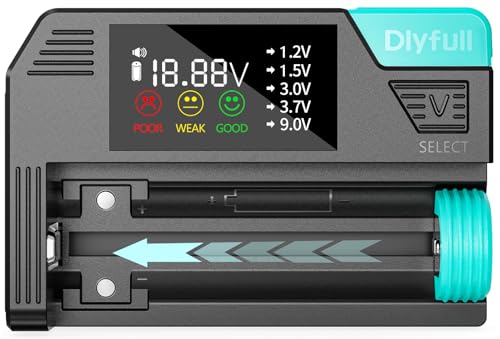
The Dlypow DB1 differentiates itself with a built-in lithium-ion battery that recharges via USB-C, eliminating the need to constantly buy replacement internal batteries. It offers a backlit LCD and uses magnetic terminals to hold cylindrical cells securely during testing — a thoughtful touch for steady readings. The tester works with 1.2V Ni-MH, 1.5V alkaline, 3.0V lithium, 3.7V Li-ion, and 9V batteries, covering most household chemistries.
Operation is straightforward: press the SELECT button to choose the voltage range, insert the battery with correct polarity, and read the voltage and status (Good/Weak/Replace) on the screen. Fun smiley-face icons add a user-friendly element. The DB1’s voltage accuracy is reported at ±0.03V compared to high-end digital multimeters, making it trustworthy for sorting mixed battery bins.
The unit is slightly larger than basic stick testers, which may limit pocket portability. It also uses an open-circuit measurement method rather than a fixed load resistor, so while it’s excellent for quick sorting, it doesn’t replicate the load-testing rigor of the KKEANIC or ZTS. The internal battery lasts 2-3 months per charge with typical use.
Why it’s great
- USB-C rechargeable internal battery — no disposable cells needed
- Magnetic contacts hold batteries securely for stable readings
- Backlit LCD with clear Good/Weak/Replace status
Good to know
- Larger than basic stick testers, less pocket-friendly
- Open-circuit measurement, not a load test
- Lithium battery inside may have limited lifespan
4. Amprobe BAT-250 Battery Tester

The Amprobe BAT-250 is a classic analog tester that doesn’t require its own power source — the battery you insert provides the energy for the reading. It applies a 5.5Ω load for AA/AAA/C/D/coin cells and a 215Ω load for 9V batteries, giving real load-based results. The color-coded dial with “Good,” “Low,” and “Replace/Recharge” zones makes interpretation instant, even for kids or guests.
The tester handles standard and rechargeable batteries across 9V, AA, AAA, C, D, and 1.5V button types. The build includes a printed battery alignment guide on the body, and the design survives reverse-polarity insertion without damage. Several users report it has saved them from tossing batteries that still had plenty of life left, especially in low-drain devices like remote controls.
The downside is a slightly awkward handling feel — the angled slots require some fiddling to seat small coin cells properly. The plastic construction feels utilitarian rather than premium, but the functional reliability is well established. It is an excellent budget-friendly entry point for households that only test alkaline batteries.
Why it’s great
- Load-based testing with 5.5Ω / 215Ω resistors
- No internal battery required — tested cell powers the meter
- Clear analog color-coded display for quick decisions
Good to know
- Analog needle less precise than digital LCD
- Small coin cells can be tricky to align in slots
- Plastic build feels lightweight and utilitarian
5. Dlyfull B2 Battery Tester (Black)
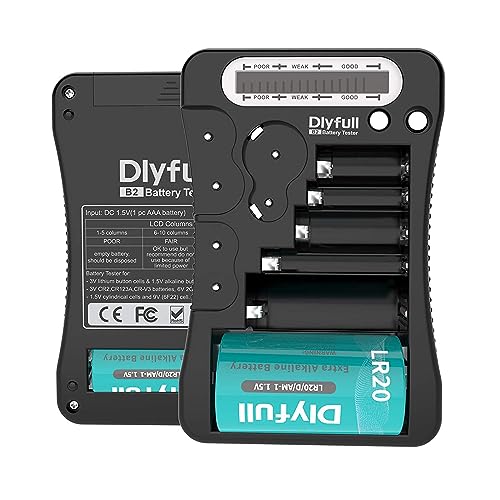
The Dlyfull B2 (black model) is a compact digital tester that specializes in broad compatibility, handling AA, AAA, C, D, 9V, N, CR2, CR123A, CRV3, 2CR5, CR-P2, and a wide range of 1.5V/3V button cells. The LCD uses a bar graph to show Good, Weak, or Poor status, and the anti-slip finish makes it comfortable to grip during repeated testing sessions. It comes with one AAA battery included for its own power.
One key detail: the B2 is an open-circuit voltage tester, not a load tester. It measures the resting voltage of the cell, which is sufficient for sorting obviously dead batteries from healthy ones, but it may overestimate the capacity of borderline cells. The device is praised by users who need a quick, no-nonsense way to check the batteries in remote sensors, thermometers, and AirTags.
Another known limitation is that the tester requires its own AAA battery to operate, and it does not support testing rechargeable batteries. Some users also note that removing AA batteries from the slot can require a bit of wiggling. However, its small footprint and simple operation make it a solid utility pick for everyday home use.
Why it’s great
- Tests a huge variety of button cells and cylindrical types
- Compact with anti-slip finish for comfortable daily use
- Included AAA battery makes it ready out of the box
Good to know
- Open-circuit measurement, not a load test
- Does not test rechargeable batteries
- AA batteries can be tight to remove from the slot
6. Dlyfull Battery Tester (Blue)

The blue Dlyfull unit shares the same core design as the black B2 but is arguably the most pocket-friendly option in this lineup, weighing just 0.02 pounds. It tests the same broad range of cylindrical and button cell batteries and uses a crisp LCD bar graph for results. It is powered by one included AAA battery and carries CE, FCC, and RoHS certifications.
The ultra-compact chassis makes it a natural fit for a kitchen drawer or tool bag, and the quick-result display helps avoid unnecessary battery swaps in remotes and clocks. User reviews consistently highlight its ease of use for testing small coin cells like CR2032 and LR44, which can be fiddly on larger testers. The low cost makes it an easy impulse buy for anyone tired of guessing which batteries are dead.
Like the black model, this tester uses open-circuit voltage and does not support rechargeable batteries. The smaller size means less leverage for removing snug AA batteries, and the plastic build is basic. For a household that just wants to separate the living from the dead in a mixed bin of alkalines, it gets the job done with zero fuss.
Why it’s great
- Extremely compact and lightweight for easy storage
- Tests a wide variety of button cells and cylindrical types
- Comes with AAA battery and safety certifications
Good to know
- Open-circuit measurement, not a load test
- Does not support rechargeable batteries
- Small size makes removing tight AA batteries harder
7. Ontel Battery Daddy Storage & Organizer Case

The Ontel Battery Daddy is a hybrid product — a double-sided storage case that holds up to 180 batteries (78 AA, 64 AAA, 8 9V, 10 C, 12 coin cells, and 8 D) and includes a simple tester right in the lid. If your main pain point is a chaotic drawer of loose cells, this solves the organization problem first and provides testing as a secondary benefit.
The built-in tester works by aligning the battery’s positive and negative terminals with the tester’s contacts; the indicator then shows a basic Good/Low result. It is a straightforward voltage-based test suitable for sorting standard alkaline cells. The clear locking lid lets you see inventory at a glance, and the heavy-duty latches and carrying handle make it easy to move the whole collection.
The trade-off is that the tester is basic — not a load-testing device — and is primarily useful for checking if a battery is fully dead or still okay for low-drain use. The case itself is plastic and can get heavy when fully loaded. For someone who wants a single solution for both storing and testing a large household battery collection, this package is hard to beat in its value tier.
Why it’s great
- Combines large-capacity storage (180 batteries) with a tester
- Clear lid and sturdy latches for organized inventory
- Portable carrying handle for moving the whole kit
Good to know
- Included tester is basic voltage-only, not load testing
- Case is bulky and heavy when fully stocked
- Most slots designed for AA/AAA, fewer for D/C/9V
FAQ
What does a load resistor do in a battery tester?
Can I test rechargeable batteries with a standard alkaline tester?
How do I test a CR2032 coin cell correctly?
Final Thoughts: The Verdict
For most users, the best battery tester for small batteries winner is the KKEANIC SL-049 because it combines real load resistors with support for rechargeable Ni-MH cells at a mid-range investment. If you want patented pulse-load accuracy for a serious battery collection, grab the ZTS MBT-1. And for a compact, rechargeable unit with a backlit screen and magnetic terminals, nothing beats the Dlypow DB1.