
Our readers keep the lights on and the weekend projects moving. As an Amazon Associate, I earn from qualifying purchases.
Specs are compiled from manufacturer listings and verified buyer reviews and can change over time — please confirm the key details on the product page before buying.
The difference between a tent that survives the afternoon sea breeze and one that becomes a sand-filled sail depends on sand-anchor design, pole thickness, canopy shape, and guylines.: sand-anchor design, pole thickness, canopy shape, and the number of guylines (ropes that tie the tent down). This guide walks through nine of the most proven models, comparing what matters most for a beach camping tent so you can match the right one to the wind conditions where you actually go.
I’m Rikta — the founder and writer behind FitlyFast. This guide is built by comparing the manufacturers’ published specifications and the patterns across verified customer reviews, so you get each pick’s real strengths and trade-offs instead of marketing spin.
Whether your priority is instant setup, full-day sun protection, or a tent that can handle a windy shore without shaking itself apart, the best beach camping tent depends on the specific trade-offs you are willing to make between stability, space, and pack weight.
Our Picks at a Glance
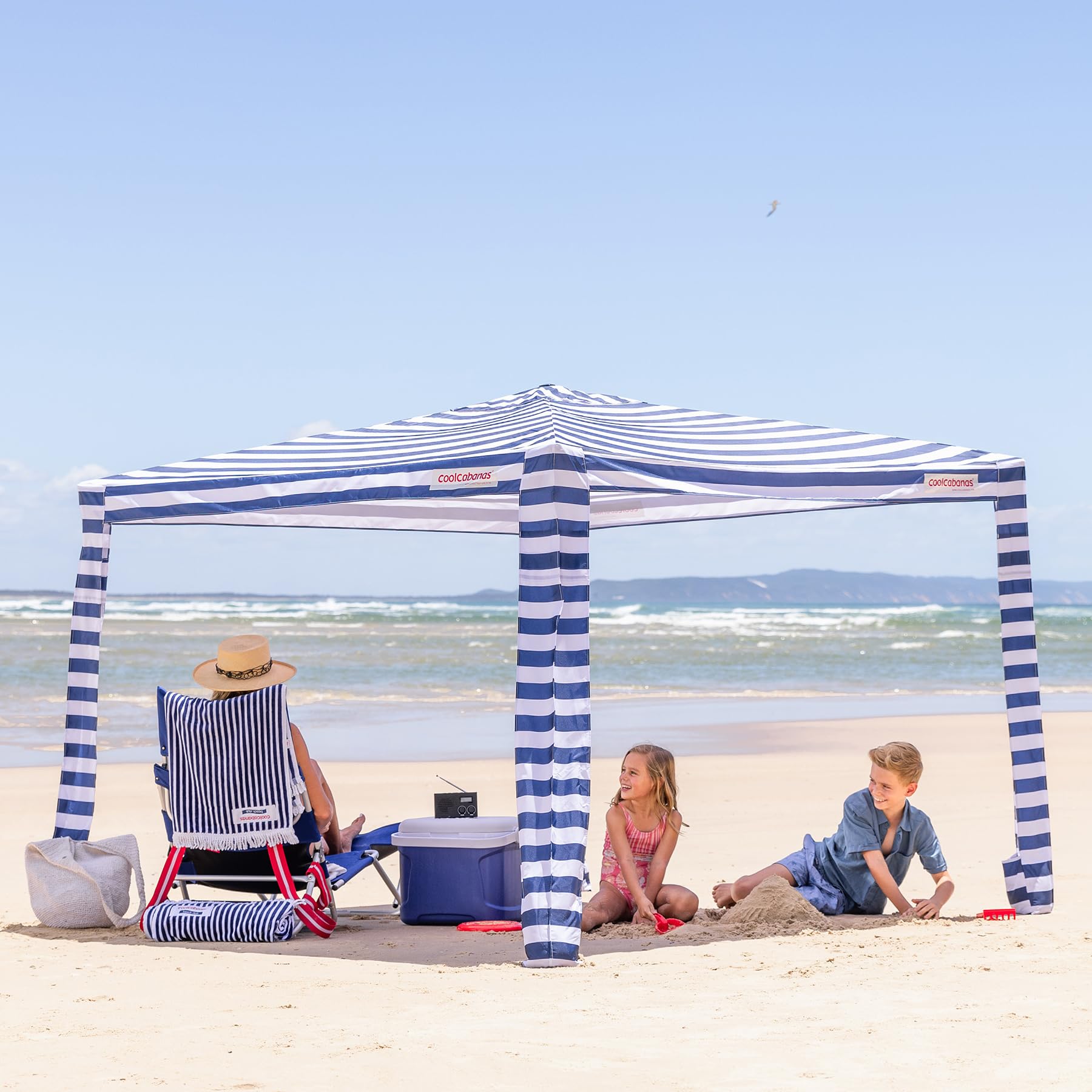


How To Choose The Best Beach Camping Tent
Most beach tents fail because of the anchor system, not the fabric. A tent with light sand bags becomes a kite at the first real gust. On a hot beach with kids or a cooler, a tent that takes more than two minutes to open feels like a chore.
Wind-anchor system
The standard beach tent uses four sand pockets or bags at the corners — you scoop sand into them, bury them, and hope the tent stays. The most stable tents add more: eight sandbags, a center pole that angles against the wind, or extra guylines (the ropes you stake out). If you go to a beach where wind is predictable, a four-bag tent with decent guylines is enough. If you face sudden gusts, look for six or eight bags plus thicker poles (9.5 mm fiberglass or aluminum, not the cheap 6 mm rods).
Sun-blocking vs blackout
Nearly every tent here has UPF 50+ fabric — that blocks 98% of UV rays. But blocking UV is not the same as blocking visible light. A standard silver-coated tent keeps the sun off your skin; a blackout-coated tent (like the OutdoorMaster) also dims the interior enough for a child to nap. That matters if you plan to sleep in the tent or keep a baby out of direct brightness. The trade-off is that blackout fabric can trap more heat inside unless the tent has large mesh panels for cross-ventilation.
Real capacity vs label capacity
A tent promising “4-person” space often fits two adults lying side by side — no chairs, no cooler. If you want room for chairs and a bag, look for a floor dimension above 90 inches in length. Tents with an extended front floor (a “porch” or “awning” area) give you a place to leave sandy shoes and bags outside the main sleeping zone. That extra foot or two of extended fabric makes a huge difference in how many people can actually sit comfortably inside.
Quick Comparison
| Model | Best For | Floor Size | Wind Anchors | Weight | Amazon |
|---|---|---|---|---|---|
| CoolCabana Beach Shade Tent★ Best Overall | All‑day wind stability | 96″ x 72″ | 4 sand pockets (35 lbs each) | Compact carry bag | Amazon |
| OutdoorMaster Beach TentTop Performer | Blackout napping / baby naps | 94.4″ x 55.1″ | 4 guylines + stakes | 8.5 lbs | Amazon |
| Elegear Beach Tent with CanopyBest Value | Maximum shade area for groups | 109″ x 94.5″ | 5 sandbags, 10 stakes, 6 ropes | 8.2 lbs (3.7 kg) | Amazon |
| Old Bahama Bay Pop Up | Fast open & close simplicity | 81″ x 54.5″ | 4 sand pockets + stakes | 8.2 lbs | Amazon |
| Vibemo Beach Canopy | Large group shade (10×10 ft) | 10 ft x 10 ft | 8 sandbags, 4 aluminum poles | 8.3 lbs | Amazon |
| COMMOUDS Beach Shelter | Ultra-light & airline portable | 7 ft x 7 ft | 4 sand anchors, 4 poles, ropes | 6.2 lbs | Amazon |
| easierhike Beach Canopy | Windproof with 6 bags | 8 ft x 8 ft (95″ x 95″) | 6 sandbags + metal carabiners | 6 lbs | Amazon |
| Rhino Valley 10×10 Canopy | Tall headroom (6.5 ft center) | 10 ft x 10 ft | 8 sandbags, 4 aluminum poles, ropes | 8.7 lbs | Amazon |
| Oileus XX-Large Beach Tent | Quick pop-up for 5–6 people | 98.4″ x 55″ | 6 sand pockets, 10 stakes, 4 guylines | 5 lbs | Amazon |
In‑Depth Reviews
1. CoolCabana Beach Shade Tent
Our pick — over 4.5★ from 950+ verified ratings; the strongest balance of quality and price.
The one that stays planted when every other tent on the sand starts tumbling.
The defining feature is not the UPF 50+ fabric or the 64 ft² of shade — it is the sand pockets. Each of the four corners holds up to 35 pounds of sand when filled, which is what keeps this tent grounded even in stiff coastal wind. Buyers report it survived a full week at the Jersey Shore without budging, and one owner described it simply: “It does not blow over in the wind and offers excellent shade.” The setup is straightforward enough for one person — the instructions are sewn into the bag so you never lose them. At 4.8 stars from nearly a thousand owners, this is the most consistently praised tent in the list.
The catch is the size label: the Medium is tight for more than two adults with gear. The Medium (43 ft² of shade) is fine for two adults with a cooler but tight if you want to stretch out with chairs and a playpen. The Large (64 ft²) is the better call for a family of four, and it still folds down to just 3 feet 5 inches for the trunk. The frame is aluminum, which keeps the weight manageable but still feels solid when the wind picks up. The 4 guylines are standard — other tents here have 6 — but the sand pockets do the heavy lifting so it does not matter as much.
What wins people over
- Sand pockets hold 35 lbs each — genuinely wind-stable without stakes
- Easy setup solo; instructions stitched to the bag
- Compact carry size (3’2″ folded) fits in small car trunks
The honest limit
- Medium size is snug for more than 2 adults with gear
- No blackout coating — lets light through if napping
- Premium-priced vs pop-up competitors
Best for steady-wind beaches: If you go to a shore where the breeze never quits and you want a tent that simply does not move, this is it. Reach for the Large if you plan to bring chairs.
Who should size up: If you normally camp with 4+ people in the shade, the Medium will feel cramped — go straight to the 64 ft² Large.
2. OutdoorMaster Beach Tent Blackout Coating
A blackout cave that knocks out 95% of sunlight — perfect for real daytime sleep.
Most beach tents let enough light through that a nap is a squint. The OutdoorMaster uses a blackout coating that eliminates 95% of sunlight while still blocking 99.95% of UVA and UVB rays (UPF 50+). Parents report that a baby can nap inside during the bright midday — one owner with an 8-month-old called the blackout function a standout for beach days. The pole thickness is 9.5 mm (thicker than the 8.0 mm market standard) and the tent is made with 190T fabric, which feels noticeably more durable than the thin polyester on budget pop-ups. Setup and takedown takes roughly 30 seconds, as owners note it can be done without even needing a towel underneath.
The trade-off is size: the floor measures 94.4 x 55.1 x 53.1 inches, which comfortably fits 2 adults lying down but is snug for 3. The 4 guylines and stakes help with wind, but the tent is heavier at 8.5 lbs compared to lighter pop-ups. The dark interior does trap heat — the blackout coating blocks light but also reduces ventilation, so on a still hot day the inside can feel warm. The mesh panels and one large zippered door help, but this is not the tent for breezeless scorchers. Compared to the Elegear below, the OutdoorMaster is smaller but much darker inside.
What families love
- 95% light block enables real midday naps — rare in beach tents
- 9.5 mm poles + 190T fabric feel sturdier than average pop-ups
- Fully zip-able door provides privacy for changing clothes
The honest trade-off
- Dark interior can get warm without a breeze
- True capacity is 2 adults — tighter than the 4-person label
- 8.5 lbs is heavier than the lighter canopy-style shelters
Ideal for nappers and babies: If a dark, quiet space for a child or an afternoon sleep is your beach-day priority, this is the tent. The blackout coating makes the difference.
Skip if you want group space: Four adults will not fit comfortably — this is a 2-person + gear shelter despite the “4-person” label.
3. Elegear Beach Tent with 360° Removable Canopy
A two-zone design that doubles the usable shade for larger groups.
The 360° removable canopy is what sets the Elegear apart — a second layer of shade that attaches to the main tent, effectively creating an awning that doubles the covered area. The main body is 109 x 94.5 inches, making it the largest floor in this list, and the canopy adds even more room. The setup is a patented spring-loaded system that pops open in one second, and the whole thing packs down to a compact carry bag. UPF 50+ comes from a 190T double-layer silver-coated polyester that the brand says can reduce interior temperature by up to 9°F. With 5 sandbags, 10 stakes, and 6 ropes, the anchoring kit is more complete than most, though some owners mention the stakes struggle in soft sand.
The stability feedback is mixed — the main tent holds well when the sandbags are buried, but the removable canopy poles are thinner (8.5 mm fiberglass) and lack their own sand pockets, so they can flap or shift in a strong breeze. One owner noted the canopy is not recommended for windy days. The 6 guylines are a significant upgrade over the 4 on the CoolCabana, but they are only useful if you actually stake them out — and in loose sand, the included stakes may not grab. Still, for a calm-day family outing where space matters most, this tent has more room than anything else near its price tier.
Spacious edge
- Removable canopy creates the largest shade footprint in this lineup
- 1-second pop-up setup with patented spring poles
- Includes 3 storage pockets, roof hook, and closable windows
The canopy caveat
- Canopy lacks sand pockets — can flap or shift in wind
- Stakes struggle in soft sand; sandbags help but need filling
- Heavier at 3.7 kg (8.2 lbs) with full kit
Choose for group shade: If you are heading to a calm beach with 4-6 people and want the most square footage, this is the tent. The canopy turns it into a mini pavilion.
Think twice if it is always windy: The canopy is not designed for gusts — on blustery days, leave it off or pick a simpler tent like the CoolCabana.
4. Old Bahama Bay Pop Up Beach Tent

It opens in 10 seconds and closes just as fast — no assembly, no guessing.
The Old Bahama Bay is a pure pop-up: you take it out of the bag, let the spring-loaded frame expand, and you are done. No poles to connect, no canopy to attach. The 4 sand pockets at the corners hold it down, and the UPF 50+ silver-coated fabric blocks up to 98% of UV rays. The extended front floor adds a little extra space for bags or a changing area, and the 4-sided mesh windows provide decent cross ventilation. Customers note it is roomy enough for two adults and a child, and it packs down to a compact size that fits in a trunk or carry-on.
The downside is stability in strong wind. The included sandbags are not huge, and on a really gusty day some owners found the tent needed extra anchoring. The 4 guylines are present but the included stakes are lightweight. The 8.2 lb weight is average, but the pop-up mechanism means folding it back into the carry bag takes some practice — the first few attempts can be frustrating. For a beach where wind is moderate and you want a tent that goes from bag to shade in under a minute, this is a solid pick with a 4.5-star track record from over 550 owners.
Instant-gratification appeal
- No assembly — truly pop-and-go in seconds
- Extended floor gives space for gear or changing
- 4 mesh panels keep air moving on hot days
Weather limits
- Sandbags are small — can struggle in strong gusts
- Folding it back into the bag takes practice
- Tighter than labeled for 3 adults with chairs
Pick for lazy setup: If assembling poles feels like work on vacation, this pop-up is your answer. It works best on calm-to-moderate-wind beaches.
Pass on super-windy days: The anchor system is light — a 15+ mph gust can lift it if the sandbags are not well buried.
5. Vibemo Beach Tent 10x10ft Canopy

A 10×10 ft shade square with 8 sandbags — built for groups, not couples.
The Vibemo is a canopy-style shelter rather than an enclosed tent — a large 10 x 10 ft shade with open sides, designed for maximum coverage for up to 8 people. The standout feature is the 8 upgraded sandbags (two per pole), which along with 4 thickened aluminum poles provide a claimed 80% more stability than a standard beach umbrella. The fabric is high-stretch Lycra with UPF 50+ protection, and the whole thing folds into a travel bag at 8.3 lbs. Buyers who tested it in windy Hatteras (12-13 mph) reported it held well when the poles were angled and the sand anchors were properly filled.
The height is the main limitation: at 10 ft wide but relatively low, a 5-foot-8-inch person has to duck to stay under the center. The canopy fabric stretches in the wind, requiring occasional pole readjustment. Some owners found that the poles — while aluminum — feel a bit flimsy compared to thicker alternatives, and the tent is not an enclosed shelter (no walls, no bug mesh). It is best for those who want a shaded gathering spot for a group rather than a private changing or napping tent.
Group coverage
- 100 sq ft of shade — room for 4+ adults with chairs and a cooler
- 8 sandbags provide more anchoring points than most
- Lycra fabric is stretchy and lightweight for the size
The height caveat
- Low center: 5’8″ person must duck inside
- Open canopy — no privacy, no bug protection
- Stretchy material needs pole readjustment in wind
Great for group beach days: If you want a shade spot for friends and family rather than a private tent, the Vibemo delivers the biggest covered area. Bring lightweight chairs.
Not for privacy or naps: Open sides mean no shade change area and no wind blockage — this is a canopy, not a tent.
6. COMMOUDS Beach Tent Sun Shelter

At 6.2 lbs and a 24-inch carry case, it fits in airline luggage.
The COMMOUDS is one of the lighter full-size shelters here — 6.2 lbs with a packed size of just 24 inches, small enough to fit in a suitcase or a compact trunk behind other gear. The 7 x 7 ft canopy creates 49 sq ft of shade with 5.8 ft of headroom, and the 4 reinforced aluminum poles plus a 3-layer windproof system (elastic cords, upgraded ropes, conical pole bases) are designed to handle wind up to 25 mph. The UPF 50+ fabric blocks 98% of UV rays, and the water-resistant coating handles light rain. Setup is tool-free: unfold, extend the poles, anchor the sandbags, and you are done in roughly 90 seconds.
The elephant in the room is stability. While the brand claims 25 mph wind resistance, owner feedback is mixed — the stretchy Lycra fabric arms can flutter in wind, and the included sandbags need to be fully filled (some owners say 60 lbs of sand total) to keep the tent planted. Without that weight, the shelter can wobble. The 4 guylines and stakes help but the canopy shape works best when the wind is moderate. For calm beach days or for those who prioritize carry weight over bombproof anchoring, the COMMOUDS is a good middle ground.
Travel-friendly design
- 6.2 lbs and 24-inch carry bag — easiest to pack in this list
- 49 sq ft of shade with decent headroom for a shelter this light
- Quick-tilt poles let you re-angle the shade as the sun moves
Wind honesty
- Light poles flex — needs fully-loaded sandbags to stay stable
- Stretchy fabric arms can flap; some owners replace with rope
- Not waterproof for sudden storms — drizzly rain only
Pick for travel: If carrying weight matters most, the COMMOUDS is the lightest full-size shelter. It works best on calm beaches or for backyard shade.
Pass for constant wind: The anchoring system needs careful setup to stay put — windy beaches require the sandbags to be absolutely full.
7. easierhike Beach Canopy Windproof Design
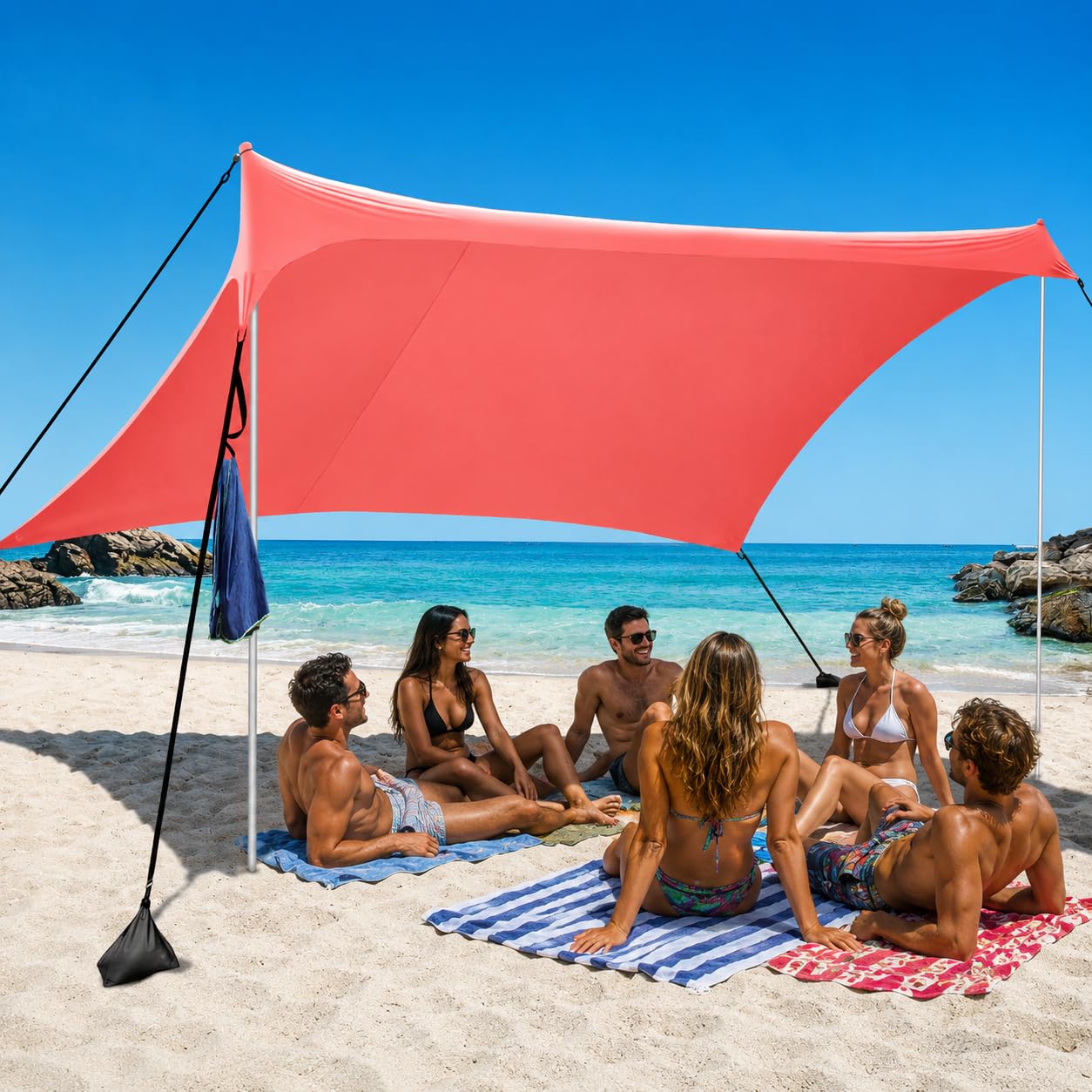
Six sandbags and a grooved pole top — small details that keep the canopy from lifting.
The easierhike tackles the weakest part of canopy shelters — where the rope meets the pole top — with a patented grooved pole tip that stops the fixing cords from slipping down. It also uses metal carabiners instead of knots for the anchor connections, making installation faster and more secure. At 6 lbs, it is one of the lighter canopy shelters, and the included sand shovel makes filling the bags easier.
The main trade-off reported by owners is durability over time. After roughly 24 beach trips, one owner noted the UV protection faded enough to cause skin blistering. The canopy is not an enclosed tent — no walls, no privacy — and the tail end can whip around in wind, occasionally hitting people sitting underneath. The hardware works well initially but some owners felt the carabiners could be stronger. For the price, it competes well with the COMMOUDS and Rhino Valley, especially if you value the extra sandbags and the slip-proof pole design.
Smart anchoring
- 6 sandbags offer more balanced wind protection than 4-bag canopies
- Grooved pole top and metal carabiners prevent cord slippage
- Built-in hanging loops for towels, sunglasses, accessories
Long-term considerations
- UV protection may degrade after extended sun exposure
- Open canopy — no wind blockage, no privacy
- Hardware quality gets mixed long-term feedback
Choose for better anchoring: If you have had a canopy lift off before, the 6-bag design and grooved poles give you more confidence for moderate wind days.
Skip for all-day sun exposure: If you vacation for weeks at a time, consider a model with a longer UV-blocking track record.
8. Rhino Valley 10 x 10 FT Beach Tent

The rare beach tent where a 6-foot person can stand upright indoors.
Most beach shelters top out around 5-foot-3 to 5-foot-8 at center. The Rhino Valley stands 6.5 ft tall, so adults can walk in and out without hunching — a significant quality-of-life upgrade when you are carrying bags in and out all day. The 10 x 10 ft footprint (100 sq ft) comfortably fits 6-8 people in chairs, and the 8 sandbags plus 4 aluminum poles and 4 windproof ropes provide the anchoring needed for a structure that large. The Lycra fabric is triple-stitched for tensile strength and offers UPF 50+ protection, and the whole thing packs into a durable storage bag at 8.7 lbs. Buyers consistently call it easy to set up — spread it, fill the bags, add the poles — and it holds up well in typical beach wind.
A small number reported the aluminum poles breaking over extended use. The tent is a canopy (open sides), so it does not offer the privacy or bug protection of an enclosed tent. If standing-room height is your primary need — especially for older family members or anyone with back issues — the Rhino Valley is a solid choice with a 4.4-star average across more than 900 ratings.
Stand-up comfort
- 6.5 ft center height — rare in beach shelters
- 100 sq ft of shade fits a large group with chairs
- 8 sandbags provide strong anchoring for the size
The known flaws
- Plastic sand scoops can break; bring a sturdy replacement
- Some pole breakage reported after regular use
- Open design — no privacy, no full wind protection
Best for standing room: If your beach crew includes anyone who has trouble sitting on the ground, the standing height makes this tent the most comfortable for moving around.
Watch out: The sand scoops are a weak point — bring a small cup or shovel to fill the bags.
9. Oileus XX-Large Pop Up Beach Tent

A sub-30-second pop-up that weighs just 5 lbs — and costs less than a nice dinner.
The Oileus is the lightest enclosed tent in the lineup at 5 lbs, and the pop-up mechanism means you can go from bag to shaded shelter in under 30 seconds. The floor is 98.4 x 55 inches — generous for 2 adults and 2 kids but tight for 4 adults in chairs. The 6 sand pockets, 10 steel stakes, and 4 guylines provide a solid anchoring system for a tent this light, and the 210T polyester with 3000mm PU coating and UPF protection (blocking 99% of UV rays) feels well-built for the price point. Owners say it fits a 6-foot-4 person easily, and the awning provides extra shade at the front. The 3 mesh windows keep airflow moving, and the internal storage pocket keeps small items off the sandy floor.
The durability feedback is split. Some reviewers point out the tent holds up well even in heavy winds; others find the 9 mm fiberglass poles and fabric too flimsy for regular rough use. The capacity is overstated — the “5-6 person” label is optimistic for seated comfort. Folding the pop-up back into the carry bag takes practice and can be frustrating. For a budget-friendly price and the lowest carry weight in the list, those trade-offs are fair, but if you plan to use the tent every weekend, a heavier model with thicker poles will last longer.
Lightning-fast setup
- Pops up in under 30 seconds — fastest setup in the lineup
- 5 lbs with carry bag — easiest to carry to the sand
- 6 sand pockets + 10 stakes + 4 guylines = good anchor kit
Durability notes
- 9 mm fiberglass poles can feel fragile over many trips
- “5-6 person” is tight for 4 adults in chairs
- Folding it back into the bag is tricky without practice
Budget winner: For the price and the weight, this is the best value enclosed tent for occasional beach trips with 2-3 people. The fast setup and light carry make it a great first tent.
Limit your expectations: Not for weekly use or high-wind beaches — the poles and fabric are best for moderate conditions and a fair-weather trip.
Understanding the Specs
UPF 50+ vs Blackout Coating
UPF 50+ blocks 98% of ultraviolet rays — that is the standard needed to prevent sunburn through the fabric. Blackout coating adds a layer that also blocks visible light, so the interior is much darker. That is excellent for napping but can trap heat. If you want to sleep or change clothes during the day, blackout helps. If you just want a shady spot to sit, standard UPF 50+ is enough and stays cooler.
Sand Pockets vs Sandbags
Sand pockets are built into the tent corners — you scoop sand directly into the fabric channel. Sandbags are separate pouches that you fill and attach to the frame. Pockets are simpler but can stress the seam over time. Bags are more secure but require separate filling and take longer to set up. The best wind resistance comes from having multiple anchoring points (6 or 8 bags/pockets) rather than relying on just 4.
Guyline Count (4 vs 6)
Guylines are the ropes you stake out away from the tent to hold it open and steady. More guylines (6 vs 4) generally mean better wind resistance because the tent is anchored in more directions. But guylines only help if you actually stake them out with the included stakes — and on sandy beaches, stakes often pull out before the tent moves. Sandbags and sand pockets are usually more effective for beach use than guylines.
Pop-up vs Pole Setup
Pop-up tents have pre-attached spring frames that expand when you unfold them — setup takes 10-30 seconds. Pole tents require you to insert fiberglass or aluminum rods into fabric sleeves, which takes longer but often allows for a stronger, more durable frame. If you value speed above all else, choose pop-up. If you plan to camp in wind frequently, the pole-style tents (especially those with thicker 9.5 mm poles) tend to last longer and hold steadier.
FAQ
How do I keep a beach camping tent from blowing away?
What size beach tent do I need for 4 people?
Can I use a beach tent for camping overnight?
What is the difference between UPF 50+ and SPF 50?
How do I fold a pop-up beach tent back into the bag?
Are beach tents safe for babies and toddlers?
How do I clean a beach tent after a trip?
Can I use a beach tent as a changing room?
What beach tent is best for windy conditions like the Outer Banks or Cape Cod?
How long does a beach tent typically last?
Final Thoughts: The Verdict
For most buyers, the best beach camping tent is the CoolCabana Beach Shade Tent because it pairs genuine wind stability (those 35-lb sand pockets) with one-person setup and enough shade for a couple or small family — the most consistently praised pick in the lineup across nearly a thousand owners. If you need a dark interior for napping or a baby, grab the OutdoorMaster Beach Tent with its blackout coating and 9.5 mm poles. And for a budget-friendly first tent that weighs almost nothing and sets up in halfa minute, the Oileus XX-Large Pop Up is the one to reach for — just keep expectations realistic for wind and long-term wear.
How We Picked
We do not accept paid placement. Every pick is matched to a real buyer and a real use-case; we do not hands-on test units.
Sources & Methodology
Specifications: manufacturer listings and product documentation. Review insights: verified customer reviews, as of July 2026. Pricing: not shown on this page (it changes often); check the current price via the retailer link.
As an Amazon Associate, FitlyFast earns from qualifying purchases. This does not affect which products we feature.