
Our readers keep the lights on and the weekend projects moving. As an Amazon Associate, I earn from qualifying purchases.
Many so-called “bombs” or foggers are ineffective against these resilient pests, often driving them deeper into your walls. Effective treatment requires a targeted spray strategy that reaches every crack and crevice where bed bugs hide.
I’m Rikta — the co-founder and writer behind FitlyFast. I’ve spent countless hours analyzing the chemistry, application methods, and user-reported outcomes of dozens of bed bug sprays to identify which formulations actually deliver on their promises.
This guide breaks down the specific active ingredients, residual durations, and best-use scenarios to help you choose the most effective bed bug bomb for your situation, cutting through the marketing to focus on what scientifically works.
How To Choose The Best Bed Bug Bomb
Choosing the right spray is a decision between a contact killer that provides immediate relief and a residual treatment that continues working for weeks. The best approach often combines both, but understanding the key differentiators will help you select the right product for your specific infestation level.
Active Ingredient Chemistry: Repellent vs. Non-Repellent
This is the single most critical factor. Many household sprays use pyrethroids that repel bugs on contact. While this seems good, it often causes bed bugs to scatter and hide deeper, making the problem worse. Professional-grade options use non-repellent active ingredients like Chlorfenapyr or the combination of Imidacloprid and Beta-cyfluthrin. These are undetectable to bed bugs, allowing them to walk through the treated area, pick up the poison, and die later, even transferring it back to their harborage.
Residual Duration and Egg Hatch Prevention
A spray that kills on contact but evaporates in a day is just a band-aid. For true elimination, you need a product with a residual life of at least 2-4 weeks. This ensures that any new hatchlings from existing eggs are killed as they emerge. Look for explicit claims of “residual control” and “egg hatch prevention” on the product label, which are hallmarks of a formulation designed for complete eradication, not just a quick knockdown.
Quick Comparison
On smaller screens, swipe sideways to see the full table.
| Model | Category | Best For | Key Spec | Amazon |
|---|---|---|---|---|
| Crossfire Aerosol | Aerosol | Complete Lifecycle Kill | Kills all stages, prevents egg hatch | Amazon |
| Harris 5 Minute Kill Time | Spray | Rapid Contact Kill | Kill time in 5 minutes | Amazon |
| Bayer Temprid Ready Spray | Residual Spray | Long-Lasting Barrier | Dual-active residual formula | Amazon |
| BASF PT Phantom II | Non-Repellent | Stealth Kill / Resistance | Chlorfenapyr non-repellent action | Amazon |
| Bedlam Insecticide Spray | Aerosol | Mattress & Fabric Use | Safe for use on mattresses | Amazon |
| Good Night Bed Bug Spray | Water-Based | Multi-Pest Control | Odorless, water-based formula | Amazon |
| Crossfire Liquid Concentrate | Concentrate | Severe Infestations | Non-repellent, long residual life | Amazon |
In‑Depth Reviews
1. Crossfire Aerosol

The Crossfire Aerosol stands apart because it uses a patented non-repellent technology that bed bugs cannot detect. This is the single most critical feature for any spray. Unlike repellent foggers or essential oil solutions that cause bugs to scatter, Crossfire allows them to walk through the treated area, making contact with a lethal dose that kills them and prevents their eggs from hatching.
Its formula is approved for direct application onto mattresses and is non-staining, making it a safe and versatile tool for treating sleeping areas. The included pair of protective gloves is a practical touch for a DIY user serious about following safety protocols. User reports consistently describe this as a “one and done” solution when used as part of a comprehensive two-cycle treatment plan.
For anyone facing a moderate to severe infestation, this aerosol provides the professional-grade chemistry needed to break the life cycle without the risk of driving the problem into other rooms. Its rapid knockdown combined with a long residual makes it the most effective single-can solution on the market.
Why it’s great
- Non-repellent formula prevents scattering of bed bugs.
- Kills all life stages, including eggs.
- Approved for direct use on mattresses with no staining.
Good to know
- Best results require treating entire room, not just the bed.
- Moderate price point for a single aerosol can.
2. Harris 5 Minute Kill Time Bed Bug Killer

The Harris 5 Minute Kill Time spray is a powerful mid-range option that focuses on speed of action. Its water-based formula is designed to kill bed bugs on contact within 5 minutes, which is significantly faster than many residual-only products. This provides immediate psychological relief when you see a bug and want it gone instantly.
Despite its fast kill-on-contact, the formula still provides up to 30 days of residual protection, which is crucial for killing newly hatched nymphs. The spray is completely odorless and dries clear, making it suitable for use on mattresses, box springs, and base furniture without leaving any evidence of treatment. Harris is a trusted brand since 1928, adding a layer of reliability for first-time users.
While it works very fast on direct contact, its residual action is not as non-repellent as the top-tier professional chemistries. For a severe, multi-room infestation, it may require more frequent reapplication than a Chlorfenapyr-based product. It is a strong choice for early-stage or spot treatments where immediate visual confirmation of death is a priority.
Why it’s great
- Delivers extremely fast 5-minute kill on contact.
- Odorless and non-staining for use on fabrics and mattresses.
- Long 30-day residual protection against re-infestation.
Good to know
- Residual may be repellent, potentially scattering bugs in deep infestations.
- Requires thorough coverage for full effectiveness.
3. Bayer Temprid Ready Spray

The Bayer Temprid Ready Spray is a professional-grade residual aerosol that uses a unique dual-active combination of Beta-cyfluthrin and imidacloprid. This combination provides a powerful, non-repellent kill on contact and a long-lasting barrier that remains effective for up to six months in dry indoor environments. The inclusion of Imidacloprid, a neonicotinoid, provides a different mode of action that helps combat resistant bed bug strains.
The bag-in-can design is a significant practical advantage. It allows the can to be used at any angle, including upside down, without losing propellant pressure. This makes it easy to spray into cracks, crevices, and behind baseboards where bed bugs hide. User reports confirm that insects are incapacitated within 5 minutes and dead in 20, with no lingering chemical smell.
The main drawback reported by multiple users is a faulty spray nozzle that can clog or blow off after short use, wasting product. This quality control issue makes it a less reliable option than the Crossfire or BASF offerings. For those willing to risk the nozzle, the chemical performance is top-tier, but the potential for waste is a real concern.
Why it’s great
- Dual-active formula (Imidacloprid + Beta-cyfluthrin) attacks resistant bugs.
- Bag-in-can design allows use at any angle for crack treatment.
- Provides very long-lasting residual barrier (up to 6 months).
Good to know
- Spray nozzle is prone to clogging or failing.
- Not as effective as a standalone solution for severe, active infestations.
4. BASF PT Phantom II
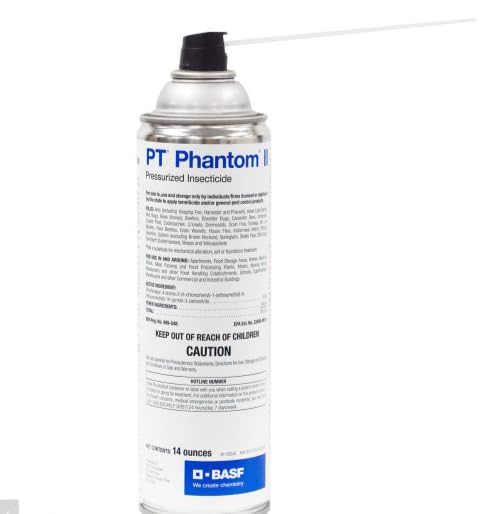
The BASF PT Phantom II is a top-tier non-repellent spray that uses Chlorfenapyr, a unique pro-insecticide. This chemistry works by entering the insect’s body and converting into a more toxic form inside, which significantly reduces the chance of resistance developing. This makes it an excellent choice for bed bug strains that have already survived pyrethroid-based treatments.
Its non-repellent nature is its greatest strength. Bed bugs cannot detect the spray, so they walk through it freely, pick up the active ingredient, and then transmit it back to their harborage, effectively creating a “Trojan horse” effect. User reports from licensed applicators note that it lasts 2-4 months for general pests and can deter ants for up to a year. It is also effective against a wide range of other insects, making it a versatile tool for general pest control.
Because it works more slowly than a contact-kill aerosol, users need patience; bugs may not die for 24-48 hours after exposure. However, this slow action is precisely what allows the poison to spread through the population. It is a better strategic weapon for eradication than a reactive tool for instant gratification.
Why it’s great
- Chlorfenapyr is effective against resistant bed bug strains.
- Non-repellent, undetectable formula allows poison to spread.
- Extremely long residual life (months) for sustained control.
Good to know
- Slow-acting compared to contact sprays (24-48 hours to kill).
- Small 14 oz can size for a premium product.
5. Bedlam Insecticide Spray

Bedlam Insecticide Spray is a well-regarded product specifically formulated as a key component of a multi-step bed bug elimination strategy. It is designed for use on mattresses, box springs, headboards, and other fabric surfaces, making it a powerful tool for treating the primary harborage zone. Its claim to kill both bed bugs and their eggs makes it a critical piece of the puzzle.
User reports consistently describe this spray as a vital part of a five-stage or three-pronged strategy that involves multiple treatments spaced a week apart. It does not kill instantly but instead contaminates nests and pathways, working over time to eliminate the population. This requires patience and a strict schedule of reapplication.
The primary concern about this product is that it is a repellent spray. While it kills bugs on contact and has some residual, it can cause bugs to scatter if applied incorrectly. This means it must be used with caution as part of a comprehensive plan that includes physical barriers and monitoring, rather than as a standalone silver bullet.
Why it’s great
- Kills bed bug eggs on contact, breaking the life cycle.
- Safe for direct application on mattresses and fabric surfaces.
- Well-known and recommended by professionals as part of a system.
Good to know
- Can be repellent, potentially scattering bugs if not used correctly.
- Requires multiple, scheduled treatments for full elimination.
6. Good Night Bed Bug Spray

Good Night Bed Bug Spray is a veteran product that has been on the market since 2008, known for its multi-pest efficacy against bed bugs, lice, ticks, fleas, and dust mites. Its water-based formula is advertised as odorless, though some user reports note a slight chemical scent that dissipates. It provides up to 8 weeks of long-lasting protection, making it a decent option for preventative maintenance.
This spray is best suited for individuals dealing with a general pest issue, not just a dedicated bed bug war. Users praise it for effectively killing fleas and dust mites in carpets and on furniture. Its low price point makes it an attractive entry-level product for those unsure about their pest type.
The key limitation is its chemistry. It is not a professional-grade, non-repellent insecticide. For a true bed bug infestation, particularly a severe one, this product is unlikely to be strong enough. It serves better as a general household insect spray for light, occasional pests than as a primary weapon in bed bug eradication.
Why it’s great
- Effective against a wide range of pests (fleas, ticks, lice, mites).
- Water-based and nearly odorless after drying.
- Very budget-friendly entry-level option.
Good to know
- Not strong enough for moderate to severe bed bug infestations.
- Lacks professional-grade non-repellent chemistry.
7. Crossfire Liquid Concentrate

The Crossfire Liquid Concentrate is the heavy artillery for serious infestations. Unlike the aerosol version, this is a concentrate that must be mixed with water and applied with a pump sprayer. This allows for much larger volume coverage — an entire 13 oz bottle can be used to treat a single room thoroughly, ensuring no crack or crevice is missed.
Its patented non-repellent technology is identical to the aerosol, making it undetectable by bed bugs. This is critical for ensuring the bugs do not scatter. The product is approved for direct mattress application and provides a long residual life, killing bugs that emerge over subsequent weeks. Users who have used this product as part of a kit report eliminating severe infestations after just two treatments.
This product is not for the casual user. It requires a separate sprayer and careful mixing to ensure the correct concentration. However, for anyone facing a chronic, multi-room, or multi-level infestation, this is the most cost-effective and potent solution available. Its ability to cover vast surface area with a non-repellent, long-lasting poison makes it the final word in DIY bed bug control.
Why it’s great
- Extremely cost-effective for large, severe infestations.
- Non-repellent formula prevents scattering and allows poison to spread.
- Provides long residual control for weeks after application.
Good to know
- Requires a separate pump sprayer for application.
- Not a simple point-and-spray; requires mixing and preparation.
FAQ
Will a fogger or “bomb” actually get rid of bed bugs?
Why is non-repellent spray better than a contact killer?
Can I spray these products directly on my mattress?
Final Thoughts: The Verdict
For most users, the best bed bug bomb winner is the Crossfire Aerosol because it combines a professional, non-repellent formula with a convenient aerosol design that kills all life stages. If you want a product for rapid visual confirmation of kills on contact, grab the Harris 5 Minute Kill Time Spray. And for large-scale, severe infestations where you need to cover maximum area with a long-lasting biocide, nothing beats the Crossfire Liquid Concentrate.