
Our readers keep the lights on and the weekend projects moving. As an Amazon Associate, I earn from qualifying purchases.
Waking up with a sore back because your sleeping pad went flat at 2 AM is a camping trip ruiner. The ground saps your body heat, rocks dig into your hips, and an air mattress that loses pressure leaves you cradled by cold dirt. A proper bed lifts you off the tent floor, insulates you from the chill, and delivers the kind of rest that makes you want to hike farther the next day.
I’m Rikta — the founder and writer behind FitlyFast. I’ve spent over a decade analyzing outdoor sleep systems, from cheap foam pads to expedition-grade cots, to find which designs actually hold up under real tent conditions.
The difference between a restless night and deep sleep in the backcountry comes down to one decision: choosing the right beds for camping in a tent that match your weight, tent size, and packing style.
How To Choose The Best Beds For Camping In A Tent
Picking the right camping bed is not about grabbing the thickest pad or the biggest cot. You have to match the bed to your tent’s floor footprint, your sleeping style, and how you transport gear. A 30-inch-wide cot might feel luxurious, but it will not fit inside a standard two-person tent without rubbing against the walls and collecting condensation. Start by measuring your tent’s actual floor width and peak height.
Cot Height and Tent Compatibility
A cot that sits 15 inches off the ground makes getting in and out easy and creates valuable storage space underneath for boots and backpacks. However, that same height can be problematic in a low-profile tent where the walls slope sharply. Many modern cots offer dual-height designs — a lower 6- to 8-inch setting for inside the tent and a taller 15-inch setting for car camping under a tarp or in a large cabin tent. Always check your tent’s center height before buying a cot with leg extensions.
Weight Capacity and Frame Material
Steel frames offer bombproof stability and handle 300 pounds or more, but a steel cot typically weighs 13 to 20 pounds. Aluminum cots, especially those using 7075 aircraft-grade alloy, cut weight by half while still supporting similar loads. If you are carrying the bed more than 50 feet from car to tent, weight is less critical. If you are backpacking or hauling gear across a large campsite, every pound matters. Check both the weight limit and the frame material — 600D Oxford cloth fabric on steel legs is a different product than 300D ripstop on aluminum rails.
Insulation and R-Value for Cold Ground
A cot lifts you off the ground, which helps with airflow and reduces condensation under your sleeping bag. But air moving underneath a cot actually steals heat faster than a direct ground contact sleeping pad with high R-value. If you camp in temperatures below 50°F, pair your cot with a closed-cell foam pad or an insulated inflatable pad. Memory foam toppers add comfort but do not provide meaningful insulation on their own — look for pads with an R-value of 4.0 or higher for three-season use.
Quick Comparison
On smaller screens, swipe sideways to see the full table.
| Model | Category | Best For | Key Spec | Amazon |
|---|---|---|---|---|
| Naturehike ArmyWild | Cot | Dual-height versatility | 7075 aluminum, 330 lbs | Amazon |
| ONETIGRIS SUPRANUBIS | Cot | Wide sleeping surface | 27.5″ wide, 330 lbs | Amazon |
| Sportneer Camping Cot | Cot | Quick setup, wide fit | 28.7″ wide, 330 lbs | Amazon |
| TIMBER RIDGE Quick Set-Up | Cot | Ultralight, 20-sec setup | 7.1 lbs, 225 lbs | Amazon |
| Gaialoop 4 Inch Memory Foam | Pad | Luxury car camping | 4″ thick, 30″ wide | Amazon |
| CYMULA 3 Inch Memory Foam | Pad | Budget-friendly cot topper | 3″ thick, waterproof bottom | Amazon |
| Therm-a-Rest NeoAir Xlite NXT | Pad | Ultralight backpacking | 13 oz, R-Value 4.5 | Amazon |
In‑Depth Reviews
1. Naturehike ArmyWild Folding Camping Cot

The Naturehike ArmyWild delivers the best balance of packability, strength, and adaptability for tent camping. Its aircraft-grade 7075 aluminum frame is 67 percent stronger than standard alloys, yet the entire cot weighs far less than steel equivalents. You can set it to a low 6.7-inch profile for snug tent fits or raise it to 15 inches for easier entry and under-cot storage — a rare dual-height option in this weight class.
The 300D Oxford fabric sleeping surface is breathable and anti-static, which helps reduce heat loss on cold nights. The quick locking system with shock-cord tubes means setup takes under five minutes with no tools. Three support legs and twelve extending legs distribute weight evenly and prevent the frame from sinking into soft ground. At 25.6 inches wide, it fits comfortably inside most two-person tents without crowding the walls.
Users consistently note that the cot remains stable with no side-to-side wobble even at 250 pounds, and the included hanging pockets and mesh storage underneath add real convenience for keeping a phone, headlamp, or extra layers accessible through the night.
Why it’s great
- Two height settings adapt to tent floor or open air
- Ultra-strong 7075 aluminum saves weight without sacrificing capacity
Good to know
- Requires assembly — not a fold-out design
- Some users need a pad on top for optimal comfort
2. ONETIGRIS SUPRANUBIS Camping Cot

The ONETIGRIS SUPRANUBIS stands out for its generous 27.5-inch width — a full two inches wider than many standard cots — which gives side sleepers room to shift without hanging off the edge. The frame uses 7075 aluminum bars and legs rated to 330 pounds, and the 300D Oxford fabric is rip-stop and water-resistant. A leverage locking mechanism makes assembly straightforward, and the cot packs into a large stuff sack for transport.
Height adjustability matches the Naturehike with a 15.75-inch tall setting using 12 extending legs and a low 5.9-inch mode for tent use. The lower setting keeps the center of gravity stable inside small tents, while the taller mode doubles as a bench seat around camp. A side pocket and an under-cot mesh storage net add practical stash space for gear you want off the tent floor.
Owners praise the rock-solid stability and the fact that the cot shows no side-to-side movement even when shifting position through the night. The wider platform does make it bulkier when packed, so confirm your tent floor can accommodate the extra width before buying.
Why it’s great
- Extra width for unrestricted sleeping positions
- Two height modes plus under-cot storage net
Good to know
- Heavier than ultralight cots at 9.5 pounds
- Assembly required with leverage lock system
3. Sportneer Camping Cot
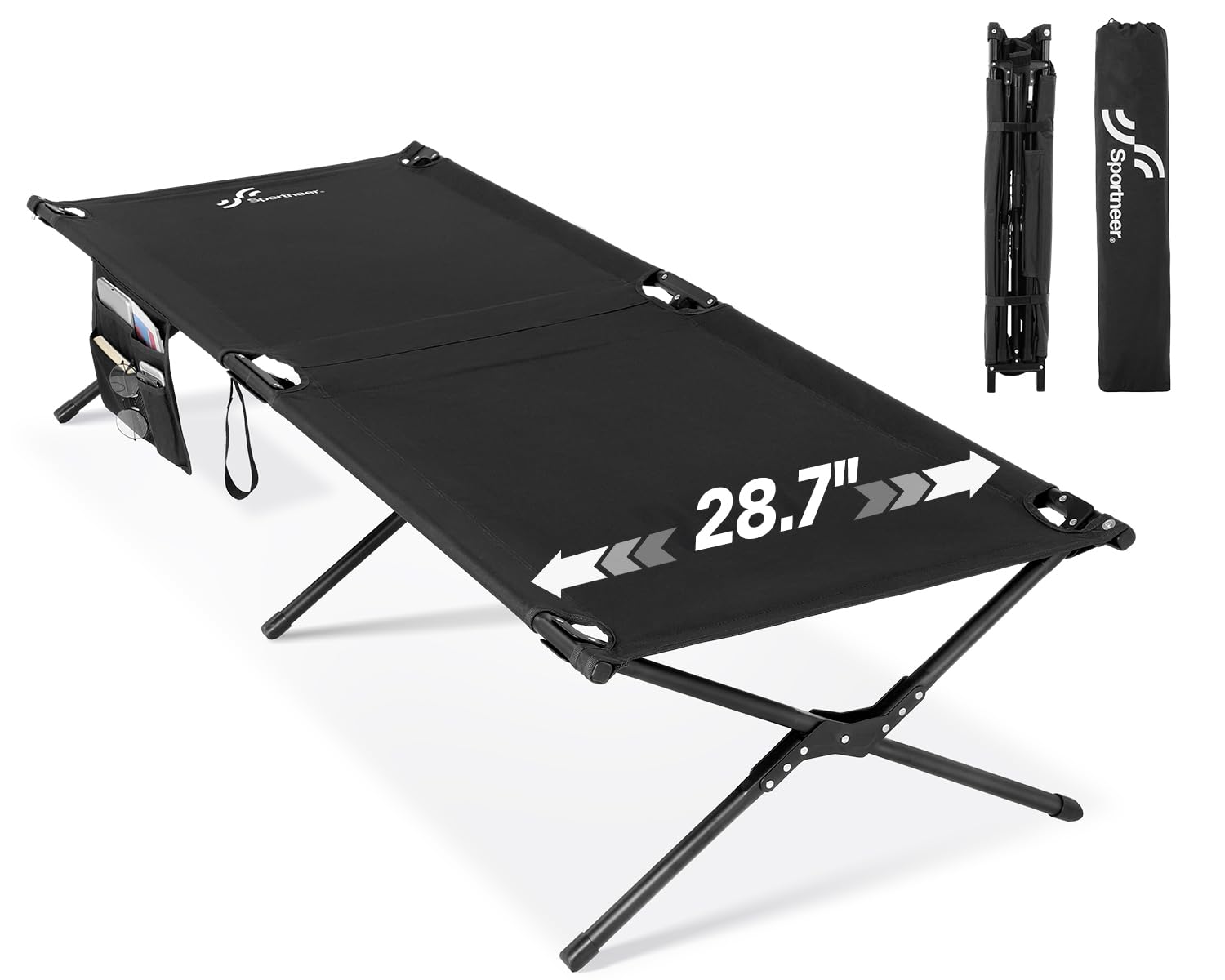
The Sportneer Camping Cot is built for campers who prioritize a fast, tool-free setup and a spacious sleeping platform. The frame uses high-quality stainless steel brackets and 600D Oxford cloth, creating a taut surface that supports up to 330 pounds. With an unfolded width of 28.7 inches, it is one of the widest cots in this roundup, giving restless sleepers generous room to move.
Setup takes about 30 seconds thanks to a fold-out design with leg rotation locks that prevent accidental collapse. The sleeping surface sits 15 inches off the ground — enough clearance to store gear underneath but low enough to fit inside most cabin tents. The folded size of 40.2 by 7.9 inches slides into most car trunks without dominating the cargo space.
Customer feedback highlights the sturdy legs and easy assembly, though some users note a slight front-to-back wobble that becomes noticeable when shifting weight. Adding a 3-inch memory foam pad on top resolves comfort concerns and turns this cot into a reliable guest bed for home use as well.
Why it’s great
- Widest cot at 28.7 inches for maximum room
- Instant fold-out setup with leg rotation locks
Good to know
- Steel brackets add weight for backpacking
- Slight wobble reported without a mattress topper
4. TIMBER RIDGE 20-Second Quick Set-Up Camping Cot
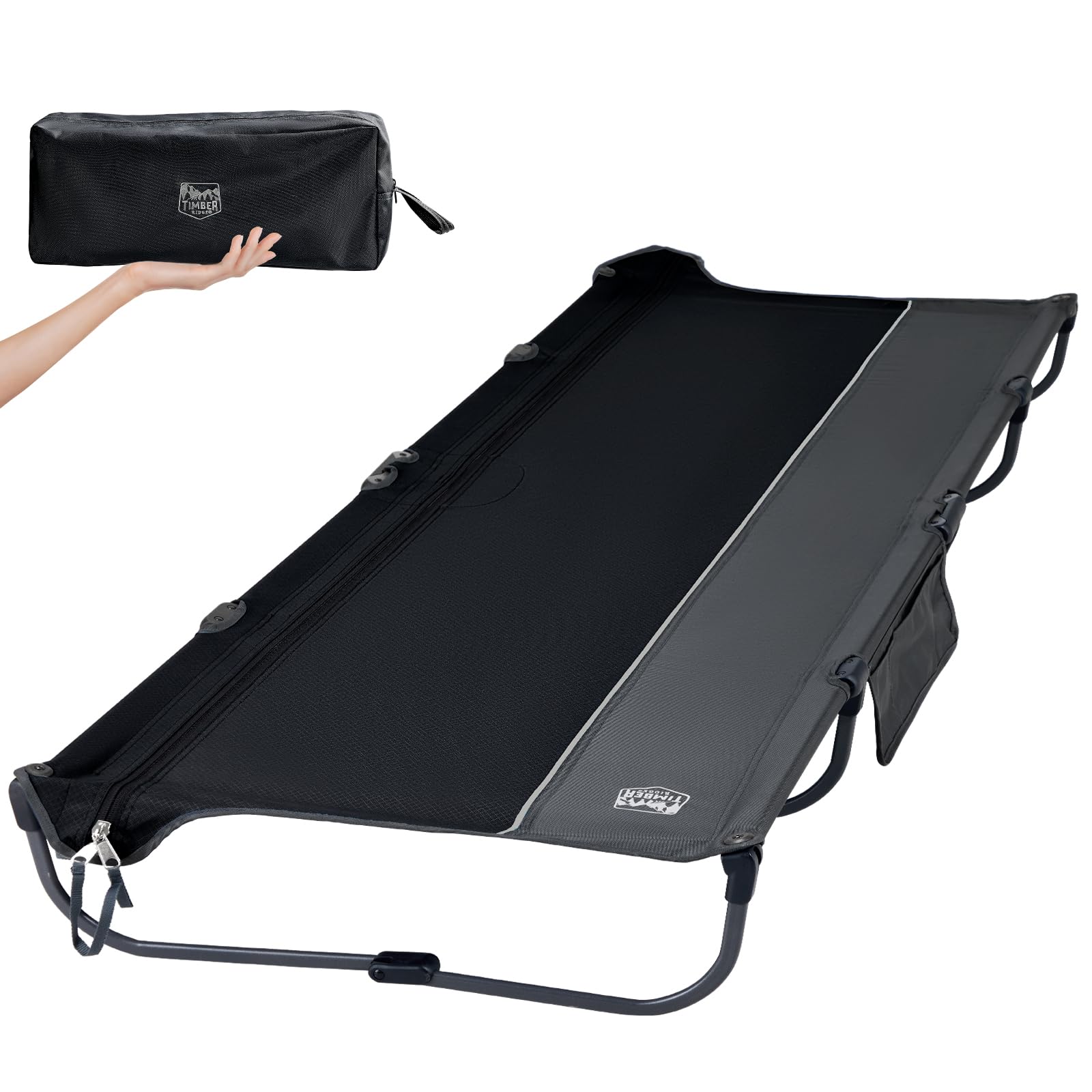
The TIMBER RIDGE cot is the lightest folding cot in this group at just 7.1 pounds, making it a top choice for campers who hike from car to site or need a bed that fits inside a compact one-person tent. The aluminum frame supports up to 225 pounds, and the pre-attached structure means zero assembly — just unfold, zip the closure, and sleep. Packed size measures 19.7 by 9.4 by 5.9 inches.
The sleeping surface is 76.4 by 26.8 inches, accommodating adults up to 6 feet 1 inch tall. The cot sits only 7.9 inches off the ground, which is low enough to fit inside most small tents but still lifts you above rocks and roots. The fabric is taut with no crossbars underneath, so there are no pressure points poking into your back.
Owners love the speed of setup and how small it packs, but the 225-pound weight limit and 7.9-inch height are real constraints for larger or taller users. The fold-and-zip mechanism has an industrial-grade zipper that needs to be kept clean for smooth operation, and collapsing the legs requires care to avoid pinching fingers.
Why it’s great
- Ultralight aluminum frame at 7.1 pounds
- Folds and zips shut in under 20 seconds
Good to know
- Weight limit of 225 pounds limits larger users
- Low 7.9-inch height reduces under-cot storage
5. Gaialoop 4 Inch Memory Foam Camping Mattress
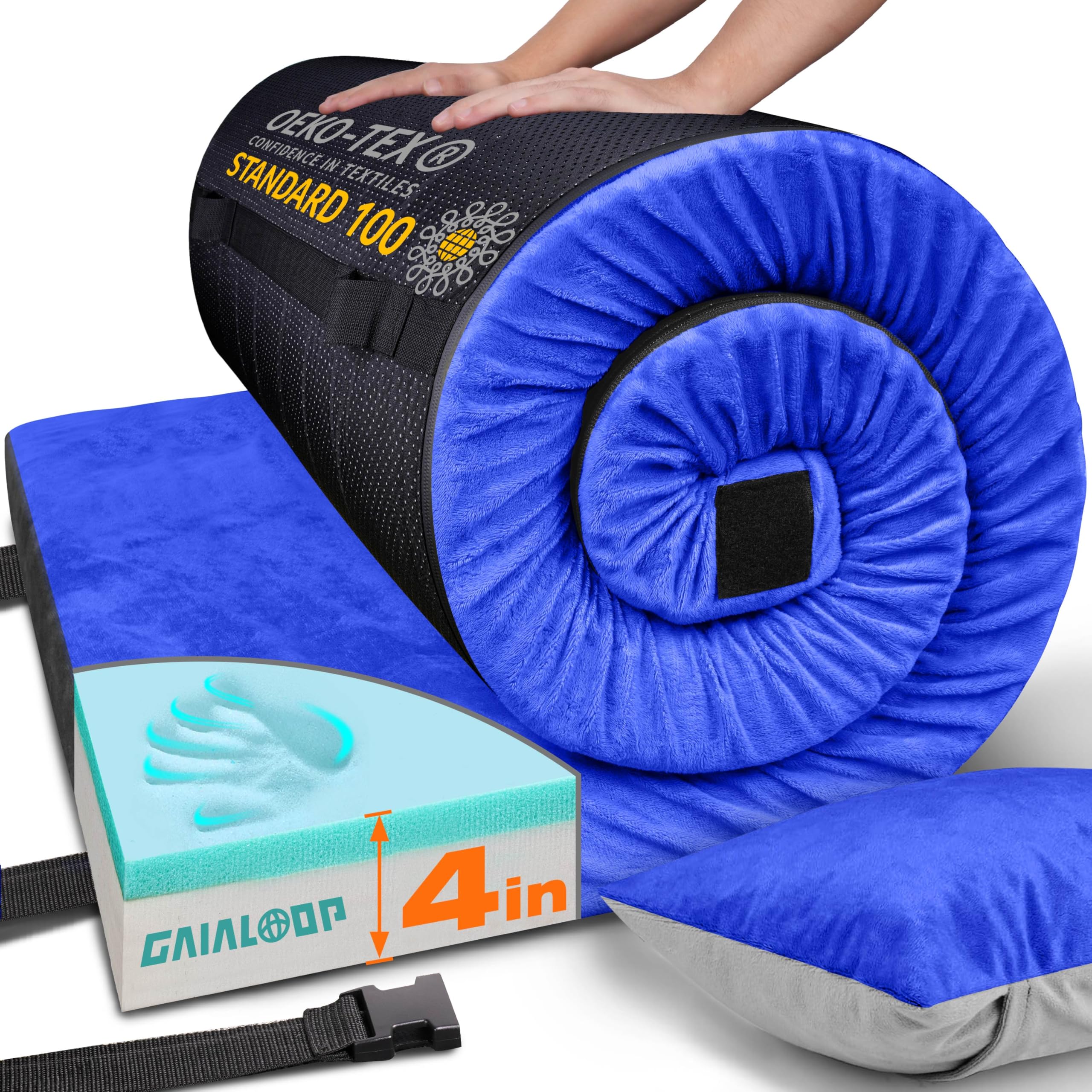
The Gaialoop 4 Inch Memory Foam mattress transforms a tent floor or a basic cot into a bed that rivals home comfort. The pad uses a dual-layer construction — 30D support foam beneath 40D memory foam — to deliver a 4-inch thickness that is thick enough for side sleepers who push hard into the surface. The 30-inch width provides ample space for sprawling, and two twins can be zipped together to form a king-size sleeping area.
The cover is a velvet-like plush fabric that is removable and machine-washable, with a waterproof coating on the inner side of both top and bottom panels to guard against dew, rain, and damp ground. The pad rolls up with securing straps into a sturdy carry case, though the packed size is substantial — about 2 feet in diameter and 5.5 feet long — so this is strictly for car camping or base camps with vehicle access.
Users report that the pad regains full shape within hours of unrolling and provides excellent insulation from cold ground. The 4-inch thickness does make rolling it back up a two-person job, and the bulk means it takes up significant cargo space. For side sleepers and anyone with joint pain, the comfort trade-off is generally worth the packing penalty.
Why it’s great
- 4-inch memory foam supports side and stomach sleepers
- Removable, washable cover with waterproof protection
Good to know
- Packed size is bulky — not for backpacking
- Rolling the pad back up solo can be difficult
6. CYMULA 3 Inch Memory Foam Camping Pad
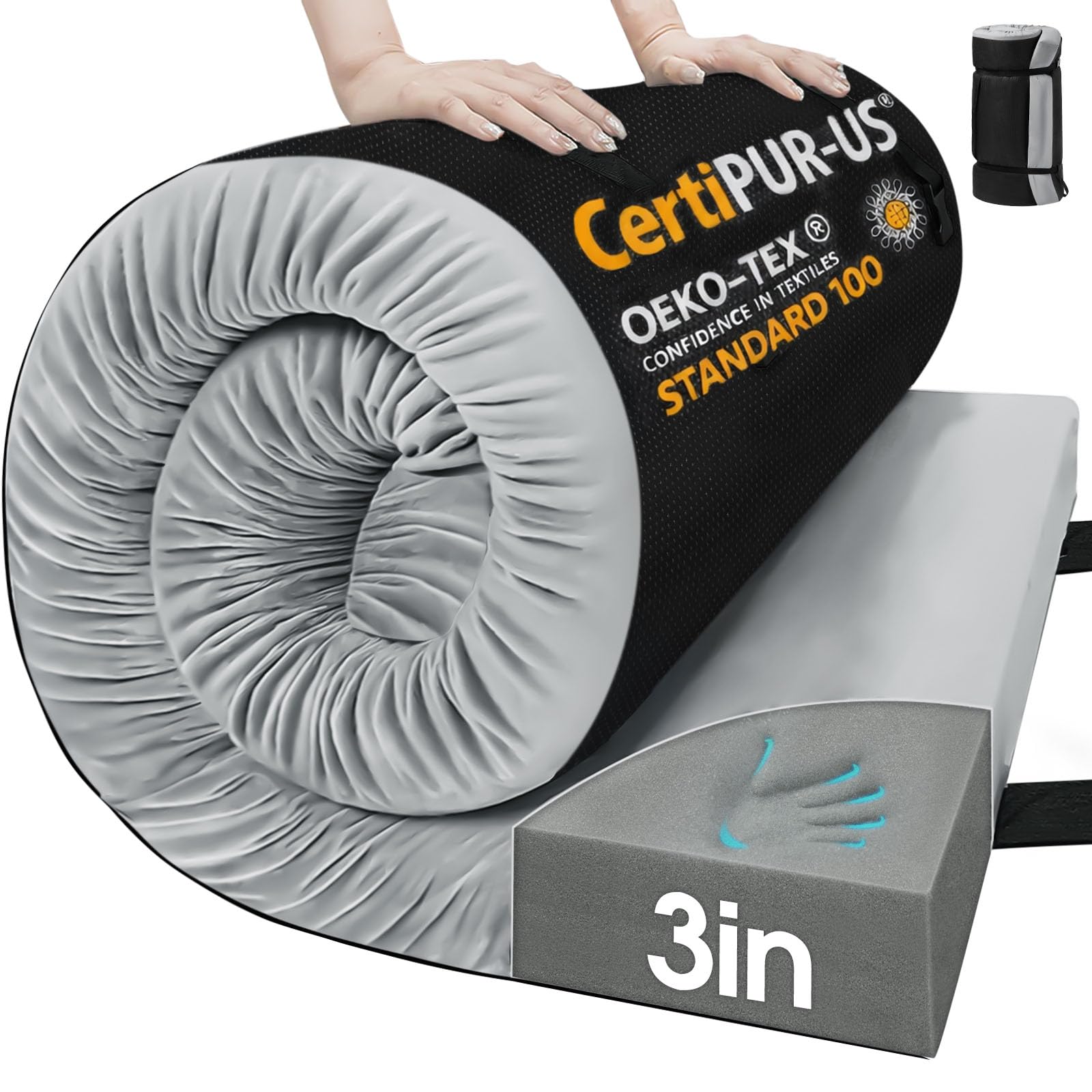
The CYMULA 3 Inch Memory Foam Pad solves the problem of hard cot surfaces without adding excessive bulk. It uses a carbon-fiber high-elasticity memory foam layer on top of a high-density base foam for a 3-inch thickness that takes the edge off tent floors and cot fabric. The pad measures 72 by 24 inches, fitting most standard cots and tent floors, and it weighs 6.4 pounds — manageable for car camping.
The bottom layer is waterproof with rubberized anti-slip dots that keep the pad from sliding around on slick tent floors or cot fabric. Built-in straps secure the pad to a cot frame so it stays put during the night. The breathable fabric cover is removable and machine-washable, which helps manage the smell and dirt that accumulate after multiple camping trips.
Users consistently note that this pad adds significant comfort to hard cots and floors, especially for those with hip or shoulder joint pain. The 3-inch thickness is a noticeable improvement over the thin foam pads often bundled with cots. Some owners report a strong chemical smell when first unboxed, which dissipates after airing out for a day or two. The pad rolls up into a bundle roughly the size of a bath towel, making it easy to store.
Why it’s great
- 3 inches of memory foam relieves pressure points on cots
- Waterproof bottom with anti-slip dots prevents shifting
Good to know
- Initial chemical smell needs time to air out
- 24-inch width is narrow for broad-shouldered sleepers
7. Therm-a-Rest NeoAir Xlite NXT Ultralight Sleeping Pad

The Therm-a-Rest NeoAir Xlite NXT is the standard for ultralight backpacking. Weighing just 13 ounces in the regular size, it rolls up to the volume of a one-liter water bottle and provides 3 inches of air cushion that lifts you off the ground. The reflective ThermaCapture technology traps radiant heat, and the Triangular Core Matrix minimizes convective heat loss to deliver an R-value of 4.5 — warm enough for year-round use down to freezing temperatures.
The WingLock valve makes inflation and deflation quick and hassle-free, and the included pump sack lets you inflate without introducing moisture from your breath. The 30D ripstop nylon fabric is lightweight but requires careful handling to avoid punctures. In the regular wide size (25 by 72 inches), the pad fits inside most backpacking tents without crowding, and the 3-inch thickness keeps hips off the ground for side sleepers.
Users upgrading from older versions report that the current model is significantly quieter — the crinkle noise that plagued earlier NeoAir pads is largely gone. The pad holds up well over years of use when paired with a ground sheet, but the thin fabric means any sharp rock or stick can cause a leak. The price positions this as a specialist tool for hikers who prioritize weight above all else.
Why it’s great
- Unmatched weight-to-warmth ratio at 13 ounces
- R-Value 4.5 handles three-season and near-freezing conditions
Good to know
- Fragile 30D fabric requires ground sheet protection
- Premium price reflects ultralight specialization
FAQ
Can I use a regular air mattress inside a tent instead of a cot or pad?
How thick should a sleeping pad be for side sleeping in a tent?
What is the best cot height for a typical two-person tent?
Final Thoughts: The Verdict
For most users, the beds for camping in a tent winner is the Naturehike ArmyWild Folding Camping Cot because it combines dual-height adjustability, lightweight 7075 aluminum construction, and rock-solid stability in a package that fits both small tents and open camp setups. If you want a luxurious car camping sleep surface that rivals your home mattress, grab the Gaialoop 4 Inch Memory Foam Camping Mattress. And for ultralight backpacking where every ounce counts, nothing beats the Therm-a-Rest NeoAir Xlite NXT.