
Our readers keep the lights on and the weekend projects moving. As an Amazon Associate, I earn from qualifying purchases.
Nighttime accidents stack up into loads of laundry, interrupted sleep, and a child whose confidence quietly erodes. A bedwetting alarm that reliably detects the first drop of urine and wakes a deep sleeper can break this cycle in a matter of weeks—the key is finding one that your child will actually tolerate wearing and that won’t false-alarm from a single bead of sweat.
I’m Rikta — the founder and writer behind FitlyFast. I’ve spent years analyzing sensor technology, alarm volume specifications, battery endurance, and wireless reliability across dozens of enuresis solutions to separate the conditioning tools that truly work from the ones that just add noise.
Every home deserves a reliable solution that fits their child’s specific sleep sensitivity and independence needs, which is exactly what this guide to the best bedwetting alarm for kids delivers through hands-on spec analysis and real parent feedback.
How To Choose The Best Bedwetting Alarm For Kids
Choosing a bedwetting alarm comes down to three non-negotiable factors: your child’s sleep depth, the sensor’s reliability against moisture versus sweat, and the alarm’s ability to rouse without terrifying. Get these three right, and dry nights are a matter of weeks, not years.
Wired vs. Wireless: The Freedom Trade-Off
Wired alarms use a cable that runs from a sensor clipped to the underwear up to a receiver worn on the wrist or placed by the bed. The cable can tangle with active sleepers and poses a minor strangulation risk for very young children. Wireless designs eliminate that cord entirely—the sensor clips to the underwear and transmits a signal to a separate receiver placed up to 100 feet away. Wireless units give a child more freedom to roll over and let a parent monitor from another room, but they introduce the risk of a lost transmitter or a weak battery causing a missed alert.
Alarm Volume, Vibration, and Tone Variety
A deep sleeper requires a loud, piercing alarm—around 80 decibels—combined with a strong vibrate function. Some children habituate to a single tone after a few nights, so alarms that offer 6 or 7 different melodies reduce the risk of the child sleeping through the alert. Volume control is equally critical: a fixed-pitch, max-volume unit can cause panic attacks in sensitive children, while a unit with adjustable levels lets you start low and increase only if necessary.
Sensor Placement and False Alarm Resistance
Most alarms use a contact sensor that clips to the front of the child’s underwear. The sensor must sit in the exact spot where the first drops of urine hit; placement too high or too low causes missed events or false alerts from sweat. Some newer units use a separate pad that lies under the fitted sheet—no clip on the body at all. Pad-style sensors are less prone to false alarms from perspiration but require the child to sleep without underwear for proper detection. Sweat-induced false alarms are the number one complaint across this category, so look for sensors that require a sustained moisture threshold rather than mere humidity.
Quick Comparison
On smaller screens, swipe sideways to see the full table.
| Model | Category | Best For | Key Spec | Amazon |
|---|---|---|---|---|
| DryEasy Pro Wireless | Mid-Range | Deep sleepers needing volume control | 6 selectable sounds + 6 volume levels | Amazon |
| Wet Detective Kit | Premium | Sweat-prone kids & adults | Pad-based sensor, 4 alarm settings | Amazon |
| Wet-Stop3 Blue | Mid-Range | Proven conditioning with 6 alarm tones | 80 dB loudness, 6 varying tones | Amazon |
| Wet-Stop3 Kit + Pad | Premium | Parents wanting mattress protection | Includes waterproof bed pad | Amazon |
| ovevve 2026 | Premium | Children who dislike armband receivers | 7 melodies, 3 modes, USB-C charging | Amazon |
| FENCY Wireless | Mid-Range | Budget-friendly wireless starter | 10–20 meter receiver range | Amazon |
| Vastaint Wireless | Mid-Range | LCD screen & programmable reminders | 100 ft range, LCD display | Amazon |
In‑Depth Reviews
1. DryEasy Pro Wireless
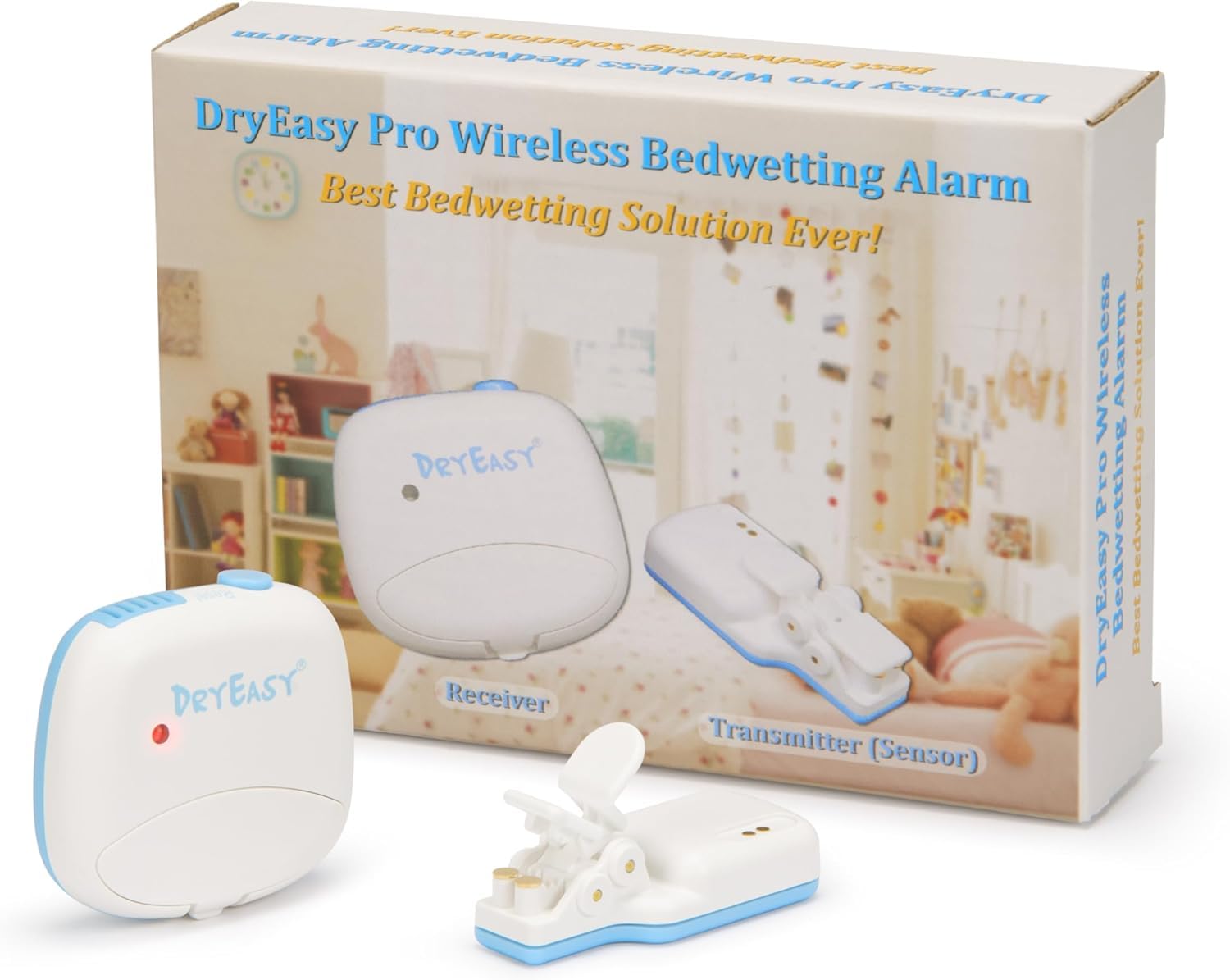
The DryEasy Pro is the most thoughtfully engineered wireless alarm in this class. Its toggle-clamp transmitter grips the underwear edge securely—no sliding off during active sleep—and the receiver offers six distinct sounds plus six digital volume levels. That range of adjustability means you can start at a gentle chime for a light sleeper and gradually increase loudness (or switch to vibration-only) for a child who sleeps through everything. Parents of children with ADHD or autism report the combination of random-tone cycling and strong vibration conquered deep sleep within about ten days.
The two-piece Bluetooth-style design (transmitter on the underwear, receiver on the nightstand or armband) eliminates the strangulation risk of a cable and lets the child roll freely. Battery life exceeds a month on a single charge, which is practical for families who do not want to hunt for AAA batteries at midnight. The sensor triggers instantly on the first drops of urine, and the manufacturer’s customer support is unusually responsive—one reviewer had a lost charging cord replaced free without hassle.
The trade-off is that the transmitter is small (easy to misplace) and the armband receiver can fall off a thrashing sleeper. Some users recommend a dedicated storage container and a thin Velcro reinforcement strap. A few reviewers also note the unit does not detect moisture when the sensor is positioned too high on the underwear—precision placement matters. Still, for the mid-range price point, the DryEasy Pro delivers the best balance of sensitivity, safety, and customization.
Why it’s great
- Six sounds plus six volume levels prevent habituation and allow a tailored wake-up intensity.
- Wireless design removes cable entanglement risk and gives the child full sleeping freedom.
- Exceptional battery life—over a month between charges reduces daily management.
Good to know
- The small transmitter can be easily misplaced; needs a dedicated storage routine.
- Sensor placement on the underwear must be precise or it can fail to detect the first drops.
2. Wet Detective Bedwetting Kit

The Wet Detective takes a completely different approach: instead of clipping a sensor onto underwear, it uses a large waterproof pad that lies under the fitted sheet. The alarm unit sits on the bedside table and connects to the pad via a short cable. This design is a godsend for children who sweat heavily and trigger false alarms on contact sensors, and it works for adults managing incontinence as well. The pad covers most of a twin mattress and is machine-washable, which simplifies middle-of-the-night cleanup enormously.
You get four alarm settings (light, medium, alert beep, and loud alarm) plus a flashing LED response light. Because the child does not wear anything on their body, there is zero risk of the sensor slipping off or causing discomfort. The kit includes two pads so you can swap one out while the other dries after washing—critical for back-to-back wet nights. Developed by a board-certified urologist, the system carries a one-year manufacturer warranty on the alarm unit, which adds peace of mind.
The main catch: for the pad to detect urine, the child must sleep without underwear (or with very thin training pants), which some families find impractical. False alarms can still occur from sweat if the child sleeps directly on the pad without a flat sheet in between—a thin top sheet solves that reliably. The alarm unit must be within about three feet of the pad due to the cable, so portability is limited. A small number of units have reported pad failure after washing, though the second pad provides a backup.
Why it’s great
- Body-free pad sensor eliminates false alarms from sweat and skin moisture entirely.
- Two machine-washable pads allow quick swaps during overnight accidents.
- Four adjustable alarm settings plus LED flash suit different sleep depths and hearing sensitivities.
Good to know
- Child must sleep underwear-free for the sensor to work effectively.
- Cable connecting pad to alarm unit limits bedside placement to within about three feet.
3. Wet-Stop 3 Blue

The Wet-Stop 3 is the wired alarm that has trained more children to dryness than almost any other model. Its 80-decibel alarm is genuine wake-the-household loud—exactly what a dead-to-the-world sleeper needs. It offers six distinct alarm tones plus a vibrating alert, and the patented contact sensor is straightforward to clean between uses. The two-step shut-off (press and hold the button while drying the sensor) prevents a child from accidentally disabling the alarm before fully waking, a common failure mode with cheaper designs.
The included reward chart and star stickers provide a visual motivator that pairs well with the alarm itself. The company also offers a free download of “The Complete Bedwetting Book,” which helps parents navigate the conditioning process with evidence-based tactics.
The loudness is also the biggest drawback. Several reviewers describe the alarm as causing panic, crying, or sleep deprivation in sensitive children. There is no volume adjustment—it is always at maximum intensity. The wired sensor cable can tangle or pose a minor strangulation risk for very young users (under 3 years old), and false alarms from sweat are common unless you wrap the sensor in a paper towel and tape—a workaround that does work but requires extra effort.
Why it’s great
- Proven conditioning track record—many children achieve dry nights within two to four weeks.
- 80-decibel loudness and strong vibration reliably wake the deepest sleepers.
- Two-step shut-off prevents accidental disarming before the child is fully conscious.
Good to know
- No volume control—the fixed maximum loudness can frighten sensitive or anxious children.
- Wired sensor cable can tangle and poses a slight risk for very young children.
4. Wet-Stop3 Kit with Waterproof Bed Pad

This kit bundles the classic Wet-Stop3 alarm with a waterproof, washable mattress pad—solving two problems at once. The alarm unit itself is identical to the standalone Wet-Stop3: 80-decibel maximum volume, six alarm tones, vibration alert, and the two-step shut-off. Adding the pad means one less layer of cleanup when an accident happens; you strip the pad rather than washing the entire mattress protector and sheets. The pad is machine-washable and reusable, made from a cotton-poly blend that feels comfortable against the skin.
Parents report the combination is a “life changer” for families managing nightly accidents. One seven-year-old who had been wetting the bed every single night for seven years achieved complete dryness in one month with the kit and remained dry three months after stopping use. The included star stickers and reward chart turn the process into a game, which can accelerate motivation for younger children. The mattress pad also provides an extra layer of protection for guests or siblings who occasionally sleep in the bed.
The wired sensor still requires careful placement to avoid false alarms, and the loud fixed-volume alarm can overwhelm sensitive kids. The bed pad is durable but should not be bleached, ironed, or dry-cleaned—some parents accidentally shrink it. A small number of units have been reported defective on arrival, though the one-year manufacturer warranty covers the alarm unit. For a family starting from scratch, this kit eliminates the need to buy a separate mattress protector and is worth the slight premium over the alarm alone.
Why it’s great
- Includes a waterproof, washable mattress pad that simplifies overnight cleanup.
- Proven alarm performance with six alarm tones and strong vibration for deep sleepers.
- One-year manufacturer warranty on the alarm unit provides long-term backing.
Good to know
- Alarm volume is fixed at maximum—no adjustment for sensitive children.
- Pad requires air drying and cannot be bleached, ironed, or dry-cleaned.
5. ovevve Wireless Bedwetting Alarm
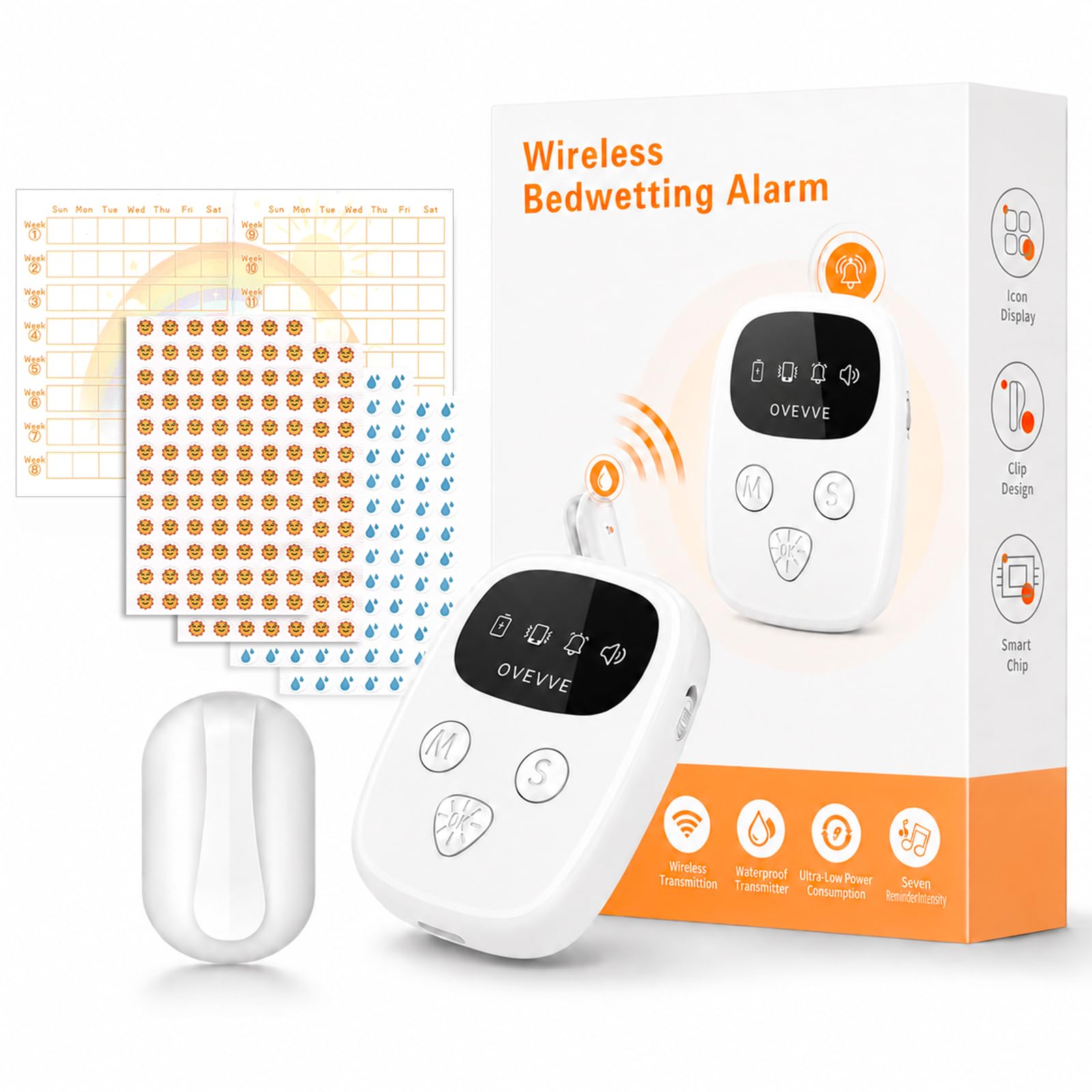
The ovevve alarm is designed with a child’s comfort and independence in mind. The transmitter is fully waterproof, compact, and discreet enough to wear under pajamas at sleepovers or summer camp without embarrassment. The receiver does not require an armband—it sits on the bedside table, which many children prefer over strapping a device to their arm. With seven different ringtones, three alert modes (sound, vibration, both), and two volume levels, this unit offers the most melodic variety in the list, reducing the chance a child habituates to a single tone.
Charging is modern and convenient: the receiver charges via USB-C, and the transmitter uses magnetic charging that snaps to the back of the receiver for storage when not in use. The built-in rechargeable battery eliminates the need for disposable cells. A printed progress card and sticker set are included, giving the child a visual chart to track their own journey—a feature that particularly helps children who respond to external motivation like Sun and Water Drop stickers.
The main drawback is that some units have shown inconsistent sensor behavior—falsely triggering even when the sensor is clean and dry. One reviewer returned the product after two nights of false alarms. The 7-melody selection is pleasant but none of the tones are as loud as the 80-decibel Wet-Stop3, so a profoundly deep sleeper may not wake to the gentler chimes. For children who are ready to be trained and not in the deepest stage of sleep, the ovevve is a comfortable, low-stress option.
Why it’s great
- Waterproof, compact transmitter is discreet enough for school camps and sleepovers.
- USB-C and magnetic charging are convenient and eco-friendly compared to disposable batteries.
- Seven ringtones and a progress card keep the child engaged and motivated.
Good to know
- Some units experience random false alarms that can undermine conditioning trust.
- Maximum volume is lower than wired competitors—may not rouse a very deep sleeper.
6. FENCY Wireless Bedwetting Alarm

The FENCY wireless alarm delivers the essential wireless feature set at a practical entry point. The two-piece system clips the transmitter along the edge of the child’s underwear, and the receiver can sit on the bedside table or in the parent’s room, with a stated 10- to 20-meter range. Three alert modes (sound, vibration, sound-plus-vibration) give basic flexibility, and the USB rechargeable batteries mean no hunting for AAAs. Several parents report that the alarm broke a 9-year-old hard sleeper’s nightly accident pattern inside a month, with full dryness achieved after five months.
Daytime potty training is an unexpected bonus—some parents use the FENCY with waterproof training pants to alert during daytime accidents, and the electronics hold up better than more expensive competitors. The compact receiver is loud enough to wake the child without shaking the whole house, and the vibration mode works well for children who startle at loud noises. The wireless range is sufficient for a standard home layout; you can place the receiver on the nightstand in the child’s room and still hear it clearly from the hallway or a nearby bedroom.
The critical flaw: the system does not support multiple independent units in the same home. If you have two children using FENCY alarms simultaneously, all transmitters sync to all receivers, causing false alarms whenever one child uses the bathroom normally. Also, a small number of units arrive non-functional or stop working within days, and the manufacturer’s customer support appears inconsistent. For a single child who needs a basic wireless solution, the FENCY works well despite these caveats.
Why it’s great
- Wireless design with 10–20 meter range allows receiver placement in a parent’s room.
- Three alert modes suit different sleep sensitivities and startle thresholds.
- Rechargeable batteries reduce ongoing cost and waste compared to disposable cells.
Good to know
- Multiple units in one home cause cross-sync interference—not suitable for siblings.
- Inconsistent quality control; some units fail shortly after purchase.
7. Vastaint Wireless Bedwetting Alarm
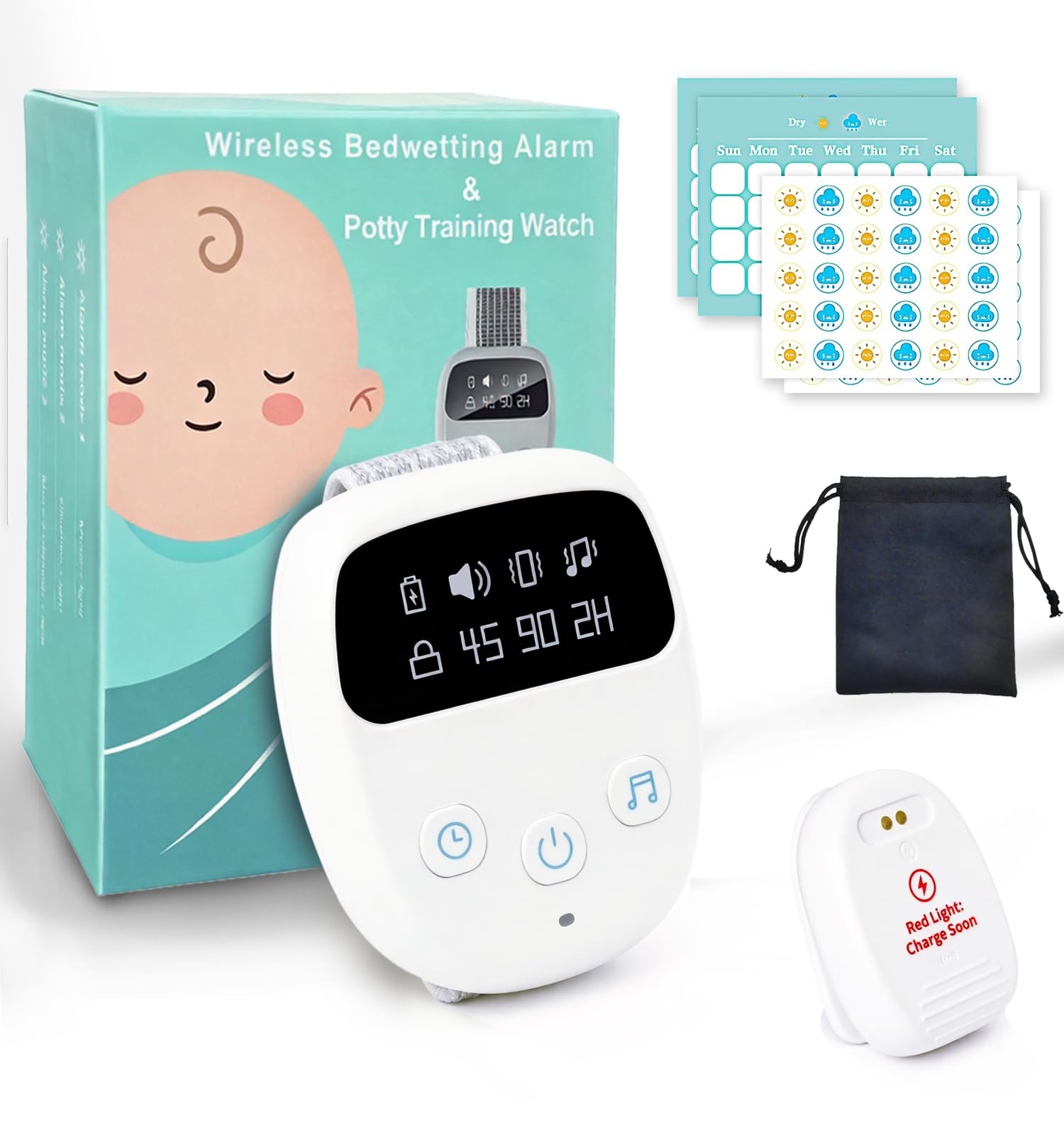
The Vastaint alarm distinguishes itself with a large LCD screen, programmable interval reminders, and a 100-foot wireless range—the longest of any unit reviewed. The interval reminder (settable to 45, 90, or 120 minutes) is a unique feature: it can prompt the child to get up and try to use the bathroom at a predetermined time, reinforcing the waking-and-walking routine even when no accident occurs. The main unit and sensor both recharge via a shared magnetic USB-C cable, and standby battery life is quoted at 20–40 days, which is excellent for this category.
The armband receiver includes large buttons and a clear display, making it easy for both children and elderly users to operate—the manufacturer markets it for senior care as well as childhood bedwetting. Parents of 4-year-olds report the loud alarm wakes children from deep sleep reliably, and the wireless design eliminates the tangle risk of cords. The package includes a storage bag, fun stickers, and record cards to turn the process into a game.
The downsides: the armband is too small to fit around an adult upper arm, and the wristband is a better fit for kids. Several units have developed charging failures after two weeks, with one reviewer reporting the sensor stopped charging and emitted a constant buzzing sound. The sensor’s clip can also slip off active sleepers during the night. While the LCD screen and reminder timer are genuinely innovative, reliability concerns make this more of a gamble than the DryEasy Pro or Wet-Stop3.
Why it’s great
- Programmable interval reminders (45/90/120 min) encourage proactive bathroom trips.
- 100-foot wireless range is the longest in this list for flexible home monitoring.
- Large LCD screen and large buttons are easy to read and operate in the dark.
Good to know
- Several users report charging failures or sensor buzzing after two weeks of use.
- Wristband is too small for an adult upper arm; child wrist fit is fine.
FAQ
How long does it usually take for a bedwetting alarm to work?
What is the difference between a wireless and a wired bedwetting alarm?
My child is a heavy sweater—will a clip-on alarm give false alarms?
Can a bedwetting alarm be used for daytime potty training?
What age is appropriate to start using a bedwetting alarm?
Final Thoughts: The Verdict
For most users, the best bedwetting alarm for kids winner is the DryEasy Pro Wireless because it combines a safe cord-free design with six selectable sounds and six volume levels that can grow with your child’s sleep sensitivity. If you want a pad-based solution that eliminates false alarms from sweat and protects the mattress, grab the Wet Detective Kit. And for a deep sleeper who needs maximum wake-up force, nothing beats the proven track record of the Wet-Stop 3.