
Our readers keep the lights on and the weekend projects moving. As an Amazon Associate, I earn from qualifying purchases.
If your teenager still wets the bed, you know the frustration piles up — more laundry, more embarrassment, more broken sleep. You have likely tried limiting drinks before bed or waking them for a middle-of-the-night bathroom trip, but those fixes don’t teach the brain a new skill. An alarm does: it senses the first drop of moisture and sounds an alert, so over weeks the brain learns to wake up when the bladder is full. This guide picks the five best alarms for a teenager’s unique needs, comparing the loudness, sensor sensitivity, and what real families say about each. The goal is to get you a confident choice and those dry nights as fast as possible.
I’m Rikta — the co-founder and writer behind FitlyFast. This guide is built by comparing the manufacturers’ published specifications and the patterns across verified customer reviews, so you get each pick’s real strengths and trade-offs instead of marketing spin.
A bedwetting alarm (a device that detects a leak and triggers an alert) trains a deep-sleeper’s brain to connect a full bladder with waking up. Whether your teen is a heavy sleeper or has a complex medical need, the right bedwetting alarm for teenagers matches features to their sleep style and sensitivity.
How To Choose The Best Bedwetting Alarm For Teenagers
Choosing an alarm for a teenager is different than buying one for a toddler. Teenagers are often deeper sleepers, more self-conscious, and need a system that feels discreet and mature. Start by focusing on these four key areas.
Wake-Up Power: Sound, Vibration, and Light
The single most important job of an alarm is to wake the sleeper. Look for models that offer at least 8 different tones or a combination of a loud sound, a strong vibration, and a bright flashing light. A teenager’s brain is harder to rouse, so a multi-sensory assault (sound + vibration + light) gives you the best chance of breaking through a deep sleep cycle.
Sensor Sensitivity: The One-Drop Test
You want an alarm that triggers on the very first drop of urine — not after a full wetting event. This trains the brain to connect the sensation of a full bladder to waking up. Look for terms like “instant detection technology” or “one drop detection” in the specs. A sensor that is too slow will cause the alarm to sound when the bed is already soaked, missing the critical learning moment.
Wired vs. Wireless: Comfort and Range
Wired alarms have a cord connecting the sensor (on the underwear) to the alarm unit (on the pajama collar). This can be uncomfortable for active sleepers and poses a slight strangulation risk. Wireless alarms separate the sensor from the receiver, allowing the alarm unit to sit on a nightstand up to 40 feet away — perfect for a parent who wants to hear it in their room. The wireless option is generally preferred for teenagers who move around in bed.
Battery Life and Rechargeability
Teenage training can take weeks or months. An alarm that relies on disposable AAA or AA batteries will cost you over time and leave you scrambling at 2 AM when they die. Models with a USB-C rechargeable battery — especially those that last up to 20 days on a single charge — are much more convenient and eco-friendly. Check how long the battery lasts between charges to avoid mid-training interruptions.
Quick Comparison
On smaller screens, swipe sideways to see the full table.
| Model | Category | Best For | Key Spec | Amazon |
|---|---|---|---|---|
| Eclipse Wireless | Premium Wireless | Deep sleepers & 12+ teens | 40 ft range / 1.45 oz sensor | Amazon |
| Newly Upgraded Wireless | Mid-Range Rechargeable | Value & eco-conscious families | USB-C / 20-day battery | Amazon |
| Wet Detective Kit | Premium Under-Pad | Teens who hate wearing sensors | 2 waterproof pads / 4 alarm modes | Amazon |
| Shield Max | Value Wired | Budget-first & light sleepers | 8 tones + “Fuzzy Logic” AI | Amazon |
| Wet-Stop3 Kit | Budget Wired | Starting out on a tight budget | Included waterproof pad | Amazon |
In‑Depth Reviews
1. Eclipse Wireless Bedwetting Alarm

1.45 ounces (about the weight of a large egg) and a 40-foot wireless range make the Eclipse Wireless the top pick for the deep-sleeping teenager who sleeps through doorbells and alarms. Its wireless sensor is barely noticeable inside underwear, yet the alarm unit can sit up to 40 feet away in your bedroom, so *you* hear it even if your teen doesn’t. One reviewer noted it “cured 12-year-old’s lifelong bedwetting in 3 weeks,” and the loud, specific frequency is designed to rouse even the heaviest sleepers.
Buyers report it worked on a 12-year-old with Aspergers in 8 weeks and on a neurotypical teen in just 10 nights, proving its results for older kids. The plastic-coated sensor means no skin irritation against a teenager’s more sensitive skin, and because it is wireless, there is zero cord-safety concern. At 1.45 ounces, it is also 32% lighter than the Shield Max (4 ounces), which makes a big difference for a teen who tosses and turns.
The catch is the price — it is a premium investment — and one buyer mentioned false alarms from sweat, while another found the small sensor easy to lose. But for a teenager who has struggled for years, the consistent, loud, wireless wake-up signal is often the magic bullet that finally clicks. This alarm has the highest chance of ending the wet nights for good.
Why it’s great
- Wireless range up to 40 feet — parent hears it in their room
- Extremely loud, specific frequency wakes deep sleepers
- Ultra-lightweight plastic sensor (1.45 oz) — no skin irritation
- Proven results: 12-year-old helped in 3 weeks per reviews
Good to know
- Higher price point — premium investment
- False alarms possible from sweat on very warm nights
- Small sensor can be easily misplaced
- Requires lithium batteries (included) — not rechargeable
2. Newly Upgraded Wireless Bedwetting Alarm
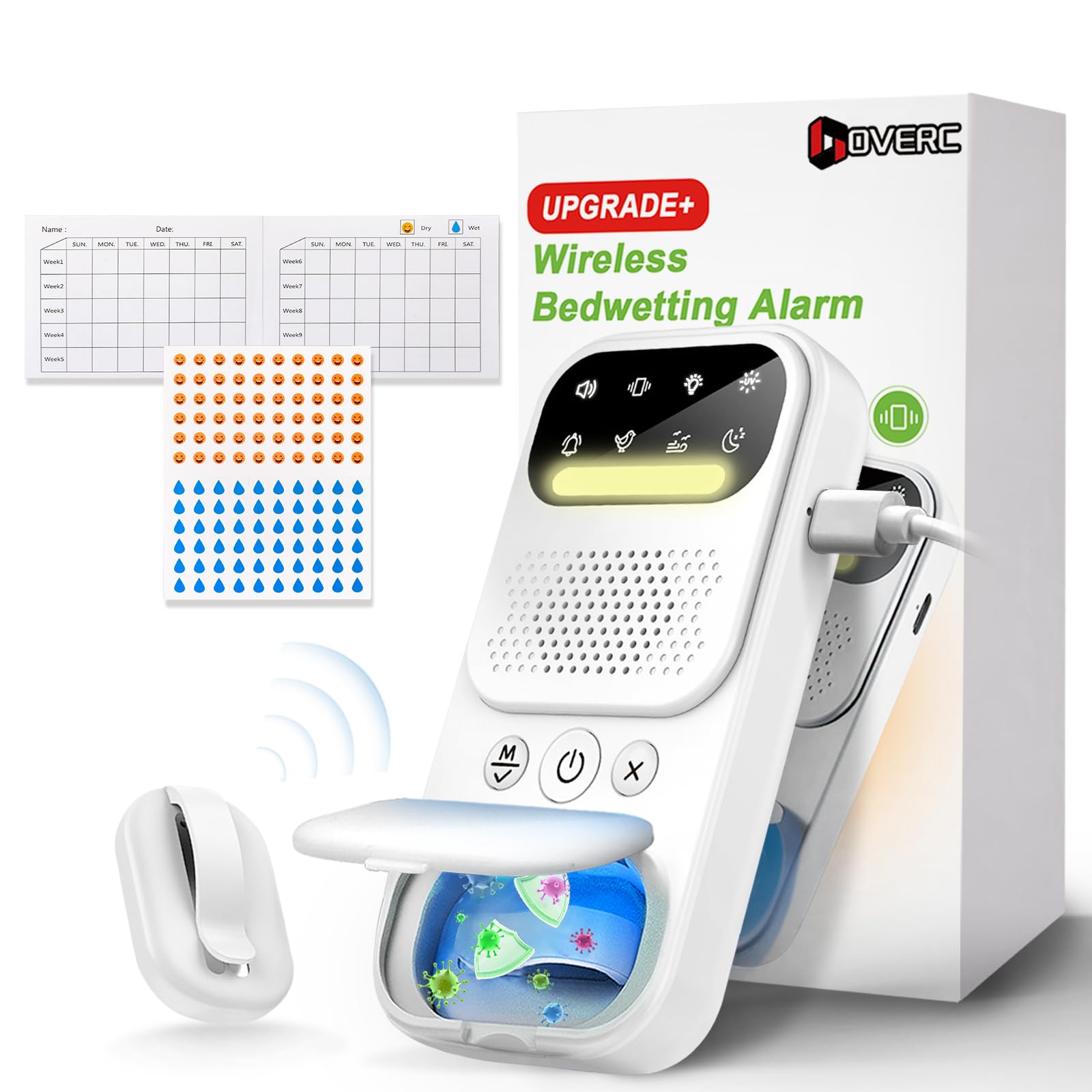
The Eclipse Wireless beats the Newly Upgraded on raw wake-up power (its single frequency has more reviews confirming it works for deep sleepers), but this mid-range option fights back on convenience and cost. Its strongest feature is the USB-C rechargeable battery — one full charge lasts up to 20 days, saving you from buying disposable batteries every few weeks. That is a real perk for a busy family that doesn’t want to scramble for AAs at midnight.
This alarm offers three alert modes — sound only, vibration only, or both — plus a soft night light and a UV sanitizing mode for the sensor. The wireless sensor connects to a separate receiver unit that can sit on the nightstand, so there are no cords tugging on your teen’s pajamas. Owners mention the “high sensitivity sensor” picks up the first drop of moisture instantly, and the multiple alarm tones (9 melodies) prevent your teen from getting used to a single sound.
The standout is the UV sanitizing mode — a unique spec that helps keep the sensor clean and odor-free after weeks of use. If you want wireless convenience, a rechargeable battery that lasts 20 days, and the hygiene bonus of UV cleaning, this is the smartest middle-ground pick. Choose this over the top pick if you prioritize rechargeable savings and UV sanitation over the Eclipse’s deeper-sleeper wake-up power.
Where it shines
- USB-C rechargeable — 20-day battery life saves on disposables
- Wireless sensor is comfortable and secure per customer reviews
- UV sanitizing mode keeps sensor clean and odor-free
- 3 alert modes + night light to suit any sleeper
Worth noting
- Noise level is loud but less penetrating than Eclipse for very deep sleepers
- Sensor may need occasional cleaning to avoid false triggers
- Newer model (2025) — fewer long-term reliability reviews available
3. Wet Detective Bedwetting Kit

Some teenagers absolutely refuse to wear a sensor clipped to their underwear — it feels bulky, babyish, or just uncomfortable. The Wet Detective Kit solves that by ditching the wearable sensor entirely. Instead, it uses a waterproof pad that sits *under* the fitted sheet. When urine hits the pad, the alarm at the bedside sounds. This is a standout for teens with sensory sensitivities, autism, or simple stubbornness about wearing a device.
The kit comes with two waterproof pads (so you have a spare while washing one) and offers four alarm modes: light only, medium alarm, alert beep, and a loud siren, plus a flashing LED light. It is machine washable, though buyers recommend air drying the pad to protect the sensor snaps. One owner reported that “after a rough first week, son had 2 consecutive dry nights,” and another praised the “adjustable volume” and the inclusion of a second pad for quick swaps. At 2.82 pounds, the kit is heavier than wearable alarms (a 2.8x weight gap vs the Wet-Stop3’s 1-pound kit), but that bulk is the pad itself, not something your teen has to wear, making it a non-issue.
The decisive reason to choose this over the others: it is the only option that requires zero attachment to your teen’s body. If your teen hates the feeling of a plastic sensor or moves violently in their sleep, the under-pad approach is a lifesaver. The callout spec is the four distinct alarm volumes — you start with a soft beep to avoid startling a sensitive sleeper and ramp up to the loud siren only if needed.
What stands out
- No wearable sensor — pad sits under the sheet, ideal for sensory-sensitive teens
- Comes with two reusable waterproof pads for easy swapping
- 4 alarm modes + flashing LED for customizable wake-up
- Doctor-developed by a board-certified urologist
The trade-offs
- Pad can false-alarm from sweat if teen sleeps hot (use a flat sheet layer)
- Must be air-dried after washing — machine drying can damage sensor snaps
- Heavier kit (2.82 lbs) due to pads — not portable for travel
4. Shield Max Bedwetting Enuresis Alarm

The single number that matters most in this category is 8 different loud tones — a genuine advantage over cheaper alarms with a single beep — plus a bright light and strong vibration that each attack the sleep cycle from a different angle. For a light to moderate sleeper, this sensory combination is often enough to trigger the wake-up response without spending premium money.
The downside you accept here is wired reliability. The sensor clips to the underwear and connects via a cord to the alarm unit on the pajama collar. Customers note two patterns: some say “daughter (7) stopped bedwetting in 4 weeks” with consistent results, while others complain the “clip broke by day 3” and that false alarms require battery removal and sensor cleaning to reset. At 4 ounces, it is significantly heavier than the wireless Eclipse (1.45 oz), which may be noticeable for a small teen.
The “Fuzzy Logic” AI feature — which adapts to your child’s bladder behavior over time, according to the maker — is a smart spec for the money, but reviews suggest the sensor clip durability is the weak link. If your teen is a calm sleeper and you are comfortable with a corded alarm, the Shield Max offers a price-to-value read that works if you get a good unit.
The upsides
- 8 different loud tones prevent habituation to a single sound
- Bright light + strong vibration for multi-sensory wake-up
- “Fuzzy Logic” AI adapts to bladder patterns over time
- Budget-friendly price for families on a tight budget
Keep in mind
- No on/off switch — requires battery removal to reset
- Sensor clip durability is a common complaint in reviews
- Wired cord can be a tripping/safety hazard for active sleepers
- Heavier wearable unit (4 oz) vs wireless competitors
5. Wet-Stop3 Kit: Bedwetting Enuresis Alarm

At the lowest price point in this lineup, the Wet-Stop3 Kit gives you the absolute essentials: a wired alarm with six different tones plus a vibration setting, a waterproof bed pad that protects the sheets, and a reward chart with star stickers to keep a younger teen motivated. The kit comes with a clip-on sensor that attaches to the underwear, and at just 1 pound total, it is the lightest wired kit here (compared to the Wet Detective’s 2.82 lbs).
What you give up is wireless convenience and premium build quality. The wired cord connects the sensor to a collar-mounted alarm unit, and the only way to turn off the alarm is to remove the battery — which means your teen cannot just hit snooze and ignore it. Reviewers warn the long cord is a “safety hazard for younger kids” and that “active sleepers can unclip it easily.” However, positive reviews also note that “after 8 weeks, 7-year-old accident-free for 5 months” and “3-year-old dry after 2 weeks,” showing the core training mechanism works well.
This is the kit for a family trying bedwetting alarms for the first time without wanting to commit a lot of money. The included waterproof pad is a nice bonus, and the reward chart with star stickers adds a gamification element that can keep a younger teen engaged during the early weeks. It trades the Newly Upgraded’s rechargeable battery for a lower entry price but still delivers the core training mechanism. If your teen is a calm sleeper and you are budget-conscious, this is a solid starting point.
Why we’d pick it
- 6 alarm tones + vibration for varied wake-up stimulus
- Included waterproof bed pad protects sheets from accidents
- Reward chart and star stickers motivate younger teens
- Lightest wired kit at just 1 lb total
A few caveats
- Wired cord poses safety risk for active sleepers
- Alarm cannot be turned off without removing battery
- Some units have false alarm issues (defective sensor)
- No wireless receiver — alarm must be worn on collar
Understanding the Specs
Sensor Type: Wired vs. Wireless vs. Under-Pad
This is the most important decision you will make. Wired sensors (like the Wet-Stop3 and Shield Max) clip to the underwear and connect via a thin cord to the alarm unit worn on the collar. They are cheaper but can be uncomfortable for active sleepers and pose a slight cord-strangulation risk. Wireless sensors (Eclipse, Newly Upgraded) use a small transmitter that clips to the underwear and sends a radio signal to a receiver on the nightstand — no cords, and a range of 40 feet so parents can hear it. Under-pad sensors (Wet Detective) are great for teens who hate wearing anything clipped to their body — a waterproof pad under the fitted sheet triggers the alarm when it gets wet. Each type has a trade-off in comfort vs. cost vs. reliability.
Alarm Modes: Sound, Vibration, and Light
A teenager who is a deep sleeper needs more than a gentle beep. Look for at least multiple distinct alarm tones (8 is ideal) so the brain cannot habituate to a single sound. Vibration is critical — a strong buzz on the collar or receiver can wake a child who sleeps through noise. A bright flashing LED light adds a third sensory channel, useful for teens who are visually responsive. The best alarms offer all three modes individually or together (sound + vibration + light), letting you customize the wake-up assault. The Newly Upgraded model even adds a UV mode to sanitize the sensor — a nice bonus for hygiene.
Weight and Worn Comfort
The alarm unit and sensor are worn on the body (unless you use a pad-based system). Weight matters here because a 4-ounce device clipped to pajamas feels noticeable all night. The lightest wearable options are the Eclipse (1.45 oz) and the Newly Upgraded (3.04 oz). The heavier Shield Max (4 oz) and Wet-Stop3 (1 lb for the full kit, but the worn part is lighter) can feel bulkier, especially for a teenager who is self-conscious or sensitive. A lighter sensor generally means better compliance — your teen is less likely to remove it in their sleep.
Battery Life and Rechargeability
Alarms that use disposable AAA or AA batteries (Wet Detective, Eclipse, Wet-Stop3, Shield Max) require you to keep spares on hand and can fail at the worst moment. A model with a USB-C rechargeable battery, like the Newly Upgraded, offers a major convenience boost — up to 20 days on a single charge, which means you plug it in once every three weeks. No battery hunting at 2 AM. If you are managing a multi-month training period, the rechargeable option is worth the small premium for the sheer elimination of battery anxiety.
FAQ
What if my teenager is a deep sleeper and the alarm doesn’t wake them?
How long does it normally take for a bedwetting alarm to work on a teenager?
Is a wireless alarm worth the extra cost for a teenager?
Can my teenager wear the alarm sensor inside a pull-up or Goodnites at night?
What should I do if the alarm gives false alarms at night?
Final Thoughts: The Verdict
For most families with a teenager, the bedwetting alarm for teenagers winner is the Eclipse Wireless because its 40-foot range, ultra-light 1.45-ounce sensor, and proven track record with 12-year-olds give it the best chance of waking even the deepest sleeper. If you want the convenience of USB-C rechargeability and a UV sanitizing mode at a friendlier price, grab the Newly Upgraded Wireless. And for a teenager who refuses to wear any sensor on their body, the Wet Detective Kit with its under-pad design is the only option that sidesteps that issue entirely while still delivering reliable training.