
Our readers keep the lights on and the weekend projects moving. As an Amazon Associate, I earn from qualifying purchases.
Moving from a smartphone to a dedicated camera is the single biggest leap you can make for video quality, but the wrong first choice can bury you in menus you don’t need or leave you with footage that looks exactly like your phone. The beginner 4K camera market has split cleanly into two camps: pocket-sized vlogging tools that prioritize ease and stabilization, and interchangeable-lens mirrorless bodies that give you room to grow into manual photography. Picking the wrong lane means either hitting a wall when you want to learn aperture control or carrying a bulky kit that never leaves the bag.
I’m Rikta — the co-founder and writer behind FitlyFast. I’ve spent hundreds of hours analyzing the spec sheets and real-world user feedback on every beginner-level 4K camera currently available, comparing sensor size, stabilization type, autofocus speed, and accessory ecosystems to find what actually matters for someone learning the craft. This guide is built on that research, not on brand hype.
Whether you’re filming family trips, starting a YouTube channel, or finally learning photography beyond auto mode, choosing the right beginner 4k camera comes down to sensor performance, stabilization technology, and whether you need the flexibility of interchangeable lenses or the simplicity of an all-in-one design.
How To Choose The Best Beginner 4K Camera
Every beginner 4K camera forces a trade-off between portability, sensor size, lens flexibility, and stabilization. Understanding which trade-off matches your intended use — vlogging, travel photography, or learning interchangeable-lens shooting — is the only way to avoid buyer’s remorse. The three factors below are the non-negotiables.
Sensor Size and Low-Light Performance
The sensor is the heart of any camera. For beginner 4K cameras, the two most common sizes are the 1-inch sensor (found in compact vlogging cameras) and the APS-C sensor (found in entry-level mirrorless bodies). A 1-inch sensor is roughly four times larger than a typical smartphone sensor, giving you noticeably cleaner 4K footage in dim indoor lighting or golden hour shots. An APS-C sensor is roughly three times larger than a 1-inch sensor, offering even better dynamic range and shallower depth of field for that blurred-background look. Your choice determines how much light you need before grain appears.
Stabilization: Gimbal vs. In-Body vs. Digital
Shaky footage is the fastest way to make 4K look amateurish. Three approaches exist: a physical 3-axis gimbal built into the camera (like the Xtra Muse), which mechanically counteracts every hand movement; in-body image stabilization or IBIS (found in the Panasonic G85 and Olympus E-M10 Mark IV), which shifts the sensor to compensate for shake; and purely digital stabilization, which crops the frame and uses software to smooth motion. For walking shots where the camera bounces with every step, a built-in gimbal or robust IBIS is essential — digital stabilization alone will produce a wobbly, zoomed-in result.
Autofocus System and Lens Ecosystem
Beginner-friendly autofocus should be reliable without requiring constant tapping. Phase-detection autofocus (like Canon’s Dual Pixel CMOS AF) locks focus quickly and tracks faces or animals smoothly, while older contrast-detection systems hunt back and forth in low light and slow down 4K video work. Equally important is the lens mount: Canon’s RF mount and Sony’s E-mount have the widest selection of affordable third-party lenses, while Micro Four Thirds offers a compact system with excellent stabilization but a smaller sensor. Your choice here either opens a path to growing your kit or locks you into the lens that came in the box.
Quick Comparison
On smaller screens, swipe sideways to see the full table.
| Model | Category | Best For | Key Spec | Amazon |
|---|---|---|---|---|
| Xtra Muse | Pocket Gimbal | Stabilized vlogging on the move | 1-inch CMOS + 3-axis gimbal | Amazon |
| Canon PowerShot V10 | Compact Vlogging | Ultra-portable point-and-shoot video | 19mm wide-angle fixed lens | Amazon |
| Sony ZV-1F | Creator Vlogging | Content creation with one-button background defocus | 20mm f/2 lens + Eye-AF | Amazon |
| Canon EOS R100 | Mirrorless Entry | Learning photography with interchangeable lenses | 24.1MP APS-C + Dual Pixel AF | Amazon |
| Canon EOS R100 Bundle | Starter Kit | All-in-one beginner kit with bag and card | 24.1MP APS-C + 64GB card | Amazon |
| Panasonic LUMIX G85 | Mid-Range Mirrorless | Weather-sealed hybrid photo/video | 16MP MFT + 5-axis IBIS | Amazon |
| Panasonic LUMIX G100 | Compact Mirrorless | Lightweight camera with advanced audio | 4K 24/30p + 360° tracking mic | Amazon |
| Canon EOS R100 Pro Bundle | Complete Kit | Everything-in-box starter experience | 24.1MP APS-C + accessory kit | Amazon |
| OM SYSTEM E-M10 Mark IV | Stylish Mirrorless | Retro design with serious stabilization | 20MP MFT + 4.5-stop IBIS | Amazon |
| Panasonic LUMIX G100 Dual Lens | Dual Lens Kit | Versatile shooting with zoom range | 12-32mm + 40-150mm lenses | Amazon |
| Sony Alpha 6100 | Performance Mirrorless | Fast autofocus and excellent image quality | 24.2MP APS-C + 0.02s AF | Amazon |
In‑Depth Reviews
1. Xtra Muse

The Xtra Muse delivers the closest experience to a DJI Pocket 3 at a fraction of the cost. Its 1-inch CMOS sensor captures 4K footage at up to 120fps, allowing you to slow down fast action without losing resolution. The built-in 3-axis gimbal physically stabilizes every walking shot — no software cropping, no wobble — making it the single most effective tool for handheld vlogging in this price range.
Face and object tracking work reliably during movement, and the 2-inch touchscreen flips between horizontal and vertical framing with a tap. The X-Log color profile records a 10-bit color space, giving beginners room to color-grade footage in post-production without the heavy banding typical of 8-bit cameras. Battery life sits around 161 minutes of continuous use, and the USB-C PD port lets you charge while shooting.
Recent firmware added compatibility with DJI microphones, which is a welcome bonus for those upgrading audio. The main trade-off is the fixed lens — you cannot swap optics, so you are limited to the built-in wide-angle field of view. For vloggers who prioritize smooth, cinematic movement above all else, this is the most practical entry point available.
Why it’s great
- Mechanical 3-axis gimbal eliminates shake without cropping the frame
- 4K/120fps slow-motion in a pocket-sized body
- 10-bit X-Log color for flexible post-processing
Good to know
- Fixed lens with no zoom range beyond digital crop
- Requires a microSD card with U3 speed class for 4K/120fps
2. Canon PowerShot V10

The PowerShot V10 is Canon’s most compact 4K vlogging camera, designed around a fixed 19mm wide-angle lens and a 15.2-megapixel back-illuminated 1-inch sensor. Its defining feature is the built-in folding stand, which lets you prop the camera on a table or shelf for hands-free recording — a simple but brilliant addition for solo creators who do not want to carry a tripod. The camera fits into a small fanny pack comfortably.
Video quality is clean and sharp in good light, with three image stabilization modes (Off, On, Enhanced) available via a recent firmware update. The built-in stereo microphones include a third center channel to suppress background noise, and audio quality is noticeably better than most cameras in this size class. The retractable front-facing screen makes self-framing natural.
The biggest limitation is the lack of zoom — there is no optical zoom mechanism at all, so framing is entirely dependent on walking closer or farther. Battery life is modest, and some users report the exposure balance struggles in very bright scenes. For casual vloggers who value simplicity and pocketability over lens flexibility, this is a stress-free option.
Why it’s great
- Built-in stand for instant hands-free tabletop recording
- Excellent stereo audio with background noise rejection
- Truly pocketable size with a retractable front screen
Good to know
- No optical zoom — fixed 19mm field of view only
- Battery life is below average for extended day trips
3. Sony ZV-1F

Sony’s ZV-1F is purpose-built for content creators who want a dedicated camera that behaves like an intuitive smartphone upgrade. The 20mm ultra-wide lens and f/2 aperture let in plenty of light for indoor filming, and the one-press background defocus button instantly creates a blurred-background portrait look without manual aperture adjustments — a feature beginners love and experienced shooters appreciate for speed.
The Eye AF and real-time tracking are the fastest in this class, locking onto faces reliably even when the subject turns or moves across the frame. The three-capsule directional microphone with an included windscreen captures clear audio outdoors, and the side-articulating touchscreen makes self-recording straightforward. The Product Showcase mode automatically pulls focus to an object held near the lens, which is ideal for review and unboxing channels.
Battery life is the weakest point — expect roughly 45 minutes of continuous 4K recording. The fixed 20mm lens means no zoom, and the digital stabilization crops the frame noticeably. For creators who prioritize autofocus speed and simple operation over battery endurance, this camera delivers professional results from the first shot.
Why it’s great
- Industry-leading autofocus with Eye AF and object tracking
- One-button background defocus for instant portrait video
- Product Showcase mode for review-style content
Good to know
- Battery lasts under an hour when recording 4K continuously
- Fixed wide-angle lens with no optical zoom
4. Canon EOS R100

The Canon EOS R100 is the lightest and smallest body in the EOS R mirrorless series, making it a natural entry point for anyone who wants an interchangeable-lens camera without the bulk. The 24.1-megapixel APS-C sensor paired with the DIGIC 8 processor delivers sharp stills with natural bokeh, and the RF-S 18-45mm kit lens covers the standard zoom range needed for travel and family photography.
Dual Pixel CMOS AF with 143 zones covers a wide portion of the frame and includes human face and eye detection for both photos and video, keeping subjects sharp during 4K recording — though the 4K mode crops the sensor, narrowing the field of view by roughly 1.6x. Continuous shooting reaches 6.5 frames per second in One-Shot AF, which is adequate for capturing kids or pets in moderate motion.
Video features are basic: 4K caps at 24fps with a crop, and Full HD goes up to 60fps. The lack of in-body image stabilization means you rely on the kit lens’s optical stabilization, which works for gentle handheld use but not walking shots. For beginners focused on learning photography who also want decent 4K video, this is the most affordable path into a full mirrorless ecosystem.
Why it’s great
- Smallest and lightest EOS R body for easy carrying
- Dual Pixel AF with face/eye detection is reliable for beginners
- Access to Canon’s growing RF lens ecosystem
Good to know
- 4K mode crops the sensor, reducing the field of view
- No in-body stabilization — shake is stronger in handheld video
5. Canon EOS R100 Bundle

This bundle takes the Canon EOS R100 body and pairs it with the RF-S 18-45mm kit lens, a shoulder bag, a 64GB SD card, and the necessary charger and battery — everything you need to start shooting immediately. The value proposition is that you spend zero additional time hunting for accessories; the bag protects the body during travel, and the card is already UHS-I rated for 4K video recording.
The image quality mirrors the standalone R100: 24.2-megapixel APS-C sensor, Dual Pixel CMOS AF, and the same DIGIC 8 processor. The RF-S 18-45mm lens includes optical image stabilization that compensates for about four stops of shake, and the electronic ring on the lens lets you adjust aperture or exposure compensation without diving into menus. Beginners report that the camera’s guided interface and Creative Assist modes make the learning curve gentle.
Wireless transfer via Wi-Fi and Bluetooth works seamlessly with the Canon Camera Connect app, so you can share photos to social media quickly. The bundle does not include a spare battery, which is worth noting for long event days. This is the cleanest way to buy a complete starter kit without worrying about compatibility.
Why it’s great
- All accessories included — bag, card, and charger ready out of the box
- Wi-Fi and Bluetooth for instant photo transfer to your phone
- Dual Pixel AF makes focusing simple for absolute beginners
Good to know
- 4K video is cropped and limited to 24fps
- Only one battery included — a spare is recommended for long shoots
6. Panasonic LUMIX G85

The Panasonic LUMIX G85 is the price-to-performance champion of the Micro Four Thirds system. Its 16-megapixel sensor omits the low-pass filter, which increases sharpness by roughly 10 percent compared to earlier MFT sensors. The body is dust- and splash-proof with a magnesium-alloy front plate, making it the most durable option in this roundup for outdoor shooting in less-than-perfect weather.
The class-leading feature is the 5-axis in-body image stabilization that works during both stills and 4K video. When combined with the kit lens’s Optical Image Stabilization, you get a Dual I.S. system that effectively counteracts even significant hand shake. This means you can shoot handheld at slower shutter speeds and walk while filming without the jittery look of purely digital stabilization. The 12-60mm kit zoom covers a versatile 24-120mm equivalent range.
The 4K Photo mode lets you extract 8-megapixel stills from a 4K video burst at 30fps, and Post Focus lets you change the focus point after taking a shot — both are useful learning tools for understanding depth of field. The electronic viewfinder has 2360k dots, providing a clear preview even in bright sunlight. Battery life is below average, and the autofocus can hunt in dim light during video, but the stabilization and build quality are unmatched at this level.
Why it’s great
- 5-axis IBIS provides silky smooth handheld footage for walking shots
- Weather-sealed magnesium-alloy body is built for outdoor use
- Versatile 12-60mm kit lens and growing lens library
Good to know
- Battery life is modest — plan for an extra pack on day trips
- Autofocus can hunt in low-light 4K video scenes
7. Panasonic LUMIX G100

The LUMIX G100 was designed with audio-first thinking: its built-in microphone uses three capsules and tracking software that automatically adjusts pickup direction as you move, keeping your voice clear and reducing ambient noise shifting. For solo creators who do not want to manage a separate lavalier or shotgun mic, this integrated system produces surprisingly clean sound for indoor and outdoor shoots alike.
The 20-megapixel Micro Four Thirds sensor captures 4K video at 24fps and 30fps, and the 5-axis Hybrid Image Stabilization helps smooth out minor hand movement. The body is exceptionally compact — close to the size of the Xtra Muse — but includes an electronic viewfinder for composing shots in bright conditions. The iA (intelligent auto) mode handles exposure decisions well for beginners, and V-Log L recording is available for those who want to color-grade later.
The main limitation is the 4K recording time, which stops at a few minutes before automatically terminating — this makes it awkward for long interviews or event coverage. The kit lens (12-32mm) is good but not optically exciting. For vloggers who care deeply about clean audio without external gear, this is the most thoughtful solution in its tier.
Why it’s great
- Built-in microphone with 360-degree tracking captures clean directional audio
- Very compact body that is easy to hold one-handed
- V-Log L color profile available for post-processing learners
Good to know
- 4K recording time is limited — unsuitable for continuous long sessions
- Kit lens is compact but optically average
8. Canon EOS R100 Pro Bundle
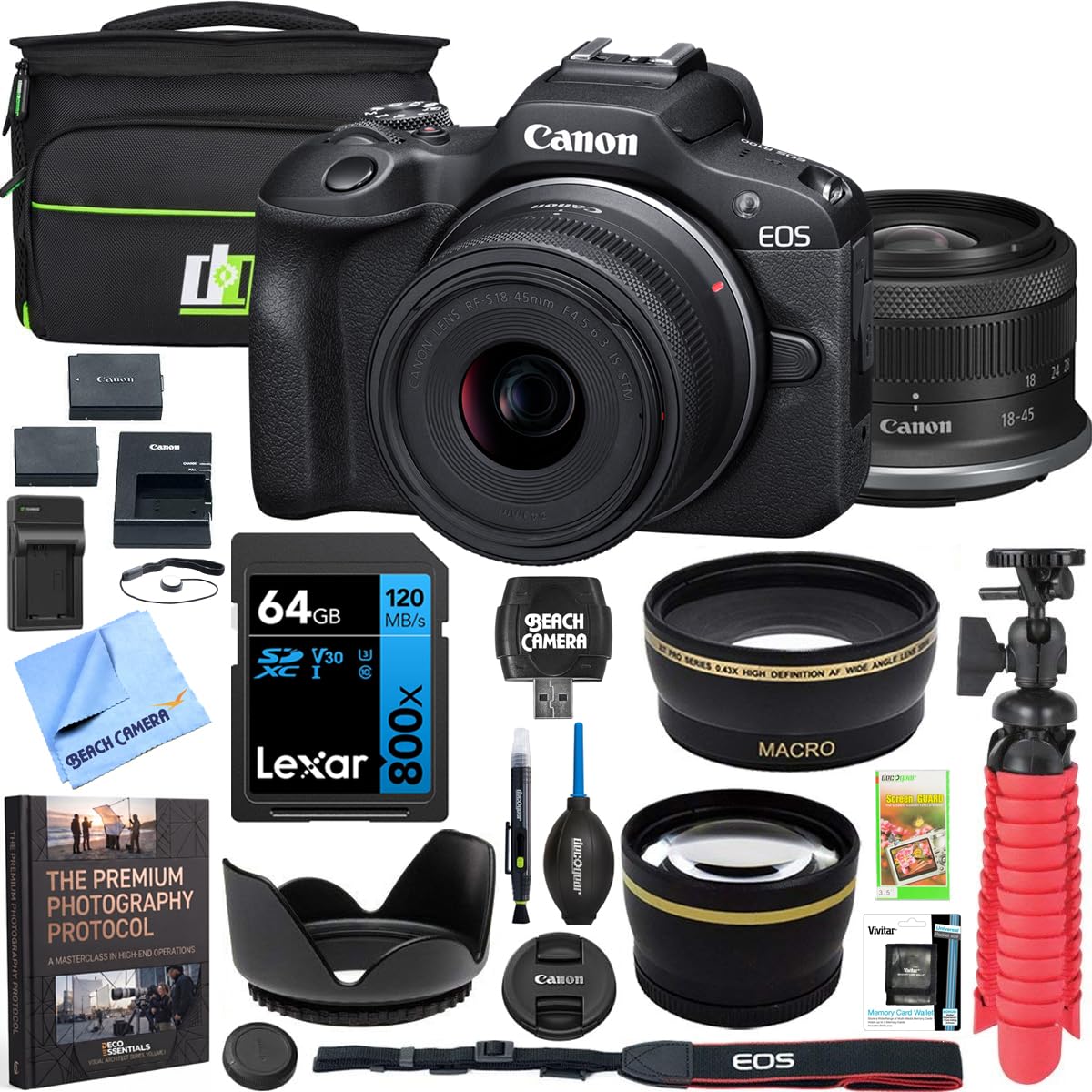
This bundle amplifies the standard EOS R100 kit with the accessories that beginners rarely think to buy separately: a spare compatible LP-E17 battery and charger, a 12-inch vlogging tripod with grip, a 64GB Lexar SDXC card, a card reader, and a lens accessory kit that includes a 0.43x wide-angle adapter and a 2x telephoto adapter. The inclusion of a tulip lens hood and step-up ring adds versatility for outdoor shooting where lens flare is a problem.
The core camera performance is identical to the standalone R100 — 24.1-megapixel APS-C sensor, Dual Pixel CMOS AF with 143 zones, 4K cropped video at 24fps, and Full HD up to 60fps. The spare battery effectively doubles your shooting time, which is critical for day-long events or travel. Users consistently report that the bundle’s bag is durable enough for everyday carry and that the tripod grip provides decent stability for selfie-style recording.
Wireless connectivity via Wi-Fi and Bluetooth lets you transfer images to a smartphone for quick sharing. The only caveat is that the included telephoto and wide-angle adapters attach to the front of the kit lens and will degrade image quality slightly compared to dedicated lenses — fine for experimentation, less so for critical work. This bundle removes the friction of accessory shopping entirely.
Why it’s great
- Spare battery and charger included — doubling your run time
- Vlogging tripod and lens adapters give creative options immediately
- Canon Dual Pixel AF is beginner-friendly and reliable
Good to know
- 4K is cropped and capped at 24fps
- Wide-angle and telephoto adapters soften image edges compared to native lenses
9. OM SYSTEM Olympus E-M10 Mark IV

The E-M10 Mark IV combines a retro aesthetic with modern stabilization technology. Its 20-megapixel Live MOS sensor and TruePic VIII processor deliver clean images, and the 5-axis in-body image stabilization offers up to 4.5 stops of shake compensation — enough to shoot handheld 4K video at slow shutter speeds without noticeable blur. The flip-down monitor activates a dedicated selfie mode automatically, making it one of the most intuitive cameras for front-facing video work.
The camera is remarkably compact for an interchangeable-lens body. The included M.Zuiko 14-42mm EZ pancake lens collapses nearly flush with the body, allowing the whole setup to fit into a jacket pocket. The 121-point contrast-detection autofocus is fast in good light and the 16 Art Filters (including Instant Film) provide creative looks straight out of camera — a fun way for beginners to experiment without diving into editing software.
The biggest limitation for video work is the 4K recording time, which is capped at roughly 29 minutes due to EU tax classification rules, and the built-in Wi-Fi app can be slow for transferring large files. The lack of a USB-C port means charging is via a dedicated external charger. For beginners who value style, compactness, and serious stabilization, this camera offers a unique blend.
Why it’s great
- 4.5-stop in-body stabilization is among the best in its class
- Compact body with pancake lens fits in a jacket pocket
- Dedicated selfie mode and creative Art Filters for instant fun
Good to know
- 4K recording stops at 29 minutes
- No USB-C charging — uses a proprietary external charger
10. Panasonic LUMIX G100 Dual Lens

The dual-lens iteration of the LUMIX G100 pairs the standard 12-32mm pancake zoom with a 40-150mm telephoto zoom, giving you a full-frame equivalent range of 24-300mm. This covers everything from wide-angle landscape shots to compressed portrait length, all within a lightweight kit that weighs less than many single-lens APS-C setups. It is the most versatile lens kit in this guide for the price.
The core camera features are identical to the single-lens G100: 20-megapixel Micro Four Thirds sensor, 4K 24/30p video, 5-axis Hybrid Stabilization, and the tracking microphone system. The dual-lens setup encourages beginners to experiment with focal length — learning how compression at 150mm changes perspective compared to the wide angle at 12mm is a practical photography lesson baked into the hardware.
The same 4K recording time limit applies, and the telephoto lens has a variable aperture (f/4.0-5.6), which means your shutter speed drops in dim conditions. The camera’s contrast-detection autofocus can struggle for continuous tracking of fast-moving subjects. For a beginner who wants to explore different types of photography without immediately investing in multiple expensive primes, this dual-lens package is a smart starting point.
Why it’s great
- Two lenses cover 24-300mm equivalent — wide to telephoto
- Extremely lightweight for a dual-lens mirrorless kit
- Tracking microphone captures clean audio without external gear
Good to know
- 4K recording time limit persists across all G100 variants
- Telephoto lens aperture narrows at longer focal lengths, struggling in low light
11. Sony Alpha 6100

The Sony Alpha 6100 is the fastest autofocus camera in this lineup, with Real-time Eye AF locking onto human and animal eyes in 0.02 seconds. The 24.2-megapixel APS-C Exmor sensor with a front-end LSI delivers excellent dynamic range and low-light performance up to ISO 51,200, making it the best option for shooting in dim environments without resorting to flash. The 4K video captures 2.4x oversampling from the full pixel readout, which produces noticeably sharper footage with less moiré than cropped 4K implementations.
The body includes a 180-degree tiltable 3-inch touchscreen for easy self-framing, and the E PZ 16-50mm power zoom lens is compact enough for everyday carry. Continuous shooting reaches 11fps with full autofocus and auto exposure tracking, which is fast enough to capture action or fast-moving pets without missing a frame. The Sony E-mount ecosystem is the largest of any mirrorless system, with hundreds of affordable third-party lenses available once you outgrow the kit glass.
The menu system on this generation of Sony cameras is notoriously complex — there is a learning curve just to set up basic features like manual video controls or zebra pattern. The 4K video does not offer a 60fps option, capping at 30fps. For beginners who are willing to learn a deep menu system in exchange for the best autofocus and image quality in the class, the Alpha 6100 delivers future-proof performance.
Why it’s great
- Real-time Eye AF — fastest autofocus in the beginner class
- 24.2MP APS-C sensor with excellent low-light performance up to ISO 51200
- Massive Sony E-mount lens ecosystem for future upgrades
Good to know
- Sony menu system is dense and non-intuitive for beginners
- 4K video is limited to 30fps — no 4K/60fps option
FAQ
Is a 4K crop factor important for a beginner to worry about?
Why do some beginner cameras limit 4K recording to 29 minutes?
Should a beginner buy a kit lens or upgrade immediately?
Is 4K at 24fps enough for beginner video, or do I need 60fps?
How important is an external microphone jack for a beginner 4K camera?
Final Thoughts: The Verdict
For most users, the beginner 4k camera winner is the Xtra Muse because its built-in 3-axis gimbal and 1-inch sensor deliver smooth, high-quality footage without any accessory spending, making it the easiest path to great video from day one. If you want interchangeable lenses and superior still-image quality to grow into photography, grab the Panasonic LUMIX G85 — its 5-axis IBIS and weather-sealed body offer premium features at a mid-range cost. And for the fastest autofocus and best low-light performance among interchangeable-lens options, nothing beats the Sony Alpha 6100.