
Our readers keep the lights on and the weekend projects moving. As an Amazon Associate, I earn from qualifying purchases.
Handing a teenager their first interchangeable-lens camera is the moment a casual phone photographer starts thinking about aperture, shutter speed, and composition. The leap from a smartphone to a real camera opens up creative control, but the wrong pick—too complex, too bulky, or too limiting—can kill that spark before it ignites.
I’m Rikta — the founder and writer behind FitlyFast. I’ve spent years analyzing mirrorless and DSLR lineups to pinpoint which models genuinely welcome a new shooter without shortchanging image quality or room to grow.
Whether your teen dreams of vlogging, street photography, or landscapes, the right beginner camera for teenager balances intuitive controls with real photographic potential that won’t feel like a toy by next year.
How To Choose The Best Beginner Camera For Teenager
Teenagers want a camera that keeps up with their lifestyle—light enough to carry to a friend’s house, fast enough to catch a pet mid‑jump, and easy enough to share results instantly. Here are the three specs that separate a keeper from a shelf‑warmer.
Sensor Size and Autofocus Coverage
APS‑C sensors strike the perfect balance for a first camera: they produce noticeably better low‑light shots and background blur than a phone’s tiny sensor, yet keep the body compact and affordable. Full‑frame is overkill for a beginner budget, but a camera with at least 100 autofocus points and human/animal eye detection removes the frustration of missed focus so the teen can concentrate on composition.
Video Capabilities and 4K Limits
Nearly every teen wants to shoot clips for social media. Check whether 4K video is cropped or uncropped, and confirm the frame rate—24 fps is the bare minimum, 30 fps is comfortable, and 60 fps opens slow‑motion edits. A microphone jack matters more than you think; on‑camera audio from budget cameras sounds thin, and teen vloggers quickly outgrow built‑in mics.
System Longevity and Lens Roadmap
The camera body is just the beginning. Look at the mount system: Canon RF and RF‑S, Sony E, Nikon Z, and Micro Four Thirds all have growing lens libraries. A teen who picks a system with affordable prime lenses (a 50mm f/1.8, for example) can evolve their skills without buying a whole new body. Avoid proprietary mounts with only two lens options.
Quick Comparison
On smaller screens, swipe sideways to see the full table.
| Model | Category | Best For | Key Spec | Amazon |
|---|---|---|---|---|
| Canon EOS R100 (Body Only) | Mirrorless | Budget entry into RF mount | 24.1MP APS-C / 143 AF zones | Amazon |
| Canon EOS Rebel T7 (Renewed) | DSLR | Classic learning experience | 24.1MP APS-C / 9-point AF | Amazon |
| Canon EOS 2000D Bundle | DSLR | All‑in‑one starter kit | 24.1MP APS-C / Wi‑Fi & NFC | Amazon |
| Panasonic LUMIX G85 | Mirrorless | Stabilized 4K video | 16MP MFT / 5‑axis IBIS | Amazon |
| Canon EOS R100 Kit | Mirrorless | Best overall for teens | 24.1MP APS-C / 4K video 24fps | Amazon |
| Sony ZV‑E10 Deluxe Bundle | Mirrorless | Vlogging and content creation | 24.2MP APS-C / 425 AF points | Amazon |
| Nikon Z50 II | Mirrorless | Creative color presets | 20.9MP APS-C / 31 Picture Controls | Amazon |
| Canon EOS RP Kit | Mirrorless | Full‑frame learning platform | 26.2MP Full‑Frame / 4K UHD | Amazon |
| Canon EOS R8 Body | Mirrorless | High‑end growth path | 24.2MP Full‑Frame / 4K60p uncropped | Amazon |
In‑Depth Reviews
1. Canon EOS R100 Mirrorless Camera with RF-S18-45mm Lens Kit
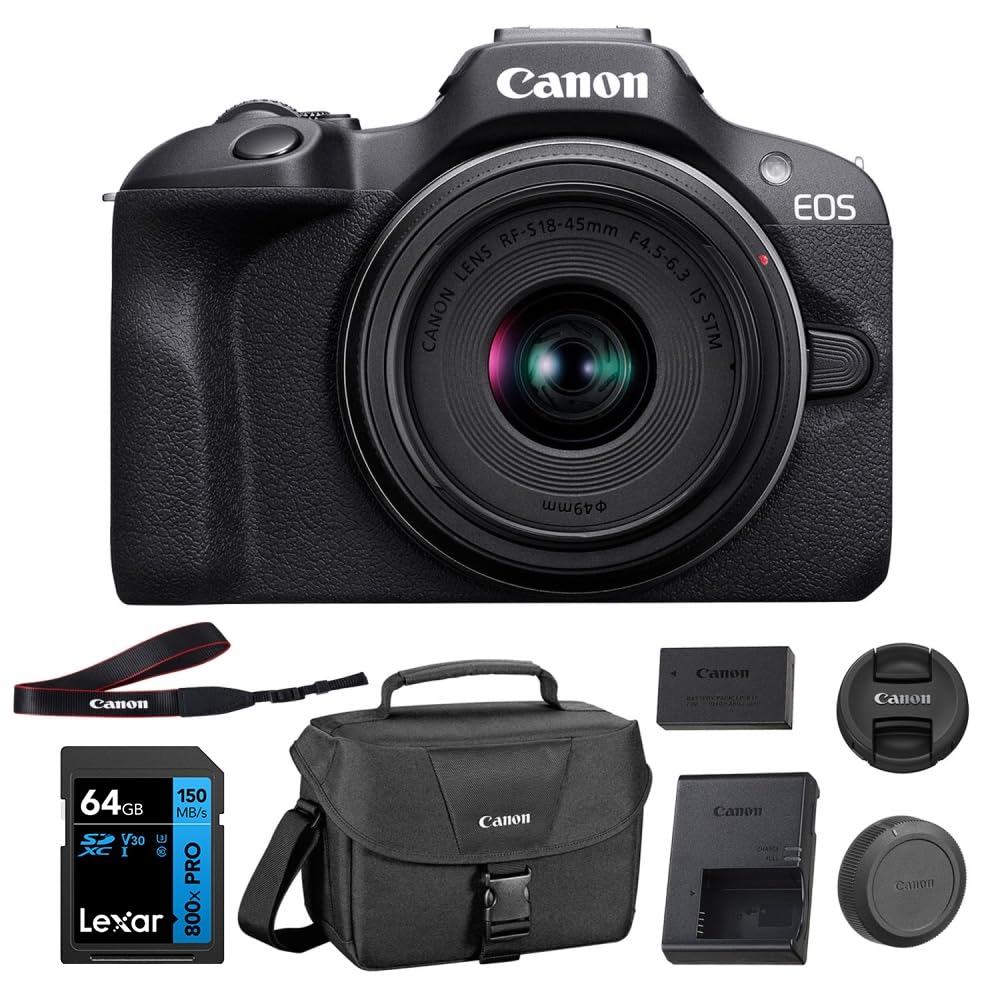
The R100 kit is the goldilocks starter package for a teen. Its 24.1‑megapixel APS‑C sensor and DIGIC 8 processor deliver image quality that visibly outclasses any phone, while the compact RF‑mount body—the lightest in Canon’s R series—fits easily in a small backpack. Dual Pixel CMOS AF with human face and eye detection covers 143 zones, which means the camera handles focus so the shooter can learn framing and light.
4K video at 24 fps is a limitation—if slow‑mo clips or 60p capture are priorities, this isn’t the pick. The included RF‑S 18‑45mm f/4.5‑6.3 IS STM lens is a capable walkaround zoom, but its slow aperture struggles indoors without extra light. The bundle adds a 64GB card and shoulder bag, making it truly ready out of the box. A 6.5‑fps burst rate catches action like a friend’s skateboard trick or a dog catching a frisbee.
Beginners love that Scene Intelligent Auto mode makes the first day frustration‑free, while the ability to switch to Program, Aperture‑Priority, or Manual mode gives a real learning curve. No in‑body stabilization means the kit lens’s optical IS does the work—fine for daytime handheld shots. Wi‑Fi and Bluetooth enable quick transfers to a phone for social posting.
Why it’s great
- Smallest and lightest RF‑mount body makes it easy to carry everywhere
- Human/animal eye AF keeps sharp focus without fiddling
- Kit bundle includes memory card and bag—ready to shoot immediately
Good to know
- 4K capped at 24 fps; no 60p for slow‑motion video
- Kit lens aperture is slow in dim settings without flash
- No in‑body stabilization; relies on lens‑based IS
2. Sony ZV‑E10 Mirrorless Camera Deluxe Bundle

Sony designed the ZV‑E10 specifically for content creators, and the bundle doubles down with a wide‑angle adapter, extra lens, tripod, grip, spare battery, and editing software. The 24.2‑megapixel APS‑C sensor paired with 425‑point phase‑detection AF delivers fast, accurate tracking that locks onto a teen’s face even during movement. The side flip‑out touchscreen lets them frame self‑shots for vlogs without guesswork.
UHD 4K at 30 fps and Full HD at 120 fps for slow‑motion are a step above the Canon R100. The directional three‑capsule mic and included windscreen improve audio quality, though a dedicated microphone is a future upgrade. Background Defocus mode and Face Priority AE automate two things new creators struggle with: separating the subject from the background and keeping skin tones correct in changing light.
The 16‑50mm power zoom lens is compact but optically average—many users swap it for a 50mm f/1.8 prime for better separation and low‑light performance. Battery life is modest, so the spare battery in the bundle is essential. Some buyers report the software is not always included as advertised, so verify the bundle contents on arrival.
Why it’s great
- 425‑point hybrid AF with Real‑Time Eye Tracking is among the best at this level
- Side flip screen and hotshoe make self‑recording and microphone mounting easy
- Deluxe bundle provides tripod, extra battery, and editing software for a complete start
Good to know
- Battery life is short; the spare is needed for a full day out
- Kit lens is dim and soft; plan to add a prime lens soon
- Check bundle contents carefully—some units have missing software
3. Nikon Z50 II Compact Mirrorless

Nikon’s Z50 II is the camera that lets a teen define their visual style before they know what f‑stop means. The dedicated Picture Control button gives instant access to 31 built‑in color presets—from muted flat profiles to vibrant pop looks—and the ability to download custom presets from Nikon Imaging Cloud. This feature alone makes the camera feel less like a learning tool and more like a creative toy.
Subject detection covers people, dogs, cats, birds, and vehicles, with dedicated bird and airplane modes that improve AF accuracy for wildlife and travel. The 20.9‑megapixel DX‑format sensor is slightly lower resolution than the Canon or Sony options, but in practice the difference is negligible for social media use. 4K at 60 fps is a strong video spec, and the built‑in flash handles night portraits better than most competitors at this level.
Nikon’s SnapBridge app transfers images to a phone automatically, which removes the cable‑or‑card‑reader hassle. Battery life is the main trade‑off—expect around 300 shots per charge. The Z mount has a growing library of native lenses, but adapter options for F‑mount glass give affordable upgrade paths. Body‑only kit means you’ll need to budget for a lens separately.
Why it’s great
- 31 built‑in Picture Controls and downloadable presets make styling photos fun and easy
- Bird and airplane detection modes add accuracy for wildlife and travel shots
- 4K 60p video and built‑in flash provide versatility most entry cameras lack
Good to know
- Battery life is short; a spare battery is recommended for longer outings
- Body‑only purchase requires a separate lens investment
- Single SD card slot limits backup options during shoots
4. Panasonic LUMIX G85 with 12-60mm Lens

The G85 is the cheat code for smooth handheld video without a gimbal. Five‑axis in‑body image stabilization works with any lens to cancel out footsteps, shaky hands, and slight pans, making it the best choice for a teen who plans to film more than they photograph. The 16‑megapixel Micro Four Thirds sensor lacks a low‑pass filter, which gives a tangible boost in fine detail—especially noticeable in daylight landscapes.
4K video at 30 fps is paired with Panasonic’s 4K Photo mode, which lets the teen extract 8‑megapixel stills from a video burst—great for capturing a split‑second expression or a pet’s funny moment. Post‑Focus allows reframing the focus point after the shot, which is a brilliant teaching tool for understanding depth of field. The 12‑60mm kit lens covers a useful wide‑to‑short‑tele range and includes Optical Image Stabilization that works in tandem with the IBIS.
Build quality punches above its class with a magnesium alloy front plate and weather sealing—the Z50 II and R100 kits lack this. The 49 autofocus points and eye detection feel dated compared to the 425‑point Sony system, and low‑light AF hunts noticeably in 4K. Wi‑Fi transfer is finicky, and battery life is mediocre. For a teen focused on video, however, the stabilization alone justifies the pick.
Why it’s great
- Five‑axis IBIS produces smooth handheld footage without extra gear
- Weather‑sealed magnesium body can handle real‑world bumps and drizzle
- 4K Photo and Post‑Focus modes teach focus and composition interactively
Good to know
- Autofocus points and eye detection are less advanced than newer Sony/Canon systems
- Low‑light AF performance is sluggish, especially in 4K
- Battery life is average; plan for a spare
5. Canon EOS Rebel T7 DSLR with 18-55mm Lens (Renewed)

The Rebel T7 is the traditional entry‑level DSLR experience. It has the same 24.1‑megapixel APS‑C sensor found in many entry Canons, a 9‑point autofocus system, and an optical viewfinder that teaches the old‑school discipline of composing through the lens. For a teen who wants to understand photography fundamentals—aperture, shutter speed, ISO—the optical viewfinder and physical mode dial are the best teachers.
Wi‑Fi and NFC make it possible to transfer images to a smartphone without a cable, though the Canon Connect app feels slower than Nikon’s SnapBridge or Sony’s Imaging Edge. The 18‑55mm kit lens covers the standard zoom range and has image stabilization, but its f/3.5‑5.6 aperture limits performance indoors. The 9‑point AF system requires active selection of the focus point—there is no automatic eye detection—which demands more attention from the shooter.
Battery life is excellent, lasting a full day of casual shooting on a single charge. At this price point, the renewed models deliver like‑new hardware at a fraction of new cost. The trade‑off is bulk: a DSLR with the kit lens is larger and heavier than any mirrorless option here, and the 3‑inch LCD is fixed rather than articulating. A teen who values battery stamina and optical viewfinder will appreciate this classic form factor.
Why it’s great
- Optical viewfinder and physical dials teach exposure fundamentals directly
- Battery lasts a full day even with Wi‑Fi transfers
- Renewed units offer substantial savings with Canon EF‑S lens compatibility
Good to know
- 9‑point AF system requires manual focus point selection; no eye detection
- Heavier body and lens combo compared to mirrorless alternatives
- Fixed 3‑inch LCD limits creative angles for video and self‑shots
6. Canon EOS 2000D / Rebel T7 Bundle (Renewed)

This bundle takes the same Canon 2000D body used by classrooms and workshops and wraps it with a 32GB card, tripod, case, wide‑angle lens, and telephoto lens. The 24.1‑megapixel APS‑C sensor and 9‑point AF system match the Rebel T7, but the two extra lenses give the teen immediate reach for sports, wildlife, or wide landscapes without a second purchase. The bundle effectively removes the “what else do I need?” question.
Wi‑Fi with NFC lets the teen control the camera remotely from a phone using the Camera Connect app and share images wirelessly. Scene Intelligent Auto mode handles exposure decisions while they learn, and the optical viewfinder delivers a direct, lag‑free view. The included tripod is basic but functional for group shots or long exposures at night.
The caveat: there is no external microphone input, which kills this option for a teen serious about video. The camera body is also the same aging 2000D design—no touchscreen, no articulating screen, and a 3‑fps continuous shooting rate that feels slow. The two accessory lenses are plastic‑mounted and optically mediocre, but they let a beginner explore different focal lengths cheaply before investing in better glass.
Why it’s great
- Bundle includes telephoto and wide‑angle lenses, tripod, and case for a complete start
- Wi‑Fi remote control lets teens experiment with self‑portraits and group shots
- Scene Intelligent Auto mode lowers the learning curve on day one
Good to know
- No microphone input limits video audio quality
- Aging design lacks touchscreen, articulating screen, and fast burst rate
- Included accessory lenses have plastic mounts and average optics
7. Canon EOS RP with RF24-105mm F4-7.1 IS STM Lens

The EOS RP is the most affordable full‑frame mirrorless camera available, and for a teen who shows serious dedication, it skips the APS‑C stepping stone entirely. The 26.2‑megapixel full‑frame sensor delivers visibly shallower depth of field, better high‑ISO performance, and wider dynamic range than any APS‑C camera in this list. The RF 24‑105mm kit lens is optically stabilized and covers a very useful range for daily shooting.
Dual Pixel CMOS AF with face and eye detection is fast and reliable for static and slow‑moving subjects, but the RP’s 5‑fps burst rate and contrast‑detect AF in Servo mode mean it struggles with fast sports or erratic pets. Video is 4K but with a severe 1.6x crop and limited frame rates—the G85 actually outperforms it for video. The vari‑angle touchscreen and compact body make it pleasant for travel vlogging, but the lack of IBIS means stabilization comes only from the lens.
The RP uses the same LP‑E17 battery as the R100, which provides roughly 250 shots per charge—noticeably low for a full‑frame system. Carrying one spare is essential. RF lenses are excellent but expensive, and the mount is compatible with EF/EF‑S lenses via a cheap adapter, opening a massive used lens market. A teen who outgrows this body can step into the R6 or R5 without replacing lenses.
Why it’s great
- Full‑frame sensor delivers professional‑grade image quality and shallow depth of field
- Compact and lightweight body suitable for travel and daily carry
- RF mount with EF adapter access provides a huge lens upgrade path
Good to know
- 4K video has a severe crop; this is primarily a stills camera
- Battery life is low; at least one spare battery is mandatory
- Slow burst rate and limited Servo AF make action photography difficult
8. Canon EOS R8 Mirrorless Camera Body

The EOS R8 packs the R6 Mark II’s sensor and processing into Canon’s lightest full‑frame body. The 24.2‑megapixel sensor with DIGIC X delivers uncropped 4K at 60 fps oversampled from 6K, plus Full HD up to 180 fps for dramatic slow‑motion. Dual Pixel CMOS AF II covers 100% of the frame with 1,053 AF zones and deep‑learning subject detection for people, animals, and vehicles—including aircraft and trains.
For a dedicated teen who has outgrown a Rebel or R100, the R8 provides flagship autofocus in a 461‑gram body. The 40‑fps electronic shutter with full AF tracking is overkill for most beginners but ensures the camera never limits what they can shoot. Canon Log 3 and HDR PQ support give video work serious grading flexibility. The downside is no in‑body stabilization, modest battery life, and a single card slot—compromises that keep the weight and price down.
The R8 is a body‑only kit, so the teen needs an RF lens. Pairing it with the affordable RF 50mm f/1.8 STM creates a lightweight, fast‑aperture combo that rivals systems costing twice as much. This is the pick for a teen who has spent a year shooting on a cheaper body and is ready for a long‑term creative tool.
Why it’s great
- Uncropped 4K 60p video oversampled from 6K delivers excellent quality
- 40‑fps electronic shutter with full AF tracks fast action without limits
- DIGIC X processor and 1,053 AF zones provide near‑flagship autofocus
Good to know
- No in‑body stabilization; relies on lens‑based IS
- Single SD card slot and short battery life require backup planning
- Body‑only purchase means a budget for at least one RF lens
9. Canon EOS R100 Mirrorless Camera Body (Renewed)

The body‑only R100 is the entry point to Canon’s RF mount for the absolute minimum investment. It uses the same 24.1‑megapixel APS‑C sensor and DIGIC 8 processor as the kit version, but buying it without a lens lets the teen or parent choose exactly which lens fits their budget and style—perhaps the RF 50mm f/1.8 for portrait work or an RF‑S 18‑45mm for versatility. The renewed discount makes this the cheapest way into a modern mirrorless system.
Dual Pixel CMOS AF covers 143 zones with human and animal eye detection, and the 6.5‑fps burst rate is competitive at this price. The camera is notably small—the lightest in the R series—so it fits in a jacket pocket with a pancake lens. 4K video at 24 fps is present but basic, and the lack of a microphone input limits vlogging use. Wi‑Fi is included for phone transfers.
Renewed units come with only a body, battery, and charger. The charger issues reported by some buyers (non‑functioning or third‑party batteries) suggest buying a spare official Canon charger early. The RF mount’s native lens library is still growing and leans toward premium pricing, though third‑party options from Viltrox and Samyang are filling gaps. This is a smart pick for a teen who already has a specific lens in mind or who wants to learn on a manual‑focus vintage lens via an adapter.
Why it’s great
- Cheapest entry to the Canon RF mirrorless system with modern AF features
- Body‑only purchase allows custom lens selection from day one
- Extremely compact and lightweight body is easy to carry everywhere
Good to know
- No microphone input limits video audio quality
- Renewed units may ship with aftermarket chargers or batteries
- RF mount native lens options are currently limited and often expensive
FAQ
Is a DSLR or mirrorless better for a teenage beginner?
What lens should I get for a teenager starting out?
How many megapixels does a beginner camera need?
Final Thoughts: The Verdict
For most teens, the beginner camera for teenager winner is the Canon EOS R100 Kit because it combines a compact RF‑mount body, modern Dual Pixel AF with eye detection, and a complete kit bundle so they can shoot immediately without extra purchases. If your teen is vlogger‑focused and wants a side flip screen and better 4K frame rates, the Sony ZV‑E10 Deluxe Bundle is the stronger pick. And for a teen who has already learned the basics and is ready to grow into professional‑grade stills and video, nothing beats the Canon EOS R8 for its uncropped 4K 60p and flagship autofocus in a lightweight body.