
Our readers keep the lights on and the weekend projects moving. As an Amazon Associate, I earn from qualifying purchases.
Sharp, stable footage is the goal, but beginner cameras often deliver soft focus, jittery pans, and autofocus that hunts in the middle of a take. You need a body with reliable subject tracking and either in-body or lens-based stabilization to avoid a gimbal purchase right out of the gate. The right choice saves you hours of unusable clips and keeps your creative momentum intact.
I’m Rikta — the co-founder and writer behind FitlyFast. I’ve spent countless hours analyzing sensor readout speeds, codec depth, and stabilization systems to separate the video-first bodies from stills cameras that merely record video.
This guide cuts through the noise to pinpoint the most capable beginner camera for videography, one that delivers usable 4K with smooth autofocus and practical ergonomics for learning the craft.
How To Choose The Best Beginner Camera For Videography
The wrong camera can bottleneck your growth. Prioritize clean 4K output (oversampled from a wider readout if possible), reliable continuous autofocus with eye detection, and some form of stabilization — either sensor-shift or lens-based. A microphone jack is non-negotiable for any serious video work, and a fully articulating screen saves your neck on low-angle or front-facing shots.
Autofocus: Phase-Detect vs Contrast-Detect
Phase-detect autofocus points (PDAF) deliver the snappy, confident tracking you see in professional footage. Contrast-detect systems hunt back and forth during recording, ruining takes. Look for cameras with on-sensor PDAF — Sony, recent Canon RF bodies, and Panasonic’s DFD system in the G-series all do this well.
Stabilization: IBIS or Bust for Walkaround Shooting
In-body image stabilization (IBIS) moves the sensor to cancel out hand shake, turning handheld walking shots into usable footage. Without IBIS, you will need a gimbal or a lens with optical stabilization (OSS/IS) to avoid micro-jitters. The Panasonic G85 and G100 have excellent IBIS; Sony’s ZV-E10 lacks it, so budget for a stabilized lens or gimbal.
Codec Depth: 8-bit vs 10-bit
8‑bit video records roughly 16.7 million colors; 10‑bit records over a billion, giving you drastically more latitude to adjust exposure and white balance in post without banding. Most beginner cameras cap at 8‑bit, but some Panasonic Micro Four Thirds bodies offer 10‑bit internal recording. If you plan to color grade, prioritize 10‑bit.
Quick Comparison
On smaller screens, swipe sideways to see the full table.
| Model | Category | Best For | Key Spec | Amazon |
|---|---|---|---|---|
| Canon EOS R10 w/ 18-150mm | Mirrorless | All-in-one hybrid | 15 fps mech, 4K 60p | Amazon |
| Sony Alpha a6400 | Mirrorless | Fast AF, compact | 0.02 sec PDAF, 4K 30p | Amazon |
| Sony ZV-E10 (Bundle) | Mirrorless | Vlogging kit | 6K oversampled 4K | Amazon |
| Canon EOS R50 V | Mirrorless | Creator-first design | 4K uncropped, vertical vid | Amazon |
| Sony ZV-E10 (Body+Lens) | Mirrorless | Budget vlogging | 425 PDAF points | Amazon |
| Panasonic LUMIX G85 | Mirrorless | IBIS, weather-sealed | 5-axis Dual IS | Amazon |
| Panasonic LUMIX G100 | Mirrorless | Compact with tracking audio | 360° mic, 4K 24/30p | Amazon |
| Canon EOS M50 (Renewed) | Mirrorless | Entry-level value | 4K 24p, DP CMOS AF | Amazon |
| Canon EOS Rebel T7 | DSLR | Budget stills/video hybrid | Full HD 1080p 30fps | Amazon |
In‑Depth Reviews
1. Canon EOS R10 w/ 18-150mm

The R10 brings Canon’s RF mount to the entry-level tier with a 24.2MP APS-C sensor and DIGIC X engine that push 4K 60p and mechanical burst rates up to 15 fps. The kit 18-150mm lens covers a wide telephoto range, reducing the need to swap glass while you learn focal lengths. Subject detection — people, animals, vehicles — locks on during 4K recording with confidence that outperforms any DSLR in this class.
Dual Pixel CMOS AF II delivers phase-detect coverage across roughly 80 percent of the sensor, so tracking stays sticky even when the subject moves across the frame. The electronic viewfinder is brighter and larger than the R50’s, and UHS-II SD card support speeds up buffer clearing for long video clips. The body includes a hotshoe for external audio, though the kit lens relies on lens-based rather than in-body stabilization.
For the beginner who wants one body to handle both sharp video and fast action stills without compromise, the R10 packs professional AF speed into a compact RF-mount package. The 18-150mm kit lens is versatile but struggles in low light, so an RF 35mm f/1.8 is a logical next step once you outgrow the kit.
Why it’s great
- 4K 60p oversampled from sensor
- Subject-tracking AF works during video
- Bright, high-res EVF and UHS-II slot
Good to know
- No IBIS — relies on lens stabilization
- Kit lens slow in low light
2. Sony Alpha a6400

The a6400 has been a reference point for affordable phase-detect AF since release. The 24.2MP APS-C Exmor sensor with front-end LSI provides 4K oversampled from a 6K readout, delivering crisp detail without aliasing. Real-time Eye AF for humans and animals works in video mode, and the 425-point phase-detection grid covers nearly the entire frame — runners, pets, and sudden head turns stay sharp.
The 180-degree tiltable touchscreen flips up for front-facing recording, and the 16-50mm OSS II kit lens adds optical stabilization that smooths out handheld pans. Battery life is average for mirrorless — expect around an hour of continuous 4K — so carrying a spare is wise. The menu system is Sony’s classic deep menu, which has a learning curve but offers extensive custom button mapping once mastered.
For videographers who prioritize focus reliability above all else, the a6400’s Real-Time tracking is still class-leading. The lack of IBIS means you trade sensor-shift stabilization for that bulletproof AF, but the OSS lens compensates for casual walking shots.
Why it’s great
- Real-Time Eye AF for video
- 4K oversampled from 6K readout
- Compact, robust magnesium build
Good to know
- No IBIS — gimbal recommended for walk-and-talk
- Menu system is dense
3. Sony ZV-E10 (Bundle)
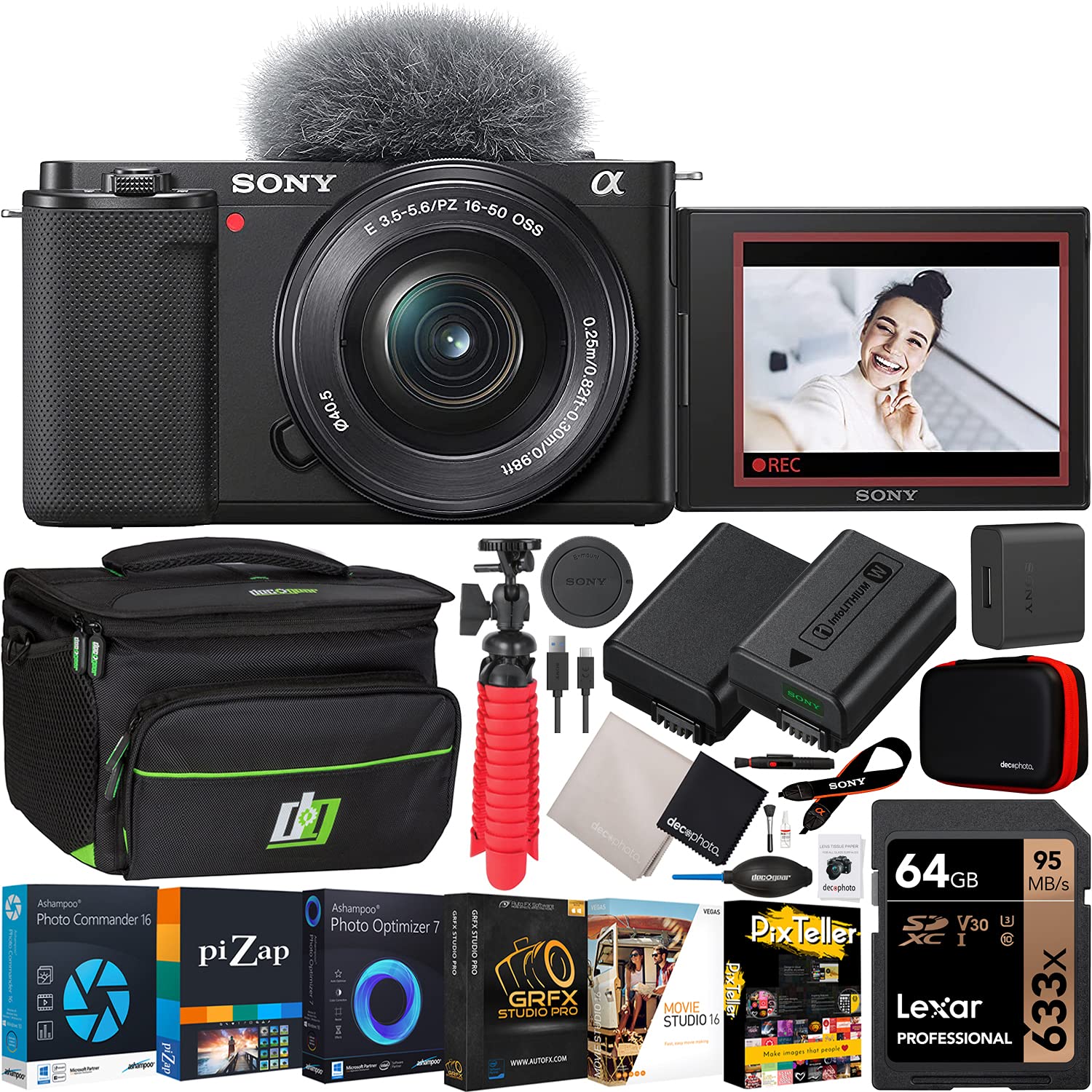
This bundle version of the ZV-E10 includes the 16-50mm OSS lens, a Deco Gear case, extra battery, tripod grip, and editing software — a practical starter kit for vloggers who want to unbox and shoot the same day. The core camera features the same 24.2MP APS-C sensor as the a6400, with 4K oversampled from 6K, but adds vlogging-specific tools: a dedicated Product Showcase mode that racks focus from your face to an object held up to the lens, and a Background Defocus button that instantly opens the aperture.
The 3-capsule directional microphone with included windscreen captures clean on-camera audio for quick content, though an external lavalier through the 3.5mm jack still sounds better. Active Mode stabilization uses electronic cropping to smooth walking shots, but it’s not as effective as true IBIS — you’ll still want a gimbal for smooth follow shots. The vari-angle flip screen faces forward for self-recording and the tally light confirms recording from the front.
If your primary use is talking-head vlogs, reviews, and livestreaming, the ZV-E10 bundle removes friction at every step. The lack of IBIS is the main trade-off, and the 4K 30p crop in some modes limits framing options, but the oversampled 4K quality combined with Real-Time Eye AF makes this the most video-focused APS-C body at this price point.
Why it’s great
- Vlogger-specific features (Product Showcase, Bokeh Switch)
- 64GB card, extra battery, and case included
- Real-Time Eye AF and oversampled 4K
Good to know
- No IBIS — relies on Active Mode or gimbal
- 4K 30p has a 1.23x crop
4. Canon EOS R50 V
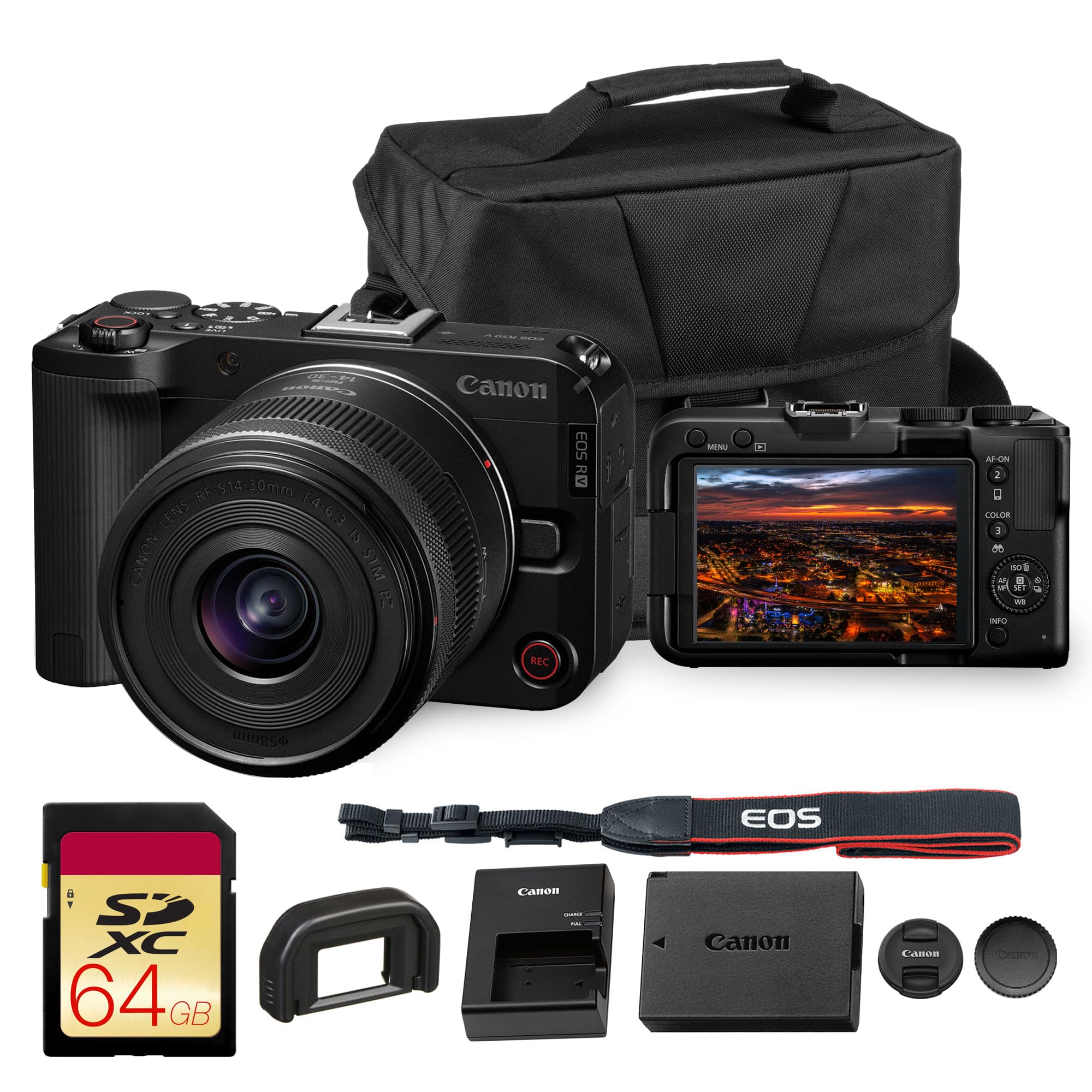
Canon designed the R50 V specifically for social media creators, adding a vertical video mode that rotates metadata so clips appear upright on platforms without manual editing. The 24.2MP APS-C CMOS sensor and DIGIC X processor deliver uncropped 4K at 30p and Full HD 120p for slow motion, all with Dual Pixel CMOS AF II that detects eyes, faces, and animals in real time. The 14-30mm RF-S kit lens provides a wide field of view ideal for handheld vlogging.
The fully articulating flip screen rotates 270 degrees, making overhead or low-angle shots simple. A dedicated livestream mode via USB-C turns the camera into a plug-and-play webcam at 4K resolution without third-party software. The body is compact and lightweight, though the grip is shallow — users with larger hands may find it less secure for long handheld sessions. Canon’s menu system is the most beginner-friendly in the industry, clearly labeled and logically organized.
For a pure content creation tool that requires minimal setup, the R50 V eliminates the friction between capture and upload. The kit lens is adequate for well-lit indoor scenes, but low-light performance will improve with a faster prime lens like the RF 24mm f/1.8.
Why it’s great
- Vertical video and USB-C livestreaming
- User-friendly Canon menu system
- Uncropped 4K and 120p slow motion
Good to know
- Small grip for larger hands
- Kit lens slow in low light
5. Sony ZV-E10 (Body+Lens)
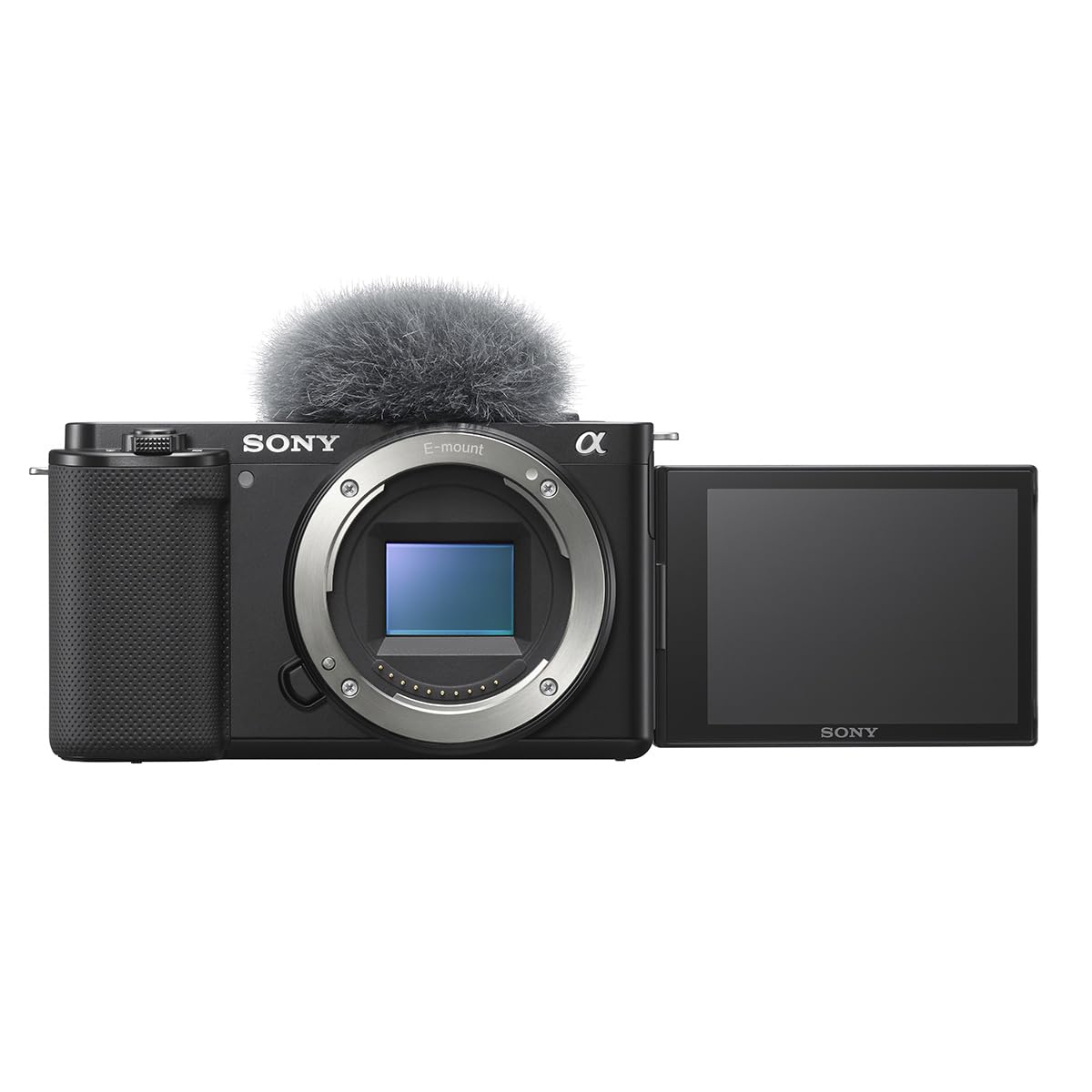
The standard ZV-E10 body-plus-lens kit strips out the accessories and delivers the same core camera: 24.2MP APS-C Exmor CMOS sensor, BIONZ X processor, and 4K oversampled from 6K with full pixel readout. The 16-50mm OSS power zoom lens offers electronic zoom control and optical stabilization, making it a compact walk-around solution for run-and-gun shooting. The 425-point phase-detection grid covers a wide area and Real-Time Eye AF works for both humans and animals in video.
Product Showcase mode is a standout feature for review channels — hold an item to the lens and the camera smoothly racks focus to it, then back to your face when you lower it. The 3-capsule mic with windscreen is better than any built-in mic on competing bodies, though an external lavalier still produces superior sound. The battery is the same NP-FW50 found in other Sony APS-C bodies, delivering about 40 minutes of 4K recording per charge.
For creators on a strict budget who still want Sony’s class-leading AF and oversampled 4K, this non-bundle ZV-E10 is the cleanest path. The lack of IBIS is a gap you’ll need to fill with a gimbal or steady hands, but the image quality and autofocus are difficult to beat at this investment level.
Why it’s great
- Best AF in the price bracket
- Oversampled 4K with excellent sharpness
- Product Showcase and Background Defocus modes
Good to know
- No IBIS — electronic Active Mode has a crop
- Battery life modest for 4K
6. Panasonic LUMIX G85

The G85’s 5-axis in-body stabilization is the standout feature at this price point — it cancels hand shake so effectively that many walking shots are usable without a gimbal. The 16MP Micro Four Thirds sensor lacks a low-pass filter, extracting extra fine detail, and the 12-60mm kit lens includes Power O.I.S. that works in tandem with the IBIS for what Panasonic calls Dual I.S. 2. The magnesium alloy body is weather-sealed, making it the most durable option for shooting outdoors in light rain or dusty environments.
4K video records at 3840 x 2160 up to 30p, and the 4K Photo mode lets you extract 8MP stills from video frames at 30 fps — useful for capturing peak moments. The OLED live viewfinder has 2.36M dots and the 3-inch tilt touch LCD is responsive for touch-to-focus during recording. Autofocus is contrast-detect DFD, which is reliable in good light but hunts more than phase-detect systems in low-light scenarios. There’s a microphone jack but no headphone jack, so audio monitoring requires an external recorder.
If you shoot a lot of handheld video and can’t justify a gimbal, the G85’s IBIS is a genuine superpower. The 16MP sensor is lower resolution than competitors for stills, but the video stabilization more than compensates for run-and-gun shooters.
Why it’s great
- Best IBIS in its price class
- Weather-sealed magnesium body
- No low-pass filter for sharper detail
Good to know
- Contrast-detect AF hunts in low light
- No headphone jack
7. Panasonic LUMIX G100

The G100 packs a built-in 360-degree tracking microphone that automatically adjusts its pickup pattern to follow the subject in the frame — a rare feature that simplifies audio capture for solo creators. The Micro Four Thirds 20.3MP sensor pairs with the 12-32mm collapsible kit lens to create a camera that fits in a jacket pocket. 4K video records at 24p and 30p, and 5-axis Hybrid I.S. (electronic and optical) smooths handheld footage without adding weight.
The iA (Intelligent Auto) mode handles exposure, white balance, and focus automatically, making it the most beginner-friendly option for those who want to focus on framing rather than settings. The Micro Four Thirds system grants access to a huge library of compact lenses from Panasonic, Olympus, and third parties. V-Log L recording is available for users who want to color grade later. The downsides include a limited 4K recording time (around 10 minutes per clip in some modes) and an 8-bit codec that restricts grading flexibility.
For vloggers who prioritize portability and clean on-board audio without external gear, the G100 is uniquely suited. The compact size and smart auto modes let you start shooting immediately while the lens ecosystem provides a clear upgrade path.
Why it’s great
- Tracking microphone captures usable audio
- Ultra-compact with collapsible kit lens
- V-Log L and Micro Four Thirds lens selection
Good to know
- 4K recording limited to short clips
- 8-bit codec limits color grading
8. Canon EOS M50 (Renewed)

The renewed M50 delivers Canon’s Dual Pixel CMOS AF at a budget-friendly entry point, with 24.1MP APS-C sensor and 4K UHD at 24p. The 15-45mm kit lens is compact, and the EF-M mount can be adapted to Canon’s extensive EF/EF-S lens lineup, giving you access to affordable glass. HD 120p slow motion adds creative flexibility for social media clips. The OLED EVF with touch-and-drag AF allows you to set focus points by dragging on the screen while looking through the viewfinder.
4K video crops to about 1.6x the sensor, making wide-angle shooting difficult without a wide lens. Contrast detection drives the AF in 4K mode rather than the full Dual Pixel system, so tracking is less reliable than in 1080p mode. The body is lightweight and the touchscreen is responsive, though battery life is modest at roughly 30 minutes of continuous 4K recording. The renewed condition means the unit is tested and often indistinguishable from new.
For absolute beginners who want Canon color science and Dual Pixel AF in 1080p without a premium investment, the renewed M50 is a compelling starting point. The 4K crop and contrast-detection limitations mean you’ll eventually outgrow it, but the learning curve is gentle and the EF-M adapter system keeps future lens costs low.
Why it’s great
- Dual Pixel AF works great in 1080p
- Touch-and-drag AF via EVF
- Canon color science straight out of camera
Good to know
- 4K has 1.6x crop, AF drops to contrast-detect
- Battery life short for 4K
9. Canon EOS Rebel T7

The Rebel T7 is the entry-level DSLR option, built around a 24.1MP APS-C CMOS sensor and Canon’s optical viewfinder system. It records Full HD 1080p at 30fps — no 4K — and uses a 9-point phase-detect AF system through the viewfinder, or Live View contrast-detect when using the rear screen. The 18-55mm EF-S kit lens provides a standard zoom range ideal for learning framing fundamentals.
Built-in Wi-Fi and NFC transfer images to your phone for quick social sharing, and the EF-S lens mount opens the entire Canon EF/EF-S ecosystem, which means affordable used lenses are everywhere. The ISO range of 100-6400 (expandable to 12800) limits low-light video performance; expect noticeable noise above 1600. The optical viewfinder uses a 95% coverage pentamirror, meaning the final shot includes slightly more than what you see in the finder.
If your focus is primarily stills with occasional home video, the T7 is a functional tool that teaches basic exposure and composition. For videography, the lack of 4K, contrast-detect AF in Live View, and no microphone jack make it the least video-capable option here. It serves best as a pure learning camera before stepping into a mirrorless body.
Why it’s great
- Optical viewfinder for learning exposure
- Massive EF/EF-S lens ecosystem
- Wi-Fi sharing built in
Good to know
- No 4K video — 1080p only
- No microphone jack
- Live View AF is slow contrast-detect
FAQ
Do I need a gimbal for a beginner videography camera?
Why is 4K crop important when choosing a camera?
Final Thoughts: The Verdict
For most users, the beginner camera for videography winner is the Canon EOS R10 because it pairs Canon’s excellent Dual Pixel AF with 4K 60p and a fast 15 fps burst rate in a compact RF-mount body. If you want the best in-body stabilization for handheld shooting, grab the Panasonic LUMIX G85. And for the best autofocus system at the lowest cost, nothing beats the Sony ZV-E10.