
Our readers keep the lights on and the weekend projects moving. As an Amazon Associate, I earn from qualifying purchases.
Walking into the camera aisle for the first time is confusing. Mirrorless, DSLR, megapixels, crop sensors, aperture rings—every term feels like an exam you didn’t study for. But your first camera doesn’t need to be expensive or packed with features you’ll never touch. It needs to get out of your way and let you learn the craft of taking a great photo.
I’m Rikta — the co-founder and writer behind FitlyFast. After hundreds of hours analyzing sensor specs, autofocus point counts, kit lens performance, and real-world user feedback across every major brand, I’ve narrowed down what actually matters for someone picking up a camera for the first time.
This guide is built around the real priorities of a new photographer—ease of use, image quality out of the box, and room to grow—without drowning you in jargon. Whether you’re shooting family portraits or weekend landscapes, these are the top contenders for the best beginner camera today.
How To Choose The Best Beginner Camera
The biggest mistake new buyers make is chasing high megapixel numbers or the lowest price tag. Neither guarantees a good photo. What matters is how the camera handles light, how fast it focuses, and whether the interface encourages you to experiment rather than hide in Auto mode forever. Start with these three filters.
Sensor Size: APS-C vs Micro Four Thirds vs Full-Frame
Sensor size determines how much light the camera captures. Larger sensors produce cleaner images in low light and give you more control over background blur. For a first camera, APS-C (found in most Canon, Nikon, and Sony beginner models) offers the best balance of image quality and cost. Micro Four Thirds (Panasonic, OM SYSTEM) is smaller and lighter but slightly noisier in dim conditions. Full-frame (Canon RP, Sony a7 III) is the gold standard but comes with a premium price and heavier lenses—worth it if you’re serious from day one.
Kit Lens: The Lens Stays on 90% of the Time
When you buy a kit, the lens bundled with the body is what you’ll shoot with most. A standard 18-55mm or similar zoom gives you wide-angle to portrait-length coverage. Some kits double up with a telephoto lens, extending your reach for sports or wildlife. Pay attention to the maximum aperture—f/3.5-5.6 is typical, but a lens with f/2.8 or wider lets in more light for better low-light shots. A sharp, stabilized kit lens will teach you more than a bare body with an expensive prime you’re not ready for.
Autofocus and Ease of Use
New photographers benefit from reliable autofocus that locks onto faces and eyes automatically. Look for phase-detection autofocus (PDAF) with at least 100 points coverage—this makes a huge difference for portraits and action shots. Avoid cameras with slow contrast-detection only, as they hunt and miss focus in anything but still scenes. Also check the menu layout: a camera with guided menus, scene modes, and a dedicated auto setting lets you learn without frustration.
Quick Comparison
On smaller screens, swipe sideways to see the full table.
| Model | Category | Best For | Key Spec | Amazon |
|---|---|---|---|---|
| Canon EOS RP + 24-105mm | Full-Frame | Best overall value full-frame | 26.2MP full-frame CMOS | Amazon |
| FUJIFILM X-T30 III | Mirrorless | Film simulations and style | 26.1MP X-Trans CMOS 4 | Amazon |
| Sony a7 III + 28-70mm | Full-Frame | Top-tier autofocus and battery life | 24.2MP BSI full-frame | Amazon |
| OM SYSTEM OM-5 II | Mirrorless | Weather-sealed adventure camera | 20.4MP Micro Four Thirds | Amazon |
| Canon EOS R100 (Two-Lens) | Mirrorless | Best two-lens mirrorless kit | 24.1MP APS-C CMOS | Amazon |
| Panasonic LUMIX G85 | Mirrorless | Best video-friendly hybrid | 16MP Micro Four Thirds | Amazon |
| Canon EOS R100 (Single Lens) | Mirrorless | Lightweight and easy mirrorless | 24.1MP APS-C CMOS | Amazon |
| Sony Alpha a3000 | Mirrorless | Budget-friendly APS-C mirrorless | 20.1MP APS-C Exmor CMOS | Amazon |
| Nikon D3200 (Renewed) | DSLR | Best entry-level DSLR value | 24.2MP DX-format CMOS | Amazon |
| Canon EOS Rebel T7 (Two-Lens) | DSLR | Complete two-lens DSLR bundle | 24.1MP APS-C CMOS | Amazon |
| Canon EOS Rebel T7 (Pro Bundle) | DSLR | All-in-one accessory-packed kit | 24.1MP APS-C CMOS | Amazon |
In‑Depth Reviews
1. Canon EOS RP + 24-105mm f/4-7.1 STM Lens Kit

The Canon EOS RP gets you into a full-frame sensor without requiring a second mortgage. Packing a 26.2-megapixel CMOS sensor and DIGIC 8 processor, it delivers the depth, low-light performance, and background separation that APS-C cameras struggle to match. The kit’s RF 24-105mm f/4-7.1 IS STM lens covers everything from wide landscapes to portrait-length reach, with optical stabilization rated up to five stops—handy for handheld shooting in dim interiors.
What makes this a true beginner’s full-frame is the interface. The menu system borrows from Canon’s DSLR lineage, offering guided mode, scene intelligent auto, and creative filters that let you experiment without fear. The 4K video is cropped and lacks dual-pixel AF, but at 1080p you get excellent face-tracking autofocus and clean footage. The flip-out touchscreen tilts for overhead or low-angle shots, and the electronic viewfinder (EVF) is sharp enough to judge exposure in real time.
Battery life runs about three hours of mixed use, and the body weighs only 1.1 pounds—light enough for daily carry. The kit lens is decent at center sharpness but soft at the edges wide open; stopping down to f/8 cleans it up considerably. For a beginner who wants room to grow into professional-grade glass without replacing the body, this is the smartest start money can buy.
Why it’s great
- Full-frame sensor offers best-in-class low-light performance for beginners
- Lightweight build with intuitive Canon menu system
- Versatile 24-105mm kit lens with effective stabilization
Good to know
- 4K video is cropped and lacks dual-pixel AF
- Kit lens edges are soft at maximum aperture
- Single UHS-II SD card slot limits backup options
2. FUJIFILM X-T30 III Mirrorless Camera Body (Silver)
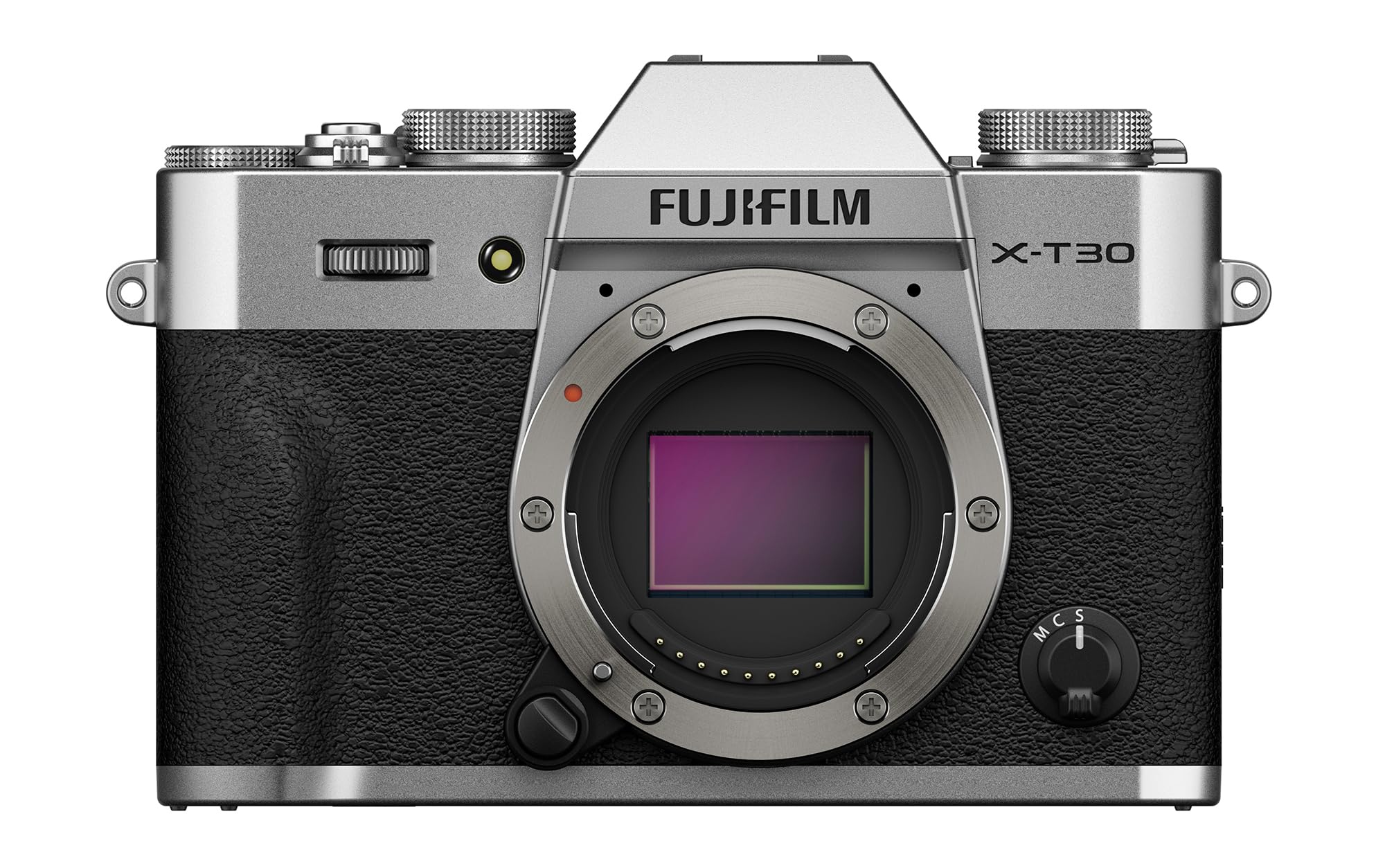
Fujifilm’s 20 built-in Film Simulations, including classic PROVIA and nostalgic Velvia, produce JPEGs straight out of camera that look like they were graded in a darkroom. You don’t need to learn RAW editing to get beautiful, moody shots. The 26.1MP X-Trans CMOS 4 sensor with no optical low-pass filter resolves fine detail that makes foliage and fabric textures pop.
Autofocus received a huge upgrade here: AI-powered subject detection locks onto faces, eyes, animals, and even cars or birds. With 179 phase-detection points covering almost the entire frame, you can trust it for fast-moving kids or dogs. The compact body with retro dials encourages you to adjust shutter speed and ISO physically, which is the best way to learn exposure. The bundled XC13-33mm F3.5-6.3 kit lens is optically stabilized and covers wide to portrait territory.
The lack of in-body image stabilization means you rely on lens stabilization for video, and the 4K / 30p footage is good but not class-leading. Battery life runs around 380 shots per charge—carry a spare. The silver design looks timeless and draws compliments, but the control dials take a day or two to memorize. For someone who values photography as an experience rather than just a technical exercise, this is the most rewarding start.
Why it’s great
- Film Simulations produce stunning JPEGs with zero editing
- AI-powered autofocus with wide subject detection
- Compact, stylish body encourages manual learning
Good to know
- No in-body stabilization—requires stabilized lenses for video
- Moderate battery life; recommend a spare
- Control dial layout has a learning curve
3. Sony a7 III Full-Frame with 28-70mm f/3.5-5.6 Lens

The Sony a7 III set a new bar when it launched, and it’s still the benchmark for entry-level full-frame. Its 24.2MP back-illuminated sensor delivers 15 stops of dynamic range and extraordinary low-light performance up to ISO 51,200. The 693-point phase-detection autofocus system covers 93% of the frame, meaning you can track a runner’s eye moving across the composition and stay sharp.
The mechanical shutter fires at 10 fps with continuous autofocus, which is fast enough for sports and action. The 28-70mm f/3.5-5.6 kit lens is optically decent but not the star here—the magic is in the body’s processing. 4K video from the full width of the sensor with full pixel readout and no crop is stunning, and the 5-axis in-body stabilization cleans up handheld footage nicely. Battery life is class-leading at roughly 710 shots per charge; you can shoot a full day without a spare.
The menu system is dense—Sony’s labyrinthine layout is the camera’s weakest aspect for a beginner. Initial setup requires patience, but once configured, the physical controls (dual dials, customizable buttons) make shooting fast. No in-body flash, and the included hotshoe flash must be purchased separately. For a beginner who plans to grow into professional work quickly, the a7 III is the camera that won’t hold you back for years.
Why it’s great
- Exceptional autofocus with 693 points and 93% coverage
- Professional-grade low-light and dynamic range
- Incredible battery life for all-day shooting
Good to know
- Complex menu system is steep for absolute beginners
- Kit lens is mediocre; budget for an upgrade later
- No built-in flash; no included external flash
4. OM SYSTEM OM-5 II with 12-45mm f/4.0 PRO Lens Kit
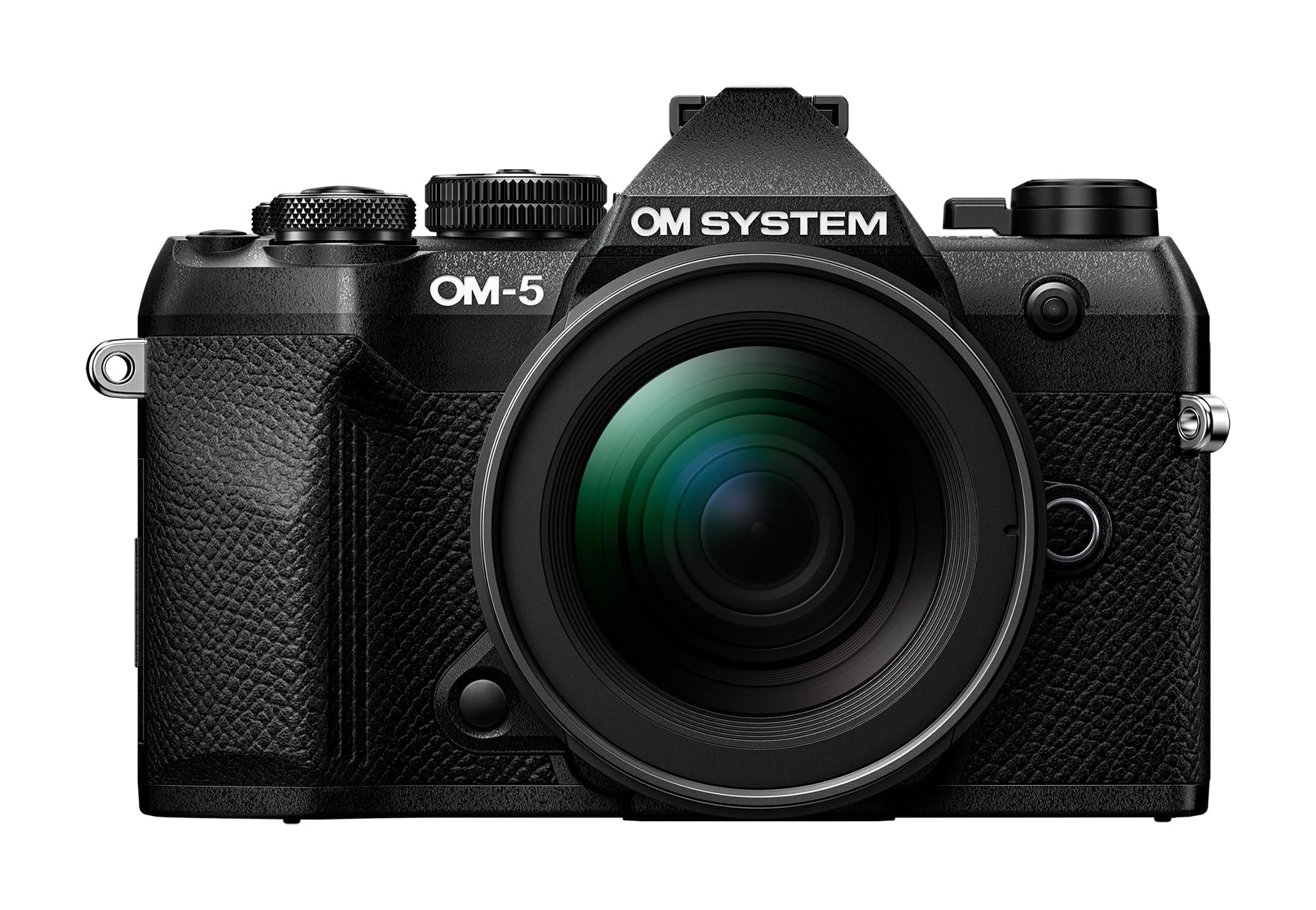
The OM-5 II is built for the outdoors. Its weather-sealed magnesium alloy body handles rain, dust, and freezing temperatures without flinching, and the kit’s 12-45mm f/4.0 PRO lens is equally sealed. The 20.4MP Micro Four Thirds sensor packs a computational photography button that unlocks high-res shot modes, focus stacking, and a live ND filter that simulates long exposures without a tripod.
The 5-axis in-body stabilization is extraordinary, rated at up to 7.5 stops. You can handhold at 1/2 second shutter speed and still get sharp images—game-changing for low-light travel photography without a tripod. Autofocus uses a 121-point hybrid system that tracks faces and eyes reliably. The body is light enough to forget you’re carrying it, and the kit lens covers 24-90mm equivalent with constant f/4.0 aperture, which is sharp across the frame.
Unlimited 4K video recording with stabilized footage means you can vlog or document trips without gimbals. The small battery is the main trade-off—expect about 310 shots, so pack spares for full-day outings. The grip is also small for larger hands. For the beginner whose primary camera will live in a backpack on trails, this is the most durable and capable compact system available.
Why it’s great
- Best-in-class 7.5-stop in-body stabilization
- Fully weather-sealed for outdoor adventures
- Computational photography modes expand creative options
Good to know
- Small battery requires spares for full-day shooting
- Grip is compact; may feel cramped for large hands
- Micro Four Thirds sensor has more noise at high ISO than APS-C
5. Canon EOS R100 Two-Lens Bundle (18-45mm + 55-210mm)
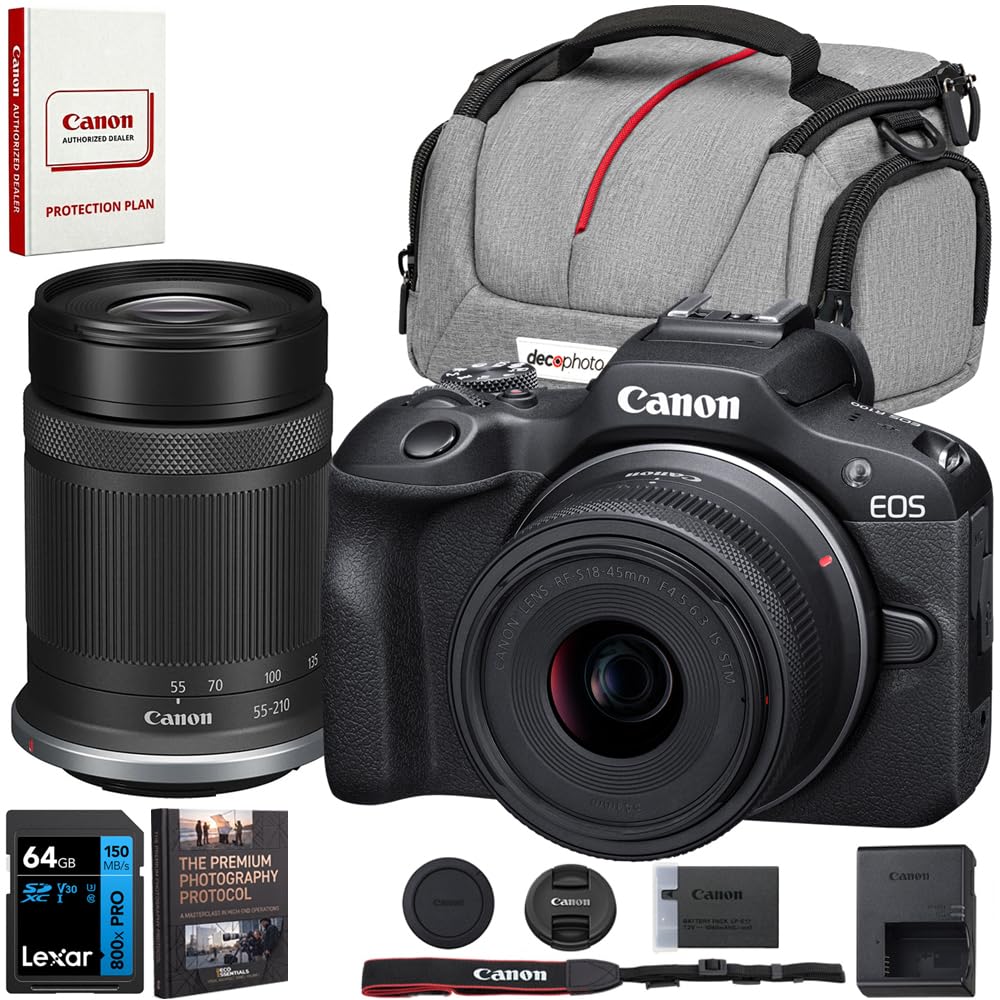
This bundle gives you two lenses right out of the box: the RF-S 18-45mm f/4.5-6.3 IS STM for everyday walk-around shots, and the RF-S 55-210mm f/5-7.1 IS STM for telephoto reach that brings distant subjects close. That pair alone covers 29mm to 336mm equivalent, handling landscapes, portraits, and sports. The R100 body itself uses the same 24.1MP APS-C sensor and DIGIC 8 processor found in more expensive Canon models.
The Dual Pixel CMOS AF with 143 autofocus points locks onto human faces and eyes instantly, making portrait shots easy. The body is the smallest and lightest in the EOS R series, weighing about 12.7 ounces, which is ideal for the beginner who wants something they can toss in any bag. 4K video is cropped (1.6x) and limited to 24 fps, but full HD at 60 fps is usable for family clips and social content.
The bundle also includes a 64GB Lexar memory card and a padded camera bag, so you’re ready to shoot immediately. The 18-45mm kit lens lacks stabilization, relying on the body’s digital IS, but the telephoto lens includes optical stabilization. No built-in flash and no EVF—the LCD only composition will frustrate some in bright sunlight. For the price-to-features ratio, this is the most complete beginner mirrorless package available.
Why it’s great
- Two-lens kit covers wide to telephoto range
- Lightest EOS R body for easy carry
- Reliable Dual Pixel AF with face and eye detection
Good to know
- 4K video is cropped and limited to 24 fps
- No electronic viewfinder—LCD only
- 18-45mm lens lacks optical stabilization
6. Panasonic LUMIX G85 4K with 12-60mm Power O.I.S. Lens

The G85 is a video-oriented hybrid that punches above its class. The 16MP Micro Four Thirds sensor omits the low-pass filter, producing sharper-than-expected stills. But the headline feature is the 5-axis in-body stabilization that works in tandem with the 12-60mm Power O.I.S. lens—together they deliver footage smooth enough that you can often skip a gimbal for casual vlogging. The kit lens itself offers a useful 24-120mm equivalent range.
4K video recording at 30 fps is uncropped, and the camera includes Lumix 4K Photo mode that extracts 8-megapixel stills from video at 30 fps. The 49-point contrast-detect autofocus is snappy in good light and for stills, but slows down in low light for 4K video. The weather-sealed magnesium alloy build with an articulating touchscreen makes it confidence-inspiring outdoors. The electronic viewfinder is crisp at 2360K dots.
Battery life is middling at about 320 shots, and there’s no headphone jack for audio monitoring. The Micro Four Thirds sensor shows more noise at ISO 3200 compared to APS-C rivals. However, the G85’s dual stabilization, 4K features, and price point make it the best entry-level mirrorless for someone who plans to shoot as much video as photos. It’s a capable travel companion that won’t limit your creative range.
Why it’s great
- Industry-leading dual stabilization (IBIS + lens OIS)
- Uncropped 4K video with 4K Photo mode
- Weather-sealed build with articulating touchscreen
Good to know
- Low-light autofocus is slower than phase-detect systems
- No headphone jack for audio monitoring
- Battery life is underwhelming
7. Canon EOS R100 Mirrorless with RF-S 18-45mm Lens

The EOS R100 stripped down to a single lens kit is the most affordable path into Canon’s RF mirrorless system. The body is the exact same 24.1MP APS-C unit with DIGIC 8 and Dual Pixel CMOS AF found in the two-lens bundle—no compromises on the sensor or autofocus performance. At just over half a pound, it’s genuinely pocketable in a camera bag and comfortable for all-day shooting.
The 18-45mm f/4.5-6.3 kit lens extends to 18mm for wide selfies and group shots, and the 143 autofocus points with eye detection make portraits nearly foolproof. Wireless connectivity via Wi-Fi and Bluetooth transfers photos directly to your phone for sharing. The shutter is rated up to 1/4000 second, and continuous shooting at 6.5 fps in One-Shot AF is snappy enough for casual action.
4K video is cropped and limited to 24 fps, which is a notable limitation for videographers. The lack of an electronic viewfinder means you rely entirely on the 3-inch LCD, which washes out in bright sunlight. Battery life is decent for a mirrorless at roughly 300 shots. For a beginner photographer who wants Canon’s trusted user interface and a modern RF mount with upgrade options, this single-lens kit is the simplest and most cost-effective starting point.
Why it’s great
- Same excellent sensor and AF as higher-tier Canon models
- Ultra-lightweight and compact design
- Simple wireless sharing via Wi-Fi and Bluetooth
Good to know
- No electronic viewfinder, LCD only
- 4K video is heavily cropped
- Kit lens has slow aperture range
8. Sony Alpha a3000 with 18-55mm OSS Lens

The a3000 is a survivor from Sony’s early mirrorless era that still delivers compelling value. Its 20.1MP Exmor APS-C sensor captures excellent image quality with low distortion and natural color reproduction. The 18-55mm f/3.5-5.6 OSS lens includes optical stabilization, which helps in dimmer conditions. For a beginner entering Sony’s E-mount ecosystem, this is the cheapest way to get a modern sensor with interchangeable lenses.
The camera body has a DSLR-style grip that is genuinely comfortable for extended shooting—the largest grip in its class. The electronic viewfinder is low-resolution by today’s standards (only for framing, not critical exposure checking), and the 3-inch LCD is also modest. However, the menu system is intuitive, and the built-in flash works for casual indoor fill. USB charging means one less cable to carry.
Autofocus uses a 25-point contrast-detection system, which is reliable in good light but hunts in low conditions. Full HD 1080p video is functional but lacks 4K. Battery life drains faster than modern Sony models. The a3000 feels dated, but for someone who strictly wants to learn manual controls on a budget and has access to Sony’s massive lens library, it’s a solid education platform.
Why it’s great
- Excellent APS-C image quality for the price
- Comfortable, large grip for extended shooting
- Access to Sony’s extensive E-mount lens ecosystem
Good to know
- Low-resolution EVF and LCD
- Slow contrast-detect autofocus in low light
- No 4K video recording
9. Nikon D3200 (Renewed) with 18-55mm VR Lens
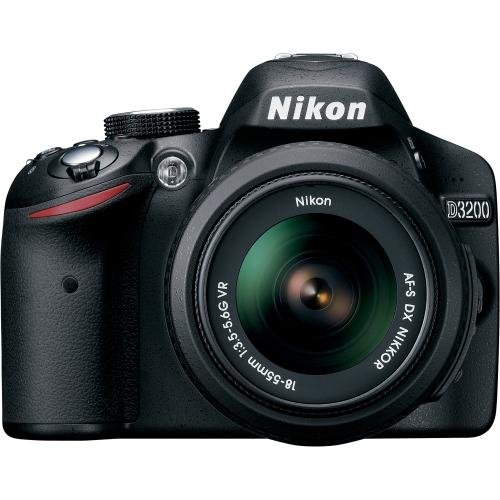
The D3200 is a legend in the beginner photography community—and for good reason. The 24.2MP DX-format CMOS sensor paired with the EXPEED 3 processor produces images that rival modern entry-level cameras. The 18-55mm f/3.5-5.6 VR lens includes vibration reduction, which noticeably sharpens handheld shots at slower shutter speeds. For around the cost of a dinner out, this is the highest-value DSLR build available.
The optical viewfinder gives you a bright, real-time view with zero latency—a feature many mirrorless beginners miss. The 11-point autofocus system is contrast-detect, but it’s fast and reliable in good light. Battery life is excellent at approximately 500 shots per charge, and the guide mode walks you through settings step by step. The camera is lightweight at about 1.1 pounds with the kit lens attached.
Being a refurbished model, it shows minimal cosmetic wear and includes a 90-day warranty. No Wi-Fi or Bluetooth means sharing photos requires a card reader or USB cable. The 3-inch LCD has 921,000 dots and is clear but not touch-sensitive. Full HD 1080p video at 30 fps is functional but limited. For the no-frills beginner who wants a physical camera that teaches the exposure triangle through a beautiful optical viewfinder, the D3200 remains unmatched at its price.
Why it’s great
- Outstanding 24.2MP DX sensor for the price
- Optical viewfinder with zero lag
- Incredible battery life (approx 500 shots)
Good to know
- Refurbished unit with 90-day warranty
- No Wi-Fi or Bluetooth connectivity
- LCD is not touch-sensitive
10. Canon EOS Rebel T7 with 18-55mm + 75-300mm Lenses
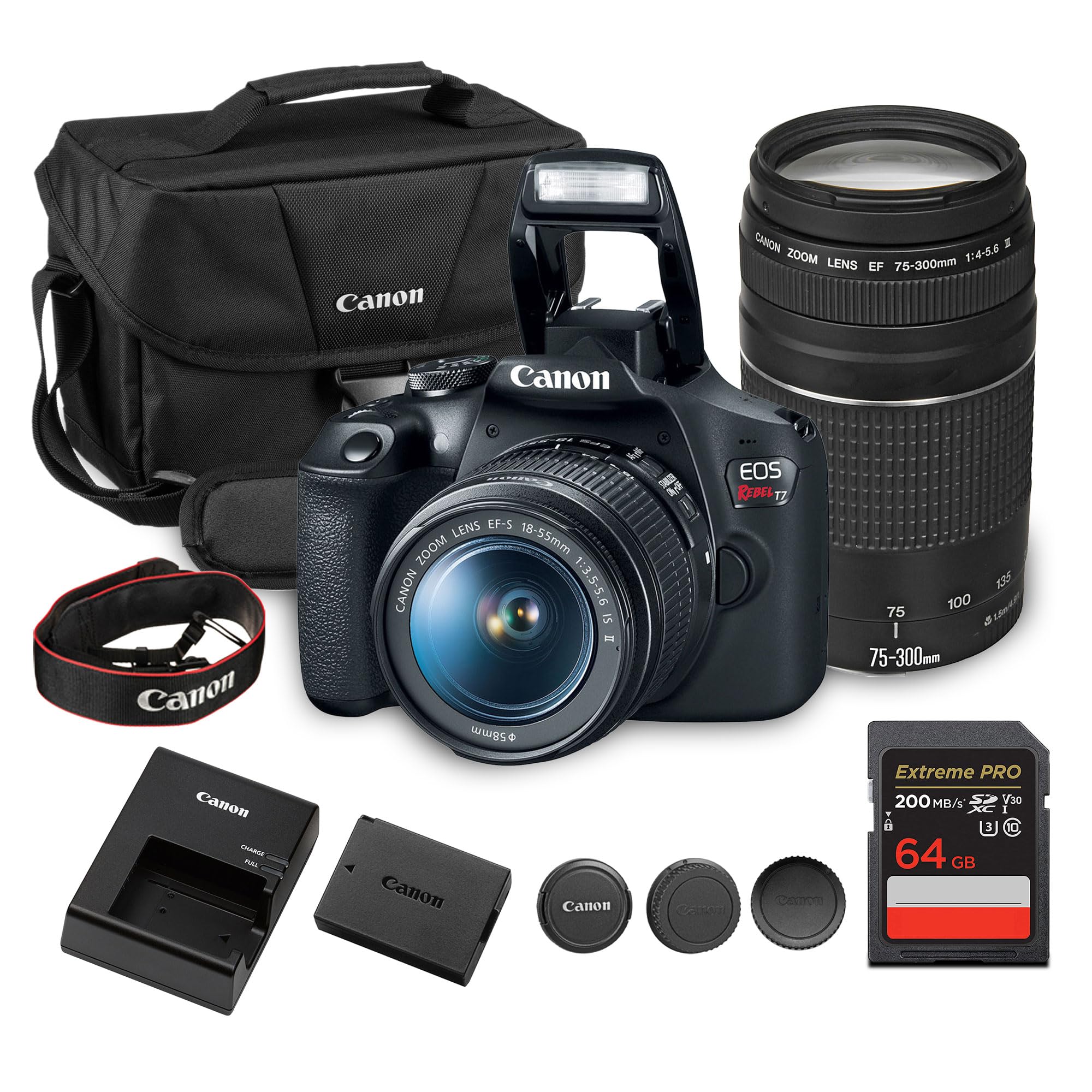
The Canon EOS Rebel T7 DSLR kit with both the EF-S 18-55mm f/3.5-5.6 IS II and EF 75-300mm f/4-5.6 III lenses gives you true flexibility from wide-angle to telephoto without buying additional glass. The 24.1MP APS-C sensor and DIGIC 4+ processor produce sharp, color-rich images with Canon’s signature warm skin tones. The 18-55mm handles everyday shooting, while the 75-300mm brings distant wildlife and sports into frame.
The optical viewfinder offers a clear, real-time view, and the 9-point autofocus system with AI Servo tracking is reliable for static and slow-moving subjects. Built-in Wi-Fi with NFC lets you transfer images to your phone and control the camera remotely. The scene intelligent auto mode handles challenging lighting well, and the creative filters encourage playful experimentation. The included 64GB memory card and shoulder bag make this a shoot-ready kit.
The autofocus is only 9 points, which feels outdated compared to current mirrorless systems with hundreds of points. Continuous shooting at 3 fps is slow for action photography. The 75-300mm lens has visible chromatic aberration and softness at maximum zoom. Battery life is good at about 500 shots, but a USB charging option would be welcome. For the traditionalist who prefers a DSLR’s handling and wants a full range of focal lengths from day one, this kit delivers tremendous value.
Why it’s great
- Two-lens kit covers wide to 300mm telephoto range
- Wi-Fi and NFC for easy photo sharing
- Classic DSLR with optical viewfinder and long battery life
Good to know
- Only 9 autofocus points
- Slow 3 fps continuous shooting
- 75-300mm lens shows chromatic aberration at long zoom
11. Canon EOS Rebel T7 Pro Bundle with 500mm Lens and Extras
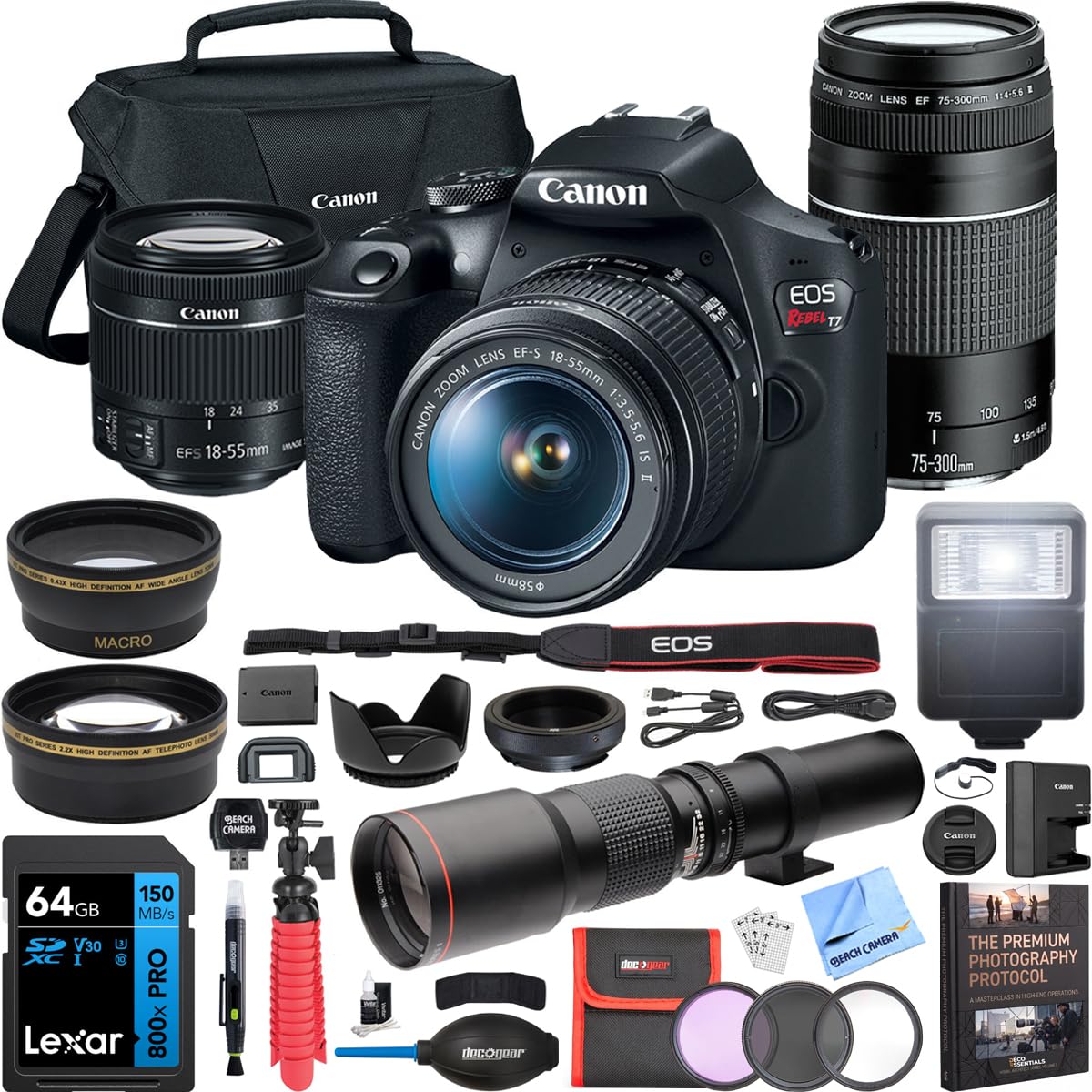
This pro bundle takes the same excellent 24.1MP EOS Rebel T7 DSLR body and surrounds it with accessories that would cost a small fortune individually. Beyond the EF-S 18-55mm and EF 75-300mm lenses, you get a 500mm f/8 preset telephoto lens—great for moon shots and distant wildlife—plus a 0.43x wide-angle and 2.2x telephoto adapter. The kit also includes a bounce flash, a tabletop tripod, UV/polarizer/FLD filter set, cleaning tools, and a 64GB memory card.
The body itself offers the same dependable Canon experience: DIGIC 4+ processing, Wi-Fi and NFC, full HD 1080p video at 30 fps, and scene intelligent auto. The 3-inch 920K-dot LCD is sharp for playback and menu navigation. The 9-point AF system is basic but functional for portraits and landscapes. The 500mm lens is a budget telephoto that requires a T-mount adapter and is manual focus only, preset at f/8—it’s a tool to experiment with, not a precision instrument.
Battery life is roughly 500 shots, but some users report the accessory flash drains it faster when triggered. The included bag is too small to hold all the accessories, and the shipping packaging sometimes results in loose parts rattling against the body. The 500mm lens is soft and only works in bright daylight. For a beginner who wants to try astrophotography, macro, and telephoto without buying individual pieces, this is the most complete photography starter kit available.
Why it’s great
- 13-piece kit covers every accessory a beginner needs
- Includes 500mm telephoto for moon and wildlife
- Canon’s reliable DSLR with Wi-Fi and good image quality
Good to know
- 500mm lens is manual focus, preset f/8, and soft
- Battery drains faster with active flash use
- Bag too small for all included accessories
FAQ
Should a beginner buy a DSLR or mirrorless camera in 2025?
How many megapixels do I really need as a beginner?
What is the difference between a kit lens and a prime lens?
Does in-body image stabilization matter for beginners?
How much should I spend on my first camera?
Final Thoughts: The Verdict
For most users, the best beginner camera winner is the Canon EOS RP + 24-105mm kit because it delivers full-frame image quality in a lightweight body with a beginner-friendly menu, giving you room to grow without feeling overwhelmed. If you want creative JPEGs straight out of camera and a tactile learning experience, grab the FUJIFILM X-T30 III. And for the budget-conscious student who still wants a capable DSLR that teaches the exposure triangle perfectly, nothing beats the Nikon D3200. Each of these cameras respects your learning curve while rewarding improved skill—choose the one that fits your budget and body, then go shoot.