
Our readers keep the lights on and the weekend projects moving. As an Amazon Associate, I earn from qualifying purchases.
Learning to fly doesn’t mean you have to settle for blurry, shaky footage. A well-chosen camera drone can deliver crisp photos and smooth video right from your first flight, but the market is flooded with toys that look the part without the GPS stability and sensor quality you actually need. The difference between a frustrating toy and a reliable tool comes down to a few key specs that beginner guides often gloss over.
I’m Rikta — the co-founder and writer behind FitlyFast. This guide cuts past the marketing hype to focus on the transmission systems, gimbal types, and flight controller hardware that separate real beginner photography drones from disposable gadgets, based on hundreds of hours of spec analysis and market research.
Whether you are looking for your first aerial camera platform or a capable travel companion, finding the right beginner drone for photography means understanding what actually matters for capturing clean, usable images right out of the box.
How To Choose The Best Beginner Drone For Photography
Not every flying camera is built for the learning pilot. Beginners need forgiving flight controllers, reliable satellite locking before takeoff, and a camera system that doesn’t require perfect lighting to produce usable results. Prioritize brushless motors for wind resistance, GPS-based return-to-home for peace of mind, and a stabilized camera — either a mechanical gimbal or high-quality EIS — to avoid jelly-like footage on your first edit.
Gimbal vs. EIS: The Stabilization Trade-off
A 3-axis mechanical gimbal physically counteracts drone vibration and wind gusts, delivering smooth 4K footage straight from the sensor. EIS (Electronic Image Stabilization) crops the frame and uses software to smooth out shake, which works in calm conditions but degrades image quality and field of view in moderate wind. For photography, a mechanical gimbal is always the superior choice, though it adds cost and weight.
Transmission Range and Video Feed Reliability
A beginner drone with a weak Wi-Fi signal loses video feed at a few hundred feet, forcing you to fly blind. Look for digital transmission systems (like DJI OcuSync or the PixSync 2.0 on the Potensic) that maintain a clean HD feed well beyond one kilometer. A reliable real-time view makes composing shots vastly easier and reduces the risk of disorientation.
Battery Endurance and Charging Practicality
Maximum flight time per battery for portable drones typically ranges from 25 to 40 minutes in ideal conditions. In reality, wind and aggressive flying cut that by 25 percent. Kits that include three batteries and a charging hub let you shoot for over an hour without returning to a power outlet, which is critical for location shooting where you can’t recharge easily.
Quick Comparison
On smaller screens, swipe sideways to see the full table.
| Model | Category | Best For | Key Spec | Amazon |
|---|---|---|---|---|
| DJI Flip (RC-N3) | Premium | Best Overall | 1/1.3″ CMOS, 4K/60fps HDR | Amazon |
| Skyrover S1 Mini | Mid-Range | Image Quality | 3-Axis Gimbal, 48MP Photo | Amazon |
| Bwine F7MINI | Mid-Range | Controller Display | Built-in 5.5″ Screen Controller | Amazon |
| G11PRO 6K Drone | Mid-Range | Wind Resistance | 3-Axis Brushless Gimbal, FAA Compliant | Amazon |
| Potensic ATOM LT | Mid-Range | Ultra-Light Travel | 4 GNSS, PixSync 2.0, 2.5K EIS | Amazon |
| DJI Mini 2 SE Fly More | Mid-Range | Long Flight Bundle | 3 Batteries, 93 Mins Total Flight | Amazon |
| GPS Drone with EIS Camera | Budget | Controller Screen | Built-in 4.5″ LCD on Controller | Amazon |
| SIMREX GPS Drone | Budget | Smart Flight Modes | 4K Camera, Brushless Motors | Amazon |
| CHUBORY 4K Drone | Budget | Max Flight Time | 3 Batteries, 84 Mins Max Time | Amazon |
In‑Depth Reviews
1. DJI Flip (RC-N3)

The DJI Flip marks a significant step forward for beginners who want professional-grade image quality without the complexity. Its 1/1.3-inch CMOS sensor captures more light than standard drone sensors, delivering 4K/60fps HDR video with wide dynamic range that handles sunset and shadow detail equally well. The full-coverage carbon fiber propeller guards give new pilots the confidence to fly near obstacles without immediate panic.
Stabilization comes from a 3-axis mechanical gimbal, which physically isolates the camera from drone vibration and wind gusts. The RC-N3 remote controller provides a clear low-latency feed up to 13 kilometers, and the DJI Fly app offers subject tracking that keeps moving targets centered in the frame. Paired with the 31-minute flight time per battery and smart return-to-home, this is a forgiving platform that grows with your skills.
At under 249 grams, the Flip requires no FAA registration or Remote ID, making it a truly grab-and-go system. The only real barrier is the initial investment in extra batteries and storage, though the core kit includes everything needed for a first flight. For pure image quality per gram, the Flip is the clear benchmark for this category.
Why it’s great
- Large 1/1.3″ sensor outperforms most sub-250g drones for low-light detail
- Full-coverage propeller guards reduce crash anxiety for beginners
- 3-axis gimbal delivers genuinely smooth 4K/60fps HDR footage
- 13km video transmission is overkill but ensures zero dropouts at normal ranges
Good to know
- No built-in screen; requires a smartphone for the live feed
- Only forward-facing obstacle avoidance; side and rear sensors absent
- Extra batteries and a carrying case are additional purchases
2. Skyrover S1 Mini Drone
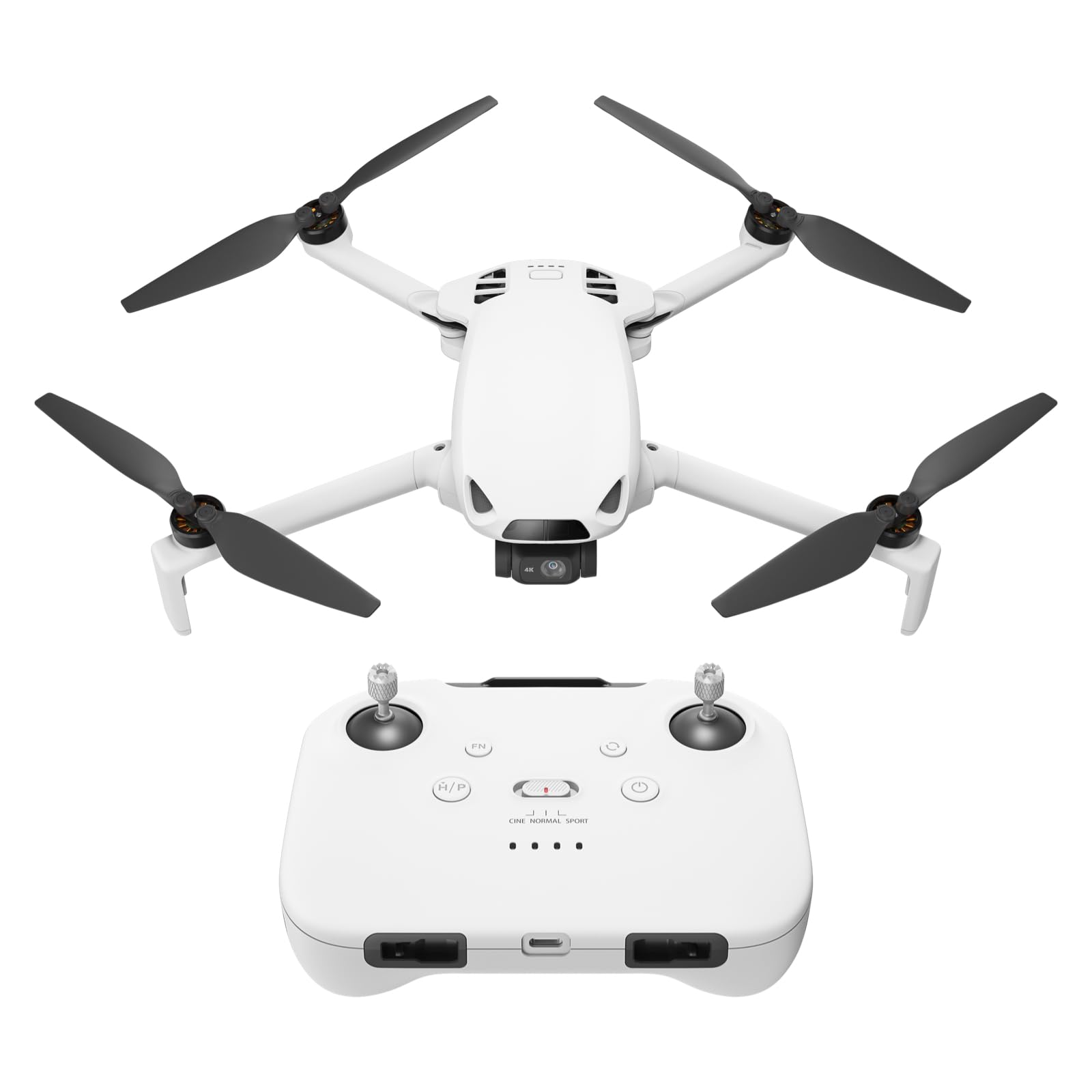
The Skyrover S1 brings a Sony 1/2-inch CMOS sensor and a full 3-axis mechanical gimbal to a sub-249g frame, enabling 48MP photos and true 4K/60fps video without software upscaling. In good light, the detail and color accuracy rival drones costing significantly more, making it a strong choice for travel vloggers and real-estate shooters on a tighter budget.
Auto Track and Subject Lock work reliably in open areas, keeping subjects centered during hikes or bike rides without requiring manual joystick corrections. The 39,000-foot video transmission range is generous for the class, and the SmartGo one-tap creation modes simplify getting cinematic camera moves without learning complex flight patterns. Battery life lands at 40 minutes per charge, which is excellent for a drone this compact.
The biggest caveat is the app delivery — it must be sideloaded from the Skyrover website rather than downloaded from the Play Store or Apple App Store, which adds friction to the initial setup. A small number of early units experienced gimbal issues, though customer service has been responsive. For the spec sheet alone, the S1 punches well above its weight class.
Why it’s great
- Sony sensor with 3-axis gimbal captures sharp 48MP photos and 4K/60fps video
- 40-minute flight time is best-in-class for this weight bracket
- Auto Track and Subject Lock work well for hands-free filming
- Under 249g for FAA-exempt portable flying
Good to know
- App not available on official app stores; must be sideloaded
- Low-light performance is adequate but not exceptional
- Gimbal QC has been inconsistent in early batches
3. Bwine F7MINI 4K Drone
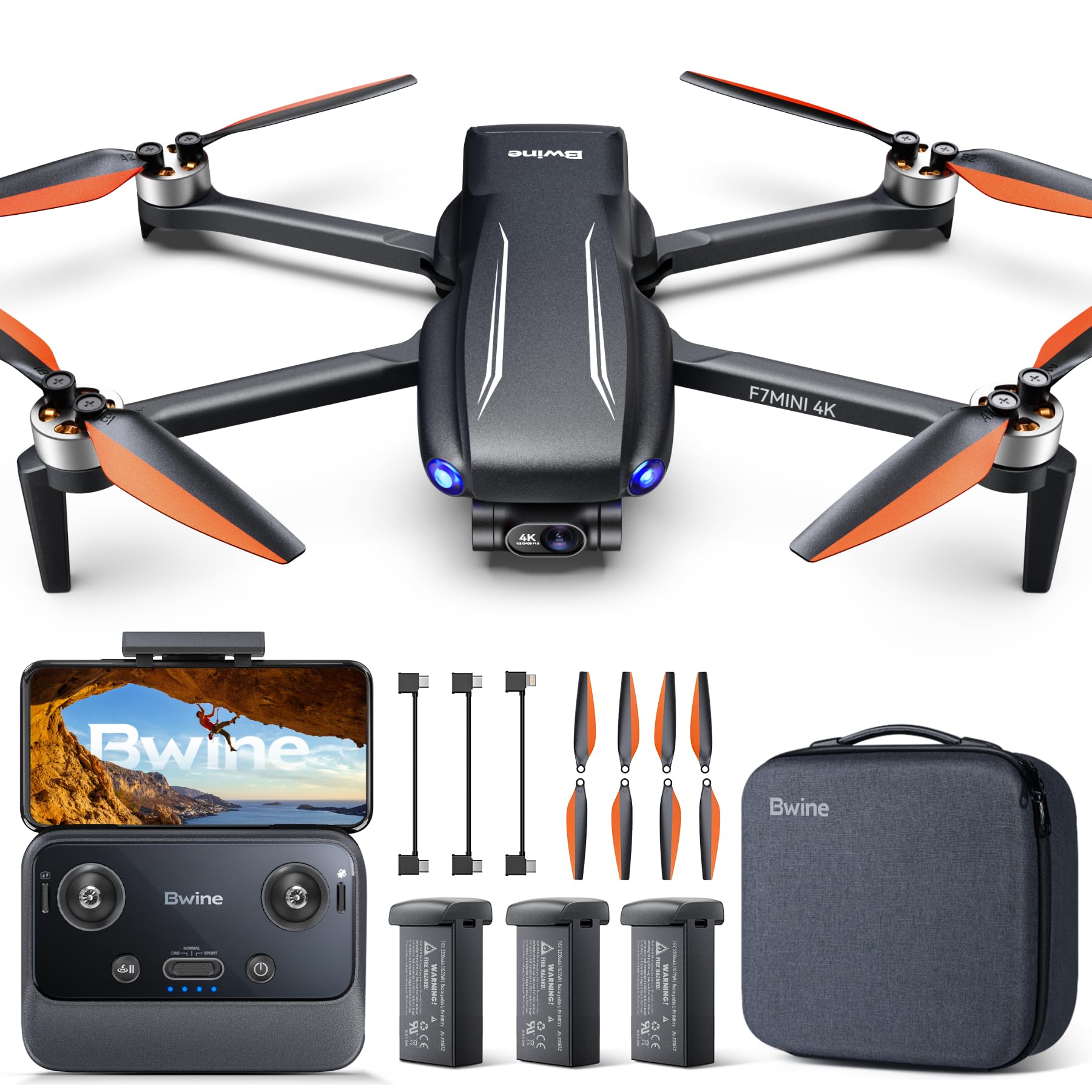
The Bwine F7MINI solves the most annoying beginner pain point: not needing to clamp your phone into the controller. Its remote has a bright 5.5-inch built-in touchscreen, so you launch the drone and fly without ever touching your smartphone. The 48MP 1/2-inch CMOS sensor with F1.8 aperture captures crisp 4K/30fps video, and the 3-axis mechanical gimbal keeps it steady even in level 5 wind.
With three included high-density batteries, the total flight time reaches 96 minutes (32 minutes per battery), and they support PD 3.0 fast charging to minimize downtime. The PixSync-like digital transmission stretches to 6 kilometers, and the 120dB locator buzzer helps recover the drone if it lands out of sight. Smart return-to-home, waypoint, and orbit modes make complex shots achievable on the first flight.
At under 249 grams, it avoids FAA registration entirely. The built-in screen eliminates the worry about phone compatibility or screen brightness in direct sunlight. The only real downside is the file transfer speed from the controller to a phone, which is slower than using an SD card reader directly. For beginners who want a self-contained system, this is the most convenient package available.
Why it’s great
- Built-in 5.5″ controller screen removes phone dependency entirely
- 3-axis gimbal with F1.8 aperture and large sensor for clean low-light shots
- 96 minutes total flight time with included fast-charging batteries
- 6km digital transmission maintains clean feed at long ranges
Good to know
- File transfer from controller to phone is slow; use a computer instead
- No microSD card included despite supporting internal storage
- Controller is larger than phone-clamp models due to the integrated screen
4. G11PRO 6K Drone

The G11PRO from Gleesfun is built for pilots who need to fly in challenging conditions. Its 3-axis brushless gimbal and high-performance control chip keep the camera locked and level even in 20 to 30 MPH winds, a scenario that would introduce heavy jello in cheaper EIS-based drones. The 1/3.2-inch CMOS sensor captures 6K photos and 4K/30fps video with rich color reproduction.
The GQ2.0 digital transmission system pushes a stable video feed to 10,000 feet, and the Cruise Control mode lets the drone maintain a steady flight path while the pilot focuses on camera composition. The GL2.0 smart batteries provide 35 minutes of flight time each, with fast charging in about 2.5 hours and over 300 charge cycles before degradation. The kit includes 40 pieces, including a carrying case, spare propellers, and two batteries.
FAA compliance with a QR-coded Remote ID is already handled out of the box. The build quality feels robust, and customer service has a strong track record of fast replacements when issues arise. The 357-gram weight puts it above the no-registration threshold, so FAA registration is required. For beginners who want professional wind performance without the DJI price premium, this is a compelling alternative.
Why it’s great
- Handles moderate wind conditions better than most sub- drones
- Cruise Control mode simplifies single-operator shots
- Fast-charging batteries with long cycle life reduce long-term cost
- Complete kit with case, spare props, and all cables included
Good to know
- Weighs 357g, requiring FAA registration and Remote ID
- No built-in storage; relies on microSD card
- Transmission system is proprietary, so no DJI compatibility
5. Potensic ATOM LT

The Potensic ATOM LT is purpose-built for the traveler who needs a drone that disappears into a pocket. Its folded dimensions of 3.5 x 5.6 x 2.3 inches and 249-gram weight mean it fits in a jacket pocket and needs no FAA registration. The 2.5K EIS camera with a Sony sensor uses ShakeVanish 2.0 stabilization, which smooths out light wind vibration without a mechanical gimbal, though the EIS crop does reduce the field of view slightly.
The PixSync 2.0 transmission system is a standout feature at this price point, delivering a low-latency HD feed up to 4 kilometers. Four GNSS satellite systems (GPS, GLONASS, Galileo, BeiDou) lock quickly and provide accurate positioning for auto return and follow-me modes. The two 3000mAh batteries deliver a claimed 40 minutes each, with actual flight times closer to 35 minutes in calm conditions, which is still excellent for the size.
ATOM LT only flies in GPS mode, so indoor use is limited, and the camera’s EIS struggles in low light where shadows cause stabilization artifacts. The smartphone app is intuitive, and customer support has a reputation for responsive issue resolution. For budget-conscious travelers who prioritize portability and transmission range over 4K resolution, this is a strong pick.
Why it’s great
- Tiny folded footprint fits in a jacket pocket with ease
- PixSync 2.0 delivers clean HD video at ranges up to 2.5 miles
- Four GNSS systems provide fast satellite locking and accurate positioning
- 80 minutes total flight time from two included batteries
Good to know
- EIS camera only; no mechanical gimbal so field of view is cropped
- Requires GPS lock before takeoff; cannot fly indoors
- Low-light EIS performance causes stability artifacts on footage
6. DJI Mini 2 SE Fly More Combo

The DJI Mini 2 SE Fly More Combo is the bundle that removes the single biggest frustration of drone ownership: running out of battery. Three batteries in the two-way charging hub give you 93 minutes of total flight time, and the hub itself can double as a portable charger for your phone or remote. The 1/2.3-inch CMOS sensor records QHD video at 2.7K/30fps, which lacks the 4K resolution of newer siblings but still produces clean, color-accurate footage thanks to the 3-axis mechanical gimbal.
The RC-N1 remote controller supports 10 kilometers of video transmission, which is overkill for most beginners but guarantees a rock-solid feed within normal flight distances. 4x zoom in HD mode allows you to reframe shots without moving the drone, and the QuickShots modes (Dronie, Helix, Rocket, Circle) automate simple cinematic moves that look impressive with zero practice. The Fly More bundle also includes a propeller holder and a shoulder bag for convenient transport.
The trade-off for the lower price is the absence of obstacle avoidance and 4K video. The camera is limited to 2.7K, which is perfectly adequate for social media and personal projects but won’t match the sharpness of 4K rivals. The kit does not include a charger plug or microSD card, so those are separate purchases. For beginners who want DJI reliability and a generous battery bundle at an entry-level price, this is the most straightforward recommendation.
Why it’s great
- Fly More Combo with three batteries delivers 93 minutes of total flying
- 10km transmission provides a rock-solid link at any reasonable distance
- 3-axis mechanical gimbal produces smooth footage without EIS crop
- Mature DJI Fly ecosystem with reliable app and firmware updates
Good to know
- Camera resolution limited to 2.7K; no 4K or HDR mode
- No obstacle avoidance sensors on any axis
- Does not include a charger plug or microSD card in the box
7. GPS Drone with EIS Camera & 4.5″ LCD
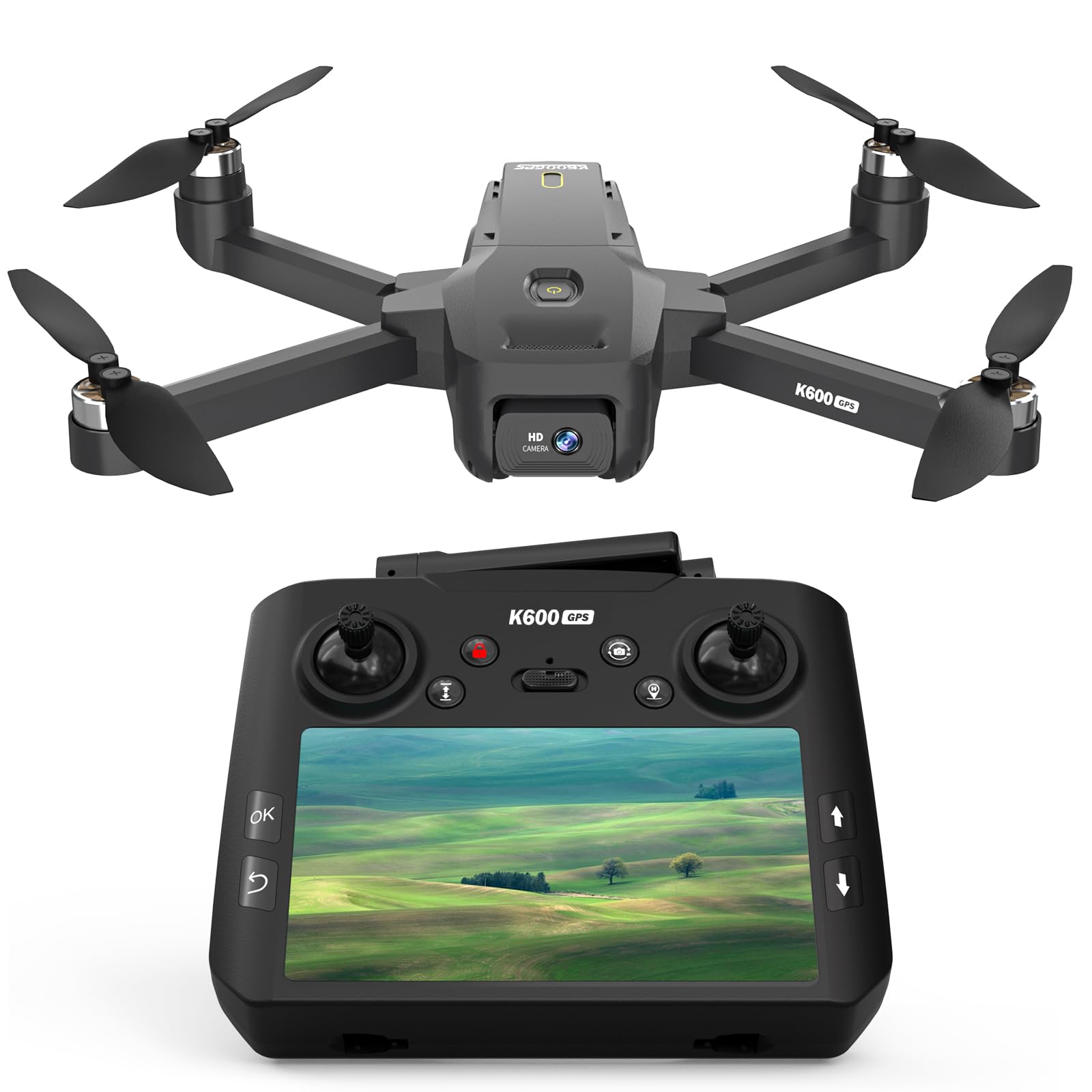
This entry-level GPS drone packs a 4.5-inch HD display directly on the controller, bypassing the need for a smartphone for live video. The EIS camera delivers stable 1080p footage that looks clean in good daylight, though the sensor resolution and bit rate are modest compared to gimbal-equipped drones. For absolute beginners who just want to see what their drone sees without downloading an app, this setup removes barriers to entry.
Brushless motors provide quieter and more wind-resistant flight than the coreless motors found in cheap toy drones, and the GPS-assisted return-to-home prevents flyaways when the signal drops. The Follow Me, Waypoint, and Orbit modes let beginners experiment with automated camera moves, and the 2200mAh battery delivers roughly 25 minutes of flight time. The 400-meter control range is adequate for local parks and open fields.
At just over 205 grams, it stays under the 249g FAA exemption threshold, so no registration is required. The EIS stabilization is software-based and crops the image slightly, but it does reduce the rolling shutter effect common in non-stabilized drones. For the lowest-cost path to a controller screen and reliable GPS features, it occupies a unique niche in the market.
Why it’s great
- Built-in 4.5″ LCD on controller eliminates phone dependency
- Brushless motors provide decent wind resistance for the price tier
- GPS auto return, Follow Me, and Waypoint modes are functional and reliable
- Very lightweight at 205g, below all registration thresholds
Good to know
- EIS camera lacks a mechanical gimbal; footage is cropped and less stable in wind
- Controller screen brightness may struggle in direct sunlight
- Control range of 400m is far shorter than mid-range competitors
8. SIMREX GPS Drone with 4K Camera

The SIMREX G29 brings a 90-degree electrically adjustable 4K camera and 5G Wi-Fi FPV to a price point that undercuts most gimbal-equipped drones. The camera can angle downward 90 degrees to capture straight-down shots, which is useful for inspection work and creative framing. The brushless motors and optical flow sensor provide stable hovering even without a strong GPS lock, making it forgiving for first-time pilots.
Intelligent flight modes include Follow Me, Waypoint, and Circle modes, all of which work through the app on your phone. The total flight time of 40 minutes comes from two batteries, and the foldable arm design makes it compact enough for a backpack. The 2,296-foot maximum range is generous for the class, though video quality degrades noticeably past 1,000 feet in urban environments with Wi-Fi interference.
The 4K camera uses interpolation rather than a true 4K sensor, so the effective resolution is closer to 2.7K after processing. Low-light performance is limited, and the lack of a gimbal means wind above 10 MPH introduces noticeable shake. For a budget-friendly introduction to GPS flight and basic photography, it works well, but pilots who prioritize image quality should look at gimbal-equipped options.
Why it’s great
- Adjustable 4K camera with 90° tilt range for versatile framing
- Brushless motors and optical flow sensor for stable, predictable flight
- Follow Me and Waypoint modes provide easy automated shots
- Foldable design fits easily into a daypack or suitcase
Good to know
- 4K is interpolated, not true 4K sensor resolution
- No mechanical gimbal; footage shows shake in moderate wind
- Wi-Fi FPV signal degrades quickly in areas with interference
9. CHUBORY 4K Drone with 3 Batteries
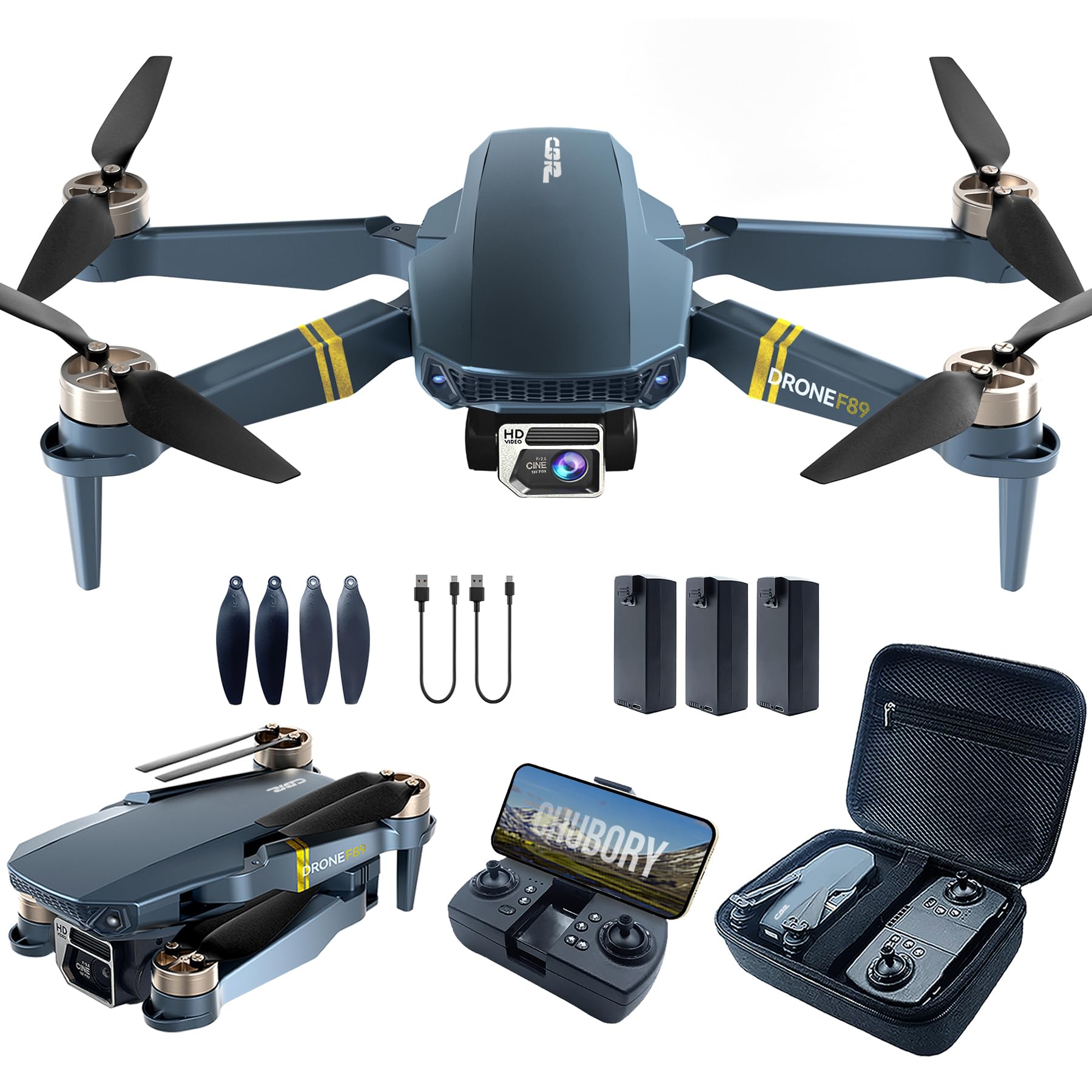
The CHUBORY drone puts its emphasis on endurance with three upgraded batteries providing a combined 84 minutes of flight time. The 120-degree wide-angle 4K HD camera is switchable between a front view and a bottom optical flow camera, allowing you to monitor both the horizon and the ground below. The brushless motors are quieter and more durable than standard brushed motors, and the wind resistance is adequate for light breezes under 10 MPH.
All the expected beginner features are present: one-key takeoff and landing, altitude hold, headless mode, gesture selfie, trajectory flight, and optical flow positioning for indoor stability. The 2,650-foot control range is competitive for the entry-level tier, though the 5G Wi-Fi transmission is susceptible to interference in crowded airspace. The sub-249g weight keeps FAA registration out of the picture, and the foldable carrying case is a nice touch for portability.
The 4K camera is more of a marketing specification than a true high-resolution sensor, with effective still resolution landing at 8.3 MP and video output at 3.7 MP. The footage looks good on a phone screen but won’t hold up to heavy cropping or large displays. For beginners who prioritize maximum time in the air over pixel-level detail, the CHUBORY offers the most flight time per dollar in this lineup.
Why it’s great
- 84 minutes total flight time from three included batteries is class-leading
- Dual front and bottom cameras provide unique perspective options
- Brushless motors deliver quieter, more reliable performance than toy drones
- Compact carrying case makes transport and storage straightforward
Good to know
- Camera resolution is much lower than advertised 4K marketing suggests
- 5G Wi-Fi transmission range drops with interference
- No gimbal stabilization; EIS only on the front camera
FAQ
Do I need FAA registration for a sub-249g drone?
Why does EIS footage look cropped compared to a gimbal?
What does “Level 5 wind resistance” mean for a beginner drone?
Can I fly a beginner photography drone indoors safely?
Final Thoughts: The Verdict
For most users, the beginner drone for photography winner is the DJI Flip (RC-N3) because its large CMOS sensor, 3-axis mechanical gimbal, and full-coverage propeller guards set the highest standard for image quality and ease of use in the sub-249g class. If you want a built-in controller screen that works without a phone, grab the Bwine F7MINI. And for the best total flight time with three batteries under DJI’s reliable ecosystem, nothing beats the DJI Mini 2 SE Fly More Combo.