
Our readers keep the lights on and the weekend projects moving. As an Amazon Associate, I earn from qualifying purchases.
That first groove you build from scratch—hitting the kick on the one, snare cracking on the backbeat—is the moment everything clicks. But without the right gear, the learning curve feels more like a brick wall. A dedicated beginner drum machine should make that moment inevitable, not elusive.
I’m Rikta — the co-founder and writer behind FitlyFast. I’ve spent dozens of hours dissecting sequencers, pad layouts, sound engines, and build quality across the most accessible beat-making hardware on the market to find what actually serves a first-time user.
My goal is to cut through the spec sheets and highlight the models that turn a new player into a confident beat maker. After weeks of research, I’ve built a curated list of the best beginner drum machine options that prioritize immediate usability without sacrificing the depth needed to grow.
How To Choose The Best Beginner Drum Machine
Not every box with drum sounds serves a learner well. The wrong unit will bury you in menus, while the right one puts a beat together in seconds. These criteria cut through the noise for a brand-new beat maker.
Step Sequencer Simplicity
A 16-step sequencer with dedicated mute and solo buttons is the gold standard for learning. You can visually place each kick, snare, and hi-hat on a grid, which builds an intuitive understanding of rhythm and bar structure without needing to read a manual.
Pad Quality vs. Knob Density
Driven by pads? Look for velocity-sensitive pads with good response—they allow dynamic expression from ghost notes to powerful accents. If you prefer programming, a machine with dedicated knobs for pitch, decay, and level on each sound will teach you sound design principles faster than deep menu-diving.
Sound Engine: Analog, Sample, or Hybrid
Analog circuits offer raw, punchy character but often limited sound sets. Sample-based engines provide huge libraries at lower cost but can feel sterile. A hybrid approach gives you the best of both worlds: the warmth of analog tones combined with the variety of PCM samples for cymbals and claps.
Expandability and Connectivity
USB MIDI and audio interfaces are crucial. They let you pair your drum machine with a DAW like Ableton or GarageBand, turning your hardware into a controller that grows with your production skills. Sync in/out (MIDI or analog clock) also lets you jam with other gear later.
Quick Comparison
On smaller screens, swipe sideways to see the full table.
| Model | Category | Best For | Key Spec | Amazon |
|---|---|---|---|---|
| Korg Volca Beats | Analog Rhythm Machine | Learning analog sound design | 16-step sequencer, 8 memory patches | Amazon |
| Behringer RD-78 | Classic Analog Clone | Retro CR-78 sounds & presets | 15 drum sounds, 34 rhythm presets | Amazon |
| Yamaha FGDP-30 | Finger Drum Pad | Live finger drumming & practice | 18 velocity-sensitive pads, built-in speaker | Amazon |
| FLAMMA FS21 | Looper & Drum Pedal | Loop-based jamming & practice | 100 drum grooves, 160 min loop capacity | Amazon |
| FLAMMA FF20 | Advanced Looper & Drums | Long-record sessions & stage use | 220 drum grooves, 300 min recording | Amazon |
| JOYO JAM Buddy II | All-in-One Amp & Drums | Portable practice with backing band | 36 drum patterns, 30 sec looper | Amazon |
| NUX Mighty Lite BT MKII | Desktop Amp with Drums | Bedroom practice with app control | 10 drum styles, 512 IR samples | Amazon |
| MOOER Micro Drummer II | Compact Drum Pedal | Pedalboard drum machine | 48 grooves, 6 music styles | Amazon |
| Coolmusic DM100 | Drum Amp (Speaker) | Playing drum machine through a cab | 100W, 10-inch woofer, 3-band EQ | Amazon |
In‑Depth Reviews
1. Korg Volca Beats

The Korg Volca Beats is a compact analog rhythm machine that punches well above its size. It features an Electribe-style 16-step sequencer that lets you program patterns by tapping lit step buttons, making the relationship between a musical bar and your beat visually obvious. The analog kick drum is famously punchy, and the PCM-based clap and crash sounds fill in the gaps that pure analog circuits can’t handle well. With eight memory patches for pattern storage, you can build a small live set or just save your favorite grooves.
What makes this a strong entry point is the tactile immediacy. The sequencer’s active step function allows for odd time signatures, and the stutter effect adds instant glitchy flavor to your patterns. The built-in speaker is surprisingly serviceable for low-volume practice, and it runs on six AA batteries, which means your creative space is truly cordless. The SYNC in/out and MIDI input also mean you can connect this to other Volca units or a DAW as you expand your setup.
Beginners should be aware of the Volca’s quirks: the snare drum is widely considered its weakest voice, often described as thin and lacking punch. The tiny tempo knob can be fiddly to adjust precisely, and there is no swing parameter built in. Some users eventually mod the snare circuit to improve it, but out of the box, it remains a known compromise. Still, for learning the fundamentals of analog sequencing and sound shaping at a low entry price, it’s hard to beat.
Why it’s great
- True analog sound with a punchy kick drum and warm character.
- Intuitive 16-step sequencer makes pattern creation visually clear.
- Battery-powered with a built-in speaker for practice anywhere.
- MIDI in and sync ports for future expansion with other gear.
Good to know
- Snare drum sounds weak and may require hardware modification to improve.
- Tempo knob is very small and makes precise BPM adjustments difficult.
- No swing or shuffle parameter limits rhythmic feel variation.
- Only 1/8-inch audio jacks; no 1/4-inch outputs.
2. Behringer RD-78
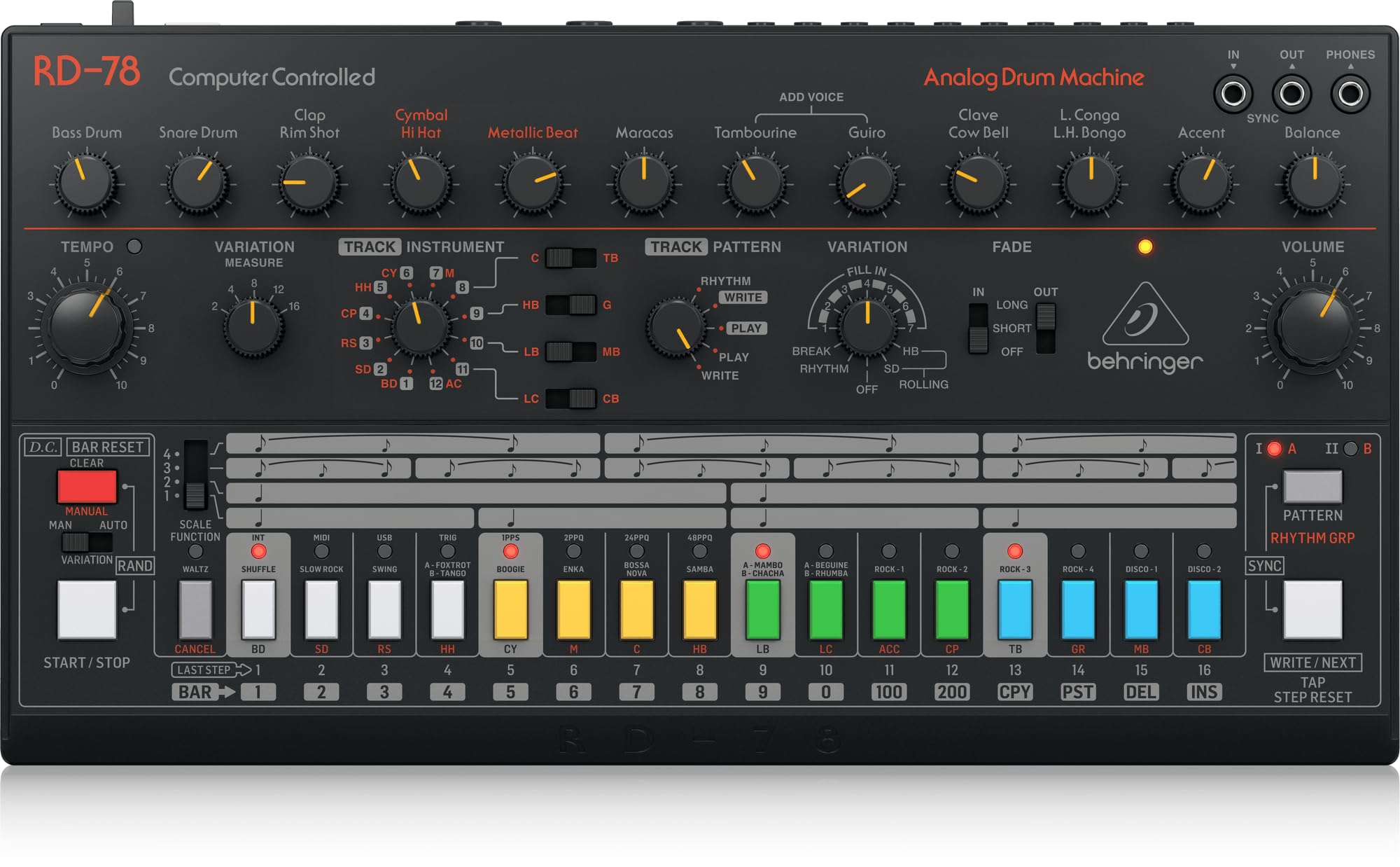
The Behringer RD-78 is a faithful analog reproduction of the legendary Roland CR-78, the drum machine behind iconic Phil Collins and Hall & Oates grooves. It houses 15 drum sounds—all of which can be used simultaneously—and 34 built-in rhythm presets that span the classic 1970s palette of bossa nova, samba, rock, and ballad patterns. The 16-step sequencer allows you to program your own custom beats, and each sound has its own volume slider for quick mixing right on the panel.
What sells this machine for a beginner is its immediate familiarity. The presets are musical and usable out of the box, and the interface is entirely hands-on with no menu diving. The steel chassis feels robust enough for the road, and the alloy steel body adds a reassuring weight. It includes a USB port for connectivity, though deeper integration may require some setup. For someone who wants to play classic rhythms instantly while also learning to program their own, this is an efficient path.
The RD-78 is not a 100% clone of the original CR-78, and purists will note differences in the sound and behavior of certain parameters. Build quality at this entry-level price point is decent but not luxurious; some users report that the knobs feel less premium than vintage gear. The unit lacks built-in effects like reverb or delay, so you’ll need external processing if you want ambience. However, for the price, you get an authentic analog engine that lands you in a specific and highly influential sonic territory.
Why it’s great
- Authentic analog reproduction of the classic CR-78 sound.
- 34 ready-to-play rhythm presets that sound great immediately.
- Robust all-metal alloy steel chassis for durability.
- All 15 sounds are usable at the same time, no voice stealing.
Good to know
- Not a perfect clone of the original CR-78; some sound differences exist.
- No built-in effects; you need external pedals for reverb or delay.
- Knob and build quality is acceptable but not premium.
- Requires some setup to integrate deeply with a DAW.
3. Yamaha Finger Drum Pad FGDP-30

The Yamaha FGDP-30 is an all-in-one finger drum pad designed from the ground up for expressive hand percussion. It features 18 ultra-responsive pads arranged in a layout optimized for finger drumming, with velocity sensitivity and aftertouch that allow for ghost notes, accents, and flams with subtle finger pressure changes. The internal sound engine comes loaded with high-quality studio drum kits, and the built-in 2.5-inch speaker is loud enough for solo practice without headphones.
This unit is a standalone powerhouse. It boots in about five seconds and lets you play immediately—no app, no DAW, no setup required. The built-in rechargeable battery offers hours of playtime, and the USB audio/MIDI interface turns it into a controller for triggering samples in your DAW when you’re ready to record. The voice prompts feature is a thoughtful inclusion, allowing visually impaired musicians to navigate settings without a screen. The Rec’n’Share app integration also makes it easy to capture and share performance videos.
The FGDP-30 is tailored for finger drumming, so if your primary goal is programming step sequences rather than playing pads live, the workflow is different. The pads need occasional cleaning to maintain their sensitivity. The internal memory does not include a built-in looper, which is a notable omission for a practice tool at this price point. The battery is non-replaceable, and the micro USB port may feel less durable than USB-C, which is a concern for long-term reliability.
Why it’s great
- Excellent velocity-sensitive pads with aftertouch for dynamic finger drumming.
- Standalone operation with a built-in speaker and long battery life.
- USB audio/MIDI interface for direct DAW integration.
- Voice prompts make it accessible for visually impaired musicians.
Good to know
- No built-in looper, which is a missed feature for practice and jamming.
- Battery is non-replaceable, potentially limiting lifespan.
- Micro USB port feels less robust than a USB-C connection.
- Pads may require occasional cleaning to maintain sensitivity.
4. FLAMMA FS21 Stereo Looper & Drum Machine

The FLAMMA FS21 combines a stereo looper with a full drum machine in a rugged pedal format. The looper module offers 40 slots, each capable of recording up to four minutes of 24-bit audio, for a total of 160 minutes of loop time. The drum engine delivers 100 grooves across 10 styles, plus 10 metronome settings. Dual footswitches give you independent control of the looper and the drum machine, which can also be synced together for seamless jam sessions.
What sets the FS21 apart for a beginner is how it marries loop recording with a backing band. You can lay down a chord progression, then layer drums that follow the same BPM. The TAP tempo function lets you dial in your speed by feel, and the drum machine will complete its current bar before switching patterns—reducing timing errors during transitions. The unit automatically saves loops on power loss, so no creative idea is accidentally erased.
Some users find the footswitch assignment has a learning curve compared to the Boss RC series. The included instructions are sparse, and there are no dedicated drum fills—you’ll need an external footswitch to trigger them, which is sold separately. Not all 100 drum patterns are equally musical; some genres like metal and hip-hop are weaker than the rock and pop sections. The mini USB connection for data transfer may feel dated, and Mac users may find the software compatibility limited.
Why it’s great
- Massive 160-minute loop capacity across 40 slots for endless jams.
- 100 drum grooves across 10 styles provide a wide rhythmic palette.
- Stereo I/O with dual footswitches for independent looper and drum control.
- Auto-saves loops on power loss, protecting your creative work.
Good to know
- Footswitch layout has a learning curve compared to competitors.
- No built-in drum fills; requires an external footswitch sold separately.
- Some drum patterns (metal, hip-hop) are less convincing than others.
- Mini USB data port and limited Mac software support.
5. FLAMMA FF20 Looper & Drum Machine

The FLAMMA FF20 is a significant step up from the FS21, packing 220 drum grooves from 11 musical styles and a whopping 300 minutes of stereo loop recording across 100 memory slots. The 2-inch full-color screen is a massive usability upgrade, displaying loop position, BPM, drum patterns, and menu settings clearly at a glance. Dual footswitches control the looper functions, and the time stretch feature lets you adjust loop speed without affecting pitch—great for matching the tempo of backing tracks.
This pedal is built for the guitarist or bassist who wants to practice with a virtual band. The auto-record function starts capturing the moment you play your first note, removing the need to stomp a switch mid-phrase. The USB-C port for data transfer is a modern touch, and the headphone output allows for silent practice at any hour. The mint green color is distinctive, and the plastic chassis feels surprisingly sturdy despite its light weight.
The learning curve is real, especially when it comes to deleting loops. The manual is relatively clear, but erasing a specific loop from the device requires a specific button sequence that isn’t immediately intuitive. The plastic case, while sturdy, may not withstand the abuse of regular stage use as well as a metal enclosure. Some users wish the internal drum sounds had more character or variety per style. Still, for a practice tool with this much storage and flexibility, the value proposition is strong.
Why it’s great
- 220 drum grooves across 11 styles offer huge rhythmic variety.
- 600 minutes of total stereo loop storage across 100 slots.
- 2-inch full-color screen makes navigation and visualization easy.
- Time stretch and auto-record features are powerful for practice.
Good to know
- Erasing loops from the device requires a non-intuitive button sequence.
- Plastic chassis is light but less durable than metal for stage use.
- Internal drum sounds are functional but lack deep character.
- Moderate learning curve for full feature utilization.
6. JOYO JAM Buddy II
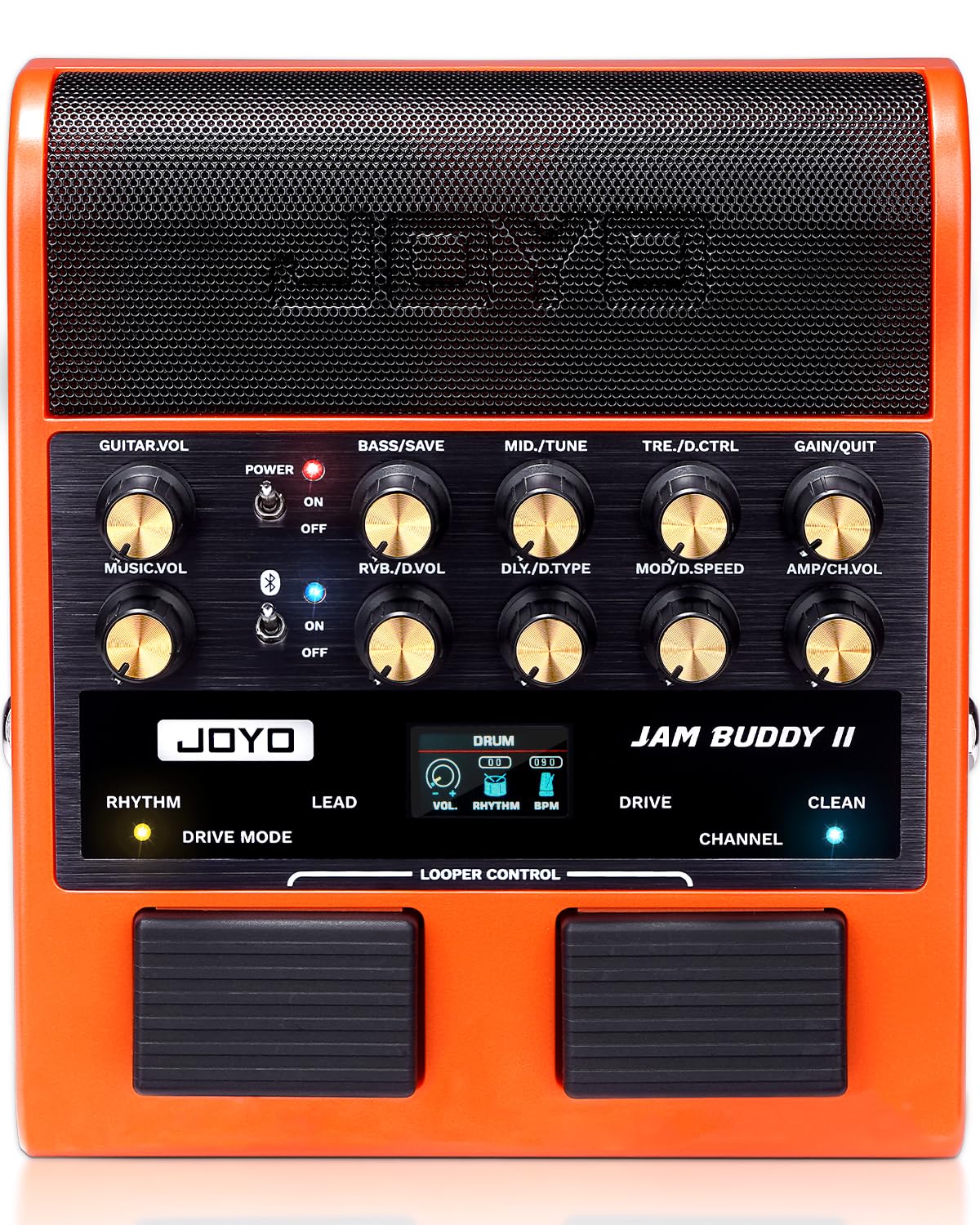
The JOYO JAM Buddy II is a full practice rig crammed into a palm-sized, 940-gram portable amplifier. Beyond being a guitar amp with 14 amp models and 9 built-in effects, it includes a 36-pattern drum machine and a 30-second looper. The dual 2-inch full-range speakers and bass radiator deliver sound that is far bigger than the chassis suggests. The OTG USB-C port allows direct recording to a phone or computer, making it an ideal one-box solution for content creation and silent practice.
What makes this a great entry point is the sheer versatility. You can switch between clean, rhythm, and lead channels, dial in a drum pattern, and start layering loops immediately. The rechargeable battery lasts 5-6 hours, and the included phone mount lets you follow YouTube lessons while jamming. The Bluetooth audio playback also means you can jam along with your favorite tracks. For a guitarist or bassist who wants a full band experience without a PA, this is a compelling package.
The drum machine is a secondary feature in a box primarily designed as a guitar amplifier. The patterns are preset and not editable, so you cannot tweak the drum sounds or program your own beats. The looper is limited to 30 seconds, which restricts longer song structures. The internal speakers, while impressive for the size, can distort at high volumes if you push heavy bass tones. This is not a dedicated drum machine; it’s a practice tool that includes drums as a feature.
Why it’s great
- All-in-one amp, effects, looper, and drum machine in a portable unit.
- Built-in rechargeable battery runs 5-6 hours for cordless practice.
- OTG USB-C audio interface for direct recording to phone or computer.
- 14 amp models and 9 effects provide huge tonal variety.
Good to know
- Drum patterns are preset and cannot be edited or programmed.
- Looper is limited to 30 seconds, restricting longer arrangements.
- Built-in speakers can distort at high volume with heavy bass.
- Primarily a guitar amp; drum machine is an integrated feature, not standalone.
7. NUX Mighty Lite BT MKII

The NUX Mighty Lite BT MKII is a 3-watt desktop modeling amplifier with a built-in drum machine and Bluetooth connectivity. Its TSAC-HD amp modeling algorithm delivers studio-grade tone simulation across clean, overdrive, and distortion channels. The drum machine offers 10 versatile styles—from pop, metal, and blues to Latin and funk—each providing a solid rhythmic foundation for practice. The MightyAmp app and Mighty Editor software unlock deep control over the signal chain, including gate, effects, amp modeling, and IR loading.
This unit is perfect for desk-bound practice where space is at a premium. It’s extremely lightweight and can slip into a backpack easily. The Bluetooth audio playback feature lets you stream backing tracks from your phone, and the USB-C audio interface enables silent recording. The 512 built-in IR samples with 20 user-loadable slots give you an incredible range of cabinet simulations. The fact that it can run on AA batteries adds another layer of portability, ideal for practicing in different rooms or outside.
The 3-watt output limits clean headroom, especially for jazz players who need pristine volume. While the app integration is powerful, initial Bluetooth pairing can sometimes be finicky. The drum machine is a supporting feature rather than a primary instrument; you cannot program your own patterns, only select from the 10 presets. The plastic enclosure feels durable for its weight class, but it’s not designed for stage abuse. If you want a quiet, feature-rich practice buddy that includes drum beats, this fits the bill.
Why it’s great
- Excellent TSAC-HD amp modeling for realistic tube-like tones.
- Compact and ultra-portable design, fits easily in a backpack.
- Bluetooth audio and USB-C interface for recording and jamming.
- 10 drum styles and extensive IR library for versatile practice.
Good to know
- 3-watt output limits clean headroom for jazz or loud practice.
- Drum patterns are preset and cannot be user-edited.
- Bluetooth pairing can be occasionally finicky.
- Plastic construction is not stage-ready for heavy use.
8. MOOER Micro Drummer II

The MOOER Micro Drummer II is a compact pedal that brings 48 drum grooves across 6 music styles—rock, blues, pop, metal, R&B, and funk—each with 8 rhythm variations per style. It is a miniaturized version of the MOOER Drummer X2, using the same authentic sampled audio. Measuring just 2.05 by 1.65 inches, it is designed to sit on a pedalboard alongside your other effects. In addition to the grooves, it includes a FILL function triggered via footswitch, TAP tempo, and two onboard EQ presets to shape the drum tone.
For the guitarist or bassist who already has a pedalboard, this is the most space-efficient way to add a drum machine. The sounds are clean, with very low noise floor and a cab-simulated output that works well into an amp or interface. The tap tempo lets you set your speed in real-time, and the drum fills add variety to your practice loops. The compact footprint means you don’t need to sacrifice a chunk of your board space.
Some users have reported early failures where the pedal stopped emitting sound after a month of use. MOOER’s customer service has been described as slow and requiring extensive documentation before offering a resolution. The FILL function must be toggled off to stop the drums, which can be tricky on a mini pedal with small switches. The Micro Drummer II is purely a drum playback device—you cannot program your own patterns, only select from the 48 presets. If you need custom sequencing, this is not the right tool.
Why it’s great
- Ultra-compact pedalboard-friendly design saves valuable space.
- 48 high-quality sampled grooves with a very low noise floor.
- Cab-simulated output works great for direct amp or interface use.
- Drum fills and tap tempo add live variety to practice sessions.
Good to know
- Some units have failed early; customer service reports are mixed.
- Cannot program custom patterns—only the 48 presets are available.
- Small footswitches make it tricky to stop drums mid-jam.
- FILL function must be toggled off to silence the drums, not standalone stop.
9. Coolmusic DM100 Drum Amp

The Coolmusic DM100 is a 100-watt powered speaker designed specifically for electronic drums and keyboards, though it works excellently as a dedicated amplifier for any drum machine or beat-making device. It features a 10-inch woofer paired with a 3-inch tweeter, delivering clear, punchy lows and crisp highs. The dual-channel input lets you connect your drum machine and a separate backing track source, and the 3-band EQ gives you straightforward tone shaping. The DI output allows you to send your mix to a PA system for larger spaces.
If you are using a dedicated drum machine like the Korg Volca Beats or Behringer RD-78, playing them through a proper amplifier transforms the experience. The bass response from these built-in speakers is far more impactful than headphones or small guitar amps. The Bluetooth input is convenient for streaming backing tracks, though the music playback quality is adequate rather than audiophile-grade. The wooden cabinet construction helps keep low-end resonance clean and prevents unwanted buzz.
This is a speaker amplifier, not a drum machine. It has no built-in sounds, sequencer, or pads. The Bluetooth audio quality for music playback can be underwhelming, with some users reporting that the music sounds thin compared to the drum input. The unit is relatively large and heavy, not something you toss in a backpack. It’s best suited for a home studio or rehearsal space where you want your drum machine to sound huge. If you want a drum machine with a built-in speaker, look at the Volca Beats or Yamaha FGDP-30 instead.
Why it’s great
- 100 watts of clean power through a 10-inch woofer and 3-inch tweeter.
- Brings out the full low-end punch of any drum machine.
- DI output for connecting to a PA system or mixer.
- Dual-channel input allows drum machine + backing track simultaneously.
Good to know
- Not a drum machine—requires an external sound source.
- Bluetooth music playback quality is average, lacking deep bass.
- Relatively large and heavy, not portable for quick transport.
- Best suited for home studio or rehearsal room use.
FAQ
What is the difference between analog and sample-based drum sounds?
Can a beginner drum machine help me learn music production?
Final Thoughts: The Verdict
For most users, the beginner drum machine winner is the Korg Volca Beats because it combines a hands-on step sequencer, true analog sound, and portable flexibility that teaches you the fundamentals while encouraging experimentation. If you want classic presets and a robust all-metal build, grab the Behringer RD-78. And for finger drumming and expressive live play, nothing beats the Yamaha FGDP-30.