
Our readers keep the lights on and the weekend projects moving. As an Amazon Associate, I earn from qualifying purchases.
Walking past a coffee shop every morning knowing you could make that same bold, syrupy shot at home is a frustrating feeling. The world of espresso machines often looks intimidating, with complex levers, pressure gauges, and a language of its own. But the reality is that a handful of machines are built specifically to get you from zero to a drinkable, crema-topped shot without a barista certification.
I’m Rikta — the co-founder and writer behind FitlyFast. I’ve spent countless hours analyzing the specifications, user experiences, and real-world performance of dozens of home espresso machines to separate the genuinely beginner-friendly models from the ones that demand too much too soon.
Whether you are after your first morning latte or a compact setup for a small apartment, this guide will help you find the best beginner espresso machine that matches your space and your ambition.
How To Choose The Best Beginner Espresso Machine
Entering the world of home espresso is exciting, but the number of options can be overwhelming. By focusing on a few key areas, you can avoid common beginner mistakes and pick a machine that will grow with you rather than frustrate you after a few weeks.
Pump Pressure and Crema Quality
The pump pressure is the heart of extraction. Most entry-level machines boast a 15 or 20 bar pump. While 9 bars is the ideal pressure for extraction at the group head, a higher-rated pump compensates for pressure loss through the system. A 20 bar pump generally provides more headroom, ensuring consistent pressure and thick, velvety crema, even when using pre-ground coffee with a pressurized basket.
The Basket Type: Pressurized vs. Non-Pressurized
This single feature defines the beginner experience. Pressurized baskets restrict flow through a tiny outlet, building pressure artificially. This allows you to use pre-ground grocery store coffee and get a passable crema without perfect tamping or grind size. Non-pressurized baskets require a fine, consistent grind and proper tamping, but reward you with true, rich espresso. Many beginner machines include both, letting you transition as your skills grow.
Built-In Grinder vs. Using Pre-Ground Coffee
A built-in grinder offers ultimate convenience, but the quality of sub- integrated grinders often forces you into a narrow grind range. If a machine has an integrated grinder, look for at least 15 settings to dial in your beans. A separate, high-quality manual or electric burr grinder will always outperform an integrated budget grinder, but adds a step to the morning routine and takes up more counter space.
Water Tank Capacity and Footprint
For a beginner machine, a removable water tank is non-negotiable for easy filling. A capacity of around 40 to 70 ounces will let you make several drinks without constant refills. Consider the counter footprint: compact machines like the Gevi or De’Longhi Dedica fit easily under low cabinets, while machines with integrated grinders like the Chefman or Breville Barista Express require more vertical clearance for the bean hopper.
Quick Comparison
On smaller screens, swipe sideways to see the full table.
| Model | Category | Best For | Key Spec | Amazon |
|---|---|---|---|---|
| Breville Barista Express | Semi-Auto w/ Grinder | Learning full control | 54mm Non-Pressurized Basket | Amazon |
| De’Longhi Magnifica Start | Super-Automatic | Bean-to-cup convenience | 13 Grind Settings / Auto Frother | Amazon |
| Gevi 20 Bar | Semi-Auto | Precision with PID control | 58mm Non-Pressurized Basket | Amazon |
| De’Longhi Dedica Maestro Plus | Semi-Auto | Compact design & auto froth | Auto Steam Wand / 3 Temps | Amazon |
| Chefman Crema Supreme | Semi-Auto w/ Grinder | All-in-one at a mid price | 30 Grind Settings / 3L Tank | Amazon |
| Philips Baristina | Semi-Auto w/ Grinder | Minimal steps, one swipe | In-Grinder Tamp / 16 Bar | Amazon |
| CASABREWS Ultra | Semi-Auto | Large water tank & 58mm | 58mm Portafilter / 4 Temps | Amazon |
| CASABREWS 5418 PRO | Semi-Auto | Ultra-fast heat up | 5-Second FlashHeat™ | Amazon |
| HiBREW H10B | Semi-Auto | Customizable parameters | PID / Pressure Gauge | Amazon |
In‑Depth Reviews
1. Breville Barista Express BES870XL
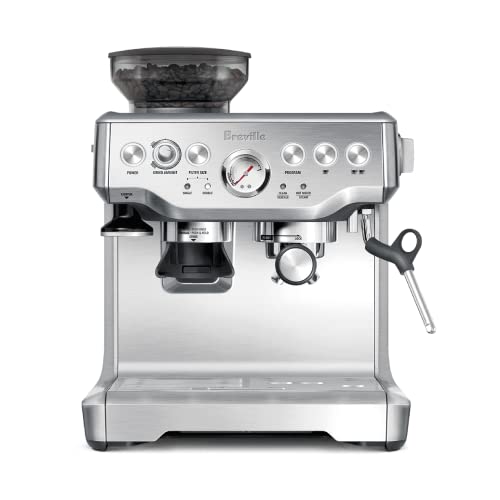
The Breville Barista Express is the benchmark for entry-level home espresso. It combines a 15 bar Italian pump with an integrated precision conical burr grinder, 30 grind settings, and a low-pressure pre-infusion cycle that evenly saturates the grounds before full extraction. The 54mm stainless steel portafilter accepts both single-wall (non-pressurized) and dual-wall (pressurized) filter baskets, letting you start with forgiving pre-ground coffee and progress to dialing in fresh beans.
Its digital PID temperature control ensures stable water temperature across multiple back-to-back shots, which is critical for consistent flavor. The powerful steam wand gives you manual control over microfoam texture, and the Razor Dose Trimming tool helps you achieve the correct dose weight in the basket every time. The 67 oz water tank is generous, and the built-in tamper stores neatly in the machine body.
The main compromise is the learning curve. Beginners must master the grind-to-dosing workflow, and the grinder can clog with oily, dark-roast beans. Maintenance is non-negotiable: daily group head flushing, regular backflushing with a cleaning disc, and periodic descaling. Community reports suggest the O-ring and solenoid valve may need replacement after 1-2 years of heavy use, but these are affordable, user-serviced parts that extend the machine’s life for years.
Why it’s great
- Exceptionally consistent temperature and pressure for the price point.
- Integrated grinder with wide range allows you to dial in any roast.
- Durable build with strong community support and available replacement parts.
Good to know
- Steeper learning curve compared to pressurized-basket machines.
- Grinder may struggle with very light or very oily beans.
- Requires regular cleaning and periodic part replacements.
2. De’Longhi Magnifica Start ECAM29061SB

The De’Longhi Magnifica Start is a super-automatic machine that handles the entire workflow from bean to cup. Its conical burr grinder offers 13 distinct settings, automatically dosing the correct amount for a single or double shot. The LatteCrema System textures both milk and alternative milks into dense, velvety foam, then dispenses it directly into your cup at the touch of a button for one of five pre-programmed recipes.
The 60 oz water tank is front-access and easy to refill, and the machine prompts you when the grounds bin or drip tray need emptying. The interface uses a simple touch panel and indicator lights rather than a complex screen, so you never need to scroll through menus. Long-term user reports indicate the machine survives 2+ years of daily use (4-5 drinks per day) with no breakdowns, as long as regular descaling and cleaning cycles are performed.
The trade-off for this convenience is a lack of manual control. You cannot easily pull a single shot with different beans mid-session, and the fixed brew group size means that larger cup volumes produce weaker coffee. The auto-clean cycle is water-intensive, and the bean hopper has no level indicator, so you may grind air mid-shot if you aren’t paying attention. It’s perfect for someone who prioritizes consistency and speed over the art of espresso.
Why it’s great
- One-button push for latte, cappuccino, or espresso.
- 13 grind settings allow flexibility across different bean origins.
- Milk carafe stores in fridge and handles dairy alternatives well.
Good to know
- Fixed dose volume means larger drinks can taste watery.
- No bean level indicator can lead to empty-hopper grinding.
- Descaling procedure is a detailed 15-step process.
3. Gevi 20 Bar Espresso Machine
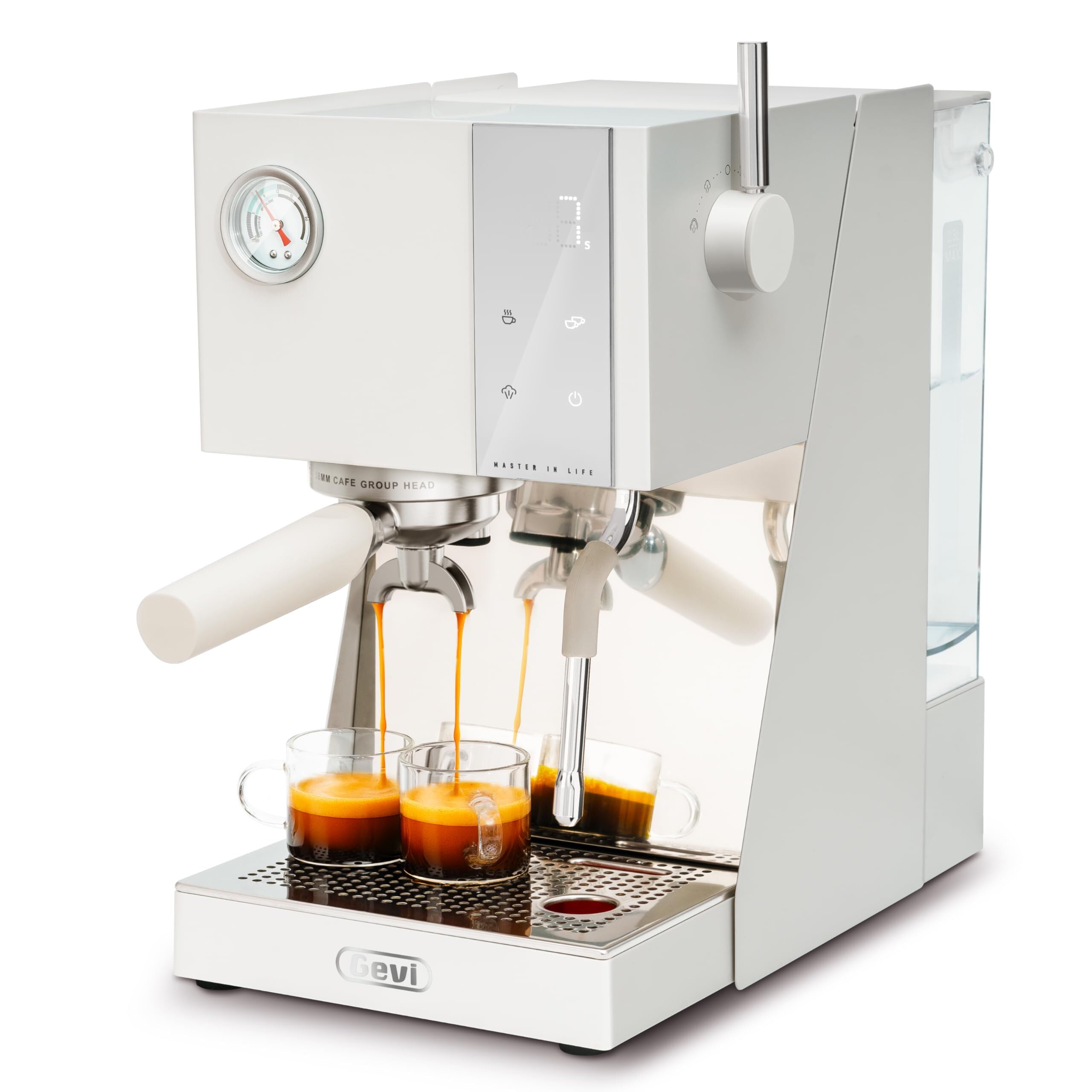
The Gevi 20 Bar delivers features typically reserved for machines costing twice as much. It uses a professional 58mm portafilter with both single-wall and dual-wall baskets, plus an Italian Ulka 20 bar pump paired with an OPV valve that opens to maintain the 9-12 bar sweet spot at the group head. The PID dual-chip system lets you select among three brewing temperatures (92°C, 94°C, 96°C), eliminating the sour or bitter notes caused by temperature swings.
The real-time touch display shows live shot timing, selected temperature, and pressure feedback, which is invaluable for learning how grind size and tamp pressure affect your shot. The 3-way solenoid valve relieves portafilter pressure immediately after brewing, producing dry, crumbly pucks instead of the muddy mess common on budget machines. The stainless steel steam wand produces powerful, dry steam for silky microfoam, and a stainless steel milk pitcher is included.
The 2.3-liter water tank is large, but the machine footprint is moderate at 15.5 inches deep. User reviews consistently praise the all-metal build quality and the quiet steam operation. The main drawback is that achieving perfect shots still requires a good external grinder, as the included pressurized baskets are adequate but not as capable as a dedicated burr grinder paired with the non-pressurized basket. The included tamper is better than most in its class but still feels light compared to aftermarket options.
Why it’s great
- PID, OPV, and 58mm portafilter at an aggressive price.
- 3-way solenoid valve creates dry, easy-to-clean pucks.
- Touch display with live shot timer aids the learning process.
Good to know
- Requires a good external grinder to unlock full potential.
- Steam wand is powerful but may need practice for latte art.
- Footprint is slightly larger than ultra-compact options.
4. De’Longhi Dedica Maestro Plus

The De’Longhi Dedica Maestro Plus packs a 15 bar professional pump, Advanced Thermoblock heating, and an automatic steam wand into a body only 8 inches wide. The thermoblock heats to brewing temperature in around 30 seconds, and the Active Temperature Control offers three settings to match different roast levels. The steam wand automatically textures milk to one of three foam densities, and it performs a self-purge when you return it to the park position.
The kit includes both pressurized and non-pressurized baskets, a professional tamper, a stainless steel milk jug, and a cleaning brush — everything needed to start immediately. The dishwasher-safe drip tray and water tank make cleanup simple. The Dedica accepts both ESE pods and ground coffee, offering flexibility for rushed mornings. The 54 oz removable water tank is generous for the machine’s tiny footprint.
Community reports indicate that the automatic steam wand, while convenient, produces foam that is slightly wetter than what a skilled manual wand achieves. The machine does not include a hot water dispenser; to get hot water you must route it through the steam wand. A subset of users report internal water leaks within the first year, which suggests quality control can be inconsistent. Still, the combination of size, speed, and automatic frothing is unmatched for truly tight countertops.
Why it’s great
- Ultra-compact footprint at only 8 inches wide.
- 30-second heat-up time from cold start.
- Automatic steam wand with three foam density settings.
Good to know
- Some units may experience internal water leaks over time.
- Auto-froth texture is good but not as dry as manual microfoam.
- No dedicated hot water spout.
5. Chefman Crema Supreme

The Chefman Crema Supreme integrates a conical burr grinder with 30 grind settings and a semi-automatic espresso unit into one heavy stainless steel chassis. The 15 bar pump produces rich espresso, and the touchscreen interface with a pressure gauge display lets you monitor extraction in real-time. The 58mm portafilter includes both single and double shot baskets, and you can set brew temperature and shot volume to your preference.
The 3-liter removable water tank is the largest in this group, making it ideal for entertaining. The machine includes a full accessory kit: milk pitcher, stainless steel tamper, a grinding funnel to reduce mess, and cleaning tools — all stored in the detachable drip tray. User reports note that the learning curve is manageable, with most pulling a drinkable shot within two attempts, and the flavor profile beats pod-based or Ninja Luxe alternatives at similar price points.
The grinder is capable but requires regular cleaning to prevent clogging, especially with oily beans, and some users find the frother loud during operation. The portafilter lock can be tight for those with limited hand strength. The small milk pitcher included is functional but undersized for large drinks. The machine also vibrates cups off the warming platform, easily fixed by placing a silicone coaster beneath the cup.
Why it’s great
- 30 grind settings plus 3-liter tank for high-volume use.
- Touchscreen with pressure gauge for visual brewing feedback.
- Full accessory set included, stored neatly in the drip tray.
Good to know
- Grinder needs frequent cleaning to maintain consistency.
- Frother is noticeably loud during operation.
- Portafilter lock can be stiff for some users.
6. Philips Baristina

The Philips Baristina is designed to minimize the steps between wanting a coffee and drinking it. You load whole beans into the hopper, swipe the handle forward, and the machine grinds a precise dose directly into the portafilter, tamps it, and brews. The 16 bar pump extracts a bold flavor, and the machine offers three shot types: Espresso, Lungo, and Extra Intense. The entire process takes less than 60 seconds from start to finish.
Its compact footprint (7 inches wide) fits easily into crowded kitchens, and the sustainable design uses over 50% recycled plastics without feeling cheap. User feedback highlights that the grinder performs best with medium-roast beans, and the crema quality is competitive with manual-entry machines in the same range. The lack of a separate steam wand simplifies cleaning—just rinse the sealed brew group under running water.
The durability reports are mixed. Multiple verified reviews report the machine failing within 6 to 8 months due to water leaking from the portafilter area or pressure loss. The single-shot-only design means you must run two cycles for a double shot, which slows down the workflow. The plastic body and portafilter handle feel less premium than the all-metal competitors, and the machine tends to slide on smooth countertops. It earns its place as a budget-friendly option for those who value absolute speed over long-term investment.
Why it’s great
- Single-swipe workflow is the simplest of any bean-to-cup machine.
- Very compact, fitting where larger machines cannot.
- No separate steam wand means minimal daily cleaning.
Good to know
- Mixed long-term reliability reports with water leak issues.
- Single-shot only; need to brew twice for a double latte.
- Plastic construction and sliding feet can feel flimsy.
7. CASABREWS Ultra
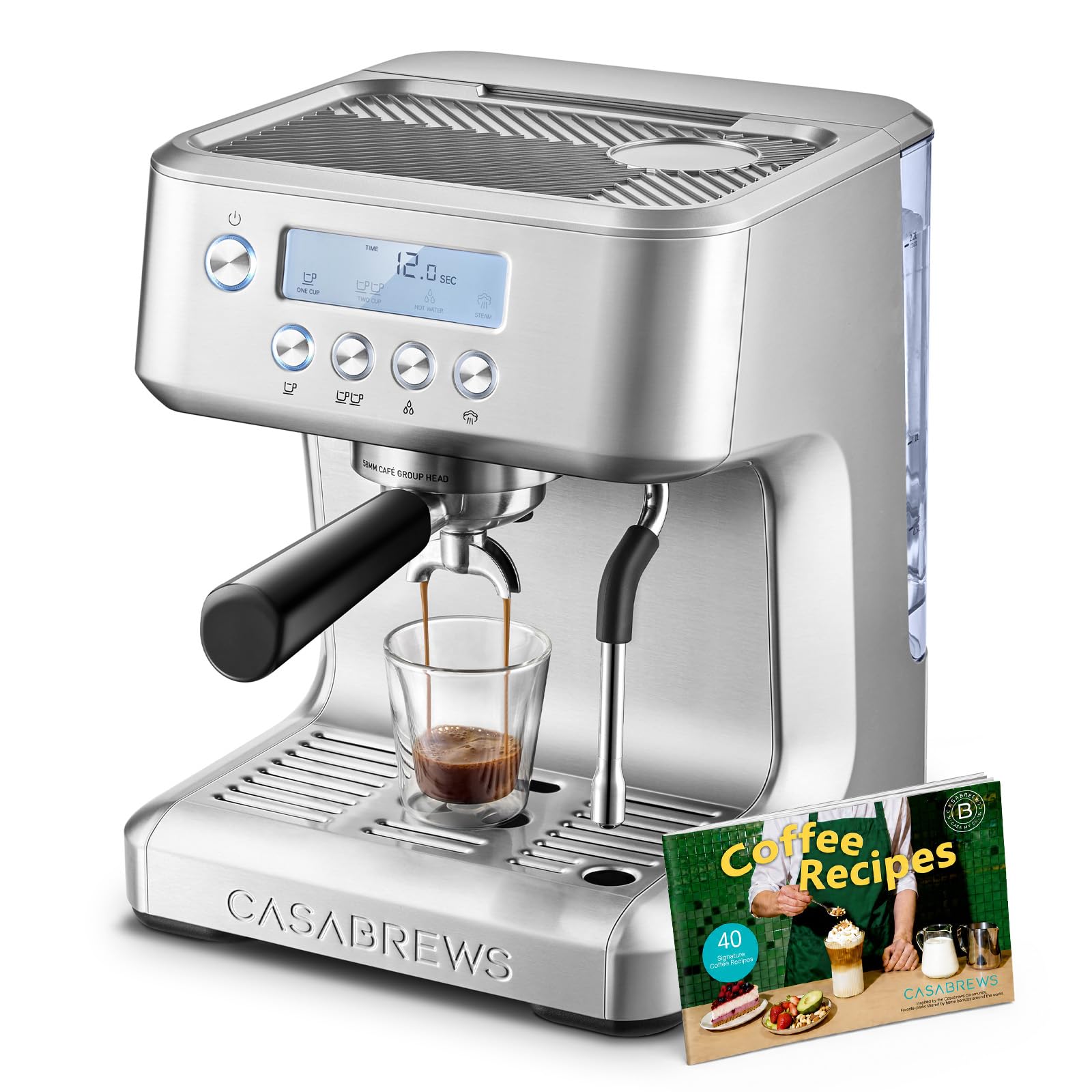
The CASABREWS Ultra brings a 58mm professional portafilter and a 20 bar Italian pump to a mid-range price point. The all-metal portafilter feels substantial in hand, and the machine accepts both single-wall and dual-wall baskets, giving the new home barista a clear path from pressurized convenience to non-pressurized precision. The LCD display with push-button controls makes navigation simple: you select your shot, steam, or hot water with one press.
What sets the Ultra apart is the 73 oz removable water tank, the largest on this list, minimizing refill frequency for households brewing multiple drinks daily. The adjustable brew temperature with four presets allows you to compensate for different roast levels — a feature usually reserved for more expensive machines. The steam wand produces decent microfoam, and the hot water function is useful for preheating cups or making Americanos.
The included plastic tamper feels cheap compared to the metal portafilter, and users recommend upgrading to a 58mm aftermarket tamper. The machine does not have a 3-way solenoid valve, so the puck will be wetter and messier than on the Gevi. The dual-spout portafilter is functional but can create a narrow drip window that causes side-splashing with large mugs. It is a solid all-around choice for the beginner who wants room to grow without leaving the sub- tier.
Why it’s great
- Generous 73 oz water tank for extended brewing sessions.
- 58mm professional portafilter at an approachable price.
- Adjustable brew temperature with LCD display.
Good to know
- No 3-way solenoid valve leads to wetter pucks.
- Included tamper is lightweight plastic; budget for an upgrade.
8. CASABREWS 5418 PRO
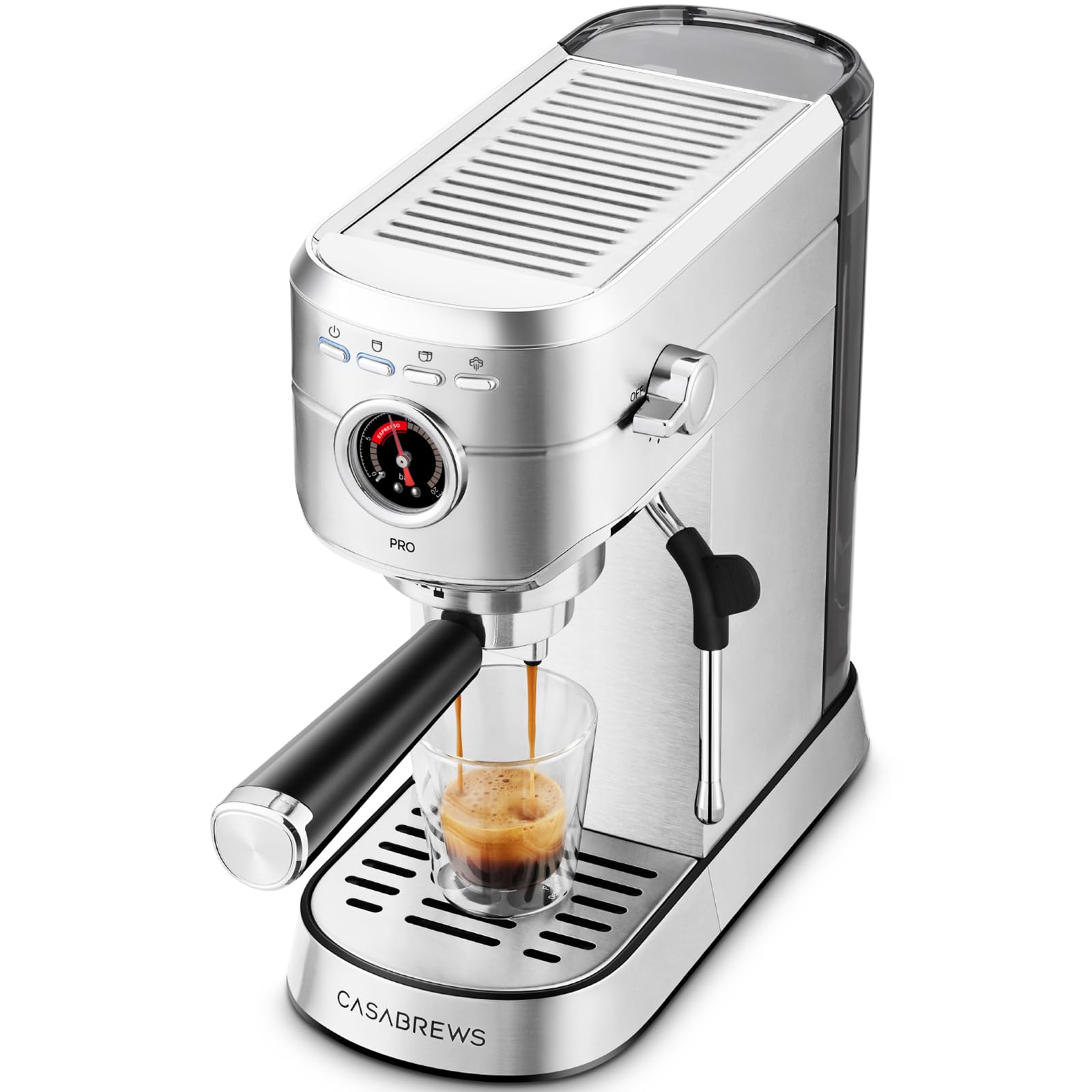
The CASABREWS 5418 PRO centers on FlashHeat technology, which reaches optimal brew temperature in under 5 seconds. This is paired with 3-second rapid steam switching, meaning you can go from pulling a shot to steaming milk in a few seconds, then switch back equally fast. Traditional budget machines take 30 seconds or more for this transition, making the 5418 PRO uniquely fast for consecutive drink preparation.
The 20 bar pump with pre-infusion and a built-in pressure gauge allows beginners to watch extraction pressure and adjust their technique. The machine body is brushed stainless steel with a compact footprint (5.9 inches wide, 12.3 inches deep), fitting easily under standard cabinets. The steam wand produces dry, powerful steam, and the auto shut-off function adds peace of mind. Users report pulling perfect shots with exceptional crema consistently, particularly with non-oily fresh beans.
The trade-offs are significant. The water tank is hidden at the rear with poor visibility, making refill tracking difficult. The machine is lightweight (8.4 pounds) and has low-friction feet, causing it to slide across the counter when locking the portafilter — user reports suggest placing it on a silicone mat. It cannot brew and steam simultaneously, and you must run a blank shot during warm-up to stabilize temperature. The pressurized baskets limit true espresso quality, and the included tamper is basic.
Why it’s great
- Sub-5-second heat-up is the fastest in this class.
- 3-second steam-to-brew switching speeds up workflow.
- Pressure gauge provides real-time extraction feedback.
Good to know
- Lightweight construction slides on countertops when locking basket.
- Cannot brew and steam at the same time.
- Water tank location is hard to see for level checking.
9. HiBREW H10B
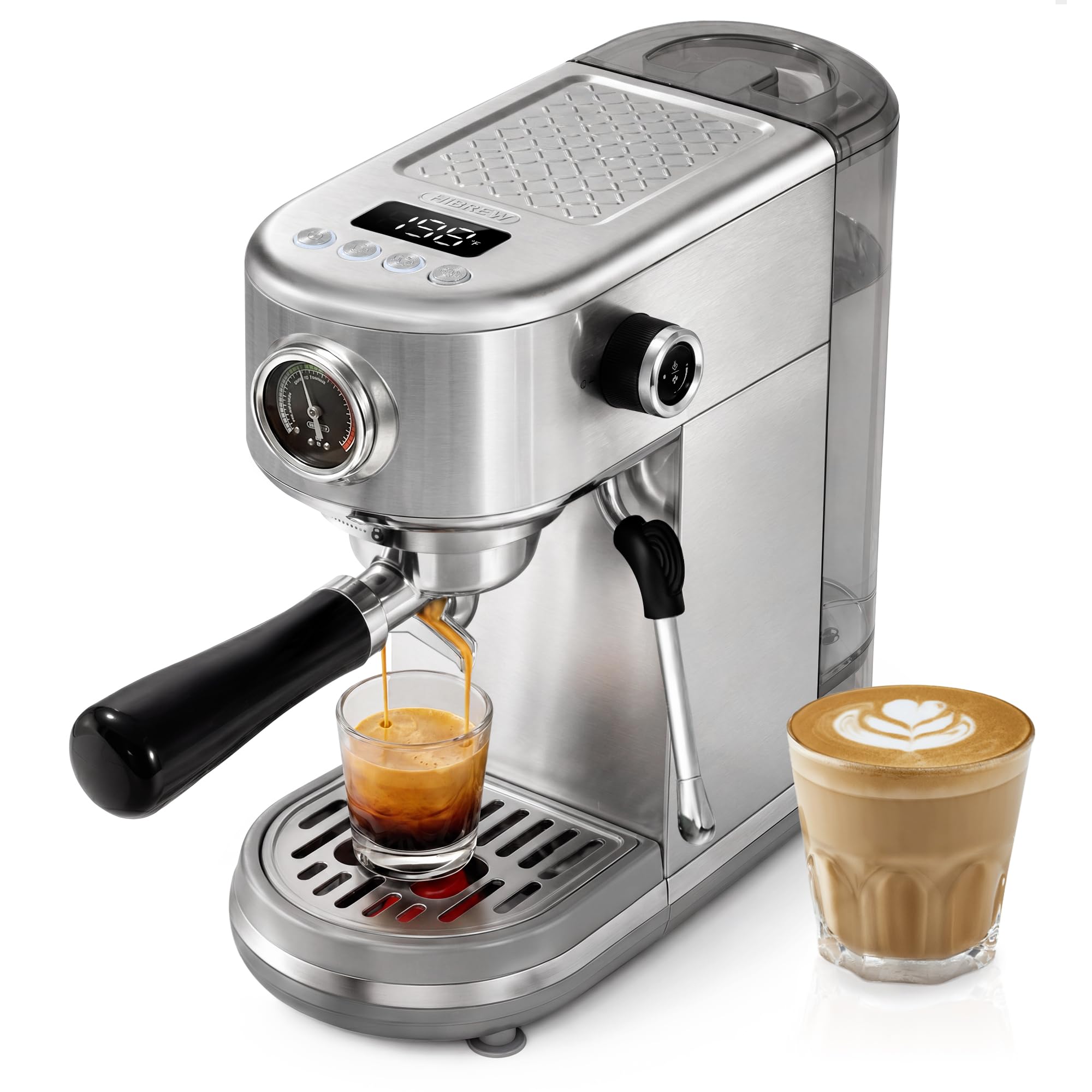
The HiBREW H10B is a semi-automatic with a full digital control suite: you can adjust extraction temperature from 194°F to 204°F, set single or double shot volume, and tailor pre-infusion duration. The NTC temperature sensor paired with the 20 bar pump maintains stable pressure, and the built-in pressure gauge gives real-time visual feedback, helping you learn the relationship between grind, tamp, and flow. The stainless steel steam wand operates at 257°F–302°F for strong microfoam.
The machine includes both pressurized and non-pressurized baskets, plus a dual-wall precision basket that is effective for beginners. The compact brushed stainless steel body (5 inches wide) is the narrowest on this list, ideal for tight coffee nooks. The suction feet grip the counter firmly, solving the sliding issue common in other budget machines. Long-term users report the machine surviving over a year of daily use with consistent espresso quality and good customer support.
The 51mm portafilter is non-standard, meaning it is harder to find aftermarket bottomless portafilters. The 44 oz water tank is on the smaller side for busy kitchens, and the clearance beneath the group head is limited — large travel mugs may not fit. The grinder-finding process is essential, as the pressurized basket requires a coarser grind than the non-pressurized. The machine also displays an E-2 error occasionally, fixable by a simple button sequence.
Why it’s great
- Fully adjustable brew temperature, volume, and pre-infusion.
- Narrow footprint at just 5 inches wide.
- Suction feet prevent sliding during portafilter locking.
Good to know
- 51mm portafilter limits aftermarket upgrade options.
- Water tank is small at 44 oz.
- Low clearance under group head for tall cups.
FAQ
Can I use pre-ground coffee from a grocery store with a beginner espresso machine?
Is a more expensive machine always better for a beginner?
Do I need a separate grinder for the Breville Barista Express?
How often should I descale a beginner espresso machine?
What does OPV do and why does it matter for a beginner machine?
Final Thoughts: The Verdict
For most users, the beginner espresso machine winner is the Breville Barista Express BES870XL because its integrated grinder, stable PID temperature control, and dual-walled basket system provide a complete education in espresso from day one. If you want super-automatic convenience without touching a portafilter, grab the De’Longhi Magnifica Start. And for the purest value-to-feature ratio, where you get a 58mm portafilter, PID, and OPV at a budget-friendly price, nothing beats the Gevi 20 Bar Espresso Machine. Each machine has a clear home on your counter — the right one depends on how much of the process you want to own.