
Our readers keep the lights on and the weekend projects moving. As an Amazon Associate, I earn from qualifying purchases.
Specs are compiled from manufacturer listings and verified buyer reviews and can change over time — please confirm the key details on the product page before buying.
Starting flute lessons is exciting, but picking the right instrument can feel like a gamble — especially when you are not sure if the shiny model you are looking at will even play a clean scale. The good news is that a solid beginner flute seals tight across every pad, lets you hit a clear low C on the first try, and does not fight you as you move up the register. That is exactly what this guide sorts out for you.
I am Rikta, the writer behind FitlyFast. This guide is built from the manufacturers’ published specifications and verified customer reviews, so you get each pick’s real strengths and trade-offs instead of marketing spin.
A dependable instrument changes everything for a new player. Finding the best beginner flute means looking at sealing, key action, and how forgiving the embouchure hole (the opening you blow across) is before you even think about brand names.
Quick Picks
- Jean Paul USA Silver Plated Flute (FL-220) — Best Overall
- AKLOT Closed-Hole Concert C Flute (LUM-MV) — Premium Value
- Mendini By Cecilio Flute (MFE-N-PB-SD) — Best Starter Kit
- EastRock Closed Hole Flutes C 16 Key — Budget Champion
- POGOLAB Closed Hole C Flute (M02659SB) — Best Color Choice
- Rhythm C Flutes with Engraved Flower Closed Hole — Decorative Pick
How To Choose The Best Beginner Flute
Buying your first flute is not about getting the shiniest model — it is about getting one that lets you make music without fighting the instrument. A flute with air leaks, sticky pads (the cushioned covers that seal the tone holes), or awkward key spacing will discourage a new player fast. Here is what actually matters before you buy.
Closed-Hole (Plateau) Keys Are Your Friend
Closed-hole flutes have solid keycaps with no holes, so you do not need to perfectly cover an open hole with your fingertip. This removes a major frustration for beginners and lets you focus on breath control and finger placement. All six picks here are closed-hole models for exactly this reason. Some brands call it a “plateau” system — same thing, less fuss.
Offset G Key: Comfort for Your Left Hand
The G key on a flute sits under your left ring finger. On an offset G model, that key is moved slightly toward your palm, which relaxes your wrist and eliminates the stretch that causes hand fatigue during practice. Every flute in this list uses an offset G, so your left hand stays comfortable during longer sessions.
Pad Sealing and Spring Quality
Air-tight pads are what let you hold a note steady. Beginners often blame themselves when a note sounds fuzzy, but the real culprit is often a pad that does not seal completely. Look for leather or double-bladder pads (two layers of material) rather than basic felt — they last longer and resist moisture from your breath. Stainless steel springs give consistent key action that does not weaken over time.
Quick Comparison
| Model | Best For | Weight | Material | Key Mechanism | Amazon |
|---|---|---|---|---|---|
| Jean Paul USA FL-220 | Premium entry-level quality | 1.2 Pounds | Silver-Plated | Offset G + Split E | Amazon |
| AKLOT LUM-MV | Leather case + leak-free build | 0.97 Kilograms | Silver-Plated | Offset G | Amazon |
| Mendini by Cecilio MFE-N-PB-SD | Complete kit with lesson book | 2 Pounds | Nickel-Plated | Offset G + Split E | Amazon |
| EastRock Closed Hole C Flute | Budget-friendly starter | 1 Kilograms | Cupronickel / Silver-Nickel | Offset G + Split E | Amazon |
| POGOLAB M02659SB | Vibrant color for younger players | 1.12 Kilograms | Nickel | Offset G | Amazon |
| RHYTHM Engraved Flower Flute | Decorative look with extra accessories | 1.12 Kilograms | Cupronickel | Offset G | Amazon |
In‑Depth Reviews
1. Jean Paul USA Silver Plated Flute (FL-220)

This flute arrives ready to play, not in a box that needs fixing first.
You want an instrument that lets you focus on learning, not on fighting air leaks or sticky keys. The Jean Paul FL-220 delivers that because each flute is set up and play-tested by NAPBIRT-certified technicians (professionals certified by the National Association of Professional Band Instrument Repair Technicians). Buyers report the feel and sound rival more expensive flutes. One reviewer noted a professional player was impressed with its tone and build quality.
The silver-plated body (a thin layer off silver over the metal) gives you a brighter, clearer tone than nickel alone. The offset G key (the G key under your left ring finger is moved closer to your palm) makes hand position more natural. The closed-hole keys are ideal for beginners because you never have to perfectly seal an open hole with your fingertip. A split E mechanism (a separate key for the third-octave E — the high E above the staff) makes that high note easier to produce cleanly without extra finger contortions.
At 1.2 pounds, this flute feels solid but not heavy. The included case keeps it protected between lessons. The trade-off is that the FL-220 lacks open-hole keys for advanced players, but as a beginner you do not need those for years. Unlike the budget options below, this flute avoids the small tolerance issues that sometimes cause sharp or flat notes in the upper register. Reviewers consistently say the tuning holds steady across the entire range.
What You Get For Your Money
- Silver-plated body produces a bright, clear tone that intermediate players can keep using
- Split E mechanism makes high E easier for beginners to hit consistently
- Expert setup means almost zero adjustment needed from the start
- Plays low C better than many competing beginner flutes, per multiple reviews
A Few Honest Caveats
- Lacks advanced open-hole keys for later-stage players (not a concern for beginners)
- A small cosmetic blemish or missing accessory can occur with Amazon-returned stock — contact Jean Paul directly if needed
Buy this for: A flute that plays like a much pricier model and comes set up correctly from day one. It is built to carry a student from beginner to intermediate level without needing to upgrade.
Where it hits its limit: Advanced players will eventually outgrow the closed-hole design, but that is two to three years down the road for most beginners.
2. AKLOT Closed-Hole Concert C Flute (LUM-MV)
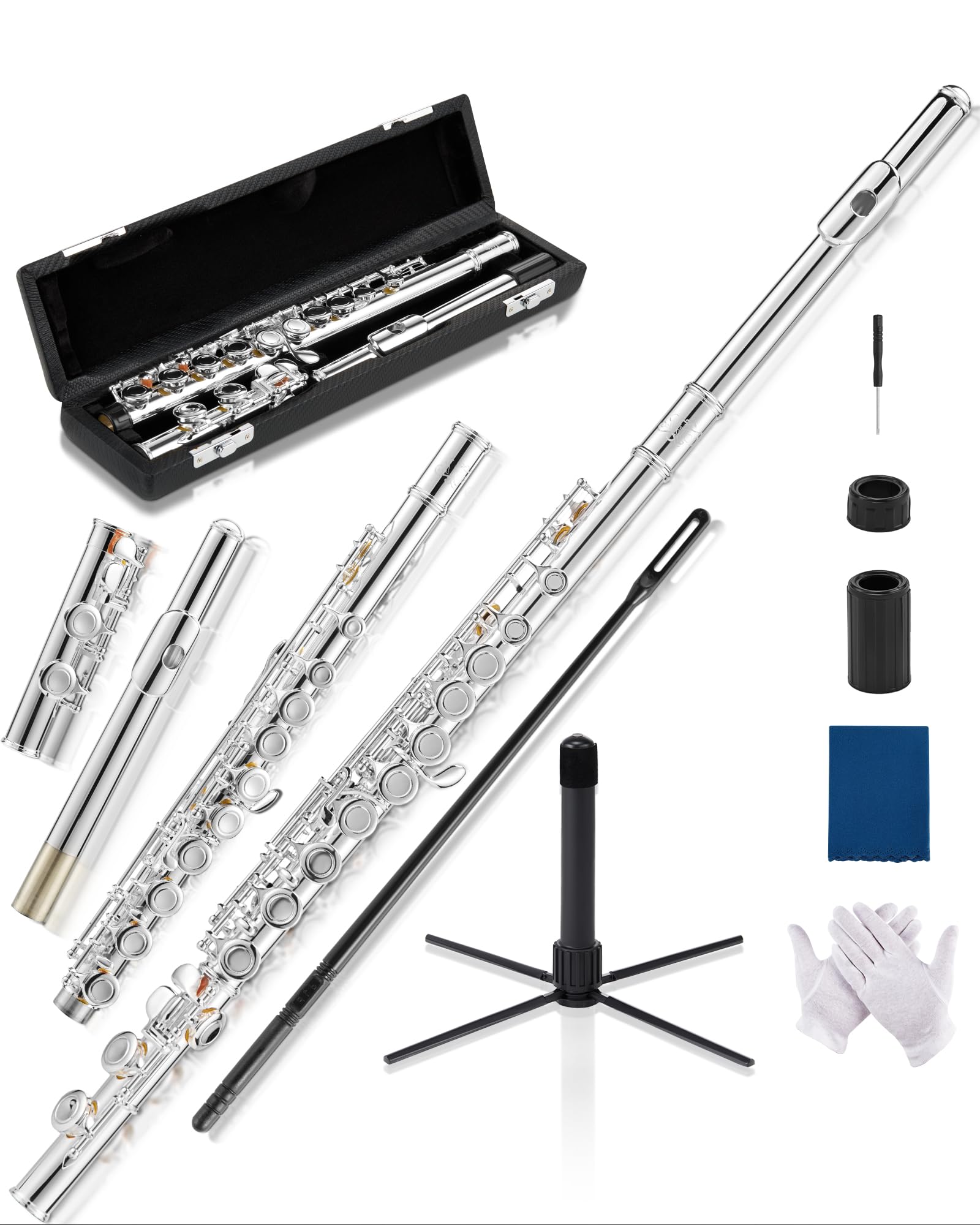
The leak-free build that reviewers call “incredibly well made” for the money.
AKLOT packs features that usually stay in higher price brackets: a silver-plated body, air-tight leather pads, and a leather hard case that feels more like a pro accessory than a student kit. One buyer wrote that the “assembly of the parts is flawless, sound is great,” and mentioned the third octave is easy to reach — rare praise for a flute in this tier. At 0.97 kilograms, this is lighter than the POGOLAB (1.12 kilograms), which makes a noticeable difference during longer practice sessions for younger players.
The offset G key and straight headjoint (the section you blow into is a straight tube rather than curved) help you develop proper hand position and breath control without strain. Each flute is leak-tested from the factory, so you are less likely to chase air leaks while trying to hold a note. The bright, clear sound profile (what the manufacturer describes as “high frequency focused”) carries well in a school band setting.
The one area where it trails the Jean Paul above is the lack of a split E mechanism — so hitting the third-octave E requires slightly more breath support. But for the included accessories (a portable flute stand, polishing cloth, gloves, and that leather hard case), the AKLOT delivers a refined package that does not feel like a beginner compromise.
Why This Stands Out
- Silver-plated body and headjoint for a resonant, focused tone
- Leather hard case provides better protection than the standard fabric cases bundled with most budget flutes
- Air-tight leather pads tested at the factory reduce frustrating air leaks
- Balanced key spacing and stainless steel springs for consistent key feel
Things To Keep In Mind
- No split E mechanism — high E requires more breath control than the Jean Paul or Mendini
- A few buyers noted intonation shifts on the very highest notes, though still fine for a beginner instrument
Reach for this if: You want a complete, handsome set that feels more premium than its price suggests, and you value leak-free performance from the start. Excellent for a student who needs to pack up and carry the flute daily.
Look elsewhere if: Getting the easiest possible high E is your priority — the Jean Paul or Mendini will give you that with their split E keys.
3. Mendini By Cecilio Flute (MFE-N-PB-SD)
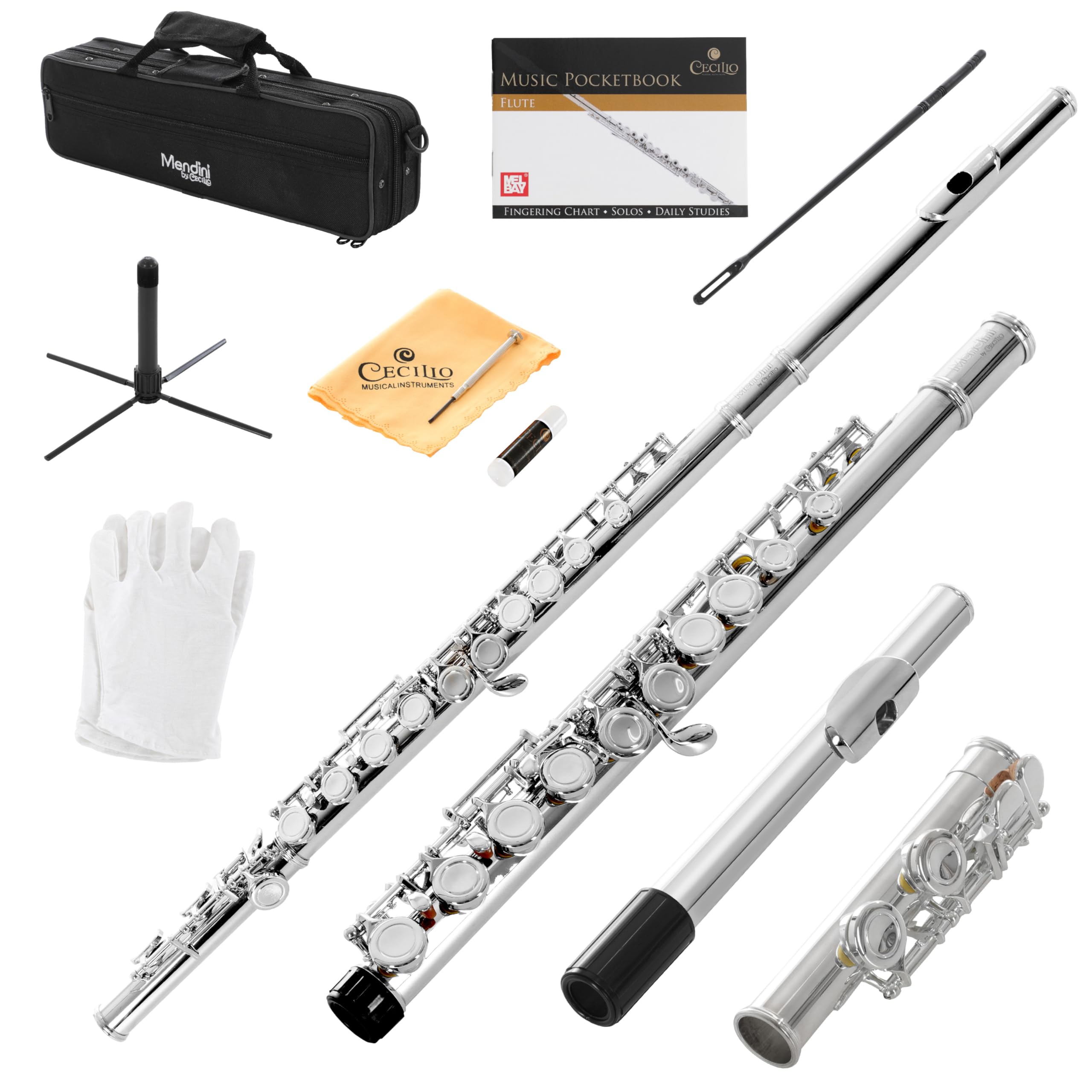
The complete beginner package that throws in a lesson book and stand along with the flute.
Mendini’s flute kit comes with everything a first-time player actually needs: the flute, a durable case, a folding stand, joint grease, a cleaning rod, gloves, and a pocket-sized lesson book that covers how to hold the instrument and basic maintenance. An advanced-level reviewer who owns a Pearl and a Yamaha wrote that this flute “exceeds expectations” with a clear tone across the range and a “crisp high register.” The offset G and split E keys (the same key mechanism found on the premium Jean Paul above) make high notes easier to produce without extra effort.
The body is nickel-plated rather than silver (which mutes the tone slightly versus the Jean Paul or AKLOT), but the double-bladder pads (two layers of material instead of one) give good air sealing that beginners need to hold steady notes. The flute weighs 2 pounds, while the AKLOT is listed at 0.97 kilograms, which young players may feel during long practice sessions.
The honest catch: durability is the main concern here. This is best viewed as a “starter that gets you through early learning stages” rather than a multi-year investment. But for checking whether flute lessons are right for you or your child, the value is tough to top.
The Kit Highlights
- Split E mechanism and offset G make high notes and hand position easier
- Pocket lesson book included — a thoughtful extra that other kits skip
- Double-bladder pads reduce air leakage for better sound quality
- Available in 6 colors including purple, blue, and pink
The Durability Reality
- Fragile construction — a single drop can break lower keys and cost more to fix than the flute is worth
- Nickel lip plate can leave stains on the chin over time
- Black coating on some color variants may peel after extended use
Best use case: Grab this if you or your child are trying lessons for the first time and want a full kit with a lesson book to start immediately, without spending hundreds. Treat it as a trial instrument.
When to pass: If you need a flute that can survive at least a couple of years of middle school band without repairs, go with the Jean Paul or AKLOT instead.
4. EastRock Closed Hole Flutes C 16 Key

The sub- flute where one buyer mentioned they could “easily play the lowest note, C.”
The EastRock proves that you do not need to spend much to get a functional starter instrument. Its cupronickel body (a copper-nickel alloy that resists corrosion) with silver-nickel plating gives decent resonance without the cost of full silver-plating. The 16 keys include an offset G and a split E mechanism — features you normally only see on pricier models. One satisfied buyer specifically praised that low C, noting it “was hard to get on the other more expensive flute that I was playing.”
The undercut beveled embouchure hole (the opening on the mouthpiece has a slight inward angle that helps air flow respond faster) makes producing a first clear note easier compared to flutes with a simple straight cut. The double-bladder pads and memory springs (springs that return to shape consistently after being pressed) give reasonable air seal and key action. The EastRock is also available in multiple colors that resist chipping better than some painted models.
The catch: a few buyers reported finding black residue and metal shavings inside the mouthpiece that needed to be cleaned out before playing. The included stand is mediocre — fine for holding the flute at home but not for transport. For the money, though, this flute delivers more features (split E, offset G, memory springs) than most flutes at its price point.
The Value Punch
- Split E and offset G at budget pricing — rare find in this price tier
- Memory springs keep key action consistent without weakening over time
- Cupronickel body with silver-nickel plating provides good tonal resonance
- Double-bladder pads minimize air leakage for a better beginner sound
The Budget Trade-Offs
- Residue or metal shavings can be found inside — needs a thorough clean before first use
- Included stand is not durable enough for daily gigging or travel
- No slide grease included (you may need to buy your own)
Go for this if: Your budget is tight but you do not want to skip the split E and offset G features that make early practice easier. A good first flute that you can upgrade from later without guilt.
skip it if: You want a sit-down-and-play experience without cleaning or adjusting anything first — the Jean Paul or AKLOT are better suited for that.
5. POGOLAB Closed Hole C Flute (M02659SB)

The sky-blue student flute that one buyer called a “great bargain for beginners.”
POGOLAB targets the young student directly with a vibrant sky-blue body that stands out in a school band. The polished nickel body has anti-oxidation treatment (a surface coating that slows tarnishing from moisture and sweat), and the sheep casing bladder leather pads (pads made from treated sheep leather that hold air better than felt) give richer sound quality than basic felt pads. At 16.73 x 5.71 x 3.27 inches, the dimensions are slightly bigger than the AKLOT (16.54 x 5.12 x 2.56 inches) but still manageable for younger hands.
The undercut beveled embouchure hole design (the mouthpiece opening has a slight inward slope that directs air more efficiently) makes producing a clear tone easier for new players. The offset G key provides a more ergonomic left-hand position. Owners mention it is a “good backup flute” but also mention “harder top notes vs. Yamaha” — meaning the upper register requires more breath support compared to more expensive models. The kit does include a cleaning rod, gloves, strap, and carry bag, though one owner reported the cleaning rod was missing from their kit.
Compared side-by-side with the Rhythm flute below, the POGOLAB is slightly shorter (16.73 inches vs 16.73 inches — the same) but the Rhythm weighs 1.12 kilograms versus the POGOLAB’s 1.12 kilograms (identical). The real difference is color variety and key feel — the POGOLAB’s pads seal well but the tone is slightly “off” per some reviews, though fine for a novice who is still developing their ear.
What Makes It Fun To Play
- Sky blue finish stands out and makes practice feel more personal for younger students
- Sheep casing bladder leather pads give better air seal than basic felt pads
- Anti-oxidation coating helps the flute resist tarnish from saliva moisture
- Offset G key provides natural, comfortable hand position
Where It Lags Behind
- Upper register requires more effort and breath support than pricier alternatives like the Jean Paul
- Some units arrive with sticky keys or missing cleaning rod — check your kit immediately after opening
Best for: A young student who is excited by a colorful instrument and needs an affordable flute to practice on at home and in school band.
Not ideal for: A player who needs easy access to high notes from the start — the Jean Paul or EastRock are better for that with their split E mechanisms.
6. Rhythm C Flutes with Engraved Flower Closed Hole

The engraved flower flute looks beautiful on a stand but has noisy keys.
Rhythm’s flute catches the eye with engraved floral detailing on the cupronickel body (a copper-nickel alloy that offers reasonable tonal resonance). The package is generous: a lightweight hard case, a foldable stand, joint grease, tuning rod, cleaning cloth, and gloves. At 1.12 kilograms, it matches the POGOLAB’s weight but the engraving makes this one stand out as a visual gift option. Customers note the painted finish can show “some light chipping of the paint after a few months where the pieces connect.”
The offset G key and closed-hole design are standard for this class, and the instrument plays a solid scale across the middle register. A reviewer who played flute in high school said the “sound is great” and found it a good practice instrument. However, a more detailed review flagged that “keys are noisy, especially C to D transition; pads hit holes loudly” — meaning the pad cushioning is not as quiet as on the AKLOT or Jean Paul. This does not affect playability, but you will hear a mechanical clicking sound as you play certain notes.
If you are choosing between this and the POGOLAB, the Rhythm gives you a more distinctive look with the engraving but the POGOLAB has quieter pad action. Neither has a split E mechanism, so high notes require more finesse compared to the EastRock or Mendini.
Why You Might Choose This One
- Engraved flowers give a unique, elegant look that standard silver flutes lack
- Includes a standalone foldable stand for display and easy access during practice
- Lightweight hard case provides better protection than soft bags
The Noise Issue
- Keys produce a clicking sound, especially when transitioning between C and D notes
- Painted finish can chip at connection points after a few months of use
- No split E mechanism — upper register requires more breath control
The right buyer: Someone who values the decorative look and wants a full accessory package as a gift. It plays well enough for a beginner to practice on without embarrassment.
The honest limitation: The noisy key action and potential paint chipping make this a weaker everyday workhorse compared to the AKLOT or EastRock at a similar price.
Understanding the Specs
Closed-Hole (Plateau) Keys
Closed-hole keys have a solid surface across the key cap — no hole for your fingertip to seal. This lets beginners focus on finger placement and breath without worrying about perfectly covering an open hole with fingertip positioning. All student flutes start with closed-hole keys because they remove one variable from early practice. The alternative, open-hole (French) keys, come on intermediate and professional flutes where the player already has precise finger placement.
Offset G vs Inline G
The G key sits under your left ring finger. On an offset G flute, that key is positioned just slightly toward your palm, reducing the stretch and keeping your wrist in a straighter, more relaxed position. An inline G sits in a straight line with the other keys, which requires a longer reach and more wrist angling. Every flute in this list uses offset G because it dramatically reduces hand fatigue during practice sessions.
Split E Mechanism
The split E is a small extra key that splits the standard E key into two separate pads so that when you play the third-octave E (the high E above the staff), the mechanism creates a smaller opening that lets the note speak more easily. Without it, beginners often struggle to produce that E cleanly. It is a minor mechanism that makes a major difference in confidence during early playing.
Embouchure Hole Design
The embouchure hole is the opening on the headjoint where you blow across the edge to produce sound. An undercut bevel means the inside of the hole has a slight angled slope that helps beginners direct air more efficiently and produce a tone with less effort. Flutes with a straight cut (no bevel) require more precise air direction that takes months of practice to develop.
FAQ
Is a closed-hole or open-hole flute better for a beginner?
How many keys should a beginner flute have?
What does offset G mean and do I need it?
What is the split E key and why does it matter?
Should I choose a nickel or silver-plated flute as a beginner?
Do I need a flute stand and case included in the kit?
Why does my new flute have metal shavings or black residue inside?
How long should a beginner flute last before I need to upgrade?
Can I take a budget flute to a repair shop for adjustment?
What accessories should come with a beginner flute kit?
Final Thoughts: The Verdict
For most beginners, the winning beginner flute is the Jean Paul USA FL-220 because it arrives set up by certified technicians, features a silver-plated body for a bright tone, and has both offset G and split E mechanisms to make early practice smoother. If you want a complete kit with a lesson book and stand to start immediately, grab the Mendini by Cecilio. And for a premium-feel package with a leather hard case and leak-tested build at a mid-range price, the AKLOT LUM-MV is an excellent choice that does not feel like a compromise.
How We Picked
We do not accept paid placement. Every pick is matched to a real buyer and a real use-case; we do not hands-on test units.
Sources & Methodology
Specifications: manufacturer listings and product documentation. Review insights: verified customer reviews, as of July 2026. Pricing: not shown on this page (it changes often); check the current price via the retailer link.
As an Amazon Associate, FitlyFast earns from qualifying purchases. This does not affect which products we feature.