
Our readers keep the lights on and the weekend projects moving. As an Amazon Associate, I earn from qualifying purchases.
Smooth camera drones hover in place and beg for a gentle landing — a true racing drone punishes the throttle, carves through a gate at 35 mph, and screams back for another pass. That difference in DNA is exactly why the wrong first purchase leaves hundreds of beginners grounded within a week, nursing a broken frame and a bruised ego. A proper entry-level FPV rig needs a durable whoop-style frame, a flight controller that supports Acro mode, and the guts to tumble through the grass without quitting.
I’m Rikta — the co-founder and writer behind FitlyFast. I’ve spent countless hours dissecting flight controller specs, comparing camera latency figures, and reading through real crash reports from beginners to separate true FPV race platforms from re-badged camera drones wearing racing paint.
This guide breaks down nine models that actually belong on a race course or a practice field, not just a scenic overlook. Whether you want a ready-to-fly kit with goggles or a sub-250g ripper that sidesteps FAA paperwork, here is the definitive take on the best beginner fpv racing drone for your budget and ambition level.
How To Choose The Best Beginner FPV Racing Drone
Racing drones are built for speed, agility, and crash survival — three traits that directly oppose the hovering, GPS-stabilized camera drone most beginners assume they need. Understanding the hardware differences up front saves you a broken bank account and a broken quad.
Flight Controller & Firmware: Betaflight vs. Proprietary
A true racing drone runs an open-source flight controller firmware like Betaflight, which allows you to tune rates, adjust PID loops, and enable Acro (Rate) mode where the drone does not self-level. Proprietary controllers in camera drones lock you into beginner-friendly Angle mode only. For learning to fly FPV, you need a board that supports all three modes — Angle, Horizon, and Acro — so you can progress from stabilized hovering to full manual control.
Frame Durability & Weight Class
Sub-250g drones (under 249g) require no FAA registration, but frame design matters just as much. A ducted “whoop” frame protects props and motors in collisions, making it ideal for indoor practice and low-speed gate runs. Open prop frames are lighter and faster but snap on hard impacts. Beginners should prioritize a ducted or reinforced frame over raw speed.
True FPV Video: Analog vs. Digital Transmission
Many camera drones advertise “FPV” over Wi-Fi, which introduces 200–400ms of latency — unacceptably slow for racing. Real FPV racing drones use analog or digital video transmitters (VTX) that send live video directly to goggles with sub-40ms latency. If the kit includes goggles with a separate receiver module rather than a phone cradle, it is real FPV. If it relies on a mobile app, it is not suitable for racing.
Battery Connectors & Flight Time Reality
Racing drones use high-discharge LiPo batteries with specialized connectors (BT2.0, XT30, XT60). Flight times range from 3 to 8 minutes — far shorter than camera drones. A beginner should plan on buying at least four to six batteries per flying session. Kits that include a multi-battery charger or parallel charging board add immediate value.
Quick Comparison
On smaller screens, swipe sideways to see the full table.
| Model | Category | Best For | Key Spec | Amazon |
|---|---|---|---|---|
| BETAFPV Cetus Pro Kit | FPV Whoop Kit | Total FPV beginners | Turtle Mode, N/S/M flight modes | Amazon |
| Emax Tiny Hawk RTF | Micro Racing Whoop | Indoor & small-yard racing | 35 mph top speed, 200 ft range | Amazon |
| DJI Avata Pro-View | Cinematic FPV Cinewhoop | Immersive cinematic FPV | 155° FOV, 1/1.7-inch sensor | Amazon |
| DJI Neo Motion Fly More | Self-Flying FPV Combo | Palm takeoff & controller-free flying | 135g, Goggles N3, RC Motion 3 | Amazon |
| Holy Stone HS360S | GPS Camera Drone | Beginner aerial photography | 249g, 10,000 ft range | Amazon |
| Potensic ATOM SE | Camera Drone | Budget-friendly 4K flying | 62 min flight (2 batteries) | Amazon |
| Karuisrc K600GPS | Screen Controller Drone | Gift-friendly flying | 4.5-inch LCD on controller | Amazon |
| Punieayi GPS Screen Drone | Screen Controller Drone | Beginner with built-in screen | 60 min flight (2 batteries) | Amazon |
| Oddire 4K GPS Drone | Camera Drone | Beginner with waypoint missions | 48 min flight (2 batteries) | Amazon |
In‑Depth Reviews
1. BETAFPV Cetus Pro FPV Kit

The Cetus Pro is the gold standard for a first FPV kit because it includes everything — goggles, transmitter, and a brushless whoop — in one box. The three flight modes (Normal, Sport, Manual) let you start in stabilized Angle mode and graduate to full Acro without buying a second drone. Turtle mode is a lifesaver: when you crash upside down, you flip the quad back over from the transmitter instead of walking across the field. The ducted frame protects props during indoor wall taps, and the barometer-based altitude hold in Normal mode keeps the drone steady while you learn throttle control.
The VR02 goggles are low-resolution (480p) but perfectly adequate for learning, and the LiteRadio 2 SE transmitter runs the Frsky D8 protocol so you can bind it to simulators like VelociDrone on your computer. Flight time per battery is short — around 3 to 5 minutes on the included 450mAh BT2.0 packs — but the kit includes two batteries and a voltage tester. Most serious beginners buy four extra batteries and a 6-bay charger immediately after the first flight.
Multiple user reports confirm extreme durability: one unit survived full-speed crashes into walls and even a water submersion in a dog bowl with only a lost propeller. The frame does crack over time but continues flying without issue. The only real shortcoming is the fixed camera angle, which limits forward visibility at low speeds, though an aftermarket upgrade (BetaFPV CO3 camera) solves that for a small fee. For the pilot who wants a true FPV racing path from zero to freestyle, this kit is the most complete and crash-tolerant entry point available.
Why it’s great
- Three-mode flight controller (Angle → Acro) accommodates skill progression without a second purchase.
- Turtle mode flips the drone over remotely after a crash, saving endless walks.
- Ducted whoop frame survives repeated indoor impacts with only minor prop damage.
Good to know
- Stock camera has narrow FOV; upgrading to the BetaFPV CO3 dramatically improves forward visibility.
- Flight time is 3-5 minutes per battery; plan to buy at least 4-6 packs for a decent session.
- No orientation LEDs make it easy to lose heading in bright daylight.
2. Emax Tiny Hawk RTF

The Tiny Hawk RTF is an authentic FPV racing micro that hits 35 mph out of the box — genuine race speed, not marketing speed. The kit includes goggles, a transmitter, and the drone itself, so you can open the box and be flying a gate course indoors within ten minutes. The ducted prop design survives hundreds of hard crashes, including full submersion in water according to multiple owner reports, and the 200-foot range through obstacles is solid for a 25mW VTX. Real analog FPV means sub-40ms latency, not the half-second delay of Wi-Fi camera drones.
Betaflight compatibility is a major advantage here: you can connect the Tiny Hawk to your computer, adjust PID rates, and practice on simulators with the same radio protocol. The transmitter supports auto-level (Angle) and full Acro modes, so beginners can start stable and unlock flips and rolls as their thumbs improve. The biggest complaint is that the camera angle is fixed fairly high, which forces you to fly fast just to keep the horizon in view — a minor annoyance that actually teaches good throttle discipline.
Customer service experiences are mixed, with one isolated report of a transmitter range failure and difficult warranty support, but the overwhelming majority of owners praise its durability and speed. The 450mAh battery gives about four minutes of hard flying, so extra packs are mandatory. For the beginner who wants to fly a proper racing quad — not a hovering camera platform — this kit delivers the most speed per dollar in a true ready-to-fly package.
Why it’s great
- Real analog FPV with sub-40ms latency, not Wi-Fi app streaming.
- 35 mph top speed makes it genuinely race-capable right out of the box.
- Betaflight-compatible flight controller allows full tuning and simulator practice.
Good to know
- Camera angle is fixed high; forward view at low speeds is limited.
- Battery life is short (~4 minutes); plan on buying multiple packs.
- Customer support has reported issues with warranty claims in rare cases.
3. DJI Neo Motion Fly More Combo

The DJI Neo redefines “beginner drone” by removing the transmitter barrier entirely. You launch it from your palm with a button press, and it follows you autonomously using subject tracking — no sticks, no throttle management. The Motion Fly More Combo adds the Goggles N3 and RC Motion 3, enabling immersive FPV where you steer by tilting your wrist and squeezing a trigger to accelerate. At 135g, it sits well below the FAA registration threshold and fits in a jacket pocket. The full-coverage propeller guards make indoor flying safe around furniture and people.
The 4K camera uses DJI’s stabilization to produce smooth footage in level-4 wind conditions, and the eight QuickShots modes (Dronie, Rocket, Circle, etc.) automate cinematic maneuvers with one tap. Real flight time with the goggles is 7–12 minutes per battery, and the combo includes three batteries plus a charging hub — a worthwhile upgrade over the single-battery base kit. The Goggles N3 provide a crisp digital feed, though users with glasses report the foam presses against frames uncomfortably.
The main drawback for aspiring racers is the Motion Controller 3: it is intuitive for cruising but cannot fly backward or perform freestyle flips. Many owners eventually buy the separate DJI FPV Controller 3 (adds significant cost) for full manual control. The Neo is undeniably the easiest path to flying an FPV-style drone, but it is a self-flying camera drone first and a race quad second. It is the perfect companion for a beginner who wants to taste FPV without months of simulator training.
Why it’s great
- Palm takeoff and subject tracking require zero piloting skill to start flying.
- 135g weight and full propeller guards make it safe for indoor and casual use.
- Goggles N3 and Motion Controller provide a true immersive FPV experience.
Good to know
- Motion Controller cannot fly backwards or perform freestyle flips; upgrading to a traditional controller costs extra.
- Goggles fit poorly over glasses; may cause nose pressure after extended use.
- Wind affects stability noticeably due to the lightweight 135g frame.
4. DJI Avata Pro-View Combo

The Avata is the drone that convinced thousands of camera pilots to try FPV — and it works because DJI made the motion controller stupidly easy. Squeeze the trigger to go forward, twist your wrist to turn, and let the built-in propeller guard bounce off tree branches. The 155-degree super-wide FOV gives you a peripheral view that most racing goggles cannot match, and the 1/1.7-inch sensor captures clean 4K footage even in low light. The O3+ video transmission pushes a crisp HD feed up to 10 km, though most beginners will stay within a few hundred meters.
Flight time sits around 14 to 18 minutes per battery in gentle cruising, dropping to 10–12 minutes in Sport mode. The Goggles 2 offer excellent clarity but are uncomfortable for sessions over 30 minutes due to nose bridge pressure. The bundle includes the Motion Controller, but like the Neo, it limits you to forward-only flight. To unlock Acro racing moves, you need a separate DJI FPV Remote Controller 2, which adds notable cost. Many owners also run a virtual simulator (like the DJI Virtual Flight app) before taking the Avata outside.
The Avata is not a race drone in the traditional sense — it is a cinewhoop designed for smooth cinematic shots at low altitude. Beginners who buy it expecting gate-crashing speed will be disappointed by its moderate acceleration. But for the pilot who wants to film a mountain bike run or explore a forest trail from the air, the Avata delivers the most polished, confidence-inspiring FPV experience money can buy. The battery takes 4–5 hours to charge with the included cords, so investing in a faster charger is strongly recommended.
Why it’s great
- 155° FOV gives an immersive peripheral view unmatched by most racing goggles.
- O3+ digital transmission delivers clean HD feed with minimal latency up to 10 km.
- Propeller guards and motion controller make low-altitude flying nearly crash-proof.
Good to know
- Battery charging with included cables takes 4-5 hours; a fast charger is essential.
- Stock Motion Controller cannot fly backwards or perform flips — requires separate controller for Acro.
- Goggles 2 cause nose pressure for many users after 20+ minutes of wear.
5. Holy Stone HS360S

The HS360S is a GPS-assisted camera drone that sits at the 249g FAA exemption limit and offers a 4K GalaxyCore sensor, optical flow positioning, and a 10,000-foot control range. This is not a true FPV racing quad — it lacks Betaflight support and its flight controller remains in Angle mode at all times — but it earns a spot on this list because many beginners first learn to fly on a stabilized camera drone before graduating to a manual racer. The GPS return-to-home function is reliable: multiple users report that the drone autonomously flew back after signal loss in tall weeds, saving the quad from certain loss.
The camera captures 3840x2160P footage with a 90-degree adjustable angle via remote control, and the HS Fly app adds automated shot modes like Spiral Up and Catapult. Flight time per battery is 20 minutes, which is typical for a sub-250g GPS drone, and the modular battery design makes swapping quick. The beginner mode limits altitude and distance to prevent flyaways, and optical flow positioning helps maintain a hover indoors without GPS — a useful feature for practicing throttle control in a living room.
Owners note that the drone is not included on Holy Stone’s official comparison list, and replacement propellers can be hard to find. The single-battery package is a limitation for longer sessions. For the beginner who wants to learn orientation, GPS flight patterns, and camera framing before tackling Acro mode, the HS360S is the best camera-first stepping stone. Just do not expect to race it through gates — it is a photography tool, not a lap timer.
Why it’s great
- 249g weight requires no FAA registration, making it hassle-free for travel.
- GPS return-to-home reliably saves the drone after signal loss or low battery.
- Optical flow positioning indoors helps beginners build throttle control safely.
Good to know
- No Betaflight support; flight controller stays in Angle mode — not a true racer.
- Replacement propellers are not widely available; stock up early.
- Only one battery included; buying extras requires contacting Holy Stone support.
6. Potensic ATOM SE

The ATOM SE packs a 1/3-inch Sony CMOS sensor with EIS (electronic image stabilization) into a sub-249g foldable frame, producing genuinely smooth 4K@30fps footage. The SurgeFly flight control system offers three modes — Video, Normal, and Sport — with Sport mode hitting 16 m/s (about 36 mph) in 2.8 seconds. That is racer-adjacent speed, even though the drone remains GPS-stabilized and lacks Acro mode. The PixSync 2.0 transmission promises 4 km range, though realistic open-field range is closer to 1,200–1,500 feet with obstructions.
The kit includes two 2500mAh intelligent batteries that deliver a combined 62 minutes of flight — 31 minutes per pack — which is exceptional for this weight class. The follow-me, waypoint, and circle flight modes work flawlessly according to user reports, making it easy to capture action shots without a second pilot. The exclusive ShakeVanish stabilization technology noticeably reduces jello in windy conditions up to level 5, and the 118-degree FOV is wide enough for cinematic landscape work.
Owners praise Potensic’s customer support: one user reported that the company replaced a crashed drone under warranty without hassle. Downsides include no optical zoom (only frame speed adjustment), a front-right motor clicking sound on some units at low RPMs, and controller antenna fragility. The ATOM SE is a camera-first drone with sport mode speed, not a true Betaflight racer, but its aggressive price-to-feature ratio makes it the best budget 4K platform for beginners who want fast, stable footage without the FAA paperwork.
Why it’s great
- Sony CMOS sensor with EIS produces genuinely smooth 4K footage in moderate wind.
- 62 minutes combined flight time (two batteries) is best-in-class for sub-250g drones.
- Potensic support is widely praised for replacing crashed units under warranty.
Good to know
- No Acro mode; GPS-stabilized only — not suited for manual racing practice.
- Some units develop a clicking motor sound at low RPMs.
- Controller antenna and joystick are reported as fragile after repeated drops.
7. Karuisrc K600GPS
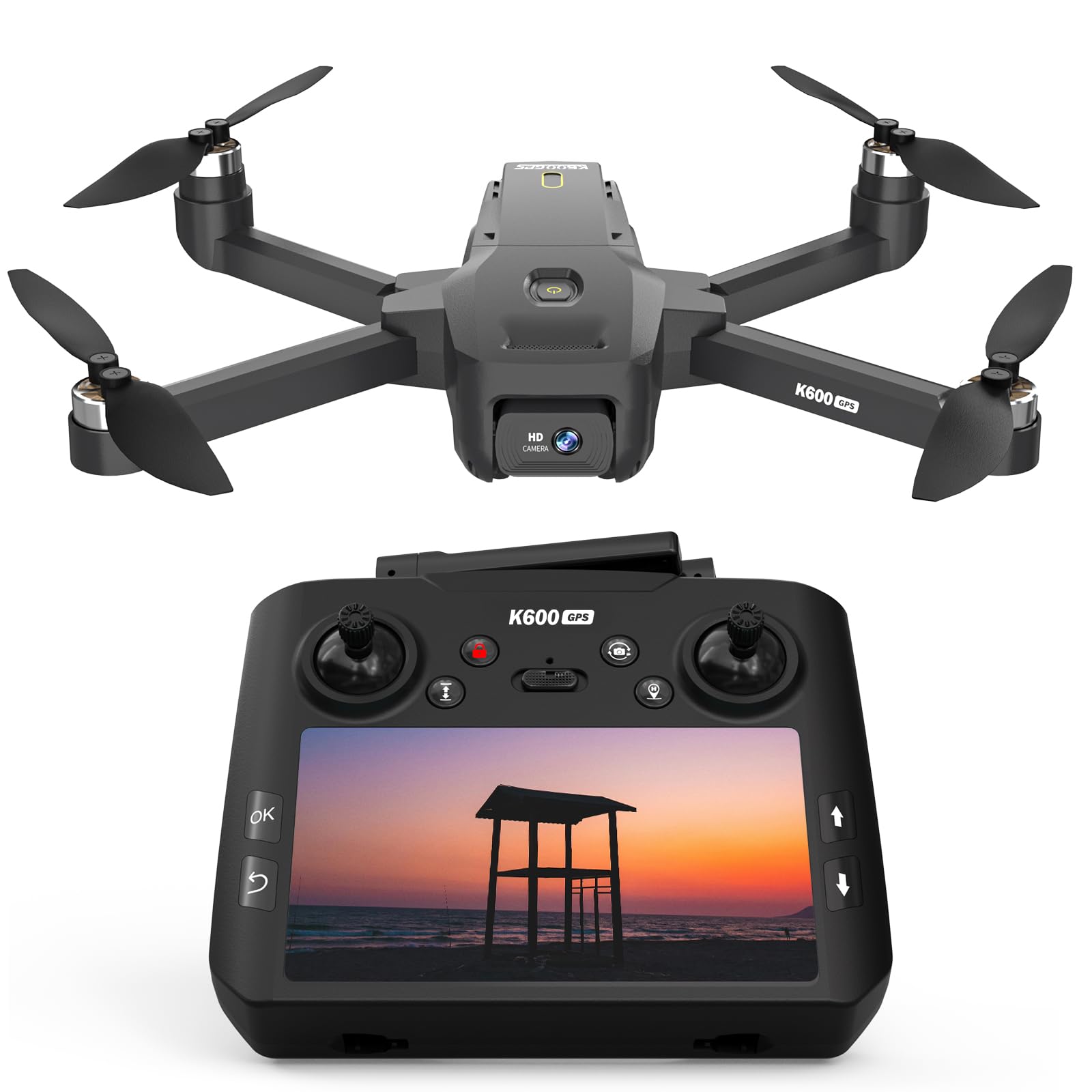
The K600GPS eliminates the need for a smartphone by packing a 4.5-inch non-touch LCD directly into the remote controller. That screen provides real-time FPV feed with no app downloads, no cable connections, and no compatibility worries. At 195g, it is well below the FAA registration limit, and the brushless motors spin at 12,000 RPM for stable flight in light wind. The 1080P camera is adjustable 90 degrees via remote, and the built-in 32GB TF card support means you can record hours of footage without touching a phone.
GPS functions are genuinely useful for beginners: auto return-to-home triggers on low battery or signal loss, follow-me mode tracks a moving subject without stick input, and the waypoint/fixed-point fly modes let you plan a flight path on the controller. The 3-speed modes and 3D flip capability add a taste of acrobatic flying, though the drone remains GPS-stabilized and does not support manual Acro mode. The modular battery fills via Type-C, which is convenient, and the included storage bag makes transport easy.
User reports consistently praise the “out of the box” experience — quick setup, intuitive controls, and reliable GPS hold. The follow-me mode is described as smooth rather than jerky, and the camera footage is called “crisp” for casual use. The main limitation is the lack of a traditional FPV upgrade path: there are no Betaflight ports or analog VTX modules. For the beginner who wants a complete, self-contained flying camera with GPS safety nets and zero smartphone fuss, the K600GPS is a strong mid-range choice with a built-in screen that actually works.
Why it’s great
- Built-in 4.5-inch LCD removes the need for a phone — fully self-contained FPV.
- 195g weight avoids FAA registration while still offering GPS return-to-home.
- Follow-me, waypoint, and orbit modes work smoothly for hands-free filming.
Good to know
- Non-touch screen means you navigate with controller buttons, not taps.
- No Betaflight or analog VTX support — not upgradable to a true racing platform.
- 1080P camera is adequate for social media but not 4K crisp.
8. Punieayi GPS Screen Drone
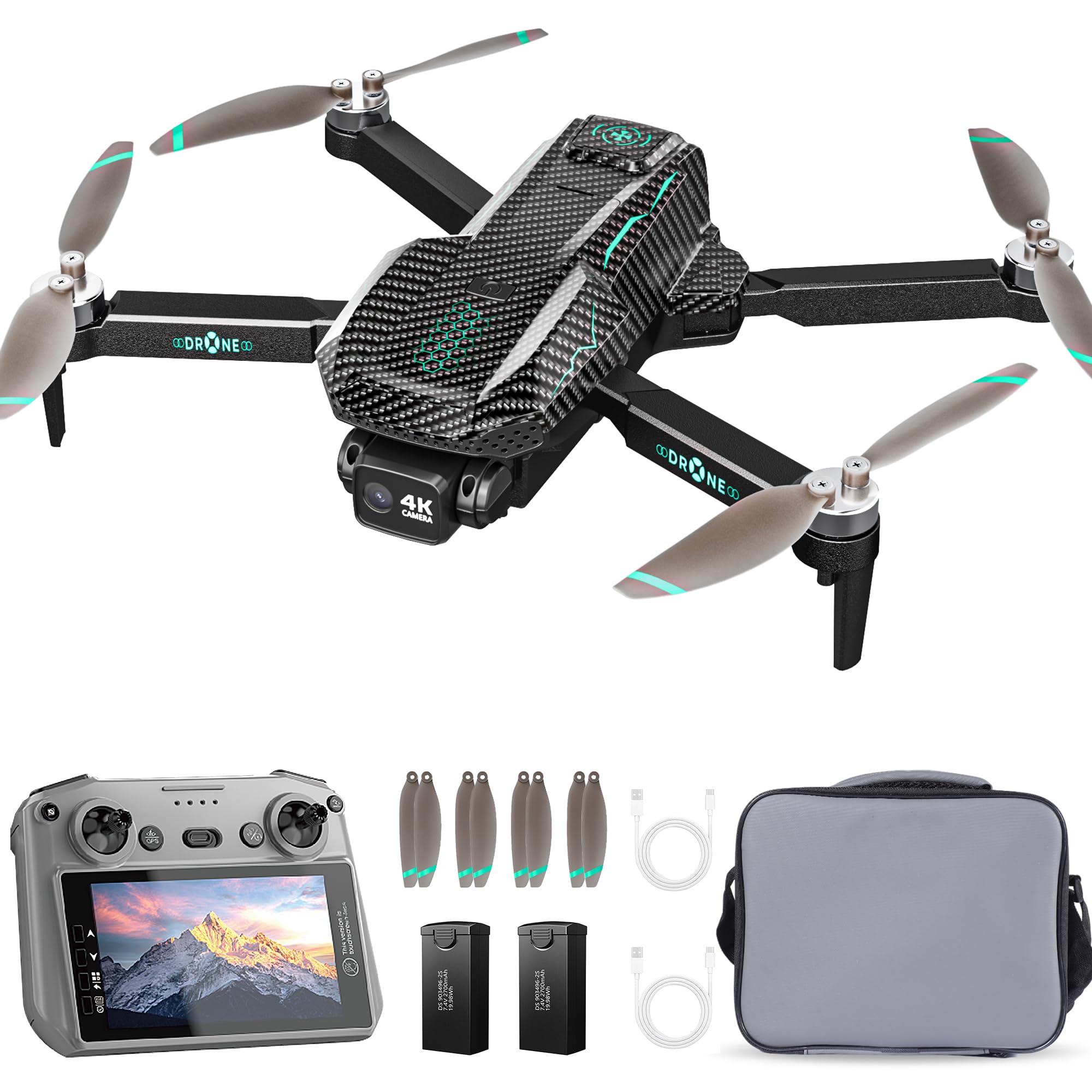
The Punieayi GPS Screen Drone takes the built-in display concept a step further with a 5-inch HD screen on the controller — larger than the K600GPS and still smartphone-free. The 7.4V 2700mAh batteries provide a combined 60 minutes of flight, and the brushless motors handle level-4 wind conditions without drifting. The 4K camera is adjustable within 90 degrees via remote and includes an included 8GB micro SD card for immediate recording. The 238g weight stays under the FAA threshold, though just barely.
GPS features include auto return-to-home, circle fly, and follow-me mode, all of which function reliably according to owners. The controller has two adjustable speed settings (default is low for beginners) plus one-key takeoff, landing, photo, and video buttons — the layout is straightforward enough for a child to operate. The integrated 5-inch display is not a touchscreen, but it provides clean, low-latency video that eliminates the “dead phone battery” problem common with app-based drones.
User feedback highlights the drone’s surprising durability: multiple owners report crashes that would destroy a toy drone, yet the Punieayi flew fine afterward. The lack of headless mode is a minor oversight, but the GPS hold makes orientation less critical. The main caveat is the same as every other camera drone on this list — it does not support Acro mode or Betaflight. For a beginner who wants a big-screen flying experience without the expense of DJI goggles, this is a solid mid-range option with a generous flight time.
Why it’s great
- 5-inch HD controller display offers the largest built-in screen for smartphone-free flying.
- 60-minute total flight time (two batteries) reduces between-session charging frustration.
- Frame survives hard crashes that would destroy cheaper toy-grade drones.
Good to know
- No headless mode; orientation is managed through GPS hold alone.
- Controller screen is non-touch; all inputs are via physical buttons.
- 238g is close to the FAA limit; double-check weight with any added accessories.
9. Oddire 4K GPS Drone

The Oddire 4K GPS Drone is the most affordable entry in this lineup that still offers a legitimate 4K camera, GPS return-to-home, and brushless motors. Its 7.7V 1800mAh batteries — higher voltage than the typical 7.4V pack — deliver a combined 48 minutes of flight, and the level-5 wind resistance keeps it stable in breezy conditions. The 5G Wi-Fi FPV transmission claims 1,640 feet of range, though users report a more realistic 300-meter reliable zone. The 249g weight hits the FAA exemption ceiling perfectly, no registration needed.
The feature set is generous for the price: waypoint flight, orbit mode, gravity control, gesture photos, 3D flips, and even VR compatibility through the XDRONE GO app. The camera captures 4096x3072P stills and 2048x1088P video — true 4K for photos, but only 2K for video. The headless mode and altitude hold make it easy for absolute first-timers to keep orientation. Multiple reviewers noted that the included hard case is sturdy enough for travel and that the drone survived crashes that would have grounded cheaper models.
Owners warn about two quirks: the main app listed in the manual does not work, so you must download the separate “XDRONE GO” app, and the drone requires compass and accelerometer calibration every time you power on. Several users reported that the return-to-home function flew the drone into a tree due to GPS interference — always test RTH in an open field first. For the budget-conscious beginner who wants a full GPS safety net and 4K capability without breaking the bank, the Oddire is a functional starter that leaves room in the budget for extra batteries.
Why it’s great
- 49 grams and brushless motors deliver excellent value for entry-level 4K flying.
- GPS return-to-home, waypoint, and orbit modes provide a full camera-drone feature set.
- 249g weight keeps FAA registration off the to-do list.
Good to know
- Requires the separate “XDRONE GO” app — the manual’s listed app is non-functional.
- Compass and accelerometer calibration needed every power-on; skipping it causes drift.
- Return-to-home can fly into obstacles if GPS accuracy is marginal; test in open fields.
FAQ
What is the difference between a camera drone and an FPV racing drone?
Do I need an FAA license to fly a beginner FPV racing drone?
What is Turtle Mode and why does it matter for beginners?
How many batteries do I need to start flying FPV?
Can I use a simulator with a beginner FPV kit?
Final Thoughts: The Verdict
For most users, the best beginner fpv racing drone winner is the BETAFPV Cetus Pro Kit because it delivers a complete FPV ecosystem — goggles, transmitter, and a whoop with Turtle Mode and three flight modes — in a single box that survives repeated crashes while letting you graduate from stabilized to full Acro. If you want raw speed and racing heritage in a true RTF kit, grab the Emax Tiny Hawk RTF. And for a self-contained, controller-free experience that anyone can fly immediately, nothing beats the DJI Neo Motion Fly More Combo.