
Our readers keep the lights on and the weekend projects moving. As an Amazon Associate, I earn from qualifying purchases.
Walking into a guitar store as a new player can feel like staring at a wall of alien electronics. You know you want to shape your sound, but the endless knobs, switches, and jargon make every choice feel like a potential mistake — especially when your signal chain is still just a single cable and a practice amp. That is exactly where a well-chosen first pedal becomes your best investment, one that teaches your ears while keeping your wallet intact.
I’m Rikta — the co-founder and writer behind FitlyFast. I’ve spent hundreds of hours analyzing the audio specs, build materials, and real-world player feedback on the most accessible stompboxes so you can land on a pedal that actually upgrades your practice sessions from day one.
Whether you need a warm reverb, a crisp delay, or your first taste of amp-style distortion, this guide walks you through the seven most reliable models to help you confidently pick your best beginner guitar effects pedal for where your playing is right now.
How To Choose The Best Beginner Guitar Effects Pedal
Picking your first effects pedal is about matching the effect type to your practice goals and the genre you want to play. A rock beginner needs distortion, while an ambient player will get more mileage from reverb or delay. Start by identifying the single effect that fills a gap your current amp cannot cover.
True Bypass vs. Buffer vs. Trail-On
True bypass routes your signal straight through when the pedal is off, preserving your guitar’s raw tone with zero color. Buffered bypass uses a preamp circuit to keep signal strength over long cable runs, common in pedals with complex switching. Trail-on allows reverb or delay tails to fade naturally after the pedal is disengaged, a critical feature if you want smooth transitions between clean and effected sounds. Beginners with short cable runs rarely need a buffer, but trail-on is a major plus for clean decay on delay and reverb pedals.
Power and Connectivity
Most compact pedals require a 9V DC center-negative power supply with a specific current rating. Budget models often ship without a power adapter, so factor that cost into your build. If you plan to connect multiple pedals on a board, invest in an isolated power supply to cut ground-loop noise. Also verify whether the pedal supports mono input or true stereo in/out — stereo capability is more important for reverb and modulation effects than for distortion.
Build Quality and Footswitch Feel
Aluminum alloy housings resist corrosion and hold up to frequent stomping. Clickless footswitches are becoming standard on better beginner pedals, offering silent switching that avoids the loud pop common with older mechanical switches. Check whether the footswitch is a soft-touch or a standard mechanical type — soft-touch mechanisms last longer and are quieter on stage, though both work fine for bedroom practice.
Quick Comparison
On smaller screens, swipe sideways to see the full table.
| Model | Category | Best For | Key Spec | Amazon |
|---|---|---|---|---|
| VALETON GP-200 | Multi-Effects | All-in-one modelling & recording | 240+ effects, 140 amp/cab sims | Amazon |
| BOSS CH-1 Super Chorus | Modulation | Classic chorus for guitar or keys | Stereo output, 4 shaping knobs | Amazon |
| BOSS DS-1 Bundle | Distortion | Rock, grunge and punk rhythm tones | All-metal chassis, 10 mA draw | Amazon |
| FLAMMA FS02 Reverb | Reverb | Stereo ambience with editable presets | 7 presets, hi/lo cut filters | Amazon |
| Donner Echo Square Delay | Delay | Versatile delay in a mini chassis | 7 delay modes, 20–838 ms range | Amazon |
| LEKATO Looper Pedal | Looper | Practice layering and improvisation | 3 loops, 18 min total, USB import | Amazon |
| JOYO American Sound | Preamp/DI | Direct amp‑sim tone for recording | 6‑knob control, cab sim built‑in | Amazon |
In‑Depth Reviews
1. VALETON GP-200 Multi-Effects Pedal

The VALETON GP-200 is a desktop multi-effects processor that crams over 240 effects, 140 amp and cab simulations, and a full USB audio interface into a compact metal chassis with a 4.3-inch color display. Its 8 customizable LED footswitches and dedicated expression pedal input make real-time preset switching feel natural during practice or early gigs.
Beginners benefit massively from the built-in 100-pattern drum machine and 180-second looper, which transform a single pedal into an entire rhythm section for practice. The adjustable signal chain lets you reorder up to 11 simultaneous effect blocks, teaching signal-flow logic without buying separate stompboxes.
The GP-200 also supports third-party IR loading and includes stereo XLR outputs for direct recording, meaning you can plug into an interface with zero extra gear. While the depth of menus may feel overwhelming at first, the free Mac/Windows editor simplifies patch creation, and the included 9V power supply eliminates hidden costs. This is the most versatile single-pedal investment for a beginner who wants to explore every effect type before committing to dedicated boxes.
Why it’s great
- Over 240 effects and 140 amp/cab simulations in one unit
- Built‑in looper and drum machine for solo practice
- USB audio interface + XLR out for direct recording
- Free desktop software for deep patch editing
Good to know
- Menu‑based UI can be overwhelming for absolute beginners
- Expression pedal sold separately
- Heavier learning curve compared to single‑knob pedals
2. BOSS CH-1 Super Chorus

The BOSS CH-1 has been a studio and stage staple since 1989, delivering a clean, crystalline chorus that works equally well on guitar, bass, and keyboards. Its four-knob layout — Effect Level, EQ, Rate, and Depth — gives you precise control over the shimmer without adding muddiness to your dry signal.
This pedal supports mono input with stereo outputs, meaning you can run it into two amplifiers or feed a stereo recording interface for a wide, spacious modulation. The low 13 mA current draw means it plays nicely on any daisy-chain power supply, a practical advantage for a growing pedalboard.
What makes the CH-1 ideal for a beginner is its transparent sound: it thickens single-note lines and adds depth to chords without overwhelming your amp’s core tone. The sturdy BOSS chassis and five-year warranty back the build quality, though you will need to buy a 9V adapter separately. This pedal teaches the value of subtle modulation better than any multi-effects preset.
Why it’s great
- Pristine, studio‑grade chorus tone built for clarity
- Stereo outputs enable wide modulation soundscapes
- Very low current draw works on most daisy chains
- Durable metal enclosure with a five‑year warranty
Good to know
- Power supply not included
- Only a single effect type — no multi‑mode versatility
- Buffered bypass may slightly color long cable runs
3. BOSS DS-1 Distortion Bundle

The Boss DS-1 is the most recognizable distortion pedal in rock history, favored from Nirvana to Prince for its bright, cutting tone with tight lows and smooth sustain. This bundle includes the pedal plus a power supply, instrument cable, patch cable, picks, and polishing cloth, so a beginner gets everything needed to plug in and play right away.
Its three-knob control (Level, Tone, Distortion) is about as straightforward as it gets — turn the Tone knob clockwise for sharp, aggressive highs or counter-clockwise for warmer, rounder distortion. The 10 mA draw is the lowest on this list, making it the most pedalboard-friendly option for shared power.
One thing to note: the DS-1 does not add significantly more distortion than many modern practice amps can produce on their own, but it delivers a distinct equalization curve and compression characteristic that shapes your sound in a way amp circuits simply don’t. If you play rock, punk, or grunge, this is the safest first-stompbox choice you can make, backed by decades of touring reliability.
Why it’s great
- Iconic rock distortion with tight, cutting midrange
- Bundle includes essential cables, power supply and picks
- Ultra‑low current draw ideal for daisy‑chain power
- Legendary BOSS build quality and five‑year warranty
Good to know
- Won’t add dramatically more gain than a good amp channel
- Tone knob range can be harsh at extreme settings
- Battery compartment is inconvenient if you forgo the adapter
4. FLAMMA FS02 Reverb Pedal
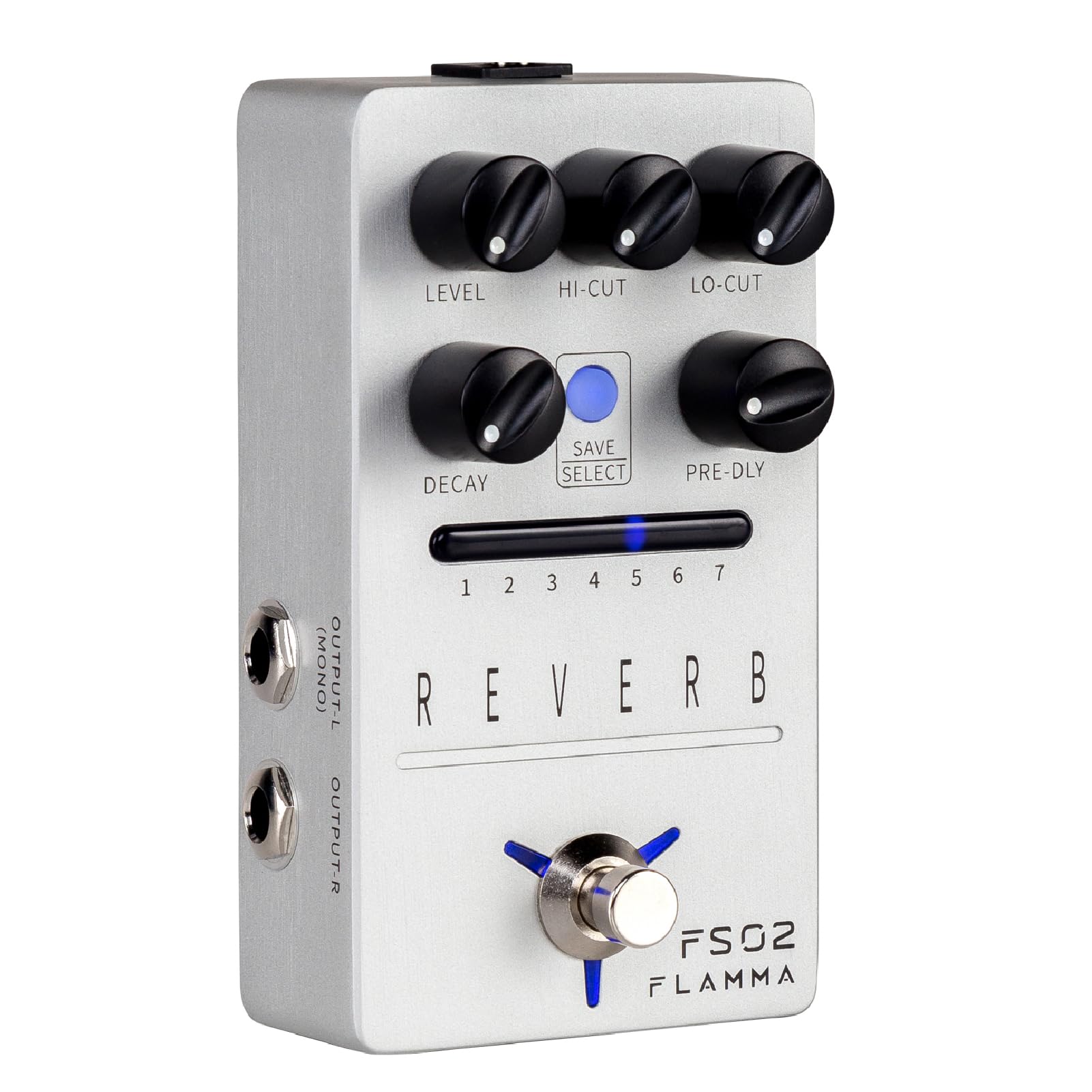
The FLAMMA FS02 packs seven distinct digital reverb types — Room, Hall, Church, Cave, Plate, Spring, and Mod — into a compact metal enclosure with true stereo input and output. Each reverb can be shaped with Hi-Cut, Lo-Cut, Decay, and Pre-Delay controls, then saved to one of seven color-coded preset slots for instant recall.
Trail-On mode allows reverb tails to decay naturally when the pedal is switched off, a feature that separates beginner-friendly reverb units from basic ones. The clickless footswitch operates silently, and the stereo layout means you can run the effect through two amplifiers for a massive soundstage that makes single-note melodies feel immersive.
What elevates the FS02 beyond typical beginner reverb pedals is its ability to load user presets — you can tweak the Church shimmer or the Cave ambience and store your favorite settings without losing factory defaults. The Spring setting lacks the percussive “drip” of a real spring tank, but the Plate and Mod modes sound lush enough to satisfy most ambient and pop styles. You will need a 9V supply with at least 300 mA, so budget for a compatible adapter.
Why it’s great
- Seven editable reverb presets in a compact pedal
- True stereo input/output for wide ambience
- Trail‑On mode for natural decay after bypass
- Clickless footswitch for silent operation
Good to know
- Requires 300 mA power supply (not included)
- Spring reverb lacks authentic “drip” character
- No battery option — must plug into a power source
5. Donner Echo Square Delay Pedal

The Donner Echo Square delivers seven delay types — Digital, Analog, Tape, Mod, Sweep, Lofi, and Reverse — in a mini chassis that takes up minimal board space. Dedicated Mix, Time, and Feedback knobs give you direct control over the wet/dry blend, delay interval ranging from 20 ms to 838 ms, and the number of repeats without menu-diving.
True bypass ensures your clean tone stays transparent when the effect is off, and the aluminum-alloy housing can withstand regular stomping without flexing. The Lofi and Reverse modes are particularly useful for a beginner exploring creative textures beyond standard slapback or dotted-eighth echoes.
One physical quirk: the pedal generates noticeable internal heat when left plugged in, even in bypass mode, which some users report as a concern for long studio sessions. However, the sound quality across all seven modes is consistent and noise-free, and the compact footprint makes it easy to reposition as your board grows. At its price tier, this is the most delay-mode variety you can get in a single mini box.
Why it’s great
- Seven distinct delay modes including Lofi and Reverse
- Mix, Time, and Feedback knobs for hands-on tweaking
- True bypass preserves clean tone when pedal is off
- Rugged aluminum housing saves pedalboard space
Good to know
- Generates internal heat when plugged in, even in bypass
- No power supply included (requires 9V DC, 140 mA)
- Mini knobs can be slightly cramped for large fingers
6. LEKATO Looper Pedal

The LEKATO Looper Pedal offers three independent loop slots with a total record time of 18 minutes, each layer built using unlimited overdubs. The 48 kHz / 24-bit uncompressed audio path ensures your recorded phrases stay clean, and the Analog-Dry-Through design keeps your unaffected guitar signal pure even while looping.
A built-in tuner function eliminates the need for a separate tuner pedal, and the USB port allows you to import or export WAV loop files from a PC. The single-knob playback volume and color LED ring that shows loop time progress make operation intuitive, even with one foot tapping in the middle of a solo.
The footswitch requires a two-click sequence to pause a loop and a single click to stop, which can feel awkward when switching between multiple pedals quickly. Some units also produce a static noise artifact at the very end of a loop, so you may want to test the pedal immediately and exchange if you hear clicking. For purely home practice and idea capture, however, the LEKATO delivers solid value and a handy tuner in one package.
Why it’s great
- Three loop slots with 18 minutes total record time
- USB import/export lets you transfer loops to your DAW
- Built‑in chromatic tuner saves pedalboard space
- 48 kHz / 24-bit uncompressed audio quality
Good to know
- Static pop at loop end reported on some units
- Footswitch requires multi‑tap for pause and stop
- Power supply not included (9V DC, 300 mA)
7. JOYO American Sound Preamp

The JOYO American Sound is a mini amp-and-cab-simulator preamp that faithfully models classic American tube amp circuits — from scooped Blackface sparkle to thick Tweed overdrive. Six knobs (Level, Drive, Low, Mid, High, and Voice) let you stage the gain structure and EQ before sending the signal straight to a PA, interface, or mixer via its built-in analog cabinet simulation.
This pedal is a secret weapon for beginners who record with software amp sims: you can dial in a usable core tone before your interface, then blend it with virtual cabs for hybrid sounds. The Voice knob sweeps from scooped clean tones to a mid-forward growl, teaching you how preamp voicing interacts with cab resonance.
The housing is lightweight but durable aluminum alloy, and the small footprint fits on even the most cramped beginner board. One trade-off: the Drive knob introduces noticeable hiss at high gain settings, so using an isolated 9V supply helps keep noise under control. For a player who wants a backup direct-in solution or a portable rig for silent practice, this pedal delivers a shockingly authentic amp snap without the weight of a real head.
Why it’s great
- Authentic American tube amp simulation with cab sim
- Six‑knob layout offers detailed EQ and gain shaping
- Compact aluminum housing ideal for travel rigs
- Can go direct to PA or interface without an amp
Good to know
- Noticeable background hiss at high Drive settings
- No power supply included (9V DC, needs clean supply)
- Single effect type — no built‑in reverb or modulation
FAQ
Do I need a dedicated power supply or can I use batteries?
What order should I place my delay, reverb, and distortion pedals?
Can I use a guitar effects pedal with a keyboard or bass?
Final Thoughts: The Verdict
For most users, the best beginner guitar effects pedal winner is the VALETON GP-200 because its all-in-one architecture lets you explore dozens of effect types, amp models, and recording features without buying separate pedals. If you want a single, tactile effect that teaches chorus the right way, grab the BOSS CH-1. And for pure rock distortion with a starter-friendly accessory bundle, nothing beats the BOSS DS-1.