
Our readers keep the lights on and the weekend projects moving. As an Amazon Associate, I earn from qualifying purchases.
If you are just starting to play guitar, the wrong strings can make sore fingers worse and leave you fighting the instrument instead of enjoying it. You need a set that is easy to press down, stays in tune as you learn, and sounds clean enough to keep you motivated. This guide walks you through the six best beginner-friendly sets, focusing on the gauge (the thickness of the string, in thousandths of an inch), the material, and what each one actually feels like to play.
I’m Rikta — the co-founder and writer behind FitlyFast. This guide is built by comparing the manufacturers’ published specifications and the patterns across verified customer reviews, so you get each pick’s real strengths and trade-offs instead of marketing spin.
We have looked at everything from light-gauge electric strings to coated acoustics to help you pick the perfect first set. You will know exactly which beginner guitar strings will make learning smoother and your playing sound better.
How To Choose The Best Beginner Guitar Strings
Picking your first set of strings does not need to be complicated, but a couple of simple choices make all the difference. The two most important things to get right are the gauge (how thick the strings are, measured in thousandths of an inch) and the material (what metal they are made of). Get those two things right for your guitar type and your hands, and everything else — brand, coating, price — falls into place.
Gauge: How Thick Should Your Strings Be?
Gauge is measured in thousandths of an inch, and a set is usually described by the thinnest and thickest string — for example, 9-42 or 10-46. As a beginner, you want a lighter gauge (a lower first number like 9 or 10). A thinner string requires less finger pressure to press down against the fretboard, which means less pain in your fingertips while you build up calluses. Lighter strings also make bending notes easier. The catch is that very light strings can feel a little loose and may buzz against the frets if you strum hard, but for the first few months, lighter is almost always better.
Material: Electric vs. Acoustic
Electric guitar strings are almost always wrapped in nickel-plated steel, which gives a warm, balanced tone that works well with magnetic pickups (the magnets that pick up string vibration on an electric guitar). Acoustic guitar strings are wrapped in bronze or phosphor bronze, which creates the bright, ringing sound that a hollow body naturally projects. Never put acoustic strings on an electric guitar — they are thicker and will not sound right — and never put electric strings on an acoustic guitar, because they will sound dull and quiet. Stick to the right type for your instrument.
Coated vs. Uncoated
Coated strings have a thin polymer layer (a type of plastic coating) over the wound strings that protects them from the oils and moisture on your fingers. The main benefit is that coated strings last two to three times longer before they start to sound dull or corrode. The downsides are that they cost a little more upfront and some players feel the coating slightly reduces the brightness of the tone. For a beginner, coated strings are a smart choice because you will not have to change them as often, which saves money and hassle.
Quick Comparison
On smaller screens, swipe sideways to see the full table.
| Model | Category | Best For | Key Spec | Amazon |
|---|---|---|---|---|
| D’Addario XS 80/20 Bronze | Premium Acoustic | Long-lasting tone & smooth feel | Light 12-53 gauge, coated | Amazon |
| Ernie Ball Super Slinky 3-Pack | Electric Value | Easy bending & bright tone | Super light 9-42 gauge | Amazon |
| D’Addario EJ11-3D 3-Pack | Acoustic Value | Bright acoustic sound, 3 sets | Light 12-53 gauge, uncoated | Amazon |
| Ernie Ball Hybrid Slinky 3-Pack | Electric Mid-Range | Easy bends & solid low-end | Hybrid 9-46 gauge | Amazon |
| Ernie Ball Regular Slinky 3-Pack | Electric Standard | Industry standard feel | Standard 10-46 gauge | Amazon |
| Stringjoy Signatures 2-Pack | Premium Electric | Balanced tension & tuning stability | Balanced Light 10-48 gauge | Amazon |
In‑Depth Reviews
1. D’Addario XS 80/20 Bronze Coated Acoustic Strings (Light 12-53)

Light 12-53 gauge with ultra-thin coating on every wound string: the top pick for the acoustic beginner who wants strings that feel smooth on the fingers and keep their bright tone for months. The ultra-thin coating on every wound string means the winding is protected from sweat and dirt, so the bright 80/20 bronze sound lasts much longer than a standard uncoated set.
The light 12-53 gauge strikes a great balance — it is not as heavy as a medium set, so your fretting hand will not tire out quickly, but it still has enough body to drive your guitar’s top for a full, projecting sound. Buyers report that these strings “bring a Taylor Grand Theater to life” and stay in tune reliably thanks to the NY Steel core (a stronger inner wire developed in New York) and Fusion Twist technology at the ball end. You also get a resealable VCI bag that keeps the second set fresh until you need it.
The honest limit is the upfront cost — these are a premium pick compared to basic uncoated strings. For a beginner, though, you will spend less time and money over a year because you will change them far less often. This is the set to buy if you want a no-compromise start on acoustic.
Why it’s great
- Coating keeps tone fresh for months — less changing for beginners
- Smooth feel reduces squeak and is gentle on fingertips
- Resealable packaging keeps spare set factory-fresh
Good to know
- More expensive per set than standard uncoated strings
- Some players feel the coating slightly dulls the highest treble sparkle
2. Ernie Ball Super Slinky Nickel Wound Electric Strings 3-Pack (9-42)

Compared to the D’Addario XS acoustic set above, the Ernie Ball Super Slinky 9-42 set is a third lighter in tension, making it significantly easier to press down and bend than the standard 10-46 sets — a difference that matters when your fingertips are still sore.
At just 0.2 pounds for the three-pack, these are incredibly light on the guitar and on your wallet. The nickel-wound steel produces a bright, balanced tone that works well across all pickup types. One buyer who has used them since 1994 sums it up: “I started using Super Slinkys in 1994… but I keep coming back to these.” The Element Shield packaging individually wraps each set to keep them fresh, and the pack includes three full sets so you have spares ready when the first set wears out.
The downside is that the very light 9-42 gauge can feel a little loose if you play with a heavy strumming hand, and they may produce some fret buzz on guitars that are not perfectly set up. For a pure beginner learning chords and simple solos, that is rarely an issue. Choose this over the top pick if you want the easiest possible bend and the least finger pain on electric.
Where it shines
- Super light 9-42 gauge is the easiest on beginner fingers
- 3-pack gives great value and keeps spares on hand
- Bright, balanced nickel tone works on any electric guitar
Worth noting
- May feel too loose for heavy strumming or drop tunings
- Uncoated — can corrode faster if you do not wipe them down after playing
3. D’Addario EJ11-3D 80/20 Bronze Acoustic Strings 3-Pack (12-53)
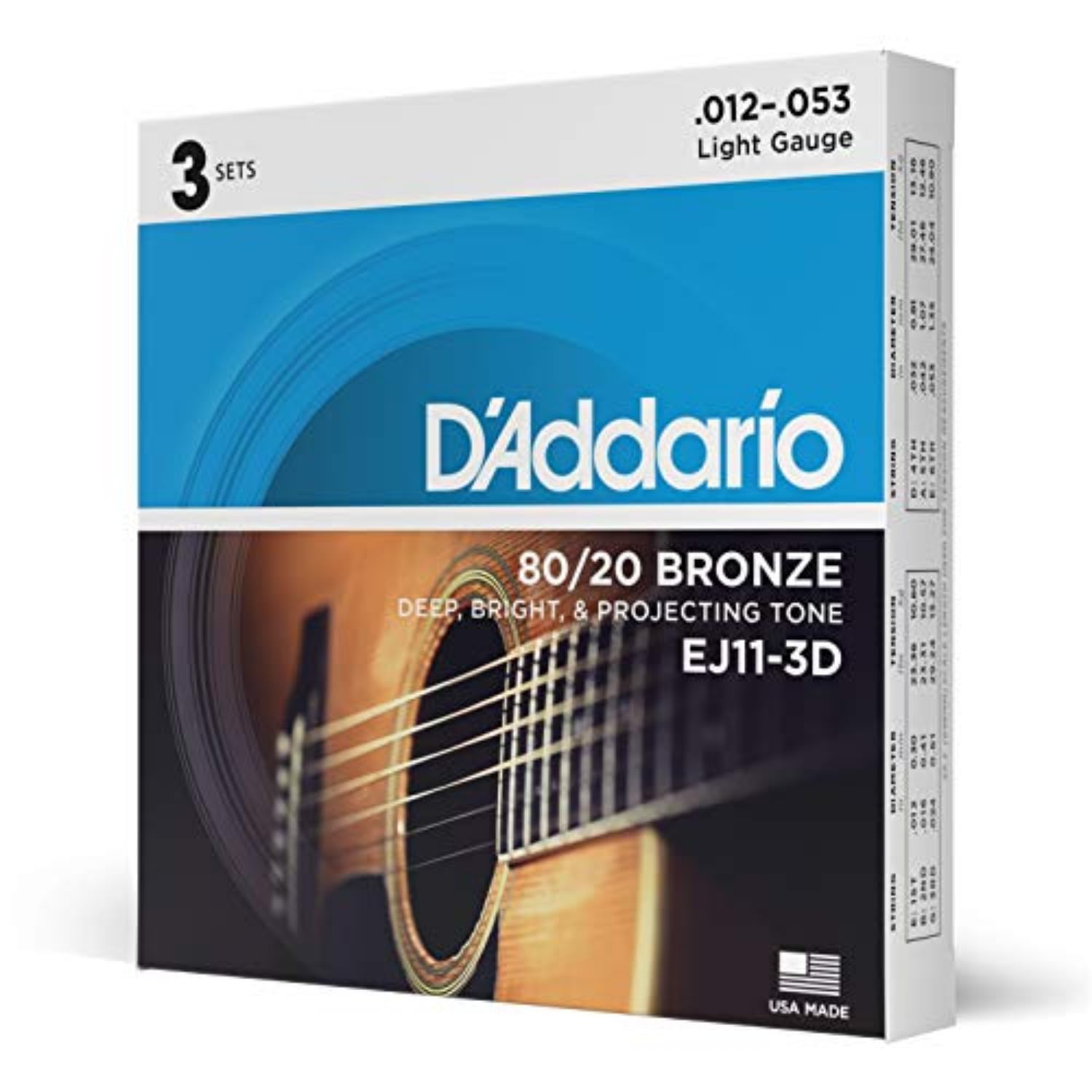
Imagine you have just bought your first acoustic guitar, you want that bright, ringing sound that made you want to play, and you do not want to spend a lot to get it. That is exactly the scenario where the D’Addario EJ11-3D shines. These are the original 80/20 bronze formula that John D’Addario Sr. and John D’Angelico created back in the 1930s — a proven recipe for bold, clear projection.
The light 12-53 gauge keeps finger pressure manageable for a beginner on acoustic, and the 3-pack means you get three full sets in one box for an excellent per-set cost. Reviewers who have used them for years say they “sound great on both guitars, stay in tune and are pretty easy on the fingers.” The set includes a resealable ziplock bag for storing any unused individual sets, and the strings are made in the USA to D’Addario’s specifications.
The trade-off is that these are uncoated, so they will start to lose their brightness and may show signs of corrosion faster than a coated set — especially if you live in a humid climate or have sweaty hands. For the price-to-performance ratio, however, this is the most affordable way to keep your acoustic sounding crisp.
What stands out
- Classic 80/20 bronze tone — bright, clear, and projecting
- 3-pack is excellent value with a low cost per set
- Light 12-53 gauge is beginner-friendly on acoustic
The trade-offs
- Uncoated — tone dulls faster than coated alternatives
- Not as smooth-feeling as coated strings on slides
4. Ernie Ball Hybrid Slinky Nickel Wound 3-Pack (9-46)

The single number that matters most in this category is the high E string gauge: 9, which makes the Hybrid Slinky set the lightest-feeling option for lead work while still offering a 46 on the low E for rhythm punch.
This set gives you the high strings from the Super Slinky (9, 11, 16) and the low strings from the Regular Slinky (26, 36, 46). At 3.52 ounces for the 3-pack, these are slightly heavier than the Super Slinky pack, but the difference is in the feel, not the weight. The light highs make lead work feel effortless, while the thicker lows give your chords a fuller, more solid sound. One buyer explains: “I prefer the 09-46 because you get the best of both worlds – good solid tone and easy to bend.” These are a great middle ground if you are not sure whether you prefer a super light set or a standard set.
One limitation is that hybrid gauges are a little less common, so if you fall in love with this specific feel, you need to keep buying this specific set instead of grabbing any standard Slinky off the shelf. For the price of a 3-pack, you get two extra sets built into the purchase, making this a strong value for beginners who want to experiment without committing to a single gauge.
The upsides
- Light high strings for easy bends, heavier low strings for full chords
- 3-pack gives you three sets at a great per-set price
- Bright, warm nickel tone that covers many musical styles
Keep in mind
- Hybrid gauge less common — you need to specifically buy this set
- Uncoated — will not last as long as a coated alternative
5. Ernie Ball Regular Slinky Nickel Wound 3-Pack (10-46)

At this lower price you get a 3-pack of three individually wrapped 10-46 sets, each with separate label numbers so you never mix up string thicknesses, weighing 3.2 ounces total.
One verified buyer wrote, “Beginner guitarist: great value ( for 3 sets), made in USA. Balanced tone, reduced finger pain vs. stock strings.” The bright, punchy tone is consistent and reliable — exactly what you want when you are learning to hear the difference between good and bad sound. The main consideration is that some players report the high E string can break faster if you buy from certain sellers (one review noted an E string breaking after 3 days on an Epiphone).
The overall consensus from thousands of players is that these are a solid, durable choice. If you have average to strong fingers or you want a set that will feel familiar when you eventually try other guitars, start here — this is the exact budget buyer it is perfect for.
Why we’d pick it
- Industry-standard 10-46 gauge — consistent, reliable feel
- 3-pack is excellent value for beginners on a budget
- Bright, punchy tone works for rock, blues, pop, and more
A few caveats
- Heavier than Super Slinky — more finger pressure needed
- Quality control on Amazon can vary; some report early breakage
6. Stringjoy Signatures 10-48 Balanced Light Gauge 2-Pack
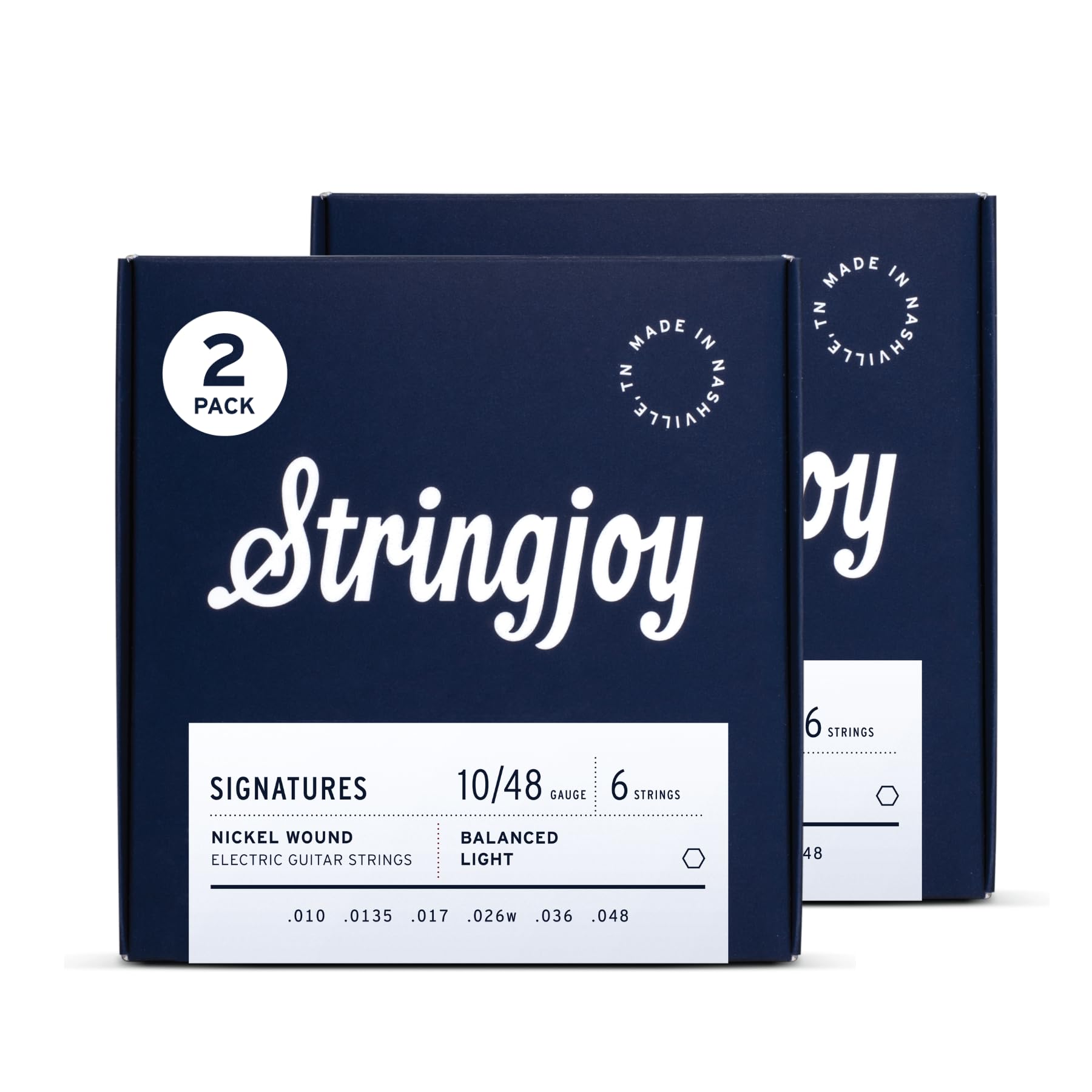
Stringjoy Signatures are perfect for the beginner who already feels frustrated by inconsistent string tension and wants a more predictable, even feel across all six strings. This Nashville-based brand hand-winds every string in-house, and their Balanced Light set offers a genuinely different concept: instead of having one uniform tension feel across all strings, each string’s tension is individually tuned so that every string feels equally resistant under your fingers.
The 10-48 balanced light gauge is slightly heavier on the high strings than a typical 10-46 set, giving you more control for precise bends, while the low strings are tuned for a tight, defined low-end. Professional musicians report that these uncoated strings last as long as coated ones from other brands, and one buyer calls them “the best strings on the market” — high praise from a gigging player. The 2-pack gives you two sets at a price that sits between the budget 3-packs and the premium coated sets.
The honest limit is availability and price per set — this is a boutique product from a smaller manufacturer, so it costs more per set than the Ernie Ball 3-packs. If you are a beginner who might not feel the subtle tension difference, you might not notice the improvement.
Strong points
- Balanced tension — every string feels equally easy to press
- Hand-wound in Nashville, Tennessee for premium quality
- Uncoated strings that last as long as coated alternatives
Before you buy
- Higher cost per set than mass-produced 3-packs
- Balanced feel may not be noticeable to absolute beginners
Understanding the Specs
String Gauge (the thickness number)
Gauge is measured in thousandths of an inch. A set labeled 9-42 means the thinnest string (high E) is .009 inches thick and the thickest (low E) is .042 inches thick. A lower first number means easier bending and less finger pain — perfect for beginners. A higher number like 11 or 12 means more tension, which produces a louder, fuller tone but requires more hand strength. For your first set, stick with light gauge: 9-42 or 10-46 for electric, 12-53 for acoustic.
Nickel Wound vs. 80/20 Bronze
Nickel-wound strings (nickel-plated steel wrapped around a steel core) are designed for electric guitars — they produce a warm, balanced tone that responds well to magnetic pickups (the magnets that capture string vibration). 80/20 Bronze strings (80% copper, 20% zinc wrapped around a steel core) are for acoustic guitars — they create the bright, ringy sound you expect from an acoustic. Using the wrong type will make your guitar sound thin, dull, or just wrong. Always match the string material to your guitar type.
Coated Strings (what the coating does)
A coated string has an ultra-thin layer of polymer (a type of plastic) over the wound strings. This seals the metal from the air and the oils on your fingers, significantly slowing down corrosion. The result is a string that keeps its bright tone for 2 to 4 times longer than an uncoated string. The compromise is a slightly higher upfront cost and some players feel a subtle reduction in high-frequency sparkle. For beginners, coating is a smart upgrade because you change strings less often.
String Core Shape (hex vs. round)
Most modern guitar strings use a hexagonal (six-sided) steel core, which grips the outer wrap wire tighter than a round core. This hex core gives you better tuning stability and a slightly brighter tone. Round-core strings are rarer and tend to feel more flexible under the fingers, but they can be harder to keep in tune. For a beginner, hex-core strings (which nearly all mainstream brands use) are the most reliable choice — they stay in tune better and are more consistent from set to set.
FAQ
How often should a beginner change guitar strings?
Should I start with 9-gauge or 10-gauge strings on electric guitar?
What is the difference between nickel wound and pure nickel strings?
Can I put electric guitar strings on an acoustic guitar?
Do I need a special tool to change guitar strings?
Final Thoughts: The Verdict
For most buyers, the beginner guitar strings winner is the Ernie Ball Super Slinky 3-Pack because the ultra-light 9-42 gauge makes pressing down and bending notes as easy as possible — the number one thing that keeps beginners from quitting. If you want long-lasting tone and a smooth feel on acoustic, grab the D’Addario XS 80/20 Bronze. And for the best value — three sets of bright, proven acoustic strings at a low per-set price — the standout is the D’Addario EJ11-3D 3-Pack.