
Our readers keep the lights on and the weekend projects moving. As an Amazon Associate, I earn from qualifying purchases.
Bringing the thrill of flight inside your living room sounds impossible until you find a drone light enough to hover without a gust of wind, durable enough to survive a collision with the sofa, and simple enough that you are not wrestling with a dozen settings before lift-off. The entire point of an indoor drone is that it works in tight spaces, which means stability, safety guards, and intuitive controls matter far more than raw speed or outdoor range.
I’m Rikta — the co-founder and writer behind FitlyFast. I have spent dozens of hours comparing flight control systems, battery chemistries, camera resolutions, and propeller guard designs to separate the genuinely beginner-friendly models from the ones that just look good on a spec sheet.
Living rooms, basements, and bedrooms each present unique obstacles, and the best beginner indoor drone is the one that stays steady through those challenges while keeping the learning curve flat enough for a first-time pilot to feel confident within minutes.
How To Choose The Best Beginner Indoor Drone
The market is packed with mini quadcopters that all promise easy flying, but the difference between a drone that hovers obediently and one that drifts into a wall comes down to a handful of specific features. Focus on these four areas and you will quickly separate the genuinely capable indoor models from the toys that belong outside.
Altitude Hold and Stability Sensors
Altitude Hold locks the drone at a fixed height, so you only steer left, right, forward, and backward without worrying about throttle control. For indoor flying where ceilings and furniture sit close, that stability is everything. Optical Flow Positioning takes this a step further — it uses a downward-facing camera to track movement over the floor and hold position in a tight bubble. Without these two features, a beginner drone will drift unpredictably the moment you let go of the sticks.
Propeller Guards and Build Durability
Indoor environments are not forgiving. Walls, lamps, ceiling fans, and even curtains become obstacles. A drone with full propeller guards — ideally an enclosed duct design — can bounce off a wall and keep flying. Drop a drone without guards and you risk chipped blades, scratched surfaces, or worse. Look for guards made from nylon-reinforced ABS plastic that can handle repeated impacts without cracking.
Battery Life and Swap Speed
Most mini drones ship with flight times between 6 and 12 minutes per battery, which feels frustratingly short when you are just getting the hang of things. The best entry-level indoor drones include two modular batteries that you can swap in seconds, doubling your total session to 20–30 minutes. Modular batteries also charge faster than built-in packs and cost less to replace when they eventually wear out.
Control Interface and Headless Mode
Standard remote controllers work well, but some new pilots find it easier to steer when the drone always moves relative to the pilot rather than its own nose. That is exactly what Headless Mode does. If you push the stick forward, the drone moves away from you regardless of orientation. This eliminates the brain-twisting moment when the drone faces you and left becomes right. A few premium models now include a built-in screen on the controller, which removes the need to mount your phone, saving setup time and avoiding flimsy phone holders that can drop your device mid-flight.
Quick Comparison
On smaller screens, swipe sideways to see the full table.
| Model | Category | Best For | Key Spec | Amazon |
|---|---|---|---|---|
| Holy Stone HS210T | Mini Indoor | Young kids & ground racing | 2-in-1 Land & Fly Mode | Amazon |
| SYMA X100 | Safety Focused | Collision resistance indoors | 4-way infrared obstacle avoidance | Amazon |
| SIMREX X800 | Camera Starter | Learning with aerial photos | Optical Flow Positioning | Amazon |
| Pallton Sky Blue | Budget Camera | First-time flyers under | 24 min total flight (2 batteries) | Amazon |
| RELIDOL PK01 | Screen Controller | No phone needed for FPV | Built-in 1080p screen on remote | Amazon |
| REDRIE HK33 | GPS Follow Me | Outdoor-capable beginner | 4K Camera + 2-Axis Gimbal | Amazon |
| karuisrc K600 | GPS Premium | Serious starter with GPS safety | 4.5″ LCD Controller Screen | Amazon |
In‑Depth Reviews
1. Holy Stone HS210T

The HS210T stands out because it is not just a drone — it flips into a ground racer mode, turning the same unit into a remote-control car that drifts and spins across the floor. That dual-purpose design is brilliant for a child or a beginner who loses interest in flying after a few minutes, because the toy remains engaging even after the first battery runs out. The nylon ABS propeller guards are genuinely tough, and multiple customer reports confirm the drone survives crashes that would crack cheaper plastic shells.
Altitude hold and one-key start make the first flight nearly effortless, and the three speed modes allow the pilot to progress from slow indoor circuits to faster passes as confidence builds. Reviewers note that the modular batteries take over an hour to charge for about eight minutes of flight each, so planning ahead is required. Some units needed initial trim adjustment out of the box, but that is standard for any mini drone in this class.
What makes the HS210T the top pick is its combination of durability, versatility, and genuine beginner accessibility. The 2.4 GHz remote allows multiple drones to fly simultaneously without interference, which makes it a strong choice for siblings or parent-child racing sessions. For a first indoor drone that keeps everyone entertained beyond the initial hover, this is the benchmark.
Why it’s great
- 2-in-1 design converts to RC car for ground play
- Exceptionally durable nylon ABS propeller guards
- Three speed modes suitable for absolute beginners
Good to know
- Batteries charge slowly — over an hour per pack
- May require initial trim calibration before first flight
- Propellers attract dust and pet hair during indoor use
2. SYMA X100

The X100 addresses the single biggest anxiety new indoor pilots have — crashing into furniture — with four-way infrared obstacle avoidance sensors that detect objects within roughly 12 inches and automatically steer the drone away. Combined with a fully enclosed propeller guard that blocks direct contact with spinning blades, this is one of the safest options for younger children and skittish adults testing their first flight in a furnished living room. The 180-degree flip-to-stop safety design adds an extra layer of assurance when things go wrong mid-air.
Altitude hold and Headless Mode are both present, and the two speed modes let beginners start slow before advancing to faster maneuvers. The one-key 360-degree flip feature turns practice into a mini game, which reviewers say keeps kids engaged longer than basic hovering. The drone weighs only 58 grams, so it feels almost weightless in hand and generates very little momentum during a collision — a key advantage for indoor safety.
The tradeoff is that the obstacle avoidance system can be fooled by certain surfaces. One reviewer lost control when the infrared sensors detected a hedge during an outdoor flight, causing an unexpected turn. Indoors, the system works reliably on walls and furniture, but ceiling encounters can trigger unpredictable behavior. For pure indoor use with young pilots, the protective design is hard to beat.
Why it’s great
- 4-way infrared obstacle avoidance actively prevents crashes
- Full enclosed propeller guard blocks blade contact
- Extremely lightweight at 58g — minimal impact force
Good to know
- Obstacle avoidance can struggle with hedges and ceilings
- Learning curve for novices — read instructions step-by-step
- Flight time per battery runs shorter than advertised
3. SIMREX X800

The X800 punches above its price class by combining Optical Flow Positioning — a feature usually reserved for drones costing double — with a 1080P HD camera that has a manually adjustable 90-degree lens. Optical Flow uses a downward-facing camera sensor to lock the drone over a specific spot on the floor, which means it hovers with almost no drift even when you take your hands off the controller. For a beginner trying to frame a stable aerial shot without fighting the throttle, this is a transformative feature.
The two modular batteries each deliver roughly 15 minutes of flight, totaling 30 minutes of air time — far above the 12–16 minute standard for similar-sized indoor drones. Customers consistently praise the ease of setup and the fact that the drone stays steady within a one-square-foot hover zone indoors. The 360-degree flip mode, Headless Mode, and Waypoint Flight path programming give a clear progression path as skill improves.
Camera quality is acceptable for casual social sharing but does not approach true 1080P resolution — reviewers estimate it looks closer to 480P even in the app. The phone holder on the controller feels flimsy and the app interface is dated. This is not a drone for serious photography, but for a beginner who wants to learn steady flight while capturing tolerable home videos, the X800 delivers excellent value.
Why it’s great
- Optical Flow Positioning for near-drift-free hover indoors
- 30 minutes total flight with two included 1000mAh batteries
- Clear skill progression from hover to Waypoint Flight
Good to know
- Camera resolution is effectively lower than advertised 1080P
- Phone holder on controller is prone to tipping
- Struggles even in light outdoor wind
4. Pallton Sky Blue Drone

This model delivers a remarkably complete beginner package at a very accessible price point: 1080P camera, two batteries for 24 minutes of total flight, a premium carrying case, Gesture Selfie control, 3D flips, and 3-speed adjustments. For the price it is difficult to find another drone that includes every basic learning feature plus a half-decent camera and a protective case in one box. The sky-blue color also makes the drone easy to spot against most home interiors.
Customer feedback highlights the drone’s surprising durability — multiple reviewers deliberately crashed it into walls and floors during testing, and the propeller guards and plastic body held up without cracking. The One-Key Takeoff and Altitude Hold work reliably, which reduces the stress of the first few flights. The Gravity Control feature, which lets you steer by tilting your phone, is a favorite among younger flyers who find traditional joysticks unintuitive.
The camera is best described as decent for casual use. It captures recognizable images and smooth FPV video for social sharing, but fine details blur noticeably. The app connection can occasionally drop at longer distances, though for indoor flights under 50 feet it remains stable. For a true budget entry point that still offers a proper feature set, this is a strong contender.
Why it’s great
- Complete kit with carrying case, 2 batteries, and guards
- Durable build survives multiple indoor crashes
- Gesture Selfie and Gravity Control add fun variety
Good to know
- Camera detail is adequate but not sharp
- App Wi-Fi connection can drop beyond 50 feet
- Flips require open space — tight rooms risk collisions
5. RELIDOL PK01
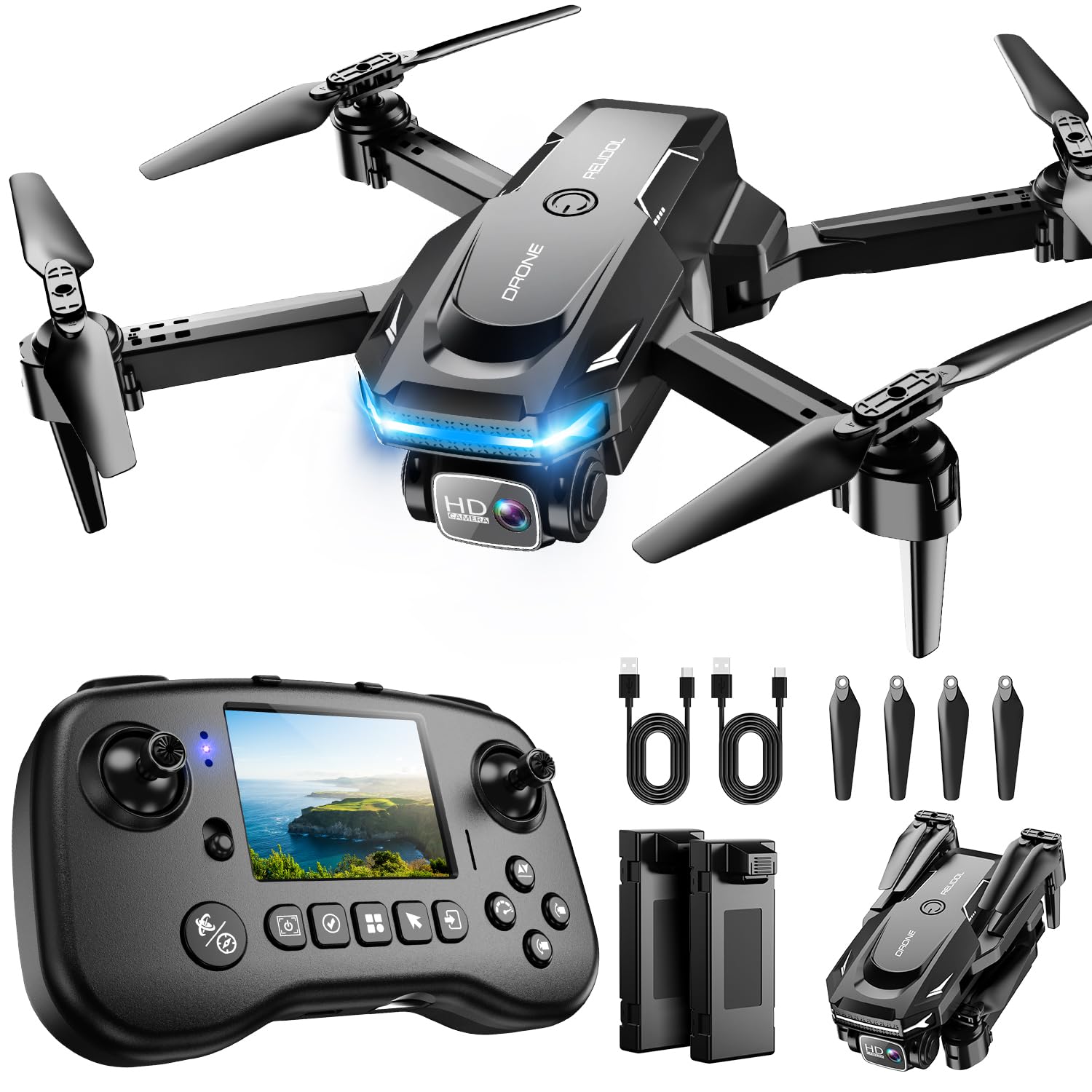
The PK01 solves the most annoying setup step for beginners: mounting and connecting a phone to the controller for live video. Its remote has a built-in 1080P screen that displays the camera feed directly, so you power on the drone, pair the remote, and start flying without downloading an app or fiddling with a phone holder. That simplicity is a genuine advantage for non-tech-savvy users or parents setting up a drone for their child.
Under the hood, brushless motors provide smoother, quieter operation and better durability than the brushed motors found in cheaper drones. The PK01 also includes voice control — saying “take off” launches the drone — which adds a fun interaction layer that younger pilots love. The two enhanced batteries deliver up to 25 minutes of combined flight time, and the remote charges via USB-C, a convenience that many competitors overlook.
Footage is saved to a MicroSD card (not included), and the camera quality is acceptable for a drone in this class but not exceptional. The maximum recommended indoor range is about 30 meters, which is plenty for most living rooms. A memory card must be purchased separately to record video or photos, which catches some buyers off guard.
Why it’s great
- Built-in screen on controller eliminates phone dependency
- Brushless motors are quieter and more durable
- Voice command support for hands-free takeoff
Good to know
- MicroSD card required for recording — not included
- Indoor range limited to about 30 meters
- Camera quality is decent but not sharp
6. REDRIE HK33
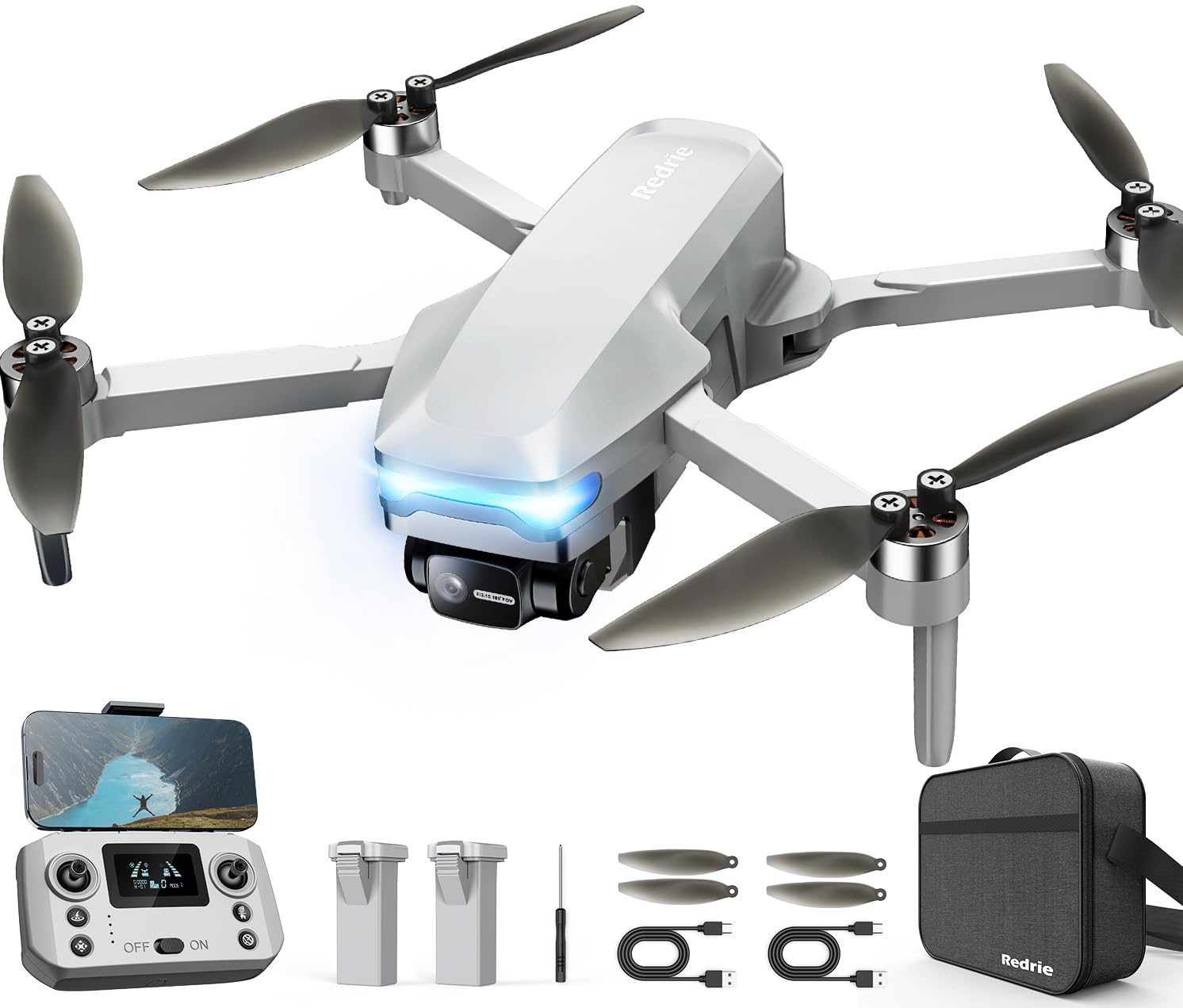
The HK33 is the bridge between a pure indoor toy and a serious camera drone. Its 4K camera is paired with a 2-axis mechanical gimbal that physically stabilizes the lens against tilt and vibration — a feature rarely seen at this price tier. The result is smooth, watchable footage that genuinely looks good on a phone or computer screen, making it a solid choice for beginners who want to create shareable aerial content from day one.
GPS integration brings features that remove the biggest beginner fears: the drone automatically returns to its takeoff point when the battery runs low, the signal drops, or it flies beyond the preset range. The Follow Me mode tracks the controller, allowing the drone to orbit or trail the pilot automatically. These features make it much safer to fly outdoors, though the HK33 remains light enough (under 249 grams) to avoid FAA registration.
The two 1800mAh batteries deliver 40–45 minutes of total flight time, the longest in this roundup. The tradeoff is that the image stabilization, while mechanically active, still produces slightly soft footage compared to premium gimbals, and the phone holder on the controller is poorly designed and can drop larger phones. This drone is for the beginner who already knows they want to graduate to outdoor photography and is willing to invest accordingly.
Why it’s great
- 2-axis mechanical gimbal provides true stabilization
- GPS auto-return and Follow Me add safety for outdoor flights
- Under 249g — no FAA registration required
Good to know
- Phone holder on controller is flimsy for larger phones
- Video softness remains despite the gimbal
- Setup requires more steps than simpler indoor drones
7. karuisrc K600
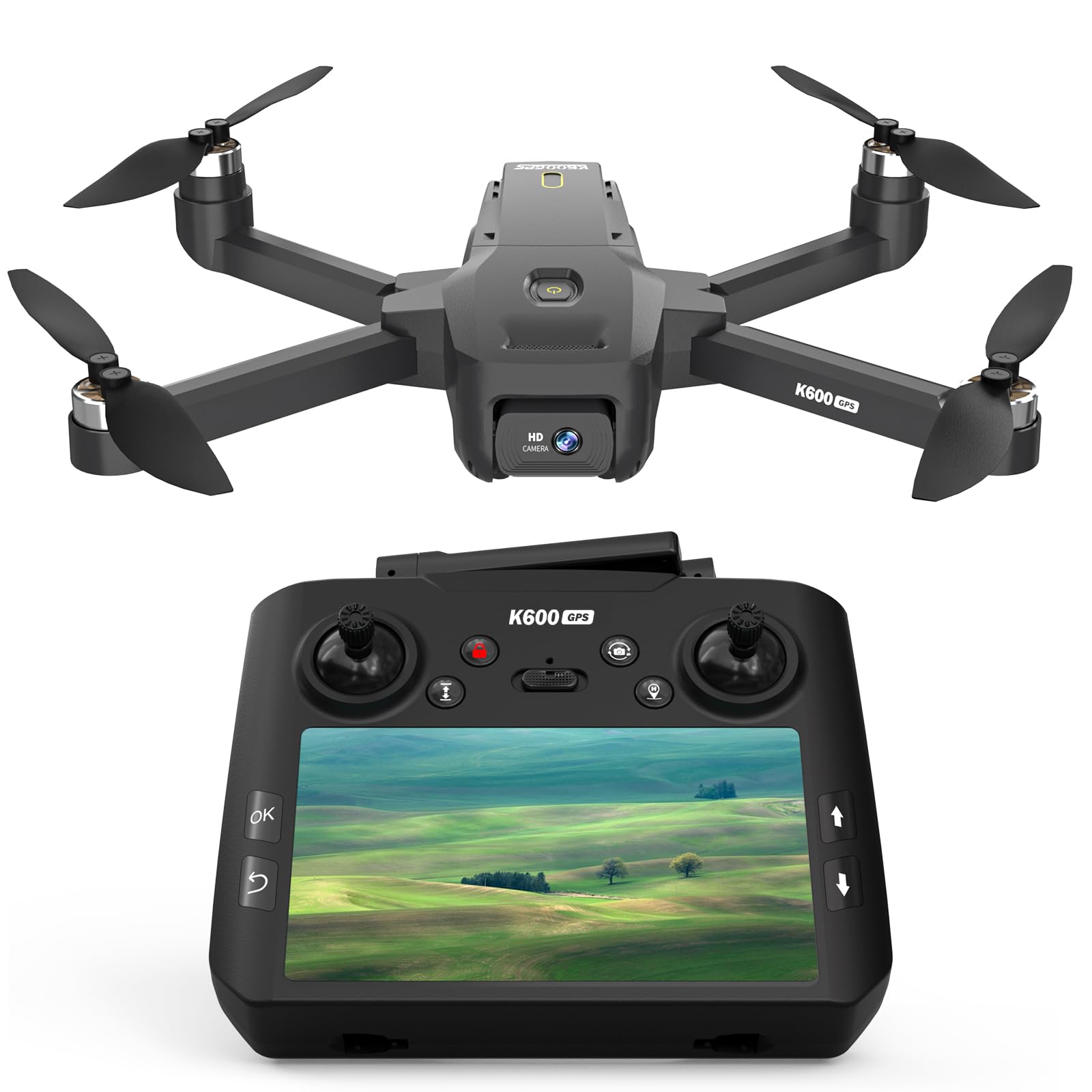
The K600 combines GPS-assisted flight with the largest built-in controller screen in this roundup — a 4.5-inch HD display that provides a bright, clear live feed without any phone connection. That screen size is genuinely useful for framing shots and reading telemetry data like altitude, battery level, and GPS satellite count. For a beginner who finds small phone screens hard to read in daylight, this is a meaningful upgrade.
GPS positioning provides rock-solid hover stability and automatic return-to-home, which customers consistently cite as the feature that gave them the confidence to fly farther afield. The AI Track and Orbit Mode lock onto a moving subject and follow it automatically, making it possible to capture action sports or hiking footage without a second operator. The EIS (Electronic Image Stabilization) smooths out minor vibration, though it is not as effective as a physical gimbal.
Build quality feels robust, and the 2200mAh battery delivers longer individual flight times than any other model here. The operation range is rated at 400 meters for control and 250 meters for video transmission, though real-world performance depends heavily on line-of-sight conditions. The camera produces cinema-quality footage at its marketing claim, but fine detail is acceptable for social media and home use. This is the drone for the beginner who wants GPS safety features and refuses to use their phone as a viewfinder.
Why it’s great
- 4.5-inch HD screen on remote for live FPV without a phone
- GPS auto-return and Orbit Mode provide safety and creativity
- Long battery duration with 2200mAh capacity
Good to know
- EIS stabilization is not as effective as a gimbal
- Real-world range may be less than advertised
- Camera quality is good but not professional-grade
FAQ
Why does Headless Mode matter more for indoor flight than outdoor?
Are drones under 250 grams actually safer for indoor use?
Final Thoughts: The Verdict
For most users, the best beginner indoor drone winner is the Holy Stone HS210T because its 2-in-1 land-and-fly design, durable nylon ABS guards, and no-fuss altitude hold deliver the widest appeal for kids and first-time pilots without breaking the bank. If you want optical flow stability and a better camera for learning steady flight, grab the SIMREX X800. And for the beginner who already plans to fly outdoors and wants GPS auto-return plus a gimbal-stabilized camera, nothing beats the REDRIE HK33.