
Our readers keep the lights on and the weekend projects moving. As an Amazon Associate, I earn from qualifying purchases.
A looper pedal is the single most effective practice tool a guitarist can buy. It turns a quiet bedroom into a full band rehearsal, letting you lay down a chord progression, solo over it, layer melodies, and hear your own song ideas take shape in real time. The wrong pedal, however, buries your creativity under button combinations and noisy circuits.
I’m Rikta — the co-founder and writer behind FitlyFast. I’ve spent dozens of hours analyzing looper pedal specs, combing through user reports on audio fidelity, loop slot architecture, recording limits, and noise-floor performance to separate the practice tools from the frustration generators.
Whether you are learning to improvise, writing original material, or building a live looping rig, this guide walks you through the essential features and narrows the field to the best beginner looper pedal options worth your attention.
How To Choose The Best Beginner Looper Pedal
The first looper you buy shapes how you write, practice, and perform. Choose based on loop capacity, sound quality, and control simplicity — not just price.
Recording Time and Overdub Layers
A beginner pedal should offer at least ten minutes of recording time and unlimited overdubs. Shorter loop times force rushed playing, while capped overdub layers kill creative momentum. Most budget-friendly loopers land between six and ten minutes, which is enough for chord progressions and a few melody lines. If you plan to build full song arrangements, look for models offering 30 minutes or more.
Audio Fidelity and Noise Floor
Each new layer in a loop carries the risk of summed noise. Pedals using 24-bit / 48kHz sampling preserve detail across multiple overdubs without adding hiss or hum. True bypass circuits also matter — they keep your guitar signal clean when the looper is disengaged. Cheap loopers often introduce a faint buzz or color the tone, which becomes obvious once you stack three or four layers.
Controls and Memory Slots
Single-button loopers offer simplicity but require learning long-press and double-tap commands for undo, redo, erase, and stop. Multi-slot loopers let you store separate loops and recall them later, which is useful for practicing setlists or saving song ideas. A built-in tuner is a welcome bonus that removes the need for an extra pedal on your board.
Quick Comparison
On smaller screens, swipe sideways to see the full table.
| Model | Category | Best For | Key Spec | Amazon |
|---|---|---|---|---|
| BOSS RC-5 Loop Station | Premium | Serious practice & live looping | 13 hours record / 99 phrase memories | Amazon |
| MOOER Micro Looper II | Mid-Range | Extended creative layering | 480 minutes / 3 banks of 16 slots | Amazon |
| LEKATO 9-Loop Pedal | Mid-Range | Multi-slot memory with tuner | 40 minutes / 9 loop slots | Amazon |
| MOOER Micro Looper | Budget | Simple one-button practice | 30 minutes recording time | Amazon |
| LEKATO 3-Loop Pedal | Budget | Compact 3-slot with sync | 18 minutes total / 3 loops | Amazon |
| Rowin Tiny Looper | Budget | Ultra-compact home use | 10 minutes / one-button control | Amazon |
| VALETON GP-200 | Premium | Multi-effects + looper combo | 180 seconds looper / 240 effects | Amazon |
In‑Depth Reviews
1. BOSS RC-5 Loop Station
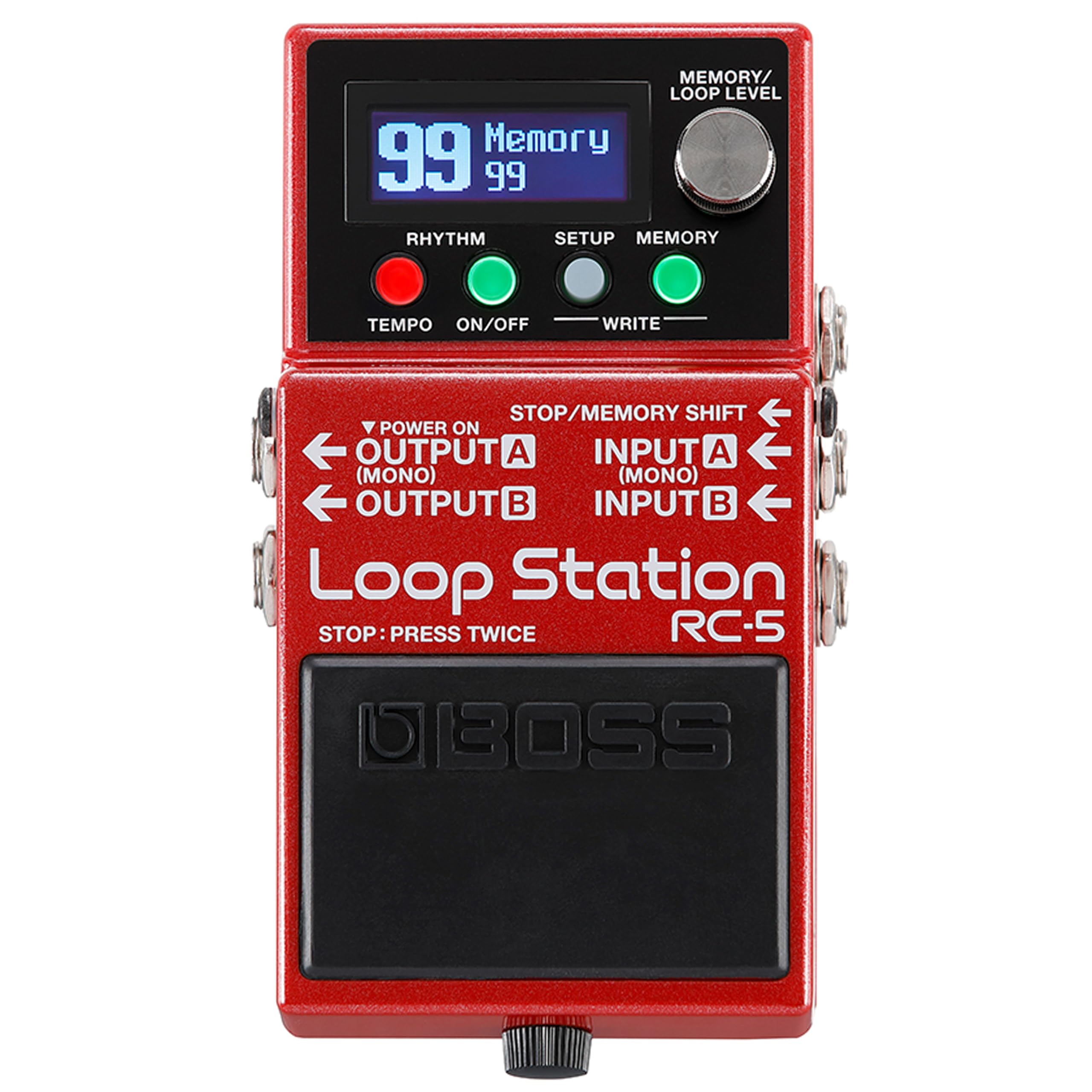
The BOSS RC-5 sets the benchmark for compact loopers with 32-bit floating-point processing that keeps every overdub pristine. Its 13 hours of stereo recording and 99 phrase memories let you save an entire practice set and recall loops on demand — a level of storage no other pedal in this roundup touches. The multi-color LCD shows loop status and editing parameters clearly, which cuts the learning curve drastically compared to single-LED designs.
Fifty-seven built-in rhythms with A/B variations and seven drum kits add a drummer to your practice sessions without needing a second device. MIDI I/O via mini TRS jacks opens external control and sync options if you expand your rig later. The reverse function injects texture into loops, which creative players will appreciate.
The RC-5 runs on a 9V battery or optional PSA adapter — the battery lasts only a few hours, so a power supply is recommended for longer sessions. A single footswitch manages most commands, which means you will rely on external footswitches for hands-free slot navigation in live settings. Audio quality, build durability, and rhythm library depth make this the long-term investment for any serious beginner.
Why it’s great
- 32-bit floating-point processing with zero audible noise accumulation across layers
- 13 hours total record time plus 99 phrase memory slots
- 57 built-in drum rhythms with A/B variations and 7 kits
- Full MIDI I/O and USB connectivity for expansion and file transfer
Good to know
- Single footswitch design requires external controllers for efficient live slot switching
- 9V battery drains quickly; a PSA adapter is recommended for regular use
- Premier price point compared to all other beginner loopers listed
2. VALETON GP-200 Multi-Effects Pedal

The VALETON GP-200 is a complete multi-effects workstation with a 180-second looper built in. It packs 240+ effects, 140 amp and cab simulations, and 100 stompbox models into a single metal chassis, making it ideal for guitarists who want both loop functionality and a full effects arsenal from one unit. The 4.3-inch TFT color LCD and eight customizable footswitches provide far more hands-on control than a standalone looper.
USB Type-C audio streaming supports direct recording to a computer or mobile device via OTG, and the bundled software allows deep preset management. The looper operates within a maximum signal chain of 11 simultaneous effect blocks, which means you can drop a compressor, overdrive, delay, and reverb on your loop without patching additional pedals.
The looper length is 180 seconds — enough for song sections but shorter than dedicated loopers from BOSS or MOOER. Beginners focused purely on looping should consider a standalone unit, while those building a pedalboard from scratch will find the GP-200’s all-in-one design saves space and money compared to buying separate pedals. Build quality is excellent, with a metal casing and Gorilla Glass display.
Why it’s great
- 240+ effects and 140 amp/cab simulations in one package
- Eight customizable footswitches for hands-on control
- USB Type-C audio streaming with direct mobile recording via OTG
- Free desktop software for preset editing and management
Good to know
- Built-in looper limited to 180 seconds compared to dedicated loopers
- Learning curve for navigating the full signal chain and effects routing
- Larger footprint than compact standalone loop pedals
3. MOOER Micro Looper II

The MOOER Micro Looper II offers 480 minutes of total recording time spread across three banks with 16 slots each — a storage architecture normally reserved for much larger units. Each slot provides up to ten minutes, and you can stack unlimited overdubs per slot. The AUTO REC function starts recording the moment it detects input signal, which eliminates missed starts during fast creative bursts.
Metal casing gives this pedal rugged durability, and the compact size fits easily on a crowded pedalboard. The savings bank system lets you organize loops by song or practice session, so you never have to delete a saved idea to make room for new ones. The supported MicroSD interface expands capacity even further if the onboard 48 slots fill up.
Some users report reliability issues after extended use, and MOOER’s customer service process has drawn complaints about slow resolution. The single footswitch handles all commands via long-press and double-tap gestures — effective once memorized but less intuitive than multi-switch designs. For the price, the slot count and total recording time beat every other budget-priced looper in this list.
Why it’s great
- 480 minutes total recording time across 48 memory slots
- AUTO REC function triggers recording on signal detection
- MicroSD expandable storage for nearly unlimited loop saving
- Rugged metal casing in a compact footprint
Good to know
- Single footswitch requires memorizing multi-tap commands
- Reports of reliability concerns and slow customer service response
- No built-in tuner or drum rhythms
4. LEKATO 9-Loop Guitar Looper Pedal

The LEKATO 9-Loop Pedal stands out among mid-range options because it includes a power supply in the box — a simple but rare inclusion that saves an immediate purchase. Nine individual loop slots, each holding up to ten minutes, give a total of 40 minutes of storage. The built-in tuner is responsive and eliminates the need for a separate tuning pedal on your board.
Audio quality uses 48kHz / 24-bit sampling for lossless sound reproduction, and the Analog-Dry-Through design keeps your unaffected guitar tone clean when the looper is bypassed. Import and export WAV files via USB, which is convenient for transferring practice ideas to a DAW or backing tracks to the pedal for live play-along.
Navigating the nine slots with a single knob and button takes practice — the instruction manual is minimal, and many users rely on online tutorials. Loop import via computer does not always work reliably, so test that feature early. For the price, the slot count, included power supply, and tuner make this a strong value pick for beginners who want organized storage.
Why it’s great
- Nine loop slots with 40 minutes total recording time
- Included power supply and built-in chromatic tuner
- 48kHz / 24-bit sampling with Analog-Dry-Through circuit
- USB WAV import/export for DAW integration
Good to know
- Single-knob slot navigation can feel cramped with nine memory positions
- PC loop import feature may be unreliable
- No optional Bluetooth footswitch for seamless live slot changes
5. MOOER Micro Looper

The original MOOER Micro Looper delivers 30 minutes of recording time in the smallest chassis in this lineup — just 93.5mm deep. A single footswitch controls record, playback, stop, overdub, undo, redo, and full erase through a series of short and long presses. The LED indicator changes color between red (record) and blue (playback) for quick visual confirmation.
Unlimited overdubs and 24-bit uncompressed audio mean your loops retain clarity through multiple layers. The true bypass circuit keeps your dry signal transparent when the pedal is inactive. For acoustic guitarists and minimalists who want a tiny, no-menu looper, this form factor is hard to beat.
Some units have been reported to fail after a few weeks of use, and MOOER’s customer support has been criticized for slow replacements. The single-button command system, while simple, requires memorizing the hold-duration for undo (2 seconds) versus erase (double-tap and hold). Practice at home before relying on this pedal for a live performance.
Why it’s great
- 30 minutes of loop time in a micro chassis smaller than most pedals
- 24-bit uncompressed audio with unlimited overdub layers
- True bypass preserves clean dry signal
- Color-coded LED for clear record/playback status
Good to know
- Reports of unit failure within the first month of use
- Single-button controls require memorizing multi-step commands
- No memory slots, tuner, or rhythm tracks
6. LEKATO 3-Loop Looper Pedal

The LEKATO 3-Loop offers three independent loop slots with a total of 18 minutes of record time and synchronous recording mode that lets you start a new loop while another is playing without interrupting the phrase. The built-in chromatic tuner is accurate enough for stage tuning and eliminates an extra pedal. A visual time indicator on the LED ring shows your current loop progress.
Audio quality runs at 48kHz / 24-bit with lossless, uncompressed capture and Analog-Dry-Through for no tone coloration. USB import and export of WAV files allows backing track transfer to the pedal for practice. The single footswitch controls all record and playback functions, with the tuner accessible via a long press.
Some users report a static pop noise when a loop ends recording, which makes this pedal less suitable for quiet performance settings. The three-slot limit compared to competitors offering nine or more slots means you will fill the memory quickly if you save many separate ideas. Best suited for practice and jamming where loop count is not a limitation.
Why it’s great
- Synchronous recording lets you layer a new loop while another is playing
- Three loop slots with 18 minutes total and visual time ring
- Built-in tuner and USB WAV import/export
- 48kHz / 24-bit lossless audio with Analog-Dry-Through
Good to know
- Audible static pop at loop end may affect quiet performance use
- Only three slot positions; fills quickly for multi-song users
- No power supply included; requires 9V center-negative adapter
7. Rowin Tiny Looper LN-332

The Rowin Tiny Looper is the smallest and most affordable entry point in this guide, measuring under three inches wide and weighing less than five ounces. Despite the size, it delivers ten minutes of clear, 24-bit / 48kHz uncompressed looping with unlimited overdubs. The true bypass circuit keeps your guitar signal completely silent when the pedal is not engaged — no buzz, no hum, no noise floor contamination.
USB import and export of WAV files works with PC software for transferring loops, though Mac users will find the software incompatible. The single footswitch controls record, playback, overdub, undo, redo, and erase through press-and-hold durations that become intuitive after a few practice sessions. Sound quality is impressively clean, with no gap or degradation at the loop point.
The biggest limitation is the single memory slot — you cannot save separate loops, so any new recording overwrites the previous one. The power supply is not included, and the pedal requires a specific 9V center-negative adapter with correct polarity. After about a year of heavy use, some users report the development of background hiss. For the price, it is a reliable practice companion for absolute beginners testing the waters.
Why it’s great
- Extremely compact nano size fits any pedalboard or gig bag pocket
- Ten minutes of 24-bit / 48kHz uncompressed looping with unlimited overdubs
- True bypass with zero added noise or tone coloration
- USB WAV transfer for saving loops to a PC
Good to know
- Single memory slot overwrites previous loop on new recording
- Power supply not included; 9V center-negative adapter required
- PC-only USB software; no Mac compatibility for file transfer
FAQ
How many minutes of recording time do I need as a beginner?
Is a single-button looper harder to use than a multi-button model?
Does a looper pedal need its own power supply?
Final Thoughts: The Verdict
For most users, the best beginner looper pedal winner is the BOSS RC-5 Loop Station because it combines pristine 32-bit audio, 99 phrase memories, and 57 drum rhythms in a compact shell that grows with your skills. If you want massive memory capacity at a mid-range price, grab the MOOER Micro Looper II with 48 slots and 480 minutes of recording. And for a budget-friendly entry point that proves the concept without commitment, nothing beats the Rowin Tiny Looper for pure simplicity and portability.