
Our readers keep the lights on and the weekend projects moving. As an Amazon Associate, I earn from qualifying purchases.
A beginner microscope is the gateway to a hidden universe, turning a leaf vein, a grain of salt, or the wing of a fruit fly into a spectacle of intricate detail. The problem is that most entry-level scopes struggle with two things—delivering a clear, focused image and surviving the clumsy hands of a new user without breaking or frustrating them. The market is flooded with plastic toys that claim high magnification but deliver blurry, unusable views that kill curiosity before it starts.
I’m Rikta — the founder and writer behind FitlyFast. I’ve spent years analyzing the hardware specifications of educational science tools, comparing objective lens construction, LED illumination quality, and chassis durability to separate real learning instruments from disposable junk.
Whether you’re shopping for a curious child or an adult hobbyist taking their first steps into microscopy, choosing the wrong scope can turn a fascinating hobby into a frustrating blur. This guide cuts through the noise to help you find the absolute best beginner microscope for your specific needs and budget.
How To Choose The Best Beginner Microscope
Choosing a beginner microscope isn’t about grabbing the highest number on the box. A 2000X claim on a cheap plastic scope often delivers a blurry, unusable mess. You need to evaluate three core pillars: the optical system, the illumination source, and the chassis build. A good beginner scope balances magnification power with clarity, durability, and ease of use.
Optical Quality vs. Magnification Claims
A beginner scope with achromatic objective lenses will deliver a sharp, color-corrected image that makes specimens pop. Watch out for scopes that boast high magnification but use plastic lenses—you’ll get a dark, distorted view. For a true beginner, a reliable 400X to 1000X range with glass optics is the sweet spot. Digital zoom on handheld units is a different beast—it enlarges the image on a screen, but the sensor resolution determines how much detail you actually see.
Illumination: LED, Mirror, or Dual Light
Compound microscopes for beginners typically use either a mirror that reflects ambient light or built-in LED bulbs. LED illumination is superior because it provides a consistent, bright light source regardless of the room’s lighting conditions. Dual-light systems—which allow you to switch between a top light (for solid objects like coins) and a bottom light (for slides)—offer greater versatility. The SWIFT SW200DL, for example, uses a dual LED system that lets you examine both transparent and solid specimens without squinting.
Build Material and Portability
A metal chassis is a strong indicator of longevity. Plastic frames can crack or warp, especially when handled by excited young scientists. Traditional compound scopes like the AmScope M102C-PB10 use an all-metal framework that can survive years of use. On the other hand, digital handheld microscopes are designed to be lightweight and portable—they trade raw durability for the convenience of pocket-sized exploration. The choice here depends on whether the scope will live on a desk or travel to the backyard.
Quick Comparison
On smaller screens, swipe sideways to see the full table.
| Model | Category | Best For | Key Spec | Amazon |
|---|---|---|---|---|
| SWIFT SW200DL | Compound | Dual-light versatility | Metal arm, fine focus knob | Amazon |
| AmScope M102C-PB10 | Compound | All-metal durability | Glass achromatic lenses | Amazon |
| AmScope M30-ABS-KT2 | Compound | Complete kit with book | 1200X max, 52-pieces | Amazon |
| BEAVERLAB Finder | Digital Handheld | Large 4-inch screen | 1600X, WiFi sharing | Amazon |
| barchrons 4K | Digital Handheld | Camera and telescope combo | 4K screen, 4-hour battery | Amazon |
| Odatay 4K | Digital Handheld | Long-distance viewing | 4K camera, 0.5 lb weight | Amazon |
| Alotwan HD | Digital Handheld | Pocket-sized exploration | 1080P screen, 0.3 lbs | Amazon |
In‑Depth Reviews
1. SWIFT SW200DL Compound Monocular Microscope
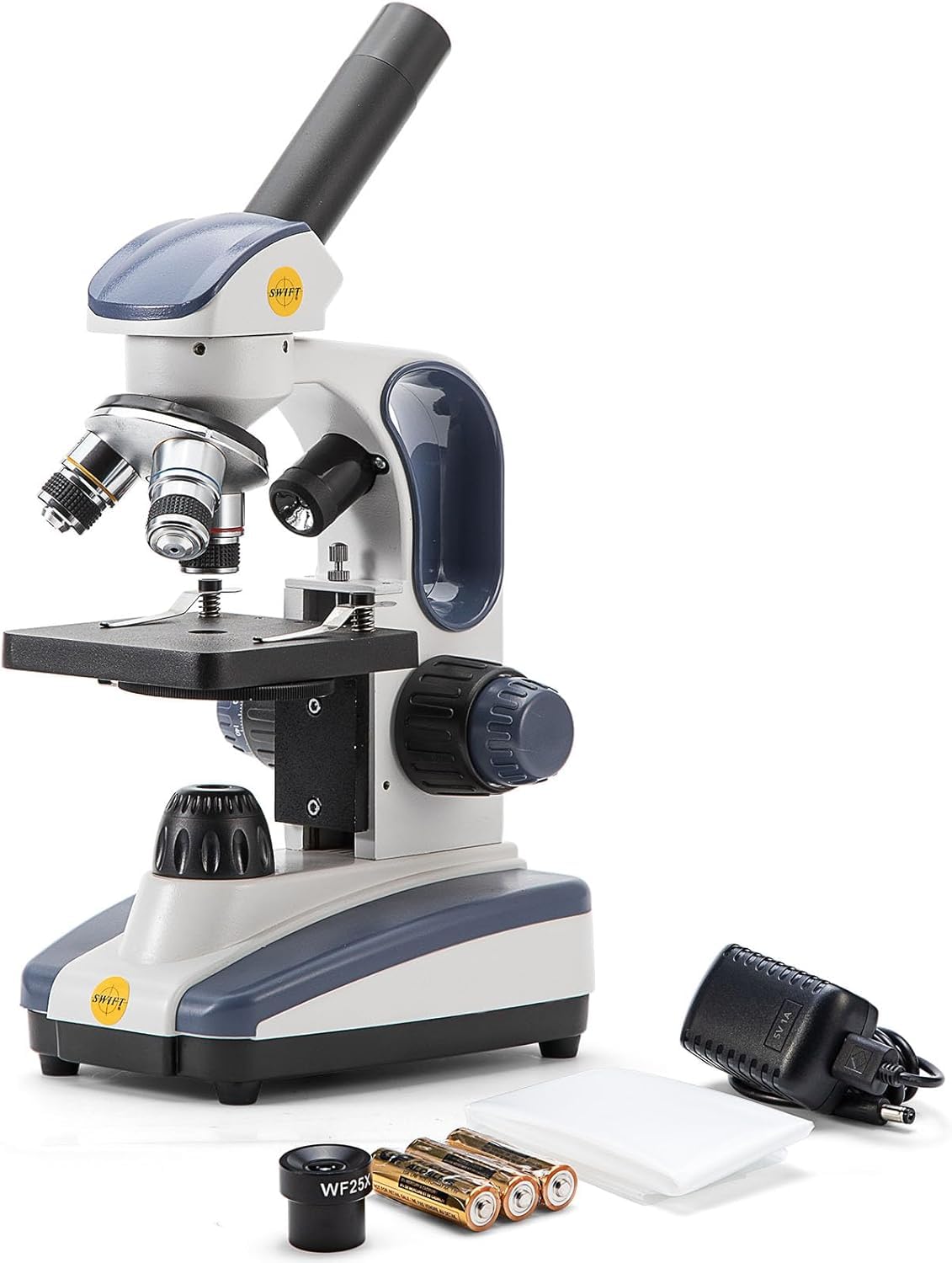
The SWIFT SW200DL sits at the top of this list because it solves the two biggest frustrations of a beginner: unclear focus and poor lighting. It uses a dual illumination system—cool LED lights for both top and bottom—so you can examine a transparent slide of onion cells in one session and switch to a solid coin or rock specimen without needing a separate light source. The metal arm and base give it a rugged feel that plastic-bodied scopes simply can’t match, and the built-in carrying handle makes it practical for moving between a desk and a science fair table.
Optically, this scope is a serious step up from toy-grade models. It offers five magnification settings—40X, 100X, 250X, 400X, and 1000X—through aberration-correcting 4X, 10X, and 40X glass objectives paired with wide-field 10X and 25X eyepieces. The precision fine focus mechanism allows you to dial in sharp detail on specimens like nematodes or algae at 400X without the image drifting out of view. The fully rotatable monocular head is a practical feature for shared instruction, letting you pass the scope between a student and a teacher without moving the entire unit.
For the price, it also runs on batteries, giving you cordless capability for field experiments. The only minor drawback reported is that the LED could be slightly brighter for low-light specimens, but in most classroom and home settings, the light output is more than adequate. This is a starter scope that won’t leave you wishing you bought something better three months down the line.
Why it’s great
- Dual LED illumination handles both slides and solid objects
- Precision fine focus for sharp images up to 1000X
- Rugged metal chassis with a carrying handle
Good to know
- LED brightness could be slightly higher for very dark specimens
- Some units may arrive with a disconnected internal cable—check immediately
2. AmScope M102C-PB10 Biological Compound Microscope

The AmScope M102C-PB10 is the scope for families and educators who want a no-nonsense instrument built to last through years of heavy use. The all-metal framework and glass optical lenses give it a professional-grade feel that immediately separates it from the plastic alternatives commonly found at this price point. It’s a traditional monocular compound microscope with a single-lens condenser and disc diaphragm, delivering consistent, predictable illumination through a wall-powered LED light source.
The magnification range covers 40X, 100X, 250X, 400X, and 1000X, and the achromatic objectives correct for color distortion effectively—meaning that when you look at a prepared slide of a bee wing at 400X, the edges won’t be fringed with blue or red. It comes with a set of five prepared slides and five blank slides, giving a new user enough material to start exploring immediately. Reviewers consistently note that this scope is easy enough for an 11-year-old to use independently but capable enough for general college biology work.
The only consistent issue reported is the LED light bulb burning out after a handful of uses in some units. While this isn’t a universal problem, it’s worth knowing that finding a replacement bulb can be tricky. If you want a scope that teaches proper slide preparation and microscope technique without the digital distractions of a screen, this is a strong candidate.
Why it’s great
- All-metal construction guarantees long-term durability
- Achromatic glass objectives deliver sharp, color-corrected images
- Includes prepared and blank slides for immediate use
Good to know
- LED bulb can burn out—replacement sourcing may be difficult
- Wall-powered only, no battery option for field work
3. AmScope M30-ABS-KT2-W-WM 52-Piece Kit

The AmScope M30 kit is built around the philosophy that a beginner needs more than just a scope—they need a complete lab experience. The kit includes a compound microscope with six magnification settings ranging from 120X to 1200X, a rotating color filter wheel for enhancing contrast on transparent specimens, and a set of tools that includes tweezers, a pipette, and a brine shrimp hatchery kit. It also comes with a copy of “The Book of the Microscope,” which turns the whole package into a structured educational program rather than just a piece of hardware.
The microscope itself is a monocular compound design with an LED light source and a color filter wheel that helps beginners see details in stained or thin specimens. The 52-piece count includes pre-made slides and blank slides, plus a storage case to keep everything organized. For a parent introducing a child to STEM, this kit removes the guesswork of what to buy next—everything is in the box. The body is plastic, but reviewers report that it feels solid enough for the target age range of 8 to 13 years old.
The trade-off is the plastic build. It lacks the fine focus mechanism found on metal-bodied scopes, and the field of view can shift slightly when you turn the coarse focus knob. Some users also report that the light/mirror mechanism can break if handled roughly. That said, for the sheer breadth of the kit—slides, tools, book, and case—no other scope on this list offers a better out-of-the-box learning experience for an absolute beginner.
Why it’s great
- Extensive 52-piece kit includes slides, tools, and a book
- Rotating color filter wheel improves contrast on thin specimens
- Brine shrimp hatchery kit provides hands-on biology experiment
Good to know
- Plastic body may not survive rough handling
- No fine focus adjustment—image can drift at higher magnifications
4. BEAVERLAB Finder 4.0″ Digital Microscope

The BEAVERLAB Finder M2C breaks the mold of kid-focused handheld microscopes by offering a design and feature set that appeals equally to adult hobbyists. It features a 4.0-inch IPS display—the largest screen on any product in this roundup—which makes group viewing comfortable without everyone crowding around a tiny phone-sized screen. The 1080P imaging sensor captures full HD video and photos, and the built-in hotspot lets you upload images directly to your phone for sharing on social media or saving to a portfolio.
Magnification ranges from 100X to 1600X, but unlike cheap digital scopes that simply enlarge a low-resolution image to a blur, the BEAVERLAB uses a 2MP CMOS sensor that retains usable detail up to about 800X. The 8 adjustable LED lights give you fine control over illumination, which is critical when switching between dark specimens like a dead insect and reflective ones like a coin. The body uses a combination of ABS plastic and aviation aluminum alloy inner rails, giving it a sturdiness that the all-plastic alternatives lack.
The camera button can be stiff to press, making single-handed photo capture a bit awkward. And while the WiFi feature is convenient, the companion app interface for browsing photos is clunky compared to simply pulling the TF card and viewing files on a computer. But for its combination of screen size, build quality, and imaging capability, this is the handheld scope that feels the least like a toy and the most like a serious exploration tool.
Why it’s great
- Large 4-inch IPS screen is best-in-class for group viewing
- WiFi hotspot enables instant sharing of discoveries
- Aviation aluminum alloy inner rails add structural rigidity
Good to know
- Camera button is stiff and requires firm pressure
- WiFi app for photo browsing is not intuitive
5. barchrons 4K HD Handheld Microscope
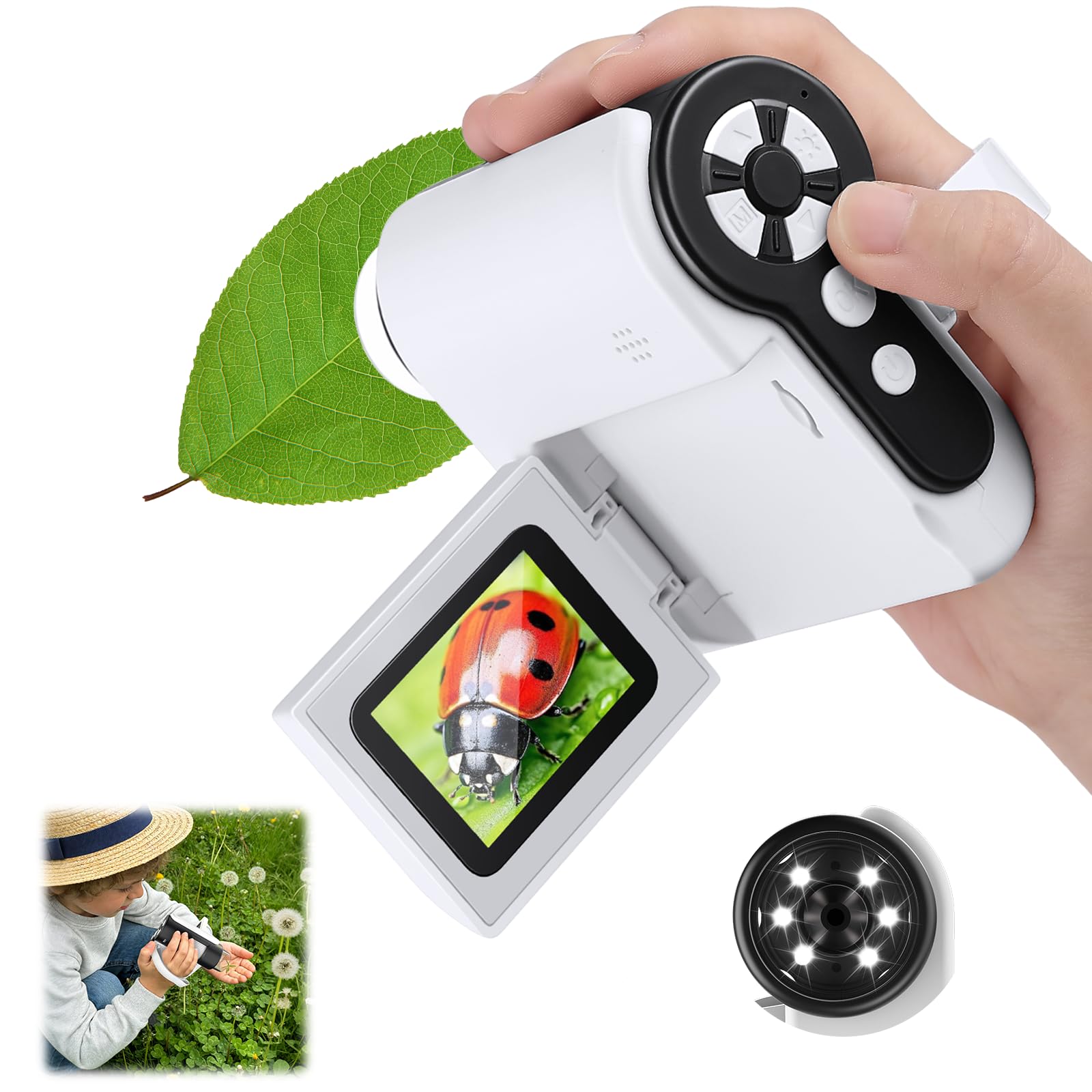
The barchrons 4K digital microscope is a 3-in-1 device that functions as a microscope, camera, and telescope, making it one of the most versatile entry points into the world of magnification. The headline feature is the 4K HD screen, which provides higher resolution than the 1080P screens on most other handheld scopes, giving you a noticeably crisper view of fine details like the ridges on a fingerprint or the weave of a fabric. The 6-level adjustable LED light ensures you have enough illumination for tricky outdoor specimens where ambient light is low.
The magnification range covers 100X to 1000X, and while the 4K sensor does help retain clarity at the higher end, you’ll get the best results between 200X and 600X for most solid objects. The 1200mAh battery supports about 4 hours of continuous use, which is genuinely useful for a day of outdoor exploration at a park or a camping trip. It also functions as a telescope when you adjust the focus for distant objects—a quirky but fun bonus feature for a kid who wants to switch between looking at a ladybug and spying a bird in a nearby tree.
The plastic casing feels durable enough for travel, but some users have noted that the build does look and feel like a toy compared to the metal-bodied compound scopes. The biggest hiccup reported is that some units ship without the TF card needed for video recording, so check the package contents immediately upon arrival. For a parent who wants a single device that covers multiple scientific curiosities, this is a compelling choice.
Why it’s great
- 4K screen offers class-leading display resolution
- 3-in-1 design works as microscope, camera, and telescope
- 1200mAh battery delivers a full 4 hours of field use
Good to know
- TF card for video recording may not be included
- Plastic casing has a toy-like feel despite adequate durability
6. Odatay 4K 1000X Digital Microscope
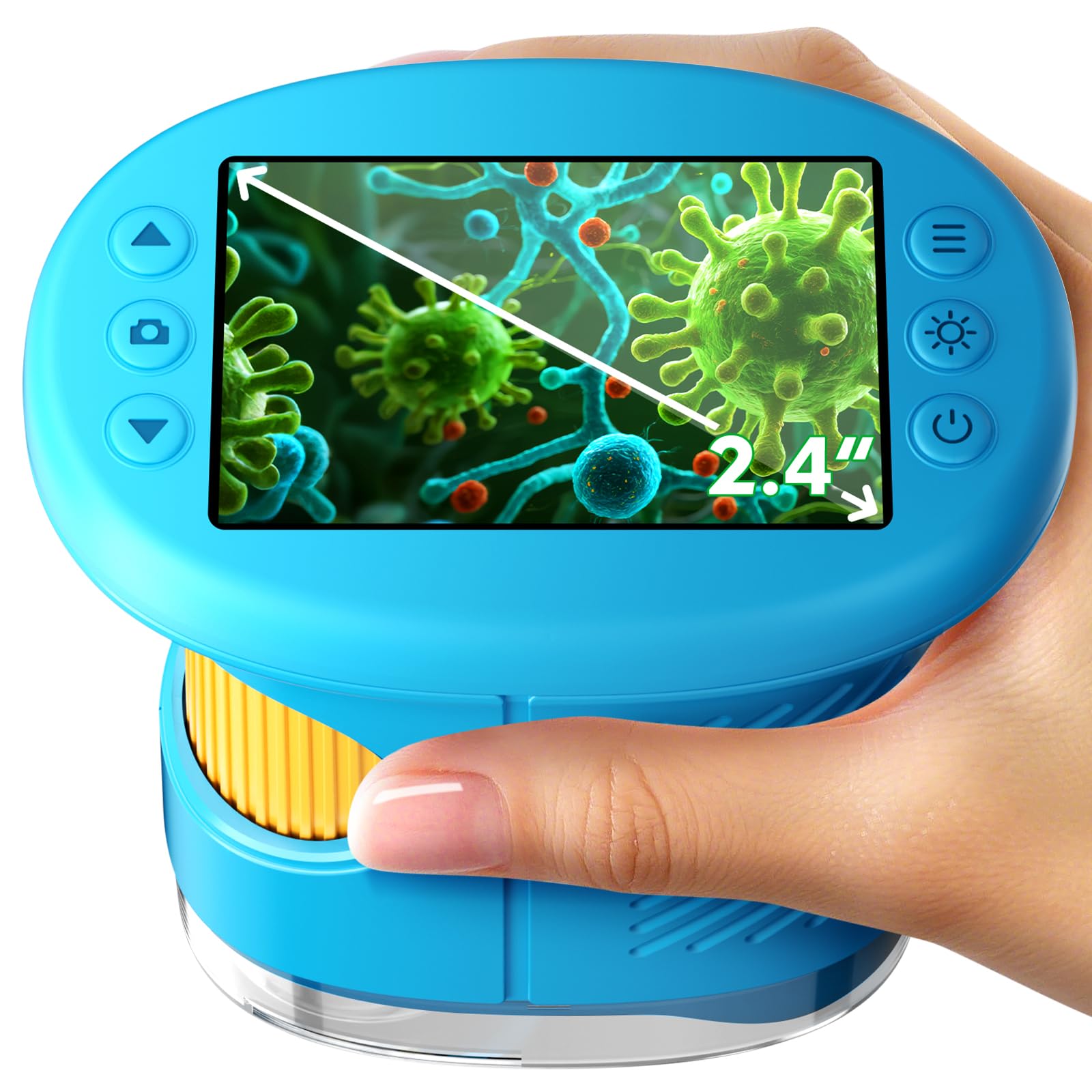
The Odatay 4K digital microscope punches well above its weight class by offering a 4K HD camera, a 2.4-inch screen, and a complete accessory kit that includes a 32GB TF card and 12 prepared slides—all at a price that competes with basic plastic toy microscopes. The 200X to 1000X 4-level magnification system includes a long-distance viewing mode at the lowest level, which is a clever addition that lets a child use the device as a digital magnifying glass for close-up inspection of objects without needing to touch or mount them.
The image quality from the 4K sensor is genuinely impressive for the price point. The 8 built-in LED lights with 3-level adjustable brightness ensure you have enough light for most indoor specimens, and the 0.5-pound weight makes it easy for a child aged 5 to 12 to hold and operate without fatigue. It comes with a lanyard, a tripod hole for steady hands-free viewing, and the ability to connect to a PC for file transfer and extended use. The protective silicone case for the screen is a thoughtful inclusion that extends the device’s lifespan in a child’s hands.
The main limitation is the 2.4-inch screen, which feels small compared to the 4-inch screens on more expensive handhelds, making it harder for multiple kids to view simultaneously. The plastic construction is functional but not rugged, so it’s best suited for supervised use rather than being tossed into a backpack. However, for the sheer value of getting a 4K digital scope with a storage card and prepared slides at this price point, it’s a fantastic entry-level option for a young explorer.
Why it’s great
- 4K camera delivers sharp images for a budget device
- Includes 32GB TF card and 12 prepared slides
- Weighs only 0.5 lbs—ideal for small hands
Good to know
- 2.4-inch screen is small for group viewing
- Plastic construction requires careful handling
7. Alotwan HD Handheld Microscope
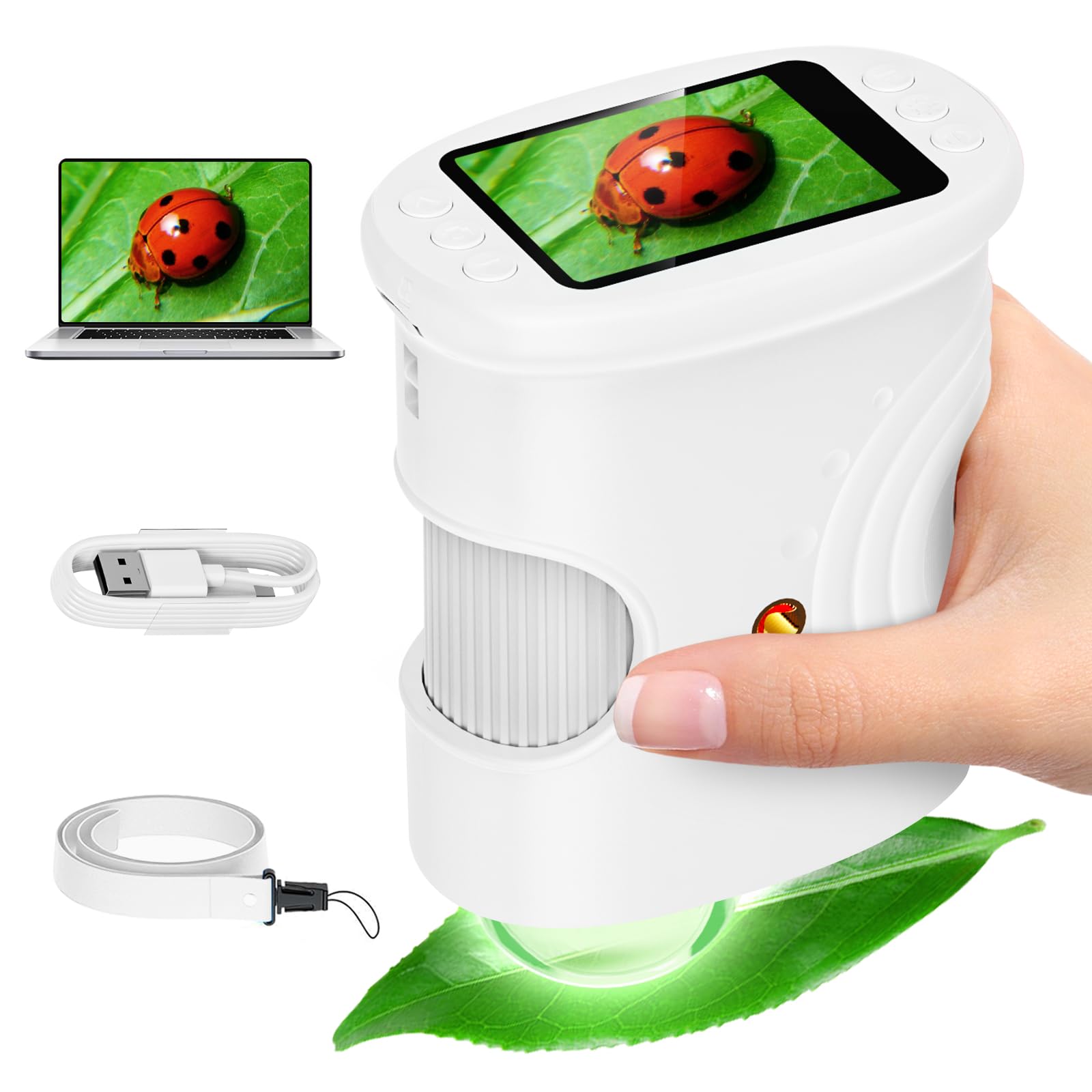
The Alotwan handheld microscope is designed with one primary goal: to make microscopy as portable as possible. At just 0.3 pounds and measuring roughly 4 inches by 3 inches, it fits comfortably into a pocket or a small bag, making it the go-to choice for outdoor adventures where you don’t want to lug around a bulky compound scope. The 1080P HD screen displays bright colors and sharp details, and the up to 1000X digital zoom allows children to explore everyday objects like leaves, coins, and fabric textures without needing to prepare slides.
A unique feature of this scope is its 3-in-1 functionality—it works as a microscope for close-up viewing, a telescope for distant observation when you adjust the focus, and a video recorder when a TF card is inserted (note that the card is not included). The built-in memory can store about 200 photos without a card, which is handy for quick snapshots during a walk. The comfortable grip and smooth focus knob are designed specifically for small hands, allowing toddlers as young as three years old to operate it with minimal frustration.
The biggest caveat is that this is a digital educational toy, not a precision instrument. It is not suitable for viewing biological cells, blood samples, or laboratory slides requiring high-resolution optics. The plastic enclosure material is light but not particularly impact-resistant. For the price, it delivers a fun, immediate, and screen-based exploration experience perfect for a preschooler or kindergarten-aged child who is just beginning to ask “what does this look like up close?”
Why it’s great
- Extremely lightweight (0.3 lbs) and pocket-sized
- Built-in memory stores 200 photos without a card
- Comfortable grip and focus knob designed for small children
Good to know
- Not suitable for lab-grade biological specimens
- TF card for video recording not included
FAQ
What is the best magnification for a beginner microscope?
Should I buy a digital or a traditional compound microscope?
What accessories should come with a beginner microscope kit?
Final Thoughts: The Verdict
For most users, the best beginner microscope winner is the SWIFT SW200DL because it combines a rugged metal chassis, precision fine focus, and dual LED illumination that handles both slides and solid objects with ease. It’s a scope that will serve a student from their first science fair through high school biology. If you want a complete educational ecosystem with slides, tools, and a book, grab the AmScope M30-ABS-KT2 kit. And for the most versatile digital experience with a large 4-inch screen and WiFi sharing, nothing beats the BEAVERLAB Finder M2C.