
Our readers keep the lights on and the weekend projects moving. As an Amazon Associate, I earn from qualifying purchases.
The smell of fresh plastic and possibility—that’s what a new model ship kit promises. But for a beginner, that same box can quickly feel like a Pandora’s box of tiny, unlabeled parts and instructions written in what looks like ancient script. Choosing the wrong kit can turn an exciting new hobby into a frustrating pile of glue and regret. The right one, however, is a gateway to craftsmanship, history, and hours of satisfying focus.
I’m Rikta — the co-founder and writer behind FitlyFast. This guide is the product of deep market research, combing through hundreds of technical specifications, and analyzing real builder feedback to isolate the kits that actually deliver on their beginner-friendly promise.
The goal is simple: help you find a kit that builds confidence, not confusion. After reading this, you’ll know exactly which model fits your skill level and which ones to set aside for later. This is your guide to the best beginner model ship kits on the market today.
How To Choose The Best Beginner Model Ship Kits
Walking into a hobby store or browsing online is overwhelming. The sheer variety of scales, materials, and price points can paralyze a new builder. But by focusing on a few critical specs, you can narrow the field to the kits that you will actually finish—and enjoy finishing.
Part Count & Complexity
A beginner kit should have a part count under 100 for your first build. This is the single most reliable indicator of build time and frustration level. A simple fishing trawler with 61 parts is a far better introduction than a 500-piece wooden galleon, which is a project that demands weeks of dedication and advanced technique.
Material: Plastic vs. Wood
Plastic kits from Tamiya and Revell are the traditional starting point. They are molded in color, require painting, and the parts fit with engineering tolerances. Wood kits like the Model Shipways Longboat offer a more “authentic” shipbuilding experience—plank-on-frame construction—but demand significantly more skill, patience, and sharp tools. For a true first kit, high-quality plastic is almost always the winner.
Instruction Clarity
This is the hidden spec. A great kit can be ruined by terrible instructions. Look for kits where reviewers explicitly praise the manual. Tamiya and Revell are consistently praised for their step-by-step diagrams. Be wary of any kit where reviews mention “poorly written,” “inarticulate,” or “no written instructions,” as this is a common pain point that can stop a beginner dead in their tracks.
Quick Comparison
On smaller screens, swipe sideways to see the full table.
| Model | Category | Best For | Key Spec | Amazon |
|---|---|---|---|---|
| Revell North Sea Trawler | Plastic Kit | First-Ever Build | 61 Parts / Skill Level 3 | Amazon |
| ROKR Seahorse Barque | Wooden Puzzle | No-Glue Assembly | 603 Pieces / 1:100 Scale | Amazon |
| Tamiya Fletcher Destroyer | Plastic Kit | Quality & Detail | 12.9″ Length / 1:350 Scale | Amazon |
| Model Shipways Longboat | Wood Kit | Learning Traditional Craft | True Plank-on-Frame | Amazon |
| Lucky Doug Cruiser | Metal Kit | STEM Project for Kids | 504 Pieces / Metal | Amazon |
| Revell Viking Ship | Plastic Kit | Historical Display | 64 Shields / 32 Paddles | Amazon |
| Tamiya Yorktown Carrier | Plastic Kit | Small-Scale Detail | 1:700 Scale / Waterline | Amazon |
In-Depth Reviews
1. Revell Germany North Sea Fishing Trawler Kit
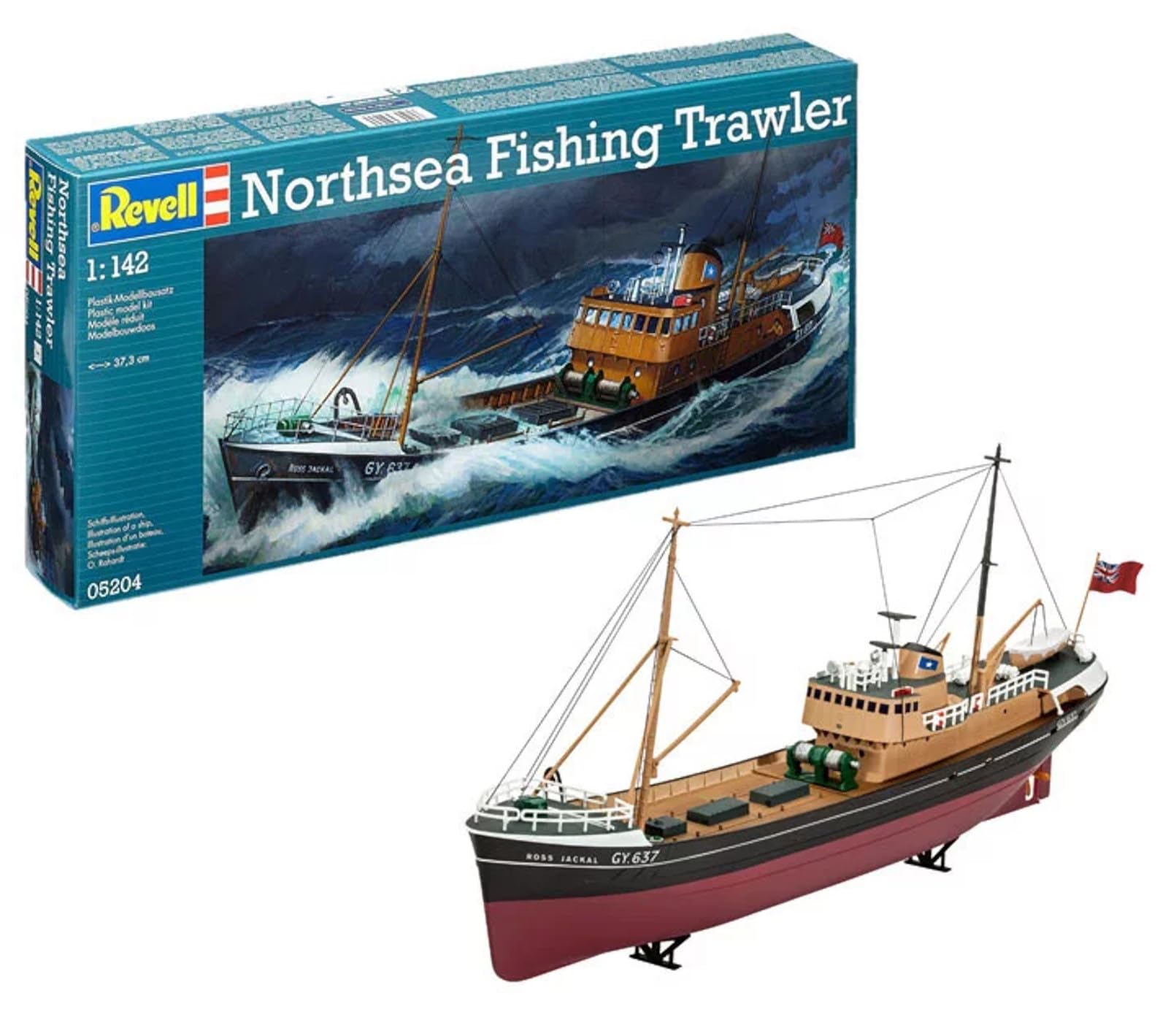
This is the kit that should be in every beginner’s shopping cart. With only 61 parts, it is a manageable weekend project, not a multi-month slog. The subject—a humble North Sea trawler—is forgiving. A few smudges of paint or imperfect joints look like character on a working fishing boat, which is a massive confidence booster for a first-timer.
The instructions are a standout feature for this price point. They are clear, accurate, and guide you through the build without requiring a magnifying glass to interpret the diagrams. Engineers praise the accuracy of the parts, noting a satisfying fit. The inclusion of a display stand and two crew figures adds immediate display value once you finish.
One experienced reviewer called it the “perfect level of difficulty” for a break from complex aircraft models. The main critique is that it is “too easy” for advanced builders, which is exactly the right problem for a beginner to have. You’ll need your own paint and glue, but the result is a handsome civilian ship that looks right at home on any shelf.
Why it’s great
- Low part count ensures a manageable first build
- Forgiving subject matter hides beginner imperfections
- Clear, well-regarded instructions
Good to know
- Some builders wish for more detail or a larger scale
- Some kits have been noted to include thinner rigging string than desired
2. ROKR 3D Wooden Puzzles Seahorse Barque
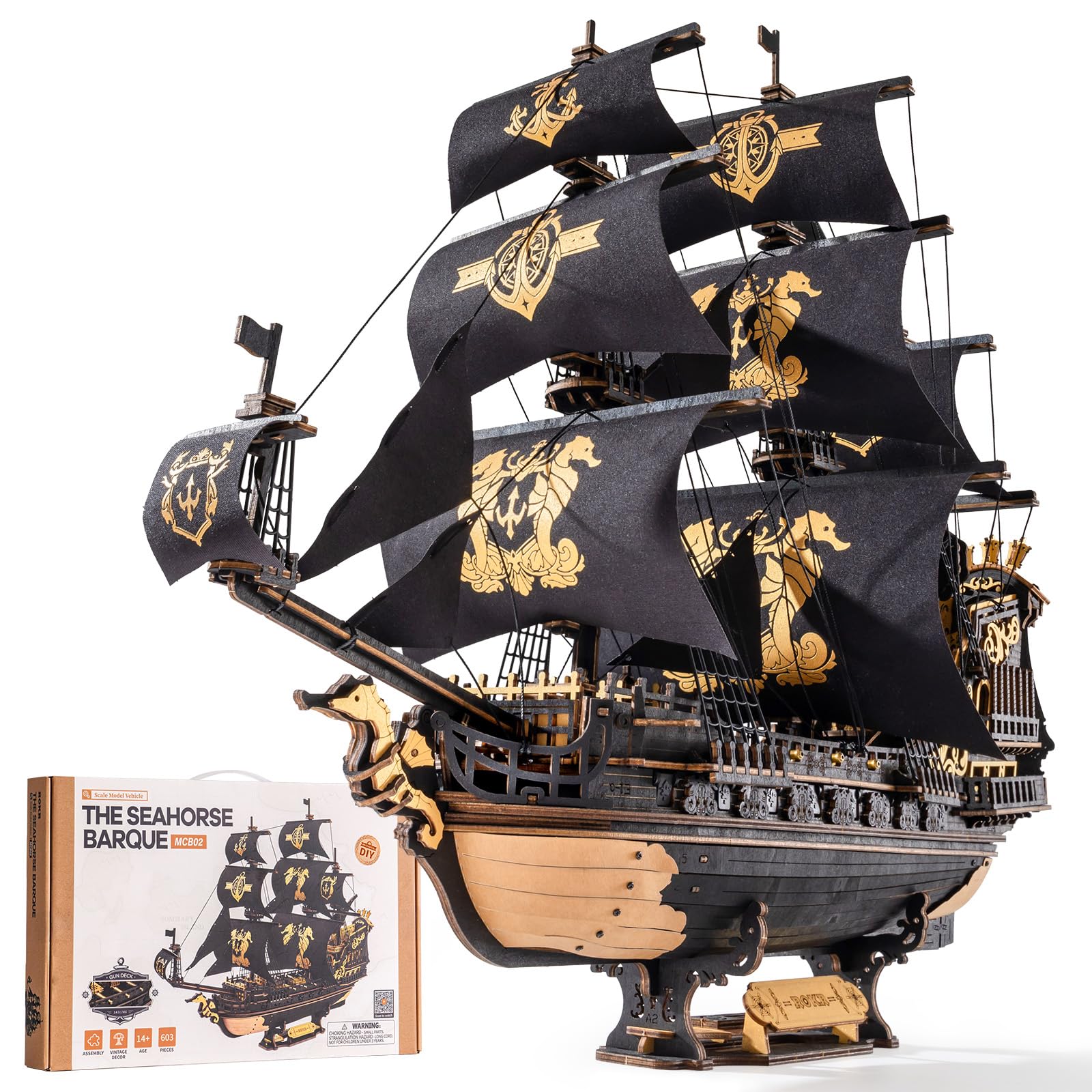
If the idea of glue and paint feels intimidating, the ROKR Seahorse Barque is your perfect entry point. This is a precision laser-cut wooden puzzle, not a traditional model kit. You simply punch out the plywood pieces and snap them together. It is a completely stress-free way to build a stunning, display-quality sailing ship.
The detail is genuinely impressive for a glue-less kit. It features a rotating rudder, intricate deck carvings, and 13 individual sails. Builders consistently describe it as “challenging but fun,” noting that while the 603 pieces are many, the fit is so precise that no glue is necessary. A pair of tweezers or needle-nose pliers is a helpful addition.
This kit bridges the gap between a puzzle and a model. It is an excellent choice for someone who wants a gorgeous finished product without the learning curve of painting or dealing with liquid cement. The primary trade-off is that it feels less like “ship modeling” and more like an elaborate 3D puzzle—which is ideal for a different kind of beginner.
Why it’s great
- No glue or paint required for assembly
- Highly detailed with moving parts like a rotating rudder
- Laser-cut pieces fit together with precision
Good to know
- Long build time (10+ hours) with many small pieces
- Some pieces are fragile and can break if forced
3. Tamiya Models Fletcher Class Destroyer

Tamiya is the gold standard for plastic model kit engineering, and this Fletcher Class Destroyer is a textbook example why. The parts fit is so flawless that you can often dry-fit them without glue. However, do not be fooled by the “scale model” label—this is a small kit loaded with delicate, tiny parts that require tweezers and a steady hand.
The customer feedback is a warning siren for true beginners. Multiple reviewers explicitly state it is “not suitable for beginners” due to the “many tiny, delicate parts.” While the engineering is top-tier, a first-time builder may find themselves frustrated by the lack of forgiveness in such a detailed small-scale warship. It is a kit for someone who has built one or two cars or planes already.
It is an excellent *second* kit. It provides an experience in high-quality engineering that you can feel in every click-fit joint. The final result is a crisp, historically accurate warship that looks phenomenal for its size. For a beginner ready to level up, this is the next logical step.
Why it’s great
- Exceptional fit and crisp detail from Tamiya
- Perfect way to level up your skills after a simpler build
- Low cost for the quality of engineering
Good to know
- Very small parts require steady hands and tweezers
- Frequent feedback that it is not for absolute beginners
4. Model Shipways 18th Century Longboat Wood Model Kit

This is the entry point into the world of *real* wooden ship modeling. The “plank-on-frame” construction is the traditional method used by model shipwrights for centuries. The Longboat is a simple, historic craft designed to teach you those core techniques without the overwhelming complexity of a full-rigged man-o’-war.
Reviews are strongly polarized for good reason. Many builders say it is “great for learning boat building techniques” and produces a “very satisfying finished product.” Others warn it is “not for absolute beginners” because the planking requires practice. The key is perspective: if you want to learn the craft of wood ship building, this is a perfect teacher. If you just want a model, start with plastic.
The instructions are a mixed bag. The kit includes a 20-page manual and full-size plans, but some builders find them “inarticulate and disorganized.” One reviewer strongly recommended against it. The Lifeline is the lifetime guarantee—if you break a piece, the manufacturer replaces it for free. This makes it a relatively low-risk way to try wood modeling, provided you have patience.
Why it’s great
- Teaches authentic wooden ship-building techniques
- Lifetime replacement guarantee on parts
- Laser-cut basswood parts are historically accurate
Good to know
- Planking is a skill that takes practice to master
- Some builders find the instructions lacking in clarity
5. Lucky Doug Stem Building Projects Model Cruiser

This kit is a metal construction set, not a traditional plastic or wood model. It is designed for a younger audience (ages 8-16) and marketed as a STEM project. The build involves bending soft iron parts and using included screwdrivers and wrenches. It is durable and has a unique industrial aesthetic when finished.
The parent reviews are a study in caution. While some families reported a “great project for kids,” a significant number of critical reviews detail severe quality control issues. Reviewers mention “pieces don’t fit,” “mismatched parts,” and “holes not aligning.” The instructions are reportedly picture-only with no text, which can be a major hurdle for a child.
This kit has a high potential for frustration. It is best suited for a child who has experience building with small parts and who is not easily discouraged by a tight fit. The finished ship is large (over 18 inches long) and looks impressive, but the journey to get there is rocky. For a guaranteed successful parent-child project, the simpler plastic kits are a safer bet.
Why it’s great
- Durable metal construction is more robust than plastic
- Large finished size makes for an impressive display piece
- Teaches mechanical assembly skills
Good to know
- Multiple reviews cite poor fit and inaccurate instructions
- Bending metal parts requires considerable hand strength
6. Revell of Germany Viking Ship Plastic Model Kit
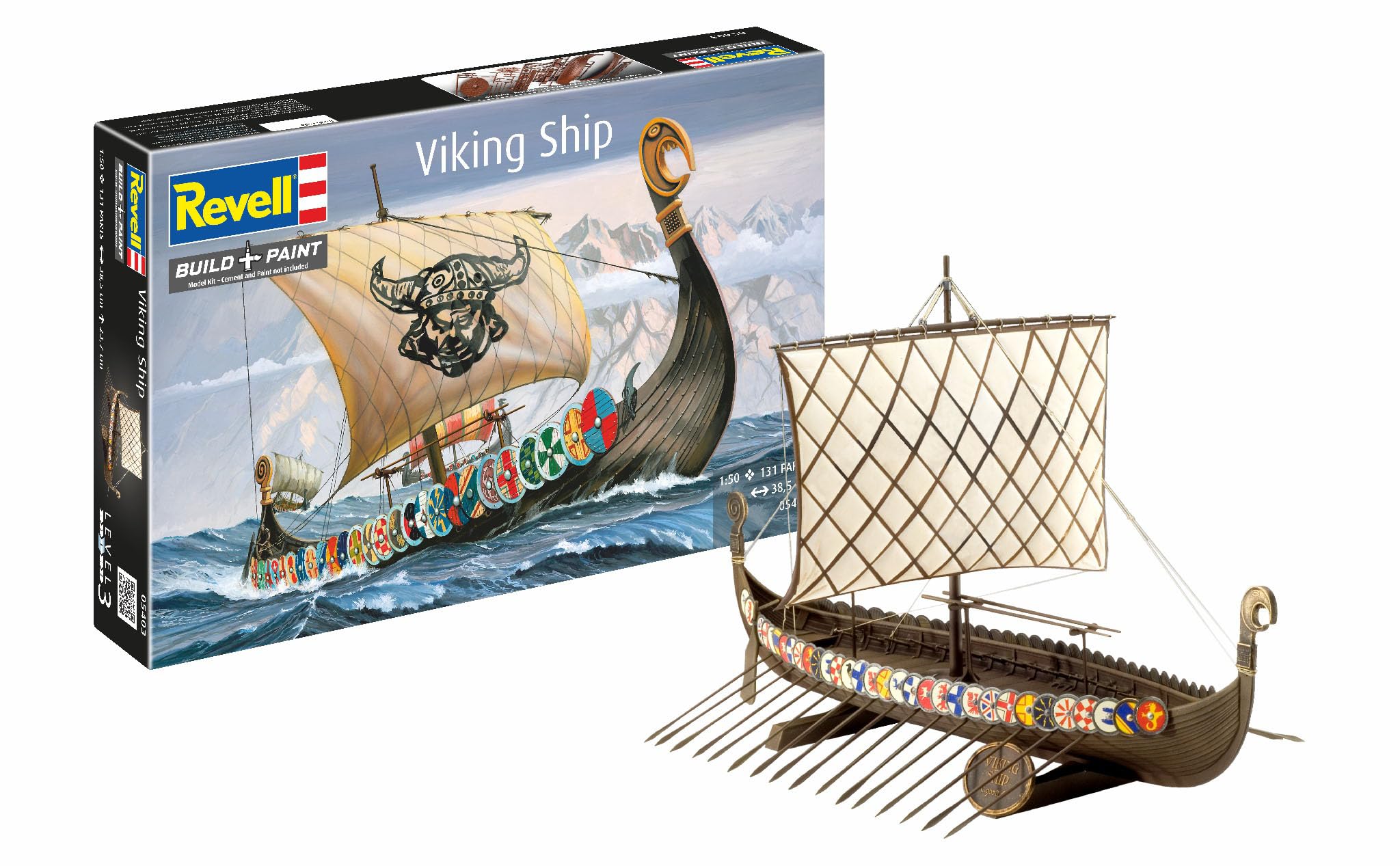
This kit trades complexity for visual impact. It is a well-designed, striking display of a Viking longship, complete with a detailed wood-grain hull, a textured sail, and 64 shields to place along the sides. The packaging and subject matter make it an instant conversation piece once finished.
The build is straightforward, perfectly suited for someone who wants an impressive shelf model without a massive time commitment. Builders report it takes around 16-20 hours. The primary challenge is the gluing of tiny parts, such as the cleats, which some reviewers found difficult. The instruction manual is considered easy to follow by most.
A critical note is the anachronistic decal for the sail—a shield with a Viking head that is not historically accurate. Most builders simply omit it, which is easy to do. For a beginner, this is an ideal project that builds historical appreciation while teaching basic gluing and painting skills. The result is a beautiful, classic model that looks far more complex to build than it is.
Why it’s great
- High visual impact with a historic and recognizable design
- Manageable build time of around 16-20 hours
- Includes a display stand and nameplate
Good to know
- The sail decal is historically inaccurate trivia
- Tiny parts like cleats can be very frustrating to glue
7. Tamiya 1/700 US Aircraft Carrier Yorktown

This is a waterline model, meaning the hull ends at the water line. It is designed for a diorama or a shelf where you don’t need the entire hull. The kit is packed with tiny aircraft and intricate deck details. It is a fantastic kit for someone who loves tiny, highly-detailed subjects and has good eyesight.
Reviewers almost universally agree this is for intermediate to advanced modelers. The extreme small scale (1:700) makes the parts incredibly tiny. A 12-year-old with prior modeling experience reportedly found it challenging but satisfying. The Tamiya quality is present—excellent fit, no flash—but the scale introduces its own difficulties.
For a beginner, this is a test of patience more than skill. The waterline presentation also means you skip the complex painting of the hull bottom. It is a great way to get a detailed carrier display without the largest piece of the build. It requires paint and glue, and is a wonderful project for someone who has successfully finished at least one or two simpler kits first.
Why it’s great
- Excellent Tamiya quality mold with minimal flash
- Waterline version saves space and painting steps
- Includes multiple aircraft types for a lively deck
Good to know
- Very small scale makes parts hard to handle
- Rated as intermediate/advanced, not for beginners
FAQ
What glue should a beginner use for a plastic model ship?
Do I need to paint a plastic model ship kit?
What tools do I need for my first model ship kit?
Final Thoughts: The Verdict
For most users, the best beginner model ship kits winner is the Revell North Sea Fishing Trawler because it offers the perfect balance of low part count, clear instructions, and a forgiving subject matter. If you want a glue-free and mess-free build that results in a stunning wooden display piece, grab the ROKR Seahorse Barque. And for the beginner ready to level up to a kit with world-class engineering and a historic warship design, nothing beats the Tamiya Fletcher Class Destroyer.