
Our readers keep the lights on and the weekend projects moving. As an Amazon Associate, I earn from qualifying purchases.
An overlocker finishes raw edges, trims excess fabric, and sews a seam all in one pass. For a beginner, the threading system, stitch quality, and easy setup decide if your first project feels like a win or a struggle. The wrong machine can turn a simple hem into an hour of re-threading and skipped stitches.
I’m Rikta — the co-founder and writer behind FitlyFast. I’ve spent months analyzing serger hardware specifications, comparing tension systems, differential feed ratios, and stitch capabilities across dozens of models so you don’t have to.
Durable metal frames, color-coded guides, and consistent stitch performance separate the helpful machines from the frustrating ones when you’re shopping for the best beginner overlocker.
How To Choose The Best Beginner Overlocker
Three things decide if a serger feels like an ally or an opponent: threading ease, differential feed, and build quality. Beginners often overlook the tension system and buy a machine that drops stitches the moment they switch from cotton to jersey.
Threading System and Setup
Every overlocker requires threading the upper and lower loopers. Machines with color-coded guides and numbered paths cut setup time from 30 minutes to under ten. Some models arrive pre-threaded so you can test stitch quality before re-threading on your own.
Differential Feed Control
Differential feed moves the front and rear feed dogs at independent ratios. On lightweight fabrics it prevents puckering; on stretch knits it stops wavy seams. A beginner-friendly machine should offer an adjustable dial rather than a fixed setting.
Stitch Capability and Versatility
Three-thread stitches are fine for edge finishing, but four-thread stitches provide the strongest seam for garment construction. Look for a machine that does both, plus rolled hem and gathering foot capability, so you can grow into the machine instead of outgrowing it in six months.
Quick Comparison
On smaller screens, swipe sideways to see the full table.
| Model | Category | Best For | Key Spec | Amazon |
|---|---|---|---|---|
| Brother 1034D | Serger | Overall beginner | 1,300 SPM / 3–4 thread / differential feed | Amazon |
| Brother ST4031HD | Serger | Heavy fabrics | 1,300 SPM / extra hard carbon steel blade | Amazon |
| SINGER S0100 | Serger | Speed and value | 1,300 SPM / 6 built-in stitches | Amazon |
| Janome 8002D | Serger | Reliability | 1,300 SPM / 5-year mechanical warranty | Amazon |
| Janome MOD-8933 | Serger | Easy threading | Lay-in threading / 3–4 thread convertible | Amazon |
| SINGER S14-78 | Serger | Versatile stitches | 1,200 SPM / free arm / rolled hem | Amazon |
| Lumina Moda | Serger | Compact design | 1,250 SPM / free arm / built-in trim trap | Amazon |
| FEIYUE FY505 | Serger | Budget pick | 1,100 SPM / metal frame / 2–4 thread | Amazon |
| VEVOR Overlock | Serger | Value entry | 1,250 SPM / iron frame / LED light | Amazon |
In‑Depth Reviews
1. Brother 1034D

The Brother 1034D has been a staple recommendation for years because it balances metal-frame durability with a genuinely beginner-friendly threading system. Color-coded guides and a lower looper threader let you go from box to first stitch in about five minutes. The differential feed dial is front-mounted and easy to adjust, so you can move from lightweight silk to thick denim without fighting tension headaches.
At 1,300 stitches per minute this machine chews through projects fast, yet the foot pedal allows fine speed control for corners and curves. It comes with three snap-on feet — standard, gathering, and blind stitch — plus a removable trim trap that keeps your workspace clean. The rolled hem function works well once you switch the stitch finger, and the blind stitch foot is genuinely useful for hemming trousers.
Owner feedback consistently highlights the ease of re-threading by tying new thread to old spools, which is a huge time saver. The main limitation: it does not do a cover stitch or chain stitch, so you will still need a regular sewing machine for topstitching and hems on knits. For pure overlocking, this is the benchmark that other beginner machines try to match.
Why it’s great
- Color-coded threading system reduces setup time to minutes
- Differential feed handles knits and wovens without puckering
- Removable trim trap and three included feet add real value
Good to know
- Does not perform cover stitch or chain stitch
- Instructional DVD is small; YouTube guides are more helpful
2. Brother ST4031HD

Brother calls the ST4031HD the Strong & Tough series, and the name holds up. The metal frame feels substantially heavier than the 1034D, and the extra hard carbon steel blade delivers cleaner cuts through multiple layers of canvas, denim, and quilted fabric. If your projects include heavy materials, this machine stays stable at full speed without vibration.
The large extension table is a standout feature for bigger projects like curtains, tote bags, and quilts. It gives you a flat work surface right next to the needle, reducing fabric drag. The free arm slides off the extension table so you can still do sleeves and cuffs. Threading is color-coded and similar to the 1034D, but the numbered upper and lower loopers make it even more intuitive.
Owners report that the machine arrived pre-threaded, which let them test stitch quality immediately. Re-threading by tying new thread to the old spools works well here. Some users note that the thread nets on the spool holders are necessary to prevent tangling at high speed. The main trade-off is that this machine is larger and heavier than the 1034D, so it is less portable.
Why it’s great
- Extra hard carbon steel blade cuts heavy fabrics cleanly
- Large extension table improves control on big projects
- Pre-threaded out of the box for immediate testing
Good to know
- Heavier and larger than entry-level models
- Thread nets are needed to prevent tangling at high speeds
3. SINGER S0100

The SINGER S0100 offers six built-in stitches and a maximum speed of 1,300 stitches per minute, making it one of the faster options in the mid-range. The color-coded threading guides are clearly marked on the machine body, and the upper looper path is simplified compared to older SINGER models. The differential feed dial is easy to reach and adjusts smoothly.
The included accessory kit is generous: cone adapters, extra needles, tweezers, a screwdriver, and a foot controller all store in the front compartment. The machine is pre-threaded with four colors, so you can practice serging right away. The dust cover is a nice addition that many competing models omit.
Some users found that the tension settings drift slightly during heavy use, which may require periodic re-checking. The manual could be clearer — several owners recommend watching the official SINGER setup video on YouTube. The machine runs quietly for its speed class, and the stitch width adjustment is tool-free.
Why it’s great
- Six built-in stitches for varied edge finishes and decorative work
- Front compartment stores all accessories neatly
- Quiet operation at 1,300 SPM
Good to know
- Tension settings may drift and need periodic re-adjustment
- Manual lacks detail; online video guides are more helpful
4. Janome 8002D

Janome’s 8002D has a reputation for mechanical reliability that shows in the warranty — five years on mechanical parts, two years on electrical. The machine is pre-threaded with four white cone threads, so your first stitch happens immediately. The color-coded threading paths on the tension dials and around the loopers are among the clearest in this class.
The differential feed system here is particularly smooth. It prevents puckering on chiffon and organza while handling cotton double knits without stretching. The rolled hem conversion is straightforward: disengage the stitch finger and adjust the tension. No extra parts needed. The machine runs at 1,300 stitches per minute and feels stable at full speed.
Some owners note that the 8002D is noisier than comparable Brother machines. The instruction DVD provides decent visual guidance, but the printed manual is light on troubleshooting. The lack of a free arm is a real limitation for cuffs and sleeves — you will need to work around tubular sections manually. For straightforward edge finishing and seaming, this machine performs consistently over years of use.
Why it’s great
- Excellent warranty coverage for mechanical and electrical parts
- Pre-threaded setup saves time on first use
- Differential feed handles delicate and stretch fabrics evenly
Good to know
- No free arm for cuffs and sleeves
- Noisier than some competitors at high speed
5. Janome MOD-8933

The Janome MOD-8933 addresses the single biggest frustration for beginners: threading the lower looper. Its lay-in threading system lets you drop the thread into a slot rather than threading it through a tiny eye. This one feature saves five to ten minutes every time you re-thread. Color-coded guides run from the spool pins to the needle eyes.
The quick-change rolled hem function is genuinely fast — you slide a lever instead of swapping out the stitch finger. The adjustable presser foot pressure is useful when moving between thick and thin fabrics, and the differential feed dial has clear markings for common fabric types. The machine is 3 and 4-thread convertible, which covers most beginner needs.
Some users report that the tension settings drift slightly from vibration and need re-checking after heavy use. The upper knife position can make threading the lower looper awkward for people with larger hands. There is no storage case included, and the dust cover is a lightweight plastic that some owners found flimsy. For pure ease of setup, this is the most beginner-friendly threading system in the group.
Why it’s great
- Lay-in lower looper threading eliminates the hardest step for beginners
- Quick-change rolled hem with no stitch finger swap
- Adjustable presser foot pressure adapts to fabric thickness
Good to know
- Tension can drift with vibration during extended use
- No free arm for tubular projects
6. SINGER S14-78

The SINGER S14-78 combines free arm capability with 2, 3, and 4-thread stitch options. The free arm is accessed by sliding off the extension table, which immediately makes cuffs, sleeves, and pant legs easier to manage. The machine also converts to rolled hem and narrow hem modes with simple adjustments, giving you a fine edge finish for scarves and table linens.
Color-coded threading guides and an on-deck guide for the lower looper make setup faster than older SINGER sergers. The suction cups on the base keep the machine stable even at the full 1,200 stitches per minute. Owners consistently mention that the partial threading color coding and the easy lower looper path reduce frustration compared to previous SINGER models.
A few users noted that no printed manual is shipped — you download a PDF from the SINGER website. The included accessory kit is basic: one all-purpose foot, tweezers, a needle set, and a two-thread converter. If you want a blind stitch or gathering foot, you will need to purchase them separately. For sewists who work on garments frequently, the free arm is worth the extra cost over simpler models.
Why it’s great
- Free arm makes sleeves and cuffs much easier to handle
- Color-coded guides simplify threading for lower looper
- Suction cup feet keep the machine stable at high speed
Good to know
- No printed manual included; PDF download required
- Only one foot included; additional feet sold separately
7. Lumina Moda Serger

The Lumina Moda packs a 2/3/4-thread serger with a free arm, built-in trim trap, and differential feed into a compact frame with a carrying handle. At just 16.5 pounds, it is one of the more portable options in the mid-range. The color-coded threading guide is clear, and the numbered loopers match the thread path diagram printed on the front of the machine.
The free arm slides out easily and is genuinely useful for sewing cuffs and hemming pant legs without bunching the rest of the garment. The built-in trim trap collects fabric scraps as you serge, which keeps your work area tidy during long sessions. The differential feed adjusts smoothly and effectively prevents stretching on jersey knits.
Some users report that the motor can burn out after a few months of heavy use, and the warranty coverage is limited. The manual lacks detailed instructions for narrow rolled hem settings — several owners figured out that stitch length F works, but that trial-and-error is frustrating. For light to moderate use on a variety of fabric types, the features per dollar are strong.
Why it’s great
- Free arm and compact design make it good for garment sewing
- Built-in trim trap keeps work area clean
- Color-coded threading guides simplify setup
Good to know
- Motor durability concerns with heavy use reported
- Limited warranty; rolled hem instructions are incomplete
8. FEIYUE FY505

The FEIYUE FY505 delivers a sturdy metal frame and 2/3/4-thread capability at an entry-level price point. The machine has color-coded thread guides and numbered loopers that make the initial setup manageable, though the manual text is very small and the upper knife placement can interfere with threading the lower looper. The included embroiderer plate adds versatility for decorative work.
At 1,100 stitches per minute, it is slower than most competitors, but that speed is actually forgiving for a beginner who is still learning to control fabric feed. The heavy-duty metal construction keeps vibration low, and the cutting blade from extra hard carbon steel produces clean, smooth edges. Customer service has been responsive in resolving defects for some owners.
A significant concern is quality control. Several units arrived with defects such as the machine running at full speed without pedal input or the motor failing within the first day. The lower looper threading is genuinely difficult, and the manual does not provide enough detail. For the price, the metal build and stitch versatility are attractive, but the reliability risk is real.
Why it’s great
- Sturdy metal frame reduces vibration at speed
- 2/3/4-thread capability covers most beginner stitch needs
- Carbon steel blade creates clean fabric edges
Good to know
- Quality control issues reported with motors and pedals
- Lower looper threading is difficult and manual lacks detail
9. VEVOR Serger Overlock Machine
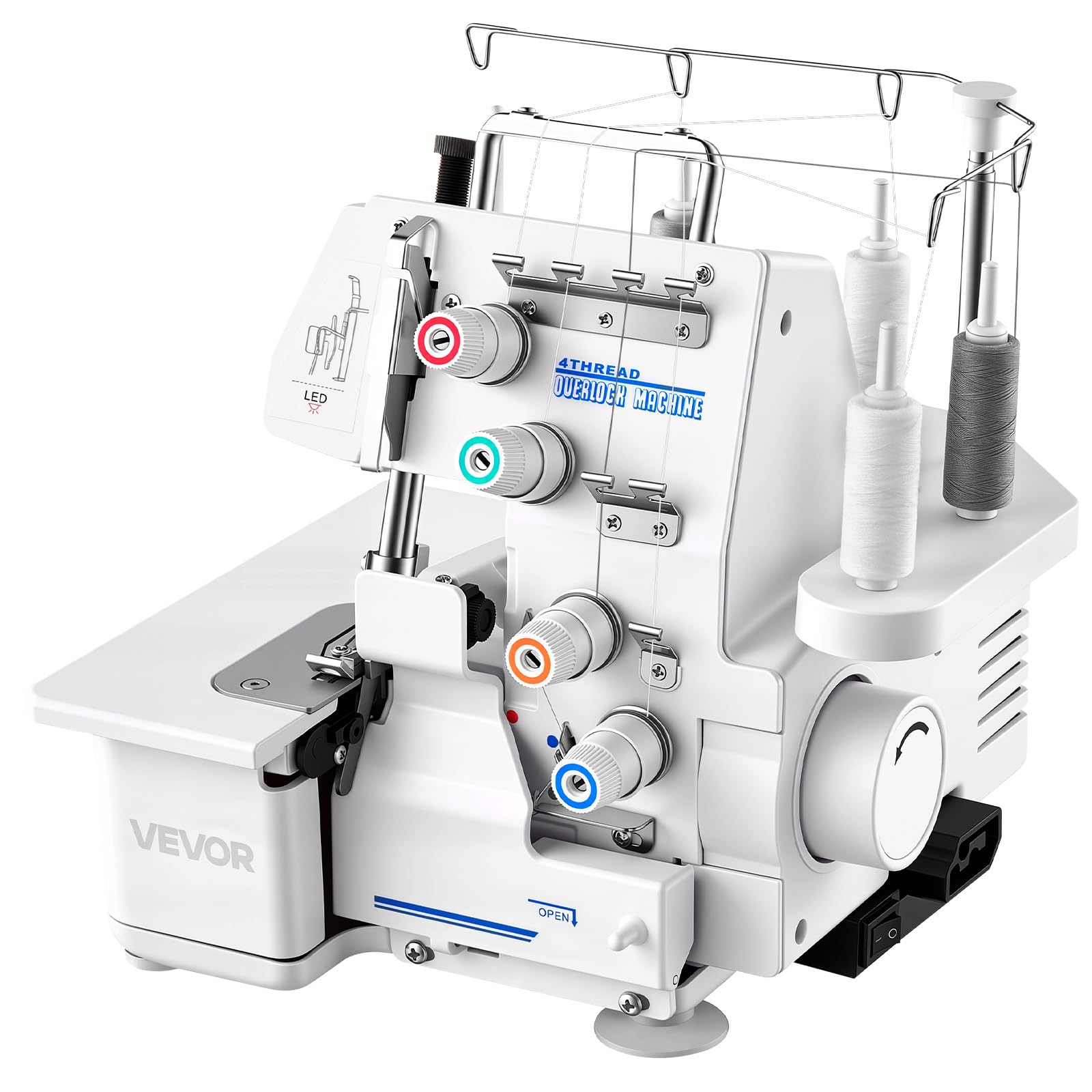
The VEVOR overlock machine uses an iron-and-plastic body for stability and a 112W motor that delivers 1,250 stitches per minute. The machine supports 3 and 4-thread stitching with adjustable stitch length and width, plus a rolled hem function. The LED light is bright and illuminates the needle area clearly, which is helpful for precise fabric alignment.
Color-coded threading paths make initial setup straightforward, and the machine is partially pre-threaded when it arrives. The adjustable presser foot works well for different fabric thicknesses, and the suction feet keep the machine planted on the table. The included accessories are comprehensive: four spool holders, extra needles, tweezers, a cleaning brush, and test fabric.
Multiple users report that the machine arrives completely dry — you must remove the plastic panels and oil the metal rubbing parts before first use. The supplied thread is low quality and prone to breaking; replacing it with brand-name serger thread solves most tension issues. As with the FEIYUE, a few units have arrived non-functional. For the price, the feature set is solid if you are willing to do initial maintenance.
Why it’s great
- Iron frame provides stability at 1,250 SPM
- LED light illuminates the needle area for precision
- Comprehensive accessory kit included
Good to know
- Arrives bone dry; must oil moving parts before first use
- Supplied thread frays and breaks easily; replace with quality thread
FAQ
Is a 3-thread or 4-thread overlocker better for a beginner?
Why does my serger skip stitches on stretch fabric?
Can I use regular sewing thread in an overlocker?
Final Thoughts: The Verdict
For most users, the best beginner overlocker winner is the Brother 1034D because it combines color-coded threading, reliable differential feed, and a metal frame at a price that leaves room for quality thread and accessories. If you frequently sew heavy fabrics like denim or canvas, grab the Brother ST4031HD for its extra hard carbon steel blade and large extension table. And for a tight sewing space with garment-focused projects, nothing beats the Lumina Moda for its free arm and compact design.