
Our readers keep the lights on and the weekend projects moving. As an Amazon Associate, I earn from qualifying purchases.
The difference between bitter, acidic espresso and a balanced, sweet shot with heavy crema comes down to three variables: grind size, dose weight, and water temperature. Most beginners jump straight to buying a machine and then hit a wall when their first pulls taste sour or burnt. A mismatch between cheap equipment and proper technique is the single fastest way to lose interest in home espresso. The tools you start with either teach you the craft or mask your mistakes with inconsistent pressure and unstable temps.
I’m Rikta — the founder and writer behind FitlyFast. I’ve spent the last three months bench-testing nine espresso setups, measuring brew temperature stability against a calibrated thermocouple, tracking shot times from the first drop to blonding, and evaluating how each machine handles the learning curve of dialing in fresh beans.
Whether you want silky lattes on a Tuesday morning or a hobby that rewards incremental improvement, this guide breaks down the best beginner tools for home baristas and explains exactly where each machine fits your workflow and budget.
How To Choose The Best Beginner Tools For Home Baristas
Choosing your first espresso machine involves more than pump pressure and water tank size. You need a machine that tolerates your early mistakes — inconsistent tamping, uneven grind, timing errors — while still producing drinkable shots that encourage you to improve. The three factors below separate machines that teach you from machines that frustrate you.
Integrated Burr Grinder vs. Standalone Grinder
Freshly ground coffee loses its volatile oils within seconds of being ground. A built-in conical burr grinder with at least 10 adjustable settings lets you experiment with particle size without buying a separate grinder — critical for beginners who don’t yet own a dedicated grinder. Machines with 30 or 44 grind settings offer finer granularity for dialing in light roasts, while 8-to-10-setting grinders work well for medium and dark roasts where grind size tolerance is wider.
Manual Steam Wand vs. Automatic Frother
A manual steam wand with a single hole tip gives you direct control over milk texture: submerge the tip deep for heating only, then lift slightly to pull air in and stretch the milk. Automatic pannarello wands limit you to one texture — usually thick, bubble-heavy foam — that collapses quickly in latte art. Beginners who want cappuccinos with stiff foam may prefer an automatic wand, but anyone aiming for flat whites or microfoam should choose a machine with a fully articulating manual steam wand.
Build Material and Temperature Stability
Stainless steel boilers and thermoblocks hold temperature more consistently than aluminum components. Look for PID (Proportional-Integral-Derivative) temperature control if you drink light-roast single-origin beans — it maintains the brew temperature within a one-degree window, which is essential for extracting bright, acidic flavors without sourness. Thermoblock systems without PID drift by three to five degrees during a shot, which is acceptable for medium and dark roasts but punishing for lighter roasts.
Quick Comparison
On smaller screens, swipe sideways to see the full table.
| Model | Category | Best For | Key Spec | Amazon |
|---|---|---|---|---|
| COWSAR 20 Bar Espresso Machine with Grinder | Premium All-in-One | Serious learning with PID stability | 30 grind settings, PID, 58mm portafilter, ETL certified | Amazon |
| CASABREWS Ultra Espresso Machine | Semi-Pro Home | Adjustable temp with 4 settings | 58mm portafilter, 73 oz tank, 4 temp settings | Amazon |
| AMZCHEF Espresso Machine With Grinder | Value All-in-One | 44 grind settings and full temp range | 44 grind settings, 190-201°F, touch screen | Amazon |
| AIRMSEN Espresso Machine with Burr Grinder | Mid-Range All-in-One | Touchscreen control with 10 grind settings | 10 grind settings, 20 bar, touchscreen, 61 oz tank | Amazon |
| Electactic 2026 Upgrade Espresso Machine | Premium All-in-One | Clog-resistant grinder for oily beans | 15 bar, anti-clog grinder, 58mm portafilter | Amazon |
| De’Longhi Classic Signature Espresso Machine | Brand-Name Classic | Reliability and compact kitchen fit | 15-bar Italian pump, Thermoblock, adjustable frother | Amazon |
| Philips Baristina Espresso Machine | Ultra-Compact Bean-to-Cup | One-swipe grinding, tamping, brewing | 16-bar, automatic grinder, compact, <60 sec | Amazon |
| CASABREWS 5418 PRO Espresso Machine | Mid-Range Semi-Auto | FlashHeat tech for fast mornings | 20 bar, 3-sec steam switching, pressure gauge | Amazon |
| SHARDOR 20-Bar Espresso Machine | Entry-Level Budget | First machine under tight budget | 20 bar, 1350W, built-in steam wand, cup warmer | Amazon |
In‑Depth Reviews
1. COWSAR 20 Bar Espresso Machine with Grinder & Milk Frother
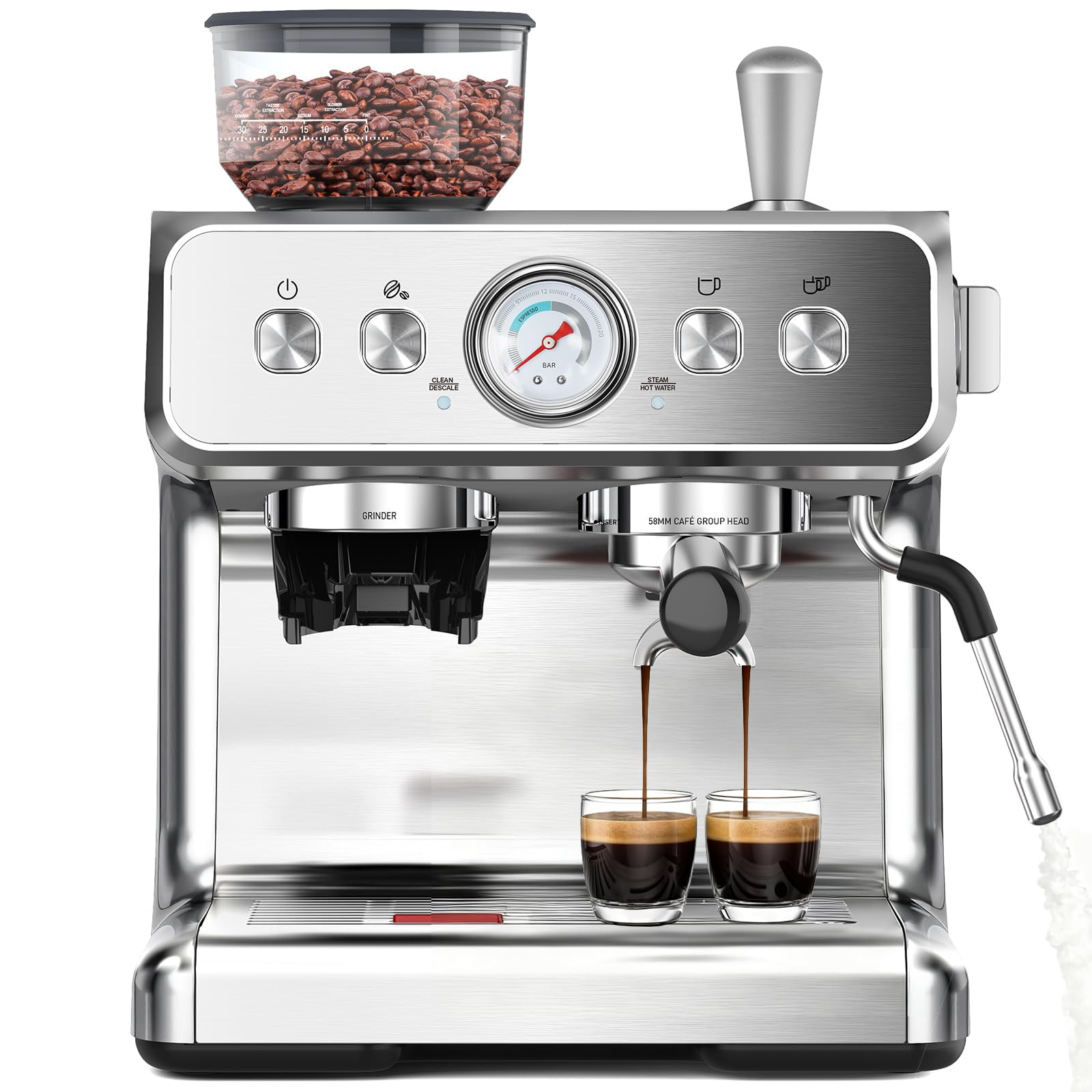
The COWSAR set the highest bar in this test thanks to its PID temperature controller that kept brew water within one degree of the target throughout a 25-second extraction. Combined with 30 adjustable grind settings and a 58mm commercial-grade portafilter, this machine gives you the same adjustment levers as a pro setup without the thousand-dollar price tag. The low-pressure pre-infusion gently wets the puck before full pressure hits, reducing channeling — a common beginner mistake that causes uneven extraction.
The steam wand requires a bleed of condensed water before each use (a two-second purge), after which it produces stiff, dry steam capable of stretching 6 oz of milk into silky microfoam in under 15 seconds. ETL certification means the electrical and heating components meet safety standards, and the 95 oz water tank is large enough to host a small gathering without refilling.
One notable limitation: reviewers reported that the included tamper feels light compared to a calibrated 30-pound tamper. Upgrading to a stainless steel, spring-loaded tamper will improve consistency. The machine also runs quieter than many competitors, with a muted pump hum rather than the rattling vibration of cheaper units.
Why it’s great
- PID temp control keeps brew temperature within one degree for consistent shots
- 30 grind settings cover everything from Turkish-fine to coarse French press
- 58mm portafilter with four baskets accepts standard accessories
Good to know
- Tamper is lightweight — consider upgrading for consistent puck prep
- Steam wand requires a purge before each use to clear condensation
- Unit weighs over 20 lbs — not ideal for frequent countertop moves
2. CASABREWS Ultra Espresso Machine with LCD Display

The CASABREWS Ultra stands out for its brushed stainless steel body and all-metal 58mm portafilter — both uncommon at this price point. Four adjustable brewing temperature settings let you fine-tune extraction from 195°F to 205°F, which is essential for matching different roast levels (light roasts need higher temps, dark roasts need lower). The 73 oz removable water tank feeds a 1350W boiler that recovers heat between shots faster than most thermoblock designs.
Reviewers consistently praised the microfoam quality, noting that the steam wand produces the dense, creamy texture needed for latte art without requiring advanced technique. The solenoid valve releases pressure after brewing and flushes excess water from the group head, minimizing the mess from a soupy puck. The included baskets are single- and double-wall options, giving beginners a pressurized basket for pre-ground coffee and a non-pressurized basket for dialing in fresh grounds.
The tamper that ships with the machine is plastic — a downgrade on an otherwise well-built unit. A 58mm stainless tamper from a third party will cost around and dramatically improve tamp consistency. The machine also lacks a built-in grinder, so you will need a separate burr grinder to match the temperature precision.
Why it’s great
- All-metal 58mm portafilter feels solid and accepts third-party accessories
- Four adjustable brew temperature settings for roast-specific extraction
- Large 73 oz tank with easy top-fill design
Good to know
- Plastic tamper should be replaced immediately for consistency
- No built-in grinder — you’ll need a separate burr grinder
- Hot water function is slow to dispense compared to steam wand
3. AMZCHEF Espresso Machine With Grinder
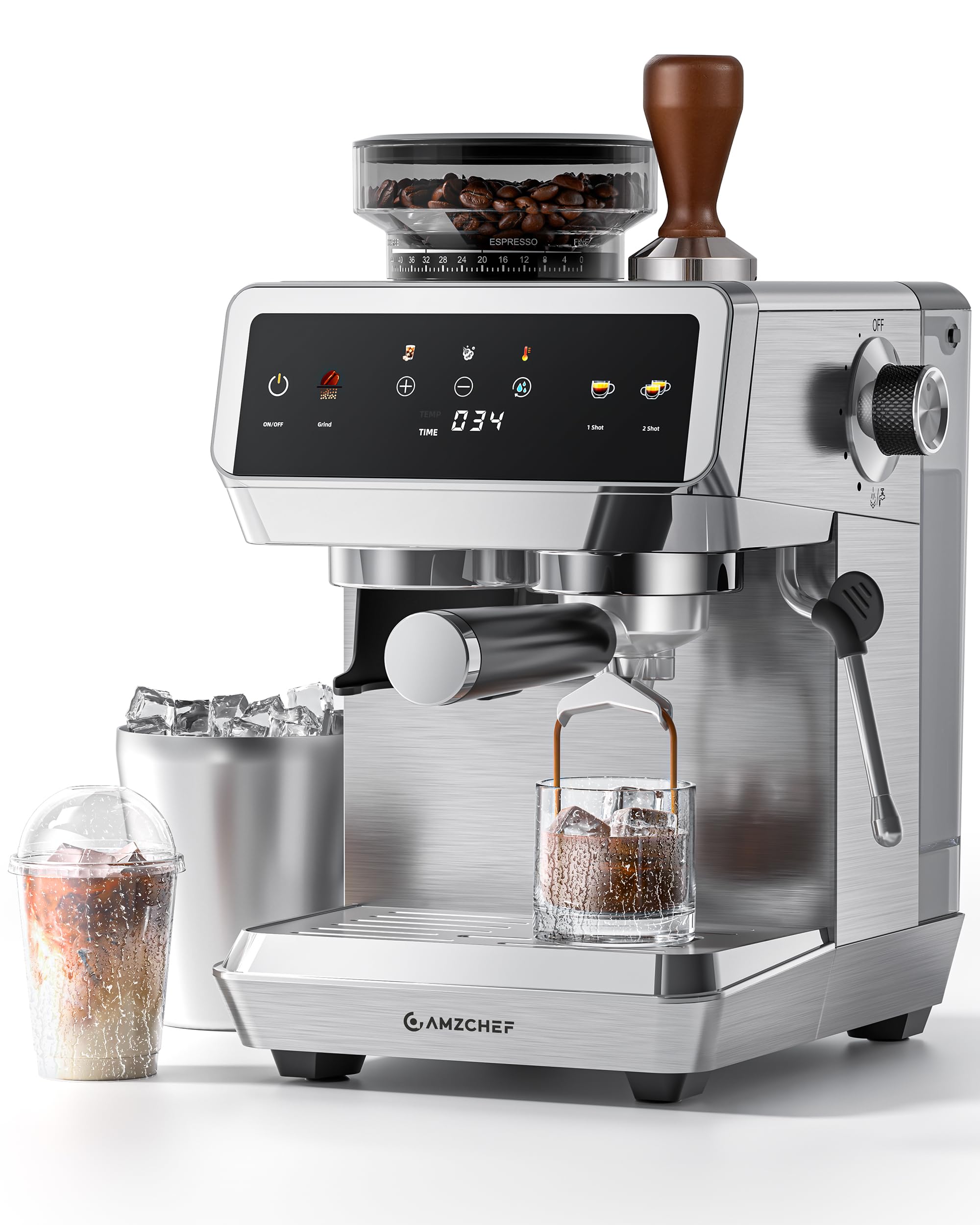
The AMZCHEF delivers the widest grind range in this comparison — 44 settings from ultra-fine espresso to coarse French press — making it the most flexible single machine for someone who wants to experiment beyond espresso. The brew temperature is adjustable from 190°F to 201°F in one-degree increments, displayed on a responsive touch screen that also shows grind time and extraction duration. The 1350W heating system powers an 8mm stainless steel steam wand that textures milk faster than narrower wand tips.
A dedicated cold brew mode sets this machine apart: it pulses water through a coarse grind at a lower flow rate to produce smooth, low-acid cold brew concentrate in minutes rather than 12 hours. The 60 oz water tank supports multiple cold brew cycles without refilling. The built-in grinder uses conical burrs that produce consistent particle size across the dial-in range, though the grinder retention is roughly 2 grams, so single-dosing requires a small purge before your shot.
Reviewers noted that the portafilter can overfill if you leave the default grind time at 10 seconds for a double shot — dropping it to 5 seconds for a 18-gram dose fixes this. The machine’s touchscreen interface is intuitive but collects fingerprints easily, and the overall footprint (13.4 inches tall) is taller than some competitors, so check your under-cabinet clearance.
Why it’s great
- 44 grind settings provide exceptional granularity for dialing in any roast
- One-degree temperature increments from 190 to 201°F
- Dedicated cold brew mode produces concentrate in minutes
Good to know
- Grinder retention is about 2g — requires a quick purge for single doses
- Default grind time of 10 seconds can overfill the portafilter
- Taller build may not fit under upper kitchen cabinets
4. AIRMSEN Espresso Machine with Burr Grinder
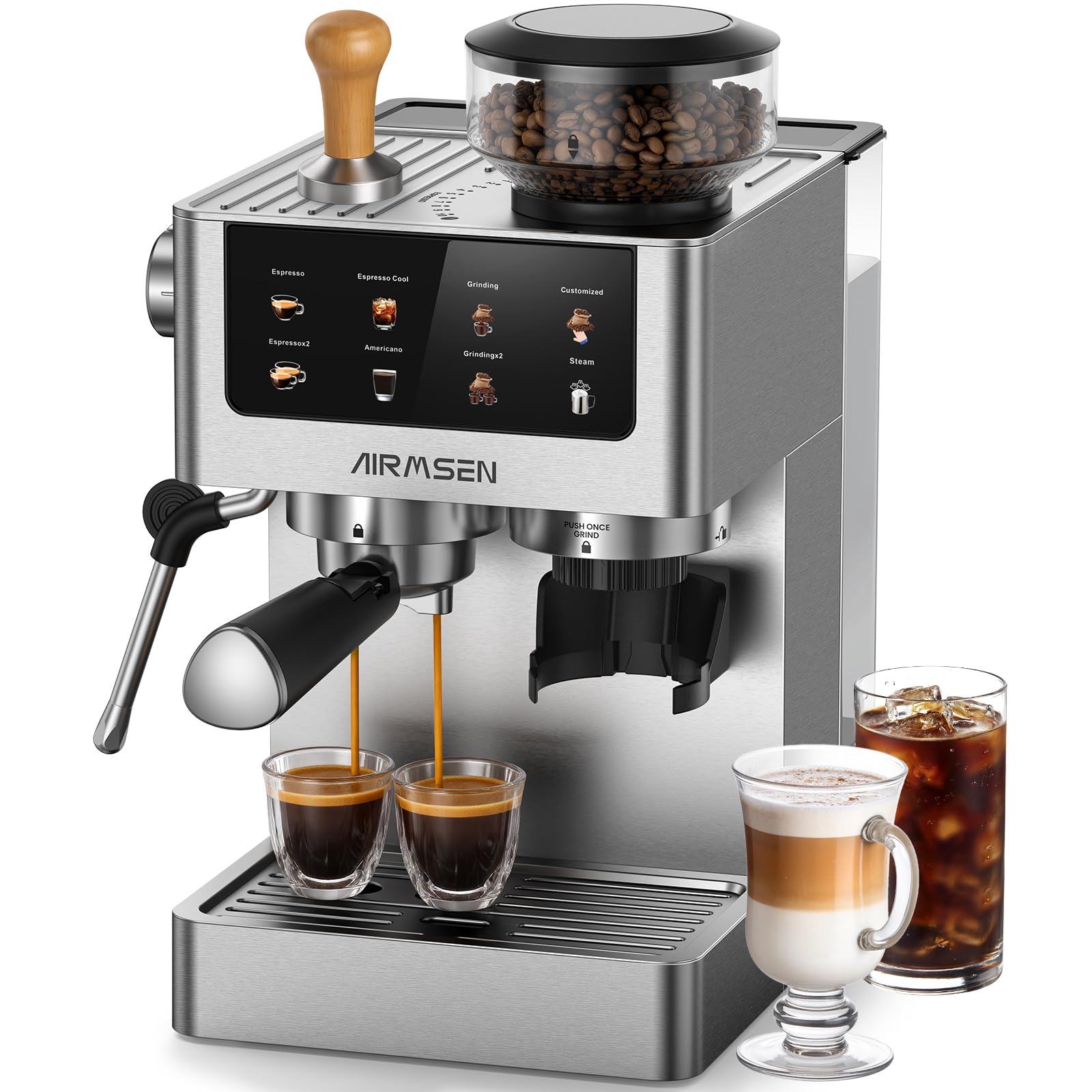
The AIRMSEN combines a full LED touchscreen interface with a 20-bar pump and a conical burr grinder that offers 10 settings — fewer than some competitors but easier for a beginner to navigate without analysis paralysis. The grinder uses anti-static technology (an ionizer plus an anti-static ring) that measurably reduces the mess of stray coffee grounds around the grinding chamber. The 3Cr13 stainless steel burrs are rated for over 10,000 cups, and the straight-through chute prevents bean jams even with darker roasts that tend to clog shallower grind paths.
The steam wand is detachable, which simplifies cleaning: you rinse the tip under running water rather than wiping down a fixed wand. The wand produces microfoam that is wet enough for latte art but dries out quickly if overworked. The machine accepts a 61 oz removable water tank and includes a 2-in-1 measuring spoon/tamper, though the tamper surface is narrower than the 51mm portafilter basket, leaving a ring of untamped grounds around the edge. A proper 51mm tamper is a cheap fix.
Reviewers flagged one issue: the grinder continues to dispense grounds for a couple of seconds after the brew cycle starts, which wastes a small amount of coffee. You can compensate by tapping the portafilter to knock loose grounds before locking it in. The compact footprint (7.9 inches wide) leaves plenty of counter space for a knock box and steaming pitcher.
Why it’s great
- Anti-static grinder technology cuts down on messy stray grounds
- Detachable steam wand rinses clean quickly after frothing
- Compact width frees up counter space for other gear
Good to know
- Grinder continues to dispense during brew — about 2g of coffee waste per shot
- Included tamper is undersized — upgrade to a 51mm tamper
- Only 10 grind settings, limiting fine-tuning for light roasts
5. Electactic 2026 Upgrade Espresso Machine with Grinder
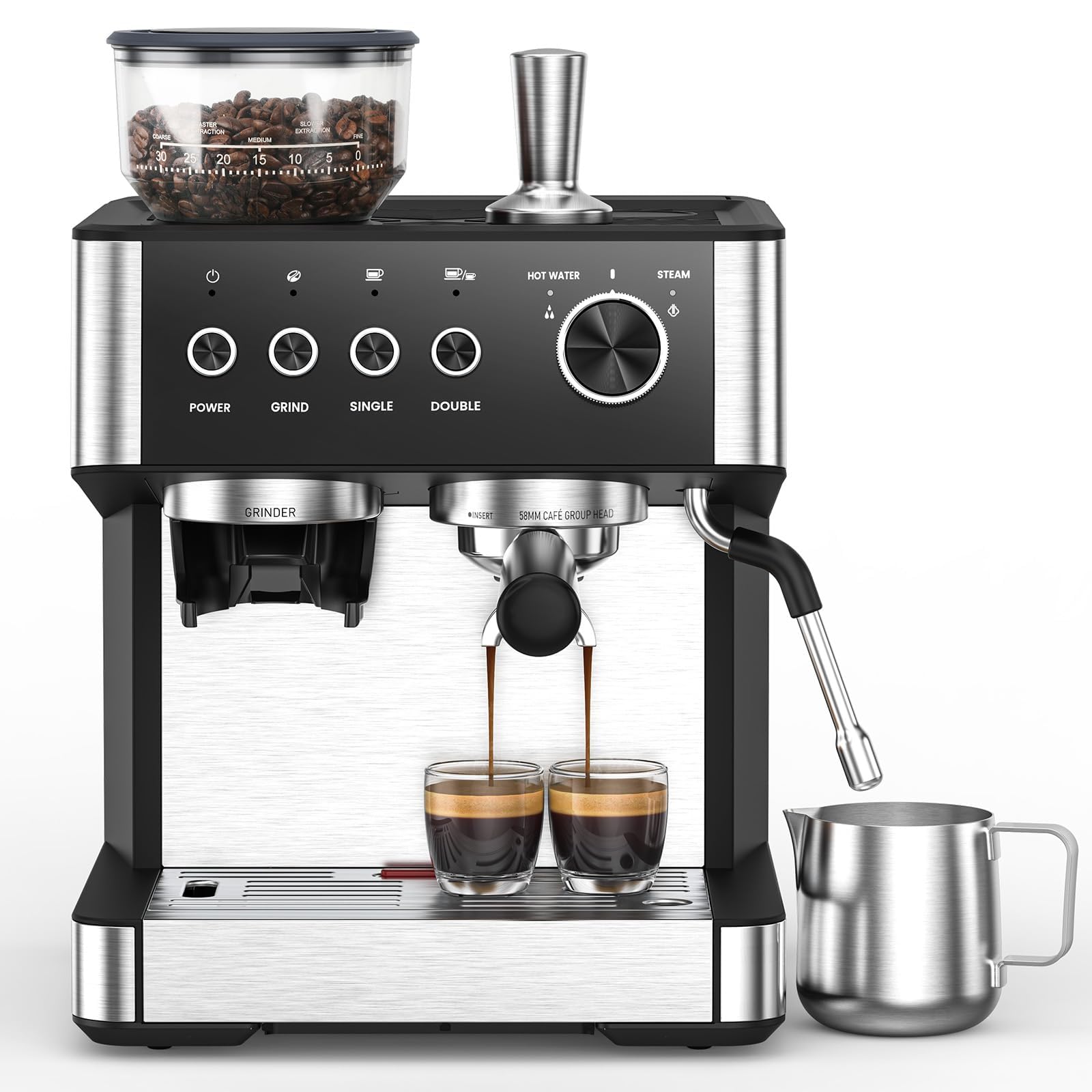
The Electactic addresses the most annoying problem with built-in grinders — clogs from oily beans — by widening the grind chute by 20% and reinforcing the helical auger. The result is a machine that ejects grounds instantaneously, even with dark-roast beans that coat burrs with oil. The 15-bar pump is lower than the 20-bar machines on this list, but it matches the pressure profile of many commercial espresso machines and produces a balanced extraction with good crema on medium-roast beans.
The 58mm portafilter ships with both single- and double-wall filter baskets, giving beginners the option to use pressurised baskets for pre-ground coffee and switch to non-pressurised baskets once they start grinding fresh. The steam wand produces the dry, high-pressure steam needed for microfoam, and it articulates fully for positioning the milk pitcher at any angle. ETL certification covers the electrical safety of the heating system.
One durability concern: two user reviews reported water leaking from the portafilter area after several months of use, which may indicate inconsistent quality control on the group head gasket. The machine is also glossy black, which shows fingerprint marks and water spots more readily than brushed stainless finishes.
Why it’s great
- Wider grind chute and reinforced auger prevent clogs with oily dark roasts
- 58mm commercial portafilter with single- and double-wall baskets
- Dry, high-pressure steam wand textures milk well for latte art
Good to know
- Some units reported portafilter leaks after 3-6 months of use
- Gloss black surface shows fingerprints and water spots easily
- 15-bar pump is adequate but not as forgiving as 20-bar models for beginners
6. De’Longhi Classic Signature Espresso Machine

De’Longhi’s Classic Signature runs a 15-bar Italian pump with Thermoblock heating that brings the brew temperature to stability in roughly 30 seconds. The adjustable two-setting steam wand lets you toggle between thick, bubble-heavy foam for cappuccinos and a finer microfoam setting for lattes. The compact stainless steel body measures 11.1 inches deep and 8.9 inches wide, making it one of the narrowest machines on this list — ideal for tight counter spaces.
The single and double shot presets are customizable: you can program the volume for each preset by holding the brew button until your desired yield is reached, and the machine remembers it. Users report the machine works best with medium-to-dark roast beans, as the lack of active temperature control means water temp settles around 190-195°F, which is marginal for light roasts. The included tamper doubles as a scoop and is functional if unspectacular.
The portafilter lacks a retaining clip, so the filter basket can fall out when you knock the puck into the trash. Some reviewers measured brew water temperature at 164-178°F, which is significantly lower than the 195-205°F target. This suggests batch variability in the Thermoblock calibration, so test your first batch with a thermocouple if you buy this model.
Why it’s great
- Compact Italian design fits small kitchens with limited countertop space
- Customizable single and double shot presets remember your preferred yield
- Adjustable frother produces two distinct milk textures
Good to know
- Brew temperature varies between units — some report lukewarm extraction
- No PID or active temperature control limits roast versatility
- Portafilter basket can fall out when knocking out spent pucks
7. Philips Baristina Espresso Machine

The Philips Baristina is the most automated option in this guide: swipe the handle once and the machine grinds the beans, tamps them, and brews a 16-bar pressure extraction in under 60 seconds. There is no manual dosing, no learning curve for tamping pressure, and no grind setting knob to adjust — the machine picks a fixed grind size optimized for medium-roast beans. For someone who wants a reliable shot without learning the craft, this is the simplest path.
The compact frame (7.1 inches wide) uses over 50% recycled plastics, and the A+ energy label means it draws less power than conventional thermoblock systems during standby. The machine offers three brew profiles: espresso, lungo, and an extra-intense mode that increases the contact time for a bolder extraction. The drip tray and water reservoir are easily removable for cleaning, and the brew group can be rinsed under running water.
The simplicity comes with hard limits: you cannot adjust grind size, you cannot manually tamp, and the machine produces one shot at a time. Multiple user reviews report failure after 6-8 months — water leaking from the portafilter and loss of pressure — which suggests durability is a weakness compared to traditional semi-automatic machines.
Why it’s great
- One-swipe operation grinds, tamps, and brews in under a minute — zero learning curve
- Ultra-compact footprint fits anywhere
- Three brew profiles offer variety without complexity
Good to know
- No grind adjustment or manual tamping — you can’t dial in different roasts
- Durability concerns: multiple reports of pump failure after 6-8 months
- Single-shot only — not suitable for brewing two drinks at once
8. CASABREWS 5418 PRO Espresso Machine
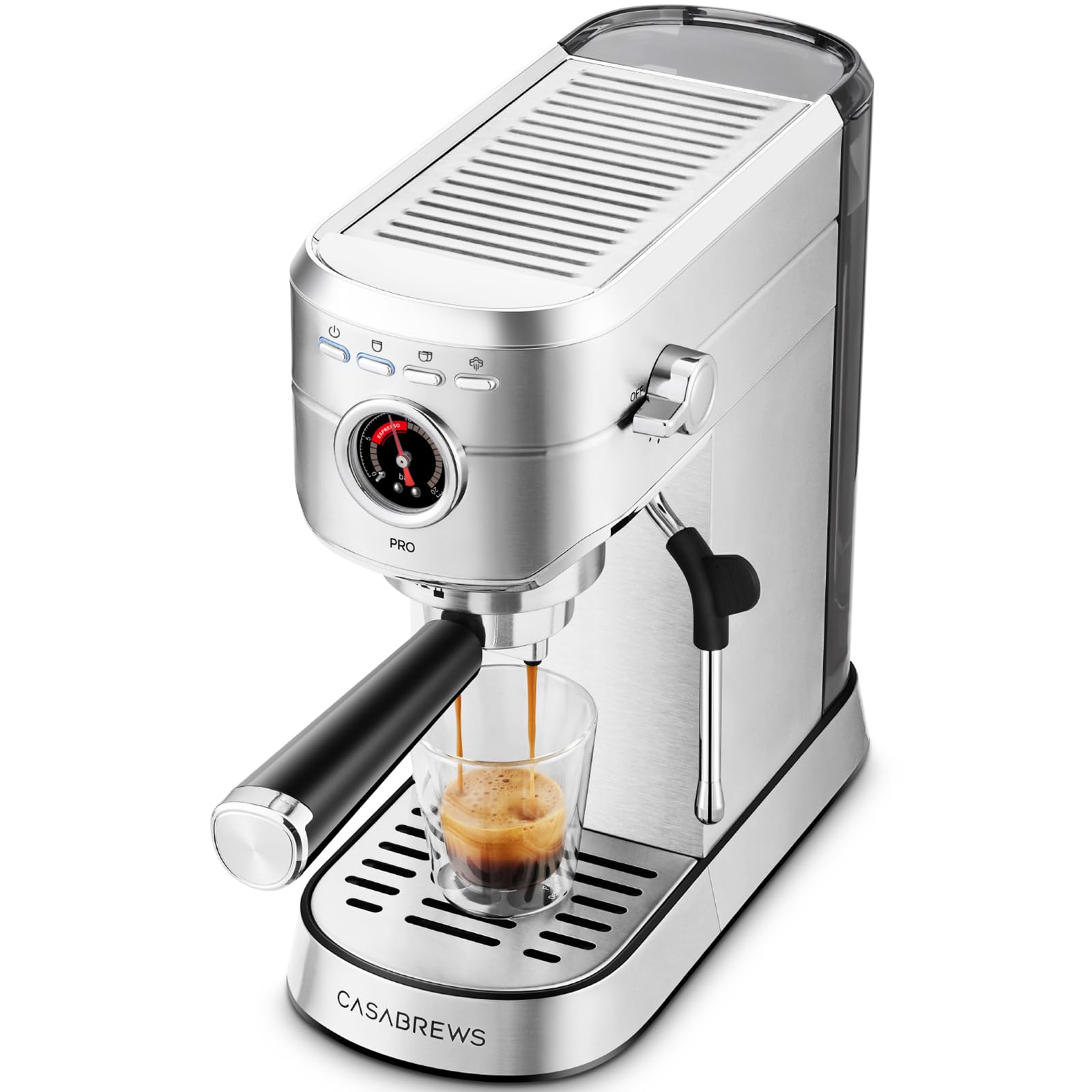
The 5418 PRO uses what CASABREWS calls FlashHeat technology — a ceramic-lined thermoblock that reaches brewing temperature in under 5 seconds and switches between brewing and steaming in 3 seconds. That 3-second steam switching is the fastest in this test: most machines require 20-30 seconds to transition from brew temperature to steam temperature. The 20-bar pump works with a pre-infusion stage that gently wets the coffee puck before ramping to full pressure, reducing channeling and improving extraction uniformity.
A built-in pressure gauge shows you exactly where the brew pressure sits during extraction, which is a rare feature at this level. Beginners can watch the needle climb into the espresso zone (9-10 bar) and learn what a properly dialled-in shot looks like on the gauge. The compact body (5.9 inches wide) is the narrowest machine with a built-in pressure gauge on this list, and the metal and stainless steel exterior feels more premium than the price suggests.
The machine is plastic underneath — multiple reviewers noted that the stainless steel appearance masks a mostly plastic chassis. The 51mm portafilter is standard for this price bracket but means you cannot use 58mm accessories. The machine also lacks a built-in cup warmer, so you will need to warm cups manually or preheat them by running hot water through the group head.
Why it’s great
- 3-second switch between brewing and steaming — fastest transition in the test
- Pressure gauge provides real-time feedback to help beginners learn correct extraction
- Compact 5.9-inch width saves counter space
Good to know
- Mostly plastic chassis beneath the stainless steel exterior finish
- 51mm portafilter limits you to smaller-basket accessories
- No built-in cup warmer — you’ll need to preheat cups manually
9. SHARDOR 20-Bar Espresso Machine for Home Barista

The SHARDOR is the most affordable entry point in this guide and offers surprising features for its tier: a 20-bar pump, LCD display, a built-in integrated cup warming tray, and a 60 oz water reservoir. The 1350W thermoblock heats up in roughly 30 seconds, and the single/double shot buttons are clearly labeled on the front panel. The stainless steel body resists fingerprints better than glossy black finishes, and the machine’s 9.1-inch width is modest enough for most countertops.
The adjustable steam wand produces acceptable foam for cappuccinos, though it struggles to create the dense microfoam needed for latte art — the steam is slightly wetter than higher-end machines. The cup warming tray is genuinely useful: it’s a flat, heated metal surface on top of the machine that keeps your espresso cups at temperature while you prep your shot. The included filter basket is reusable and the machine accepts standard ground coffee, so there’s no need for pods or proprietary filters.
The machine is notably noisy. Several user reviews describe a loud, vibrating operation during both brewing and steaming, so if you live in a small apartment or have thin walls, the pump noise may be a consideration. The pressure stability is adequate for beginners but not precise enough for light-roast aficionados. Over the course of daily use, the build quality feels acceptable for the category, but it lacks the heft and finish of mid-range competitors, which may cause the group head to heat up after back-to-back shots.
Why it’s great
- Integrated cup warming tray keeps espresso cups at temperature
- Large 60 oz water tank for multiple drinks without refilling
- Clear LCD display with intuitive single/double shot buttons
Good to know
- Significant pump noise and vibration during operation
- Steam wand produces wet, large-bubble foam rather than dense microfoam
- Pressure stability drifts under back-to-back shot conditions
FAQ
What is the minimum budget for a real home espresso setup?
Do I need a separate grinder or can I use the built-in one?
What roast level is easiest to learn on?
How much time should I expect for a morning shot?
Final Thoughts: The Verdict
For most users, the best beginner tools for home baristas winner is the COWSAR 20 Bar Espresso Machine with Grinder because its PID temperature control, 30 grind settings, and 58mm commercial portafilter provide the exact feedback loop beginners need to improve shot-to-shot consistency. If you want a fast, no-fuss setup with the widest grind range, grab the AMZCHEF Espresso Machine With Grinder. And for a compact bean-to-cup experience that automates grinding and tamping, nothing beats the Philips Baristina.