
Our readers keep the lights on and the weekend projects moving. As an Amazon Associate, I earn from qualifying purchases.
Specs are compiled from manufacturer listings and verified buyer reviews and can change over time — please confirm the key details on the product page before buying.
Starting a YouTube channel is notable, but choosing a camera can feel overwhelming. You don’t need a complex cinema rig — you need a camera that nails autofocus, flips its screen toward you, and shoots sharp 4K without demanding a film degree. This guide compares the best beginner options right now, from pocket gimbals to full-frame powerhouses.
I’m Rikta — the founder and writer behind FitlyFast. This guide is built by comparing the manufacturers’ published specifications and the patterns across verified customer reviews, so you get each pick’s real strengths and trade-offs instead of marketing spin.
Whether you vlog on the go or film desk shots, the right beginner youtube camera keeps your focus on creating, not fighting menus and blurry footage.
Our Picks at a Glance


How To Choose The Best Beginner YouTube Camera
Your first YouTube camera has to do three things well: keep you in focus while you talk, show you exactly what the lens sees, and record video that looks sharp on any screen. Match the camera to how you actually create — not to the specs that sound impressive in a store.
Autofocus Is the Real Hero
Nothing ruins a take faster than soft, blurry footage when you’re moving or talking to the lens. Look for eye-detection autofocus that locks onto a person’s eye and stays there, so you can step sideways or lean in without the focus hunting. The best beginner cameras here use phase-detection points spread across the sensor for quick, reliable grabs.
Flip Screen and Microphone Input
If you’re filming yourself, a screen that tilts or flips toward you is non-negotiable — you need to see your framing. Most vlogging cameras also offer a 3.5mm microphone jack or direct wireless mic connection, because built-in mics pick up room echo and handling noise. Audio quality matters more to viewers than a few extra megapixels ever will.
Quick Comparison
| Model | Best For | Video Resolution | Stabilization | Autofocus Points | Amazon |
|---|---|---|---|---|---|
| Sony A6100★ Best Overall | Budget mirrorless hybrid | 4K | None (lens only) | 425 | Amazon |
| Xtra MuseBudget Champion | Pocket gimbal value | 4K/120fps | 3-axis gimbal | — | Amazon |
| OBSBOT Tail AirStreaming Pick | PTZ streaming | 4K | Digital | — | Amazon |
| DJI Osmo Pocket 3 | Travel vlogging | 4K/120fps | 3-axis mechanical | — | Amazon |
| Canon EOS M50 | Budget photo/video hybrid | 4K UHD 24p | None | 143 | Amazon |
| OM System E-M10 IV | Compact travel hybrid | 4K | 5-axis in-body | 121 | Amazon |
| Insta360 Luna Ultra | 8K cinematic creators | 8K/30fps | 3-axis mechanical | — | Amazon |
| Nikon Z 30 | Vlogger-first mirrorless | 4K | Lens VR only | 209 | Amazon |
| Canon EOS RP | Budget full-frame | 4K UHD 24p | Lens IS only | — | Amazon |
| Sony a7 III | Advanced full-frame hybrid | 4K | None (lens only) | 693 | Amazon |
In‑Depth Reviews
1. Sony Alpha A6100 Mirrorless Camera
Our pick — over 4.5★ from 400+ verified ratings; the strongest balance of quality and price.
The compact mirrorless that locks onto eyes so beginners can finally stop worrying about focus.
Sony’s 0.02-second autofocus claim is backed by 425 phase-detection points covering 84% of the sensor., and the specs back up the hustle — 425 phase-detection points cover 84% of the sensor. For a beginner, this means you can wave around, turn your head, or walk toward the lens and the camera keeps your eye tack-sharp. The 180-degree tiltable 3-inch touchscreen flips up for self-filming, and you just touch the screen to tell it which subject to track.
The 24.2MP APS-C Exmor sensor with ISO up to 51,200 keeps skin tones natural in dim indoor rooms.. Continuous shooting at 11fps in RAW with autofocus tracking is overkill for most vlogs, but it means the camera won’t hold you back if you also want sharp photos. Owners consistently call it the perfect leap from a smartphone to a real interchangeable-lens camera, and It holds a 4.7-star average from 400+ verified owners..
The honest catch is the menu — buyers report the Sony menu system takes time to learn, and a few find it genuinely frustrating. The electronic viewfinder also draws criticism vs pricier rivals like the A6400, though for pure selfie-vlogging you’ll use the flip screen anyway. It’s a camera that rewards patience with setup, then disappears into the background while you create.
beginner autofocus king
- Blazing 0.02s autofocus with real-time eye tracking for people and animals
- Compact body that travels to events without a bag of gear
- Excellent JPEGs straight out of camera, even in low light
menu maze
- Menu system is clunky until you customize it
- No in-body stabilization — the kit lens has no stabilization either
- Kit zoom lens feels fragile after a drop
grab it: you want one affordable camera that shoots great video and even better photos, and you’ll spend 20 minutes learning the menu.
think twice: you demand rock-steady handheld walking shots — you’d need a gimbal on top.
2. Xtra Muse Pocket Vlogging Camera
A pocket-sized gimbal camera that delivers silky smooth 4K without the flagship price.
The Xtra Muse packs a 1-inch CMOS sensor with 4K video at 120fps — smooth enough for slow-motion dance moves or hiking shots. Its defining feature is the built-in 3-axis gimbal stabilizer, which means no shaky footage and zero extra gear to carry. The 2-inch touchscreen flips between horizontal and vertical instantly, perfect for YouTube or Shorts.
Setup takes minutes, not hours. Owners say the touchscreen interface is intuitive and the face/object tracking keeps a moving subject centered while you jump, spin, or walk. True 10-bit X-Log color modes open up dramatic grading for sunrises and sunsets. Owners mention the quality is near-identical to a far pricier competitor — one calls it “near-identical to competitor at half price” — and The 161-minute average battery covers a full day of shooting..
The vocal praise centers on build quality and ease of use, with one owner noting the gimbal “operates smoothly” even during active scenes. The battery life draws mixed reviews — some owners find it decent, others want longer runtime before reaching for the USB-C charger.
pocket vlog ease: The trade-off for the tiny body is a fixed lens — you can’t swap glass as your skills grow.
3. OBSBOT Tail Air 4K PTZ Camera
An AI-powered PTZ camera that follows you around the room so you can teach, preach, or present hands-free.
This is not a traditional vlogging camera — it’s a pan-tilt-zoom camera that rotates 320° horizontally and 180° vertically to track you automatically. The AI tracks humans, animals, and objects, so a cooking channel host can move around the kitchen while the camera follows. It packs a 50MP effective still resolution and a 4x digital zoom, all controlled by hand gestures, remote, or a phone app.
For live streamers, the connection options are unusually rich: Micro HDMI, USB-C, Ethernet, and Wi-Fi, with RTMP, RTSP, and VISCA protocols for platforms like YouTube and Twitch. The f/1.8 aperture lets in plenty of light for dim church sanctuaries or home studios. Owners who love it say it “replaced all other streaming cameras” thanks to the 23mm f/1.8 lens and full app control.
The biggest trust issue is reliability, which earns the most mention — and the most-discussed negative is a battery that gave out after 13 months, leaving the camera unable to power on. Note the NDI license key costs extra, and firmware updates require a U3 micro SD card. This one suits streamers who need hands-free movement, not beginners who want a simple point-and-shoot.
choose it: hands-free tracking during streams, presentations, or worship services where you can’t touch the camera.
look elsewhere: you want a durable everyday vlogging camera — the battery-dependent design is a long-term worry.
4. DJI Osmo Pocket 3 Creator Combo

The pocket gimbal that made thousands of creators ditch their phone-and-stabilizer combos for good.
The Osmo Pocket 3 combines a 1-inch CMOS sensor with a built-in 3-axis mechanical gimbal, so you get buttery footage with zero setup. It records 4K at 120fps and the 2-inch rotating touchscreen switches between horizontal and vertical for any platform. ActiveTrack 6.0 keeps you center-frame as you move, and the fast autofocus locks onto subjects instantly.
This Creator Combo includes the DJI Mic 2 transmitter, a windscreen, a battery handle, a mini tripod, and a carrying bag — everything a beginner needs to start. The mic pairs directly with the camera, which is a massive win for audio beginners. The 166-minute average battery life supports extended recording sessions., 10-bit D-Log M color, and stereo recording make it the complete starter package, and owners rave that it “democratizes cinematic video” and instantly upgraded their quality from a phone-plus-gimbal rig.
The 2-inch screen and clear interface earn continuous praise for ease of use, and portability is the other standout — it genuinely fits in a pocket. The trade-off is simpler to name: it’s a fixed-lens camera, so you can’t swap lenses as you grow, and the value proposition splits opinions. One owner’s verdict sums it up: “Worth the splurge.”
gimbal video all-in-one: This is the easiest route to professional-looking vlogs with audio that actually sounds good. The mic-in-the-box makes it the best ready-to-film pick here.
5. Canon EOS M50 Mirrorless Kit (Renewed)

A beloved beginner Canon that costs less renewed, with autofocus that still feels modern.
The M50 has been a starter-camera legend, and this renewed kit keeps the appeal with a 24.1MP APS-C sensor, 4K UHD 24p video, and HD 120p slow motion. Canon’s Dual Pixel CMOS AF with eye detection delivers smooth, reliable focus that beginners trust immediately. The built-in OLED electronic viewfinder adds touch-and-drag focusing — tap the screen to frame, and the viewfinder follows.
Buyers consistently describe the renewed unit as looking brand new, with the 4.6-star average reflecting genuine satisfaction. The image quality at this price point is the headline, with some saying it rivals cameras costing far more. For budget vloggers, the 3.5mm microphone input and flip screen cover the essentials.
Be honest about the limits: the 4K video crops in and facial tracking can struggle at that resolution, and camera shake is noticeable unless you add a gimbal. The small, light body is easy to carry but a bit tricky to grip firmly. One owner called it “a great budget vlog camera” and rated it 8/10, noting stabilization is the main missing piece.
best for budget: budget-conscious beginners who want Canon’s famous colors and reliable autofocus without paying new-camera prices.
not ideal: your videos are mostly handheld walking shots — plan for a gimbal in your budget.
6. OM System OM-D E-M10 Mark IV

A tiny retro-styled camera with in-body stabilization strong enough for handheld evening shots.
The E-M10 Mark IV brings something rare at this size: in-body 5-axis image stabilization rated at 4.5 shutter-speed steps of compensation. That means you can hold the camera steady in low light and still get sharp shots — a huge safety net for beginners. Its 20MP Live MOS sensor, 4K video, and flip-down monitor with a dedicated selfie mode make it genuinely vlog-ready.
The Micro Four Thirds system keeps the whole kit small enough to slip into a jacket pocket with the 14-42mm EZ pancake lens attached. Beginners praise the user-friendly menus with Scene, Art, and AP modes, plus 16 art filters (31 types) including a nostalgic Instant Film look. Owners describe it as “the best entry-level mirrorless interchangeable lens camera for the beginner” — one even notes its status as Taylor Swift’s favorite.
Quality and image quality lead the praise, but reliability is the recurring concern — several customers note units that wouldn’t power on or failed to recognize the lens. The charging setup also lacks a USB-C port and external charger, which feels dated. For the jacket-pocketable size and that stabilization, it’s still a standout if you get a good unit.
reach for it: you want the smallest interchangeable-lens camera with stabilization that forgives beginner handling.
proceed with care: reliability is your top priority — check the return policy and test the lens connection early.
7. Insta360 Luna Ultra
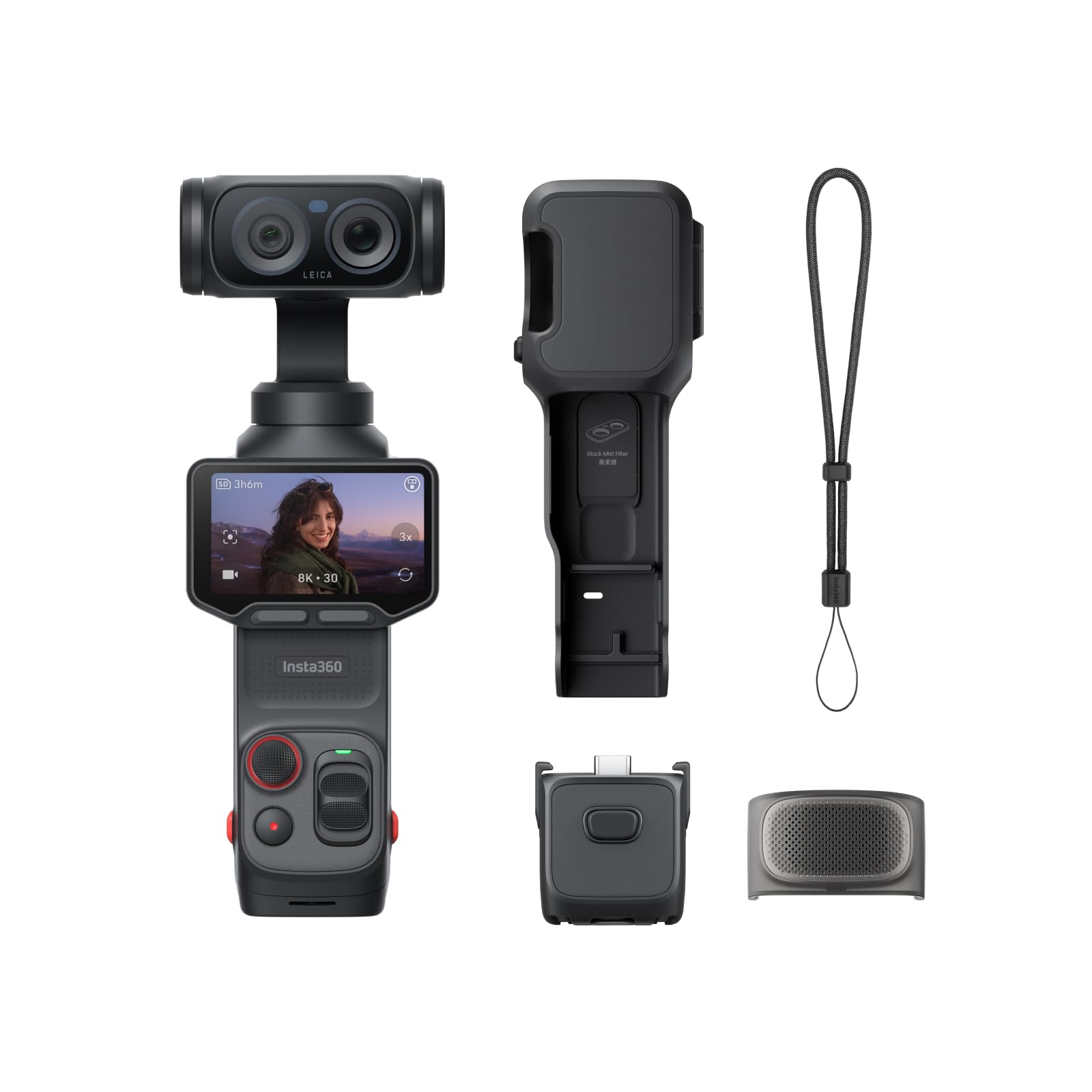
A pocket gimbal with dual Leica lenses and 8K resolution that replaces three pieces of gear.
The Luna Ultra shoots cinematic 8K at 30fps with Dolby Vision, and its dual Leica lens system pairs a 1-inch main sensor with a telephoto lens on a 1/1.3-inch sensor at f/2.0. The result is a true optical zoom — up to 6x lossless zoom out of a 12x range — with natural background blur for portraits. Owners say it replaced three separate pieces of gear in their kit.
The detachable 2-inch OLED touchscreen is the standout feature: snap it off to use as a remote viewfinder up to 20 meters away, ideal for solo filming and car vlogs. The 3-axis mechanical gimbal keeps footage steady, and 10-bit I-Log color grading integrates with DaVinci Resolve workflows. Battery life hits 4 hours per charge, with fast charging to 80% in 23 minutes..
Low-light performance earns particular praise — the 1-inch 8K sensor plus AI noise reduction keeps night scenes bright, and 14 stops of dynamic range retain highlight and shadow detail.. The trade-offs: there’s no webcam mode and no USB headphone audio monitoring, and the camera isn’t weatherproof. One owner called it “superior build quality” vs the DJI Osmo Pocket 3 and worth the price.
for cinematic: if 8K, true optical zoom, and a detachable remote screen matter more than staying under a budget, this is the premium pocket pick.
skip if new: you need a plug-and-play webcam for live streaming — that feature is missing here.
8. Nikon Z 30 with 16-50mm Lens

Nikon’s most compact mirrorless, built from the ground up for vloggers and streamers.
The Z 30 is Nikon’s answer to the creator-first camera: a 4K mirrorless with a flip-out touchscreen selfie monitor, a red REC light so you always know when you’re rolling, and a built-in stereo microphone with adjustable sensitivity. Autofocus covers 209 points with eye tracking for people and pets, so your dog can steal the spotlight without going blurry. It’s the lightest, most compact Nikon Z camera, made for handheld vlogging.
Live streamers get plug-and-play webcam operation — just connect USB-C for Full HD 60p streaming, or HDMI for 4K 30p, with constant power over USB-C so you never run dry mid-broadcast. The 16-50mm wide-angle zoom lens is versatile for desk shots and talking-head content. Buyers praise the sharp, vibrant images and lightning-fast autofocus, and the low-light performance impresses for a kit at this size.
The common adjustment is the missing viewfinder — you frame everything on the screen, which takes getting used to but becomes natural. There’s no in-body stabilization either, so the lens’s VR does the work. One owner chose it over the pricier Z50 specifically for the newer design, lighter body, and unlimited 4K recording — the Z50 heats up at the 30-minute mark.
flip screen vlogger: The flip screen, REC light, and USB-C streaming make this the most beginner-friendly traditional mirrorless for pure video work. The lens system gives you room to grow when you’re ready.
9. Canon EOS RP with RF24-105mm Lens

The most affordable door into full-frame photography, with a flexible 24-105mm lens included.
The EOS RP is Canon’s entry-level full-frame mirrorless, and the RF24-105mm lens covers a versatile zoom range for travel, portraits, and daily vlogging. The lens includes optical image stabilization rated up to 5 stops of shake correction, which helps handheld video a lot. Weighing only about 440g for the body alone, it’s compact and light enough to carry all day.
Body-based features include a 4K UHD 2160p video capture, a 3-inch flip screen, and compatibility with Canon’s huge EF and EF-S lens lineup via adapter — so your lens collection has room to grow affordably. Owners upgrading from old DSLRs describe it as a revelation for scenic shots, architecture, and landscapes. An in-camera auto-adjust mode takes care of the best picture settings for beginners.
Low-light performance is the full-frame advantage: reviewers point out clean, detailed shots that their crop-sensor cameras couldn’t match. Battery life earns mixed feedback — a few note it’s short per charge, so carry a spare for full-day shoots. The 4K mode has real limits (cropped, no dual-pixel AF, 30-minute cap), so treat this primarily as a photography camera that also does solid 1080p video.
choose it: photographers who want full-frame image quality for the lowest entry cost, with video as a bonus.
look elsewhere: 4K video is your main output — the RP’s 4K has compromises that vloggers will feel.
10. Sony Alpha a7 III with 28-70mm Lens

The full-frame workhorse that set the standard for hybrid shooters, now an accessible pro step up.
The a7 III’s 24.2MP back-illuminated full-frame sensor offers 15-stop dynamic range, 14-bit uncompressed RAW, and ISO up to 204,800. for situations where other cameras give up. Autofocus uses a massive 693 phase-detection points covering 93% of the image, with the eye AF that Sony fans rave about — it locks onto eyes and never lets go. At up to 10fps silent or mechanical shutter, it keeps up with action.
For video, the a7 III shoots 4K from the full sensor width with impressive quality, and the included 28-70mm f/3.5-5.6 lens covers everyday subjects. Owners transitioning from Canon or Fuji consistently praise the image depth, low-light skill, and intuitive controls once you adapt to the menu. Battery life gets strong praise in most reviews, with owners reporting hours of shooting on a single charge.
The crowd consensus is clear: image quality and autofocus are the headline strengths, and low-light performance is genuinely outstanding. The most-discussed negatives are the complex menu system and some variance in battery life reports. The 28-70mm kit lens is decent but sharpest when you stop down — many owners quickly upgrade glass. For a beginner, this is a leap rather than a first step, but it’s a camera you could grow into for a decade.
low-light powerhouse: If you’re serious about photography and video and want a body that won’t become obsolete as your skills grow, the a7 III is the plateau. The trade-off is the learning curve and the ongoing cost of full-frame lenses.
Understanding the Specs
Autofocus Points and Eye AF
Autofocus points are the focus zones spread across the sensor; more points mean the camera can grab focus nearly anywhere in the frame. Eye AF locks onto a person’s eye and keeps it sharp as they move. For a beginner, this is the difference between usable footage and a frustrating blur, especially when you’re talking to the lens.
4K Resolution and Frame Rate
4K video has four times the pixels of 1080p HD, so it looks sharp on big screens and gives you room to crop in editing. The frame rate (fps) matters too: 24fps looks cinematic, 30fps is standard online, and 60fps or 120fps open up smooth slow motion. Your camera’s frame rate choices determine what styles you can shoot.
In-Body vs Lens Stabilization
Stabilization counters camera shake for handheld shots. In-body stabilization (IBIS) moves the sensor, and it works with any lens you attach — the OM System E-M10 IV has 5-axis IBIS. Lens stabilization (like Canon’s IS) works only through that specific lens. For walking vlogs, a gimbal gives the steadiest results.
Sensor Size: APS-C vs Full-Frame
The sensor is the camera’s light-capturing heart. APS-C sensors (found in the A6100, M50, R50, Z 30) balance quality and cost, with a 1.5x crop. Full-frame sensors (in the EOS RP and a7 III) are larger, so they gather more light for better low-light shots and shallower depth of field — at a higher price and larger lens size.
FAQ
Do I need a 4K camera for my first YouTube channel?
What’s the difference between a mirrorless camera and a vlogging camera?
Will an external microphone work with these beginner cameras?
Is image stabilization important for vlogging?
How does autofocus eye tracking help a beginner?
Should I buy a renewed camera to save money?
Can I use these cameras for live streaming on YouTube?
What’s the best choice for travel and outdoor vlogs?
How does a full-frame camera differ for a beginner YouTuber?
What memory card do I need for 4K video?
Final Thoughts: The Verdict
For the majority of shoppers, the beginner youtube camera winner is the Sony A6100 because it delivers class-leading autofocus and excellent image quality in a compact, affordable body that grows with you. If you want zero-setup smooth footage with a built-in gimbal and microphone, grab the DJI Osmo Pocket 3. And for a pure vlogger-first experience with easy streaming, the Nikon Z 30 is the one to reach for.
How We Picked
We do not accept paid placement. Every pick is matched to a real buyer and a real use-case; we do not hands-on test units.
Sources & Methodology
Specifications: manufacturer listings and product documentation. Review insights: verified customer reviews, as of July 2026. Pricing: not shown on this page (it changes often); check the current price via the retailer link.
As an Amazon Associate, FitlyFast earns from qualifying purchases. This does not affect which products we feature.